THE FREEDMEN.
Reading edition
REV. JOSEPH E. ROY, D.D., Field Superintendent, Atlanta, Ga.
BUILDINGS AT TOUGALOO, MISS.
By Rev. A. Hatch.
The aim of the educational work here is, in a word, to fit our students for practical life and to instruct in the art of teaching. A course of six years, after that of our primary grade, completes the regular normal course. In addition to a long and thorough drill in the more common and elementary branches, this course requires three terms each of United States history, Latin and algebra, two each of philosophy and geometry, one of physiology, natural history and science of government and four terms of Bible study.
A small one-story house neatly finished off with Southern pine from ceiled roof to wainscoting is reserved for the primary school where, in limited numbers, children from the plantations around are permitted to attend. The chief object here is to furnish a model school for our normal classes and a place where they can both learn by observation and practice for themselves under an experienced teacher who comes from the North expressly to have charge of this room. Besides this teacher our corps of instructors is seven strong, including one who is almost exclusively music teacher.
Something of external enlargement has fallen to the lot of Tougaloo within a year past. The beginning of the last winter term brought a crowd of students who, with difficulty, could find a lodging place among us, owing to the lack of buildings. The young men, many of them, had to make the best of the rudest sort of apartments. It was when every available room apparently was full, and shortly after a number of students had been sent away, that the “chapel,” with its second floor devoted to rooms for twenty-eight young men, took fire and burned to the ground. This building, never even in its best days a very commodious, convenient, or cheery place, was the best we had, excepting, perhaps, the “mansion.” On the first floor were a low-walled chapel-room, serving the purposes of school-room, assembly-room and church, and two small recitation-rooms. In one of these was kept the small library of the institution. This library embraced sets of the New American Cyclopædia and the Family Library, some 300 or more Sunday-school books, a few miscellaneous volumes—the gifts of individuals—and a considerable collection of Congressional books, reports, etc., sent to the Normal Department from Washington. The greater part of this incipient library was saved. The sets above mentioned, however, which our students were beginning to appreciate and use intelligently, were broken up.
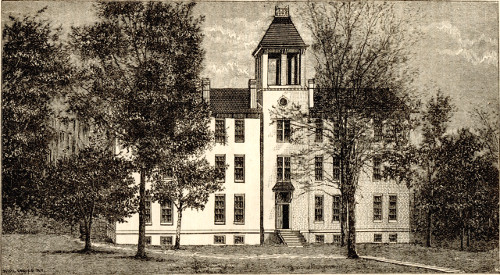
STRIEBY HALL, TOUGALOO, MISS.
There was an insurance on the chapel of $3,000. Something had been previously accumulating through special solicitations and the benevolence of friends, for enlarging the hall for young women. That addition was in progress at the time of the fire. This building contained the boarding and laundry departments of the school. It had rooms for thirty-two young women. It was proposed to enlarge it by adding another story to the long two-story structure already on the ground, and also a three-story wing, furnishing in all accommodations for seventy-two girls, besides containing two good-sized sitting-rooms, a pleasant sewing-room, and private apartments for the matron and five teachers. This has been completed.
Early last spring, funds were forthcoming for a new hall for young men. Work was immediately begun. A fair crop of “Mississippi brick” was raised on the spot. A sufficient number of men were employed to push on rapidly the work of building. A commodious and pleasing hall 41 × 112 feet stands ready for students.
A deep, roomy basement extends under the whole building, furnishing rooms not only for uses connected with the hall, but also those connected with certain of the industrial departments. The first floor affords us a large room for chapel, two convenient recitation-rooms, an office, and apartments for a small family.
The second and third floors are used as dormitories. The rooms, 34 in number, are of good size, light and airy, neatly and substantially, though simply, furnished. While in the construction of Strieby Hall strict economy has been studied, modern ideas of convenience have been introduced. Water is brought to each floor from large tanks underneath the roof. A large bath-room is on the second floor.
The large “mansion,” which has served a great variety of purposes, has now been turned for the most part into school uses. It has two large recitation-rooms, a library, a reading-room, two music-rooms, besides an office and suitable rooms for one family and guests.
These four buildings, together with the neat little cottage for the president and his family, comprise the chief externals of Tougaloo University. The old building for young men, known as the “Barracks,” is to take its proper and more humble place among the barns and outhouses connected with the farm.
INDUSTRIAL WORK AT TOUGALOO.
By Pres. G. S. Pope.
In considering the desirableness of having Industrial departments in connection with any of our schools, it is necessary, of course, to decide as nearly as possible what the expense of establishing and maintaining such departments will be, and what the advantage to the pupil. In other departments of training it is found necessary to secure liberal endowments in order to meet expenses. Why should more be asked of this? We sustain our Theological departments to train men to be successful preachers of the Word. We sustain our Industrial departments to train them to be successful business men. But one is direct Christian and missionary work. So is the other. God first put man to pruning the garden, not to preaching the gospel. And whatever is done to make the world again a garden is evidently in the line of God’s plan. It is certainly possible for us to give too little weight to the training of workmen. I suppose it is expected that I will present my thoughts in the shadow of experience.
The Industrial department at Tougaloo University embraces: 1. General Farming. 2. Strawberry Culture. 3. Gardening. 4. Stock-Raising. 5. General Housework. 6. Work in Laundry. 7. Work in Sewing-Room.
In our general farming we have confined our work to those crops that we can consume on the place—corn, oats and potatoes. We expect to cultivate cotton hereafter, rotating it with other crops. Corn yields fairly, but not equal to the West, of course. The oat crop, I think, can be made equal to the Western crop. We have done enough with grasses to satisfy ourselves that grass can be very profitable grown and marketed.
The strawberry crop can be grown, picked and marketed almost entirely with student labor. We have to hire a little outside help during the picking season. This is both a pleasant and profitable industry. We can begin shipping about April 10, or earlier, according to the season. Chicago is our market. The garden is a great help in supplying our table, and in any of our schools we ought to be able to cultivate a garden for the family with student labor with good results. But gardening for profit must be taught, and requires skill and means.
Four years ago we ventured to purchase a little thoroughbred Ayrshire and grade Jersey stock. We had no appropriation for such purchases, but felt that we must make a beginning. We needed the milk to use. We had land and must utilize it. The scholars needed to be taught the value of good cows. We have not only awakened interest in the minds of the students, in the matter of stock-raising, but also in the minds of some of the old planters about us.
The general housework and the work in the laundry and sewing-room have been well managed under the oversight of our matron and others, but in these, as in other departments already mentioned, the returns seem slight when compared with the expense of sustaining the labor.
If we look at some of the difficulties, we shall perhaps feel more forcibly the absolute need of sustaining industrial schools. The people know nothing in the line of general farmwork, except the culture of corn and cotton in the old way. They know nothing of the value of rotation in crops, underdraining, fertilizing, etc. They know nothing of the use and care of improved implements. There has been no sense of responsibility developed in them. They break tools, misplace them, lose them. A new set of hands use the tools and teams each day of the week. In a jolly, good-natured way, time is killed, and but little is accomplished. These faults must be corrected. This takes time and patience. Meanwhile the leakage and breakage and drainage is costing. In the strawberry field we have not the advantage of skilled pickers and packers, but must put new hands in the field each year. In the garden, the boys want to use the big cotton hoes, and cut and slash as they do in the field, and so they tear up the tomatoes and root up the rutabagas, and cut up the cabbages. Many of the boys have never had a fork or a rake in their hands. They know how to “gear up” a mule to plow, but would be utterly lost if they should undertake to put a decent harness on a horse and hitch him into a wagon.
In the housework the girls are no more responsible about their sweeping and scrubbing, their washing and wiping, than the boys are on the farm. In the laundry they often forget to kindle the fire until it is time to commence ironing. Then they must stand and wait for the irons to heat. In the wash-room they would as soon use a box of soap as a bar. In the sewing-room they sew and then rip, and then sew up again and rip out again. The girls have followed the plow or trundled baby wagons, and know nothing about sewing, knitting, darning, or anything else that fits them for real home life.
Multitudes of young men have their hearts set upon the pulpit and platform while there is scarcely one in ten thousand who is learning a trade. Our carpenters and masons, our tinners and shoemakers are men who are in middle life, or whose heads are frosted for the grave. These young people that we are educating will need school-houses and churches and court-houses; but the way things are going now, there will be no one to build them after their fathers are gone. In view of these facts, we have urged the establishment of shops where trades can be taught, but we are headed off with the fact that we cannot pay expenses. Do other departments of training pay expenses? Wherever the work of training is done, expense is incurred. But people will give to make teachers and preachers. Ah! they forget that the Lord Jesus worked in a carpenter’s shop before he preached the glad tidings; that Peter learned the art of catching fish before he caught men; and that Paul made tents for depraved men to use as homes in this world before he told them of the heavenly mansions. What is needed in these young people is the development of character. Manliness, womanliness, self-reliance can only be developed by a course of training that teaches hands, heads and hearts at the same time.
I have spoken of the comparative expense of our industries, but it is by no means all outgo and no income. I have no balance sheet to present with this paper, but the milk goes from the stable to the pantry by the bucketful, the vegetables from the garden to the kitchen by the basketful, and the strawberries from the field to the fruit-room by the crateful. Besides the berries used in our family, we receive from $25 to $100 net per acre from those shipped. We have raised this year $700 worth of sweet potatoes. At very moderate prices we have on hand now at least one thousand dollars worth of thoroughbred and grade stock over and above what has been paid for it. I think I am safe in saying that in spite of all the difficulties, in ordinary seasons, our outside work brings in enough to pay for the labor put upon it.
But suppose our industries bring in no returns, but are constant sources of expense; still the fact remains that great value comes through them to the boys and girls. There is a discipline gained in being obliged to do work thoroughly, and a self respect developed in them in the effort to earn something with which to pay expenses, instead of being carried like babies, that is simply invaluable.
MISSIONARY WORK AT NEW ORLEANS.
By Miss Lena Saunders.
The month just past has been replete with special Divine mercies, though marked by much sickness in the families of those interested in the school and church. One of our scholars went Home early in the month and another lies “waiting for the boatman” close by the river. She seems fully trusting in Jesus though suffering intensely and praying to die. She asks that all her schoolmates at the hall pray for her. She has walked six miles a day on her way to and from school, and now in her feeble talks dwells entirely upon the school and Heaven. My Sunday-school class has increased in numbers to 53. The little ones have been specially interested in the black-board exercises, and read the pictures in a peculiarly quaint way. The account of the “brass snake” lifted up in the wilderness particularly fascinated them. Reviewing the story of Balaam a few Sundays since, I asked the class what kind of man Balaam was, expecting them to remember the answer from the golden text. One little fellow replied “a double-jinted man.” The pastor opened the door in time to join in the smiling. I had to learn that “double-jointed” is a term applied to persons who say one thing and do another. The sewing-school is well attended. The mother’s meeting is making its influence felt by the regular members going out and bringing in those who attend no other service.
STORRS CHURCH, ATLANTA, GA
By Rev. Evarts Kent.
The Church is raising $30 per month on pastor’s salary, beginning from 1st of October last. I am sure you will be glad to know that we close the year with all indebtedness of every sort paid, and a trifling sum in the treasury. There was something of a deficiency, but we rallied last Wednesday evening and made it good. Besides, by vote of the Church at the same time, that was practically unanimous, we enrolled ourselves among the number of giving churches, pledging an annual contribution to the three missionary societies of our order, and another for church building. Our contributions may not be large; they will certainly be something. Congregation continues good. Bad weather has reduced somewhat the attendance at prayer meeting and Sunday-school; but both have been well attended and full of interest. Acting upon my suggestion at the Sunday-school concert, Christmas evening, the school brought birthday gifts to the Saviour in the form of remembrances for the poor; more than 100 packages were brought to the table; clothing, groceries, etc. It was most touching to witness the gifts brought to the Lord Jesus in this way from some of the very poorest of our children. The next morning, in a pouring rain, the pastor and deacons distributed these offerings. I hope our people gained some insight into the real meaning of the day.