THE FREEDMEN.
Reading edition
REV. JOSEPH E. ROY, D.D., Field Superintendent, Atlanta, Ga.
LIVINGSTONE MISSIONARY HALL
Was so far completed that it was ready for occupation at the beginning of the scholastic year, Sept. 4. The dedication has been fixed for Monday, Oct. 30, so that persons in attendance upon the annual meeting of the A. M. A. the previous week in Cleveland can go on to Nashville and spend the Sabbath and be present at the dedicatory exercises.
The Hall is 203 feet in length and 52 feet in width. The central part is ten feet wider, and the whole building is four stories, with a basement. The building contains a chapel, a large library room, museum, scientific lecture room 40 by 30, Treasurer’s office, President’s room, thirteen class and lecture rooms and sixty-six dormitory and living rooms. It is heated by steam.
The completion of this new Hall nearly doubles the capacity of Fisk University. The movement for the erection of this building was begun in England in 1876, and its final success is due to the munificence of Mrs. Stone, who gave, for the erection and furnishing of the Hall, $60,000. It is expected that the exercises connected with the dedication will be of great interest, and a cordial invitation is extended to the friends of our Southern work to be present.
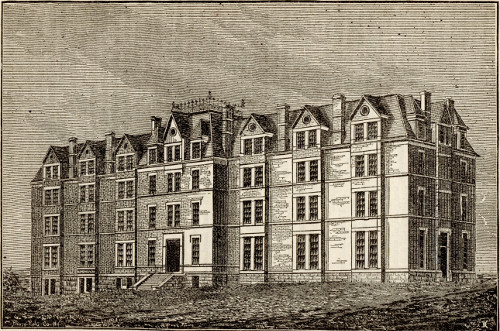
LIVINGSTONE MISSIONARY HALL, NASHVILLE, TENN.
HYGIENIC DEPARTMENT AT FISK UNIVERSITY.
BY MRS. JULIET B. SMITH
The hygienic classes were to have begun this week, but are of necessity postponed that I may help in the model school until the new teacher arrives. Small-pox being in the city, I have examined the students in all grades and vaccinated all who were unprotected. I have had much pleasure and profit in talking over the matter of the hygienic classes with Miss Parmelee, and she has given me many valuable hints from her work at Memphis. We have fitted up a sick ward to be used in case of severe or infectious disease. It is at the top of the house, with perfect ventilation, and I feel quite happy over its capabilities. Mr. Hawley has been prompt to answer my calls for disinfectants, and I hope to make them tell on the health rates for the coming year.
In the hygienic classes, as full notes as possible are to be taken by the pupils. The magnitude of the task of teaching healthful living grows upon me, but I am glad and grateful to have the chance to go to work in the old field and to be better equipped than years ago. Miss Parmelee and I have it close at our hearts to get strong hold of our city girls, and through them of their mothers with a view toward mother’s meetings sometime and somehow. The health of the school is fair, the most serious ailments being among those who have taught in the swamp lands.
STUDENT TEACHING
(BY THE STUDENTS OF FISK UNIVERSITY DURING THE SUMMER VACATION.)
REV. H. S. BENNETT.
A meeting of great interest was held in Fisk University on the night of the 15th of September. The occasion was to furnish an opportunity to those students who had been engaged in teaching during the summer to give the details of experience in their work.
Pres. Cravath presided. Rev. Geo. W. Moore was introduced as one who during the past year had been studying theology and preaching in Ohio. Mr. Moore paid a grateful tribute to Fisk University as the place where he had studied. He thought that colored students would do better to study in the South. He had been preaching to a white church, or to white churches. As a colored man he would make no apologies nor explanations. He had a message to carry to the people. He got their confidence and love before they knew who he was. He had three regular stations and preached to eight churches in all. Last Sunday he was called to Sullivan, and was told that they would oppose him on account of his race identity; but he was cordially received, and the result was a unanimous call with increase of salary.
Brethren Anderson and Ously have been highly esteemed in Oberlin. They have been hard students and have won the commendations of their teachers.
H. C. Gray taught school in Shelby County, Tenn. “My school did not have more than thirty on the roll. I tried to give satisfaction because four or five teachers before me had failed and left before their time was out. During the last two months my school was much larger than at first, but the pupils were kept out by chills and fever. I had fifteen or twenty pupils without any books.”
H. F. Mitchell, near Fernanda, Miss. “I enrolled 104 and had two assistants. I was quite successful. I introduced the tonic sol-fa method of teaching music and succeeded well in it. My health was good all summer. I was taken with a chill the last day of school.”
W. H. Ross, who had been helping in holding an institute gave an account of his work. He had attended institutes before, but they were not so much of the nature of a school. “We had a course of lectures, which was a main feature in the work. We tried to inspire the young people with a desire to pursue a course of study. All who attended were pleased with the work done. The colored people of Gibson Co. are far behind in the scale of intelligence. After the institute closed I opened my school the next Monday. The attendance was about thirty. The people have a great desire to go forward.”
Humphrey Jones taught school in Georgia, near Dalton. “I opened school on the 10th of July with nine scholars. They wanted to know whether I was Methodist or Baptist. I told them I was Congregationalist. They shook their heads; they did not know anything about that. They did not think it was anything. My school was very small, because the people would not pay twenty-five cents per month. The people are further behind there than in any place I have been.”
G. A. T. Robinson: “I taught in Georgia near Mr. Jones. The people are very poor and ignorant. They are not interested in education. A strong prejudice exists against the public schools. The most of the people are servants and are content to be such. A teacher is looked upon as a bad man. I taught in a Baptist Church and they would not let me teach in the Sunday school. They want me to come back there.”
Ella Jones, from Texas: “I had charge of the girls in the place where I taught, Huntsville. I made up my mind to live a Christian life. I taught eight months. I also taught in the Sabbath School. They wanted me to teach the next year, but I felt that I must continue my course. I tried to do whatever I did as a Christian. There were some conversions in my school. How much of this is due to my influence I do not know.”
Alice Vasser only taught five weeks at Booneville, Tenn. “When I arrived they had no school-house for me to begin to teach in. They put a floor in an old house and a roof on it, and I began to teach. I walked two miles every day. I had fifteen scholars. I feel that I did some good. The children wanted to learn very much. They were very anxious to have me come back.”
G. A. McLelland taught at Tiptonville, Tenn. “My school numbered about sixty. The children were not so far advanced in their books, but they were more easily managed. I taught in the Sunday-school. The older people were harder to interest. I got them in night school. I sang Jubilee songs and told them stories, and thus got them interested. Fisk University stands very high in the estimation of the people.”
Henrietta Bailey taught in Mississippi for three months; had a pleasant school, but did not get her money till after Christmas. Afterward taught in Lincoln school; had an attendance of forty-five, an average attendance of thirty-one.
Thus closed a very interesting exercise. Most of the students are still out teaching. The record of the evening is a fair statement of the work done by the students of the institution.
PERMANENT TEMPERANCE WORK.
MISS LYDIA P. AULD.
The first of April, 1869, by the advice of our friends in St. Augustine, Fla., and by express command from the State Superintendent, who said we were working too hard, we gave up our night school, relying more upon their judgment than upon our own view of the case.
The young men in the night class of Miss Bowker (now Mrs. Clift), expressed a strong desire to meet at least one evening in the week for instruction. The idea of forming themselves into a temperance society was suggested to them, and they decided upon a speedy organization.
Accordingly, on the evening of April 6th, about a dozen young men met in our little school room, and proceeded to organize the first temperance society in St. Augustine. After the election of the various officers, the evening was devoted to music. Miss Bowker had previously taught them several temperance melodies. Mrs. Mayhew, of Orange, N.J., who was boarding in town and greatly interested in the welfare of the colored people, was present. She was a sweet singer, and drilled them in two or three new pieces.
On the 13th, there was an increase of numbers. Mr. Berrian, from New York, was invited to address the young men. He gave them excellent counsel, and read the simple pledge he had prepared, explaining its binding obligations. We did not wish any to sign that night, as we desired them to give the subject careful consideration.
A week later, on the 20th, there was a large attendance. The good friend who was with them the previous week plainly stated the object of the meeting. He exhorted them not to do anything rashly; and read the Constitution he had drawn up for the Society, with the following simple pledge attached:
“We hereby solemnly pledge ourselves to abstain from the use of all intoxicating liquors, or drinks, as a beverage.”
A few moments of solemn silence followed the announcement, “We are now ready for signatures to this pledge,” which was broken by one after another rising and stating, in a clear and intelligent manner, his reasons for signing the pledge. Many of their remarks were truly affecting. One young man said, “A gentleman, who went North to-day, offered me a bottle of whisky. I said, ‘I thank you, sir; but I have joined a temperance society, and am going to-night to sign the pledge, so please excuse me for not accepting it.’” Another referred to his beastly intoxication on the Christmas day before, and resolved that the return of that day should find him a different man.
The first to sign was the President, who is even to this day their leader. I think no word was uttered during the signing of the pledge. The firm, manly footstep and scratch of the pen were the only sounds heard. Sixteen names were affixed, and the signatures ceased for that time. Then the organization was completed. The name Lincoln Temperance Society (since changed to Independent Lincoln Temperance Society) was adopted. Some temperance songs were sung, and those young men went quietly and thoughtfully to their homes—nobler, indeed, for the onward step they had taken.
On our return in the fall, we found that the young Society had steadily grown in strength and numbers. Not one of the “sixteen” had violated his pledge, though often and sorely tempted to do so. Such abstinence was very praise-worthy in a community where drinking was the universal custom. The Freedmen’s Bureau had erected for us a new school building, in one of the rooms of which the Society held its meetings every Monday evening.
April 20, 1870, the Lincoln Temperance Society celebrated its first anniversary. The membership had rolled up to 54. Female members had been admitted during the year, and the good the Society had accomplished was clearly perceptible in the elevated tone and manners of the young people. Several white friends were present on this occasion to listen to the speeches of the members. Miss Bowker was referred to in one of these as the “Mother of Temperance.”
A few weeks later, in May, we left St. Augustine, not to return. Years passed, and only incidentally was the Society heard from. In September, 1878, I was rejoiced to receive a letter from the President, D. M. Pappy, giving an account of the nourishing condition of the Society, from which I will make a few extracts.
“Our Temperance Society, that Mrs. Clift and yourself assisted us in organizing, numbers now about one hundred and seventy-five. I have remained President since you left, with an interval of two years. Our struggle was hard, and we had much to encounter. St. Augustine has considerably changed by so many young men abstaining from that great evil, the intoxicating drink. Our Society has also purchased a lot, and built a fine hall of two stories. The meeting room is on the upper floor, and a public reading room and library on the lower floor. The building is nicely lathed and plastered, and painted. The young men of the Society are using every means to elevate our people to respectability and intelligence: but, like everything else, it takes time. Already our Society has achieved much good, and we do tender many thanks to you and to Mrs. Clift for your influence.
“All the young men that were in the Society when you were here are still with us, except one. The young men, including myself, have never regretted signing the pledge, and we promise forever to keep it, because we have found much good in it.”
In 1881, they celebrated their twelfth anniversary, and Mr. Pappy writes:
“Our celebration went off very nicely. We had the hall handsomely decorated with flags, flowers and evergreens. Over the President’s stand was a large anchor, with ‘1869’ above and ‘1881’ below it. On the right was your name, and on the left that of Mrs. Clift. In the centre of the hall was a mound of flowers.
“The exercises consisted of a grand reception, speeches, singing, reading, essays, with excellent music by the brass band, an exhibition of fire-works and a balloon ascension. These were presented to us by some white friends. The celebration was a grand success, and has had a deep effect on those outside. Last Monday evening we received five new members, and shall on next Monday receive a few more.
“I think we are just as strong and firm in the progressive spirit as ever we were, if not more so. We number nearly 200 members now. Our building is not quite finished yet, as everything costs so much. It has cost us already nearly fifteen hundred dollars.
“The members of the Society, for the past month, have been holding temperance revival meetings every Monday evening, for the benefit of the young men. The exercises consist of speaking, singing and prayers by the members of the various churches. It has revived the hearts, not only of the members of the Society, but also of many others.”
WORK IN TOPEKA.
MISS A. D. GERRISH.
The younger class of people—the boys and girls—seem to gather around us rather than the older ones; but to win the children generally in the end secures the parents. Through music, especially the singing of the Gospel hymns, of which all are very fond, I feel that I am reaching a larger number than I perhaps could in any other way. A class of some twenty-five little folks, a second class of between thirty and forty boys and girls, a band of twenty or more young ladies, also the “Daniel’s Band,” of nine members,—these, besides others, are daily being brought under our influence and control. Their improvement in singing is very marked. Before I left (an excellent teacher having been secured) a goodly number of the young ladies accepted my invitation to attend Sunday-school. A few months, or even weeks ago, a similar invitation would have met with no response from them. In the night school a number of the older ones, who began last January with A B C, now read quite well out of the Bible. In a Bible reading, in which over fifty took part, I thought that the “Uncles” and “Aunties” read quite as well as some of the young people. The religious interest is not as great as we could wish to see; still, the weekly meetings and Sabbath services are quite well attended. We have now a small church organization, eight members. Three have united on profession of their faith; two are promising young men, members of the Band. I look for an increase of numbers in our Sunday-school next season, and we have the promise of several new teachers. July 30th we had a Sunday-school concert, using the A. M. A. concert exercise. At the close, a white gentleman, one of Topeka’s best men, said: “In looking over the crowded audience this evening, I can but say, with many others, that a change has already been wrought in Tennessee town. Improvement is stamping itself upon place and people.”