American Missionary Association.
Reading edition
OUR ANNUAL MEETING.
The Thirty-fifth Annual Meeting of the American Missionary Association will be held in Plymouth Church (Rev. G. W. Phillips’), Worcester, Mass., commencing November 1st, at 3 P.M., at which time the report of the Executive Committee will be read. The Annual Sermon will be preached Tuesday evening by Rev. C. D. Hartranft, D.D. Wednesday and Thursday will be occupied by reading of papers, reports, discussions, business, etc. The following persons with others have promised to be present and participate in the exercises: Presidents Fairchild, Ware, Hamlin, Chamberlain, Buckham; Gen’ls O. O. Howard, S. C. Armstrong; Col. H. G. Prout, late of the Khedive’s staff, Egypt; Capt. R. H. Pratt, of Carlisle, Pa.; U.S. Senator G. F. Hoar, Prof. Cyrus Northrop, Hon. J. J. H. Gregory, John B. Gough, and Rev. Drs. Herrick, Duryea and Mayo.
The following railroads have agreed to furnish free return tickets to persons attending the meeting: New York and New England; Worcester and Nashua to Portland, Me.; Boston, Barre and Gardner and Cheshire; Providence and Worcester to Whitin’s and stations south. The N.Y., N.H. and H. R. R. offers tickets to Worcester and return at the following rates: from New York $5.60, Stamford $4.70, South Norwalk $4.45, Bridgeport $4, New Haven $3.50, Meriden $2.75, Middletown $2.75, Hartford $2.
The receipts of the Association for the month of Sept. were $30,417.94. For the financial year, which closed with that month, the receipts were, with balance, $244,578.96. One year ago the Association asked for an advance of 25 per cent., and its friends have made it 30 per cent. The year has been closed without any debt upon the treasury, and with a balance in hand of $518.85. In addition to this, the Association has used during the year $77,131.97 of the Stone Fund toward the erection of the buildings for which it was given. This makes a grand total for the year of $321,710.93. This enlargement of the capital by the addition of the Stone buildings will require a corresponding increase of funds to carry on the business. The advance of the past year is an occasion for profound gratitude, and inspires hope for the needed increase of the coming year.
We are happy to furnish our readers in this number with a few reports of the successful openings of our schools South. We give also a few brief accounts of summer revivals. Such times of refreshing are quite as frequent among the colored people in summer as in winter.
Rev. Hamilton W. Pierson, D.D., formerly missionary of this Association at Andersonville, Ga., has written a very readable book on the old time social, political and religious life in the South-west. In it he has garnered up many valuable remembrances of the condition of both whites and blacks before the war, special reference being made to their religious experiences, which he had the privilege of observing during many years of service as agent of the American Bible Society. He calls his book “In the Brush.” It is published by D. Appleton & Company, New York.
JOHN BROWN MEMORIAL STEAMER FOR THE MENDI MISSION.
The Mendi Mission was organized in 1842, in about 7 deg. north latitude, West Central Africa. It was primarily a mission for the Amistad captives, freed slaves who had escaped from bondage by the incidents following their mysterious appearance in Long Island Sound, and their subsequent imprisonment in New Haven, Connecticut. The men who, by their charitable forethought, provided for their defense in the U.S. Supreme Court by John Quincy Adams, and for their education while in New England as well as their return to Africa, were most active in founding the A. M. A., which has sustained the mission since 1846.
The fact that there are no roads or domestic animals for carrying burdens in the Mendi country, renders the use of boats a necessity as a means for transportation. The interests of the mission have suffered for the want of a steamer to facilitate the work at the saw-mill and to carry the missionaries back and forth up the river, thereby avoiding the exposure to disease by long delays in the marshy regions.
The proper persons are already provided to have the steamer in charge, and we only wait for the little rills and large streams of benevolence to flow in and float it. About $10,000 are needed.
In order that old and young may have a part in this work, we have arranged to issue two grades of shares as follows: First Grade, $100; Second Grade, $10. The certificates of shares will be issued on heavy calendered paper, size about 8 by 10 inches, in two colors; the First Grade Certificates green and black, and the Second Grade black and brown.
We cordially invite all friends of African missions, whether pastors, Sunday-school superintendents, heads of families or others, to assist us in providing, at an early date, this much-needed agency for the development of Christian civilization in the dark continent.
All communications should be forwarded to H. W. Hubbard, Treasurer of the American Missionary Association, 56 Reade Street, New York.
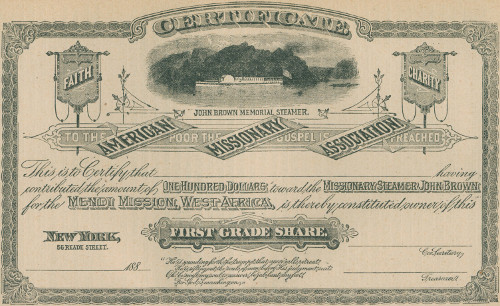
FACSIMILE OF FIRST GRADE CERTIFICATE REDUCED ONE-THIRD.
The progress of educational work in Mississippi, according to the published statement of Gen. J. A. Smith, Sup’t of Public Instruction for the State, is of a hopeful character. The number of white children in public schools for the year 1880 was greater by 7,037 than in 1879, and the number of colored children 12,914. The average daily attendance shows an increase of 6,500 white children and 11,288 colored. The number of teachers employed was 202 over that of the preceding year, the increase being confined to the colored teachers. The total number of pupils enrolled for 1880 was 112,994 whites and 123,710 colored. The total disbursements were $830,704.79.
Upon the invitation of the Congregational Union of England and Wales at the hand of Rev. Dr. Alexander Hannay, of London, and by the appointment of the National Council and of this Association, our Secretary, Dr. M. E. Strieby, went over to represent both of these bodies at the Jubilee of that Union, which was held at Manchester in Free Trade Hall, October 4th to the 10th. We learned by cablegram that Rev. Henry Allon, D.D., was made chairman, and that Dr. Strieby, with other foreign delegates, was heard on the 6th. It was fitting that the English people, who had done so much through this Association in the way of aiding students in our Southern institutions, and of raising the fund for the Arthington Mission in the basin of the Upper Nile, should seek and secure a report from our Secretary-in-Chief, of the processes and results of this missionary organization. Great Britain and America both owe a common debt to our Freedmen and to the land of their ancestors. Dr. Strieby is expected to return in season to participate in our Annual Meeting, making report of English public sentiment in respect to this great international missionary enterprise. During his absence, his place has been filled by Rev. Jos. E. Roy, D.D., the Field Superintendent of our Southern work.
It was a happy thought of Prof. Henry Cowles, after he had completed his set of sixteen volumes of Commentaries on the Bible, that he would assign the property of the stereotype plates, the copyrights, and the contract with the publishers, D. Appleton & Co., to the American Board, the Home Missionary Society and this Association. His generous devising took in also the missionaries themselves, and provides that the fifteen per cent. of royalty on all books sold shall be applied, at the discretion of the Secretaries of the several societies, in supplying with the commentaries such of them as may not be well able to buy them. When our Executive Committee, in September, passed its vote of thanks for this testimony of love, they did not know that a few days before, this John-like disciple had been called up to lean upon the bosom of his Master, who had already given him a better “well-done.”
These notes, giving the latest results of Biblical scholarship, without the tedious processes of the same and applying a sanctified common sense in interpreting the Divine Word, will stand for a long time as a fountain of instruction and of comfort to Bible students. The question is often asked, What one set of commentaries on the whole Bible can be recommended to people who do not wish to go into the extended works of Biblical exegesis? We do not know of any better one to name than this.
PRESIDENT GARFIELD AND THE NEGRO.
The mind of President Garfield was too broad and generous, his nature too honest and sincere, for him not to take at once and forever the part of the wronged, however humble, as against the wrong-doer, however powerful. He knew too well the value of education to one who was compelled to struggle up from the depths of poverty for place and power not to emphasize the duty of putting the opportunity and facilities for education within reach of all the ignorant.
He first knew of the Congressional Record when he saw it in the hands of an opponent in a discussion of the slavery question. He began his political life in the days when the Supreme Court of the United States, in the Dred Scott decision, had asserted that slavery was the genius of our Constitution, and liberty the child only of local and state regulations. With clearest vision he saw when the war began that the real issue was the death or the supremacy of slavery, and threw his whole soul into that conflict. He was selected by the constituents of Giddings, as the one most worthy to succeed that veteran opponent of slavery in Congress.
After his nomination to the Presidency, in his first regular speech, made in response to a serenade in New York City by the Boys in Blue, he said, speaking of the Freedmen: “We will stand by them until the sun of liberty, fixed in the firmament of the Constitution, shall shine with equal ray upon every man, white or black, throughout the Union. Fellow-citizens, fellow-soldiers, in this there is all the beneficence of eternal justice, and by this we will stand forever.” A noble sentiment, which must become a fact established beyond the possibility of successful assault before the nation can enter upon the path of peace or safety.
In reply to an address by a delegation of colored men who visited him in Mentor, just before he left home to assume the duties of his high office, he said, in effect, that it was not within the power of the President by appointments and official recognitions to raise the colored people to the level of social recognition and honor. The path to this leads through education and thrift. The negro, like every one else, must be the architect of his own fortunes, and compel by worth the respect he seeks. But turning from the negro who would have appointment to the nation which he held responsible for his condition—to the nation endangered by that condition—he said in his inaugural address, which his successor, nor Congress, nor the people should neither forget nor fail to heed: “The census has already sounded the alarm in the appalling figures which mark how dangerously high the tide of illiteracy has risen among our voters and their children. To the South this question is one of supreme importance. But the responsibility for the existence of slavery did not rest upon the South alone. The nation itself is responsible for the extension of the suffrage, and is under special obligation to aid in removing the illiteracy which it has added to the voting population. For the North and South alike there is but one remedy. All the constitutional power of the nation and of the states, and all the volunteer forces of the people, should be summoned to meet this danger by the saving influence of universal education. It is the high privilege and sacred duty of those now living to educate their successors and fit them by intelligence and virtue for the inheritance which awaits them. In this beneficent work sections and races should be forgotten, and partisanship should be unknown.”
He also at the same time gave due recognition to the efforts made by the Freedmen: “The emancipated race have already made remarkable progress. With unquestioning devotion to the Union, with a patience and gentleness not born of fear, they have ‘followed the light as God has given them to see light.’ They are rapidly laying the material foundations of self-support, widening the circle of intelligence, and beginning to enjoy the blessings that gather around the homes of the industrious poor. They deserve the generous encouragement of all good men. So far as my authority can lawfully extend, they shall enjoy the full and equal protection of the Constitution and laws.”
He said to the Fisk University Jubilee Singers, who at his invitation visited him at Mentor, on the 30th of September, 1880: “Now, friends, the earthly saviour of your people must be universal education, and I believe your voices are preparing the way for the coming of that blessing. You have sung a great University into being. I hope your voices are heralding the great liberation which education will bring to your lately enslaved brethren. You are fighting for light and for the freedom it brings, and in that contest I would rather be defeated with you than to be victorious against you. In the language of the song you have just sung, I say to you, ‘March on, and you shall win the victory—you shall gain the day.’”
His indignation because of the injustice done this people flashed out just before his assassination, when learning that this band of singers had been refused admission to the hotels in Springfield, Ill., he caused a telegram to be sent to them saying, that if they received similar treatment when they came to Washington, he would be glad to receive them as his own guests at the White House.
It would be unjust to the memory of this great and good man to leave at least this much unsaid of his interest in the race whose wrongs appealed so strongly to his sympathies, and whose fate he saw to be so intimately and indissolubly linked with that of the nation; and whatever in his life and character may be celebrated and memorialized, justice will not have been done him until suitable commemoration is made of this interest.
BENEFACTIONS.
—Hon. H. B. Curtis has given Kenyon College $15,000.
—Judge Hoadley has purchased for the Cincinnati Art Museum, treasures worth $30,000.
—Mr. Ahok, a Chinese gentleman, has given $10,000 toward the new College at Foochow, China.
—The endowment of Washington and Lee University, mostly from Northern men, has reached $431,500.
—A gift of $10,000 has recently been made to the Boston University, to be devoted to the scholarship fund of that institution.
—One donor has given $100,000, and another $250,000, towards the erection of the new law school building and the physical laboratory of Harvard College.
—Rev. Dr. Alva Woods of Providence, R.I., gives the Vermont Academy at Saxton’s River another $1,000 to be used in supporting embryo ministers.
—The venerable John Baldwin, founder of Baldwin University, Berea, O., has given $3,000 to establish a school at Bangalore, India, in the Rev. William Taylor’s work.
—Mrs. Noah Woods of Bangor bequeathed $5,000 to Bowdoin College for a scholarship, to be called the Blake scholarship, in memory of her son, who was a graduate of that institution.
—Talladega College, Talladega, Ala., is erecting Stone Hall by the gift of Mrs. Stone—the fourth College building. Endowments now are the great necessity. $25,000 will provide for a Professorship, and there are four such needing endowments; one of these a Theological Professorship.
GENERAL NOTES.
AFRICA.
—The French Chamber has voted a sum of fifty million francs to be expended in the purchase of land, and in colonizing Algeria.
—Two Societies of Geography have been founded in the Portuguese African colonies, the one at Mozambique, the other at Loanda.
—A French Society for the protection of the natives in the colonies, similar to the English Society of Exeter Hall, is to be formed at Paris.
—England contemplates sending two new Consuls to Souakim and to Khartoum to watch over the execution of the contracts relative to the treaty.
—A new expedition undertaken under the auspices of M. C. A. Verminck of Marseilles, and directed by M. Zweifel, will soon set out from Freetown for Timbo, Falaba and the sources of the Niger.
—Major Mechow, who has explored Loanda, has arrived at Lisbon, bringing two young negroes belonging to the same tribe, but who are completely different as to the form of the head and the color of the skin.
—In his exploration in the country of the Soumalis, M. G. Revoil has found the vestiges of a Greek colony to which a Gallas white tribe had attached itself. The arms, the clothing, the idiom and the physiognomy of the people of the tribe confirm this opinion.
—Besides the two stations founded at Vivi and Isangila, Stanley has charged Lieut. Harron with the establishment of a third at Manyanga, where M. McCall has already installed the missionaries.
—A new International Belgian expedition is to be organized by Major Hanssens and Lieutenant Vandevelde. M. Popelin, who with M. Roger had left Karéma to found a station upon the west side of Tanganyika, has unfortunately succumbed to the fever and disease of the liver.
—The South African diamond fields have been wonderfully productive. In a single year, according to the testimony of Sir Bartle Frere, brilliants valued at over seventeen and a half million dollars passed through the Cape Town post-office.
—A missionary asked an old African woman what the earthquake was. “Me tink,” said she, “God Almighty pass by, and de world make him a courtesy.” This was a strange answer; but it was her way of saying, “The Lord reigneth; ... let the earth be moved.”
—They have found in the papers of the late Captain Phipson Wybrants, who died in the exploration of the country of Oumzila, a very minute statement concerning the Sabia, one of the great rivers of Southern Africa, which flows into the Channel of Mozambique. The upper part of its course has been little known. The outline of M. Wybrants will allow of the correction of the errors on the ancient maps.
—The complete success of the expedition sent out by the Royal Geographical Society of Rome in charge of Signori Matteucci and Massari is likely to cause a disturbance among map makers. These parties have found their way from Egypt across the continent to the Gulf of Guinea, exploring many hitherto unknown regions in the dark continent. A full account of their journey and the country and people along their way will be looked for with intense interest.
—The conquest of Algeria by the French, in 1830, restored to Christianity that portion of African soil, but for prudential reasons, no missionary enterprises were permitted. But in 1868 a famine occurred which destroyed in some districts of Algeria a fifth of the population, leaving thousands of native children in utter destitution. Nine thousand of these were gathered by the Archbishop of Algiers, and cared for during their youth. In this way the Catholic church has extended its influence and fame far and wide through the back country. A hospital has been provided by the charity of the natives in the village of St. Cyprien where the sick are gratuitously attended.
THE INDIANS.
—Captain Pratt of the Indian Training School at Carlisle Barracks, has persuaded the apprentice boys who are earning money to deposit it in the bank, and forty-seven of them have opened an account. An excellent suggestion for pale faces as well.
—More than nine-tenths of the Indians in the United States are peaceably cultivating their farms, and sending their sons and daughters to the Government schools, East and West. The disturbance, therefore, made by one tribe of the most wild and untamed Indians in the country will not particularly discourage or alarm those who have been watching the admirable Peace Policy of the Government. A little more patience and perseverance in the right direction would soon overcome what remains of hostility among these wards of the Nation.
—The liberality of the Indians at White Earth Reservation is testified to by Bishop Whipple, who recently visited the Episcopal mission at that point. He says that in taking the offerings, every man, woman and child came up and deposited the gift in the alms basin. The Bishop also speaks encouragingly of the religious work carried on at Red Lake, where there is a flourishing Indian church, whereas three years ago there was not a single member. Five miles farther up the Lake, more than half the Indians are Christians, and these have been baptized within the past three years. The Indian chief, who is an exemplary Christian and one of the noblest specimens of his race, has had much to do in bringing about this wonderful change.
THE CHINESE.
—The Japanese colony in Paris are about to erect a pagoda for their religious devotions.
—The Governor of Foo Chow has issued a proclamation calling upon the people not to molest the missionaries or the converts who follow them, either at their chapels or school-houses.
—Out of one party of twenty-five Chinese students, who are returning to their homes, it is said that nine have changed their religious faith since they came to this country.
—It is reported that as fifty of the Chinese students ordered home by their Government were leaving the San Francisco wharf, September 6th, they joined in singing our National hymn, “My country, ’tis of thee.”
—The American Board has published a new map of Japan about 2½ by 4½ feet in size, which will be found a valuable aid in missionary concerts. The price of the map on fine paper is 40 cents, and on cloth 70 cents.
—It is reported that the high Chinese authorities are in favor of an International Exhibition at Shanghai in 1882. Twenty-two thousand applications for space have been received from American and European manufacturers, and if the Exhibition is determined upon, there is little doubt of its success, both in a political and an industrial point of view.