American Missionary Association,
Reading edition
56 READE STREET, N. Y.
PRESIDENT.
Hon. E. S. TOBEY, Boston.
VICE-PRESIDENTS.
Hon. F. D. Parish, Ohio. Hon. E. D. Holton, Wis. Hon. William Claflin, Mass. Rev. Stephen Thurston, D. D., Me. Rev. Samuel Harris, D. D., Ct. Wm. C. Chapin, Esq., R. I. Rev. W. T. Eustis, D. D., Mass. Hon. A. C. Barstow, R. I. Rev. Thatcher Thayer, D. D., R. I. Rev. Ray Palmer, D. D., N. J. Rev. Edward Beecher, D. D., N. Y. Rev. J. M. Sturtevant, D. D., Ill. Rev. W. W. Patton, D. D., D. C. Hon. Seymour Straight, La. Rev. Cyrus W. Wallace, D. D., N. H. Rev. Edward Hawes, D. D., Ct. Douglas Putnam, Esq., Ohio. Hon. Thaddeus Fairbanks, Vt. Rev. M. M. G. Dana, D. D., Minn. Rev. H. W. Beecher, N. Y. Gen. O. O. Howard, Washington Ter. Rev. G. F. Magoun, D. D., Iowa. Col. C. G. Hammond, Ill. Edward Spaulding, M. D., N. H. Rev. Wm. M. Barbour, D. D., Ct. Rev. W. L. Gage, D. D., Ct. A. S. Hatch, Esq., N. Y. Rev. J. H. Fairchild, D. D., Ohio. Rev. H. A. Stimson, Mass. Rev. A. L. Stone, D. D., California. Rev. G. H. Atkinson, D. D., Oregon. Rev. J. E. Rankin, D. D., D. C. Rev. A. L. Chapin, D. D., Wis. S. D. Smith, Esq., Mass. Dea. John C. Whitin, Mass. Hon. J. B. Grinnell, Iowa. Rev. Horace Winslow, Ct. Sir Peter Coats, Scotland. Rev. Henry Allon, D. D., London, Eng. Wm. E. Whiting, Esq., N. Y. J. M. Pinkerton, Esq., Mass. E. A. Graves, Esq., N. J. Rev. F. A. Noble, D. D., Ill. Daniel Hand, Esq., Ct. A. L. Williston, Esq., Mass. Rev. A. F. Beard, D. D., N. Y. Frederick Billings, Esq., Vt. Joseph Carpenter, Esq., R. I. Rev. E. P. Goodwin, D. D., Ill. Rev. C. L. Goodell, D. D, Mo. J. W. Scoville, Esq., Ill. E. W. Blatchford, Esq., Ill. C. D. Talcott, Esq., Ct. Rev. John K. McLean, D. D., Cal. Rev. Richard Cordley, D. D., Kansas. Rev. W. H. Willcox, D. D., Mass. Rev. G. B. Willcox, D. D., Ill. Rev. Wm. M. Taylor, D. D., N. Y. Rev. Geo. M. Boynton, Mass. Rev. E. B. Webb, D. D., Mass. Hon. C. I. Walker, Mich. Rev. A. H. Ross, Mich.
CORRESPONDING SECRETARY.
Rev. M. E. STRIEBY, D. D., 56 Reade Street, N. Y.
DISTRICT SECRETARIES.
Rev. C. L. WOODWORTH, Boston. Rev. G. D. PIKE, D. D., New York. Rev. JAS. POWELL, Chicago.
H. W. HUBBARD, Esq., Treasurer, N. Y. Rev. M. E. STRIEBY, Recording Secretary.
EXECUTIVE COMMITTEE.
Alonzo S. Ball, A. S. Barnes, C. T. Christensen, Clinton B. Fisk, Addison P. Foster, S. B. Halliday, J. A. Hamilton, Samuel Holmes, Charles A. Hull, Chas. L. Mead, Samuel S. Marples, Wm. T. Pratt, J. A. Shoudy, John H. Washburn.
COMMUNICATIONS
relating to the work of the Association may be addressed to the Corresponding Secretary; those relating to the collecting fields to the District Secretaries; letters for the Editor of the “American Missionary,” to Rev. G. D. Pike, D. D., at the New York Office.
DONATIONS AND SUBSCRIPTIONS
may be sent to H. W. Hubbard, Treasurer, 56 Reade Street, New York, or when more convenient, to either of the Branch Offices, 21 Congregational House, Boston, Mass., or 112 West Washington Street, Chicago, Ill. A payment of thirty dollars at one time constitutes a Life Member.
THE AMERICAN MISSIONARY.
Vol. XXXV.
OCTOBER, 1881.
No. 10.
American Missionary Association.
The Thirty-fifth Annual Meeting of the American Missionary Association will be held in Worcester, Mass., commencing November 1st, at 3 p. m. For particulars see fourth page of cover and the religious press.
Our readers have already been informed of the death of Rev. K. M. Kemp of the Mendi Mission, and it now becomes our painful duty to chronicle the death of his beloved wife. The latest advices inform us that their deaths were neither of them due wholly to the climate. Mrs. Kemp was a brave, true woman, whose life and example will not soon be forgotten in the field where so many had already learned to love her.
By the time this reaches our readers, Superintendent Ladd and Dr. Snow will be well on their way toward the Arthington Mission. It is their purpose to push directly for the region of the Sobat in the heart of Central Africa, with the view of locating the new mission. It will give us pleasure to keep the public informed of the movements of their expedition in this interesting portion of Africa. Two missionaries are under appointment to occupy this field at the call of the Superintendent.
We take pleasure in announcing the safe arrival of Rev. O. H. White, D. D., from England. After a continuous service of over six years of earnest labor in the mother country, he well deserves the rest which he now seeks. As Secretary of “The Freedmen’s Missions Aid Society,” he has ably represented this Association in its great work for the Negro, and has been enabled, we trust, to insure the success of the Arthington Mission, by so far interesting our British friends in this new and promising missionary enterprise, as to call forth many generous contributions toward its support.
As this number of the Missionary will be in the hands of our readers a few days before the close of our fiscal year, September 30th, we make this reminder to the churches and friends who have not yet made their annual offering to our treasury.
We wish to pay every obligation, and report the year closed without debt. If the gifts we have reason to hope for are promptly forwarded, we shall be able to do this.
One obstacle in the way of establishing missions in the interior of Africa is illustrated by the difficulties experienced by the missionaries of the American Board destined for Bihé. Messrs. Bagster, Sanders and Miller landed at Benguela on the coast, 250 miles from Bihé, November 13, 1880; May 1st, they had only reached Bailunda, 200 miles on their way, where they were still encamped awaiting the arrival of supplies. Five months and seventeen days had been exhausted by preparations and delays, and the end had not come at last reports. Possibly, however, the knowledge gained meanwhile of the peculiarities of the country and the language and habits of the people will quite compensate for loss of time, and enable them to lay the foundations for their future work far more wisely in consequence of the difficulties thus experienced.
The Le Moyne Institute, Memphis, Tenn., has established an industrial department for the purpose of teaching the girls the art of cookery. A kitchen has been furnished with all needful appliances. Lectures are given on housekeeping and household economy, which are followed by instruction in various methods of cooking different foods. The girls all take turns in doing the work, and in this way get the full advantage of the practice. The following list of questions on which a class in cooking was examined at the last anniversary, illustrates the scope of the work that is being done:
1. Name seven principal components of the human body.
2. Name some of the principal foods used to supply these elements.
3. At what time in the day is the most nutritious food required?
4. What is the object in cooking food?
5. Name three of the most healthful and economical modes of cooking meat.
6. Why are fried meats not healthful?
7. What should be remembered in boiling or roasting meat?
8. Give general principles for making soup.
9. What is essential in making good light bread?
10. How may bread be made “light” without the use of yeast or soda?
11. Give general principles for mixing cake.
12. Give receipt for making gruel.
13. How should potatoes be boiled?
14. Give rule for washing dishes and putting the kitchen in order.
The work among the refugees in Kansas by the different agencies has been carried forward with energy and success. According to the best estimates there are upwards of 50,000 colored people in that State, and the number is steadily increasing. The reports from our missionaries are favorable, and indicate that much is to be done and that the refugees are eager for the needed assistance. The interest taken in behalf of the exodites by the English people is worthy of the imitation of American philanthropists. During the last few months, friends in Great Britain have sent to Mrs. Comstock for the Freedmen’s Relief Association, $25,000 worth of supplies, consisting of wearing apparel, household goods and kitchen utensils. There has also been received from England during the last fifteen months $13,000 in money, making a total amount of $80,000 for the treasury of the Relief Association; two-thirds of this is said to have been given by the English people. Our appeal, published some months since, for $2,500 to provide for the work we have recently inaugurated in Kansas, has not yet met with such response as we hoped to receive. When so much is being done by friends abroad for this needy class of colored people, we believe the patrons of the American Missionary Association would not have us do less for the Kansas field than we have already undertaken. Will they not contribute so liberally for this special object that we shall be able to do a great deal more?
We clip from the New York Tribune a paragraph relating to the work of the American Missionary Association in the South. It comes from the pen of a special correspondent, who, as the editorial in the Tribune says, “has already written with great intelligence and fairness of the South and the Southern people.”
SUCCESS OF COLORED TEACHERS.
“The educational work in the South of the American Missionary Association is of the highest character, and deserves all possible recognition and assistance. The leading Southern people everywhere speak of it gratefully and enthusiastically. At the Normal and Agricultural Institute, Hampton, Va., at Talladega College, in Alabama, Tougaloo University, Mississippi, Tillotson Normal School, Austin, Texas, and in several other colleges and normal schools which I have visited, though the money endowment of the schools is scanty compared with the amounts which are needed, the endowments in personal qualities and character, as represented by the teachers, are of a remarkably high order. This is indispensable indeed, for the peculiar nature of the work of educating the colored people of the South requires the best teachers that can be obtained. In many of these institutions the boys learn something of various trades or mechanical occupations, and of farming; and the girls are taught sewing, cooking and the care of a house. I have visited a great number of the negro common and high schools, which are taught by graduates and students of the colleges and normal schools which I have named, and I think it very wonderful that so many of these negro teachers are successful. They generally have to struggle against many disadvantages, but nearly all whom I have seen have the confidence and respect of the leading white citizens where they are at work. I have found a few fools among them, of course, but a great majority appear to be sensible, earnest young men and women.”
TALLADEGA COLLEGE.
PRESIDENT HENRY S. DE FOREST.
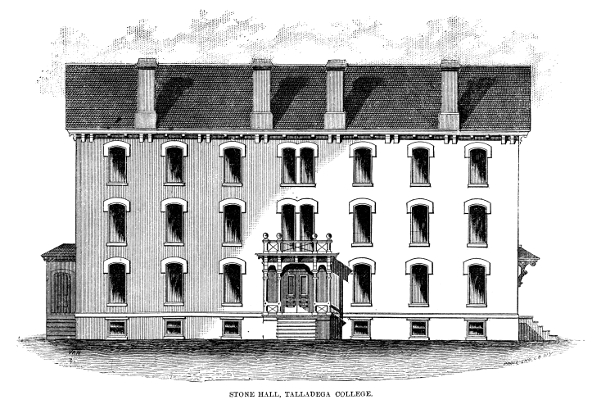
This issue of the Missionary contains a view of Stone Hall, built of Alabama bricks at Talladega. Its completion, it is believed, marks an era in the history of the College. With better equipments than ever before, with a field as large as it can wish, the College, backed by the history of half of one generation, looks forward with hope to the growing and unfolding future. From what has been we may attempt to previse something of what may be.
In 1867, only fourteen years ago, when the Freedmen’s Bureau was acting as Interex between past bloodshed and coming chaos, the building now known as Swayne Hall, with ample and beautiful grounds, was purchased, and the future College begun with spelling book and Bible primer. A few wise men of the East were there at its birth. They wore blue and carried swords, though in the scabbard. But many black men, who had been waiting through a long and starless night, thought they heard an angel chorus and forthwith were praising God. A white male high school building, reared by the unrequited labor of the slave, was bought at a mortgage sale and opened for the Christian training of all, without respect to color or sex. Men, black either in pigment or in figment, began to come, and the reconstructed building gave shelter to school and church. But a home was needed, and two years later, in 1869, Foster Hall was built, affording rooms for the girls and teachers, and also table accommodations for the entire family. From the beginning, Talladega has united the three great forces in shaping character, namely, the school, the church and the home. The foundations of the second building, Foster Hall, were laid while the Ku Klux Klan was brandishing its weapons and grating its teeth. The Nehemiahs of that time carried their weapons in one hand and wielded the trowel with the other. But they built, and the God of Heaven prospered them. From that time forward the quadrennial period has been observed. The year following a Presidential election, Talladega College has inaugurated some new thing. In 1873, Graves Hall with additional land was secured for the theological department. In 1877, when President Hayes was holding out the olive branch, we attempted more of the peaceful pursuit of agriculture, and Winsted farm was bought. And now in the beginning of President Garfield’s administration, the third brick building is reared, and Stone Hall opens its door to eighty young men.
Surely this is rapid progress. Not half of one generation has passed, and the spelling book is supplemented by normal, college preparatory, to some extent college, and theological studies. Some of those first primary students are preachers now. The babes of those recent days have become the leaders of their race. Figures are not juicy; but it is noteworthy that one hundred and sixteen of our students were teaching during the last summer vacation; that three hundred and eighteen who had pursued something of Normal studies have gone thence as pedagogues; that of our forty-two Theological students, fifteen are pastors of A. M. A. churches; as many more are ministering in other fields, and the remainder are still in training. Such facts are inspiriting and full of hope. These results, let it be remembered, have been realized with meagre resources and poor appliances. If now our means could be made more commensurate with our necessities, if our resources could compare with our opportunities, what a grand work of patriotism and Christianity might not the College attempt and expect in the near future. As regards the higher branches of learning, the College has an unrivaled place in a great State, half of whose population is black. It has in Alabama more than 600,000 colored people from whom to draw its students. It cares for muscle as well as mind, and for heart most of all. It teaches industry and thrift and economy. It emphasizes the fundamentals, and believes that the foundations of learning should be laid before the superstructure is attempted. Still in its care for the masses, it is seeking for wise leaders, and wishes to take certain elect souls through as long and as thorough a course of study as the circumstances will allow. It aims especially to furnish men well equipped for the Gospel ministry, and thinks it has found a place for uplifting not only America, but Africa, and that by laboring there among the foot-hills of our own Blue Ridge, it may help beautify the Dark Continent with salvation. As long as cotton grows on those black bottoms, or those hills yield their treasures of iron and coal, so long will Talladega College be needed, and so long it hopes to stay. It desires to grow with the generations and increase with the ages. Already it feels its need of permanent investments, and is asking for the beginning of an endowment. It calls for the personal service of some, and asks for the gifts of others who cannot offer themselves. In both cases it gives an opportunity for usefulness as large and as lasting as can be desired.
Rev. A. D. Mayo, D. D., writes in The Christian Register of Talladega College as follows:
“This year the institution numbers two hundred young men, women and children, of whom eleven are in the theological, eleven in the preparatory college, forty-eight in the normal, fifty-nine in the intermediate, and seventy-two in the primary department. Rev. Henry S. De Forest is president, and Rev. George W. Andrews pastor and instructor in theology. Three men and six women teachers in addition make up the teaching force; and an abler, more devoted, and more attractive people we have never met in any seminary of learning in any part of the country. They are all white, and represent every section of the Union and the Dominion of Canada. Talladega may congratulate itself on its “negro college,” for probably no institution in the State represents more thoroughly the best modern ideas of education.”
THE STRONG AND THE WEAK.
BY PROF. G. N. MARDEN, COLORADO SPRINGS, COL.

Injustice seems never more flagrant than when committed by the prosperous and powerful against the poor and weak. If the moral test of civilization, as of society, is its care for its weakest members, we hardly dare to measure our country by the history of its treatment of the Negro, the Indian and the Chinaman.
The diagram above is designed to illustrate the numerical strength of the white element of the United States, as compared with three other elements of the population. The large bordered square (whose side is ten centimeters) represents our country’s total population—a round fifty millions. The colored population—not less than six and a half millions—is signified by the square in the lower right hand corner. Close beside it is the little square which stands for the size of the Indian—about three hundred thousand souls; the shaded portion of the square means the wild Indians—about fifty thousand. The dreaded Chinese element of our population can be seen by looking for the minute square, which represents one hundred thousand.
This diagram, in enlarged form, can be effectively used in the Missionary Concert. To a large square of stout paper, smaller squares of different colored paper may be pinned. Correct proportions for paper or for blackboard illustrations would be, following the order of the size of the population, 50, 18, 3.87 and 2.23 centimeters respectively; or, in inches, about 192/3, 71/10, 11/2 and 7/8. These figures denote the base lines of the respective squares.
How the powerful white man looms up and looms over the little group of the three ill-treated races huddled in the corner!
The black block makes no insignificant figure, after all, and its rapid growth suggests that to have, through neglect, a dense body of such dimensions depressed by ignorance were a blunder matched only by the wickedness of oppression. The size of the Indian and the Chinaman suggests strongly the outrageous meanness of ill-using them; it makes more striking the absurdity of a war policy against the red man, and of the demagogue’s appeal to fear on account of the presence of the Chinaman.
What an opportunity, on our own shores, for strength to help weakness, for knowledge to help ignorance, for wealth to help poverty, and so to fulfil the law of a Christian civilization!
Surely it is high time for us to heed the weighty saying of John Milton: “A nation ought to be but as one huge Christian personage, one mighty growth or stature of an honest man, as big and compact in virtue as in body; for look, what the ground and causes of single happiness to one man, the same we shall find them to a whole state.”
GIVING, VIEWED FROM A COMMONPLACE STAND-POINT.
REV. SAM’L SCOVILLE.
We think this whole matter of giving is put so high sometimes that it gets clear out of sight of common people. We love now and then to put it down upon the basis of common virtues and moralities and see how it looks.
Motives, springing from the highest spiritual insight and experience, are good and always in order, but they are not essential to a fair judgment nor to proper action in this matter. A man may have much less than John’s spirituality or Paul’s experience to decide that there is a glaring inconsistency in praying for the building up of God’s kingdom on the earth, and then withholding the means necessary to that end; in praying that the Gospel may fly to earth’s remotest bound, and then refusing to contribute to the amount of a single wing feather to help its flight.
It does not take a great deal of spiritual insight to see that we cannot serve God and mammon at the same time in our churches with advantage, any more than we can in our own hearts, and that if the Judas of worldliness carries the bag, there is going to be a betrayal of the Master some day. The most common of common sense judgment is all that is needed for so simple a conclusion.
And it is not necessarily any high revelation required, but only an appreciation and approval of square dealing, to convince us that a church must so raise its money, and to such amounts, that it will be able to do its share towards carrying on the great work of evangelizing the world.
In these days of missionary spirit every church is to broaden out its parish lines until they meet only at the antipodes. All the dark places of the earth belong to us to do something for, to do what we can for, and we are not to raise our money nor use it so that this part of the work is neglected. To cheat the heathen out of his portion of the Gospel is an immorality. To help carry the Gospel to the heathen in the uttermost parts of the earth must be accepted by every church as a part of its moral obligation. This may make it necessary to put less expense into church choirs, into adornments and improvements—that the minister and the sexton shall receive smaller salaries. So be it; let the whole field be looked over, and let each receive the share adapted to him. This is good morals in this matter.
BENEFACTIONS.
—Hamilton College receives $5,000 from Lemuel Brooks, of Churchville, N. Y.
—Henry Villiard has given to the Oregon State University $70,000 to relieve its indebtedness.
—D. O. Mills has given to the University of California $75,000 to endow a chair of intellectual and moral philosophy.
—William H. Vanderbilt proposes to add to his previous gifts one-half or two-thirds enough to erect and equip suitable buildings for the Nashville Female College.
—Mr. George B. Babcock, of Plainfield, N. J., has recently given $30,000 to Alfred University, and still later $10,000 to Wilson College at Wilson, Wisconsin.
—The will of the widow of the late ex-President Millard Fillmore leaves public bequests to the amount of $50,000, among which is one of $20,000 to the University of Rochester.
—Matthew Vassar, following in the good work of his uncle, bequeathed to the college which bears the family name the handsome sum of $130,000; to the Vassar Brothers Home for Aged Men, $15,000; and to the Vassar Brothers Hospital, $85,000. These contributions are to be largely increased by some residuary legacies.
—The following table shows the increase of endowments of the New England colleges during the past year: Harvard, $500,000; Yale, $250,000; Amherst, $75,000; Tufts, $120,000; Smith, $43,000; Dartmouth, $110,000; University of Vermont, $50,000; Wesleyan, $100,000; Colby, $30,000; total, $1,278,000.
—Talladega College, Talladega, Ala., is erecting Stone Hall, by the gift of Mrs. Stone—the fourth College building. Endowments now are the great necessity. $25,000 will provide for a Professorship, and there are four such needing endowment, one of these a Theological Professorship.
GENERAL NOTES.
AFRICA.
—Forty light-houses of great range have been established in the Red Sea, to render navigation less dangerous during the night.
—Dr. Schweinfurth has returned to Suez after a month’s exploration in the Island of Socotora, where he found a very abundant flora. The forests constitute the principal riches of the isle.
—Following the massacre of the expedition Giulietti, two Italian vessels have been sent to Assab, to be stationed there during the inquest that the Egyptian Government has ordered, with a view of discovering the murderers and punishing them. They will be supported by an English vessel.
—Dr. Southern, of the London Missionary Society, has been laboring for more than a year at Urambo, the capital of the noted chief Mirambo. He has been received with much cordiality, and is able to report results of his work in terms which are suggestive of a bright future for that station.
—The Governor of the Gold Coast has placed, as a condition to the conclusion of a treaty with the King of Achantis, the abolition of human sacrifices in the states of the latter. The king having demanded that a representative of the Governor should visit him, M. Maloney, the Colonial Secretary, has accompanied Prince Buaki, who has returned to Coomassie.
—The necessary materials for the construction of the railroad of the Senegal have been transported over the upper river, the King of Foutah guaranteeing the security of the passage. There is still some difficulty with the King of Cayor on the subject of the passage of the road over his territory, but they hope for a satisfactory solution.
—A business house in Hamburg has sent out an agent to attempt the culture of coffee in the region of the Ogove. A clearing has been made near Corisco bay, where several thousand coffee trees have been planted, promising an abundant harvest this year. The American Presbyterians have a mission some hundreds of miles up the Ogove river, and the project is on foot to open a route this way to Stanley Pool on the Congo.
—The Universities Mission to Central Africa, which was first undertaken in 1860 through the influence of Dr. Livingstone, and afterwards suspended, has recently entered upon a very hopeful career. Bishop Steere has now a well equipped staff of thirty-one European missionaries, of whom seven are ladies. He already understands the language of the tribes among whom he labors. The present work of the mission is threefold: First, that on the island of Zanzibar, which is now of a comprehensive character, including many agencies; secondly, the work at Magila and its surroundings, some forty miles from Pangani, on the main land to the north of Zanzibar; and thirdly, the missions on the main land to the south in the Rovuma district.
—The Missionary Herald for August, the organ of the Baptist Missionary Society of London, contains an admirable map of the Congo from its mouth to Stanley Pool. This Society already has a mission at San Salvador, south of the Congo, between one hundred and two hundred miles from the coast. It recently sent two of its missionaries, Mr. H. E. Crudgington and Mr. W. H. Bentley, on an exploring tour to Stanley Pool for the purpose of fixing a site for a mission at the latter point. The report of their exploration is given almost entire in the Herald, and constitutes one of the most interesting and profitable narratives of perseverance and heroism that has been given to the public in the annals of missions.
—The C. M. S. of London has established a new mission at Uyui, a collection of villages under the control of a governor appointed by the Sultan of Zanzibar. It is described as a very large town for Africa. Mr. Copplestone, one of the early missionaries for Mtesa’s kingdom, took up his abode at Uyui in 1879, and in June 1880 was joined by Mr. Litchfield, who came south from Uganda for the benefit of his health. Mr. Copplestone, who has learned the Unyamnezi language, has built a school-room where he teaches the natives. He is assisted by one of the Frere Town African Christians.
THE INDIANS.
—The Baptist Home Missionary Society has established at Tahiequah, Indian Territory, the “Indian University,” and at present conducts a school in their mission buildings. The society is out with an appeal for buildings and endowments.
—The Board of Publication of the Presbyterian Church supports a Book, Tract and Sunday-school missionary in the Indian Territory. Meetings are held, families visited, and a large amount of religious literature is scattered broadcast. The work is reported to be quite encouraging.
—Mr. Townsend, Special Agent of the Indian Department, has organized an Indian police force among the Pimas. His squad consists of fifteen men under the command of Captain Maichu, a very competent and trustworthy Indian. The primary object of the force is to maintain order in a quiet way, and to educate the tribe in the principles and practices of civilization.
—Rev. Sheldon Jackson, D. D., to whom the country is so much indebted for his admirable work on Alaska, is now on a visit to that territory, superintending the building of two mission chapels, besides attending to other duties. A recent gift of $1,000 from a lady in Zanesville, Ohio, in aid of the one at Chileat, is mentioned as an important factor in the movement.
THE CHINESE.
—The chief official at the custom house near Bangkok, Siam, is a negro. The position is a very responsible one, and was given to him on account of his education, honesty and capacity. He is said to discharge his duties with much efficiency and satisfaction to the government.
—Mr. S. A. Butler, a pure negro, at one time a protégé of Anson Burlingame, is in charge of one of the most important departments of the Chinese Steamship Company. He is a natural organizer, and when employed by the company, systematized the business, brought order out of chaos, introduced economy, enforced discipline, and rivaled the Europeans in their steamship service. The result is that after two years’ work this Chinese Steamship Company, instead of running at a loss, has earned over $1,000,000 net profit.
—Some gentlemanly Chinese laborers in Chicago gave a banquet to about two hundred of their American Christian friends, not long since, in the rooms of the Young Men’s Christian Association. The sons of the Flowery Kingdom were in full bloom, quiet, radiant and attentive. The tables were beautifully adorned and sumptuously loaded. Speeches were made by Rev. James Powell, Franklin Fisk and Ah Sing Get. The entertainment was enlivened by the singing of a number of “Moody and Sankey” songs, which lost nothing by the slight Chinese brogue with which they were so earnestly rendered.
ITEMS FROM THE FIELD.
Woodbridge, N. C.—Rev. W. H. Ellis reports a very interesting and precious revival among the children growing out of the Band of Hope temperance work.
Beaufort, N. C.—One of the colored bishops testified to a brother that the church at Beaufort, though small, was a power for good that could not be estimated.
McIntosh, Liberty Co., Ga.—We feel especially thankful for the beautiful organ presented to us by the Smith American Organ Company; also for articles of clothing sent by the Ladies’ Benevolent Society, 2d Church, Keene, N. H., and the ladies of Framingham, Mass., to distribute among the needy ones around us. A blind father, who has a one-armed wife and seven children to care for, is just leaving us with his quota.
Woodville, Ga.—Pilgrim church was crowded last night to witness the reception of nine persons to the church. During the revival, still going on, seven persons professed conversion, and two backsliders returned home. Next Sunday night a thanksgiving service will be held and a collection will be taken up to help rebuild three churches that were blown down by the recent storm.
Savannah, Ga.—Special meetings were held in this church in the summer. Rev. S. N. Brown, temporary supply, was aided by Rev. John McLean, of Miller’s Station. More than a score of souls were hopefully joined to Christ.
Helena, Texas.—Rev. M. Thompson, pastor, rejoices over a revival in his church. Nearly every unconverted person in the community was moved, and not a few to a final reconciliation.
Memphis, Tenn.—Pastor Imes had his people come in upon him by way of a surprise party, August 30th, to celebrate his wife’s birthday. Many useful presents, of no small value, were the tokens of love.