THE FREEDMEN.
Reading edition
SYSTEMATIC BENEFICENCE IN ATLANTA UNIVERSITY.
BY REV. HORACE BUMSTEAD.
During a portion of the past school-year a plan of systematic beneficence has been in operation among the scholars and teachers of Atlanta University. It was undertaken largely as an experiment, and with many misgivings as to the results. Its success has been so gratifying as to suggest the possibility that other schools and churches in this missionary field might like to introduce it, if made acquainted with its practical workings.
The Plan.—This is set forth in the following recommendations, drawn up by a committee of teachers and scholars, and adopted by a unanimous vote of the school:—
“1. That we recognize more fully the duty and privilege of systematic giving.
“2. That during the remainder of the school-year we make twenty-five weekly offerings of money at the Friday afternoon meeting, to aid in paying the debt of the A. M. A.
“3. That all persons connected with the school be invited to hand in on slips of paper, to be provided, a statement of the amount which they will endeavor to give weekly.
“4. That all persons handing in these statements be provided with envelopes in which to deposit the weekly amount; and that envelopes be furnished also to any who may desire to give as they are able, without stating beforehand a definite amount.
“5. That any persons who prefer to devote their offerings to any other benevolent object than the one already suggested, be allowed to do so by giving timely notice of their desire.
“6. That arrangements be made for furnishing cents in exchange for larger coins, so that all may be enabled to give as small sums as they wish.
“7. That an account be kept with each holder of an envelope showing the amount given by each.
“8. That some person be appointed by the president to superintend the execution of this plan.”
Its Object.—We desired not so much to raise a large sum of money as to cultivate the habit of giving with thoughtfulness and regularity. The value of this habit we sought to impress upon our scholars in several prayer-meeting talks when the subject was under consideration. If each one gave only one cent a week, the habit of giving would be acquired, and this would be worth acquiring. We wished also to encourage the idea that benevolent giving is a fitting act of Divine worship. Our offerings were made at the weekly school prayer-meeting on Friday afternoon, and were always preceded by a short prayer of consecration from the president.
Its Freedom.—So far as possible the word “pledge” was avoided in presenting the matter to the school. Each person was asked to consider carefully how much he was able and willing to give. The handing in of a statement of his resolve to give so much per week was designed chiefly to secure a thoughtful decision on the part of each one. If any preferred not to do this they could still receive an envelope and give what they liked from week to week. The keeping of the record was not for the purpose of dunning delinquents; this was never done. Undoubtedly, however, the mere fact that the record was kept proved a stimulus to regularity in making the offerings, and made it possible to tell any donor at any time how much he had paid or had yet to pay. If any one desired to change the amount of his offering, or to discontinue it altogether, he was met with no remonstrance. While it was suggested that the offerings be devoted to the debt of the A. M. A., full opportunity was given to each one to contribute to any other object that he might select. The scholars were especially urged not to be ashamed to give a small sum if they could not give more. In a word, the whole management of the plan was designed to be helpful rather than dictatorial or inquisitive.
Its Details.—These may be skipped by those not specially interested. One thousand strong Manilla envelopes, of the size represented below, were bought for eighty-five cents, and five hundred of them were printed, with the dates of the twenty-five weekly offerings, at an expense of one dollar. A blank cash book, with stiff covers, was bought for twenty-five cents, and a conductor’s punch for a dollar and a quarter. Thus, the cost of the outfit was but $3.35, and we have the book and punch for indefinite use, and envelopes enough for another year or more.
There being no cents in general circulation in Atlanta, several dollars’ worth were procured from the Post Office. Every Friday morning, for half an hour before school, the “money-changer” sat at his table in one of the school halls and gave pennies in exchange for nickels and dimes. The sight of him, by the way, proved a very serviceable reminder to the scholars that the day of the offering had come.
Each person was provided with only one envelope, to be used over and over again. In case of loss a new one was cheerfully given. On the envelope, between the columns of printed dates, are written his name, the number of the name in the record book, and the page where found, and a letter indicating the school-room or department to which he belongs. On the inside of the flap is written the number of cents he is to give weekly, or an interrogative mark if no definite sum has been stated. When the holder of the envelope receives it again, he finds a little hole punched opposite the date which his last payment has covered; this constitutes his receipt, and the unpunched dates show how many more offerings he has to make.
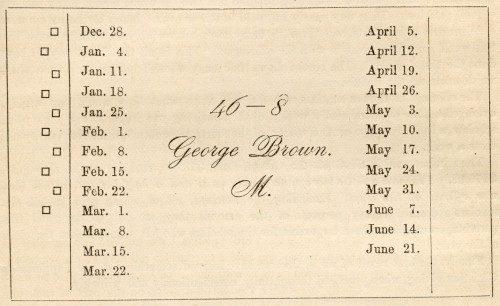
George Brown, for example, has made ten offerings, and has fifteen yet to make. His name is numbered “46” on page “8” of the record book, and he is to receive his envelope back in the Middle (“M”) school-room, where he studies.
The envelopes as they are emptied of their contents are separated into two piles, the first consisting of those which contain exactly the stipulated weekly offering, and the second of those which do not, as for example, when the donor wishes to make two or more offerings at once. Care is taken to mark on each envelope of the second pile, opposite the proper date, the amount which has been found in it. Each of these piles is now assorted, so as to bring together all the envelopes whose names occur on the same page of the record book, for convenience in entering the amounts. Much time is saved by having a second person read the name-numbers and amounts to the person who enters them, reading of course, the figures on the flaps of the first pile, and those opposite the given date on the second. The envelopes are then properly punched, and afterwards assorted according to the school-rooms, and given to the respective teachers to distribute to the scholars. To save loss, this distribution is deferred till the day before the offering.
The record book is long and narrow, so as to get as many names as possible on a page. The account of each donor requires but one line running across two opposite pages, which are ruled vertically for twenty-five entries. The amount given each week, even when more or less than the stipulated amount, is entered under the date of that week, thus bringing all the offerings of the same week in the same column.
The handling of the money is facilitated by using small cotton bags large enough to hold a hundred cents, or several dollars in nickels.
Its Results.—Envelopes were issued to two hundred and nine persons. Only ten of these preferred not to state how much they would give each week. Sixty-nine, or about one-third, offered to give one cent a week; forty-three, or about one-fifth, offered two cents; fifty-one, or about one-quarter, five cents. Only fifteen out of the two hundred and nine offered more than five cents a week. Among the scholars, the amounts ranged from one to ten cents; among the teachers, from five cents to one dollar.
Out of the one hundred and ninety-nine who offered definite amounts, sixty-three paid exactly what they had stated at the outset; thirty-four (all scholars) paid more—in some cases double and over; while one hundred and two (of whom a good many had left school) paid less. Thus very nearly half paid in full or over. Many of the others were deficient only a few cents, and these, in many cases, unavoidably so. Little notes like this would sometimes come in with the offerings: “This is all that I can pay; I have done the best I could.” The record shows that many who fell behind for a time afterwards made up the deficiency.
The offerings of the ten scholars who did not state what they would pay weekly, averaged a little over one cent a week; of the remaining one hundred and eighty-five scholars, a little over two cents a week; of the fourteen teachers, a little over twenty-one cents a week.
The scholars paid in all $102.02; the teachers, $73.00; making in the aggregate, $175.02. This was a little more than eighty-seven and a half percent. of all that was offered at the start. Excluding the teachers, all of whom paid in full, the scholars redeemed eighty percent. of the amount they set out to pay; and this percentage would have been larger but for the scholars who left school before the close of the year.
Finally, the best result of all is, that we have learned something of the happiness of Christian giving, when practised thoughtfully, conscientiously and willingly.
CHARLESTON, S. C.
Avery Normal Institute.
[Extracts from the Charleston News and Courier, July 4th, 5th and 9th.]
The Graduation Exercises of this institution were held at the school building in Bull street, yesterday, commencing at nine o’clock in the morning.
The programme included singing by the school, and addresses and essays, which reflected great credit upon the several pupils who delivered them.
A large number of prizes, including several handsome books, were distributed to the successful pupils in the several classes, and diplomas were presented to the graduates.
Many features of the programme were excellently rendered, and it is, perhaps, fair to award the palm to the salutatory and essay by Julia D. Edwards, and to the discourse on “Class History” by Elizabeth R. Tucker. These compositions were well conceived and gracefully delivered. The singing, too, deserves special praise, and there was one contralto voice in particular very noticeable for its strength and clearness.
The institution, which is devoted to the education of the colored youth of this city, has turned out ninety-seven graduates since 1872, all of whom do honor to their instructors.
Reunion Exercises.
The series of exercises which were arranged for three days, closed most auspiciously, yesterday, with a reunion of the graduates. The programme comprised vocal and instrumental music, original essays, recitation, declamation, oration and closing address. The main hall, where the exercises were held, was thronged with an audience highly appreciative, as was continuously evinced.
The exercises were opened by a piano solo, a galop, which was admirably played by Martha C. Gadsden, of the graduates of ’73. After an address of welcome by Mrs. M. S. Lowery, an oration on “True Greatness” was pronounced by John M. Morris, an alumnus of the institute.
It is but justice to make special mention of the essays: “Youth the Crisis of Character and Destiny,” by Merton B. Lawrence; “Avery Normal Institute our Home,” by Susan B. Artson; “Woman’s Position in Society,” by Susan A. Schmidt; “Necrology,” by Catharine A. Wallace; “What is Life Without an Aim,” by Ada C. Turner.
Avery can well afford to risk its reputation as an educational institution on such essays, all of which showed no ordinary degree of culture. The vocal gem of the exercises was the soprano solo, “Blooming Springtide,” rendered with rare sweetness and taste by Martha C. Gadsden.
Impressions made on a Visitor from a Neighboring State.
Although daily notices were made in the News and Courier of the closing exercises of Avery Institute, as they took place from day to day, the following account by a visitor from a neighboring State will not be without interest:
“Avery Institute has had four principals during its brief existence of thirteen years, and has been fortunate in their quality. Two of them, Mr. Warren and the present incumbent, Mr. Farnham, were fitted for their work by a course of moral training and considerable experience in schools of similar grade to this, and especially by their ardent love for their occupation.
“Absence of weeds from the flower-beds, tidiness of walks and yards, cleanliness of floors and desks, and signs of neatness everywhere suggested the possible theory of a ‘clearing-up time’ for the occasion, but a quiet search for information on this point revealed the fact that things were not ‘fixed up for Sunday,’ but wore their every-day attire. If a maximum of stillness, with a minimum of apparent effort, is the ultima thule of school discipline, there are no new lands for Avery Institute to discover.
“The plan of ‘native helpers’ is being tried here, the faculty consisting of a principal and two lady teachers from the North, and five graduates of the school. Full attendance, good scholarship and excellent discipline point to a successful experiment.
“July 2d at Avery was ‘Children’s Day.’ There is not room for the little ones at the closing exercises, and so Mr. Farnham gives them their day. The songs, ‘A Smiling Face for Me,’ ‘If I were a Sunbeam,’ ‘I love the Merry Sunshine, and the recitations ‘The Golden Side,’ ‘The Little Philosopher,’ and ‘The Summer Time,’ indicate the joyous nature of the programme and the spirit of the occasion. The teachers seem to appreciate the sentiment of Dickens, ‘I love these little people, and it is not a slight thing when they, so fresh from God, love us.’
“July 3d was ‘Graduates’ Day.’ The class of nine girls and one boy furnished music sufficient for the occasion, both in quantity and quality. Lessons with children, one on composition and one on number, conducted by two of the graduates, constituted a novel feature in the programme, and showed something of the methods of teaching employed in the institute. By permutations and combinations almost ad infinitum on the numeral frame, the children learned the ‘Table of Sevens,’ if they had never heard of it before; and the fact that ‘reproduction’ without credit to the author is plain stealing, was faithfully impressed upon the young mind. One of the graduating girls made a strong argument in the negative upon the question, ‘Should Young Men take a College Course?’ The simplicity and self-possession of the graduates were very pleasing. So also were their fine articulation and musical voices. A little more volume, however, would not have been offensive, and would have filled the hall better.
“Prizes were distributed by the Rev. Mr. Patton and the Rev. Mr. Dunton, and diplomas were presented by Prof. Chase, of Atlanta.
“The 4th was ‘Alumni Day,’ and, despite all the attractions at the Battery, the hall was well filled. The exercises consisted of addresses, essays, recitations and songs, all by members of the class. ‘Independence Day’ afforded some stimulus to the occasion, and called forth some of the sentiments and feelings of the emancipated race, but revealed no sign of bitterness or malice. The orderly conduct, dignified demeanor, literary merit and good elocution of the day, evinced that ‘Avery’s children’ are an honor to their foster parent, the American Missionary Association, and to their native State and city. Two or three hours spent in discussing ‘viands that tickle the palate’ and in social converse, reviving memories of past school-day life, terminated the three days of closing exercises at Avery Normal Institute.
“The teachers and pupils were gratified by the presence of some of the well-known and respectable residents of the city.”
GEORGIA.
Ogeechee—Changes for the Better—Saving Souls and Saving Money.
REV. JOHN R. MCLEAN, PASTOR.
We have a good Sunday-school. It is not so large as it might be; but the children, and all who attend, are getting thoughts of the Bible that they can get nowhere else around here. And it is making a great change with the old people, as well as with the children. The other schools hold the children by giving them cake and candy; I hold them by giving them Bible truth. I find that it has more power over them for good than all the cake and candy that can be given them. The children act better on the Sabbath than they did when I first came here. I can see a great change.
The church is doing, I think, quite well. It takes a steady, but slow, patient and faithful work, to lead a people out who are so far in the dark as these have been. I can see a manifest desire on the part of the members to do better than they have been doing, and even better than the members of other churches.
Last Sabbath was our Communion-day, and I never was in a more lovely meeting in my life. We had no one to join (for the first time, I think, since I have been here), though there were three or four who had been received some time before, but were not able to be out on that day so as to join. Some of the churches that only had preaching once in the month, have it now every Sabbath, since they see that we have it every Sabbath.
I know of no place in the South where the colored people get so much money for labor as they do here. But they don’t save any money at all; they get it, and it is gone, and they cannot see what they got for it. I am trying to induce our members to save their money, and buy for themselves homes; but it is hard to get them to do this, like almost everything else that is right and for their own good.
I know the Lord has blessed me greatly in my work, for which I am thankful. Pray for us at this place.
ALABAMA.
A Surprise Party—A Church well Organized—Burrell School.
MR. E. C. SILSBY, SELMA.
Brother Noble mentions a surprise party in Montgomery. I can refer to an occurrence somewhat similar here. Last fall, during the time that we were without a pastor, Brother Callen, of the church, filled the pulpit. His labors were faithfully performed, and our “Ladies’ Society” determined to give him a “pound donation party.” The “Teachers’ Home” was decided upon as the place, and the members of the church were quite eager to bestow upon him some slight testimonial, indicating their appreciation of his Christian character and faithfulness. It was a complete surprise to him, and the articles contributed were opportune, although “pounded” at him.
One of the most encouraging features of our church is the “Ladies’ Society,” which holds a prayer-meeting every Sabbath afternoon, and a sewing society every fortnight. At these prayer-meetings the girls and young ladies of the church are frequently put forward to lead, and thus are educated to Christian work. The older and younger ladies are also brought more nearly together, and made to realize more fully a common interest in the cause of Christ. An account of this meeting has been given in the Missionary, and, by this means, a very pleasant correspondence has grown up between the society here and one at Dedham, Mass. The ladies at Dedham sent their greetings and sympathy, and encouraged and helped us with their prayers. It has been a blessing to both societies. Hearing of the efforts of our ladies to purchase matting for the aisles of our church, they generously rendered assistance, and the matting has been laid.
One interesting and instructive feature of our work is that of the Committee on Missionary Intelligence. This committee was organized during the pastorate of Brother Pope. Its work is to present at times reports of missions in this and other lands. On the occasion of this presentation the attention is certain to be fixed, and the matter of the papers is discussed for sometime afterwards.
Four new members have been received on profession; two heads of families and two young people. One has been received by letter. One of those uniting on profession—a man—had long been the subject of prayer by a wife, mother, sister, son and other friends, but at last the stubborn heart has yielded, and he is free.
The “Ministerial Association,” formed last year, and consisting of the ministers from the various colored churches, has been holding its meetings this year. The association meets at the study or residence of each pastor, in turn. The time of the meeting is occupied in discussing doctrines, presenting plans of sermons, and deciding upon practical subjects to present to their various congregations.
The Sabbath-school still continues in interest, and is growing in strength. I well remember that, a few years ago, when the Northern teachers who were laboring in the Sabbath-school went home for their vacation, we with difficulty secured a few to take their places; but now, superintendent, organist and teachers could be secured from resident members of the school.
The church is now in charge of Brother A. J. Headen, a student from the Theological Department of Talladega College.
I will add that the interest in Burrell School is not diminishing. The school was never so far advanced in studies before, and for the coming year the prospect is good for having quite a number of advanced pupils. We seem to be keeping a hold upon our older pupils. I have a class of them in one study this summer. Some are becoming very proficient in vocal music, singing by note.
Anniversary of Trinity School—A Grateful People.
REV. HORACE J. TAYLOR, ATHENS.
The thirteenth anniversary of the commencement of Trinity School occurred on the 28th of last May. On the Sabbath previous the anniversary sermon was preached by the pastor. The scholars had prepared themselves for the exercises of Tuesday evening. At the appointed hour the church was full of a bright-faced throng of old and young. A class of little girls, dressed in white, stood on each side of the broad central aisle; and as Miss Wells (who begun the school May 28th, 1865) advanced, they spread flowers in her way. She was conducted to her seat, which was covered with flowers. The exercises consisted of speeches, compositions, and music. One old man—Uncle Dennis Collier—said he was very grateful to Miss Wells for what she had done for him. He was blind, and couldn’t learn to read, but his “wife was the grandmother of sixty-six children,” and he doubtless felt that he had through them received a full share of the benefits of the school. She had done him favors, he said, “and if you want to know what kind of favors, here’s one of ’em,” as he vigorously shook his coat. Then the offerings of flowers were brought forward, and it seemed as if Miss Wells would be buried in the mass of roses, lilies, magnolias, etc.
These anniversaries do the people good, and enable them to look back and compare their condition in May, 1865, with their present condition, and to learn more forcibly what it is that is lifting them up.
School closed on the 28th of June. The examinations were on the afternoons of the 25th, 26th, and 27th. The schoolrooms were crowded with people from the neighborhood; they were of every shade from black to white, but all “colored.” All the classes were examined, from the little “tots” to those in grammar, analysis, and algebra. The examinations showed patient drill on the part of the teachers, and generally work on that of the scholars.
Friday afternoon and evening—the 28th—occurred the exhibition. Compositions, declamations, orations and music instructed and amused the audience till well along to midnight. All were pleased and edified. The colored people remember that, before the war, they sometimes went to anniversaries and exhibitions of the white people, but now they can attend those of their own.
A Gospel Ship.
REV. PETER. J. MCINTOSH, PASTOR, ANNISTON.
The church building stood unoccupied about one year after the students of Talladega Theological Class, under the direction of Rev. H. E. Brown, had ceased to work upon it. Mr. Albert Brown and J. R. McLean, students at Talladega, labored to organize a church here, but the denominational prejudice was so great that they both were compelled to give up in despair.
I came to this place in April, 1875. My first sermon was preached to a benevolent society, which assembled in the church building. The society numbered about 100 members. You can imagine how earnestly I plead with my heavenly Father that He might give me a place in the hearts of these people. I preached from 1 Cor. xiii, 13, dwelling largely upon charity, interpreted love. I see before me to-day those faces which were indexes to so many prejudiced minds, as they commenced to show approval of my discourse. At the close of the services, I asked the people if they would meet me here in this house and take part in carrying on a series of meetings, two weeks from that time. They said they would.
On my arrival at the church at the appointed time for the meetings to begin, I found the church crowded to its utmost capacity. We held meetings for one week, which resulted in the conversion of six persons, and the willingness of three others to join with me in the formation of a church. Rev. H. E. Brown came up from Talladega, and, on the 23rd of May, 1875, assisted by the Methodist minister of the white church of this place, organized the First Congregational Church of Anniston. With these nine members (all heads of families) I took charge of the church, being elected by them as pastoral supply. I preached here once in every two weeks, and pursued my studies at Talladega.
During my absence, Brother A. J. Logan took charge of the church services, and conducted them as faithfully as any one could have done under the same circumstances. (He was one of the converts). With these means, we set sail on the ocean of God’s eternal power. We drifted on until we reached October, 1875, at which time we took on board nine more passengers for glory. We again set sail with the eighteen passengers on board. By October, 1876, finding that we numbered forty-two, we deemed it expedient to stop over, and thank God for bringing us so far on our journey towards the heavenly Jerusalem.
It would have inspired every reader of this article to have heard the words of thanksgiving and rejoicing, and to have seen the sympathizing tears, as they stole silently down the cheeks of those who had previously opposed the work here on account of its name and obscure history to the colored people. Permit me to say just here that many of the aristocratic whites of our village took part in the above-stated exercises.
We anchored here for some time, making repairs and casting overboard all who were diseased with intemperance and other maladies, which are so common to those who are not willing to resist the devil.
We rejoiced that the great Physician of souls had so wonderfully preserved all of our number except six. One had taken the ship of time, and sailed into eternity on the 26th of November, 1876—“Peace be to his ashes”; three took leave for other churches; thus leaving us thirty-two passengers for the next tour.
After repairing all things needful, we set sail again, with a full supply of love, truth and mercy. We landed in the midst of a glorious revival, in September, 1877. Here we took on board nineteen passengers more, and one on the 7th day of July, 1878.
A few days ago the church committee took account of stock, and found that we have on board the gospel ship fifty-two soldiers of the Cross, varying in age from thirteen to sixty, all of whom are ready for the next tour, upon which we expect to start out on the second Sabbath in September, 1878.
We have in our community some of the finest colored people in the State of Alabama, most of whom are absolute strangers to Christ. We most humbly solicit a petition in the prayers of each one who reads this article.
MISSISSIPPI.
Grenada.
[Extracts from, the Grenada Sentinel of June 29th.]
A representative of the Sentinel witnessed the closing exercises on Friday night, the 21st inst., of one of our colored schools, under the management of Miss Anna Harwood and Miss Carrie Segur, which was an exhibition most creditable to both teachers and pupils, receiving praises from all who attended. The audience was very large, among whom we noticed quite a number of prominent white citizens, both ladies and gentlemen. The call for order, accompanied with the request for good behavior, and that there should be no talking or stamping of feet, was, considering the immense throng which filled the church, well observed, and we doubt not that all went away pleased and highly gratified with the exhibition. The exercises were commenced with an opening chorus, entitled, “Hold the Fort,” which was followed with prayer, by Elder J. D. Williams. The declamations, dialogues, songs, etc., were all very fairly rendered, and, in several instances, worthy of special mention.
That the teachers deserve not only the congratulations of the patrons of the school, but the encouragement and kindest regards of every lover and promoter of education in our community, we think all who were present, at least, will agree. That the colored people are progressing, and that rapidly, too, in an educational point of view, is a fact beyond any doubt, we will venture to say, in the minds of those who have given the subject even a casual investigation. We are impressed with the idea that our people in general have not yet given to this system of free education that reflection to which it is so richly entitled. But we are also impressed with its growing favor, and the importance that will be attached to the institution at no distant day. It is not only our duty, but we should endeavor to make it our pleasure to encourage, improve and build up our free schools.
KENTUCKY.
Berea College Commencement.
In one respect, Commencement at Berea, Ky., is unlike all other colleges. It exhibits, in the centre of a Southern State, the complete solution of the vexed negro question. In the large tabernacle, on the 3d inst., was an audience of two thousand people, rich and poor, white and colored, ex-masters and ex-slaves, sitting where they could find seats, without distinction, and with the kindest feelings. On the large platform sat in the rear the more advanced students, about half white and half colored; in front of them a choir of twenty singers, selected, evidently, with no thought of complexion; at the right a brass band of various shades; in front of all a score of professional men, with their wives, among whom were several colored preachers; outside was a mixed crowd of five hundred or more.
To this crowd twenty orations and essays were delivered by sixteen young men and four young ladies, of whom fourteen were white and six colored; and the only manifest thought of color was seen in the fact that one side of the audience was of a darker shade than the other. There was not the least sign of disturbance, nor any indication of dissatisfaction with this order of things, though more than two thousand of the audience must have come from regions outside of Berea, which is a village of five hundred inhabitants. A prominent Southern lawyer remarked that he never witnessed so good order in so large a crowd.
This state of things has been brought about without constraint, in the most natural way imaginable. It was originally a white school, but thoroughly anti slavery. A few months after emancipation, a couple of colored youths were admitted. Half the white students left immediately. But the vacancy was soon filled with colored students; and eventually the white students returned, and the trouble was over. The whole question seems to turn on the learning of one simple lesson—that contiguity with a free man is no more disagreeable than contiguity with a slave. The colors are mixed in all Southern society. A little change in the mixture has here occurred, and that is all.
The college campus, in which are all the college buildings except the Ladies’ Hall, consists of forty-five acres covered with native forest trees. Under the shade of these trees, during the intermission, two or three hundred groups spread and consumed their basket-dinners. And, in the more retired parts, a thousand horses were sheltered from the burning sun.
The afternoon exercises consisted of a rousing address by Prof. Dunn of Hillsdale College, Mich., on the conflicts of civilization, and a statement from President Fairchild to the effect that the annual number of students is about 275—males, 145; females, 128. Thirty-one are in the college department, and over a hundred are qualified to teach a common-school. Probably sixty or more will teach during the long summer vacation.
It has often been predicted that this school would either become all white or all colored; but there seems to be no such tendency. The idea of color seems almost to have passed away. Intellectual culture and moral worth determine each man’s position in society. It will be many years before this state of society becomes general; but cheering progress in this direction is very manifest, and not so tardy as many suppose.—Kentucky, in the Congregationalist.
Frankfort.
MISS MATTIE E. ANDERSON, TEACHER.
The public examination of this school occurred June 13th, and was one of great pleasure and interest. Each teacher conducted the examinations of her own classes. Parents and friends were highly gratified with the very flattering manner in which the young ladies acquitted themselves. During the year the building has been enlarged, and many improvements have been made. The new room was opened about the first of March.
The closing exercises took place at Major Hall, June 19th, and consisted of vocal and instrumental music, essays, declamations, tableaux, dialogues and concert exercises.
Upon the stage were seated Rev. Mr. Evans, pastor of the A. M. E. Church; Rev. Mr. Parris, of the Independent Baptist Church. Prayer was offered by Rev. Mr. Evans. The children then sang “Away over Mountain,” after which Miss Virgin Gatewood came forward and read the Salutatory. The exercises were of more than usual interest, and held the audience spell-bound from eight P.M. until twelve M. The Valedictory was read by Miss Mittie Streets, after which “The Star-Spangled Banner” was sung by the children, during which they waved fifty flags in the most patriotic manner. Benediction was then said by Rev. Mr. Martin, pastor of the First Baptist Church. The hall was crowded with people, who seemed perfectly delighted with all they saw and heard. We have received numerous compliments from the citizens for giving such an interesting entertainment. Four of our pupils are now teaching in different localities.