Volume 6 — Bee-culture, Honey Products, Honey Markets, &c.
Reading edition
Mr. Editor:—I herewith send you two dollars as a further fee of incorporation in the bee family. I have profited well by it this year. I was absent on a tour in Europe last spring. On my return I found my bees in poor condition. Two colonies had died from dysentery or the warmth of the bee cellar; and of the remaining sixteen stocks, two were very weak, with some others in prime order. I had but two Italian stocks left. As far as my experience goes, I must give three cheers for the Italians. The earliest natural swarm I got here from blacks was on the 17th of June. This year my first Italian swarm came off on the 13th of May. The parent stock was a good one, though I cannot set it down as my best in number of bees. I had black colonies that were more populous. As for this Italian, it yielded me fourteen natural swarms, four of which left for the woods and the remaining ten are in extra condition for wintering. The parent hive and the first swarm are the heaviest stocks in my apiary. I shall Italianize all my colonies this fall. No man will ever persuade me that black bees are as good. I shall always consider such men as jealous or prejudiced. The advantages derived from Italian bees are well worth paying for—their early swarming and their rapid breeding are sufficient compensation. The color of the queen, too, is a great advantage when looking for her in the crowd on the comb, and her superior fertility is an unquestionable fact. The fourth swarm came off in May. It was small; but as it had a beautiful Italian queen, I put it in a box hive, and today it has nearly filled a twenty pound box. The season from the beginning of May to the middle of July was very good. My hives were so full of honey that no empty cells were to be seen. I have brought up the number of my colonies to forty-five, and four swarms left for the woods; and thus far I have sold seven hundred (700) pounds of honey.
According to the Report of the Commissioner of Agriculture, there are between 70,000 and 100,000 bee-keepers in this country. If so, the number who subscribe for the Bee Journal is comparatively small. Why is this so? According to my observation and experience there are two reasons. First, because the population of this republic is largely composed of emigrants from all nations, and although they and their immediate descendants may speak and understand English, yet they are not able to read or write it readily. Every one sticks more or less to his native language, and prefers reading newspapers printed in that language, because he understands it best. The second reason or cause is jealousy. It is a fact well known to every bee-keeper away from large cities, that the sale of honey is very slow in small cities and towns; and it is often impossible to sell at a remunerating price. Thus, for instance, Green Bay is a city of 8,000 inhabitants; yet one bee-keeper with 100 hives can fully supply the annual market of that city in a good year. It is of vastly more importance to write on this subject and induce an extension of the market demand for honey, than to teach fertilization by one or more drones. Bee keeping is now very profitable—more so than is acknowledged in print; but men have a disposition to keep the thing to themselves. It is very often the case that a bee-keeper instructs his neighbors in the art of managing bees successfully and profitably, and as soon as these are well posted in the business, they become a source of annoyance, contempt, and jealousy to their instructors. This makes it the more necessary to make more extensively known the best honey markets that are now to be found, and any additional outlets and uses for honey that may be opened or devised. In France enormous quantities of honey are used in the fabrication of honey bread, called pain d’epice. I wish our friend C. Dadant would give us a receipt how to make the best kind. This might become an American institution as well as a French one. The reputation of this delicacy is world-wide, as well as that of the French wines so much liked here. Vinegar also is said to be of superior quality, when made in a perfect way from honey. I should be glad to obtain some reliable information as to the best kind of it. Much honey is spoiled, as many other things are also, by using it when not properly prepared. Let us have the true results of experience. Another matter, not less important, is the preparation of good mead. A bottle of good mead is equal to the best wine; women in confinement use it in preference to wine, and with far more benefit. I think mead can be made as cheap as, or cheaper than whiskey. Good fermented mead ought to be sold in all wine stores for medicinal purposes and other uses. It is used in Belgium extensively as a summer drink.
BEE HOUSE.
I am going to build me a bee house of cedar logs, twenty feet by sixteen inside, stuffed with one foot of saw-dust; and I wish to know how I can give the greatest amount of ventilation in winter, without light. I want the largest amount of ventilation, combined with the largest amount of darkness; and desire to know where and how to place the ventilators, and of what material these should be made—whether of wood, iron, or lead? If possible, let us have a sketch or side view. Did I not fear that Novice was drowned in honey, I would ask him to have the kindness to furnish the information according to his experience. Perhaps we should send in contributions to the editor to offer a premium for a design for the best bee-wintering house, to contain a hundred hives as described above. Bee-wintering is one of the most important points in bee-culture now, and bee-keepers could well afford to contribute towards procuring the best plan of a house.
Now, dear editor, although a passenger in the sleeping car, I am for progress. Thirteen swarms from one—say one brought up to fourteen, is a true American fact. If I had set the fourteen in four hives, with ample space for boxes, it would have been a pity for my blacks to compare results. I drummed out my old hive and first swarm, and cut three pails of honey out of them. Then I returned the bees, and the gaps are again nearly closed. I wish now to say SOMETHING ON HIVES.
Last year I made me three Price hives according to Vol. IV., page 87. On inspecting my hives, after the bees had been put in, I found in the first one all its frames lodged on one side. To obviate this, I drove small tack-nails on top sidewards, to hold the frames at proper distance apart; but this does not do. In lifting out the frames I slightly damaged brood and honey. The second hive was in order, but the combs very uneven. The third had its combs straight every time, impossible to be otherwise down to the middle; but from the middle corners down to the lower corner they were fastened together and all gone astray. Further, the crushing of bees by the honey-board annoyed me much. They are so very heavy and troublesome to handle, that I have broken up the whole concern.
Now, I have constructed a hive on the Gallup pattern, say one foot square, and use twelve frames in it. This is what I like. My combs are as straight as a piece of board, and very easy to handle. I shall stick to it. But, dear editor, I fear I have infringed on some one’s patent, and I do not like others to do the thinking, and myself to reap the harvest—which is about as criminal as stealing another man’s brains. The question is: whom have I to pay? My frames are made thus:
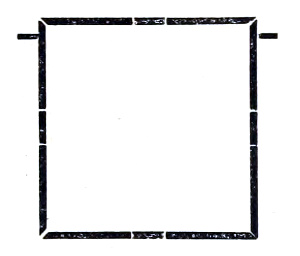
They hang on a rabbet, suspended by half an inch of iron wire, the thickness of an ordinary lead pencil. They are very easy to take out, and are never gummed fast. Now, do you not think I have infringed the Langstroth principle? If so, please inform me. My frames are three-quarters of an inch thick, and are very strong. I have had much trouble with frames as commonly made, when filled with honey. They are then too weak.
Finally, I have constructed A HONEY MACHINE according to Mr. Hubbard’s description. I had not the slightest trouble in making it. My can of zinc, eighteen inches in diameter and twenty inches high; cost three dollars. The iron wire cost one dollar, but I had more than enough. The whole cost was less than five dollars. I used the crank of a fanning-mill, to see what effect it would have, but found it too long. I was compelled to turn it with a peg half way down, which is just the thing. I can turn it as rapidly as wanted—so rapid, indeed, that the larvæ would be thrown out. I shall use no gearing. I found the machine all that could be desired, and only regret that I had it not in June. The queens might have produced some thousands of pets more, if empty cells had been provided for them. Now, something about> STRONG STOCKS.
Novice says if we are well-rooted anywhere it is in strong stocks. This, I find, is a very indefinite saying. I wish some one would give me a clear idea of what is meant by the expression strong stocks. Is it a large, prime swarm, or a first and a second swarm united, or any swarm well wintered and built up by spring feeding on Gallup’s system?
Ah, indeed, N. Woodworth, of Rochester, Wisconsin, on page 47, Vol. VI., has thrown a skunk in the face of the bee family. A skunk cannot stink more than that statement. Surely, he designs to see what effect it will have. Well, the best way is to let the skunk alone. The meanest bee-gum bee-keeper who manages to winter his bees so that they do not all die, has to acknowledge that bee-keeping pays; how much more can one accomplish who knows how to employ skilfully scientific means and methods?
Joseph Duffeler.
Rousseau, Wis., August 26.

[For the American Bee Journal.]