IV “ASSOCIATION” BOOKS AND FIRST EDITIONS
Reading edition
NO books have appreciated more in value than presentation or association volumes, and the reason is not far to seek. Of any given copy there can hardly be a duplicate. For the most part presentation copies are first editions—plus. Frequently there is a note or a comment which sheds biographical light on the author. In the slightest inscription there is the record of a friendship by means of which we get back of the book to the writer. And speaking of association books, every one will remember the story that General Wolfe, in an open boat on the St. Lawrence as he was being rowed down the stream to a point just below Quebec, recited the lines from Gray’s “Elegy,”—
“The boast of heraldry, the pomp of pow’r, And all that beauty, all that wealth, e’er gave Await alike the inevitable hour. The paths of glory lead but to the grave,”—
adding, “I would rather be the author of that piece than have the honor of beating the French to-morrow.” When Wolfe left England he carried with him a copy of the “Elegy,” the gift of his fiancée, Miss Katherine Lowther. He learned the poem by heart, he underscored his favorite lines, among them the passage quoted; he filled the book with his notes. After his death the book and a miniature of the lady were returned to her, and only a few days ago this book, a priceless volume of unique association interest, was offered for sale. The first man who saw it bought it. He had never bought a fine book before, but he could not resist this one. When I heard of the transaction I was grieved and delighted—grieved that so wonderful a volume had escaped me, delighted that I had not been subjected to so terrible a temptation. What was the price of it? Only the seller and the buyer know, but I fancy some gilt-edged securities had to be parted with.
How the prices of these books go a-soaring is shown by the continuous advance in the price of a copy of Shelley’s “Queen Mab.” It is a notable copy, referred to in Dowden’s “Life of Shelley.” On the fly leaf is an inscription in Shelley’s hand, “Mary Wollstonecraft Godwin, from P.B.S.”; inside of the back cover Shelley has written in pencil, “You see, Mary, I have not forgotten you”; and elsewhere in the book in Mary’s hand, we read, “This book is sacred to me, and as no other creature shall ever look into it, I may write in it what I please. Yet what shall I write? That I love the author beyond all powers of expression and that I am parted from him”; and much more to the same effect. At the Ives sale in 1891 this volume of supreme interest brought $190; in 1897, at the Frederickson sale, it brought $615; and a year ago a dealer sold it for $7500; and cheap at that, I say, for where will you find another?
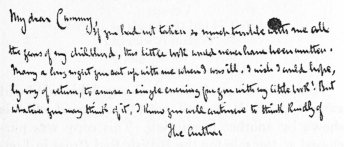
I have before me a copy of Stevenson’s “Inland Voyage.” Pamphlets aside, which, by reason of their manner of publication, are now rare, it may be said to be the author’s first book. It has an inscription, “My dear Cummy: If you had not taken so much trouble with me all the years of my childhood, this little book would never have been written. Many a long night you sat up with me when I was ill; I wish I could hope by way of return to amuse a single evening for you with my little book! But whatever you may think of it, I know you will continue to think kindly of the Author.” I thought, when I gave four hundred dollars for it, that I was paying a fabulous price; but as I have since been offered twice that sum, Rosenbach evidently let me have a bargain. He tells me that it is good business sometimes to sell a book for less than it is worth. He regards it as bait. He angles for you very skilfully, does Rosy, and lands you—me—every time.

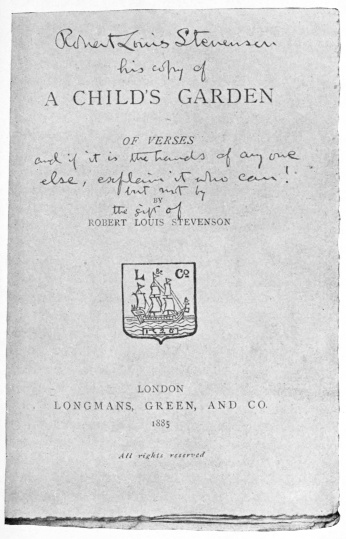
“A Child’s Garden of Verses” is another book which has doubled in value two or three times in the last few years. Gabriel Wells is now offering a copy, with a brief inscription, for three hundred dollars, having sold me not long ago, for twice this sum, a copy in which Stevenson’s writing is mingled with the type of the title-page so that it reads:—
Robert Louis Stevenson his copy of A Child’s Garden Of Verses and if it is [in] the hands of any one else, explain it who can! but not by the gift of Robert Louis Stevenson
That Stevenson afterward changed his mind and gave it to “E. F. Russell, with hearty good will,” is shown by another inscription. This copy was purchased at the sale for the British Red Cross in London, shortly after the outbreak of the war. It may be some time before it is worth what I paid for it, or the price may look cheap to-morrow—who shall say?
Watching the quotations of the first editions of Stevenson is rather like looking at the quotations of stocks you haven’t got, as they recover from a panic. A point or two a day is added to their prices; but Stevenson’s move five or ten points at a time, and there has been no reaction—as yet. Only a year or two ago I paid Drake fifty dollars for a copy of “The New Arabian Nights”; and a few days ago I saw in the papers that a copy had just been sold for fifty pounds in a London auction room.[8]
I cannot quite understand Stevenson’s immense vogue. Perhaps it is the rare personality of the man. Try as we may, it is impossible to separate the personality of a man from his work. Why is one author “collected” and another not? I do not know. Practically no one collects Scott, or George Eliot, or Trollope; but Trollope collectors there will be, and “The Macdermots of Ballycloran” and “The Kellys and the O’Kellys” will bring fabulous prices some of these days—five hundred dollars each; more, a thousand, I should say; and when you pay this sum, look well for the errors in pagination and see that Mortimer Street is spelt Morimer on the title-page of volume three of the former. And remember, too, that this book is so rare that there is no copy of it in the British Museum—at least so I am told; but you will find one on my shelves, in the corner over there, together with everything else this great Victorian has written—of all novelists my favorite. Trollope proved the correctness of Johnson’s remark, “A man may write at any time if he will set himself doggedly at it.” This we know Trollope did, we have his word for it. His personality was too sane, too matter of fact, to be attractive; but his books are delightful. One doesn’t read Trollope as Coleridge did Shakespeare—by flashes of lighting (this isn’t right, but it expresses the idea); but there is a good, steady glow emanating from the author himself, which, once you get accustomed to it, will enable you to see a whole group of mid-Victorian characters so perfectly that you come to know them as well as the members of your own family, and, I sometimes think, understand them better.
But for one collector who expresses a mild interest in Trollope, there are a thousand who regard the brave invalid, who, little more than twenty years ago, passed away on that lonely Samoan island in the Pacific, as one of the greatest of the moderns, as certain of immortality as Charles Lamb. They may be right. His little toy books and leaflets, those which
The author and the printer With various kinds of skill Concocted in the Winter At Davos on the Hill,
and elsewhere, are simply invaluable. The author and the printer were one and the same—R. L. S., assisted, or perhaps hindered, by S. L. O., Mrs. Stevenson’s son, then a lad. Of these Stevensons, “Penny Whistles” is the rarest. But two copies are known. One is in a private collection in England; the other was bought at the Borden sale in 1913 by Mrs. Widener, for twenty-five hundred dollars, in order to complete, as far as might be, the Stevenson collection now in the Widener Memorial Library. It was a privately printed forerunner of “A Child’s Garden of Verses,” published several years later.
It is a far cry from these bijoux to Stevenson’s regularly published volumes; but when it is remembered that these latter were printed in fairly large editions and relatively only a few years ago, it will be seen that no other author of yesterday fetches such high prices as Stevenson.
In recent years there have been published a number of bibliographies without which no collector can be expected to keep house. We are indebted to the Grolier Club for some of the best of these. Its members have the books and are most generous in exhibiting them, and it must indeed be a churlish scholar who cannot freely secure access to the collections of its members.
Aside from the three volumes entitled “Contributions to English Bibliography,” published and sold by the Club, the handbooks of the exhibitions held from time to time are much sought, for the wealth of information they contain. The Club’s librarian, Miss Ruth S. Granniss, working in coöperation with the members, is largely responsible for the skill and intelligence with which these little catalogues are compiled. The time and amount of painstaking research which enter into the making of them is simply enormous. Indeed, no one quite understands the many questions which arise to vex the bibliographer unless they have attempted to make for themselves even the simplest form of catalogue. Over the door of the room in which they work should be inscribed the text, “Be sure your sin will find you out.” Some blunders are redeemed by the laughter they arouse. Here is a famous one:—
Shelley—Prometheus—unbound, etc.
“—Prometheus—bound in olive morocco, etc.
But for the most part the lot of the bibliographer, as Dr. Johnson said of the dictionary-maker, is to be exposed to censure without hope of praise.
That Oscar Wilde continues to interest the collector is proved, if proof were necessary, by the splendid bibliography by Stuart Mason, in two large volumes. Its editor tells us that it was the work of ten years, which I can readily believe; and Robert Ross, Wilde’s literary executor, says in the introduction, that, in turning over the proof for ten minutes, he learned more about Wilde’s writings than Wilde himself ever knew. It gave me some pleasure, when I first took the book up, to see that Mason had used for his frontispiece the caricature of Wilde by Aubrey Beardsley, the original of which now hangs on the wall near my writing-table, together with a letter from Ross in which he says, “From a technical point of view this drawing is interesting as showing the artistic development of what afterwards was called his Japanese method in the ‘Salome’ drawings. Here it is only in embryo, but this is the earliest drawing I remember in which the use of dotted lines, a peculiarity of Beardsley, can be traced.”[9]
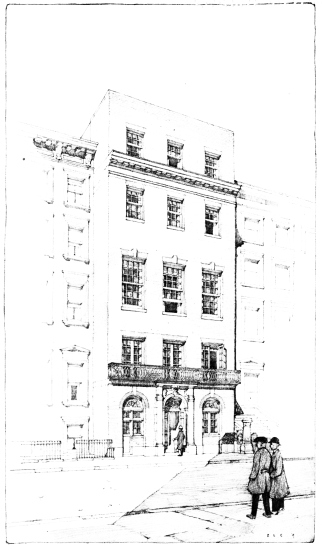
THE NEW BUILDING OF THE GROLIER CLUB 47 EAST SIXTIETH ST., NEW YORK
Another favorite bibliography is that of Dickens, by John C. Eckel. His “First Editions of Charles Dickens” is a book which no lover of Dickens—and who is not?—can do without. It is a book to be read, as well as a book of reference. In it Mr. Eckel does one thing, however, which is, from its very nature, hopeless and discouraging. He attempts to indicate the prices at which first editions of his favorite author can be secured at auction, or from the dealers in London and this country. Alas, alas! while waiting to secure prizes at Eckel’s prices I have seen them soaring to figures undreamed of a few years ago. In his chapter on “Presentation Copies,” he refers to a copy of “Bleak House” given by Dickens to Dudley Costello. “Some years ago,” he says, “it sold for $150.00. Eighteen months later the collector resold the book to the dealer for $380.00, who made a quick turn and sold the book for ten per cent advance, or $418.00.” These figures Mr. Eckel considers astonishing. I now own the book, but it came into my possession at a figure considerably in excess of that named.
A copy of “American Notes,” with an inscription, “Thomas Carlyle from Charles Dickens, Nineteenth October, 1842,” gives an excellent idea of the rise in the price of a book, interesting itself and on account of its inscription. At auction, in London, in 1902, it sold for £45. After passing through the hands of several dealers it was purchased by W. E. Allis, of Milwaukee; and at the sale of his books in New York, in 1912, it was bought by George D. Smith for $1050. Smith passed the book on to Edwin W. Coggeshall; but its history is not yet at an end, for at his sale, on April 25, 1916, it was bought by the firm of Dutton for $1850, and by them passed on, the story goes, to a discriminating collector in Detroit, a man who can call all the parts of an automobile by name. Fortunately, while this book was in full flight, I secured a copy with an inscription, “W. C. Macready from his friend Charles Dickens, Eighteenth October, 1842.” Now, what is my copy worth?
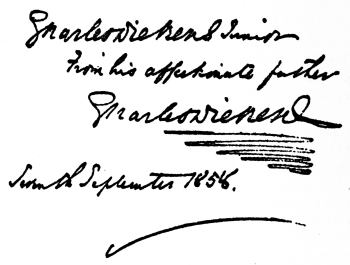
Seven years ago I paid Charles Sessler nine hundred dollars for three books: a presentation “Carol,” to Tom Beard, a “Cricket,” to Macready, and a “Haunted Man,” to Maclise. At the Coggeshall sale a dealer paid a thousand dollars for a “Carol,” while I gave Smith ten per cent advance on a thousand dollars for a “Chimes,” with an inscription, “Charles Dickens, Junior, from his affectionate father, Charles Dickens.” This copy at the Allis sale had brought seven hundred and seventy-five dollars, at which time I was prepared to pay five hundred dollars for it.
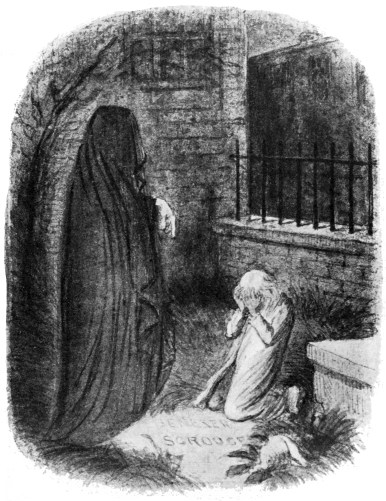
AN ILLUSTRATION, “THE LAST OF THE SPIRITS,” BY JOHN LEECH, FOR DICKENS’S “CHRISTMAS CAROL” From the original water-color drawing
I always return from these all-star performances depressed in spirit and shattered in pocket. “Where will it stop?” I say to myself. “When will you stop?” my wife says to me. And both questions remain unanswered; certainly not, while presentation Dickenses can be had and are lacking from my collection. I now possess twenty-one, and it is with presentation Dickenses as with elephants—a good many go to the dozen; but I lack and sadly want—Shall I give a list? No, the prices are going up fast enough without stimulation from me. Wait until my “wants” are complete; then let joy be unconfined.
A final word on Dickens: the prices are skyrocketing because everyone loves him. Age cannot wither nor custom stale his infinite variety. As a great creative genius he ranks with Shakespeare. He has given pleasure to millions; he has been translated into all the languages of Europe. “Pickwick,” it is said, stands fourth in circulation among English printed books, being exceeded only by the Bible, Shakespeare, and the English Prayer-Book; and the marvel is that when Dickens is spoken of, it is difficult to arrive at an agreement as to which is his greatest book.
But this paper is supposed to relate to prices rather than to books themselves. Other seductive arguments having failed, one sometimes hears a vendor of rare books add, in his most convincing manner, “And you couldn’t possibly make a better investment.” The idea, I suppose, is calculated to enable a man to meet his wife’s reproachful glance, or something worse, as he returns home with a book under his arm. But when one is about to commit some piece of extravagance, such as buying a book of which one already has several copies, one will grasp at any straw, the more so as there may be some truth in the statement.
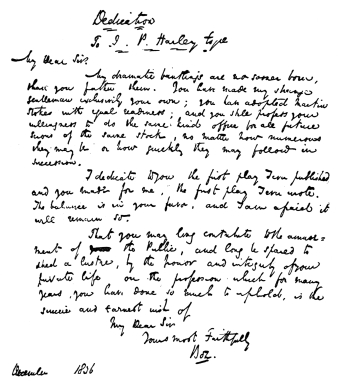
DEDICATION TO “THE VILLAGE COQUETTES,” BY CHARLES DICKENS From the manuscript formerly in the Coggeshall collection, much reduced in size
There are, however, so many good reasons why we should buy rare books, that it seems a pity ever to refer to the least of them. I am not sure that I am called on to give any judgment in the matter; but my belief is that the one best and sufficient reason for a man to buy a book is because he thinks he will be happier with it than without it. I always question myself on this point, and another which presses it closely—can I pay for it? I confess that I do not always listen so attentively for the answer to this second question; but I try so to live as to be able to look my bookseller in the eye and tell him where to go. I govern myself by few rules, but this is one of them—never to allow a book to enter my library as a creditor.
“Un livre est un ami qui ne change jamais”; I want to enjoy my friends whenever I am with them. One would get very tired of a friend if, every time one met him, he should suggest a touch for fifty or five hundred dollars. On the shelves in my office are some books that are mine, some in which there is at the moment a joint ownership, and some which will be mine in the near future, I hope—and doubtless in this hope I am not alone; but the books on the shelves around the room in which I write are mine, all of them.
The advice given by “Punch” to those about to marry—“Don’t”—seems, then, to be the best advice to a man who is tempted to buy by the hope of making a profit out of his books; but I observe that this short and ugly word deters very few from following their inclinations in the matter of marriage, and this advice may fall, as advice usually falls, on deaf ears. Only when a man is safely ensconced in six feet of earth, with several tons of enlauding granite upon his chest, is he in a position to give advice with any certainty, and then he is silent; but it will nevertheless be understood that I do not recommend the purchase of rare books as an investment, and this in spite of the fact that many collectors have made handsome profits out of the books they have sold. While a man may do much worse with his money than buy rare books, he cannot be certain that he can dispose of them at a profit, nor is it necessary that he should do so. He should be satisfied to eat his cake and have it; books selected with any judgment will almost certainly afford this satisfaction, and of what other hobby can this be said with the same assurance?
The possession of rare books is a delight best understood by the owners of them. They are not called upon to explain. The gentle will understand, and the savage may be disregarded. It is the scholar whose sword is usually brandished against collectors; and I would not have him think that, in addition to our being ignorant of our books, we are speculators in them also. Let him remember that we have our uses.
Unlearned men of books assume the care, As eunuchs are the guardians of the fair.
It may as well be admitted that we do not buy expensive books to read. We may say that it is a delight to us to look upon the very page on which appeared for the first time such a sonnet as “On First Looking into Chapman’s Homer,” or to read that bit of realism unsurpassed, where Robinson Crusoe one day, about noon, discovered the print of a man’s naked foot upon the sand; but when we sit down with a copy of Keats, we do not ask for a first edition; much less when we want to live over again the joys of our childhood, do we pick up a copy of Defoe which would be a find at a thousand dollars. But first editions of Keats’s Poems, 1817, in boards, with the paper label if possible, and a Defoe unwashed, in a sound old calf binding, are good things to have. They are indeed a joy forever, and will never pass into nothingness. I cannot see why the possession of fine books is more reprehensible than the possession of valuable property of any other sort.
In speaking of books as an investment, one implies first editions. First editions are scarce; tenth editions, as Charles Lamb stutteringly suggested, are scarcer, but there is no demand for them. Why, then, first editions? The question is usually dodged; the truth may as well be stated. There is a joy in mere ownership. It may be silly, or it may be selfish; but it is a joy, akin to that of possessing land, which seems to need no defense. We do not walk over our property every day; we frequently do not see it; but when the fancy takes us, we love to forget our cares and responsibilities in a ramble over our fields. In like manner, and for the same reason, we browse with delight in a corner of our library in which we have placed our most precious books. We should buy our books as we buy our clothes, not only to cover our nakedness, but to embellish us; and we should buy more books and fewer clothes.
I am told that, in proportion to our numbers and our wealth, less money is spent on books now than was spent fifty years ago. I suppose our growing love of sport is to some extent responsible. Golf has taken the place of books. I know that it takes time and costs money. I do not play the game myself, but I have a son who does. Perhaps when I am his age, I shall feel that I can afford it. My sport is book-hunting. I look upon it as a game, a game requiring skill, some money, and luck. The pleasure that comes from seeing some book in a catalogue priced at two or three times what I may have paid for a copy, is a pleasure due to vindicated judgment. I do not wish to rush into the market and sell and secure my profit. What is profit if I lose my book? Moreover, if one thinks of profit rather than of books, there is an interest charge to be considered. A book for which I paid a thousand dollars a few years ago, no longer stands me at a thousand dollars, but at a considerably greater sum. A man neat at figures could tell with mathematical accuracy just the actual cost of that book down to any given minute. I neither know nor want to know.
There is another class of collector with whom I am not in keen sympathy, and that is the men who specialize in the first published volumes of some given group of authors. These works are usually of relatively little merit, but they are scarce and expensive: scarce, because published in small editions and at first neglected; expensive, because they are desired to complete sets of first editions. Anthony Trollope’s first two novels have a greater money value than all the rest of his books put together—but they are hard to read. In like manner, a sensational novel, “Desperate Remedies,” by Hardy, his first venture in fiction, is worth perhaps as much as fifty copies of his “Woodlanders,” one of the best novels of the last half century. George Gissing, when he was walking our streets penniless and in rags, could never have supposed that a few years later his first novel, “Workers in the Dawn,” would sell for one hundred and fifty dollars, but it has done so. I have a friend who has just paid this price.
Just here I would like to remark that for several years I have been seeking, without success, a copy of the first edition of that very remarkable book, Samuel Butler’s “The Way of All Flesh.” Booksellers who jauntily advertise, “Any book got,” will please make a note of this one.
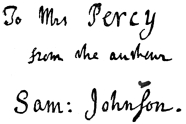
Nor do I think it necessary to have every scrap, every waif and stray, of any author, however much I may esteem him. My collection of Johnson is fairly complete, but I have no copy of Father Lobo’s “Abyssinia.” It was an early piece of hack-work, a translation from the French, for which Johnson received five pounds. It is not scarce; one would hardly want to read it. It was the recollection of this book, doubtless, that suggested the “Prince of Abissinia” to Johnson years later, when he wanted to write “fiction,” as the dear old ladies in “Cranford” called “Rasselas”; but it has never seemed necessary to my happiness to have a copy of “Lobo.” On the other hand I have “stocked” “Rasselas” pretty considerably, and could supply any reasonable demand. Such are the vagaries of collectors.
IN A COPY OF “RASSELAS”
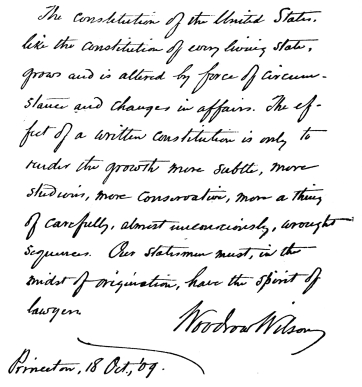
Only once, I think, have I been guilty of buying a book I did not particularly want, because of its speculative value—that was when I stumbled across a copy of Woodrow Wilson’s “Constitutional Government in the United States” with a long inscription in its author’s cursive hand. Even in this case I think it was my imagination rather than avarice that led me to pay a fancy price for a book which some day when I am not “among those present” will fetch as many thousands as I paid hundreds. In 1909, when the inscription was written, its author was a relatively unimportant man—to-day he is known throughout the world and is in a position to influence its destinies as no other man has ever been.
No paper dealing with the prices of books would be complete without the remark that condition is everything. Any rare book is immensely more valuable if in very fine condition. Imagine for a moment a book worth, say, six hundred dollars in good condition,—for example, the “Vicar of Wakefield,”—and then imagine—if you can—a copy of this same book in boards uncut. Would twenty-five hundred dollars be too high a price for such a copy? I think not.
Another point to be remembered is that the price of a book depends, not only on its scarcity, but also on the universality of the demand for it. And once again I may take the “Vicar” as an example of what I mean. The “Vicar” is not a scarce book. For from six to eight hundred dollars, dependent upon condition, one could, I think, lay his hands on as many as ten copies in as many weeks. It is what the trade call a bread-and-butter book—a staple. There is always a demand for it and always a supply at a price; but try to get a copy of Fanny Burney’s “Evelina,” and you may have to wait a year or more for it. It was the first book of an unknown young lady; the first edition was very small, it was printed on poor paper, proved to be immensely popular, and was immediately worn out in the reading; but there is no persistent demand for it as there is for the “Vicar,” and it costs only half as much.
In reading over whatever I have written on the subject of the prices of rare books, I am aware that my remarks may sound to some like a whistle—a whistle to keep up my courage at the thought of the prices I am paying. But so long as the “knockout” does not get a foothold in this country,—and it would immediately be the subject of investigation if it did, and be stopped, as other abuses have been,—the prices of really great books will always average higher and higher. “Of the making of many books there is no end,” nor is there an end to the prices men will be willing to pay for them.