Volume 5 — A MANDARIN.
Reading edition
From the French of Auguste Vitu.
It was Saturday night, and the pavement sparkled with frost diamonds under flashing lights and echoing steps in the opera quarter. Tinkling carnival bells and wild singing resounded from all the carriages dashing towards Rue Lepelletier; the shops were only half shut, and Paris, wide awake, reveled in a fairy-night frolic.
And yet, Felix d'Aubremel, one of the bright applauded heroes of those orgies, seemed in no mood to answer their mad challenge. Plunged in a deep armchair, hands drooping and feet on the fender, he was sunk in sombre revery. An open book lay near him, and a letter was flung, furiously crumpled, on the floor.
An orphan at the age of twelve, Felix had watched his mother's slow death through ten years of suffering. The Marquis Gratien d'Aubremel, ruined by reckless dissipation, and driven by necessity, rather than love, into a marriage with an English heiress, Margaret Malden, deserted her, like the wretch he was, as soon as the last of her dowry melted away. A common story enough, and ending in as common a close. D'Aubremel sailed for the Indies to retrieve his fortune, and met death there by yellow fever. So that the sad lessons of Felix's family life stimulated to excess his innate leaning towards misanthropy—if that name may define a resistless urgency of belief in the appearances of evil, linked with a doubt of the reality of good. Probably, at heart, he believed himself incapable of a bad action, but he would take no oath to such a conviction, since by his theory every man must yield under certain circumstances, attacking powerfully his personal interest, while threatening slight danger of failure or detection. This style of thought, set off by a fair share of witty expression and ever-ready impertinence, gave Felix a kind of ascendancy in his circle of intimates—but naturally it gained him no friends. Common reputation grows out of words rather than actions, and Felix suffered the just penalty of his sceptical fancies. They cost him more than they were worth, as he had just learned by sad experience.
He had chanced to make the acquaintance of a rich manufacturer, Montmorot by name, whose daughter Ernestine was pleased with the devotion of a charming young fellow, who mingled the rather reckless grace of French cleverness with a reserved style and refined pride gained from the English blood of the Maldens. For his part, Felix really loved the girl, and had let his impatience, that very day, carry him into a step that failed to move the elder Montmorot's inflexibility. He refused absolutely to give his daughter to a man without fortune or prospects. Felix was crushed, his hopes all shattered at a blow, by this answer, though he had a thousand reasons to expect it. And at what a moment! A half-unfolded red ticket, stuffed with disgusting threats, peeped out from between the wall and his sofa. The officers of justice had paid him a little visit. He got into a passion with himself.
"Pshaw," he cried, "confound all scruples! If I had been less in love I should be Ernestine's husband now. With a pretty wife, one I am so fond of, too, I should have fortune, position, and the luxury indispensable to my life—now, I don't know where to lay my head to-morrow. To-morrow, at ten o'clock, the sheriff will seize everything—everything, from that Troyou sketch to that china monster, nodding his frightful sneering head at me. They will carry off this casket that was my father's—this locket, with the hair of—of—what the deuce was her name? Poor girl! how she loved me! And now all that is left of her vanishes—even her name!
"What, nothing? no hope? Not even one of those silly impulses that used to drive me out into the streets when everybody else was abed, with the firm conviction that at some crossing, in some gutter, some unknown deity must have dropped a fat pocket-book, on purpose for me! I believed in something, then—even in lost pocket-books. And now, now! I would commit no such follies as that, but I believe I could be guilty of even worse things, if crime, common, low, contemptible, shameful crime, were not forbidden to the son of the Marquis d'Aubremel and Margaret Malden.
"Oh, great genius!" he went on, taking up the open book near him, "great philosopher, called a sophist by the ignorant—how deep a truth you uttered in writing these lines, that I never read over without a shudder: 'Imagine a Chinese mandarin, living in a fabulous country three thousand leagues away, whom you have never seen and shall never see—imagine, moreover, that the death of this mandarin, this man, almost a myth, would make you a millionaire, and that you have but to lift your finger, at home, in France, to bring about his death, without the possibility of ever being called to account for it by any one; say, what would you do?'
"That fearful passage must have made many men dream—and does not Bianchon, that great materialist, so well painted by Balzac, confess that he has got as far as his thirty-third mandarin? What a St. Bartholomew of mandarins, if my philosopher's supposition could grow into a truth!"
Felix ceased his soliloquy, and bent his head to let the storm raised in his soul by the atheist philosopher pass over. His bad instincts, aroused, spoke louder at that instant than reason, louder than reality. His glance fell on the chimney-piece, where a porcelain figure, the grotesque chef d'oeuvre of some great Chinese artist, leered at him with its everlasting grin. The young man smiled. "Perhaps that is the likeness of a mandarin—bulbous nose, hanging cheeks, moustaches drooping like plumes, a peaked head, knotty hands—a regular deformity. Reflecting on the ugliness of that idiotic race, there is much to be urged by way of excuse for people who kill mandarins."
Some persistent thought evidently haunted Felix's mind. Again he drove it off, and again it beset him.
"Pshaw!" he exclaimed, after a last brief struggle, "I am alone, and out of sorts. I will amuse myself with a carnival freak, a mere theoretic and philosophic piece of nonsense. I have tried many worse ones. It wants a quarter to twelve. I give myself fifteen minutes to study my spells. Let me see, what mandarin shall I murder? I don't know any, and I have no peerage list of the Flowery Empire. Let me try the newspapers."
It was in the height of the English war with China. On the seventh column of the paper our hero found a proclamation signed by the imperial commissioners, Lin, Lou, Lun, and Li.
"Here goes for Li," he said to himself. "He is likely to be the youngest."
The clock began to strike, announcing the hour. Felix placed himself solemnly before the mirror, and said aloud, in a grave tone: "If the death of Mandarin Li will make me rich and powerful, whatever may come of it, I vote for the death of Mandarin Li." He lifted his finger—at that instant the porcelain figure rocked on its base, and fell in fragments at Felix's feet. The glass reflected his startled face. He thrilled for an instant with superstitious terror, but recollecting that his finger had touched the fragile figure, he accounted for it as an accident, and went to bed and to such repose as a debtor can enjoy with an execution hanging over his head.
Masks and dominos made the street merry under his window. The opera ball was unusually brilliant, experts said, and nothing made the Parisians aware that on the night of January 12th, 1840, Felix d'Aubremel had passed sentence of death on Chinaman Li, son of Mung, son of Tseu, a literate mandarin of the 114th class.
Nine months later Felix d'Aubremel was living in furnished lodgings in an alley off the Rue St. Pierre, and living by borrowing. The gentlemanly sceptic owed his landlady a good deal of money; his clothes were aged past wearing, and his tailor had long ago broken off all relations with him. The Marquis d'Aubremel was within a hairsbreadth of that utterly crushed state that ends in madness, or in suicide—which is only a variety of madness.
One morning while sitting in the glass cage that leads to the staircase of every lodging-house, waiting to beg another respite from his landlady, he took up a newspaper, and the following notice was lucky enough to catch his attention.
"Chiusang, 12th January, 1840. Hostilities have broken out between England and the Celestial Empire. The sudden and inexplicable death of Mandarin Li, the only member of the council who opposed the violent and warlike projects of Lin, led to unfortunate events. At the first attack the Chinese fled, with the basest want of pluck, but in their retreat they murdered several English merchants, and among them an old resident, Richard Maiden, who leaves an estate of half a million sterling. The heirs of the deceased are requested to communicate with William Harrison, Solicitor, Lincoln's Inn."
"My uncle!" cried Felix. "Alas, I have killed my uncle and Mandarin Li."
He had not a penny to pay for his traveling expenses to London; but, on producing his certificate of birth and the newspaper article, his landlady easily negotiated for him with an honest broker, who advanced him a thousand francs to arrange his affairs, without interest, upon his note for a trifle of eighteen hundred, payable in six weeks.
Eight days after reaching London, Felix, established in a fashionable hotel, was awaiting with nervous eagerness the first instalment of a million, the proceeds of a cargo of teas, sold under the direction of Mr. Harrison. He was too restless for thought, burning with impatience to take possession of his property, to handle his wealth, and, as it were, to verify his dream. Yet the fact was indisputable. Richard Malden's death, and his own relationship to the intestate had been legally proved and established. Felix d'Aubremel regularly and assuredly inherited a fortune, and he had no doubts nor scruples on that point.
A servant interrupted his reflections, announcing his solicitor's clerk. "Why does not Mr. Harrison come himself?" he was on the point of asking, but amazement at the clerk's appearance took away his breath. He was a shriveled little object, slight, bony, crooked and hideous, with a monstrous head and round eyes, a bald skull, a flat nose, a mouth from ear to ear, and a little jutting paunch that looked like a sack.
"I bring the Marquis d'Aubremel the monies he is expecting," said the man, and his voice, shrill and silvery, like a musical box or the bell of a clock, impressed Felix painfully. The voice grated on the nerves. "I have drawn a receipt in regular form," said Felix, extending his hand. But the solicitor's clerk leaned his back against the door, without stirring a step. "Well, sir," Felix exclaimed with a convulsive effort. The man approached slowly, scarcely moving his feet, as if sliding across the floor. His right hand was buried in his coat pocket; he held his head bent down, and his lips moved inaudibly. At last he pulled from his pocket a large bundle of banknotes, bills and papers, drew near the window, and began to count them carefully.
Felix was then struck by a strange phenomenon that might well inspire undefined terror. Standing directly in front of the window, the clerk's figure cast no shadow, though the sun's rays fell full upon it, and through his human body, translucent as rock crystal, Felix plainly saw the houses across the street. Then his eyes seemed to be suddenly unsealed. The clerk's black coat took colors, blue, green, and scarlet; it lengthened out into the folds of a robe, and blazed with the dazzling image of the fire-dragon, the son of Buddha; a lock of stiff grayish hair sprouted like a short tuft out of his yellowish skull; his round tawny eyes rolled with frightful rapidity in their sockets.
Felix recognized Li, son of Mung, son of Tseu, the literate mandarin of the 114th class. The murderer had never seen his victim, but could not doubt his identity a moment, thanks to the marvelous resemblance between the solicitor's clerk and the china monster that dropped into bits at his feet the night of January 12th, 1840.
Meantime the man had done counting his package, and held it out to Felix, saying, in his grating, vibrating tones, "Monsieur le Marquis, here are forty thousand pounds sterling; please to give me your receipt." And Felix heard the voice say in a shriller under-key, "Felix, here is an instalment of the million, the price of your crime. Felix, my assassin, take this money from my hand."
"From my hand," echoed a thousand fine voices, quivering all through the air of the room.
"No, no," cried Felix, pushing the clerk away, "the money would burn me! Begone with you!"
He dropped exhausted into a chair, half suffocated, with drops of sweat rolling down his convulsed face. The man bowed to the floor, and slowly moved away backwards. With every gradual step Felix saw his natural shape return. The rays of the autumn sun ceased to light up that mysterious apparition, and only his attorney's humble clerk stood before Felix. With a rush overpowering his will, Felix dashed after the old man, already across the threshold, and overtook him on the staircase.
"My papers!" he shouted imperiously. "Here they are, sir," said the old fellow quietly.
Felix regained his room, bolted the door, and counted the immense sum contained in the pocket-book with excitement bordering on frenzy. Then he bathed his burning head with cold water, and threw an anxious look around the room.
"I must have had an attack of fever," he muttered.
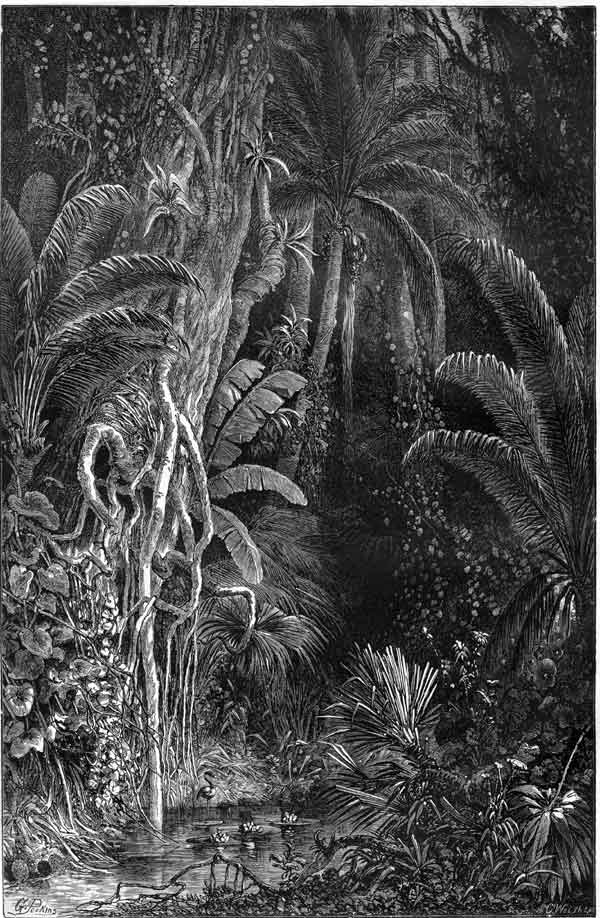
A TROPIC FOREST.—GRANVILLE PERKINS
"Mandarins don't rise from the dead, and a man can't kill another by simply lifting his finger. So my philosopher talked like one who knows nothing of moral experience. If the fancy of an unreal crime almost drove me mad, what must be the remorse of an actual criminal?"
The same evening Felix ordered post horses and set out for France.
Some months later, Monsieur Montmorot, chevalier of the legion of honor, gave a grand dinner to celebrate his daughter's betrothal with the Marquis Felix d'Aubremel, one of the noblest names in France, as he styled it. The contract settling a part of his fortune on his daughter Ernestine was signed at nine in the evening. The Monday following the pair presented themselves before the civil officials to solemnize their marriage by due legal ceremonies.
Felix, a prey to the strange hallucination that incessantly pursued him, saw a likeness between the official and the Chinese figure he had awkwardly thrown down and broken one night long ago. Presently his face darkened, and his eyes began to burn. Behind the magistrate's blue spectacles he caught the gleam and roll of the tawny eyes belonging to Mr. Harrison's clerk, to Li, son of Mung, son of Tseu.
When at length the magistrate put the formal question, "Felix Etienne d'Aubremel, do you take for your wife Ernestine Juliette Montmorot," Felix heard a shrill ringing voice say, "Felix, I give you your wife with my hand—my hand."
The official repeated the question more loudly. "With my hand—my hand," whispered a thousand mocking little voices.
"No!" Felix shouted rather than answered, and rushed away from the spot like a lunatic.
Once more at home, he shut out everyone and flung himself on his bed, in a state of stupor that weighed him down till night—a sort of dull torpor of brain, with utter exhaustion of physical strength—a misery of formless thought. Towards evening one persistent idea aroused him from this strange lethargy.
"I am a cowardly murderer," he groaned. "I wished for my fellow-being's death. God punishes me—I will execute his sentence." He stretched out his hand in the dark, groping for a dagger that hung from the wall. Then a mild brightness filtered through the curtains and irradiated the bed. Felix distinctly saw the grotesque figure of Mandarin Li standing a few steps away. The shadow of death darkened his face, and without seeming movement of his lips, Felix heard these words, uttered by that shrill ringing voice so hated, now mellowed into divine music.
"Felix d'Aubremel, God does not will that you should die, and I, his servant, am sent to tell you his decree. You have been cruel and covetous—you have wished an innocent man's death, and his death caused that of a multitude of victims to the barbarous passions of a great western nation. Man's life must be sacred for every man. God only can take what he gave. Live, then, if you would not add a great crime to a great error. And if forgiveness from one dead can restore in part your strength and courage to endure, Felix, I forgive you."
The vision vanished.
Felix religiously obeyed the instructions of Li, and consecrated his life by a vow to the relief of human misery wherever he found it. He devoted Richard Malden's vast fortune to founding charitable establishments. Ernestine Montmorot would never consent to see him again.
Two years ago, yielding to an impulse easy to understand, he requested the English consul at Chiusang to make inquiries as to the family of Li, who might perhaps be suffering in poverty. Nothing more could be discovered than that the gracious sovereign of the Middle Kingdom had confiscated the property of Li's family, that his wife had died of sorrow, in misery, and that his son, Li, having taken the liberty to complain of the glorious emperor's severity, suffered death by the bowstring, as is proper and reasonable in all well-governed states.
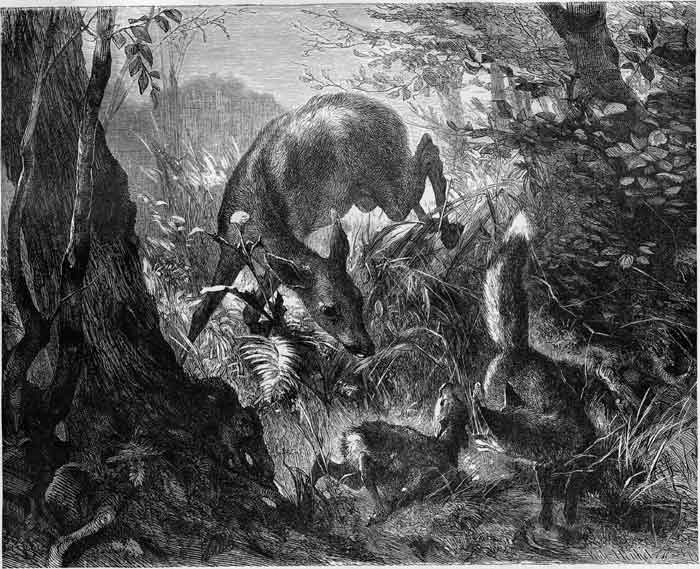
MOTHER IS HERE!—DEIKER.
MOTHER IS HERE!—A little fawn in the clutches of a fox bleats loudly for help. The mother appears quickly on the scene, and Renard retires, foiled and chagrined at the loss of his dinner. He stays not upon the order of his going, but goes at once. The artist Deiker is a well-known German painter, whose success with these pictures of animal life ranks him with such men as Beckmann and Hammer, whose names are familiar to the friends of THE ALDINE.
A TROPIC FOREST.
Trees lifted to the skies their stately heads, Tufted with verdure, like depending plumage, O'er stems unknotted, waving to the wind: Of these in graceful form, and simple beauty, The fruitful cocoa and the fragrant palm Excelled the wilding daughters of the wood, That stretched unwieldly their enormous arms, Clad with luxuriant foliage, from the trunk, Like the old eagle feathered to the heel; While every fibre, from the lowest root To the last leaf upon the topmost twig, Was held by common sympathy, diffusing Through all the complex frame unconscious life.
—Montgomery's Pelican Island.
What makes us like new acquaintances is not so much any weariness of our old ones, or the pleasure of change, as disgust at not being sufficiently admired by those who know us too well, and the hope of being more so by those who do not know so much of us.—La Rochefoucauld.