DIRECTIONS TO TEACHERS
Reading edition
Oral Spelling
Oral spelling should always precede written spelling in the primary grades. Careful and distinct pronunciation by the child should always precede oral spelling. Children cannot be expected to spell correctly words that they cannot pronounce. It is well to emphasize the form of a word of more than one syllable by syllabication. It makes the spelling more obvious, promotes clear enunciation, and assists in creating a correct mental picture of the word. The sight words in this book are so syllabicated when first presented. A slight pause between the syllables is usually sufficient in oral spelling. In writing the words they should not be divided.
Testing
The mere “hearing” of spelling lessons is happily a thing of the past in most schools. However, teachers cannot be too strongly impressed with the worthlessness of such exercises. The primary object is to instruct, not to examine—to teach to spell correctly, not to find out how many words may be spelled incorrectly. Review lessons should be given frequently, and these are sufficient for test purposes. All other lessons should be thoroughly taught with instruction the aim and object of the lesson.
Interest
It has been well said that “interest is nine-tenths of education.” This is true in teaching spelling. Any means which will arouse interest in mastering words is likely to be effective. So far as our forefathers succeeded in securing results in this subject they did so by interest in the old-fashioned “spelling-bee.” Spelling matches of various sorts are desirable for creating interest. The review lists and special lists will be found admirable for this purpose. It should be remembered, however, that this is testing what is already learned and is not teaching something new.
Pupils’ Lists
Each pupil has his own difficulties in spelling. Teach him to make private lists of the words which he finds especially hard to spell and have him use extra effort to conquer these trouble-makers. These may be listed in the back of his textbook or in his individual note book. Occasional lessons may be devoted entirely to this kind of exercise and they should be individual and painstaking. Such words should be watched for in the other written work and misspelling prevented rather than corrected. Besides making the misspelled words the basis of a lesson they may well be correctly and carefully written on the board with the difficulty shown in colored crayon. If possible leave them in sight for several days.
Homophones
Words spelled differently but pronounced alike should be kept apart until the spelling of each has become fixed and the ability to use correctly in sentences reasonably sure. Then only may they safely be brought together for comparison. When this is done much care must be used that no confusion may exist in the child’s mind as to the proper use of each.
Order of Presentation
All children do not learn spelling equally well in the same way. Some are sense organ learners while others are largely motor organ learners. Most children are both. In all cases the order of seeing words, hearing them pronounced, pronouncing them, spelling them aloud, and then writing them, will be found to be most effective. Appeal is thus made successively to the eye, the ear, the memory, and the hand.
Enunciation
Poor enunciation is a common source of incorrect spelling. Occasionally test your pupils on sounding words. See to it that they learn to give the right value to the vowel sounds and do not omit any that should be sounded. Do not permit “in” for “ing,” final “ed” to be sounded like “t,” or “body” to be sounded “buddy.” Remember that “A word correctly pronounced is half spelled.”
Proper Names
No place has been given in this book to proper names since the needs of different classrooms vary so widely. They must be thoroughly taught, however, and it is the teacher’s duty to teach such proper names as her pupils need to use. Strongly emphasize the fact that these proper names always begin with a capital letter.
Phonetic Words
Many of the words in this book are grouped into phonetic lists. The object of this is strongly to impress the common part of these words upon the child. The repeated sight, sound, and spelling of this common combination of letters make it possible to learn the words in a list easily and in a short time. This common part is pronounced the same and spelled the same in all the words of a list. Have the children find this common part, pronounce it distinctly, and spell it. Then have each word in the list spelled orally, emphasizing the part that is not common. For example, in lesson 6, page 2, is a list of phonetic words.
1. Have the children give the part that is common to every word in the list—ever.
2. Have the children point to and pronounce this common part.
3. Have this common part spelled orally.
4. Have the children pronounce each word in the list, slightly separating and emphasizing the part that is different, as n—e-v-e-r, c-l—e-v-e-r.
5. Have each word spelled orally, emphasizing the uncommon part.
By giving or having the children give sentences using the words correctly, make sure that the meaning of every word is understood by the pupils.
Much of the spelling of phonetic lists may be done orally. After several groups have been studied, dictate words from them to be written by the children. For example, after lessons 5, 6, and 7 have been studied and spelled orally, dictate ten or twelve words selected from these groups for the children to write. Several groups may be studied and spelled orally in one spelling period, and words from these groups dictated and written during another period. The writing of a spelling lesson only tests the pupil’s power. Put most of your time and effort into teaching, into helping the pupils to acquire the power.
Words that are not Phonetic
Most so called non-phonetic words contain some particular letter, or combination of letters, that makes the spelling difficult. If this difficulty is clearly pointed out, it is half overcome. Find, with the pupils, the “catch” in each word; emphasize it by underlining, or by writing it in colored chalk, or by focusing the children’s attention on it in some way. Then have them concentrate their energy in mastering it.
Read with the children the story addressed to them at the beginning of their book, “The King’s Rules.” Refer to the story frequently and encourage them to follow the rules daily. Study the notes on the spelling of difficult words throughout the book. See that the children not only apply the notes on the pages on which they occur, but look for other words that contain the same problems.
For seat work, after every word in a lesson has been correctly and distinctly pronounced, have the children decide what in each word calls for special attention. This they may do by copying the word and indicating in some way the difficulty as by underlining. Or they may make little notes based on those in their book.
Make your children keen to detect and overcome these special difficulties, and their interest will secure excellent results.
Review Words
From time to time pages of review words are given. These lists are made up of commonly used, often misspelled, words. Call the children’s attention over and over again to the difficulties in these words. Use some of them daily. Hold the children to the correct spelling of them in all written work. Make opportunities to use them. Keep a record in plain sight, showing the children’s progress in the mastery of these words. Make the mastery of these words a personal matter to yourself, even to the extent of considering your teaching a failure if every child in the third year does not form the habit of spelling correctly the words on page 30, and every child in the fourth year those on page 75. Call attention to these pages at the beginning of the year, and arouse the children’s interest and ambition to master the words as early as possible.
Quotations
The sentences, proverbs, poems, myths, and various quotations are carefully selected for certain definite purposes:
1. They review the words that have been taught.
2. They give new words in their natural context—a much better way of fixing their meaning and making them a part of the child’s vocabulary than the use of definitions or short, unrelated sentences.
3. They are examples of good English and may serve as models for the children’s attempts at composition.
These quotations may be used in different ways:
1. Copying. Read the selection with the children that they may have an idea of the whole. Do not allow them to copy letter by letter, glancing from the book to the paper. At first they may study and copy single words, later they should read and copy phrases, clauses, and sentences.
The child’s copy should always be compared with the book and corrected. A special mark or word of praise should be given to the child who makes an exact copy.
2. Dictation. In dictating, read a complete sentence once for the children. Do not use the poems for dictation, as dictating them line by line often destroys the sense, and always the beauty, of the rhythm.
3. Memory. Children often spell words correctly when they are dictated and misspell the same words when they are trying to express their own thought. For this reason it is well to have the children write some of the selections from memory. It is a step between taking dictation and writing original compositions. The proverbs and rhymes are especially well adapted for memory work.
Reproduction
The short stories may be rewritten, using different words in place of certain indicated words, as suggested in lesson 99, page 64, or a free reproduction may be made.
Original Sentences
The words in each lesson have been grouped about a central thought. Have the children write original sentences or stories, using the words in a lesson, as in lesson 31, page 51.
Authors
The authors of the different selections, or their sources, are given in the child’s book. It is hoped he will thus become somewhat acquainted with their origin. But he should not be required or expected to memorize these names or sources.
Pictures
For seat work have the children make lists of words suggested by the pictures in their book.
The Vocabulary
The vocabulary, alphabetically arranged, will be found on pages 33 and 74. Encourage the children to use this vocabulary to check up the words that they are positive they can spell correctly, and for reference to find any word they may wish to use in their written work. These lists of words may also be used for oral spelling matches or written reviews. Regularly and systematically test the pupils. Keep records, to which the children have ready access, showing their progress and efficiency. Have each child keep a list of the words he misspells, and keep on urging him and testing him, until he has mastered his particular “word demons.”
Summary
To sum up: Arouse a spelling interest; develop a spelling sense; teach the children how to study intelligently; review constantly; keep definite records of progress.
To the Girls and Boys:
THE KING’S RULES
(Said to be a true story)
Late one summer afternoon a boy sat at his desk trying to learn a spelling lesson. It was warm in the schoolroom and the boy’s head ached. His teacher had gone out for a moment and he was alone.
A shadow fell across his desk. The boy looked up and saw a stranger standing before him. He thought he had seen this man before. He felt that he was a great man.
“Why are you not out of doors playing with the other children?” asked the stranger.
“I am studying my spelling lesson,” answered the boy. “I have to stay in every night because I just can’t learn how to spell. I hate it!”
“Nonsense!” said the man. “I can tell you in one minute how to learn to spell.”
The boy laughed. “You must be a magician,” he said.
“No,” said the man, “I am not a magician, but I am the king. Boy, do you think your king would tell you anything that is not true?”
“No, Sire,” answered the boy, springing to his feet, for now he recognized the king from pictures he had seen.
“Then listen, my lad. Any one can become a good speller who follows these three rules:
“1. Listen carefully when the word is spoken.
“2. Say it correctly when you speak it.
“3. Look at the word thoughtfully to get an exact picture of it in your mind.
“If you will study every word in your lesson in this way, you will never again have to stay after school to learn your spelling lesson.”
“Thank you, Sire,” said the boy. “I will follow your three rules.”
Twenty-two years later the king received a present of a wonderful book. When he opened it, he found the following words written on the first page:
“This book is gratefully dedicated to The King By the boy whom he taught to spell.”
Yes, the boy followed the king’s rules. He learned how to spell and how to write, and now he was one of the greatest writers in the land.
Do you listen carefully while your teacher pronounces each word, or do you write what you think she says?
Do you say each word correctly, or do you say jest when you mean just, or comin’ when you mean coming?
Do you look carefully at each word until you have an exact picture of it in your mind?
Will you try to follow the king’s rules in the study of the spelling words in this book?
They will surely make your work better and easier.
THE ALDINE SPELLER PART II THIRD YEAR
1 2
world hap py should cure
full I am would sure
num ber I’m could pure
When you spell world make the o very clear.
Be sure you do not put an h in sure.
3
HAPPY THOUGHT
The world is so full of a number of things, I’m sure we should all be as happy as kings.
—Robert Louis Stevenson.
4 5 6 7
shoes bat tle ev er leave
horse cat tle nev er weave
rid er rat tle clev er cleave
dai ly tat tle sev er heave
its coun try post shall
Shoes is a word to look at thoughtfully.
8
For want of a nail the shoe was lost. For want of a shoe the horse was lost. For want of a horse the rider was lost. For want of a rider the battle was lost. For want of a battle the country was lost.
9
reach teach peach trust
preach beach each enter
10 11 12 13
drank life this fox
thank wife hiss ox
bank knife kiss ox en
rank strife bliss roof
plank stone miss proof
sank fol low wire case
Which is the hardest word in Lesson 11? Why?
14
be come read oar pitch er
dropped wa ter roar thirst y
15
THE CROW AND THE PITCHER
Did you ever read about the thirsty crow? One day he found a pitcher with some water in it. He could not reach the water. He dropped stones into the pitcher. The water rose to the top. Then the crow drank his fill.
—Æsop.
16 17 18 19
feel great felt next
heel a fraid melt size
peel li on belt morn ing
kneel off knelt safe
wheel chase spelt heard
20
THE FOX AND THE LION
Once a fox heard a lion roar. He was afraid and ran off. But the lion did not chase him.
21
Next morning the fox again met the lion. He looked at its great size and was not afraid. The lion roared, but the fox did not run. This time he felt safe.
—Æsop.
22 23 24 25
bowl scrape first dash
floor clean sec ond lash
side lean third flash
be side bean fourth rash
a round mean fifth sash
bot tom like moth er cash
26
scratch catch match
patch latch hatch
27
Jack likes to scrape the cake bowl. Mother sets it on the floor. Jack sits down beside it. First he scratches around the side. Then he scrapes the bottom clean.
28 29 30 31
float In di an boy pond
boat flow er joy fond
coat heart toy bond
goat lil y coy blond
oats gold en Troy which
Why do Indian and Troy begin with capitals?
Don’t forget the e in heart.
Be very careful in spelling which.
32
THE FIRST WATERLILY
One night an Indian boy saw a star fall. Next morning he found a new flower. It had a golden star in its heart. It floated on a still pond. This was our first waterlily.
—Indian Myth.
33 34 35 36
own trace cut goose
known place but geese
shown race hut strange
grown grace nut sor ry
thrown face rut ev er y
blown lace shut ev er y bod y
sown space oth er ev er y thing
laid thought in side an oth er
37
THE GOLDEN EGGS
A man once owned a strange goose. Every day she laid a golden egg. The man thought she must be full of gold. He killed the goose and cut her open. But not a trace of gold could he find. She was just like other geese. Then how sorry the man felt!
—Æsop.
38 39 40 41
pic ture bough ap ple au tumn
bar rel branch bas ket leaf
lad der limb han dle sour
climb slip pers bus y sug ar
gath er toe curls ripe
What letters are not sounded in climb, limb, autumn?
Be sure you say basket correctly.
42
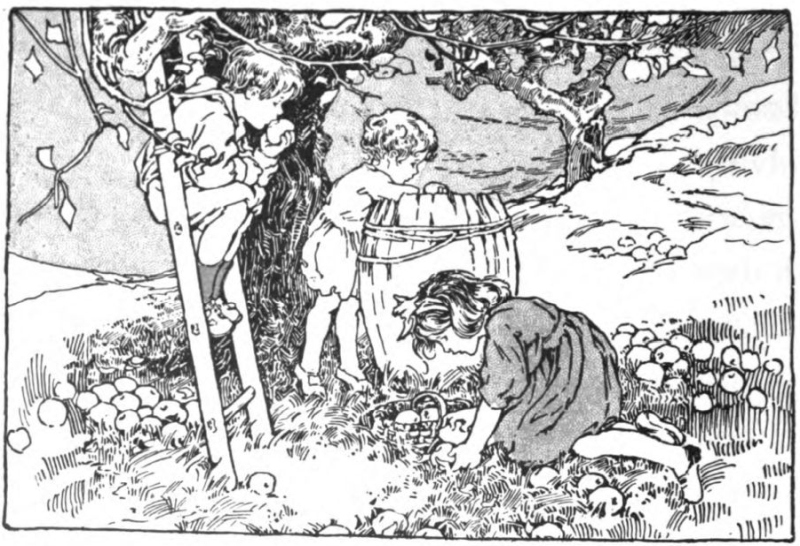
GATHERING APPLES
It is autumn. The apples are ripe. The children are busy gathering them. These are not sour apples. They are as sweet as sugar.
43 44 45 46
roll root mo ment week
toll boot min ute peek
stroll hoot hour seek
knoll soot month cheek
south dai ly north meek
47
to day to night to mor row yes ter day
af ter noon eve ning
48 49 50 51
steal al most bet ter age
meal beau ty let ter rage
deal than beg cage
heal work leg page
seal ei ther keg stage
thus nei ther peg wage
There is only one l in almost.
Look at ei in either and neither.
52
Almost never wins.
—German.
A thing of beauty is a joy forever.
—John Keats.
Better beg than steal, But better work than either.
—Russian.
He buys very dear who begs.
—Portuguese.
The following review words are often misspelled. Each has a little “catch” in it. Are you going to be caught by these little words? Use the king’s third rule. See what is hard in each word, then you can soon learn how to spell them all.
53 54 55
there over there any been
their their books many some
don’t do not which once
can’t can not could does
won’t will not would sure
hear I hear should where
here Come here hour just
People who misspell which and where do not say the h in these words. Do you?
People who misspell just do not see the letters of the little word us in the middle. They do not say the word right. Do you?
Which words have silent letters?
56
but ter pret ty sun ny
but ter cups com ing oh
57
Buttercups and daisies, Oh the pretty flowers! Coming in the springtime, Tell of sunny hours.
—Mary Howitt.
When ing is added to come to make coming, the e is dropped.
Look at e in pretty.
58 59 60 61
aid pea faint wear
maid sea paint bear
paid lea saint tear
laid tea dain ty pear
sto ry fix out side these
62 63 64 65
harm fel low ink bunch
arm yel low think lunch
charm feath er sink does not
farm weath er pink doesn’t
farm er leath er wink help
your move drink point
Be sure to pronounce the you in your.
66
When about to put your words in ink, It will do no harm to stop and think.
A grain does not fill a sack but it helps its fellows.
—Spanish.
A feather will point the wind.
—Danish.
67
cart tart dart art
part start chart smart
68 69 70 71
po ta toes God noth ing talk
lamb food an y thing walk
mouth mon ey some thing chalk
wolf gives some time bun ny
heav y giv en some bod y fun ny
ov er soft a like gave
72
Doing nothing is doing ill.
—Scottish.
Lambs don’t run into the mouth of the sleeping wolf.
—Danish.
God gives every bird its food, but does not throw it into the nest.
—J. G. Holland.
73
la zy sheep wool harm
Potatoes don’t grow by the side of the pot.
—Dutch.
A lazy sheep thinks its wool heavy.
—Scottish.
Want of care does more harm than want of money.
—Benjamin Franklin.
74
through a mong Bil ly that is
mead ow pa per know that’s
Look carefully at ough in through, ea in meadow, and o in among.
75
This I know, I love to play, Through the meadow, among the hay, Up the water and over the lea, That’s the way for Billy and me.
—James Hogg.
76
care ful riv er worth house
care less up set what ev er mouse
Look carefully at the o in worth.
77
Be careful in all things.
A little stone may upset a large cart.
—Italian.
A mouse can drink no more than its fill from a river.
—Chinese.
Whatever is worth doing at all is worth doing well.
—Chesterfield.
78
he ro fruit climb hon ey
eas y have or mon ey
Look carefully at the i in fruit, the o in honey and money, and the b in climb.
Easy is a word often misspelled.
Remember the King’s third rule.
79
Who does the best he can is a hero.
—Josh Billings.
He who would have the fruit must climb the tree.
—Spanish.
No bees, no honey; No work, no money.
It is as easy to grin as to growl.
—French.
80 81 82
task laugh care hare
cask laugh ing dare fare
flask doc tor bare pare
mask world scare stare
ask smile rare snare
asked mile spare glare
ask ing while share square
83
Laugh at your ills, And save doctor’s bills.
—Spanish.
Smile on the world and it will smile on you.
—Italian.
A light heart, a light task.
—French.
84
work friend none hap py
true hap pi ness
Look carefully at the o in work and in none, the i in friend and in happiness.
85
Be true to your word, your work, and your friend.
—John Boyle O’Reilly.
Love all, do wrong to none.
—Shakespeare.
All who joy would win Must share it—Happiness was born a twin.
—Byron.
86 87 88 89
al ways east spo ken blue
be have least bro ken due
whole feast a ble cue
man ner ly beast ta ble glue
du ty yeast fa ble hue
There is only one l in always.
90
A child should always say what’s true, And speak when he is spoken to, And behave mannerly at table; At least as far as he is able.
—Stevenson.
91 92 93 94
much hard haste hole
re main card has ten whole
of ten yard taste stole
tar dy guard paste pole
ar rive lard waste sole
learn hurt it self print
The letter t is not sounded in often, but don’t leave it out when you spell the word.
Look at u in guard.
Remember the w in whole.
95
Haste not, rest not.
—Goethe.
Too swift arrives as tardy as too late.
—Shakespeare.
Who hastens too much often remains behind.
—German.
Learn to creep before you run.
—Scottish.
96 97 98 99
e lev en six teen thir ty cream
twelve sev en teen for ty team
thir teen eight een fif ty beam
four teen nine teen six ty dream
fit teen twen ty hun dred steam
100 101
Sun day Sun. Wednes day Wed.
Mon day Mon. Thurs day Thurs.
Tues day Tues. Sat ur day Sat.
Fri day Fri. Jan u a ry Jan.
Look at the d and the second e in Wednesday and the u in Saturday.
102 103
speak leak cane pane
weak peak lane vane
beak freak mane crane
104 105
child lov ing end tend
mild giv ing send spend
wild liv ing lend bend
woe hap pi est mend
When ing is added to love, give, and life, e is dropped. What letter is changed in life?
106
BIRTHDAYS
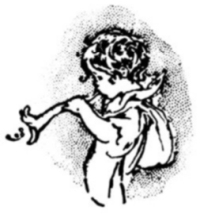
Monday’s child is fair of face, Tuesday’s child is full of grace, Wednesday’s child is full of woe, Thursday’s child has far to go, Friday’s child is loving and giving, Saturday’s child must work for a living; But the happiest child of all, they say, Is the child who is born on the week’s first day.
107 108
dish pie
fin ger please
thumb such
stock ing piece
bus y sleeve
109
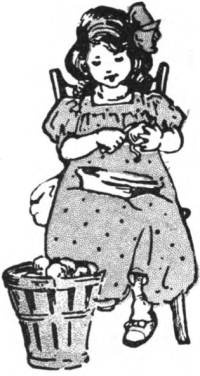
Such a busy girl! She is peeling apples for a pie. Please give me a piece of pie.
110 111 112 113
dress wrist skirt neck
guess mist shirt deck
bless twist dirt peck
less fist flirt check
press young suf fer speck
114 115
Jan u a ry Jan. Sep tem ber Sept.
Feb ru a ry Feb. Oc to ber Oct.
A pril Apr. No vem ber Nov.
Au gust Aug. De cem ber Dec.
116
dance do not world is
mu sic don’t world’s
sulk
117
THE WORLD’S MUSIC
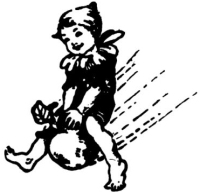
The world’s a very happy place, Where every child should dance and sing, And always have a smiling face, And never sulk at anything.
—Gabriel Setoun.
118 119 120 121
store re turn dog change
wore count log says
more car ried frog mis take
shore for get hog dol lars
or der sign form pen ny
122
JACK’S ORDER BOOK
Every day Jack goes to the store for mother. He writes her orders in a book. He says it is a real order book. He never forgets anything.
123
When he returns he counts his change. He never makes a mistake. He has carried many dollars and never lost a cent. Every day mother signs the order book.
124 125 126
doz en doz. cheese or ange
pound lb. fresh ber ry
pounds lbs. loaf ber ries
gal lon gal. loaves oat meal
quart qt. flour soap
pint pt. oil add
TWO PAGES FROM JACK’S ORDER BOOK
127 128
Mon., June 7 Fri., June 11
1 lb. cheese. 1 bag flour
1 doz. fresh eggs 3 gal. oil
1 loaf bread 1 doz. oranges
1 qt. berries 1 box oatmeal
1 pt. cream 6 cakes soap
5 lbs. sugar 3 loaves bread
1 lb. tea 1 lb. candy
129
sea sons fire
sum mer
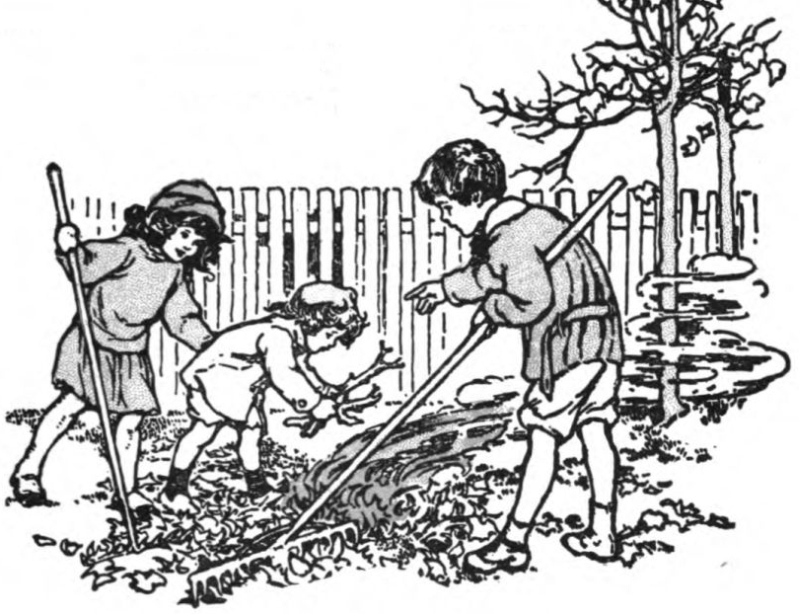
Sing a song of seasons, Something bright in all,— Flowers in the summer, Fires in the fall.
—Stevenson.
130
lip nip grip chip
drip tip whip hip
dip slip skip ship
131
raise dust turn churn
road dust y burn e ven
132
THE FLY ON THE CART WHEEL
Once there was a fly on a cart wheel. The wheel turned round and the dust from the road rose in clouds. “Oh,” cried the fly, “what a dust we raise!” But the wheel did not even know that the fly was there.
—Æsop.
133 134 135 136
hun ter dug dull mat ter
teeth bug hull plat ter
tooth rug skull scat ter
him self tug since flat ter
whom jug hasn’t chat ter
137
THE HUNTER AND THE LION
“Have you seen any tracks of a lion?” asked a hunter of a man whom he met.
“Oh, I can show you the lion himself,” said the man.
The hunter turned pale with fright. His teeth chattered.
“I don’t want to see the lion. I only want to see his tracks,” he cried.
—Æsop.
138 139 140 141
oak pale rush dip per
cloak tale brush slip per
croak gale crush skip per
soak sale hush drip ping
move scale mush whip ping
tenth whale blush tip ping
Review of Troublesome Words
142 143 144 145
friend Tuesday making just
always won’t having doctor
done too coming know
heard two loving minute
Wednesday among writing blue
February busy buy through
very none week every
146 147 148 149
whole shoes piece often
there any been sugar
their many once hour
don’t which does says
here could sure laid
can’t should where break
world would climb flour
The following 100 words have been found to be the “One Hundred Commonest Words in the English Language.” They are used and repeated so frequently in our writing that they constitute about one half of all the words we write. You have studied all of them. Can you spell each of them correctly?
the will my had
and as this has
of have his very
to not which were
I with dear been
a be from would
in your are she
that at all or
you we me there
for on so her
it he one an
was by if when
is but they time
go please letter do
some week make after
any night write than
can their thing sir
what other think last
send up should house
out our truly just
them good now over
him say its then
more could two work
about who take day
no may thank here
THIRD YEAR VOCABULARY
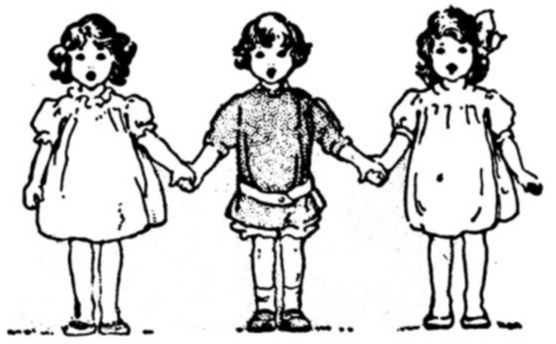
We have followed the king’s rules. We can spell all these words. Can you?
able another asking beam
add anything August bean
afraid apple autumn bear
afternoon April bank beast
age arm bare beauty
aid around barrel became
alike arrive basket been
almost art battle beg
always ask beach behave
among asked beak belt
bend branch cart clever
berries broken case climb
berry brush cash cloak
beside bug cask coat
better bunch catch coming
Billy bunny cattle could
bless burn chalk count
bliss busy change country
blond but charm crane
blown butter chart crank
blue buttercups chase cream
blush cage chatter croak
boat cane check crush
bond can’t cheek cue
boot card cheese cure
bottom care child curls
bough careful chip cut
bowl careless churn daily
boy carried clean dainty
dance dream enter fifteen
dare dress even fifth
dart drink evening fifty
dash drip ever finger
deal dripping every fire
December dropped everybody first
deck due everything fist
dip dug fable fix
dipper dull face flash
dirt dust faint flask
dish dusty fare flatter
doctor duty farm flirt
does each farmer float
doesn’t east feast floor
dog easy feather flour
dollar eighteen February flower
don’t either feel follow
dozen eleven fellow fond
drank end felt food
form given hare hiss
forget giving harm hog
forty glare hasn’t hole
fourteen glue haste honey
fourth goat hasten hoot
fox God hatch horse
freak golden have hour
fresh goose heal house
Friday grace hear hue
friend great heard hull
frog grip heart hundred
fruit grown heave hunter
funny guard heavy hurt
gale guess heel hush
gallon handle help hut
gather happiest here I’m
gave happiness hero Indian
geese happy himself ink
give hard hip inside
its lard limb meek
itself lash lion melt
January latch lip mend
joy laugh living mild
jug laughing loaf mile
just leaf loaves minute
keg leak log miss
kiss lean loving mist
kneel learn lunch mistake
knelt least maid moment
knife leather mane Monday
knoll leave mannerly money
know leg many month
known lend mask more
lace less match morning
ladder letter matter mother
laid life meadow mouse
lamb lily meal mouth
lane like mean move
much off paper pitcher
music often pare place
neck oh part platter
neither oil paste please
never once patch point
next or pea pole
nineteen orange peach pond
nip order pear post
none other peak potatoes
north outside peck pound
nothing over peek preach
November own peel press
number ox peg pretty
nut oxen penny print
oak page picture proof
oar paid pie punch
oatmeal paint piece pure
oats pale pink quart
October pane pint race
rage rush September size
raise rut seventeen skip
rank safe seventy skipper
rare saint sever skirt
rash sale shall skull
rattle sash share sleeve
reach Saturday ship slip
read says shirt slippers
remain scale shoes smart
return scare shore smile
rider scatter should snare
ripe scrape shown soak
river scratch shut soap
road sea side soft
roar seal sign sole
roll seasons since some
roof second sink somebody
root seek sixteen something
rug send sixty sometime
sorry stone task thirty
sour store taste this
south story tea through
sown strange teach thrown
space strife team thumb
spare stroll tear Thursday
speak such teeth thus
speck suffer tend tip
spelt sugar tenth tipping
spend sulk than today
spoken summer thank toe
square Sunday that’s toll
stage sunny their tomorrow
stare sure there tonight
start table these tooth
steal tale think toy
steam talk third trace
stocking tardy thirsty Troy
stole tart thirteen true
trust water while wore
Tuesday weak whip work
tug wear whipping world
turn weather whole worth
twelve weave whom wrist
twenty Wednesday wife yard
twist week wild yeast
upset whale wink yellow
vane whatever wire yesterday
wage wheel wolf young
walk where woe your
waste which won’t
THE ALDINE SPELLER PART II FOURTH YEAR
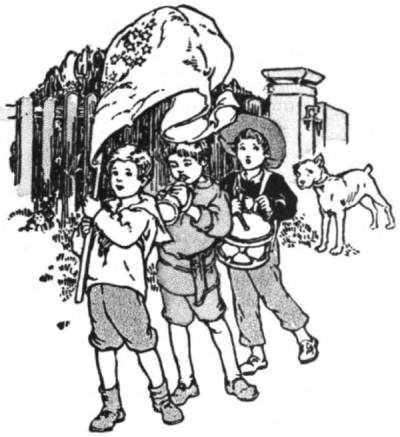
1
A mer i ca A mer i can Pil grim moun tain free dom lib er ty it is ’tis
2
AMERICA
My country, ’tis of thee, Sweet land of liberty, Of thee I sing; Land where my fathers died, Land of the Pilgrims’ pride, From every mountain-side Let freedom ring.
—Samuel Francis Smith.
3
breath breathes soul na tive
Breathes there a man with soul so dead, Who never to himself hath said, “This is my own, my native land”?
—Sir Walter Scott.
4 5
wolf re ply as sist pit y
wolves re plied poor pit ied
crea ture a lone
See what happens to y in reply and pity when ed is added.
When es is added to wolf see what happens to f. In what other words does this happen?
6
One day a fox fell into a well. He howled aloud. A wolf ran to see what the matter was. “Poor creature,” said the wolf, “how I pity you!” “Don’t pity me,” replied the fox. “Assist me.”
—Æsop.
7 8
e nough con tent trav el pock et
tough rich trav el er emp ty
rough a muse purse re cov er
9
health wealth rob ber
Health is the best wealth. Poor and content is rich, and rich enough.
—Shakespeare.
Better an empty purse than an empty head.
—German.
The traveler with empty pockets fears no robber.
10
be come be gin be gun be fore
be long be gin ning be low be fore hand
11 12 13
torn stitch trou ble
tum ble a cross af ter ward
a shamed beg gar loose
nurse pun ish blis ter
bruise fault her self
comb of fer gar den
Look thoughtfully at ui in bruise, au in fault, oo in loose, ou in trouble.
There is only one c in across.
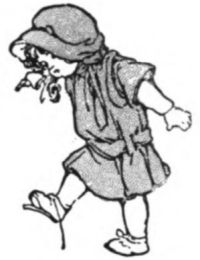
Look at the picture, then write five sentences about it, using as many words as you can from Lessons 11, 12, and 13.
14
an ger bos om jus tice win dow
sur round foot
When anger in the bosom lies, Justice out the window flies.
15 16
sil ver lady fur elm
shad y lad ies cur sir
shad ow sat in church birch
The y in lady changes to i and es is added when we mean more than one lady—ladies.
Look at the u in church and the i in birch.
17
The silver birch is a dainty lady, She wears a satin gown; The elm tree makes the old churchyard shady, She will not live in town.
—Edith Nesbit.
18
voice breeze touch
vi o let breath
The rough voiced breeze that shook the trees Was touched by a violet’s breath.
19 20 21 22
left camp nar row fir
cit y lamp ma ple grove
o’clock damp beech drove
front called spruce stove
path field for est cove
Look at o in front, ie in field, and ple in maple.
Do not forget the apostrophe in o’clock.
23
We left the city at six o’clock. The camp is in a grove of fir, maple, beech, and spruce trees. Jack called the grove our forest. In front of the camp is the river. A narrow path leads across a field to its banks.
24
lum ber tim ber boards car pen ter
shin gle sea shore
25 26 27 28
build inch un der re al ly
build ing inch es be neath porch
built firm gi ant dis tant
south sol id whose dis tance
seems fort square broad
29
The camp was built of native lumber. The building was firm and solid as a fort. The boards were over an inch thick. It stood under a giant tree whose branches really seemed to touch the distant sky. On the south side was a broad square porch.
30 31
ham mock at tic eaves can dle
buck et cel lar lan tern moon light
shov el cor ner
Make a sentence telling how the camp was lighted at night.
32 33 34 35
di vide break fast pre pare chance
la bor din ner fish watch
e qual sin ner veg e ta ble dan ger
e qual ly win ner cot tage stran ger
en joy pro vide i dle an y way
Look carefully at the second e in vegetable.
36
At camp the labor is divided. None are idle. All enjoy an equal chance to help. Jack prepares breakfast and dinner. Frank provides fish and vegetables. The dog watches that no danger comes near the cottage.
37 38
cab bage squash ba na na rai sins
car rot to ma to cur rants ol ive
rad ish tur nip grape prune
on ion lem on
39
kitch en re move ash es
ov en kin dle
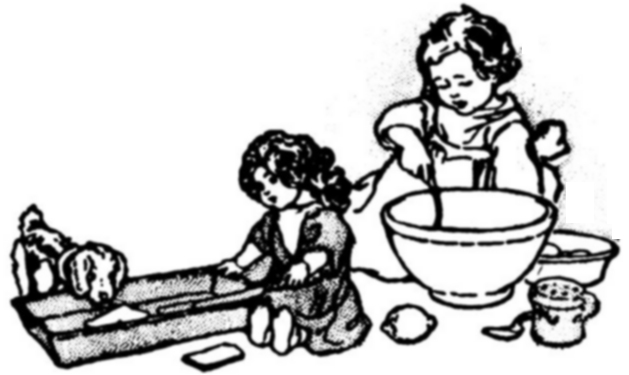
Remove the ashes. Kindle the fire. Have a hot oven. Sweep the kitchen.
40 41 42 43
salt sprin kle juice cher ry
so da wrin kle juic y choc o late
stir pud ding fork dough
spoon bis cuit pep per dough nut
coal ket tle pour jel ly
44 45
flow er heav en
show er si lent
bow er de light
tow er high
won der mir ror
46
The moon, like a flower, In heaven’s high bower, With silent delight Sits and smiles at the night.
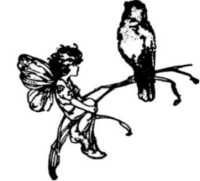
FLOWER AND FAIRY WORDS
47 48 49 50
pur ple na ture ti ny col or
pan sy fan cy fair y scar let
li lac blos som fair ies beau ti ful
com mon bush fa vor laugh ter
wreath lawn mer ry dan de li on
Review of Troublesome Words
51 52 53 54
used loose wear built
color lose early easy
break enough sugar beginning
know any minute wrote
tonight shoes tear sure
laid said read knew
would once does heard
doctor piece just writing
write having says whole
often guess done none
Each of the words on this page has some little “catch” in it. Try to find what is difficult in each word. Make a list of all you misspell. Keep this list on your desk or somewhere handy. Study whenever you get a chance. Don’t let these simple, everyday words master you. Master them.
55
o bey com mand busi ness serve
Look at e in obey, i in business.
Only two syllables in business.
He that has learned how to obey will know how to command.
—Solon.
If you would have your business done, go; if not, send.
—Franklin.
He is best served who serves himself.
56 57
tru ly po lite re main ac tion
ounce ex am ple re main der ad vice
No e in truly; ai in remain; c in advice.
Better an ounce of example than a pound of advice.
Words pass away, but actions remain.
—Napoleon.
Truly polite, always polite.
58 59
lis ten bud
rip ple bud ding
flut ter mud
blue bird mud dy
to ward fence
60
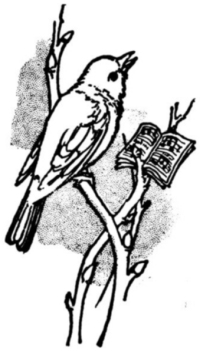
Listen a moment, I pray you; What was that sound that I heard? Wind in the budding branches, The ripple of brooks, or a bird? Hear it again, above us; and see a flutter of wings. The bluebird knows it is April, and soars toward the sun and sings.
—Eben Rexford.
61
bob o link pi geon spar row hawk
hand some won der ful
62 63 64 65
bald brief aw ful cir cle
ea gle grief se vere home
ar row com plete ar rive dome
mur der cru el man age Rome
breast wound glance bod y
Look at a in eagle and breast, ie in grief and brief, e in cruel, ou in wound.
66
THE EAGLE AND THE ARROW
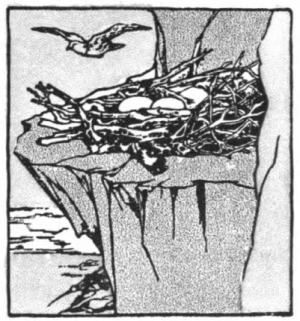
A hunter once shot an eagle. Severely wounded, the bird managed to fly to his home. When he arrived he glanced at the cruel arrow in his breast. It was winged with one of his own feathers.
“Oh,” he cried, “to think I have been murdered by an arrow that I helped to make!”
—Æsop.
67 68 69 70
learn ing in vite har vest boil
wis dom in vi ta tion this tle soil
cloth com pa ny whis tle toil
clothes pea cock ex pect toi let
be gan how ev er in deed suit
71
Learning is not wisdom any more than cloth is clothes.
—French.
How can a sparrow expect to be invited into the company of a peacock?
—Hans Andersen.
He that has a good harvest may be content with some thistles.
—Scottish.
72 73
calm waist debt moan
palm crumb mourn col umn
Find a silent letter in every word in Lessons 72 and 73.
74 75 76 77
ad mire great ness death thank ful
ad mir ing ab sent at tempt suc cess
grum ble pres ent half suc ceed
grum bling cow ard halves peo ple
lev el thous and be cause thorn
E is omitted in admire and grumble when ing is added. What changes are made in the word half when we mean more than one half?
78
In admiring greatness we rise to its level.
He who killed a lion when absent, feared a mouse when present.
—French.
A coward dies a thousand deaths.
—German.
A bold attempt is half success.
—Danish.
Some people are always grumbling because roses have thorns. I am thankful that thorns have roses.
—Karr.
79
pal ace hum ble though roam
a mid ’mid pleas ure
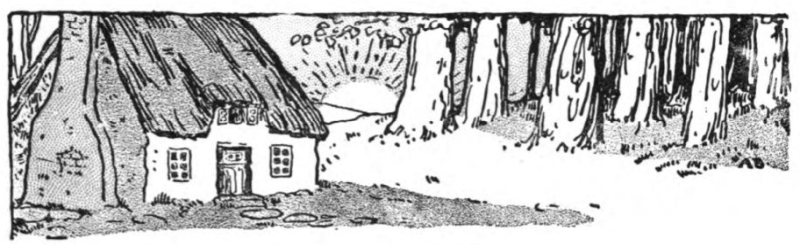
’Mid pleasures and palaces though we may roam, Be it ever so humble, there’s no place like home.
—John Howard Payne.
Home is where love is.
80 81 82 83
wig wam cup board pi an o cur tain
cab in cham ber book case so fa
cas tle par lor al bum vase
pan try bed room blot ter Bi ble
clos et bath room car pet quilt
84 85 86 87
ache bus i ly chi na wipe
head ache pleas ant brit tle fore noon
ly ing qui et ly warm a pron
sur prise quick ly wash tow el
lin en daugh ters soft fin ish
When ly is added to busy, y is changed to i.
There are two s’s in surprise; one l in towel.
Look at ea in pleasant; o in apron; a in wash and warm.
Apron is pronounced a pern.
88 89
sauce rib bon va ca tion be tween
sauc er whis per to geth er scour
plen ty bas in grate ful praise
90
MOTHER’S HELPERS
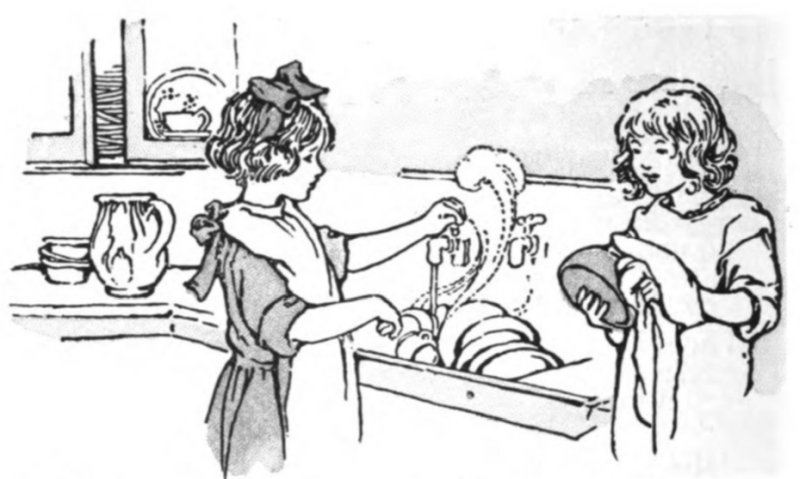
Mother has a headache this forenoon and is lying down. Her two daughters are working busily to give her a pleasant surprise.
“Work quietly and quickly, but carefully,” said Kate. “China is very brittle. I’ll wash the dishes in warm water. You wipe them with this soft linen towel. Between us we will soon finish.”
91 92 93 94
fam i ly neph ew neigh bor mas ter
grand pa cous in vis it or tax
grand ma in fant mem ber ma chine
aunt wo man butch er fur nace
un cle wo men gro cer fu el
95 96 97 98
splen did edge ter ri ble swept
might y ledge storm slept
strength wedge ex plain ten der
up root ed pledge in stead slen der
straight sledge an swered fen der
99
THE OAK AND THE REED
A mighty oak that had been uprooted by a terrible storm, lay on the bank of a river.
On the edge of the water grew a straight slender reed.
“What, are you still growing!” said the oak. “I was big and strong. You are little and weak.”
“I can explain,” answered the reed. “You fought the storm as it swept by. So you were uprooted for all your splendid strength. Instead of fighting the storm, I bent to it, and I still stand.”
—Æsop.
Rewrite the above fable, using other words in place of those that are italicized.
100
a gainst de pends worth ton al ways
A pound of pluck is worth a ton of luck.—
Garfield.
Luck is always against the man who depends upon it.
101
li ar crip ple truth be lieve pun ish ment
A liar is sooner caught than a cripple.
—Portuguese.
A liar’s punishment is in not being believed when he speaks the truth.
102
mod est mod est y sel dom jew el jew el ry much
A modest dog seldom grows fat.
—Danish.
Modesty is a jewel, but one may wear too much jewelry.
Do noble things, not dream them, all day long.
—Kingsley.
103 104 105 106
jour ney ves sel en gine sta ble
ca noe car go rail road sta tion
fer ry cam el rail way de pot
mo tor bi cy cle trol ley ga rage
har bor au to mo bile bal loon pier
107
choice sort mount
choose pre fer trip
108
far ther pub lic rath er de sire
driv en push vis it gone
What sort of travel do you prefer? You may have your choice. Mount your bicycle for a short trip. If you desire to go farther, there is the automobile or the public trolley. Or would you rather go by the railroad?
Travel Words Geography Words
109 110 111 112
a gent rap id vil lage globe
tick et mo tion cit ies sphere
de part cap tain cap i tal ho ri zon
de lay of fi cer con ti nent lo cate
ho tel con duct or val ley north ern
Look at tion in motion, the second o in conductor, ph in sphere, the ending in cities. There are several words on this page that you will misspell if you are not careful to pronounce them correctly.
113
wel come serv ant hun ger
Welcome is the best dish on the table.
—Scottish.
The master of the house is the servant of the guest.
—Persian.
Hunger is the best sauce.
114 115 116 117
show er y dawn troop er slope
pow er un less hoop rope
warn yel low loop scope
in vade with in stoop hope
bu gle with out pa rade hope ful
held their pa rad ed hop ing
118
THE DANDELIONS
Upon a showery night and still, Without a sound of warning, A trooper band surprised the hill, And held it in the morning. We were not waked by bugle-note, No cheer our dreams invaded, And yet at dawn their yellow coats On the green slopes paraded.
—Helen Gray Cone.
119 120 121 122
sor ry judge for give ness angry
sor row judg ing pa tient dis tress
bor row tongue dis be lieve dis tressed
e vil par don re port tale-bearer
con duct cheer ful cour age at ten tion
Look thoughtfully at tongue and patient; the o in courage and the tion in attention.
123
There are ten things for which no one has ever yet been sorry. These are—for doing good to all; for speaking evil of none; for hearing before judging; for thinking before speaking; for holding an angry tongue; for being kind to the distressed; for asking pardon for all wrongs; for being patient towards everybody; for stopping the ears to a tale-bearer; for disbelieving most of the ill reports.
124 125 126 127
Frank lin per haps sprout wil low
wharf no tice cheap bil low
Hol land sin gle leap pil low
else tu lip heap U ni ted
short bulb reap States
near ly close bas ket morn ing
128
While Franklin was walking on a wharf one morning, he saw some cheap willow baskets in which some tulip bulbs had been brought from Holland. Perhaps no one else would have noticed the single short green sprout on one of the willows. Franklin cut it off carefully and planted it. From this one sprout have grown most of the basket willows in the United States.
A man’s best things are nearest him, Lie close about his feet.
WORDS OFTEN HEARD IN SCHOOL
129 130 131 132
pri ma ry cor rect ex act his to ry
writ ten schol ar ex er cise charge
prompt er ror jan i tor en e my
re peat ex cuse your self can non
ob serve taught col o ny un der stand
133 134 135 136
neg lect per fect po em a rith me tic
un ion lan guage au thor di vide
at tack cop y sen tence di vi sor
chap ter com ma ti tle div i dend
liq uid pe ri od dic tate sport
137 138 139 140
meas ure curve e rect weigh
min u end carve cough weight
bush el up per re cess o mit
draw ing up right base mod el
spel ling re cite base ball an nu al
141 142 143 144
pic nic cot ton wool dif fer ent
u su al mus lin wool en dif fer ence
jol ly col lar sweat swamp
ar ranged neck tie sweat er par ty
car riage blouse pas ture lem on ade
flan nel o ver alls or chard co coa
145
THE PICNIC
Summer is the usual time for picnics, but mother arranged a jolly one for us last fall.
Instead of cotton or muslin dresses, the girls wore flannel ones. The boys left their collars and neckties at home, and wore old blouses and overalls. We all wore woolen sweaters.
We did not go in carriages. We walked across the pasture, through the orchard to the grove on the other side of the swamp. Ours was a nutting party.
Our picnic was different from summer picnics in other ways. Instead of cold lemonade we had hot cocoa, and we ate our lunch in the sunniest place we could find, by a great rock. It was almost night when we reached home, and we all ran to the fire to warm our fingers and toes.
146
Make a sentence using the following words.
scat tered crowd de cid ed search
chest nuts wal nuts
147 148
sand wich fudge squir rel club
pic kle chick en a corn tur key
nap kin hun gry rab bit crick et
149 150 151 152
false hon est prom ise faith
false hood hon est y birth faith ful
quar rel no ble knight how ev er
val or hon or knight hood loy al
for tune hon or a ble what ev er loy al ty
153
He who is honest is noble, Whatever his fortunes or birth.
—Alice Cary.
Stand by your promise, your honor, your faith, as loyally as the knights of old.
—George Herbert.
BRAVE GOOD
AND·TRUE
Here are some of the most commonly used, most commonly misspelled, words. You have studied every one of them. Are you sure that you can and do spell every one correctly?
piece raise busy write
beginning wrote color writing
though enough guess here
coming truly says hear
early sugar believe done
instead straight knew women
easy could February always
through much Wednesday where
every minute lose been
half Tuesday loose friend
none wear would business
often answer once money
cough trouble does their
ache among heard there
break said know sure
Fourth Year Vocabulary
absent amuse attention bedroom
ache anger attic beech
acorn angry aunt before
across annual author beforehand
action answered automobile beggar
admire any awful begin
admiring anyway bald beginning
advice apron balloon begun
afterward arithmetic banana believe
against arranged base belong
agent arrive baseball below
album arrow basket beneath
alone ashamed basin between
always ashes bathroom Bible
America assist beautiful bicycle
American attack because billow
amid attempt become birch
birth breathes cabin chance
biscuit breeze called chapter
blister brief calm charge
blossom brittle camel cheap
blotter broad camp cheerful
blouse bruise candle cherry
bluebird bucket cannon chestnuts
boards bud canoe chicken
bobolink bugle capital china
body build captain chocolate
boil building cargo choice
bookcase built carpenter choose
borrow bulb carpet church
bosom bush carriage circle
bower bushel carrot cities
break busily carve city
breakfast business castle close
breast butcher cellar closet
breath cabbage chamber cloth
clothes corner curve disbelieve
club correct damp distance
coal cottage dandelion distant
cocoa cotton danger distress
collar cough daughter distressed
colony courage dawn divide
color cousin death dividend
column cove debt divisor
comb coward decided doctor
comma creature delay does
command cricket delight dome
common cripple depart done
company crowd depend dough
complete cruel depot doughnut
conduct crumb desire drawing
conductor cupboard dictate driven
content cur difference drove
continent currants different eagle
copy curtain dinner early
easy expect firm garage
eaves explain fish garden
edge fairies flannel giant
elm fairy flower glance
else faith flutter globe
empty faithful foot gone
enemy false forenoon grandma
engine falsehood forest grandpa
enjoy family forgiveness grape
enough fancy fork grateful
equal farther fort greatness
equally fault fortune grief
erect favor Franklin grocer
error fence freedom grove
evil fender front grumble
exact ferry fudge grumbling
example field fuel guess
excuse finish fur half
exercise fir furnace halves
hammock honor invite know
handsome honorable janitor labor
harbor hoop jelly ladies
harvest hope jewel lady
having hopeful jewelry laid
hawk horizon jolly lamp
headache hotel journey language
health however judge lantern
heap humble judging laughter
heard hunger juice lawn
heaven hungry juicy leap
held idle just learning
herself inch justice ledge
high inches kettle left
history indeed kindle lemon
Holland infant kitchen lemonade
home instead knew level
honest invade knight liar
honesty invitation knighthood liberty
lilac mid murder offer
linen mighty muslin officer
liquid minuend napkin often
listen minute narrow olive
locate mirror native omit
loop moan nature once
loose model nearly onion
lose modest necktie orchard
loyal modesty neglect ounce
loyalty moonlight neighbor oven
lumber morning nephew overalls
lying motion noble palace
machine motor none palm
manage mount northern pansy
maple mountain notice pantry
master mourn nurse parade
measure much obey paraded
member mud observe pardon
merry muddy o’clock parlor
party pity provide rather
pasture pleasant prune read
path pleasure public really
patient pledge pudding reap
peacock plenty punish recess
people pocket punishment recite
pepper poem purple recover
perfect polite purse remain
perhaps poor push remainder
period porch quarrel remove
piano pour quickly repeat
pickle power quietly replied
picnic praise quilt reply
piece prefer rabbit report
pier prepare radish ribbon
pigeon present railroad rich
pilgrim primary railway ripple
pillow promise raisins roam
pitied prompt rapid robber
Rome sentence slept spruce
rope servant slope square
rough serve soda squash
said severe sofa squirrel
salt shadow soft stable
sandwich shady soil station
satin shingle solid stir
sauce shoes sorrow stitch
saucer short sorry stone
says shovel sort stoop
scarlet shower soul storm
scattered showery sparrow stove
scholar silent spelling straight
scope silver sphere stranger
scour single splendid strength
search sinner spoon strict
seashore sir sport succeed
seems sledge sprinkle success
seldom slender sprout sugar
suit thousand travel upper
sure ticket traveler upright
surprise timber trip uprooted
surround tiny trolley used
swamp ’tis trooper usual
sweat title trouble vacation
sweater together truly valley
swept toil truth valor
tale-bearer toilet tulip vase
taught tomato tumble vegetable
tax ton turkey vessel
tear tongue turnip village
tender tonight uncle violet
terrible torn under visit
thankful touch understand visitor
their tough union voice
thistle toward unite waist
thorn towel united walnuts
though tower unless warm
warn whisper without wound
wash whistle wolf wreath
watch whole wolves wrinkle
wealth whose woman write
wear wigwam women writing
wedge willow wonder written
weigh window wonderful wrote
weight winner wool yellow
welcome wipe woolen yourself
wharf wisdom worth
whatever within would

VAN REES
PRESS
NEW YORK