Part 2 — VIII
Reading edition
ear the place where Odysseus had landed there lived an old man who was a faithful servant in his house. Eumæus was his name, and he was a swineherd. He had made for himself a dwelling in the wildest part of the island, and had built a wall round it, and had made for the swine pens in the courtyard—twelve pens, and in each pen there were fifty swine. Old Eumæus lived in this place tending the swine with three young men to help him. The swine-pens were guarded by four dogs that were as fierce as the beasts of the forest.
As he came near the dogs dashed at him, yelping and snapping; and Odysseus might have suffered foul hurt if the swineherd had not run out of the courtyard and driven the fierce dogs away. Seeing before him one who looked an ancient beggar, Eumæus said, 'Old man, it is well that my dogs did not tear thee, for they might have brought upon me the shame of thy death. I have grief and pains enough, the gods know, without such a happening. Here I sit, mourning for my noble master, and fattening hogs for others to eat, while he, mayhap, is wandering in hunger through some friendless city. But come in, old man. I have bread and wine to give thee.'
The swineherd led the seeming beggar into the courtyard, and he let him sit down on a heap of brushwood, and spread for him a shaggy goat-skin. Odysseus was glad of his servant's welcome, and he said, 'May Zeus and all the other gods grant thee thy heart's dearest wish for the welcome that thou hast given to me.'
Said Eumæus the swineherd, 'A good man looks on all strangers and beggars as being from Zeus himself. And my heart's dearest wish is that my master Odysseus should return. Ah, if Odysseus were here, he would give me something which I could hold as mine own—a piece of ground to till, and a wife to comfort me. But my master will not return, and we thralls must go in fear when young lords come to rule it over them.'
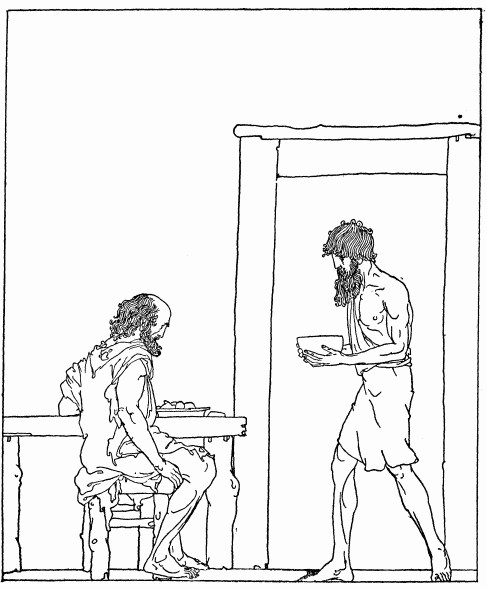
He went to the swine-pens and brought out two sucking pigs; he slaughtered them and cut them small and roasted the meat. When all was cooked, he brought portions to Odysseus sprinkled with barley meal, and he brought him, too, wine in a deep bowl of ivy wood. And when Odysseus had eaten and drunken, Eumæus the swineherd said to him:
'Old man, no wanderer ever comes to this land but that our lady Penelope sends for him, and gives him entertainment, hoping that he will have something to tell her of her lord, Odysseus. They all do as thou wouldst do if thou earnest to her—tell her a tale of having seen or of having heard of her lord, to win her ear. But as for Odysseus, no matter what wanderers or vagrants say, he will never return—dogs, or wild birds, or the fishes of the deep have devoured his body ere this. Never again shall I find so good a lord, nor would I find one so kind even if I were back in my own land, and saw the faces of my father and my mother. But not so much for them do I mourn as for the loss of my master.'
Said Odysseus, 'Thou sayst that thy master will never return, but I notice that thou art slow to believe thine own words. Now I tell thee that Odysseus will return and in this same year. And as sure as the old moon wanes and the young moon is born, he will take vengeance on those whom you have spoken of—those who eat his substance and dishonour his wife and son. I say that, and I swear it with an oath.'
'I do not heed thine oath,' said Eumæus the swineherd. 'I do not listen to vagrant's tales about my master since a stranger came here and cheated us with a story. He told us that he had seen Odysseus in the land of the Cretans, in the house of the hero Idomeneus, mending his ships that had been broken by the storm, and that he would be here by summer or by harvest time, bringing with him much wealth.'
As they were speaking the younger swineherds came back from the woods, bringing the drove of swine into the courtyard. There was a mighty din whilst the swine were being put into their pens. Supper time came on, and Eumæus and Odysseus and the younger swineherds sat down to a meal. Eumæus carved the swineflesh, giving the best portion to Odysseus whom he treated as the guest of honour. And Odysseus said, 'Eumæus, surely thou art counselled by Zeus, seeing thou dost give the best of the meat even to such a one as I.'
And Eumæus, thinking Odysseus was praising him for treating a stranger kindly, said, 'Eat, stranger, and make merry with such fare as is here.'
The night came on cold with rain. Then Odysseus, to test the kindliness of the swineherd, said, 'O that I were young and could endure this bitter night! O that I were better off! Then would one of you swineherds give me a wrap to cover myself from the wind and rain! But now, verily, I am an outcast because of my sorry raiment.'
Then Eumæus sprang up and made a bed for Odysseus near the fire. Odysseus lay down, and the swineherd covered him with a mantle he kept for a covering when great storms should arise. Then, that he might better guard the swine, Eumæus, wrapping himself up in a cloak, and taking with him a sword and javelin, to drive off wild beasts should they come near, went to lie nearer to the pens.
When morning came, Odysseus said, 'I am going to the town to beg, so that I need take nothing more from thee. Send someone with me to be a guide. I would go to the house of Odysseus, and see if I can earn a little from the wooers who are there. Right well could I serve them if they would take me on. There could be no better serving-man than I, when it comes to splitting faggots, and kindling a fire and carving meat.'
'Nay, nay,' said Eumæus, 'do not go there, stranger. None here are at a loss by thy presence. Stay until the son of Odysseus, Telemachus, returns, and he will do something for thee. Go not near the wooers. It is not such a one as thee that they would have to serve them. Stay this day with us.'
Odysseus did not go to the town but stayed all day with Eumæus. And at night, when he and Eumæus and the younger swineherds were seated at the fire, Odysseus said, 'Thou, too, Eumæus, hast wandered far and hast had many sorrows. Tell us how thou earnest to be a slave and a swineherd,'