Part 2 — THE ADVENTURES OF FERDINAND COUNT FATHOM (continued 3)
Reading edition
It would be superfluous to observe, that these tidings operated like an admirable specific on the spirits of the young lady, who, while she affected to pity the squire, was so much overjoyed at his disappointment, that her eyes began to sparkle with uncommon vivacity, and in less than two hours after the last of those terrible attacks, she was restored to a better state of health than she had enjoyed for many weeks. Fathom was not forgot amidst the rejoicings of the family. Besides an handsome gratuity for the effects of his extraordinary skill, the old lady favoured him with a general invitation to her house, and the daughter not only considered him as the restorer of her health, and angel of her good fortune, but also began to discover an uncommon relish for his conversation; so that he was struck with the prospect of succeeding Squire Stub in her affection. A conquest which, if sanctioned by the approbation of the mother, would console him for all the disappointments he had sustained; for Miss Biddy was entitled to a fortune of ten thousand pounds, provided she should marry with the consent of her parent, who was the sole executrix of the father's will.
Animated with the hope of such an advantageous match, our adventurer missed no opportunity of improving the lodgment he had made, while the two ladies failed not to extol his medical capacity among all their female acquaintances. By means of this circulation, his advice was demanded in several other cases, which he managed with such an imposing air of sagacity and importance, that his fame began to spread, and before the end of the season, he had ravished more than one half of the business from his competitor. Notwithstanding these fortunate events, he foresaw, that he should find great difficulty in transplanting his reputation, so as to take root in London, which was the only soil in which he could propose to rise to any degree of prosperity and independence; and this reflection was grounded upon a maxim which universally prevails among the English people, namely, to overlook and wholly neglect, on their return to the metropolis, all the connexions they may have chanced to acquire during their residence at any of the medical wells. And this social disposition is so scrupulously maintained, that two persons who lived in the most intimate correspondence at Bath or Tunbridge, shall in four-and-twenty hours so totally forget their friendship, as to meet in St. James's Park, without betraying the least token of recognition; so that one would imagine these mineral waters were so many streams issuing from the river Lethe, so famed of old for washing away all traces of memory and recollection.
Aware of this oblivious principle, Doctor Fathom collected all his qualifications, in order to make such an impression upon the heart of Miss Biddy, as would resist all her endeavours to shake him from her remembrance; and his efforts succeeded so well, that Squire Stub's advances to a reconciliation were treated with manifest indifference. In all probability our hero would have made a very advantageous campaign, had not his good fortune been retarded by an obstruction, which, as he did not perceive it, he could not possibly surmount. In displaying his accomplishments to captivate the daughter, he had unwittingly made an absolute conquest of the mother, who superintended the conduct of Miss Biddy with such jealous vigilance, that he could find no opportunity of profiting by the progress he had made in her heart; for the careful matron would never lose sight of her, no, not for one moment.
Had the old lady given the least intimation to our adventurer, of the sentiments she entertained in his behalf, his complaisance was of such a pliable texture, that he would have quitted his other pursuit, and made her the sole object of his attention. But she either depended upon the effect of his own good taste and discernment, or was too proud to disclose a passion which he had hitherto overlooked.
CHAPTER FIFTY-TWO REPAIRS TO THE METROPOLIS, AND ENROLS HIMSELF AMONG THE SONS OF PAEAN.
Before this affair could be brought to a proper explanation, the season being almost ended, the ladies departed from Tunbridge, and in a little time Doctor Fathom followed them to London, having previously obtained permission to visit them in that metropolis. He had solicited the same favour of some other families, in which he hoped to take root, though he knew they were pre-engaged to different physicians; and resolving to make his first medical appearance in London with some eclat, he not only purchased an old chariot, which was new painted for the purpose, but likewise hired a footman, whom he clothed in laced livery, in order to distinguish himself from the common run of his brethren.
This equipage, though much more expensive than his finances could bear, he found absolutely necessary to give him a chance for employment; as every shabby retainer to physic, in this capital, had provided himself with a vehicle, which was altogether used by way of a travelling sign-post, to draw in customers; so that a walking physician was considered as an obscure pedlar, trudging from street to street, with his pack of knowledge on his shoulders, and selling his remnants of advice by retail. A chariot was not now set up for the convenience of a man sinking under the fatigue of extensive practice, but as a piece of furniture every way as necessary as a large periwig with three tails; and a physician, let his merit, in other respects, be never so conspicuous, can no more expect to become considerable in business, without the assistance of this implement, than he can hope to live without food, or breathe without a windpipe.
This requisite is so well understood, that, exclusive of those who profess themselves doctors, every raw surgeon, every idle apothecary, who can make interest with some foolhardy coachmaker, may be seen dancing the bays in all places of public resort, and grinning to one another from their respective carriages. Hence proceed many of those cruel accidents which are recorded in the daily papers. An apothecary's horses take fright, and run away with his chariot, which is heard of no more. An eminent surgeon being overturned, is so terrified at the thoughts of mutilation, that he resolves to walk on foot all the days of his life; and the coachman of a physician of great practice, having the misfortune to be disabled by a fall from the box, his master can never find another to supply his place.
None of these observations escaped the penetrating eye of Fathom, who, before he pretended to seat himself in this machine, had made proper inquiry into all the other methods practised, with a view to keep the wheels in motion. In his researches, he found that the great world was wholly engrossed by a few practitioners who had arrived at the summit of reputation, consequently were no longer obliged to cultivate those arts by which they rose; and that the rest of the business was parcelled out into small enclosures, occupied by different groups of personages, male and female, who stood in rings, and tossed the ball from one to another, there being in each department two sets, the individuals of which relieved one another occasionally. Every knot was composed of a waiting-woman, nurse, apothecary, surgeon, and physician, and sometimes a midwife was admitted into the party; and in this manner the farce was commonly performed.
A fine lady, fatigued with idleness, complains of the vapours, is deprived of her rest, though not so sick as to have recourse to medicine. Her favourite maid, tired with giving her attendance in the night, thinks proper, for the benefit of her own repose, to complain of a violent headache, and recommends to her mistress a nurse of approved tenderness and discretion; at whose house, in all likelihood, the said chambermaid hath oft given the rendezvous to a male friend. The nurse, well skilled in the mysteries of her occupation, persuades the patient, that her malady, far from being slight or chimerical, may proceed to a very dangerous degree of the hysterical affection, unless it be nipt in the bud by some very effectual remedy. Then she recounts a surprising cure performed by a certain apothecary, and appeals to the testimony of the waiting-woman, who being the gossip of his wife, confirms the evidence, and corroborates the proposal. The apothecary being summoned, finds her ladyship in such a delicate situation, that he declines prescribing, and advises her to send for a physician without delay. The nomination of course falls to him, and the doctor being called, declares the necessity of immediate venesection, which is accordingly performed by a surgeon of the association.
This is one way of beginning the game. Though the commencement often varies, and sometimes the apothecary and sometimes the physician opens the scene; but, be that as it will, they always appear in a string, like a flight of wild geese, and each confederacy maintains a correspondence with one particular undertaker. Fathom, upon these considerations, set up his rest in the first floor of an apothecary in the neighbourhood of Charing Cross, to whom he was introduced by a letter from a friend at Tunbridge, and who being made acquainted with his ability and scheme, promised to let slip no opportunity of serving him; and, indeed, seemed to espouse his interest with great alacrity. He introduced him to some of his patients, on the strength of a gratis visit, sounded forth his praise among all the good women of his acquaintance; and even prevailed upon him to publish advertisements, importing that he would every day, at a certain time and place, give his advice to the poor for nothing; hoping that, by means of some lucky cure, his fame might be extended, and his practice grow into request.
In the meantime his chariot rolled along through all the most frequented streets, during the whole forenoon, and, at the usual hour, he never failed to make his appearance at the medical coffee-house, with all that solemnity of feature and address, by which the modern sons of Paean are distinguished; not but that he was often puzzled about the decision of his diurnal route. For the method of driving up one street and down another, without halting, was become such a stale expedient, that the very 'prentices used to stand at the shop doors, and ridicule the vain parade. At length, however, he perused the map of London with great diligence, and, having acquired a distinct idea of its topography, used to alight at the end of long narrow thoroughfares and paved courts, where the chariot was ordered to wait till his return; and, walking with great gravity through the different turnings of these alleys, regain his carriage by another passage, and resume his seat with an air of vast importance. With a view to protract the time of his supposed visits, he would, at one place, turn aside to a wall; at another, cheapen an urinal; at a third corner, read a quack advertisement, or lounge a few minutes in some bookseller's shop; and, lastly, glide into some obscure coffee-house, and treat himself with a dram of usquebaugh.
The other means used to force a trade, such as ordering himself to be called from church, alarming the neighbourhood with knocking at his door in the night, receiving sudden messages in places of resort, and inserting his cures by way of news in the daily papers, had been so injudiciously hackneyed by every desperate sculler in physic, that they had lost their effect upon the public, and therefore were excluded from the plan of our adventurer, whose scheme, for the present, was to exert himself in winning the favour of those sage Sibyls, who keep, as it were, the temple of medicine, and admit the young priest to the service of the altar; but this he considered as a temporary project only, until he should have acquired interest enough to erect an hospital, lock, or infirmary, by the voluntary subscription of his friends, a scheme which had succeeded to a miracle with many of the profession, who had raised themselves into notice upon the carcases of the poor.
Yet even this branch was already overstocked, insomuch that almost every street was furnished with one of these charitable receptacles, which, instead of diminishing the taxes for the maintenance of the poor, encouraged the vulgar to be idle and dissolute, by opening an asylum to them and their families, from the diseases of poverty and intemperance. For it remains to be proved, that the parish rates are decreased, the bills of mortality lessened, the people more numerous, or the streets less infested with beggars, notwithstanding the immense sums yearly granted by individuals for the relief of the indigent.
But, waiving these reflections, Doctor Fathom hoped, that his landlord would be a most useful implement for extending his influence, and, for that reason, admitted him into a degree of partnership, after being fully convinced that he was not under articles to any other physician. Nevertheless, he was very much mistaken in reckoning on the importance of his new ally, who was, like himself, a needy adventurer, settled upon credit, and altogether unemployed, except among the very refuse of the people, whom no other person would take the trouble to attend. So that our hero got little else than experience and trouble, excepting a few guineas which he made shift to glean among sojourners, with whom he became occasionally acquainted, or young people, who had been unfortunate in their amours.
In the midst of these endeavours, he did not omit his duty to the old gentlewoman, whose daughter he had cured at Tunbridge; and was always received with particular complacency, which, perhaps, he, in some measure, owed to his genteel equipage, that gave credit to every door before which it was seen; yet, Miss Biddy was as inaccessible as ever, while the mother became more and more warm in her civilities, till at length, after having prepared him with some extraordinary compliments, she gave him to understand, that Biddy was no better than a giddy-headed girl, far from being unexceptionable in her moral character, and particularly deficient in duty and gratitude to her, who had been always a tender and indulgent parent; she was therefore determined to punish the young minx for her levity and want of natural affection, by altering her own condition, could she find a worthy and agreeable man, on whom she could bestow her hand and fortune without a blush.
The film was instantly removed from Fathom's eyes by this declaration, which she uttered with such a significancy of look, as thrilled to his soul with joyful presage, while he replied, it would, indeed, be a difficult task to find a man who merited such happiness and honour; but, surely, some there were, who would task their faculties to the uttermost, in manifesting their gratitude, and desire of rendering themselves worthy of such distinction. Though this answer was pronounced in such a manner as gave her to understand he had taken the hint, she would not cheapen her condescension so much as to explain herself further at that juncture, and he was very well contented to woo her on her own terms; accordingly he began to season his behaviour with a spice of gallantry, when he had opportunities of being particular with this new inamorata, and, in proportion to the returns she made, he gradually detached himself from Miss Biddy, by intermitting, and, at last, discontinuing those ardent expressions of love and admiration, which he had made shift to convey in private looks and stolen whispers, during the rancorous inspection of her mother.
Such alteration could not long escape the jealous eyes of the young lady, no more than the cause of this alienation, which, in a moment, converted all her love into irreconcilable hate, and filled her whole soul with the most eager desire of vengeance. For she now not only considered him as a mercenary wretch, who had slighted her attractions for the sordid gratifications of avarice, but also as an interloper, who wanted to intercept her fortune, in the odious character of a father-in-law. But, before she could bring her aim to any ripeness of contrivance, her mother, having caught cold at church, was seized with a rheumatic fever, became delirious in less than three days, and, notwithstanding all the prescriptions and care of her admirer, gave up the ghost, without having retrieved the use of her senses, or been able to manifest, by will, the sentiments she entertained in favour of her physician, who, as the reader will easily perceive, had more reasons than one to be mortally chagrined at this event.
Miss Biddy being thus put in possession of the whole inheritance, not only renounced all correspondence with Doctor Fathom, by forbidding him the house, but likewise took all opportunities of prejudicing his character, by hinting, that her dear mamma had fallen a sacrifice to his ignorance and presumption.
CHAPTER FIFTY-THREE ACQUIRES EMPLOYMENT IN CONSEQUENCE OF A LUCKY MISCARRIAGE.
These ill offices, however, far from answering her purpose, had a quite contrary effect. For, in consequence of her invectives, he was, in a few days, called to the wife of a merchant, who piously hoped, that his practice would not give Miss Biddy the lie. The patient had long lingered under a complication of distempers, and being in no immediate danger of her life, Doctor Fathom was in no hurry to strike a decisive stroke; till the husband growing impatient of delay, and so explicit in his hints, that it was impossible to misapprehend his meaning, our adventurer resolved to do something effectual for his satisfaction, and prescribed a medicine of such rough operation, as he thought must either oblige his employer, or produce a change in the lady's constitution, that would make a noise in the world, and bring a new accession to his fame.
Proceeding upon these maxims, he could not be disappointed. The remedy played its part with such violence, as reduced the patient to extremity, and the merchant had actually bespoke an undertaker; when, after a series of swoonings and convulsions, nature so far prevailed, as to expel, at once, the prescription and the disease; yet the good-natured husband was so much affected with the agonies to which he saw the wife of his bosom exposed by this specific, that, although the effect of it was her perfect recovery, he could never bear the sight of Fathom for the future, nor even hear his name mentioned, without giving signs of horror and indignation. Nay, he did not scruple to affirm, that, had our adventurer been endowed with the least tincture of humanity, he would have suffered the poor woman to depart in peace, rather than restore her to health, at the expense of such anxiety and torture.
On the other hand, this extraordinary cure was blazoned abroad by the good lady and her gossips, with such exaggerations as roused the astonishment of the public, and concurred with the report of his last miscarriage to bring him upon the carpet, as the universal subject of discourse. When a physician becomes the town talk, he generally concludes his business more than half done, even though his fame should wholly turn upon his malpractice; insomuch that some members of the faculty have been heard to complain, that they never had the good fortune to be publicly accused of homicide; and it is well known, that a certain famous empiric, of our day, never flourished to any degree of wealth and reputation till after he had been attacked in print, and fairly convicted of having destroyed a good number of the human species. Success raised upon such a foundation would, by a disciple of Plato, and some modern moralists, be ascribed to the innate virtue and generosity of the human heart, which naturally espouses the cause that needs protection. But I, whose notions of human excellence are not quite so sublime, am apt to believe it is owing to that spirit of self-conceit and contradiction, which is, at least, as universal, if not as natural, as the moral sense so warmly contended for by those ideal philosophers.
The most infamous wretch often finds his account in these principles of malevolence and self-love. For wheresoever his character falls under discussion there is generally some person present, who, either from an affectation of singularity, or envy to the accusers, undertakes his defence, and endeavours to invalidate the articles of his impeachment, until he is heated by altercation, and hurried into more effectual measures for his advantage. If such benefits accrue to those who have no real merit to depend upon, surely our hero could not but reap something extraordinary from the debates to which he now gave rise; as, by the miraculous cure he had affected, all his patient's friends, all the enemies of her husband, all those who envied his other adversary, were interested in his behalf, exclusive of such admirers as surprise and curiosity might engage in his cause.
Thus wafted upon the wings of applause, his fame soon diffused itself into all the corners of this great capital. The newspapers teemed with his praise; and in order to keep up the attention of the public, his emissaries, male and female, separated into different coffee-houses, companies, and clubs, where they did not fail to comment upon these articles of intelligence. Such a favourable incident is, of itself, sufficient to float the bark of a man's fortune. He was, in a few days, called to another lady, labouring under the same disorder he had so successfully dispelled, and she thought herself benefited by his advice. His acquaintance naturally extended itself among the visitants and allies of his patients; he was recommended from family to family; the fees began to multiply; a variety of footmen appeared every day at his door; he discontinued his sham circuit, and looking upon the present conjuncture, as that tide in his affairs, which, according to Shakespeare, when taken at the full, leads on to fortune, he resolved that the opportunity should not be lost, and applied himself with such assiduity to his practice, that, in all likelihood, he would have carried the palm from all his contemporaries, had he not split upon the same rock which had shipwrecked his hopes before.
We have formerly descanted upon that venereal appetite which glowed in the constitution of our adventurer, and with all his philosophy and caution could hardly keep within bounds. The reader, therefore, will not be much surprised to learn, that, in the exercise of his profession, he contracted an intimacy with a clergyman's wife, whom he attended as a physician, and whose conjugal virtue he subdued by a long and diligent exertion of his delusive arts, while her mind was enervated by sickness, and her husband abroad upon his necessary occasions. This unhappy patient, who was a woman of an agreeable person and lively conversation, fell a sacrifice to her own security and self-conceit; her want of health had confined her to a sedentary life, and her imagination being active and restless, she had spent those hours in reading which other young women devote to company and diversion, but, as her studies were not superintended by any person of taste, she had indulged her own fancy without method or propriety. The Spectator taught her to be a critic and philosopher; from plays she learned poetry and wit, and derived her knowledge of life from books of history and adventures. Fraught with these acquisitions, and furnished by nature with uncommon vivacity, she despised her own sex, and courted the society of men, among whom she thought her talents might be more honourably displayed, fully confident of her own virtue and sagacity, which enabled her to set all their arts at defiance.
Thus qualified, she, in an evil hour, had recourse to the advice of our adventurer, for some ailment under which she had long laboured, and found such relief from his skill as very much prepossessed her in his favour. She was no less pleased with his obliging manners than with his physic, and found much entertainment in his conversation, so that the acquaintance proceeded to a degree of intimacy, during which he perceived her weak side, and being enamoured of her person, flattered her out of all her caution. The privilege of his character furnished him with opportunities to lay snares for her virtue, and, taking advantage of that listlessness, languor, and indolence of the spirits, by which all the vigilance of the soul is relaxed, he, after a long course of attention and perseverance, found means to make shipwreck of her peace.
Though he mastered her chastity, he could not quiet her conscience, which incessantly upbraided her with breach of the marriage vow; nor did her undoer escape without a share of the reproaches suggested by her penitence and remorse. This internal anxiety co-operating with her disease, and perhaps with the medicines he prescribed, reduced her to the brink of the grave; when her husband returned from a neighbouring kingdom, in consequence of her earnest request, joined to the information of her friends, who had written to him an account of the extremity in which she was. The good man was afflicted beyond measure when he saw himself upon the verge of losing a wife whom he had always tenderly loved; but what were his emotions, when she, taking the first opportunity of his being alone with her, accosted him to this effect:
"I am now hastening towards that dissolution from which no mortal is exempted, and though the prospect of futurity is altogether clouded and uncertain, my conscience will not allow me to plunge into eternity without unburdening my mind, and, by an ingenuous confession, making all the atonement in my power for the ingratitude I have been guilty of, and the wrongs I have committed against a virtuous husband, who never gave me cause of complaint. You stand amazed at this preamble, but alas! how will you be shocked when I own that I have betrayed you in your absence, that I have trespassed against God and my marriage vow, and fallen from the pride and confidence of virtue to the most abject state of vice; yes, I have been unfaithful to your bed, having fallen a victim to the infernal insinuations of a villain, who took advantage of my weak and unguarded moments. Fathom is the wretch who hath thus injured your honour, and ruined my unsuspecting innocence. I have nothing to plead in alleviation of my crime but the most sincere contrition of heart, and though, at any other juncture, I could not expect your forgiveness, yet, as I now touch the goal of life, I trust in your humanity and benevolence for that pardon which will lighten the sorrows of my soul, and those prayers which I hope will entitle me to favour at the throne of grace."
The poor husband was so much overwhelmed with grief and confusion at this unexpected address that he could not recollect himself till after a pause of several minutes, when uttering a hollow groan, "I will not," said he, "aggravate your sufferings, by reproaching you with my wrongs, though your conduct hath been but an ill return for all my tenderness and esteem. I look upon it as a trial of my Christian patience, and bear my misfortune with resignation; meanwhile, I forgive you from my heart, and fervently pray that your repentance may be acceptable to the Father of Mercy." So saying, he approached her bedside, and embraced her in token of his sincerity. Whether this generous condescension diffused such a composure upon her spirits as tended to the ease and refreshment of nature, which had been almost exhausted by disease and vexation, certain it is, that from this day she began to struggle with her malady in surprising efforts, and hourly gained ground, until her health was pretty well re-established.
This recovery was so far beyond the husband's expectation, that he began to make very serious reflections on the event, and even to wish he had not been quite so precipitate in pardoning the backslidings of his wife; for, though he could not withhold his compassion from a dying penitent, he did not at all relish the thoughts of cohabiting, as usual, with a wife self-convicted of the violation of the matrimonial contract; he therefore considered his declaration as no more than a provisional pardon, to take place on condition of her immediate death, and, in a little time, not only communicated to her his sentiments on this subject, but also separated himself from her company, secured the evidence of her maid, who had been confidant in her amour with Fathom, and immediately set on foot a prosecution against our adventurer, whose behaviour to his wife he did not fail to promulgate, with all its aggravating circumstances. By these means the doctor's name became so notorious that every man was afraid of admitting him into his house, and every woman ashamed of soliciting his advice.
CHAPTER FIFTY-FOUR HIS ECLIPSE, AND GRADUAL DECLINATION.
Misfortunes seldom come single; upon the back of this hue and cry he unluckily prescribed phlebotomy to a gentleman of some rank, who chanced to expire during the operation, and quarrelled with his landlord the apothecary, who charged him with having forgot the good offices he had done him in the beginning of his career, and desired he would provide himself with another lodging.
All these mishaps, treading upon the heels of one another, had a very mortifying effect upon his practice. At every tea-table his name was occasionally put to the torture, with that of the vile creature whom he had seduced, though it was generally taken for granted by all those female casuists, that she must have made the first advances, for it could not be supposed that any man would take much trouble in laying schemes for the ruin of a person whose attractions were so slender, especially considering the ill state of her health, a circumstance that seldom adds to a woman's beauty or good-humour; besides, she was always a pert minx, that affected singularity, and a masculine manner of speaking, and many of them had foreseen that she would, some time or other, bring herself into such a premunire. At all gossipings, where the apothecary or his wife assisted, Fathom's pride, ingratitude, and malpractice were canvassed; in all clubs of married men he was mentioned with marks of abhorrence and detestation, and every medical coffee-house rung with his reproach. Instances of his ignorance and presumption were quoted, and many particulars feigned for the purpose of defamation, so that our hero was exactly in the situation of a horseman, who, in riding at full speed for the plate, is thrown from the saddle in the middle of the race, and left without sense or motion upon the plain.
His progress, though rapid, had been so short, that he could not be supposed to have laid up store against such a day of trouble, and as he still cherished hopes of surmounting those obstacles which had so suddenly started up in his way, he would not resign his equipage nor retrench his expenses, but appeared as usual in all public places with that serenity and confidence of feature which he had never deposited, and maintained his external pomp upon the little he had reserved in the days of his prosperity, and the credit he had acquired by the punctuality of his former payments. Both these funds, however, failed in a very little time, his lawsuit was a gulf that swallowed up all his ready money, and the gleanings of his practice were scarce sufficient to answer his pocket expenses, which now increased in proportion to the decrease of business, for, as he had more idle time, and was less admitted into private families, so he thought he had more occasion to enlarge his acquaintance among his own sex, who alone were able to support him in his disgrace with the other. He accordingly listed himself in several clubs, and endeavoured to monopolise the venereal branch of trade, though this was but an indifferent resource, for almost all his patients of this class were such as either could not, or would not, properly recompense the physician.
For some time he lingered in this situation, without going upwards or downwards, floating like a wisp of straw at the turning of the tide, until he could no longer amuse the person of whom he had hired his coach-horses, or postpone the other demands, which multiplied upon him every day. Then was his chariot overturned with a hideous crash, and his face so much wounded with the shivers of the glass, which went to pieces in the fall, that he appeared in the coffee-house with half a dozen black patches upon his countenance, gave a most circumstantial detail of the risk he had run, and declared, that he did not believe he should ever hazard himself again in any sort of wheel carriage.
Soon after this accident, he took an opportunity of telling his friends, in the same public place, that he had turned away his footman on account of his drunkenness, and was resolved, for the future, to keep none but maids in his service, because the menservants are generally impudent, lazy, debauched, or dishonest; and after all, neither so neat, handy, or agreeable as the other sex. In the rear of this resolution, he shifted his lodgings into a private court, being distracted with the din of carriages, that disturb the inhabitants who live towards the open street; and gave his acquaintance to understand, that he had a medical work upon the anvil, which he could not finish without being indulged in silence and tranquillity. In effect, he gradually put on the exteriors of an author. His watch, with an horizontal movement by Graham, which he had often mentioned, and shown as a very curious piece of workmanship, began, about this time, to be very much out of order, and was committed to the care of a mender, who was in no hurry to restore it. His tie-wig degenerated into a major; he sometimes appeared without a sword, and was even observed in public with a second day's shirt. At last, his clothes became rusty; and when he walked about the streets, his head turned round in a surprising manner, by an involuntary motion in his neck, which he had contracted by a habit of reconnoitring the ground, that he might avoid all dangerous or disagreeable encounters.
Fathom, finding himself descending the hill of fortune with an acquired gravitation, strove to catch at every twig, in order to stop or retard his descent. He now regretted the opportunities he had neglected, of marrying one of several women of moderate fortune, who had made advances to him in the zenith of his reputation; and endeavoured, by forcing himself into a lower path of life than any he had hitherto trod, to keep himself afloat, with the portion of some tradesman's daughter, whom he meant to espouse. While he exerted himself in this pursuit, he happened, in returning from a place about thirty miles from London, to become acquainted, in the stage-coach, with a young woman of a very homely appearance, whom, from the driver's information, he understood to be the niece of a country justice, and daughter of a soap-boiler, who had lived and died in London, and left her, in her infancy, sole heiress of his effects, which amounted to four thousand pounds. The uncle, who was her guardian, had kept her sacred from the knowledge of the world, resolving to effect a match betwixt her and his own son; and it was with much difficulty he had consented to this journey, which she had undertaken as a visit to her own mother, who had married a second husband in town.
Fraught with these anecdotes, Fathom began to put forth his gallantry and good-humour, and, in a word, was admitted by the lady to the privilege of an acquaintance, in which capacity he visited her during the term of her residence in London; and, as there was no time to be lost, declared his honourable intentions. He had such a manifest advantage, in point of personal accomplishments, over the young gentleman who was destined for her husband, that she did not disdain his proposals; and, before she set out for the country, he had made such progress in her heart, that the day was actually fixed for their nuptials, on which he faithfully promised to carry her off in a coach and six. How to raise money for this expedition was all the difficulty that remained; for, by this time, his finances were utterly dried up, and his credit altogether exhausted. Upon a very pressing occasion, he had formerly applied himself to a certain wealthy quack, who had relieved his necessities by lending him a small sum of money, in return for having communicated to him a secret medicine, which he affirmed to be the most admirable specific that ever was invented. The nostrum had been used, and, luckily for him, succeeded in the trial; so that the empiric, in the midst of his satisfaction, began to reflect, that this same Fathom, who pretended to be in possession of a great many remedies, equally efficacious, would certainly become a formidable rival to him in his business, should he ever be able to extricate himself from his present difficulties.
In consequence of these suggestions, he resolved to keep our adventurer's head under water, by maintaining him in the most abject dependence. Accordingly he had, from time to time, accommodated him with small trifles, which barely served to support his existence, and even for these had taken notes of hand, that he might have a scourge over his head, in case he should prove insolent or refractory. To this benefactor Fathom applied for a reinforcement of twenty guineas, which he solicited with the more confidence, as that sum would certainly enable him to repay all other obligations. The quack would advance the money upon no other condition, than that of knowing the scheme, which being explained, he complied with Ferdinand's request; but, at the same time, privately despatched an express to the young lady's uncle, with a full account of the whole conspiracy; so that, when the doctor arrived at the inn, according to appointment, he was received by his worship in person, who gave him to understand, that his niece had changed her mind, and gone fifty miles farther into the country to visit a relation. This was a grievous disappointment to Fathom, who really believed his mistress had forsaken him through mere levity and caprice, and was not undeceived till several months after her marriage with her cousin, when, at an accidental meeting in London, she explained the story of the secret intelligence, and excused her marriage, as the effect of rigorous usage and compulsion.
Had our hero been really enamoured of her person, he might have probably accomplished his wishes, notwithstanding the steps she had taken. But this was not the case. His passion was of a different nature, and the object of it effectually without his reach. With regard to his appetite for women, as it was an infirmity of his constitution, which he could not overcome, and as he was in no condition to gratify it at a great expense, he had of late chosen a housekeeper from the hundreds of Drury, and, to avoid scandal, allowed her to assume his name. As to the intimation which had been sent to the country justice, he immediately imputed it to the true author, whom he marked for his vengeance accordingly; but, in the meantime, suppressed his resentment, because he in some measure depended upon him for subsistence. On the other hand, the quack, dreading the forwardness and plausibility of our hero, which might, one time or other, render him independent, put a stop to those supplies, on pretence of finding them inconvenient; but, out of his friendship and goodwill to Fathom, undertook to procure for him such letters of recommendation as would infallibly make his fortune in the West Indies, and even to set him out in a genteel manner for the voyage. Ferdinand perceived his drift, and thanked him for his generous offer, which he would not fail to consider with all due deliberation; though he was determined against the proposal, but obliged to temporise, that he might not incur the displeasure of this man, at whose mercy he lay. Meanwhile the prosecution against him in Doctors' Commons drew near a period, and the lawyers were clamorous for money, without which, he foresaw he should lose the advantage which his cause had lately acquired by the death of his antagonist's chief evidence; he therefore, seeing every other channel shut up, began to doubt, whether the risk of being apprehended or slain in the character of a highwayman, was not overbalanced by the prospect of being acquitted of a charge which had ruined his reputation and fortune, and actually entertained thoughts of taking the air on Hounslow Heath, when he was diverted from this expedient by a very singular adventure.
CHAPTER FIFTY-FIVE AFTER DIVERS UNSUCCESSFUL EFFORTS, HE HAS RECOURSE TO THE MATRIMONIAL NOOSE.
Chancing to meet with one of his acquaintance at a certain coffee-house, the discourse turned upon the characters of mankind, when, among other oddities, his friend brought upon the carpet a certain old gentlewoman of such a rapacious disposition, that, like a jackdaw, she never beheld any metalline substance, without an inclination, and even an effort to secrete it for her own use and contemplation. Nor was this infirmity originally produced from indigence, inasmuch as her circumstances had been always affluent, and she was now possessed of a considerable sum of money in the funds; notwithstanding which, the avarice of her nature tempted her to let lodgings, though few people could live under the same roof with such an original, who, rather than be idle, had often filched pieces of her own plate, and charged her servants with the theft, or hinted suspicion of her lodgers. Fathom, struck with the description, soon perceived how this woman's disease might be converted to his advantage; and after having obtained sufficient intelligence, on pretence of satisfying his curiosity, he visited the widow, in consequence of a bill at her door, and actually hired an apartment in her house, whither he forthwith repaired with his inamorata.
It was not long before he perceived that his landlady's character had not been misrepresented. He fed her distemper with divers inconsiderable trinkets, such as copper medals, corkscrews, odd buckles, and a paltry seal set in silver, which were, at different times, laid as baits for her infirmity, and always conveyed away with remarkable eagerness, which he and his Dulcinea took pleasure in observing from an unsuspected place. Thus confirmed in his opinion, he, at length, took an opportunity of exposing a metal watch that belonged to his mistress, and saw it seized with great satisfaction, in the absence of his helpmate, who had gone abroad on purpose. According to instruction, she soon returned, and began to raise a terrible clamour about the loss of her watch; upon which she was condoled by her landlady, who seemed to doubt the integrity of the maid, and even proposed that Mrs. Fathom should apply to some justice of the peace for a warrant to search the servant's trunk. The lady thanked her for the good advice, in compliance with which she had immediate recourse to a magistrate, who granted a search warrant, not against the maid, but the mistress; and she, in a little time, returned with the constable at her back.
These precautions being taken, Doctor Fathom desired a private conference with the old gentlewoman, in which he gave her to understand, that he had undoubted proofs of her having secreted, not only the watch, but also several other odd things of less consequence, which he lost since his residence in her house. He then showed the warrant he had obtained against her, and asked if she had anything to offer why the constable should not do his duty? Inexpressible were the anguish and confusion of the defendant, when she found herself thus entrapped, and reflected, that she was on the point of being detected of felony; for she at once concluded, that the snare was laid for her, and knew that the officer of justice would certainly find the unlucky watch in one of the drawers of her scrutoire.
Tortured with these suggestions, afraid of public disgrace, and dreading the consequence of legal conviction, she fell on her knees before the injured Fathom, and, after having imputed her crime to the temptations of necessity, implored his compassion, promised to restore the watch, and everything she had taken, and begged he would dismiss the constable, that her reputation might not suffer in the eye of the world.
Ferdinand, with a severity of countenance purposely assumed, observed that, were she really indigent, he had charity enough to forgive what she had done; but, as he knew her circumstances were opulent, he looked upon this excuse as an aggravation of her guilt, which was certainly the effect of a vicious inclination; and he was therefore determined to prosecute her with the utmost severity of the law, as an example and terror to others, who might be infected with the same evil disposition. Finding him deaf to all her tears and entreaties, she changed her note, and offered him one hundred guineas, if he would compromise the affair, and drop the prosecution, so as that her character should sustain no damage. After much argumentation, he consented to accept of double the sum, which being instantly paid in East India bonds, Doctor Fathom told the constable, that the watch was found; and for once her reputation was patched up. This seasonable supply enabled our hero to stand trial with his adversary, who was nonsuited, and also to mend his external appearance, which of late had not been extremely magnificent.
Soon after this gleam of good fortune, a tradesman, to whom he was considerably indebted, seeing no other probable means to recover his money, introduced Fathom to the acquaintance of a young widow who lodged at his house, and was said to be in possession of a considerable fortune. Considering the steps that were taken, it would have been almost impossible for him to miscarry in his addresses. The lady had been bred in the country, was unacquainted with the world, and of a very sanguine disposition, which her short trial of matrimony had not served to cool. Our adventurer was instructed to call at the tradesman's house, as if by accident, at an appointed time, when the widow was drinking tea with her landlady. On these occasions he always behaved to admiration. She liked his person, and praised his politeness, good-humour, and good sense; his confederates extolled him as a prodigy of learning, taste, and good-nature; they likewise represented him as a person on the eve of eclipsing all his competitors in physic. An acquaintance and intimacy soon ensued, nor was he restricted in point of opportunity. In a word, he succeeded in his endeavours, and, one evening, on pretence of attending her to the play, he accompanied her to the Fleet, where they were married, in presence of the tradesman and his wife, who were of the party.
This grand affair being accomplished to his satisfaction, he, next day, visited her brother, who was a counsellor of the Temple, to make him acquainted with the step his sister had taken; and though the lawyer was not a little mortified to find that she had made such a clandestine match, he behaved civilly to his new brother-in-law, and gave him to understand, that his wife's fortune consisted of a jointure of one hundred and fifty pounds a year, and fifteen hundred pounds bequeathed to her during her widowhood, by her own father, who had taken the precaution of settling it in the hands of trustees, in such a manner as that any husband she might afterwards espouse should be restricted from encroaching upon the capital, which was reserved for the benefit of her heirs. This intimation was far from being agreeable to our hero, who had been informed, that this sum was absolutely at the lady's disposal, and had actually destined the greatest part of it for the payment of his debts, for defraying the expense of furnishing an elegant house, and setting up a new equipage.
Notwithstanding this disappointment, he resolved to carry on his plan upon the credit of his marriage, which was published in a very pompous article of the newspapers; a chariot was bespoke, a ready furnished house immediately taken, and Doctor Fathom began to reappear in all his former splendour.
His good friend the empiric, alarmed at this event, which not only raised our adventurer into the sphere of a dangerous rival, but also furnished him with means to revenge the ill office he had sustained at his hands on the adventure of the former match--for, by this time, Fathom had given him some hints, importing, that he was not ignorant of his treacherous behaviour--roused, I say, by these considerations, he employed one of his emissaries, who had some knowledge of Fathom's brother-in-law, to prejudice him against our adventurer, whom he represented as a needy sharper, not only overwhelmed with debt and disgrace, but likewise previously married to a poor woman, who was prevented by nothing but want from seeking redress at law. To confirm these assertions, he gave him a detail of Fathom's encumbrances, which he had learned for the purpose, and even brought the counsellor into company with the person who had lived with our hero before marriage, and who was so much incensed at her abrupt dismission, that she did not scruple to corroborate these allegations of the informer.
The lawyer, startled at this intelligence, set on foot a minute inquiry into the life and conversation of the doctor, which turned out so little to the advantage of his character and circumstances, that he resolved, if possible, to disunite him from his family; and, as a previous step, repeated to his sister all that he had heard to the prejudice of her husband, not forgetting to produce the evidence of his mistress, who laid claim to him by a prior title, which, she pretended, could be proved by the testimony of the clergyman who joined them. Such an explanation could not fail to inflame the resentment of the injured wife, who, at the very first opportunity, giving a loose to the impetuosity of her temper, upbraided our hero with the most bitter invectives for his perfidious dealing.
Ferdinand, conscious of his own innocence, which he had not always to plead, far from attempting to soothe her indignation, assumed the authority and prerogative of a husband, and sharply reprehended her for her credulity and indecent warmth. This rebuke, instead of silencing, gave new spirit and volubility to her reproaches, in the course of which she plainly taxed him with want of honesty and affection, and said that, though his pretence was love, his aim was no other than a base design upon her fortune.
Fathom, stung with these accusations, which he really did not deserve, replied with uncommon heat, and charged her in his turn with want of sincerity and candour, in the false account she had given of that same fortune before marriage. He even magnified his own condescension, in surrendering his liberty to a woman who had so little to recommend her to the addresses of the other sex; a reflection which provoked this mild creature to such a degree of animosity, that, forgetting her duty and allegiance, she lent him a box on the ear with such energy as made his eyes water; and he, for the honour of manhood and sovereignty, having washed her face with a dish of tea, withdrew abruptly to a coffee-house in the neighbourhood, where he had not long remained, when his passion subsided, and he then saw the expediency of an immediate reconciliation, which he resolved to purchase, even at the expense of a submission.
It was pity that such a salutary resolution had not been sooner taken. For, when he returned to his own house, he understood, that Mrs. Fathom had gone abroad in a hackney-coach; and, upon examining her apartment, in lieu of her clothes and trinkets, which she had removed with admirable dexterity and despatch, he found this billet in one of the drawers of her bureau:--"Sir, being convinced that you are a cheat and an impostor, I have withdrawn myself from your cruelty and machinations, with a view to solicit the protection of the law; and I doubt not but I shall soon be able to prove, that you have no just title to, or demand upon, the person or effects of the unfortunate Sarah Muddy."
The time had been when Mr. Fathom would have allowed Mrs. Muddy to refine at her leisure, and blessed God for his happy deliverance; but at present the case was quite altered. Smarting as he was from the expense of lawsuits, he dreaded a prosecution for bigamy, which, though he had justice on his side, he knew he could not of himself support. Besides, all his other schemes of life were frustrated by this unlucky elopement. He therefore speedily determined to anticipate, as much as in him lay, the malice of his enemies, and to obtain, without delay, authentic documents of his marriage. With this view, he hastened to the house of the tradesman, who, with his wife, had been witness to the ceremony and consummation; and, in order to interest them the more warmly in his cause, made a pathetic recital of this unhappy breach, in which he had suffered such injury and insult. But all his rhetoric would not avail. Mrs. Muddy had been beforehand with him, and had proved the better orator of the two; for she had assailed this honest couple with such tropes and figures of eloquence, as were altogether irresistible.
Nevertheless, they heard our hero to an end, with great patience. Then the wife, who was the common mouth upon all such occasions, contracting her features into a very formal disposition, "I'll assure you," said she, "Doctor Fathom, my husband and I have been in a very great terrification and numplush, to hear such bad things of a person, whom, as one may say, we thought a worthy gentleman, and were ready to serve at all times, by day and by night, as the saying is. And besides, for all that, you know, and God knows, as we are dustrious people, and work hard for what we get, and we have served gentlemen to our own harm, whereby my husband was last Tuesday served with a siserary, being that he was bound for an officer that ran away. And I said to my husband, Timothy, says I, 'tis a very hard thing for one to ruin one's self for stranger people--There's Doctor Fathom, says I, his account comes to nine-and-forty pounds seven shillings and fourpence halfpenny; and you know, doctor, that was before your last bill began. But, howsomever, little did I think, as how a gentleman of your learning would go to deceive a poor gentlewoman, when you had another wife alive."
In vain did our adventurer endeavour to vindicate himself from this aspersion; the good woman, like a great many modern disputants, proceeded with her declamation, without seeming to hear what was said on the other side of the question; and the husband was altogether neutral. At length, Ferdinand, finding all his protestations ineffectual, "Well," said he, "though you are resolved, I see, to discredit all that I can say in opposition to that scandalous slander, of which I can easily acquit myself in a court of justice, surely you will not refuse to grant me a certificate, signifying that you were present at the ceremony of my marriage with this unhappy woman." "You shall excuse us," replied the female orator; "people cannot be too wary in signing their names in this wicked world; many a one has been brought to ruination by signing his name, and my husband shall not, with my goodwill, draw himself into such a primmineery."
Fathom, alarmed at this refusal, earnestly argued against the inhumanity and injustice of it, appealing to their own consciences for the reasonableness of his proposal; but, from the evasive answers of the wife, he had reason to believe, that, long before the time of trial, they would take care to have forgotten the whole transaction.
Though he was equally confounded and incensed at this instance of their perfidy, he durst not manifest his indignation, conscious of the advantage they had over him in divers respects; but repaired, without loss of time, to the lodging of the clergyman who had noosed him, resolved to consult his register, and secure his evidence. Here too his evil genius had got the start of him; for the worthy ecclesiastic not only could not recollect his features, or find his name in the register, but, when importuned by his pressing remonstrances, took umbrage at the freedom of his behaviour, and threatened, if he would not immediately take himself away, to raise the posse of the Fleet, for the safety of his own person.
Rather than put the pastor to the trouble of alarming his flock, he retreated with a heavy heart, and went in quest of his mistress, whom he had dismissed at his marriage, in hopes of effecting a reconciliation, and preventing her from joining in the conspiracy against him. But, alas! he met with such a reception as he had reason to expect from a slighted woman, who had never felt any real attachment for his person. She did not upbraid him with his cruelty in leaving her as a mistress, but, with a species of effrontery never enough to be admired, reproached him with his villany, in abandoning her, who was his true and lawful wife, to go and ruin a poor gentlewoman, by whose fortune he had been allured.
When he attempted to expostulate with this virago, upon the barbarity of this assertion, she very prudently declined engaging in private conversation with such an artful and wicked man; and, calling up the people of the house, insisted upon his being conducted to the door.
CHAPTER FIFTY-SIX IN WHICH HIS FORTUNE IS EFFECTUALLY STRANGLED.
The last resource, and that upon which he least depended, was the advice and assistance of his old friend the empiric, with whom he still maintained a slight correspondence; and to whose house he steered his course, in great perplexity and tribulation. That gentleman, instead of consoling him with assurances of friendship and protection, faithfully recapitulated all the instances of his indiscretion and misconduct, taxed him with want of sincerity in the West India affair, as well as with want of honesty in this last marriage, while his former wife was alive; and, finally, reminded him of his notes, which he desired might be immediately taken up, as he (the quack) had present occasion for a sum of money.
Ferdinand, seeing it would be impracticable to derive any succour from this quarter, sneaked homewards, in order to hold a consultation with his own thoughts; and the first object that presented itself to his eyes when he entered his apartment, was a letter from the tradesman, with his account inclosed, amounting to forty-five pounds, which the writer desired might be paid without delay. Before he had time to peruse the articles, he received a summons, in consequence of a bill of indictment for bigamy, found against him in Hicks' Hall, by Sarah Muddy, widow; and, while he was revolving measures to avert these storms, another billet arrived from a certain attorney, giving him to understand, that he had orders from Doctor Buffalo, the quack, to sue him for the payment of several notes, unless he would take them up in three days from the date of this letter.
Such a concurrence of sinister events made a deep impression upon the mind of our adventurer. All his fortitude was insufficient to bear him up against this torrent of misfortunes; his resources were all dried up, his invention failed, and his reflection began to take a new turn. "To what purpose," said he to himself, "have I deserted the paths of integrity and truth, and exhausted a fruitful imagination, in contriving schemes to betray my fellow-creatures, if, instead of acquiring a splendid fortune, which was my aim, I have suffered such a series of mortifications, and at last brought myself to the brink of inevitable destruction? By a virtuous exertion of those talents I inherit from nature and education, I might, long before this time, have rendered myself independent, and, perhaps, conspicuous in life. I might have grown up like a young oak, which, being firmly rooted in its kindred soil, gradually raises up its lofty head, expands its leafy arms, projects a noble shade, and towers the glory of the plain. I should have paid the debt of gratitude to my benefactors, and made their hearts sing with joy for the happy effects of their benevolence. I should have been a bulwark to my friends, a shelter to my neighbours in distress. I should have run the race of honour, seen my fame diffused like a sweet-smelling odour, and felt the ineffable pleasure of doing good. Whereas I am, after a vicissitude of disappointments, dangers, and fatigues, reduced to misery and shame, aggravated by a conscience loaded with treachery and guilt. I have abused the confidence and generosity of my patron; I have defrauded his family, under the mask of sincerity and attachment; I have taken the most cruel and base advantages of virtue in distress; I have seduced unsuspecting innocence to ruin and despair; I have violated the most sacred trust reposed in me by my friend and benefactor; I have betrayed his love, torn his noble heart asunder, by means of the most perfidious slander and false insinuations; and, finally, brought to an untimely grave the fairest pattern of human beauty and perfection. Shall the author of these crimes pass with impunity? Shall he hope to prosper in the midst of such enormous guilt? It were an imputation upon Providence to suppose it! Ah, no! I begin to feel myself overtaken by the eternal justice of Heaven! I totter on the edge of wretchedness and woe, without one friendly hand to save me from the terrible abyss!"
These reflections, which, perhaps, the misery of his fellow-creatures would never have inspired, had he himself remained without the verge of misfortune, were now produced from the sensation of his own calamities; and, for the first time, his cheeks were bedewed with the drops of penitence and sorrow. "Contraries," saith Plato, "are productive of each other." Reformation is oftentimes generated from unsuccessful vice; and our adventurer was, at this juncture, very well disposed to turn over a new leaf in consequence of those salutary suggestions; though he was far from being cured beyond the possibility of a relapse. On the contrary, all the faculties of his soul were so well adapted, and had been so long habituated to deceit, that, in order to extricate himself from the evils that environed him, he would not, in all probability, have scrupled to practise it upon his own father, had a convenient opportunity occurred.
Be that as it may, he certainly, after a tedious and fruitless exercise of his invention, resolved to effect a clandestine retreat from that confederacy of enemies which he could not withstand, and once more join his fortune to that of Renaldo, whom he proposed to serve, for the future, with fidelity and affection, thereby endeavouring to atone for the treachery of his former conduct. Thus determined, he packed up his necessaries in a portmanteau, attempted to amuse his creditors with promises of speedy payment, and, venturing to come forth in the dark, took a place in the Canterbury stage-coach, after having converted his superfluities into ready money. These steps were not taken with such privacy as to elude the vigilance of his adversaries; for, although he had been cautious enough to transport himself and his baggage to the inn on Sunday evening, and never doubted that the vehicle, which set out at four o'clock on Monday morning, would convey him out of the reach of his creditors, before they could possibly obtain a writ for securing his person, they had actually taken such precautions as frustrated all his finesse; and the coach being stopped in the borough of Southwark, Doctor Fathom was seized by virtue of a warrant obtained on a criminal indictment, and was forthwith conducted to the prison of the King's Bench; yet, not before he had, by his pathetic remonstrances, excited the compassion, and even drawn tears from the eyes of his fellow-passengers.
He no sooner recollected himself from the shock which must have been occasioned by this sinister incident, than he despatched a letter to his brother-in-law, the counsellor, requesting an immediate conference, in which he promised to make such a proposal as would save him all the expense of a lawsuit and trial, and, at the same time, effectually answer all the purposes of both. He was accordingly favoured with a visit from the lawyer, to whom, after the most solemn protestations of his own innocence, he declared, that, finding himself unable to wage war against such powerful antagonists, he had resolved even to abandon his indubitable right, and retire into another country, in order to screen himself from persecution, and remove all cause of disquiet from the prosecutrix, when he was, unfortunately, prevented by the warrant which had been executed against him. He said he was still willing, for the sake of his liberty, to sign a formal renunciation of his pretensions to Mrs. Fathom and her fortune, provided the deeds could be executed, and the warrant withdrawn, before he should be detained by his other creditors; and, lastly, he conjured the barrister to spare himself the guilt and the charge of suborning evidence for the destruction of an unhappy man, whose misfortune was his only fault.
The lawyer felt the force of his expostulations; and though he would by no means suppose him innocent of the charge of bigamy, yet, under the pretext of humanity and commiseration, he undertook to persuade his sister to accept of a proper release, which, he observed, would not be binding, if executed during the confinement of Fathom; he therefore took his leave, in order to prepare the papers, withdraw the action, and take such other measures as would hinder the prisoner from giving him the slip. Next day, he returned with an order to release our hero, who, being formally discharged, was conducted by the lawyer to a tavern in the neighbourhood, where the releases were exchanged, and everything concluded with amity and concord. This business being happily transacted, Fathom stept into a hackney-coach, with his baggage, and was followed by a bailiff, who told him, with great composure, that he was again a prisoner, at the suit of Doctor Buffalo, and desired the coachman to reconduct him to the lodging he had so lately discharged.
Fathom, whose fortitude had been hitherto of the pagan temper, was now fain to reinforce it with the philosophy of Christian resignation, though he had not as yet arrived to such a pitch of self-denial as to forgive the counsellor, to whose double dealing he imputed this new calamity. After having received the compliments of the jailer on his recommitment, he took pen, ink, and paper, and composed an artful and affecting epistle to the empiric, imploring his mercy, flattering his weakness, and demonstrating the bad policy of cooping up an unhappy man in a jail, where he could never have an opportunity of doing justice to his creditors; nor did he forget to declare his intention of retiring into another country, where he might have some chance of earning a subsistence, which he had so long toiled for to no purpose in England. This last declaration he made in consequence of the jealous disposition of the quack, who he knew had long looked upon him in the odious light of an interloping rival. However, he reaped no benefit from this supplication, which served only to gratify the pride of Buffalo, who produced the extravagant encomiums which Fathom had bestowed upon him, as so many testimonials of his foe's bearing witness to his virtue.
CHAPTER FIFTY-SEVEN FATHOM BEING SAFELY HOUSED, THE READER IS ENTERTAINED WITH A RETROSPECT.
But now it is high time to leave our adventurer to chew the cud of reflection and remorse in this solitary mansion, that we may trace Renaldo in the several steps he took to assert his right, and do justice to his family. Never man indulged a more melancholy train of ideas than that which accompanied him in his journey to the Imperial court. For, notwithstanding the manifold reasons he had to expect a happy issue to his aim, his imagination was incessantly infected with something that chilled his nerves and saddened his heart, recurring, with quick succession, like the unwearied wave that beats upon the bleak, inhospitable Greenland shore. This, the reader will easily suppose, was no other than the remembrance of the forlorn Monimia, whose image appeared to his fancy in different attitudes, according to the prevalence of the passions which raged in his bosom. Sometimes he viewed her in the light of apostasy, and then his soul was maddened with indignation and despair. But these transitory blasts were not able to efface the impressions she had formerly made upon his heart; impressions which he had so often and so long contemplated with inconceivable rapture. These pictures still remained, representing her fair as the most perfect idea of beauty, soft and tender as an angel of mercy and compassion, warmed with every virtue of the heart, and adorned with every accomplishment of human nature. Yet the alarming contrast came still in the rear of this recollection; so that his soul was by turns agitated by the tempests of horror, and overwhelmed by the floods of grief.
He recalled the moment on which he first beheld her, with that pleasing regret which attends the memory of a dear deceased friend. Then he bitterly cursed it, as the source of all his misfortunes and affliction. He thanked Heaven for having blessed him with a friend to detect her perfidy and ingratitude; and then ardently wished he had still continued under the influence of her delusion. In a word, the loneliness of his situation aggravated every horror of his reflection; for, as he found himself without company, his imagination was never solicited, or his attention diverted from these subjects of woe; and he travelled to Brussels in a reverie, fraught with such torments as must have entirely wrecked his reason, had not Providence interposed in his behalf. He was, by his postillion, conducted to one of the best inns of the place, where he understood the cloth was already laid for supper; and as the ordinary is open to strangers in all these houses of entertainment, he introduced himself into the company, with a view to alleviate, in some measure, his sorrow and chagrin, by the conversation of his fellow-guests. Yet he was so ill prepared to obtain the relief which he courted, that he entered the apartment, and sat down to table, without distinguishing either the number or countenances of those who were present, though he himself did not long remain so unregarded. His mien and deportment produced a prepossession in his favour; and the air of affliction, so remarkable in his visage, did not fail to attract their sympathy and observation.
Among the rest, was an Irish officer in the Austrian service, who having eyed Renaldo attentively, "Sir," said he, rising, "if my eyes and memory do not deceive me, you are the Count de Melvil, with whom I had the honour to serve upon the Rhine during the last war." The youth, hearing his own name mentioned, lifted up his eyes, and at once recognising the other to be a gentleman who had been a captain in his father's regiment, ran forwards, and embraced him with great affection.
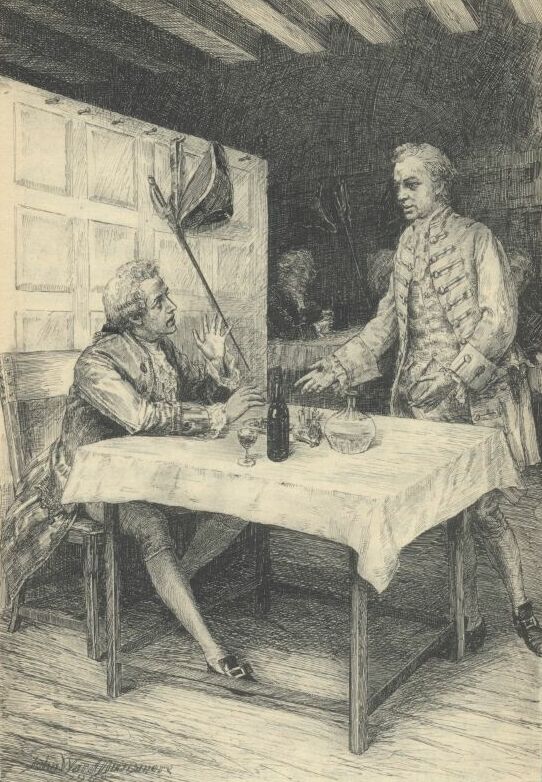
This was, in divers respects, a fortunate rencontre for young Melvil; as the officer was not only perfectly well acquainted with the situation of the Count's family, but also resolved, in a few days, to set out for Vienna, whither he promised to accompany Renaldo, as soon as he understood his route lay the same way. Before the day fixed for their departure arrived, this gentleman found means to insinuate himself so far into the confidence of the Count, as to learn the cause of that distress which he had observed in his features at their first meeting; and being a gentleman of uncommon vivacity, as well as sincerely attached to the family of Melvil, to which he had owed his promotion, he exerted all his good-humour and good sense in amusing the fancy, and reasoning down the mortification of the afflicted Hungarian. He in particular endeavoured to wean his attention from the lost Monimia, by engaging it upon his domestic affairs, and upon the wrongs of his mother and sister, who, he gave him to understand, were languishing under the tyranny of his father-in-law.
This was a note that effectually roused him from the lethargy of his sorrow; and the desire of taking vengeance on the oppressor, who had ruined his fortune, and made his nearest relations miserable, so entirely engrossed his thoughts, as to leave no room for other considerations. During their journey to Austria, Major Farrel, (that was the name of his fellow-traveller,) informed him of many circumstances touching his father's house, to which himself was an utter stranger.
"The conduct of your mother," said he, "in marrying Count Trebasi, was not at all agreeable either to the friends of the Count de Melvil, or to her own relations, who knew her second husband to be a man of a violent temper, and rapacious disposition, which the nature of his education and employment had served rather to inflame than allay; for you well know he was a partisan during the whole course of the late war. They were, moreover, equally surprised and chagrined, when they found she took no step to prevent his seizing upon that inheritance which of right belonged to you, and which, by the laws of Hungary, is unalienable from the heir of blood. Nevertheless, they are now fully convinced, that she hath more than sufficiently atoned for her indiscretion, by the barbarity of her husband, who hath not only secluded her from all communication with her friends and acquaintance, but even confined her to the west tower of your father's house, where she is said to be kept close prisoner, and subjected to all sorts of inconvenience and mortification. This severity she is believed to have incurred in consequence of having expostulated to him upon his unjust behaviour to you and Mademoiselle, whom he hath actually shut up in some convent in Vienna, which your relations have not as yet been able to discover. But the memory of your noble father is so dear to all those who were favoured with his friendship, and the sufferings of the Countess and Mademoiselle have raised such a spirit of resentment against her cruel jailor, that nothing is wanted but your presence to begin the prosecution, and give a sanction to the measures of your friends, which will in a little time restore your family to the fruition of its rights and fortune. For my own part, my dear Count, I consider myself as one wholly indebted to your house for the rank and expectation I now enjoy; and my finances, interest, and person, such as they are, I dedicate to your service."
Renaldo was not slow in making his acknowledgments to this generous Hibernian, whom he informed of his scheme, recounting to him his uncommon transaction with the benevolent Jew, and communicating the letters of recommendation he had received by his means to some of the first noblemen at the Imperial court. Meanwhile, he burned with impatience to chastise Count Trebasi for his perfidious conduct to the widow and the fatherless, and would have taken the road to Presburg, without touching at Vienna, in order to call him to a severe account, had not he been strenuously opposed by Major Farrel, who represented the imprudence of taking such a step before he had secured a proper protection from the consequences with which it might be attended.
"It is not," said he, "your own life and fortune only which depend upon your behaviour in this emergency, but also the quiet and happiness of those who are most dear to your affection. Not you alone, but likewise your mother and sister, would infallibly suffer by your temerity and precipitation. First of all, deliver your credentials at court, and let us join our endeavours to raise an interest strong enough to counterbalance that of Trebasi. If we succeed, there will be no necessity for having recourse to personal measures. He will be compelled to yield up your inheritance which he unjustly detains, and to restore your sister to your arms; and if he afterwards refuses to do justice to the Countess, you will always have it in your power to evince yourself the son of the brave Count de Melvil."
These just and salutary representations had a due effect upon Renaldo, who no sooner arrived at the capital of Austria, than he waited upon a certain prince of distinction, to whose patronage he was commended; and from whom he met with a very cordial reception, not only on account of his credentials, but also for the sake of his father, who was well known to his highness. He heard his complaints with great patience and affability, assured him of his assistance and protection, and even undertook to introduce him to the empress-queen, who would not suffer the weakest of her subjects to be oppressed, much less disregard the cause of an injured young nobleman, who, by his own services, and those of his family, was peculiarly entitled to her favour.
Nor was he the only person whose countenance and patronage Melvil solicited upon this occasion; he visited all the friends of his father, and all his mother's relations, who were easily interested in his behalf; while Major Farrel contributed all his efforts in strengthening the association. So that a lawsuit was immediately commenced against Count Trebasi, who on his side was not idle, but prepared with incredible industry for the assault, resolving to maintain with his whole power the acquisition he had made.
The laws of Hungary, like those of some other countries I could name, afford so many subterfuges for the purposes of perfidy and fraud, that it is no wonder our youth began to complain of the slow progress of his affair; especially as he glowed with the most eager desire of redressing the grievances of his parent and sister, whose sufferings he did not doubt were doubled since the institution of his process against their tormentor. He imparted his sentiments on this head to his friend; and, as his apprehensions every moment increased, plainly told him he could no longer live without making some effort to see those with whom he was so nearly connected in point of blood and affection. He therefore resolved to repair immediately to Presburg; and, according to the intelligence he should procure, essay to see and converse with his mother, though at the hazard of his life.
CHAPTER FIFTY-EIGHT RENALDO ABRIDGES THE PROCEEDINGS AT LAW, AND APPROVES HIMSELF THE SON OF HIS FATHER.
The Major, finding him determined, insisted upon attending him in this expedition, and they set out together for Presburg, where they privately arrived in the dark, resolving to keep themselves concealed at the house of a friend, until they should have formed some plan for their future operations. Here they were informed that Count Trebasi's castle was altogether inaccessible; that all the servants who were supposed to have the least veneration or compassion for the Countess were dismissed; and that, since Renaldo was known to be in Germany, the vigilance and caution of that cruel husband was redoubled to such a degree, that nobody knew whether his unfortunate lady was actually alive or dead.
Farrel perceiving Melvil exceedingly affected with this intimation, and hearing him declare that he would never quit Presburg until he should have entered the house, and removed his doubts on that interesting subject, not only argued with great vehemence against such an attempt, as equally dangerous and indiscreet, but solemnly swore he would prevent his purpose, by discovering his design to the family, unless he would promise to listen to a more moderate and feasible expedient. He then proposed that he himself should appear in the equipage of one of the travelling Savoyards who stroll about Europe, amusing ignorant people with the effects of a magic lanthorn, and in that disguise endeavour to obtain admittance from the servants of Trebasi, among whom he might make such inquiries as would deliver Melvil from his present uneasy suspense.
This proposal was embraced, though reluctantly, by Renaldo, who was unwilling to expose his friend to the least danger or disgrace; and the Major being next day provided with the habit and implements of his new profession, together with a ragged attendant who preceded him, extorting music from a paltry viol, approached the castle gate, and proclaimed his show so naturally in a yell, partaking of the scream of Savoy and the howl of Ireland, that one would have imagined he had been conductor to Madam Catherina from his cradle. So far his stratagem succeeded; he had not long stood in waiting before he was invited into the court-yard, where the servants formed a ring, and danced to the efforts of his companion's skill; then he was conducted into the buttery, where he exhibited his figures on the wall, and his princess on the floor; and while they regaled him in this manner with scraps and sour wine, he took occasion to inquire about the old lady and her daughter, before whom he said he had performed in his last peregrination. Though this question was asked with all that air of simplicity which is peculiar to these people, one of the domestics took the alarm, being infected with the suspicions of his master, and plainly taxed the Major with being a spy, threatening at the same time that he should be stripped and searched.
This would have been a very dangerous experiment for the Hibernian, who had actually in his pocket a letter to the Countess from her son, which he hoped fortune might have furnished him with an opportunity to deliver. When he therefore found himself in this dilemma, he was not at all easy in his own mind. However, instead of protesting his innocence in an humble and beseeching strain, in order to acquit himself of the charge, he resolved to elude the suspicion by provoking the wrath of his accuser, and, putting on the air of vulgar integrity affronted, began to reproach the servant in very insolent terms for his unfair supposition, and undressed himself in a moment to the skin, threw his tattered garments in the face of his adversary, telling him he would find nothing there which he would not be very glad to part with; at the same time raising his voice, he, in the gibberish of the clan he represented, scolded and cursed with great fluency, so that the whole house resounded with the noise. The valet's jealousy, like a smaller fire, was in a trice swallowed up in the greater flame of his rage enkindled by this abrupt address. In consequence of which, Farrel was kicked out at the gate, naked as he was to the waist, after his lanthorn had been broke to pieces on his head; and there he was joined by his domestic, who had not been able to recover his apparel and effect a retreat, without incurring marks of the same sort of distinction.
The Major, considering the risk he must have run in being detected, thought himself cheaply quit for this moderate discipline, though he was really concerned for his friend Renaldo, who, understanding the particulars of the adventure, determined, as the last effort, to ride round the castle in the open day, on pretence of taking the air, when, peradventure, the Countess would see him from the place of her confinement, and favour him with some mark or token of her being alive.
Though his companion did not much relish this plan, which he foresaw would expose him to the insults of Trebasi, yet, as he could not contrive a better, he acquiesced in Renaldo's invention, with the proviso that he would defer the execution of it until his father-in-law should be absent in the chase, which was a diversion he every day enjoyed.
Accordingly they set a proper watch, and lay concealed until they were informed of Trebasi's having gone forth; when they mounted their horses, and rode into the neighbourhood of the castle. Having made a small excursion in the adjoining fields, they drew nearer the walls, and at an easy pace had twice circled them, when Farrel descried, at the top of a tower, a white handkerchief waved by a woman's hand through the iron bars that secured the window. This signal being pointed out to Renaldo, his heart began to throb with great violence; he made a respectful obeisance towards the part in which it appeared, and perceiving the hand beckoning him to approach, advanced to the very buttress of the turret; upon which, seeing something drop, he alighted with great expedition, and took up a picture of his father in miniature, the features of which he no sooner distinguished, than the tears ran down his cheeks; he pressed the little image to his lips with the most filial fervour; then conveying it to his bosom, looked up to the hand, which waved in such a manner as gave him to understand it was high time to retire. Being by this time highly persuaded that his kind monitor was no other than the Countess herself, he pointed to his heart, in token of his filial affection, and laying his hand on his sword, to denote his resolution of doing her justice, he took his leave with another profound bow, and suffered himself to be reconducted to his lodging.
Every circumstance of this transaction was observed by the servants of Count Trebasi, who immediately despatched a messenger to their lord, with an account of what had happened. Alarmed at this information, from which he immediately concluded that the stranger was young Melvil, he forthwith quitted the chase, and returning to the castle by a private postern, ordered his horse to be kept ready saddled, in hope that his son-in-law would repeat the visit to his mother. This precaution would have been to no purpose, had Renaldo followed the advice of Farrel, who represented the danger of returning to a place where the alarm was undoubtedly given by his first appearance; and exhorted him to return to Vienna for the prosecution of his suit, now that he was satisfied of his mother's being alive. In order to strengthen this admonition, he bade him recollect the signal for withdrawing, which was doubtless the effect of maternal concern, inspired by the knowledge of the Count's vigilance and vindictive disposition.
Notwithstanding these suggestions, Melvil persisted in his resolution of appearing once more below the tower, on the supposition that his mother, in expectation of his return, had prepared a billet for his acceptance, from which he might obtain important intelligence. The Major, seeing him lend a deaf ear to his remonstrances, was contented to attend him in his second expedition, which he pressed him to undertake that same afternoon, as Trebasi had taken care to circulate a report of his having gone to dine at the seat of a nobleman in the neighbourhood. Our knight-errant and his squire, deceived by this finesse, presented themselves again under the prison of the Countess, who no sooner beheld her son return, than she earnestly entreated him to be gone, by the same sign which she had before used; and he, taking it for granted that she was debarred the use of pen, ink, and paper, and that she had nothing more to expect, consented to retire, and had already moved to some distance from the house, when, in crossing a small plantation that belonged to the castle, they were met by Count Trebasi and another person on horseback.
At sight of this apparition, the blood mounted into Renaldo's cheeks, and his eyes began to lighten with eagerness and indignation; which was not at all diminished by the ferocious address of the Count, who advancing to Melvil, with a menacing air. "Before you proceed," said he, "I must know with what view you have been twice to-day patroling round my enclosures, and reconnoitring the different avenues of my house. You likewise carry on a clandestine correspondence with some person in the family, of which my honour obliges me to demand an explanation."
"Had your actions been always regulated by the dictates of honour," replied Renaldo, "I should never have been questioned for riding round that castle, which you know is my rightful inheritance; or excluded from the sight of a parent who suffers under your tyranny and oppression. It is my part, therefore, to expostulate; and, since fortune hath favoured me with an opportunity of revenging our wrongs in person, we shall not part until you have learned that the family of the Count de Melvil is not to be injured with impunity. Here is no advantage on either side, in point of arms or number; you are better mounted than I am, and shall have the choice of the ground on which our difference ought to be brought to a speedy determination."
Trebasi, whose courage was not of the sentimental kind, but purely owing to his natural insensibility of danger, instead of concerting measures coolly for the engagement, or making any verbal reply to this defiance, drew a pistol, without the least hesitation, and fired it at the face of Renaldo, part of whose left eyebrow was carried off by the ball. Melvil was not slow in returning the compliment, which, as it was deliberate, proved the more decisive. For the shot entering the Count's right breast, made its way to the backbone with such a shock, as struck him to the ground; upon which the other alighted, in order to improve the advantage he had gained.
During this transaction, Farrel had well-nigh lost his life by the savage behaviour of Trebasi's attendant, who had been a hussar officer, and who, thinking it was his duty to imitate the example of his patron on this occasion, discharged a pistol at the Major, before he had the least intimation of his design. The Hibernian's horse being a common hireling, and unaccustomed to stand fire, no sooner saw the flash of Trebasi's pistol, than, starting aside, he happened to plunge into a hole, and was overturned at the very instant when the hussar's piece went off, so that no damage ensued to his rider, who, pitching on his feet, flew with great nimbleness to his adversary, then, laying hold on one leg, dismounted him in a twinkling, and, seizing his throat as he lay, would have soon despatched him without the use of firearms, had he not been prevented by his friend Renaldo, who desired him to desist, observing that his vengeance was already satisfied, as the Count seemed to be in the agonies of death. The Major was loth to quit his prey, as he thought his aggressor had acted in a treacherous manner; but recollecting that there was no time to lose, because, in all probability, the firing had alarmed the castle, he took his leave of the vanquished hussar, with a couple of hearty kicks, and, mounting his horse, followed Melvil to the house of a gentleman in the neighbourhood, who was kinsman to the Countess, and very well disposed to grant him a secure retreat, until the troublesome consequences of this rencontre should be overblown.
Trebasi, though to the young gentleman he seemed speechless and insensible, had neither lost the use of his reason nor of his tongue, but affected that extremity, in order to avoid any further conversation with the victor. He was one of those people who never think of death until he knocks at the door, and then earnestly entreat him to excuse them for the present, and be so good as to call another time. The Count had so often escaped unhurt, in the course of his campaigns, that he looked upon himself as invulnerable, and set all danger at defiance. Though he had hitherto taken no care of the concerns of his soul, he had a large fund of superstition at bottom; and, when the surgeon, who examined his wound, declared it was mortal, all the terrors of futurity took hold on his imagination, all the misdemeanours of his life presented themselves in aggravated colours to his recollection.
He implored the spiritual assistance of a good priest in the neighbourhood, who, in the discharge of his own conscience, gave him to understand that he had little mercy to expect, unless he would, as much as lay in his power, redress the injuries he had done to his fellow-creatures. As nothing lay heavier upon his soul than the cruelty and fraud he had practised upon the family of Count Melvil, he earnestly besought this charitable clergyman to mediate his pardon with the Countess, and at the same time desired to see Renaldo before his death, that he might put him in possession of his paternal estate, and solicit his forgiveness for the offence he had given.
His lady, far from waiting for the priest's intercession, no sooner understood the lamentable situation of her husband, and found herself at liberty, than she hastened to his apartment, expressed the utmost concern for his misfortune, and tended him with truly conjugal tenderness and fidelity. Her son gladly obeyed the summons, and was received with great civility and satisfaction by his father-in-law, who, in presence of the judge and divers gentlemen assembled for that purpose, renounced all right and title to the fortune he had so unjustly usurped; disclosed the name of the convent to which Mademoiselle de Melvil had been conveyed, dismissed all the agents of his iniquity, and being reconciled to his son-in-law, began to prepare himself in tranquillity for his latter end.
The Countess was overwhelmed with an excess of joy, while she embraced her long-lost son, who had proved himself so worthy of his father. Yet this joy was embittered, by reflecting that she was made a widow by the hands of that darling son. For, though she knew his honour demanded the sacrifice, she could not lay aside that regard and veneration which is attached to the name of husband; and therefore resolved to retire into a monastery, where she could spend the remainder of her life in devotion, without being exposed to any intercourse which might interfere with the delicacy of her sentiments on that subject.