Chapter XIV · FORÊT DE MORMAL AND HAUTMONT (November 3-11, 1918)
Reading edition
An advance along the entire fronts of the Fourth, Third and First Armies, French armies co-operating, had been planned for the 4th November. The attack on the 4th Corps front was to be carried out by the 37th Division on the right and the N.Z. Division on the left; and the 42nd Division was to pass through the New Zealanders, and the 5th Division through the 37th, on the night of November 5-6. As secrecy was essential, movements of troops prior to the opening of the battle had to be made in darkness.
The 126th Brigade marched out of Beauvois soon after darkness fell on November 3, the 127th following, and the 125th bringing up the rear. The roads had been much damaged by heavy traffic and rain, and the going was bad. The 127th Brigade completed its first stage—to Viesley—before midnight, and the 126th Brigade arrived at Solesmes between 2 and 3 a.m. on the 4th, and remained there until the attack of the 4th Corps was launched, at 5.30 a.m. Secrecy being no longer necessary the march was then resumed. By 6 p.m. the New Zealanders reported the capture of Le Quesnoy, with 1000 prisoners, and the 126th and 127th Brigades were now in touch with the situation on the N.Z. Division’s front, the former having reached Beaudignies, about 3000 yards south-west of Le Quesnoy.
The 126th Brigade passed through Le Quesnoy to Herbignies on the morning of the 5th November, keeping about 6000 yards in rear of the New Zealanders, and the rear brigade, the 125th, reached Beaudignies. Here D.H.Q. opened during the morning of the 5th, but on account of the situation moved further forward, to Potelle Château. In the afternoon the leading brigade entered the extensive Forêt de Mormal[24] at a point about half a mile east of Herbignies. Bad as the conditions of the march from Beauvois had been, they now became far worse. Rain had been falling steadily for some days, and the roads and forest tracks—bad at the best of times—were ankle-deep, and in places almost knee-deep in mud and decaying leaves. At the main cross-roads huge craters had been blown, measuring from 60 to 80 feet in diameter, with a depth of 30 feet. One of these was bridged by the sappers, and a corduroy deviation road made round the biggest—just west of Forester’s House—a way being cut through the trees for horses and vehicles. Four men in each platoon had been furnished with hatchets and bill-hooks in anticipation of obstacles in the forest, and wood-warfare had formed part of the training given at Beauvois.
Meanwhile the leading brigade pressed forward, leaving its transport behind. Progress was slow, as machine-guns, Lewis-guns, munitions and supplies had to be man-handled. The enemy continued to shell the forest spasmodically, and though casualties were infrequent, the sound of the shells crashing through and tearing off the branches was not exhilarating. The long and arduous passage through the Mormal Forest will long be remembered by all three brigade groups as a drab and depressing episode, unrelieved by the excitement of fighting, or even seeing the enemy.
The weather, the congestion, and the condition of the roads had become worse, and the 127th Brigade, which entered the forest on the following day, had a more wretched experience even than the others. For two days they had had no shelter from the bitterly cold rain, and as they were badly in need of a rest, the 125th Brigade was ordered up from Herbignies, where shelter and rest had been obtained, to become the support brigade, the 127th being moved to billets in Le Carnoy for a couple of days. The central road past Forester’s House was the widest and best of the routes, but even here there was barely room for one wagon to pass another. Trees had been blown across it; there were bogs on either side, and its eastern part was shelled continually. If, in making way for motor-traffic, a gun- or wagon-wheel got off the track by so much as a foot, it was at once bogged up to the axle. The Divisional Commander therefore issued an order prohibiting the use of motors beyond a certain point, so Generals and Staff Officers had to proceed on horseback or on foot. It was a necessary but not a popular order, particularly with supply officers, but in spite of all adverse conditions—rain and mud, craters and blown culverts, congestion of men, horses, guns, ammunition and ration vehicles—the transport was most efficiently managed; supplies and ammunition got through, and the troops even received a hot meal from the field-kitchens in the middle of the forest. The Engineers and Pioneers worked magnificently, as always.
November 5-6
On the evening of November 5 the command of the left division sector of the 4th Corps front passed to the G.O.C. 42nd Division, and by 3.30 a.m. on the 6th the relief of the leading N.Z. Brigade by the 126th Brigade had been completed. The relief had been peculiarly difficult, on account of the intense darkness, the uncertainty of the location of the troops to be relieved, and the state of the forest roads. The front taken over ran from a point just beyond the forest near Petit Bayay on the right and along the extreme eastern fringe a little further north, then bent back through the forest to Les Viviers and La Grande Rue, where the situation was obscure, the right division of the 6th Corps being echeloned some 3000 yards to the rear of the 42nd’s front. The 4th Corps front was, as usual, in advance of the Corps to right and left, and once again the 42nd Division formed the spearhead of the 4th Corps offensive, taking this rôle turn and turn about with their New Zealand comrades. To cover the exposed left flank a second M.G. Company was allotted to the 126th Brigade.
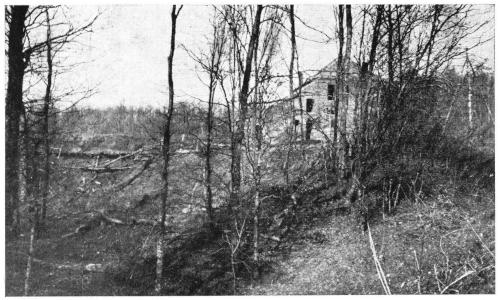
FORESTER’S HOUSE AND CRATERS IN THE FORÊT DE MORMAL.
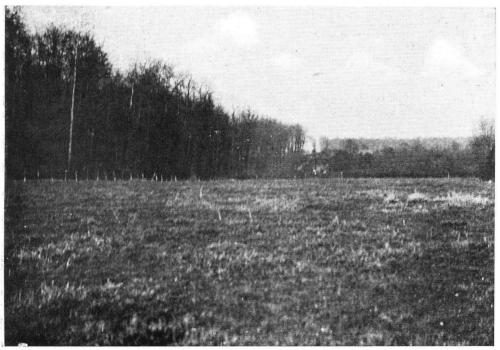
EASTERN EDGE OF THE FORÊT DE MORMAL.
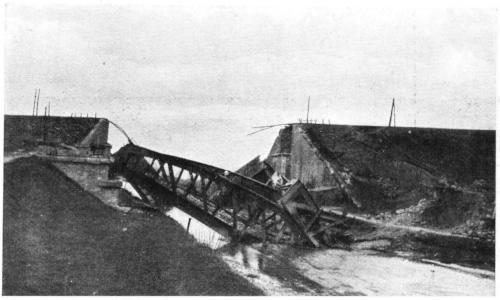
NOVEMBER 1918. THE ENEMY’S EFFORTS TO DELAY OUR ADVANCE.
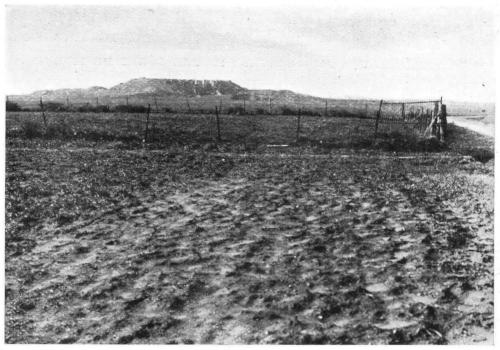
FORT EAST OF HAUTMONT, NEAR WHICH THE DIVISION HAD ITS LAST FIGHTING ON NOV. 8, 1918.
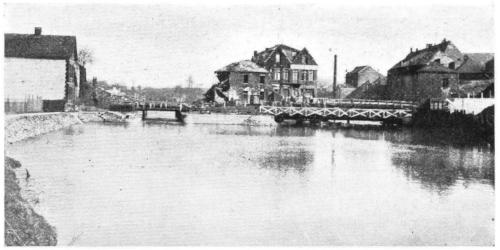
HAUTMONT, CAPTURED BY 126TH BRIGADE ON NOV. 8, 1918. THE BRIDGES WERE ERECTED BY THE DIVISIONAL ENGINEERS.
At 6.30 a.m. on the 6th—about three hours after the completion of the relief—the advance was resumed, with the 5th E. Lancs. on the right and the 8th Manchesters on the left. There could be little artillery support as the difficulties of movement through the vast expanse of forest had increased with the continuous rain and the heavy traffic over the soft tracks, and though officers and men of the artillery brigades worked like heroes they could not accomplish the impossible. The 5th E. Lancs. gained their objective—the road running south from Les 5 Chemins and Hoisies Farm—after severe fighting and numerous casualties, inflicted mainly by the enemy machine-guns strongly posted in the neighbourhood of Hoisies Farm and, further south, in the orchards and gardens between Petit Bayay and the River Sambre.
On the left the progress of the 8th Manchesters was slower. Their left flank was entirely exposed to intense machine-gun fire, particularly from Hargnies to the north-east and Coutant to the north, and their casualties were serious, one company losing all officers but one. They had to make a way through numerous thick hedges, every gap of which was under direct machine-gun fire, and despite gallant attempts to go forward the battalion was held up on a line between one hundred and two hundred yards east of the forest boundary. Fighting continued until darkness supervened, when the troops lay on the roadside, in ditches, or under hedges, in the cold and rain. The 10th Manchesters, in close support, experienced the same trying conditions.
As the nearest point to which ambulances could be brought was two and a half miles in rear of the fighting, the evacuation of the wounded was a matter of much difficulty. The badness of the roads and tracks and the persistence of enemy shelling and machine-gun fire on all forward roads gave a heavy and dangerous task to the stretcher-bearers. It was largely due to the energy of Lieut.-Colonel Callam, D.S.O., commanding the 1st Field Ambulance, in rearranging and supervising the system of evacuation, that the wounded were successfully cleared. The R.E. and the Pioneer Battalion worked day and night on the road craters and blown culverts in the Mormal Forest, and gradually the routes were opened up.
On the evening of the 6th orders were received that the advance would be continued in the early morning by the divisions on the right and left, and that the 42nd Division would not attempt to push forward until the right division of the 6th Corps, on its left, had made progress. By 8.45 a.m. on the 7th this division had passed through Coutant and come up into line, and the 126th Brigade resumed its forward move. The 10th Manchesters had been brought into the centre of the front line, with the 5th E. Lancs. on the right and the 8th Manchesters on the left. The three battalions advanced steadily, and by 10 a.m. Hoisies Farm, the Five Roads, and the hamlet of Hargnies had been captured. Casualties were now slight, for the enemy, no longer able to enfilade the left flank, gave ground without waiting for our troops to get to close quarters.
At 10.30 a.m. the Divisional Commander rode round the front and ordered the advance to be continued by means of strong patrols, which pushed forward at once to the line Vieux Mesnil—Boussières. By noon the high ground beyond Vieux Mesnil and between that village and Boussières had been occupied. In view of the heavy losses of the previous day the 8th Manchesters had been withdrawn into brigade reserve, and the other battalions continued their advance. Little opposition was encountered at first, but later Vieux Mesnil was heavily shelled, and the left flank, which was again exposed, suffered from machine-gun fire.
On the evening of November 7th the 126th Brigade was given a further objective, the high ground immediately east of the River Sambre, including Hautmont, a small manufacturing town situated on both banks of the river, and the Bois-du-Quesnoy. On the following morning the 125th Brigade would pass through the 126th and advance to the final objective, east of the Maubeuge—Avesnes road, i.e. on a line running due south from Maubeuge.
Before daybreak on the 8th the 126th Brigade had seized the Bois d’Hautmont, a large wood west of the Sambre, and had sent patrols into the western outskirts of the town, surprising a small enemy rearguard there. By 10.15 a.m. the parts of the town on the western bank of the Sambre had been secured. All the bridges had been destroyed, but, though the river here is from 40 to 50 yards in width, the leading companies of the 10th Manchesters and 5th E. Lancs. at once set to work to improvise a crossing. The main road had been carried over a lock to an island by a bridge of masonry, and then across the stream by another bridge. The explosions that had dropped these bridges had partially demolished houses on the island and on both banks, so there was ample material on the spot. Assisted enthusiastically by the inhabitants of Hautmont, who dragged doors, beds, and mattresses to the river bank, the Oldham and Burnley men managed to connect with the island, and thence with the further bank. Parties of both battalions then engaged the enemy rearguards, which were holding out with machine-guns in the eastern parts of the town and with field-guns near Fort Hautmont, more than half a mile east of the town. Street fighting continued in the outskirts until the Germans were finally driven from the town, though they still held a position at the cemetery about half a mile east of the river.
The reception given to the victorious troops by the delighted inhabitants will never be forgotten. Shells were still crashing into the houses, and machine-gun bullets flew around, but these were utterly disregarded in the exultation of the moment. Women threw their arms round the necks of the soldiers, old men embraced them, girls ran to them with cakes and flowers and wine. The horrors of a long captivity were forgotten in the joy of victory and the impulse to welcome and honour the victors. The enemy artillery made a special target of the Prisoners of War cage and hospital, in which were two English doctors and about thirty British patients, and shelled this quarter vigorously.
Capture of Hautmont, November 8
Meanwhile, at about 8 a.m., the 125th Brigade had crossed the Sambre near Pont-sur-Sambre, and a little later—the river here forming a loop northwards—had crossed again by a footbridge thrown across by the sappers near Boussières, and had approached Hautmont from the south as the 126th Brigade closed upon it from the west. Enemy shell fire was heavy, his batteries occupying forward positions and remaining in action until the infantry were close upon them. Enemy rearguards held strong positions at Fort Hautmont and Ferme de Forêt (the latter being about 800 yards south-east of the fort), and were well supplied with field artillery. The Fusiliers, however, made good progress, and by 5 p.m. the 5th L.F., on the right, were due south of Fort Hautmont and near to Ferme de Forêt, where much opposition was met from enemy machine-guns. The 7th L.F. on the left were close to the fort, threatening to envelop it from west and north, and patrols were working further north, beyond the cemetery. The 8th L.F., in close support, covered the exits from the town, formed a defensive flank facing north, and drove the Germans from the position they had held on to at the cemetery. At dusk fighting patrols worked forward and succeeded in ejecting the enemy from Fort Hautmont and Ferme de Forêt. This ended the fighting. The Fusilier Brigade had had a stiff march during the morning before coming into contact with the enemy, and their experiences of the previous day in the Mormal Forest had been anything but restful and invigorating; but their work to the south and east of Hautmont showed that “hammering the Hun” was more to their taste than any amount of rest would have been. By capturing the high ground around Hautmont on November 8, the 125th and 126th Brigades had—in the soldiers’ phrase—“broken Jerry’s heart,” and at last he was really “on the run.”
The division was now disposed with the 125th Brigade advancing towards the Maubeuge—Avesnes road, the 126th in Hautmont, and the 127th in Hargnies and Vieux Mesnil. D.H.Q. had moved to Haute Rue. At 10.45 p.m. on the 8th all three Fusilier battalions were working forward. Their losses had been comparatively slight, and at 4.40 a.m. on November 9 they occupied the final objective on the entire front.
The division on the left was still echeloned to the rear, and between 6 a.m. and 7 a.m., patrols of the 7th L.F. pushed forward to Louvroil, a suburb of Maubeuge outside the Division’s boundary, and found that the enemy had withdrawn. No further infantry advance being intended on this day (November 9) the 3rd Hussars and the 4th Corps Cyclists were sent forward. They got into touch with the German rearguards on the line of the River Thure.
The nearest railhead was at Caudry, more than 30 miles in rear of Maubeuge, and delayed-action mines, cunningly hidden, and timed to explode on different days, continued to blow up the railway line and roads. The Motor Transport Company of the Divisional Train had served the Division well throughout the campaign, but now its heavy vehicles could not get through the narrow, congested, badly damaged tracks of the forest, and had to make a long detour through Bavay. Without transport it was impossible, even for British infantry, to keep up with the rapidly retiring enemy, who had the use of a thoroughly efficient railway system and undamaged roads, all of which were destroyed later by his rearguards. The horse transport of the R.A.S.C. succeeded in bringing up the absolutely essential supplies, and the Sappers and Pioneers made this possible, though they had to work and march both day and night to keep up with the rate of advance. In addition, the bridging equipment of the three field companies and of the N.Z. Engineers had to be brought as close up to the front as possible, and at the same time kept free from any serious risk of damage by shell fire, for there was no bridging park available to replace damaged pontoons. At 10 a.m. on November 9 the Divisional Engineers began to bridge the Sambre, and by 8 p.m. a girder bridge over the lock and a pontoon bridge over the river were open for traffic. While this work was in progress the Pioneer Battalion, assisted by a crowd of willing French civilians, had cleared away all the debris, including a large coal-dump, that had blocked the approaches to the bridges.
In the afternoon the divisional front was taken over by the 7th L.F., with an outpost line 1000 yards east of the Maubeuge—Avesnes road, and the other battalions were withdrawn into billets in Hautmont, where D.H.Q. was now opened. In the evening, patrols of the 7th L.F. entered Ferrière and Les Trieux—nearly two miles beyond the outpost line—and captured three trains full of munitions, a motor-lorry, and machine-guns.
Orders were received on the morning of the 10th for the Division to take over the infantry outpost line on the whole of the Corps front. This was carried out during the day, the 7th L.F. covering the front with two outpost companies and two companies in support; and the pursuit of the enemy on the Third Army’s front was taken over by the 6th Corps.
November 11, 1918
On the morning of November 11, 1918, the order was issued—
Hostilities will cease at 11 a.m. to-day. Troops will stand fast on line reached at that hour. Defensive precautions will be maintained. There will be no intercourse of any description with the enemy.
A few hours later the Divisional Commander issued a Special Order of the Day—
“The Armistice proclaimed to-day has brought the operations in which the Division was engaged to a premature conclusion.
“Generally speaking, the recent fighting was not of the violent nature in which you have previously taken part and so greatly excelled. At the commencement of the operation, however, it was sufficiently severe, and the conditions imposed by the Forest of Mormal and the bridgeless River Sambre were such as to call for the highest soldierly qualities.
“After long marches at night in bad weather over boggy forest tracks, although cold and wet, hungry and tired, you attacked and defeated the enemy with your customary indomitableness.
“When the history of the war is written your efforts, commencing in the Forest, then forcing the passage of the bridgeless River Sambre in the face of severe enemy fire, and culminating in the capture of the town of Hautmont, will rank very high among the exploits of soldiers during this great war.
“I consider that the Divisional Motto has once again, probably for the last time, been entirely upheld.
“Officers, N.C.O.s and men of all arms and services in the Division, I am proud to be your Commander and to be able once more to thank you, in the name of our King and Country, for your gallant deeds and your steadfast loyalty.”
SPECIAL ORDER OF THE DAY
Charleroi, 18th March, 1919.
Demobilization is so rapidly scattering the officers and men of the Division, that the time has arrived when I must take a formal farewell of those who, during the past two years, have served me so well.
On such an occasion, it will not be out of place briefly to review the achievements of the Division throughout the great war.
The first critical days of August, 1914, brought with them the call to the Territorial Force to volunteer for active service abroad. The East Lancashire Division eagerly offered itself, and may well be proud of its unique record of being the first division of the Territorial Force to leave England for service abroad.
In September, 1914, the Division sailed to Egypt. There the work of training was relieved by a share of the garrison duty and defensive operations in Egypt which, in February, 1915, brought the Division its first fighting in the repulse of the Turkish attack on the Suez Canal.
In May, 1915, the Division landed in Gallipoli. There for eight long months it fought a campaign of unceasing danger and privation, punctuated only by fierce and bloody engagements. The Division, and those in East Lancashire who are associated with it, may well be proud of its achievements on June 4th, 5th and 6th, 1915.
Following the evacuation of the Dardanelles, the early months of 1916 saw the Division on another front—Sinai Peninsula. There it took part in the pursuit of the Turkish army to El Arish.
The month of March, 1917, brought the Division into France, and its achievements there are still comparatively fresh in our minds.
After its earliest tours of duty at Epéhy and Havrincourt, it took its part in the operations at Ypres in 1917. Thence it went to Nieuport, where for a spell it held a particularly difficult sector.
The winter of 1917-1918 saw it holding the line astride the Béthune—La Bassée Canal, cheerfully undergoing the trials, dangers and discomforts of a winter of trench life. During its tour here, the Division worked strenuously on a system of defence destined to prove of vital importance in the enemy offensive on the Lys in April, 1918; and its sister Division, the 55th West Lancashires, has paid a generous tribute to the assistance this work rendered them when they won renown in the heroic defence of Givenchy.
In March, 1918, the Division was plunged into the final phase of the war. From rest billets behind Béthune it was hurried in busses to the area north of Bapaume to help in stemming the great enemy offensive. This it effectually did in an epic battle in a manner which has earned for it undying fame. From the 23rd March on, it stubbornly faced a determined enemy flushed with success and far superior in numbers of men and guns. With its flanks often in the air, and no artillery support but what its own gunners could give, it coolly and gallantly covered the disorganization in the rear areas. For seventeen consecutive days it remained in action and held its ground in a manner that cannot be surpassed by the performance of any troops in any period of history.
On the 21st August, 1918, after three months’ continuous duty in the line near Hébuterne, and without any preliminary training, the Division took part in the opening stage of the great Allied attack. From that time until the Armistice on November 11th it played a continuous part in the great offensive. We can with reason be proud of the Division’s share in that fighting. Its record includes an advance of 64 miles, during which it fought in 12 general actions—each of several days’ duration. Its captures include 18 towns and villages, over 4000 prisoners, 37 guns of all calibre, 122 trench mortars, 455 machine guns, and much other valuable booty.
The Commander’s Farewell Order
Early in 1918 I set the Division a motto, “Go one better,” believing the spirit it expressed would always carry them to success. It has invariably acted up to that motto, and it is my pride to be able to say that never has the Division been called upon to undertake an operation in which it did not succeed, and never was it set a task which it did not more than accomplish.
Such honours have not been won without a heavy toll in wounded and in dead. Many a gallant Lancashire lad lies in a soldier’s grave in Gallipoli, Sinai, France and Belgium, but the memory of their glorious deeds will live in our hearts for ever.
For those who remain, I hope before relinquishing my command, to have organized a “42nd DIVISION OLD MEMBERS ASSOCIATION.” Through its agency we will meet again from time to time, and so keep alive old memories and old friendships, and lend a hand to those amongst us who may be in need, in the same spirit of mutual helpfulness which has inspired us during the past.
In bidding farewell to the Division, in command of which I have spent the happiest and proudest moments of my life, I wish to express to all ranks of every arm and department my deep admiration for the noble services they have rendered to their King and Country, and my overwhelming gratitude for the loyal support they have always accorded to me as their Divisional Commander.
GOOD LUCK. GOD PROSPER YOU.
A. Solly-Flood, Major-General, Commanding 42nd (E.L.) Division.