SERVICE OVERSEAS—HEAVY FIGHTING ALL ALONG THE FRONT, AND A TRIUMPHAL MARCH INTO GERMANY.
Reading edition
SERVICE OVERSEAS—HEAVY FIGHTING ALL ALONG THE FRONT, AND A TRIUMPHAL MARCH INTO GERMANY.ToC
The day of the move overseas arrived. This was on November 15, 1915, when the regimental transport entrained at Tidworth for Havre, followed one day later by the Battalion, which proceeded to Folkestone, Boulogne being reached on November 17, Ostrohove Rest Camp being the first objective. No time, however, was wasted there, for on November 18 the Battalion entrained at Pont-de-Briques, joining the transport which had come up from Havre.
It was at Steenbecque, reached a day later, and where billets were found in barns and farmhouses, that the sound of artillery in action was first heard by the Battalion. Four days were occupied here in sorting things out generally, the companies parading, route marching, and being inspected.
On November 23 a move was made to Busnes, the first part of the route being over badly cut up second-class roads, and the remainder on pavé. The men, the war diary tells us, marching in greatcoats, and carrying blankets, found the march very trying. Billets in the area La Miquellerie were reached at 3 p.m. Distance, 11½ miles.
Then came a very important thing from a soldier's point of view. Pay was drawn from the Field Cashier, and distributed for the first time in France. Next came the notification that in conformation with the policy of re-forming the 33rd and the 2nd Divisions by forming brigades, each consisting of two new battalions and two regular battalions, the 99th Brigade was to lose the 17th and 24th Battalions Royal Fusiliers, receive the 1st Royal Berks and the 1st King's Royal Rifle Corps and join the 2nd Division.
On November 25 the Battalion paraded to march to their new billets at Bethune, being inspected en route by General Walker and the Staff of the 2nd Division. General Walker's opinion was that the 23rd Royal Fusiliers was one of the best battalions he had seen in Bethune.
Still moving, on November 26 the Battalion marched to Annequin, Fosse 9, and owing to the road being frequently shelled, orders were given that seventy-pace intervals should be kept between platoons east of Beuvry. To improve matters, it may be mentioned, there was a heavy fall of snow, and in the portion of the village south of La Basse the majority of the houses were in ruins, the result of frequent bombardments by the enemy.
Then began the first experience of the Battalion in warfare. Before being trusted to hold a line by itself it had to serve an apprenticeship. This was done by attaching, in the first place, platoons, then companies, and then the half-battalion to battalions in the line in order to learn the work and what was expected of them.
During this time much kindness was experienced from the regular battalions to which the attachments were made. The units of the Battalion not doing attachment duty were used for working parties in the trenches and suffered several casualties. No. 2 platoon, right flank company, specially suffered, being caught by shrapnel fire on the Bethune-La Basse road, ten N.C.O.'s and men being wounded.
On December 10 instruction in the use of the gas helmet was given. Every man was required to pass through a hut sprayed with chlorine gas ten times as strong as would be used on ordinary occasions, General Kellett being present while this was being carried out, and himself going through the test.
So things went on until December 19. On that date the Battalion marched to Cambrin support point to relieve the 1st Royal Berks and take over a sector "on its own." In the trenches, No. 1 Company was on the right, adjoining the 1st King's Royal Rifle Corps, No. 2 Company on the left, adjoining the Argyll and Sutherland Highlanders, No. 3 Company was in the centre, and No. 4 Company was in support at Annequin (Fosse).
It was a very busy time, for No. 3 Company held command of the sap head at New Crater, a spot where German snipers were particularly troublesome. A gas attack was ordered upon the enemy, but, much to the disappointment of the officers and men, it proved a "wash-out" owing to the breeze dying down at the last moment. On December 21, however, as the wind was favourable, a gas attack took place on a front of about a mile. It was on this day that Captain Cameron, of No. 1 Company, was wounded in the arm by a piece of high-explosive while entering the front line.
Then the Battalion, less No. 4 Company, was relieved by the 1st Royal Berks, and proceeded to reserve billets at Annequin (Fosse) on December 22. Not for complete rest, though, as it is generally understood by the civilian, for working parties had to be detailed; indeed, on December 24 all four companies were out, less sick and those on duty. And, says the war diary, no straw was provided for the billets, no coke, coal, or wood for the drying-room, and no facilities for drying or cleaning clothes.
Christmas Day in the Trenches—On Christmas Day the Battalion paraded for trench duty to relieve the 1st Royal Berks, the trenches taken over being the same as were occupied on December 19-22, with the alteration in disposition that made No. 4 Company replace No. 3 Company in the centre.
There was also a special bombardment on this day, and the Battalion's first patrol, consisting of four men and an officer, went over the parapet, being out in No Man's Land for an hour. During that time the party located a sniper's post, cut out some wire from the enemy's entanglements, and were persistently sniped at themselves, while great difficulty was experienced in maintaining direction.
Then, on Boxing Day, Colonel Lord Maitland was wounded in the knee by a piece of high-explosive while proceeding to the 99th Brigade Headquarters via Cambrin Church.
The German snipers continued their activity, there were intermittent bombardments, several casualties were sustained, and on December 29 the Battalion was relieved by the 18th Royal Fusiliers. Owing to the bad state of the trenches this relief did not take place until 5.10 p.m., although it was due to be effected at 3 p.m.
Still, the Battalion got back to its billets at Annequin (Fosse), and on December 30 marched back to Busnettes for sixteen days' divisional rest. Owing to the very arduous work which had been done since December 19, on this occasion no packs were carried, and only three men fell out in a tiring march of 11¼ miles.
1916.
The New Year opened quietly, the usual rest-time routine of kit inspection, squad drill, route marching, and so on, being indulged in, a draft coming up from the base on January 7, while on January 11 the first leave for officers commenced. Then came a move, and on January 19 the Battalion marched to Le Touret, relieving the 6th Queen's Regiment, the 99th Infantry Brigade taking over a sector of the front at Festubert from the 37th Infantry Brigade.
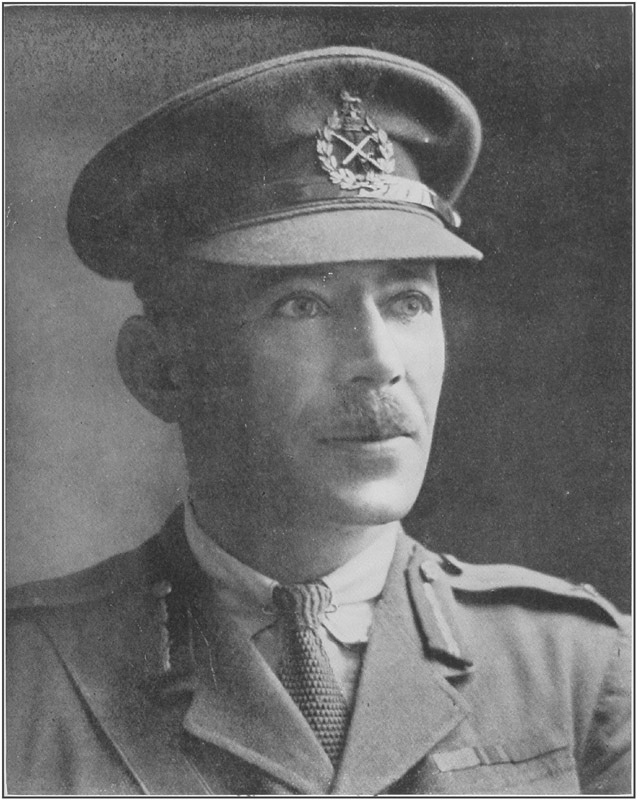
LT.-COL. H.A. VERNON, D.S.O.ToList
To face p. 42
On January 22 the Battalion relieved the 1st Royal Berks, "B" Company being in reserve in the old British line, "A" Company in support in Richmond Trench, "C" Company in front line Cover Trench and Islands, and "D" Company in front line Orchard Trench. The front line and support line garrisons, it may be noted, had to take up their positions over the top, and so could not be visited in daylight. The position remained the same until the then Kaiser's birthday, on January 27, when although the order for relief was given at 6 p.m., a "stand to" was ordered in anticipation of an attack.
This did not come off, and, the relief by the 24th Royal Fusiliers being effected, the Battalion marched back to Bethune on January 28, where the billets were inspected by General Kellett.
On January 29 Colonel Lord Maitland relinquished the command of the Battalion, temporary command being taken by Major Richey, D.S.O., and Lieutenant-Colonel H.A. Vernon (1st King's Royal Rifle Corps) assumed command on January 31, while Lieutenant Cooper was appointed machine-gun officer in place of Lieutenant Lewis, who had been wounded.
Le Quesnoy was the next move, made on February 3, and relieving the 1st Royal Berks on February 7, the Battalion was in turn moved out of the trenches into the village line Givenchy on the 11th, remaining there until the 15th, when it again relieved the 1st Royal Berks in B3 sub-sector Givenchy. On the 17th the Battalion was relieved by the 16th Royal Welsh Fusiliers and moved to Le Quesnoy, remaining there until the 27th, when it proceeded to Barlin. On February 28 another move was made to Petit Sains, relieving the 22nd Royal Fusiliers, and on the 29th the Battalion took over the Souchez North sector of trenches from the French 77th Infantry Regiment.
From March 1 to March 13 the Battalion held the line at Souchez North in turn with the 1st King's Royal Rifle Corps and on the latter date proceeded to billets at Noulette, returning again to the trenches on the 17th, the Battalion on the left being the 17th Royal Fusiliers, and on the right the 1st Royal Berks. Then on March 28 it moved to La Comte for divisional rest.
Reclinghem was the next move, made on April 9, and on April 11 there was a Brigade field day, another reinforcing draft arriving on the same day. Then on the night of April 21-22 the Battalion relieved the 1st King's Royal Rifle Corps in the Souchez second sector of the line. So the end of the month arrived with alternate duty in the trenches and rest in billets.
More reinforcements, to replace wastage, arrived in the early part of May, and on the 23rd the Battalion was in the trenches at Berthouval, marching to its billets at Camblain l'Abbé on May 30. Working parties were naturally provided for the trenches while the Battalion was resting, and two men were accidentally wounded on the 4th. But things were moderately quiet until the night of June 10-11. On that date the Battalion relieved the 17th Middlesex Regiment in the Carency left sector of the front.
On June 21 Lieutenant-Colonel Vernon was wounded whilst visiting a sap head held by Jerry Delaney, the boxer, Major H.V. Pirie assuming command of the Battalion until he returned to duty. The Battalion was relieved by the 1st King's Royal Rifle Corps on the night of June 22-23, and proceeded to billets at Villiers aux Bois. The next move, on the 27th, was made to Estrée Cauchie.
The Somme Fighting.—Then came the move to the Somme and the July of 1916, when the average life of the infantry subaltern in France was only worth three weeks. Many, indeed, were killed within a week of their crossing the Channel, on the very first day of entering the trenches and taking part in the British advance. The 23rd Royal Fusiliers were engaged in the whole of the desperate fighting on the Somme, including the battle of Delville Wood, the story of which is told in another part of this volume.
Following this bath of blood, on August 1 the Battalion left Bund support trench, two companies going to Longueval Alley, and two remaining to garrison and dig trenches at Montauban.
Becoming united again, on the 29th the Battalion, under the impression that it was going out for a promised rest after its battle, moved to The Citadel, Sandpit Valley, and on to Mericourt l'Abbé; thence on to Fremont (passing through Amiens), Naours, Longuevillette, Authie, and Bus les Artois; and next, instead of the longed-for rest, found itself back in the trenches again at Hebuterne, relieving the 1st Coldstream Guards!
September was spent in the Hebuterne sector, and October saw many moves. Starting with Coieneux (Basin Wood) the Battalion was at the Redan (Serre sector), Mailly-Maillet (where the church, it will be remembered, had been protected by means of fascines), Raincheval, and Acheux Wood, where the rail-head and the factory with its tall chimney were bombed heavily from the air and shelled by the German heavies. Finally, on October 30, the Battalion relieved the 2nd Highland Light Infantry in the Redan right sub-sector, being in the trenches there when the month drew to a close.
November saw the Battalion taking its part in the Battle of Beaumont Hamel. Told by the War Diary this month's events were:
November 1.—Battalion in Redan right sub-sector.
November 2.—Battalion relieved by the 1st King's Royal Rifle Corps, and proceeded to billets at Mailly-Maillet.
November 3-4.—Battalion in billets, providing working and carrying parties.
November 5.—Battalion relieved 1st King's Royal Rifle Corps in Redan right sub-sector.
November 6.—Battalion in Redan right sub-sector.
November 7.—Battalion relieved by 24th Royal Fusiliers and proceeded to billets at Bertrancourt.
November 8-12.—Battalion in billets, providing working and carrying parties.
November 13.—Battalion left Bertrancourt at 2.10 a.m., and proceeded to Ellis Square, Fort Hoystead, and View Trench (Redan right sub-sector). "A" and "C" Companies sent at 10.10 a.m. to G.O.C. 5th Brigade at White City. These companies proceeded later to the old German front line, and at 5 p.m. "C" Company was ordered up to reinforce the 2nd Highland Light Infantry in Green Line.
"B" and "D" Companies at 7 p.m. carried the German second line. During this time, these companies were under the command of G.O.C. 8th Infantry Brigade. At 7 p.m. Battalion Headquarters moved to White City.
November 14.—1st King's Royal Rifle Corps at 3 a.m. also established Headquarters at White City. At 6 a.m. Battalion moved forward in support of 1st King's Royal Rifle Corps and 1st Royal Berks. "A" and "C" Companies proceeded to Crater Lane, and later to Wagon Road (on right). "B" and "D" Companies (on left) took up position in Lager Alley, between the Oxford and Bucks Light Infantry and the 1st Royal Berks.
November 15.—At 1 a.m. Battalion Headquarters moved from White City to Headquarters of 1st King's Royal Rifle Corps in German front line. Companies still in support of 1st King's Royal Rifle Corps and 1st Royal Berks.
November 16.—Battalion at 1 a.m. moved back to Ellis Square.
November 17.—Battalion moved to billets in Mailly-Maillet.
November 18.—Battalion moved to billets at Sarton.
November 19.—Battalion marched to billets at Gezancourt.
November 20.—Battalion in billets at Gezancourt.
November 21.—Battalion marched to billets at Candas.
November 22.—Battalion in billets at Candas.
November 23.—Battalion marched to billets at Domqueur.
November 24.—Battalion marched to billets at Gapennes.
November 25.—Battalion marched to billets at Millencourt.
November 26.—Battalion in billets at Millencourt.
November 27.—Battalion marched to billets at Oneux.
November 28-29-30.—Battalion in billets at Oneux.
The following month, December, the Battalion also spent in rest at Oneux.
1917.
On January 9 a move was made from Oneux to Candas, to Beauquesne on the 11th, to Bouzincourt on the 13th, and to Aveluy on the 20th. From there it went into the trenches at Courcelette, "A" and "C" Companies being in the front line, and "B" and "D" in support.
On February 1 the Battalion moved from Courcelette to Ovillers Huts, and on the 5th went on to Senlis, moving to Wolfe Huts on the 15th, and into the line for operations a day later.
Intense cold was experienced at this time. The ground, like iron, was covered with snow. The frost was intense, one man being actually frozen stiff at his post on sentry, and drinking water carried to the front line arrived as lumps of ice, from which bits were chipped for eating.
An attack on the German trenches was made on February 17. Unluckily a day before the attack the frost gave way, a very rapid thaw set in, making No Man's Land deep and heavy with slush and mud. Moving to the attack over such ground was terrible; the objective line was reached, but the following casualties were sustained:
Officers killed 8
Officers wounded 4
Officers missing 1
13
Other ranks killed 30
Other ranks wounded 165
Other ranks missing 32
227
The Battalion held the Red Line on February 18, and in the night was relieved and moved to Ovillers Huts again. On the 24th it moved to Bruce Huts, and on the 26th to Albert, returning to Ovillers Huts on the 27th.
March 5 found the Battalion back in the trenches at Courcellette, and on the 10th "D" Company cooperated with the 1st Royal Berks and the 1st King's Royal Rifle Corps in an attack on Grevillers Trench and Lady's Leg Ravine, taking the ravine, killing about 20 of the enemy, and capturing 30 men and 2 machine guns. The casualties of the company amounted to 7 other ranks killed, 26 wounded, 1 accidentally wounded, and 2 died later from their wounds.
The following day the Battalion moved to Wolfe Huts, and on the 19th to Albert again, proceeding from there to Contay, Amplier, Bonnières, Framecourt, Aumerval, and Bailleul les Pernes.
Vimy Ridge.—From Bailleul les Pernes the Battalion moved up to Larosette, behind Vimy Ridge, ready to go in and take over a part of the Ridge after its capture in the coming battle for its possession. On the night of April 11, in a blinding snowstorm, the Battalion relieved the 1/5th Gordons on the captured Ridge, and on the 13th continued the advance to the line of the railway, captured the village of Bailleul, established a line on the enemy side of it, and sent out patrols to Oppy, which was found to be very strongly held by the enemy.
Swaine, photo.
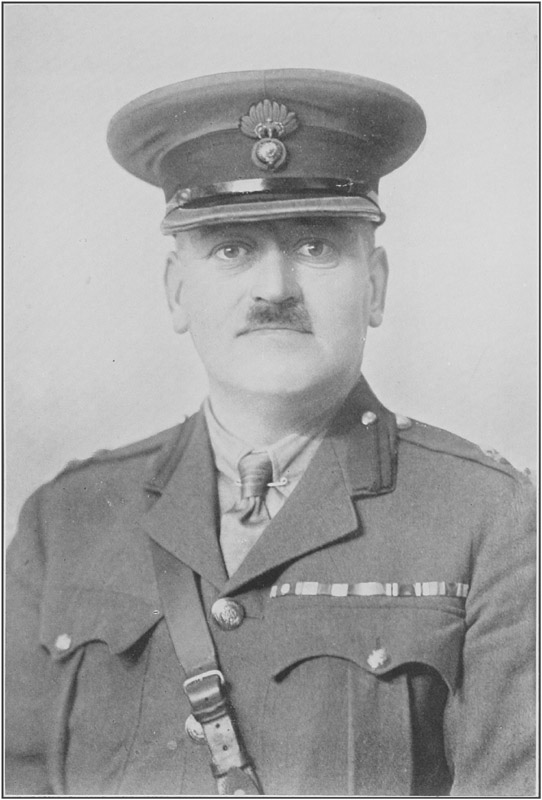
LT.-COL. E.A. WINTER, D.S.O., M.C.ToList
To face p. 50
Owing to a mistaken order, one platoon of "C" Company actually advanced on Oppy to capture it, but were themselves taken prisoners after severe fighting. During this advance one 77mm., two field guns, and one 4.2 howitzer were captured, and whilst moving forward, at the Colonel's side, to the railway embankment, the Adjutant of the Battalion, Captain Lissaman, was killed by an enemy shell.
Being relieved on the 14th by the 1st Royal Berks, the Battalion moved into support and reserve lines, but on the 18th were in the trenches west of Ecurie, moving to a tent camp on the Roclincourt-Maison-Blanche road on the 22nd. Another move, to Maroeil, was made on April 23, and on the 25th the 17th Royal Fusiliers were relieved in the trenches west of Bailleul.
On April 29, at 4 a.m., "B" Company took part in an attack on Oppy by the 1st Royal Berks and the 1st King's Royal Rifle Corps, and then the Battalion moved back into reserve trenches.
On May 1 a composite battalion was formed of two companies of the 23rd Royal Fusiliers and two companies of the 1st Royal Berks, and moved forward to a position in front of Oppy to deliver an attack on the Oppy-Fresnoy line.
Attacking on March 3, Fresnoy trench was captured with between sixty and seventy prisoners and a machine gun. Heavy counter-attacks were made by the Germans during the day, and, in view of these and the retirement of the troops on the right, it became necessary to retire along Fresnoy trench. At 3.30 a.m., on the night of May 3-4, the Battalion was relieved by the 15th Warwicks, and moved back to disused enemy trenches in the Roclincourt area, the total casualties sustained being 7 officers and 122 other ranks.
On May 5 Lieutenant-Colonel Vernon having proceeded on leave, Major E.A. Winter assumed command, and on May 24 Lt.-Colonel Vernon having to report to the War Office on promotion to Brigadier-General, Major Winter was promoted Lieutenant-Colonel, and appointed to the command of the Battalion. On the same day the Battalion moved into the line again, relieving first the 1st Royal West Kents, and then the 22nd Royal Fusiliers.
June 1 saw the Battalion relieved by the 1st King's Royal Rifle Corps in the front line (Oppy-Arleux line), and moved back to Deutscher House and Thelus Wood, working parties for the front line being provided each night. On the 4th, the 22nd Royal Fusiliers came in as the relief, and the Battalion moved to St. Aubyn for rest.
This did not last long, for on June 8-9 the Battalion relieved the 1st King's Royal Rifle Corps in immediate support, Oppy-Arleux line, the casualties sustained being one other rank killed and two wounded. Then, relieving the 22nd Royal Fusiliers, the Battalion went into the front line, being relieved in turn on the night of June 13-14 by the Royal West Kents, and proceeded to Bray.
On June 20 the Battalion was taken by omnibus to Beuvry, and on the 21st relieved the 2/5th Manchester Regiment in the front line, Cambrin left sub-sector, the casualties being two other ranks killed and six wounded. A German raid on the Battalion right was repelled at 3.30 a.m. on the 27th, and the 22nd Royal Fusiliers came in as relief on the evening of that day, the Battalion proceeding to Noyelles for rest.
July opened with the Battalion training at Noyelles under company arrangements, so far as it was possible, having in view its proximity to the line and liability to observation by the enemy. On July 3 the Battalion went into the front line, Cambrin left sub-sector. Six days later it went into support with headquarters at Annequin.
July 5 saw the Battalion, less two companies, in the Cambrin left sub-sector front line, Major N.A. Lewis assuming command in the trenches, with 100 Corps cyclists attached, while Lieutenant-Colonel Winter remained at Annequin for the purpose of training "C" and "D" Companies for a raid.
About 3.30 a.m. an enemy raiding party, about fifteen strong, entered the front line, wounding and carrying off one man. Bombing parties at once bombed along the trench, driving the raiders out, who came under Lewis gun and rifle fire both on entering and leaving their objective. On returning to their own lines they left our wounded man, who was brought in. The body of one of the enemy was found in No Man's Land, but a complete search could not be made owing to the light. At night, however, a patrol went out and brought in the body of the dead German. Other bodies had apparently been dragged back to the enemy trenches. Our casualties were only four wounded.
On July 20, at 10.30 p.m., a raiding party, consisting of two officers and about a hundred other ranks, crossed to the enemy's front and support lines, the object being the capture of these two lines, the infliction of loss on the enemy, and the securing of prisoners and identifications. The raid was preceded by a hurricane barrage from our artillery, Stokes' mortars, and machine guns, being also accompanied with a discharge from oil projectors.
Very few of the enemy were found in the front and support lines, but small parties who were in dug-outs were bombed. Five of the enemy were also bayoneted in a communication trench. The main garrisons of the lines had apparently retired, and no prisoners were taken. Our casualties during the raid were two killed, fifteen wounded, and five wounded and missing.
Then came a move into reserve at Annequin, but from the 27th the Battalion moved into the front line of the Cambrin left sub-sector again up to, and including, August 1. From then until the night of August 25 the Battalion were doing duty in the trenches and in reserve, but on the 26th was relieved by the 8th Sherwood Foresters, and moved to Oblinghem.
There training was carried on, and on September 6 the C.O., accompanied by the company commanders and specialist officers, reconnoitred the Givenchy support line. On the following day the Battalion proceeded to the village support line, no shelling being experienced during the relief of the 17th Middlesex. On September 13 the Battalion relieved the 22nd Royal Fusiliers in the Givenchy left sub-sector front line, a battalion of the Portuguese troops being attached for instruction.
Gas was projected upon the enemy on the 14th; there was no retaliation, and on the following day the Portuguese were relieved by another of their battalions.
About a hundred enemy heavy shells fell on September 16 near the right company's headquarters at Barnton Tee, Barnton Road, blowing in the trench in five places. A bombardment on the left, which commenced later, ceased on our retaliating. On September 17 the Portuguese troops left the trenches and returned to their billets, while on the night of the 18th-19th the Battalion was relieved and proceeded to Beuvry.
Training there until September 26, the Battalion then relieved the 22nd Royal Fusiliers in the Cambrin left sub-sector, and finding the enemy to be ominously quiet, a patrol was sent out to Railway Craters. On the following night eight small patrols were sent out into No Man's Land, and on the 28th two patrols reconnoitred the enemy wire. On the following day eight small patrols were established in No Man's Land to cover work in the trenches, and, ensuing upon this, the German artillery became fairly active.
A move into support, following relief, was made on September 2. On the 5th the Battalion was relieved, and the companies marched independently to the Orphanage, Bethune, then on to Raimbert, the Battalion being watched on the line of march by Generals Pereira and Kellett.
At Bourlon Wood.—Training was carried on, and on November 5 the Battalion made a move through Busnes, Merville, and the Eecke area to the Herzeele area. More training ensued, and a strong rumour was in the air that the 2nd Division was "for Italy." The Battalion was equipped up to the last button, all ranks were looking forward to a change of scenery and new phases of fighting; the medical officer lectured the Battalion on the perils to be avoided in relation to charming Italians, and spirits were high and merry.
But the first attack on Cambrai took place, and instead of going to Italy the 2nd Division was hurriedly moved south by road and rail to take over the line from troops which had conducted the attack.
On the night of November 26-27 the Battalion had reached Beaumetz-les-Cambrai, from which it was moved up to the slopes of Bourlon Wood to take over from elements of the 2/4th King's Own Yorkshire Light Infantry and the Bays. The march along the Cambrai road, across the captured Hindenburg Line, and on to the Sugar Factory will long be remembered by those who took part in it.
Again it snowed—it is curious how many important moves of the Battalion took place in a snowstorm. This time, however, it was a blessing, for it deadened the sound of moving troops, and certainly saved the Battalion being heard and shelled by the enemy.
On the line (if a few scattered posts in shell-holes can be called a line) being taken over, the Battalion at once set to work to dig itself in, profiting greatly by the recent training it had received in "intensive digging." On the left was the 1st King's Royal Rifle Corps, and on the right the 62nd Division, the battalion in support being the 1st Royal Berks. The Battalion held the line on the 27th, and on the 28th changed places with the 1st Royal Berks, going into support positions to them.
On the 30th the heavy enemy attack developed, and the Berks being hard pressed, three companies of the 23rd were moved up to their support. The enemy gained a footing in their line, and one company of the 23rd was used to counter-attack and re-establish the line, which it successfully performed.
The 17th Royal Fusiliers, on the Berks' left, having severe fighting, a section of the 23rd was sent to strengthen their posts, and help was given in supplying them with bombs and S.A.A. On the evening of December 1 the line was readjusted between the 1st Royal Berks and the 23rd Royal Fusiliers—the Berks taking the left and the 23rd the right. On the night of December 1 the position of the Battalion was: two companies and two platoons in the line; two companies, less two platoons, in support.
On the night of December 2 the unit on the right of the 23rd Royal Fusiliers pushed forward its line. In order to keep touch with them, one company from the support positions went over with them at 8.10 p.m. The advance was successful, the objective duly gained and rapidly consolidated—one prisoner and one machine gun being taken in the advance.
Then came a great disappointment to the troops who had fought so well. Further south the enemy's counter-attack had proved successful, converting the position held by the 2nd Division into a very dangerous salient, from which it was imperative to retire.
The necessary orders were issued, and at dead of night, December 4-5, the Battalion retired through Graincourt to Hermies. To cover the retirement two sections per company were left in the line with orders not to retire until just before dawn, and to spend the night in moving up and down the vacated line, firing Verey-lights and rifles to delude the enemy into thinking the line was still held.
By this ruse the Battalion was enabled to carry out the difficult operation of withdrawing in the face of the enemy without his knowledge. The sections so left behind gallantly carried out their tasks and safely rejoined the Battalion at Hermies.
From December 5 the Battalion was in support, but on the 11th it relieved the 21st Londons in the Hindenburg Line, and, after relief, marched on December 20 to Gropi Camp, where Christmas was spent in tents in the snow. In reserve until the 30th, it then relieved the 22nd Royal Fusiliers in the left canal sector (Canal du Nord) of the Hindenburg Line.
1918.
On January 3 the Battalion, relieved, marched independently by companies to Barastre for Divisional rest. January 23 found them at Villers Plouich in the Vacquerie right sub-sector, the Battalion headquarters being in Farm Ravine. On February 3 they entrained on the light railway for Equancourt, where they were placed in Divisional reserve. Not much time was spent in this way, though, for on the 9th the Battalion entrained for Trescault, and proceeded from there to the Vacquerie right sub-sector, remaining in the line there until going into reserve at Equancourt again on the 15th.
On February 22 a move was made to the line again in the Vacquerie right sub-sector. On the night of March 6-7 the Battalion was relieved, and marched to Metz, where they were billeted in huts. It was impossible, however, to secure any real rest here, for the camp was shelled intermittently both during the day and the night.
The afternoon of March 12 saw the Battalion back in the trenches again at Lincoln Reserve and Midland Reserve, "D" Company being in Snap Trench. There was a heavy gas-shell bombardment by the enemy on the nights of the 12th, 13th, and 14th, the Battalion suffering heavy casualties, also intermittent shelling during the day and night, while there was, as a welcome change, a raid on the enemy front line by the Battalion on the night of March 13-14. Then came the relief of the Battalion, which marched back to Equancourt, a rest for the Battalion being absolutely necessary owing to the fact that all the remaining members were suffering from gas poisoning.
The German Offensive.—Next came the great offensive by the enemy—the time when the Germans almost thrust their way right through by force of numbers.
The first indication of the break-through which the Battalion received was enemy bullets actually falling in the camp. Every man turned out, the Battalion took up a line north of Equancourt in an attempt to hold up the advance of the enemy, patrols being sent forward into Fins, where it was found the Germans had succeeded in establishing themselves.
On the following morning an enemy attack was beaten back with heavy loss, but both its flanks being "in the air" the Battalion received orders to retire on Le Transloy. Moving though Hayettes Wood, Ytres, Bus, and Rocquigny, Le Transloy was reached late at night, where the Brigade from which it had become separated was rejoined.
Moving again before dawn, a line was taken up round Gueudecourt, which was held during the day. Making another move at dusk, a fresh line was established at Eaucourt l'Abbaye. Very heavily attacked on the following day, the Battalion was forced to fight a rearguard action, retreating through Le Sars on Pys, where another stand was made.
Again slipping back at night, a position was taken up near Beaucourt sur Ancre. From this position the Battalion again moved back and occupied the old British trenches known as White City trenches near Beaumont Hamel. In spite of many heavy enemy attacks this position was held until the Battalion was relieved by New Zealand troops.
On relief it marched out to the wood at Mailly-Maillet only four officers and seventy men strong.
Resting at Englebelmer for a day or so, it was again moved into the front line at Aveluy Wood, where a German attack was beaten off, the enemy being badly mauled. During the fighting round Gueudecourt, Brigadier-General Barnett-Barker was killed, and, as senior Colonel in the 99th Brigade, Lieutenant-Colonel Winter assumed command, the command of the 23rd Royal Fusiliers devolving upon Major Lewis.
In his anxiety to hold up the enemy for as long as possible and to get the battalion back safely to a line being formed behind him, Major Lewis was taken prisoner at Eaucourt l'Abbaye. The command then devolved upon Captain C.H. Bowyer, who kept it until the return of Lieutenant-Colonel Winter, who rejoined the Battalion on General E. Ironside (now General Sir E. Ironside, who earned fame in Russia) taking over the Brigade.
It only remains to add that the gas casualties from March 12 onwards amounted to 11 officers and 240 other ranks, while the casualties in action from the 22nd to the 31st were:
Officers killed 1
Officers wounded 2
Officers wounded and missing 1
Officers missing 10
Other ranks killed 15
Other ranks wounded 59
Other ranks wounded and missing 6
Other ranks missing 210
During the early part of April the Battalion was busy in moving, being in turn in Hedeauville, Beauval, Houvin, Houvigneul, Ivergny, Coullemont, La Cauchie, and on the 14th relieved the 1st Coldstream Guards in Brigade Reserve in front of Blaireville. Two days later it was in the front line, right sub-sector, in front of Adinfer, doing alternate front line and support duty until the end of the month.
It was not until May 12 that the Battalion marched back to billets at Berles au Bois, where training was carried on until June 7. On that date it relieved the 1st Grenadier Guards in the Ayette left sub-sector. Relieved on the night of June 10-11, it marched back to reserve position near Monchy au Bois, going into the line again in the Ayette sector on the night of 13th-14th.
During the night of June 24-25 "A" Company carried out a raid on the enemy front line, and at 2 a.m. on the 26th "B" Company also carried out a similar operation. July came round, and on the night of the 22nd-23rd the Battalion supplied a flanking party to a raid carried out by the 1st Royal Berks. On the 30th the Battalion was in the Ayette right sub-sector, but on August 5 and August 6 there was a reorganization of the Brigade front, and it went into support.
Then came the British advance, and on the night of August 20-21 the Battalion moved up for an attack by the 3rd Army. Leading off in a dense fog, the 23rd Royal Fusiliers went over the top at Ayette, capturing Aerodrome Trench, and so clearing the way for other troops to leap-frog over them and capture Courcelles.
Moving forward again in its turn, two companies of the Battalion, under Major W.B. Cluff, captured Behagnies. On the night of August 23-24, being relieved by the Loyal North Lancs, the Battalion moved back to bivouac near Courcelles, where it remained until September 2. Moving forward on that day to Vaulx-Vraucourt, it attacked at dawn on the 3rd and reached Morchies, bivouacking near Doignes.
On the 6th-7th the Battalion took over the front line from the 1st King's Royal Rifle Corps and delivered an attack on Slag Avenue, suffering casualties of 3 officers killed and 100 other ranks killed and wounded.
Relieved on the 8th by the 52nd Light Infantry, a bivouac was made at Beaumetz-les-Cambrai, moving on the 15th to Mory. On the 27th the Battalion moved forward in support to the Brigade which was fighting its way onwards, and spent the night in the Hindenburg Support Line just west of Flesquières.
The advance continuing, the Battalion moved again at dawn on the 28th, reaching Nine Wood just west of Noyelles. From here one company was sent forward and assisted the King's Royal Rifle Corps in capturing Noyelles. Then the remainder of the Battalion moved up and took over the front line from the 1st King's Royal Rifle Corps. Attacking on the 30th, the Battalion found itself up against the strong position of Mount sur l'Ouvres, suffering casualties of two officers and sixty-four other ranks. This position could only be subsequently captured by the use of a whole new brigade for the purpose.
German Tanks Unsuccessful.—Relieved at night, the Battalion moved back to bivouac at Nine Wood. Remaining there, resting, till October 7 the Battalion moved up to east of Rumilly on the night of 7th-8th, and delivered a successful attack on Forenville at dawn on the 8th. During a counter-attack the enemy used tanks against the Battalion in an endeavour to oust it from the positions secured, but without success.
On one tank, indeed, getting close to our line an officer, Lieutenant Anderson, armed with a rifle, and accompanied by his batman, got out of the trench, went forward under heavy fire, reached the oncoming tank, hammered at its side with his rifle-butt, and called on it to surrender. The iron door opened, and out came the crew, to be escorted back in triumph as prisoners!
On the early morning of the 9th the Guards' Brigade "leap-frogged" the Battalion and continued the attack, the Battalion moving back to bivouac at Flesquières. Remaining there for a few days, a move was made on the 13th to keep in touch with the general advance, Wambaix being reached after a long march.
Training was carried out here until the 19th, when the Battalion marched to Boussières. At midnight on October 22, under the command of Major H.P. Rogers, it moved up to St. Python, and on the 23rd to Escarmain, taking over the front line from the 52nd Light Infantry. At dawn on the 24th it attacked and captured Ruesnes, and established a line of outposts on the railway beyond. This was the last actual fighting done by the Battalion. Relieved on the 26th by the 7th King's Shropshire Light Infantry, it moved back into reserve.
With the signing of the Armistice came a welcome change. Duty was relaxed so far as was possible, and the Battalion employed the rest of the year in fitting itself out, and getting back into something approaching its old condition, and marching into Germany, a distance of 200 miles.
1919.
January found the Battalion in billets at Niederaussem, forming part of the British Army of Occupation in Germany. Training was still being carried on, however, but sport was not lost sight of. There were platoon football matches, whist drives, paper-chases, and so on, while there was also voluntary educational training in such things as English, French, and shorthand.
On January 24 came the presentation of the King's Colour to the Battalion by Major-General Pereira. Later, on the reorganization of Divisions taking place, the Battalion on February 27 left the 99th Brigade, 2nd Division, in which it had served so long, proceeded by rail through Cologne to Ehreshoven, joined the London Division, and took over the outposts of the Occupied Zone at Lindlar on March 18.
On April 15, the Battalion then being back in Cologne, the command was taken over by Brevet Lieutenant-Colonel L.F. Ashburner, M.V.O., D.S.O., Lieutenant-Colonel Winter being appointed to the command of the British Camp at Antwerp. On May 6 the Battalion was inspected and complimented by General Sir William Robertson, G.C.B., K.C.V.O., D.S.O., Commander-in-Chief British Army of the Rhine.
In the event of the non-acceptance of the Peace Terms by Germany, preparations were made between June 8 and June 19 for an advance, but the orders on June 20 were held in abeyance and subsequently cancelled.
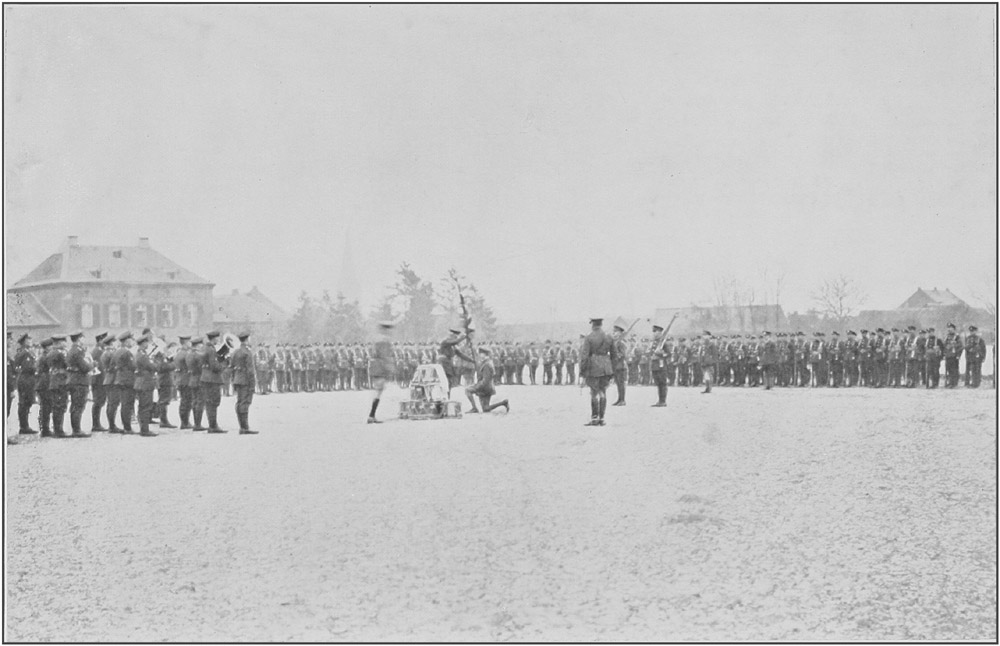
PRESENTATION OF COLOURS: NIEDERAUSSEM, GERMANY, JUNE 24TH, 1919.ToList
To face p. 66
On June 22, at the Brigade swimming gala, the Battalion won two-thirds of the prizes put up for competition, although they had previously lost (2-1) in the "Kalk" football cup final to the 57th Siege Battery.
Battalion sports were held at Klef, near Vilkerath, on July 19, the championship being annexed by "C" Company. A competition for the best company in the Division was won by "D" Company, who were subsequently called upon to furnish a guard of honour on the occasion of the visit of the Army Council to Cologne.
The Battalion also scored in another way, for on August 1 the War Savings results for July were announced. The amount subscribed by the 23rd Royal Fusiliers was £1,137 19s. 1d., the percentage of members being 51 per cent, of the Battalion strength, and the Battalion being top of the VIth Corps list for the amount subscribed.
Finally, the 23rd (Service) Battalion Royal Fusiliers (1st Sportsman's) ceased to exist in March, 1920, after having had a longer life than any other Service Battalion of the Royal Fusiliers.