Chapter XI · ENGLISH ESSAYISTS OF THE GEORGIAN ERA. (continued 2)
Reading edition
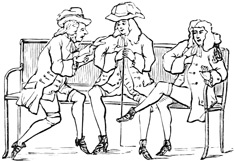
'The chief politician of the bench was a great asserter of paradoxes. He told us, with a seeming concern, "that, by some news he had lately read from Muscovy, it appeared to him that there was a storm gathering in the Black Sea, which might in time do hurt to the naval forces of this nation." To this he added, "that, for his part, he could not wish to see the Turk driven out of Europe, which, he believed, could not but be prejudicial to our woollen manufacture."
'He backed his assertions with so many broken hints and such a show of depth and wisdom, that we gave ourselves up to his opinions. The discourse at length fell upon a point which seldom escapes a knot of true-born Englishmen; whether, in case of a religious war, the Protestants would not be too strong for the Papists. This we unanimously determined on the Protestant side.[21]
'When we had fully discussed this point, my friend the upholsterer began to exert himself upon the present negotiations of peace; in which he deposed princes, settled the bounds of kingdoms, and balanced the power of Europe, with great justice and impartiality.
'I at length took my leave of the company, and was going away; but had not gone thirty yards before the upholsterer hemmed again after me. Upon his advancing towards me with a whisper, I expected to hear some secret piece of news, which he had not thought fit to communicate to the bench; but, instead of that, he desired me in my ear to lend him half-a-crown. In compassion to so needy a statesman, and to dissipate the confusion I found he was in, I told him, "if he pleased, I would give him five shillings, to receive five pounds of him when the great Turk was driven out of Constantinople;" which he very readily accepted, but not before he had laid down to me the impossibility of such an event as the affairs of Europe now stand.
'This paper I design for the peculiar benefit of those worthy citizens who live more in a coffee-house than in their shops, and whose thoughts are so taken up with foreign affairs that they forget their customers.'
No. 163. The 'Tatler.'—April 25, 1710.
Suffenus has no more wit than a mere clown, when he attempts to write verses; and yet he is never happier than when he is scribbling; so much does he admire himself and his compositions. And, indeed, this is the foible of every one of us; for there is no man living who is not a Suffenus in one thing or other.—Catul. de Suffeno, XX. 14.
'I yesterday came hither about two hours before the company generally make their appearance, with a design to read over all the newspapers; but, upon my sitting down, I was accosted by Ned Softly, who saw me from a corner in the other end of the room, where I found he had been writing something. "Mr. Bickerstaff," says he, "I observe, by a late paper of yours, that you and I are just of a humour; for you must know, of all impertinences, there is nothing which I so much hate as news. I never read a gazette in my life; and never trouble my head about our armies, whether they win or lose, or in what part of the world they lie encamped." Without giving me time to reply, he drew a paper of verses out of his pocket, telling me "that he had something that would entertain me more agreeably; and that he would desire my judgment upon every line, for that we had time enough before us until the company came in."
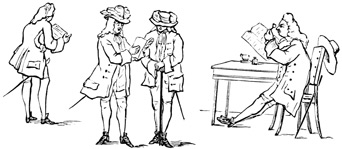
'Finding myself unavoidably engaged in such a conversation, I was resolved to turn my pain into a pleasure and to divert myself as well as I could with so very odd a fellow. "You must understand," says Ned, "that the sonnet I am going to read to you was written upon a lady, who showed me some verses of her own making, and is, perhaps, the best poet of our age. But you shall hear it."
'Upon which he began to read as follows:—
To Mira, on her incomparable Poems.
1. When dress'd in laurel wreaths you shine, And tune your soft melodious notes, You seem a sister of the Nine, Or Phœbus' self in petticoats.
2. I fancy when your song you sing (Your song you sing with so much art) Your pen was pluck'd from Cupid's wing; For, ah! it wounds me like a dart.
'"Why," says I, "this is a little nosegay of conceits, a very lump of salt. Every verse has something in it that piques; and then the dart in the last line is certainly as pretty a sting on the tail of an epigram, for so I think you critics call it, as ever entered into the thought of a poet." "Dear Mr. Bickerstaff," says he, shaking me by the hand, "everybody knows you to be a judge of these things; and, to tell you truly, I read over Roscommon's 'Translation of Horace's Art of Poetry' three several times before I sat down to write the sonnet which I have shown you. But you shall hear it again, and pray observe every line of it; for not one of them shall pass without your approbation. My friend Dick Easy," continued he, "assured me he would rather have written that 'Ah!' than to have been the author of the 'Æneid.'
'"He indeed objected that I made Mira's pen like a quill in one of the lines and like a dart in the other." "But as to that—oh! as to that," says I, "it is but supposing Cupid to be like a porcupine, and his quills and darts will be the same thing." He was going to embrace me for the hint; but half-a-dozen critics coming into the room, whose faces he did not like, he conveyed the sonnet into his pocket, and whispered me in the ear, "he would show it me again as soon as his man had written it over fair."'
No. 178. The 'Tatler.'—May 30, 1710.
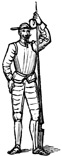
'When we look into the delightful history of the most ingenious Don Quixote of La Mancha, and consider the exercises and manner of life of that renowned gentleman, we cannot but admire the exquisite genius and discerning spirit of Michael Cervantes; who has not only painted his adventurer with great mastery in the conspicuous parts of his story, which relate to love and honour, but also intimated in his ordinary life, in his economy and furniture, the infallible symptoms he gave of his growing phrenzy, before he declared himself a knight-errant. His hall was furnished with old lances, halberds, and morions; his food, lentiles; his dress, amorous. He slept moderately, rose early, and spent his time in hunting. When by watchfulness and exercise he was thus qualified for the hardships of his intended peregrinations, he had nothing more to do but to fall hard to study; and, before he should apply himself to the practical part, get into the methods of making love and war by reading books of knighthood. As for raising tender passions in him, Cervantes reports that he was wonderfully delighted with a smooth intricate sentence; and when they listened at his study-door, they could frequently hear him read aloud, "The reason of the unreasonableness, which against my reason is wrought, doth so weaken my reason, as with all reason I do justly complain of your beauty." Again he would pause until he came to another charming sentence, and, with the most pleasing accent imaginable, be loud at a new paragraph: "The high heavens, which, with your divinity, do fortify you divinely with the stars, make you deserveress of the deserts that your greatness deserves." With these and other such passages, says my author, the poor gentleman grew distracted, and was breaking his brains day and night to understand and unravel their sense.
'What I am now warning the people of is, that the newspapers of this island are as pernicious to weak heads in England as ever books of chivalry to Spain; and therefore shall do all that in me lies, with the utmost care and vigilance imaginable, to prevent these growing evils.'
Mr. Bickerstaff goes on to describe the private Bedlam he has provided for such as are seized with these rabid political maladies.
No. 186. The 'Tatler.'—June 17, 1710.
Virtue alone ennobles human kind, And power should on her glorious footsteps wait.
'There is nothing more necessary to establish reputation than to suspend the enjoyment of it. He that cannot bear the sense of merit with silence, must of necessity destroy it; for fame being the general mistress of mankind, whoever gives it to himself insults all to whom he relates any circumstances to his own advantage. He is considered as an open ravisher of that beauty for whom all others pine in silence. But some minds are so incapable of any temperance in this particular, that on every second in their discourse you may observe an earnestness in their eyes which shows they wait for your approbation; and perhaps the next instant cast an eye in a glass to see how they like themselves.
'Walking the other day in a neighbouring inn of court, I saw a more happy and more graceful orator than I ever before had heard or read of. A youth of about nineteen years of age was in an Indian dressing-gown and laced cap, pleading a cause before a glass. The young fellow had a very good air, and seemed to hold his brief in his hand rather to help his action, than that he wanted notes for his further information. When I first began to observe him, I feared he would soon be alarmed; but he was so zealous for his client, and so favourably received by the court, that he went on with great fluency to inform the bench that he humbly hoped they would not let the merit of the cause suffer by the youth and inexperience of the pleader; that in all things he submitted to their candour; and modestly desired they would not conclude but that strength of argument and force of reason may be consistent with grace of action and comeliness of person.
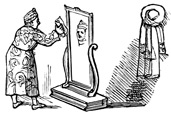
'To me (who see people every day in the midst of crowds, whomsoever they seem to address, talk only to themselves and of themselves) this orator was not so extravagant a man as perhaps another would have thought him; but I took part in his success, and was very glad to find he had in his favour judgment and costs, without any manner of opposition.'
No. 204. The 'Tatler.'—July 29, 1710.
He with rapture hears A title tingling in his tender ears. Francis's Horace, Sat. V. 32.
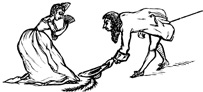
'Were distinctions used according to the rules of reason and sense, those additions to men's names would be, as they were first intended, significant of their worth, and not their persons; so that in some cases it might be proper to say of a deceased ambassador, "The man is dead; but his excellency will never die." It is, methinks, very unjust to laugh at a Quaker, because he has taken up a resolution to treat you with a word the most expressive of complaisance that can be thought of, and with an air of good-nature and charity calls you Friend. I say, it is very unjust to rally him for this term to a stranger, when you yourself, in all your phrases of distinction, confound phrases of honour into no use at all.
'Tom Courtly, who is the pink of courtesy, is an instance of how little moment an undistinguishing application of sounds of honour are to those who understand themselves. Tom never fails of paying his obeisance to every man he sees who has title or office to make him conspicuous; but his deference is wholly given to outward considerations. I, who know him, can tell him within half an acre how much land one man has more than another by Tom's bow to him. Title is all he knows of honour, and civility of friendship; for this reason, because he cares for no man living, he is religiously strict in performing, what he calls, his respects to you. To this end he is very learned in pedigree, and will abate something in the ceremony of his approaches to a man, if he is in any doubt about the bearing of his coat of arms. What is the most pleasant of all his character is, that he acts with a sort of integrity in these impertinences; and though he would not do any solid kindness, he is wonderfully just and careful not to wrong his quality. But as integrity is very scarce in the world, I cannot forbear having respect for the impertinent: it is some virtue to be bound by anything. Tom and I are upon very good terms, for the respect he has for the house of Bickerstaff. Though one cannot but laugh at his serious consideration of things so little essential, one must have a value even for a frivolous good conscience.'