XXVII.—SUNSET.
Reading edition
“Father is very feeble,” said Mrs. Wadsworth one day in June. “I shall persuade him to take a vacation. Lewis Gesner told him yesterday that he must take a rest; do you notice how he spends all his evenings on the sofa? I think that if Gus would come and play chess as he used to that it would rouse him.”
The week of Mr. Wadsworth’s vacation ran into two weeks and into a month; Dr. Greyson fell into a friendly habit of calling daily; Mr. Lewis Gesner and Mr. Hammerton came for a chat with him on the piazza as often as every other day, sometimes one of them would pass the evening beside his lounge in the sitting-room. Mr. Hammerton amused him by talk of people and books with a half hour of politics thrown in; and Mr. Gesner with his genial voice and genial manner helped them all to believe that life had its warm corners, and that an evening all together, with the feeble old man on the lounge an interested listener, was certainly one of the cosiest.
“Father, why have you kept Mr. Gesner to yourself all these years?” Tessa asked after one of these evenings.
“I would have brought him home before, if I had known that you would have found him so charming.”
“He is my ideal of the shadow of a rock in a weary land,” she answered; “I do not wonder that his sister’s heart is bound up in him. How can brothers who live together be so different?”
“John is well enough,” said her father, “there’s nothing wrong about him.”
“He makes me creep,” said Tessa, vehemently, thinking of a pair of bracelets that Sue had brought to show her that day.
Mr. Wadsworth lay silent for awhile, then opening his eyes gazed long at the figures and faces that were all his world; Mrs. Wadsworth’s chair was at the foot of the lounge, the light from the lamp on the table fell on her busy hands, leaving her face in shadow; Dinah was reading at the table, with one hand pushed in among her curls; Tessa had dipped her pen into the ink and was carelessly holding it between thumb and finger before writing the last page of her three sheets to Miss Sarepta.
“Oh my three girls!” he murmured so low that no one heard.
Mrs. Wadsworth, in these days, was forgetting to be sharp, and hovered over him and lingered around him as lovingly as ever Tessa did.
“Doctor,” said Tessa, standing on the piazza with Dr. Greyson late one evening, “do you think that he may die suddenly?”
“Yes.”
“Any time, when the pain comes?”
“Any hour when the pain comes.”
“Does mother know?”
“I think that she half suspects; she has asked me, and I have evaded the question.”
“Does he know it?”
“He has known it since March.”
Since he had wanted her to come home!
“Perhaps he has told mother.”
“She would only excite him and hasten the end.”
“She can be quiet enough when she chooses. I am glad—oh, I am so glad—”
“Is the doctor gone?” cried Dinah rushing out, “father wants him. He has the pain dreadfully.”
The paroxysm was severe, but it passed away; Dr. Greyson decided to remain through the night; he fell asleep in the sitting-room and was awakened by Tessa’s hand an hour before dawn.
“Thank you, dear,” said Mr. Wadsworth to his wife as she laid an extra quilt across his feet.
They were his last words. Tessa always liked to think of them.
July, August, and September dragged themselves through sunny days and rainy days into October. Tessa had learned that she could live without her father. There was little outward change in their home, the three were busy about their usual work and usual recreations; friends came and went; Tessa wrote and walked; gave two afternoons each week to Mrs. Towne, sometimes in Dunellen and sometimes at Old Place; ran in, as of old, for a helpful talk with Miss Jewett, not forgetting that she must be, what Dr. Lake had said,—a good friend to his wife. These were the busy hours; in the still hours,—but who can know for another the still hours?
Mr. Hammerton and Mr. Lewis Gesner proved themselves to be invaluable friends; Tessa’s warm regard for Mr. Gesner, even with the shock that came to her afterward, never became less; he ever remained her ideal of the rock in the weary land.
Two weeks after her father’s funeral, she had stood alone one evening towards dusk among her flowers: she had been gathering pansies and thinking that her father had always liked them and talked about them.
There was a sound of wheels on the grass and a carriage stood at the opening in the shrubbery; the face into which she looked this time was not worn, or thin, or excited; a dark face, with grave, sympathetic eyes, was bending towards her.
“I wish that I could help you,” he said.
“I know you do. No one can help me. I do not need help. I am helped.”
“The air is sweet to-night.”
“And so still! Do you like my pansies?”
“Yes.”
“Will you take them to your mother, and tell her that I will come to-morrow.”
“I will tell her; but I will keep the pansies for myself, if you will give them to me.”
She laid them in his hand with fingers that trembled.
“Do they say something to me?”
“They say a great deal to me!”
“What do they say?”
“I can not find a meaning for you. They must be their own interpreter.”
“But I may think that you gave them to me to keep as long as I live.”
“Yes; to keep as long as you live.”
“When you have something to say to me—something that you know I am waiting to hear—will you say it, freely, of your own accord.”
“Yes, freely, of my own accord.”
“I regret to trouble you; but if you ever waited, you know that it is the hardest of hard work.”
“I know,” said Tessa, her voice breaking; “but you may not like what I say.”
“Perhaps you will say what I like then.”
“I will if I can.”
What had she to say, freely, of her own accord? I think that it was the knowledge of what she would say by and by when she was fully sure that helped her to bear the loneliness of this summer and autumn.
And thus passed the summer that she had planned for rest. November found her making plans for winter. Her last winter’s work had been sent to her, one volume with its new illustrations, and the other, with but one new picture; her father had looked forward to them; she sent copies to Elsie, Mabel, and Sue, also to Felix Harrison and Mr. Hammerton; Miss Jewett and Mrs. Towne made pretty and loving speeches over theirs; Tessa wondered, why, when she had written them with all her heart, they should seem so little to her now.
“Where is your novel, Lady Blue,” Mr. Hammerton, asked one evening.
“I think that I shall live it first,” she answered, seriously. “I couldn’t love my ideal well enough to put him into a book, and the real hero would only be lovable and commonplace, and no one would care to read about him—no one would care for him but me.”
“It must be something of an experience to learn that one’s ideal can not be loved, and rather humiliating to find one’s self in love with some one below one’s standard.”
“That’s what life is for,—to have an experience, isn’t it?”
“It seems to be some people’s experience,” he said, looking as wise as an owl, and as unsympathetic.
November found Sue making plans, also. Her plans came out in this wise: she called one morning to talk to Tessa; Tessa was sewing in her own chamber, and Sue ran up lightly, as lightly as in the days before Gerald Lake had come to Dunellen.
“Busy!” she said blithely, her flowing crape veil fluttering at the door.
“Not too busy. Come in.”
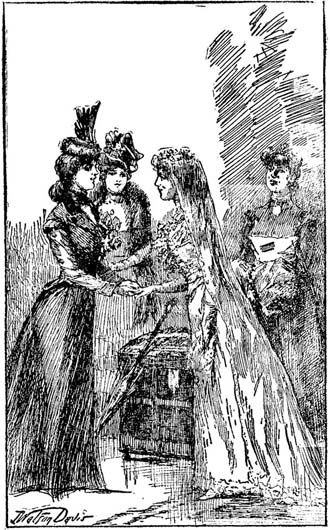
Sue talked for an hour with her gloves on, then, carelessly, as she described some pretty thing that the Professor’s wife had brought from over the sea, she drew the glove from her left hand, watching Tessa’s face. The quick color—the quick, indignant color—repaid the manœuvre; the wedding ring—the new wedding ring—was gone, and in its stead blazed a cluster of diamonds.
“You might as well say something,” began Sue, moving her hand in the sunlight.
“I have nothing to say. I wonder how you dare come to me.”
“Why shouldn’t I dare? I know it seems soon; but circumstances make a difference, and Mr. Gesner has to go to Europe next month. He took the other ring; I couldn’t help it—I wouldn’t have kept it safe with a lock of his hair in a little box—but he said that I shouldn’t have this unless I gave him that.”
Tessa’s head went down over her work; she had not wept aloud before since she was a little girl, but now the sobs burst through her lips uncontrolled. That ring that Dr. Lake had carried that day in the rain not fourteen months ago!
Sue sprang to her feet, then dropped back into her chair and wept in sympathy, partly with a vague feeling of having done some dreadful thing, partly with the fear that life in a foreign land might not be wholly alluring; Mr. Gesner was kind, but poor Gerald had loved her so!
“O, Tessa! Tessa! don’t,” she cried. “Stop crying and speak to me.”
“Go away from me. Go home. I will not speak to you.”
For a moment Sue waited, then she arose and moved towards the door, standing another moment, but as Tessa did not turn or speak, she went down-stairs, not lightly, hushed by the revelation of a grief that she could not understand.
“Good-by, Mystic; you and I will have our talk another day,” said Sue.