Front matter
Reading edition
TRANSCRIBER'S NOTE: There are a large number of compound words in this book including bird names which occur joined, spaced and hyphenated. No attempt has been made to correct these discrepancies as these are mostly alternative spellingd of thw same word. In the case of bird names it is difficult to decide as ornithologists are still debating on this subject.
TERRITORY IN BIRD LIFE
TERRITORY IN BIRD LIFE
BY H. ELIOT HOWARD
WITH ILLUSTRATIONS BY G. E. LODGE AND H. GRÖNVOLD
NEW YORK E. P. DUTTON AND COMPANY 1920
PREFACE
When studying the Warblers some twenty years ago, I became aware of the fact that each male isolates itself at the commencement of the breeding season and exercises dominion over a restricted area of ground. Further investigation, pursued with a view to ascertaining the relation of this particular mode of behaviour to the system of reproduction, led to my studying various species, not only those of close affinity, but those widely remote in the tree of avian life. The present work is the outcome of those investigations. In it I have endeavoured to interpret the prospective value of the behaviour, and to trace out the relationships in the organic and inorganic world which have determined its survival. Much is mere speculation; much with fuller knowledge may be found to be wrong. But I venture to hope that a nucleus will remain upon which a more complete territorial system may one day be established.
I have to thank Mr. G. E. Lodge and Mr. H. Grönvold for the trouble they have taken in executing my wishes; I also want to record my indebtedness to the late E. W. Hopewell; and to Professor Lloyd Morgan, F.R.S., I am beholden more than I can tell.
CONTENTS
PAGE
CHAPTER I
Introduction 1
CHAPTER II
The Disposition to Secure a Territory 20
CHAPTER III
The Disposition to Defend the Territory 73
CHAPTER IV
The Relation of Song to the Territory 119
CHAPTER V
The Relation of the Territory to the System of Reproduction 169
CHAPTER VI
The Warfare between Different Species and its Relation to the Territory 216
CHAPTER VII
The Relation of the Territory to Migration 259
Index 302
LIST OF ILLUSTRATIONS
Faces page
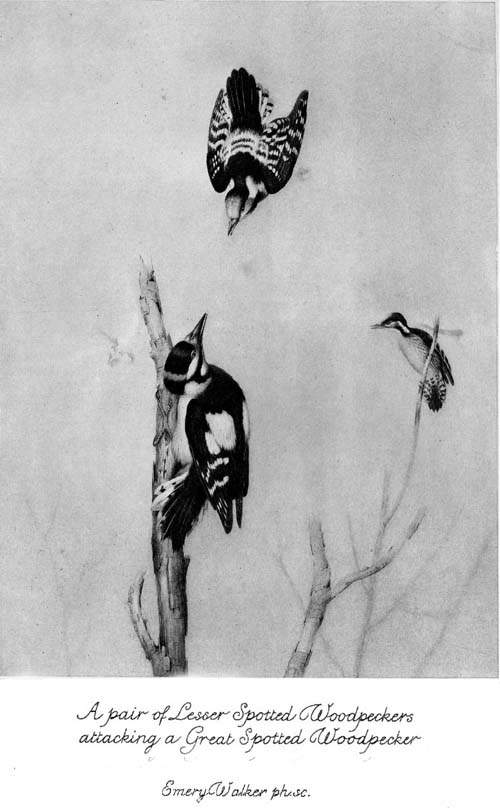
A pair of Lesser Spotted Woodpeckers attacking a Great Spotted Woodpecker Frontispiece
Territorial flight of the Black-tailed Godwit 54
Competition for territory is seldom more severe than individual Razorbills to secure positions on the among cliff-breeding seabirds, and the efforts of crowded ledges lead to desperate struggles 64
Male Blackbirds fighting for the possession of territory. The bare skin on the crown of the defeated bird shows the nature of the injuries from which it succumbed. 74
Male Cuckoos fighting before the arrival of a female 82
Two pairs of Pied Wagtails fighting in defence of their territories 86
Long-tailed Tit: males fighting for the possession of territory. The feathers have been torn from the crown of the defeated and dying rival 96
A battle between two pairs of Jays 106
The Female Chaffinch shares in the defence of the territory and attacks other females 110
Peregrine Falcon attacking a Raven 216
A battle between a pair of Green Woodpeckers and a Great Spotted Woodpecker for the possession of a hole in an oak-tree 238
Plans of the Water-meadow showing the Territories occupied by Lapwings in 1915 and 1916 Between 58 and 59
SCIENTIFIC NAMES OF BIRDS MENTIONED IN THE TEXT
Raven Corvus corax.
Carrion-Crow Corvus corone.
Hooded Crow Corvus cornix.
Rook Corvus frugilegus.
Magpie Pica pica.
Jay Garrulus glandarius rufitergum.
Chough Pyrrhocorax pyrrhocorax.
Starling Sturnus vulgaris.
Greenfinch Chloris chloris.
Hawfinch Coccothraustes coccothraustes.
House-Sparrow Passer domesticus.
Chaffinch Fringilla cœlebs.
Brambling Fringilla montifringilla.
LinnetAcanthis cannabina.
Corn-BuntingEmberiza calandra.
Yellow BuntingEmberiza citrinella.
Cirl BuntingEmberiza cirlus.
Reed-BuntingEmberiza schœniclus.
Sky-LarkAlauda arvensis.
Pied WagtailMotacilla lugubris.
Tree-PipitAnthus trivialis.
Meadow-PipitAnthus pratensis.
Great TitmouseParus major newtoni.
Blue TitmouseParus cœruleus obscurus.
Long-tailed TitmouseÆgithalus caudatus roseus.
Red-backed ShrikeLanius collurio.
WhitethroatSylvia communis.
Lesser Whitethroat Sylvia curruca.
Blackcap Sylvia atricapilla.
Grasshopper-Warbler Locustella nœvia.
Savi's Warbler Locustella luscinioides.
Reed-Warbler Acrocephalus scirpaceus.
Marsh-Warbler Acrocephalus palustris.
Sedge-Warbler Acrocephalus schœnobænus.
Willow-Warbler Phylloscopus trochilus.
Wood-Warbler Phylloscopus sibilatrix.
ChiffchaffPhylloscopus collybita.
Song-Thrush Turdus musicus clarkii.
Redwing Turdus iliacus.
Blackbird Turdus merula.
Redstart Phœnicurus phœnicurus.
RedbreastErithacus rubecula melophilus.
Nightingale Luscinia megarhyncha.
Stonechat Saxicola rubicola.
WhinchatSaxicola rubetra.
WheatearŒnanthe œnanthe.
Hedge-Sparrow Accentor modularis.
Wren Troglodytes troglodytes.
Spotted Flycatcher Muscicapa striata.
Swallow Hirundo rustica.
Martin Delichon urbica.
Sand-Martin Riparia riparia.
Great Spotted WoodpeckerDryobates major anglicus.
Lesser Spotted WoodpeckerDryobates minor.
Green WoodpeckerPicus viridis.
CuckooCuculus canorus.
Tawny OwlStrix aluco.
BuzzardButeo buteo.
Sparrow-HawkAccipiter nisus.
Peregrine FalconFalco peregrinus.
MerlinFalco æsalon.
KestrelFalco tinnunculus.
ShagPhalacrocorax graculus.
Wild DuckAnas boschas.
SnipeGallinago gallinago.
DunlinTringa alpina.
RuffMachetes pugnax.
RedshankTotanus totanus.
Black-tailed GodwitLimosa limosa.
CurlewNumenius arquata.
WhimbrelNumenius phæopus.
American Golden PloverCharadrius dominicus.
LapwingVanellus vanellus.
Oyster-Catcher Hæmatopus ostralegus.
Herring-Gull Larus argentatus.
Kittiwake Rissa tridactyla.
RazorbillAlca torda.
Guillemot Uria troille.
Puffin Fratercula arctica.
FulmarFulmarus glacialis.
Water-RailRallus aquaticus.
Corn-CrakeCrex crex.
Moor-Hen Gallinula chloropus.
Coot Fulica atra.
Wood-PigeonColumba palumbus.
Turtle-DoveStreptopelia turtur.
Partridge Perdix perdix.
Black Grouse Lyrurus tetrix britannicus.
Red Grouse Lagopus scoticus.