Mrs Molesworth (continued 2)
Reading edition
Then Frisken took Con’s right hand, and a lovely little maiden clad in the palest green, and with flowing yellow hair, took the other, and the fairies made themselves into dozens and dozens of rings, and twirled and whirled away to the sound of the gayest and most inspiriting music. Con had never enjoyed himself so much in his life, and the best of it was the more he danced the more he wanted to dance; he jumped and whirled and twirled as fast as any (though I have no doubt the fairies thought him rather clumsy about it), and yet without the very least feeling of fatigue. He felt as if he could have gone on for ever. Suddenly the elves stopped.
“Oh don’t stop!” said Con, who was beginning to feel quite at home, “do let’s go on. I am not a bit tired.”
“Tired,” said Frisken, contemptuously, “whoever heard such a word? How can you be so ill-mannered? Besides, mortal though you are, you certainly should not be tired. Why, you’re only just awake, and you slept long enough to last you at any rate for—”
“For how long?” said Con, timidly.
But Frisken did not answer, and Con, who was rather in awe of him, thought it best not to press the enquiry. The fairies did not go on dancing, however. They were fond of variety, evidently, whether they ever got tired or not. They now all “adjourned” to another part of the forest, where a grand banquet was prepared. What the viands were, Con had no idea, but he little cared, for they were the most delicious he had ever tasted. He was not a greedy boy by any means, but he did enjoy this feast; everything was so charming; the fairies all reclined on couches made of the same soft green moss as that on which he had found himself lying when he first awoke, and all the time the invisible musicians played lovely, gentle music, which, had Con not winked violently, would have brought the tears to his eyes, for, somehow, it made him think of home, and wonder what his mother was doing, and whether she was in trouble about his absence. It did not seem to affect the fairies in the same way; they were chattering, and joking, and laughing, just as merrily as ever; once Con caught Frisken’s eye fixed upon him, and almost immediately after, the music stopped, and the games began. What wonderful games they were! I cannot tell you half of them; one favourite one you may have heard of before—they buried a seed a little way in the ground, and then danced round it in a circle, singing some queer wild words which Con could not understand. Then they all stood still and called to Con to look; he could hardly believe his eyes—there was the seed already a little plant, and even as he looked, it grew, and grew, and grew, up into a great strong tree; and as the branches rose higher and higher, the fairies caught hold of them and rose up with them into the sky, till the tree seemed to be covered with fruits of every shape and colour. Con had not recovered his amazement, when they were all down again, ready for something else. This time, perhaps, it would be the mouse game—a dozen or two of fairies would turn themselves into mice, and Frisken and one or two others into cats, and then what a chase they had! It puzzled Con quite as much as the seed game, for he was sure he saw Frisken gobble up two or three mice, and yet—in a moment, there they all were again in their proper fairy forms, not one missing! He wished he could ask Frisken to explain it, but he had not time, for now an expedition to the treasure caves was proposed, and off they all set, some riding on fairy piebald ponies about the size of a rocking-horse, some driving in mother-of-pearl chariots drawn by large white cats, some running, some dancing along. And, oh, the treasure caves, when they got there! All the stories Con had ever heard of—Aladdin, and genii and pirates’ buried riches, none of them came up to these wonderful caves in the least. There were just heaps of precious stones, all cut and polished, and, according to fairy notions, quite ready for wear. For they all helped themselves to as many jewels as they wanted, strung them together on silk, with needles that pierced them as easily as if they had been berries, and flitted about as long as the fancy lasted, wreathed in diamonds and rubies, and emeralds, and every sort of brilliant stone. And then when they had had enough of them, threw them away as ruthlessly as children cast aside their withered daisy-chains.
And so it went on without intermission; incessant jousts and revels, and banquets, constant laughter and joking, no pain, no fatigue, no anxiety. For the fairies live entirely and completely in the present, past and future have no meaning to their heedless ears, time passes as if it were not; they have no nights or days, no summer or winter. It is always the same in fairyland.
But some things puzzled Con sorely. Strangely enough, in this realm of thoughtlessness, he was beginning to think as well as to fancy, to wish to know the whys and wherefores of things, as he had never done before. Now and then he tried to question Frisken, who, he felt certain, knew all he wished to learn, but it was difficult ever to get him to explain anything. Once, I was very nearly saying one day, but there are no such things there—Con could keep no count of time, he could have told how many banquets he had been at, how many times they had been to the caves, how often they had bathed in the stream, but that was all—once, then, when Frisken seemed in a quieter mood than usual, Con tried what he could do.
“Frisken,” he said, “why is it that all the oldest looking fairies among you are the smallest. Why, there’s the old fairy that drives the largest chariot, he’s not above half as big as you? It seems to me they keep getting smaller and smaller as they get older; why is it?”
“Of course they do. What else would you have?” said Frisken. “What an owl the boy must be! How can you ask such ill-mannered questions?”
“Do you mean they get smaller and smaller till they die?” said Con.
Frisken sprang to his feet with a sort of yell. It was the first time Con had seen him put out, but even now he seemed more terrified than angry. He sat down again, shaking all over.
“I don’t know what you mean,” he gasped; “we never mention such things.”
“But what becomes of you all then—afterwards?” said Con, more discreetly.
Frisken had recovered himself.
“What do you mean by your afters and befores and thens?” he said; “Isn’t now enough for you? What becomes of them? why, what becomes of things up there in that world of yours—where do the leaves and the flowers and the butterflies go to—eh?”
“But they are only things,” persisted Con, “they have no—”
“Hush!” screamed Frisken, “how can you be so ill-mannered? come along, the music is beginning; they are waiting for us to dance.”
But it was with a heavy heart that Con joined the dance. He was beginning to be very tired of this beautiful fairyland, and to wish very much that he could go home to the cottage on the mountain, to his father and mother, even to his lessons! A shudder ran through him as old tales that he had heard or read, and scarcely understood, returned to his mind—of children stolen by the fairies who never went home again till too late, and who then in despair returned to their beautiful prison to become all that was left to them to be, fairies themselves, things, like the flowers and the butterflies—supposing already it was too late for him? quickly as the time had passed, for all he knew, he had been a century in fairyland!
But he had to dance and to sing and to play incessantly like the others. He must not let them suspect his discontent or he would lose all chance of escape. He watched his opportunity for getting more information out of Frisken.
“Do you never go ‘up there?’” he asked him once, using the fairy word for the world he had left, “for a change you know, and to play tricks on people—that must be such fun.”
Frisken nodded his head mysteriously. He was delighted to see what a regular elfin Con was growing.
“Sometimes,” he said. “It’s all very well for a little while, but I couldn’t stay there long. The air is so thick—ugh—and the cold and the darkness! You wouldn’t believe, would you, now that you know what it’s like down here, that fairies have been known to go up there and to stay by their own choice—to become clumsy, miserable, short-lived mortals?”
“What made them?” said Con.
“Oh, a stupid idea that if they stayed up there they would have the chance of growing into— oh, nonsense, don’t let us talk of anything so disagreeable. Come and have some games.”
But Con persisted. He had discovered that when he got Frisken all to himself he had a strange power of forcing him to answer his questions.
“Was old Nance once down here?” he asked suddenly. Frisken wriggled.
“What if she was?” he said, “she’s not worth speaking about.”
“Why did she go up there?” said Con.
“She was bewitched,” answered Frisken. “I cannot think why you like to talk about such stupid things. You have forgotten about things up there; luckily for you you came down here before you had learnt much. Did you ever hear talk of a stupid thing they call ‘love’ up there? That took her up, and then she stayed because she got more nonsense in her head.”
“I love my mother and my father,” said Con stoutly.
“Nonsense,” said Frisken, “you make me feel sick. You must forget all that. Come along and make a tree.”
But Con did not forget. He thought about it all constantly, and he understood much that he had never dreamt of before. He grew to detest his life among the fairies, and to long and plan for escape. But how to manage it he had no notion; which was the way “up” the fairies carefully concealed from him, and he had no clue to guide him.
“Nance! Nance! are you there? O dear Nance! do let me out, and take me home to my mother again. O Nance! Nance!”
It was Con. He had managed to escape from Frisken and the others, amusing themselves in the treasure caves, and had made his way along a narrow winding passage in the rock, with a vague idea that as it went “up” it would perhaps prove to be a way out of fairyland. He had passed the little cave where Nance had warmed him by the fire, and the sight of it had brought back a misty feeling that Nance had had something to do with that night’s adventures. Now he was standing at the end of the passage, the way was stopped by a great wall of rock, he could go no farther. In an agony of fear lest his fairy jailers should overtake him, he beat upon the rock and cried for his old friend’s help. For some time he got no answer, then suddenly, just as he fancied he heard the rush of the elves behind him in hot pursuit, he caught the sound of his own name whispered softly through the rocky door.
“Connemara,” a voice said, “I will strike the door three times, but stand back or it may crush you.”
He crept back into a corner and listened for the taps. One, two, three, and the tremendously heavy door of stone rolled back without a sound, and in a moment Con was back in the stupid old world again! There stood Nance; she put her arms round him and kissed him without speaking. Then “run home, Connemara,” she said, “run home fast, and do not linger. There is light enough to see the way, and there will soon be more.”
“But come with me, dear Nance. I want to tell you all about it. Come home with me and I will tell mother you saved me.”
But Nance shook her head. “I cannot,” she said, sorrowfully; “run home, I entreat you.”
He obeyed her, but turned to look back when he had run a little way. Nance was no longer there.
It was early morning, but it was winter time. The ground was covered with snow beginning to sparkle in the red light of the rising sun. The dear old sun! How glad Con was to see his round face again. The world looked just the same as when he had left it, but suddenly a dreadful fear seized Con. How would he find all at home? How long had he been away? Could it be a hundred years, or fifty, or even only seven, what a terrible change he would find. He thought of “little Bridget” in the ballad, and shivered. He was almost afraid to open the garden door and run in. But everything looked the same; and, yes—there to his delight was old Evan the gardener already at work, apparently no older than when last he had seen him—it must be all right, Evan was so old, that to see him there at all told that no great time could have passed.
“You’ve come home early this morning, Master Con,” he said. “Master and Missis came back last night in all that storm, but they weren’t frightened about you, as they had the message that you had stayed at school.”
“What do you mean, Evan—what message? Who said I had stayed at school?” “Last night—could it have been only last night,” he whispered to himself.
“A little boy brought the message, the queerest little chap you ever saw—not as big as you by half hardly, but speaking quite like a man. I met him myself on my way home, and turned back again to tell. What a rough night it was to be sure!”
Feeling as if he were dreaming, Con turned to the house. There on the doorstep stood his mother, looking not a little astonished at seeing him.
“Why, Con, dear,” she exclaimed, “you have come over early this morning. Did you get home-sick in one night?”
But Con had flung his arms round her neck, and was kissing her dreadfully. “O mother, mother! I am so glad to see you again,” he cried.
“You queer boy. Why, I declare he has tears in his eyes!” his mother exclaimed. “Why, Con, dear, you seem as if you had been away a year instead of a night.”
“I will tell you all about it, mother. But, oh! please, why did you tie up my sleeves with green ribbon before I was christened?”
His mother stared. “Now who could have told you that, child?” she said. “It was silly of me, but I only did it to tease old nurse, who was full of fancies. Besides the days of fairy stealings are over, Con, though I have often thought nurse would have been alarmed if she had known how full of fairy fancies you were, my boy.”
“Mother, mother! listen, it is quite true,” said Con, and he hastened to pour out the story of his wonderful adventure. His mother did look astonished, but naturally enough she could not believe it. She would have it he had fallen asleep at old Nance’s cottage and dreamt it all.
“But who was the boy that brought the message then?” said Con. “I know he was a fairy.”
And his mother could not tell what to say.
“I know what to do,” he went on; “will you come with me to Nance’s cottage and ask her?” and to this his mother agreed.
And that very morning to the old woman’s cottage they went. It was in perfect order as usual, not a speck of dust to be seen; the little bed made, and not a stool out of its place. But there was no fire burning in the little hearth—and no Nance to be seen. Con ran all about, calling her, but she had utterly disappeared. He threw himself on the ground, sobbing bitterly.
“She has gone back to them instead of me—to prevent them coming after me,” he cried, “and oh! she will be so unhappy.”
And nothing that his mother could say would console him.
But a night or two afterwards the boy had a dream, or a vision, which comforted him. He thought he saw Nance; Nance with her kind, strange smile, and she told him not to be troubled. “I have only gone back for a time,” she said, “and they cannot hold me, Connemara. I shall have conquered after all. You will never see me again here. I am soon going to a country very far away. I shall never come back to my little cottage, but still we may meet again and you must not grieve for me.”
So Con’s mind was at peace about his old friend. Of course she never came back, and before long her cottage was pulled down. No one could say to whom it belonged, but no one objected to its destruction. She had been a witch they said, and it was best to do away with her dwelling.
What Con’s mother really came in the end to think about his story, I cannot say; nor do I know if she ever told his father. I fancy Con seldom, if ever, spoke about it again. But as all who knew him when he grew up to be a man could testify, his taste of the land of “all play and no work,” never did him any harm.
Chapter Five.
Mary Ann Jolly.
“But I lost my poor little doll, dears, As I played in the heath one day; And I cried for her more than a week, dears—”
They say that the world—and of course that means the people in it—has changed very much in the last half century or so. I daresay in some ways this is true, but it is not in all. There are some ways in which I hope and think people will never change much. Hearts will never change, I hope—good, kind hearts who love and trust each other I mean; and little children, they surely will always be found the same,—simple and faithful, happy and honest; why, the very word childlike would cease to have any meaning were the natures it describes to alter.
Looking back over more than fifty years to a child life then, far away from here, flowing peacefully on, I recognise the same nature, the same innocent, unsuspicious enjoyment, the same quaint, so-called “old-fashioned” ways that now-a-days I find in the children growing up about me. The little ones of to-day enjoy a shorter childhood, there is more haste to hurry them forward in the race—we would almost seem to begrudge them their playtime—but that I think is the only real difference. My darlings are children after all; they love the sunshine and the flowers, mud-pies and mischief, dolls and story-books, as fervently as ever. And long may they do so!
My child of fifty years ago was in all essentials a real child. Yet again, in some particulars, she was exceptional, and exceptionally placed. She had never travelled fifty miles from her home, and that home was far away in the country, in Scotland. And a Scottish country home in those days was far removed from the bustle and turmoil and excitement of the great haunts of men. Am I getting beyond you, children, dear? Am I using words and thinking thoughts you can scarcely follow? Well, I won’t forget again. I will tell you my simple story in simple words.
This long-ago little girl was named Janet. She was the youngest of several brothers and sisters, some of whom, when she was born even, were already out in the world. They were, on the whole, a happy, united family; they had their troubles, and disagreements perhaps too, sometimes, but in one thing they all joined, and that was in loving and petting little Janet. How well she remembers even now, all across the long half century, how the big brothers would dispute as to which of them should carry her in her flowered chintz dressing-gown, perched like a tiny queen on their shoulders, to father’s and mother’s room to say good-morning; how on Hallowe’en the rosiest apples and finest nuts were for “wee Janet;” how the big sisters would work for hours at her dolls’ clothes; how, dearest memory of all, the kind, often careworn, studious father would read aloud to her, hour after hour, as she lay on the hearth-rug, coiled up at his feet.
For little Janet could not read much to herself. She was not blind, but her sight was imperfect, and unless the greatest care had been taken she might, by the time she grew up, have lost it altogether. To look at her you would not have known there was anything wrong with her blue eyes; the injury was the result of an accident in her infancy, by which one of the delicate sight nerves had been hurt, though not so as to prevent the hope of cure. But for several years she was hardly allowed to use her eyes at all. She used to wear a shade whenever she was in a bright light, and she was forbidden to read, or to sew, or to do anything which called for much seeing. How she learnt to read I do not know—I do not think she could have told you herself—but still it is certain that she did learn; perhaps her kind father taught her this, and many more things than either he or she suspected in the long hours she used to lie by his study fire, sometimes talking to him in the intervals of his writing, sometimes listening with intense eagerness to the legends and ballads his heart delighted in, sometimes only making stories to herself as she sat on the hearth-rug playing with her dolls.
There are many quaint little stories of this long-ago maiden that you would like to hear, I think. One comes back to my mind as I write. It is about a mysterious holly bush in the garden of Janet’s home, which one year took it into its head to grow all on one side, in the queerest way you ever saw. This holly bush stood in a rather conspicuous position, just outside the breakfast-room window, and Janet’s father was struck by the peculiar crookedness which afflicted it, and one morning he went out to examine it more closely. He soon found the reason—the main branch had been stunted by half an orange skin, which had been fitted upon it most neatly and closely, like a cap, just where it was sprouting most vigorously. Janet’s father was greatly surprised. “Dear me, dear me,” he exclaimed as he came in; “what a curious thing. How could this ever have got on to the holly bush? An old orange skin, you see,” he went on, holding it up to the assembled family party. Little Janet was there, in her usual place by her father’s chair.
“Was it on the robin’s bush, father?” she asked.
“The robin’s bush, Janet? What do you mean?”
“The bush the wee robin perches on when he comes to sing in the morning,” she answered readily. “A long, long time ago, I tied an orange skin on, to make a soft place for the dear robin’s feet. The bush was so prickly, I could not bear to see him stand upon it.”
And to this day the crooked holly bush tells of the little child’s tenderness.
Then there is another old story of Janet, how, once being sorely troubled with toothache, and anxious to bear it uncomplainingly “like a woman,” she was found, after being searched for everywhere fast asleep in the “byre,” her little cheek pillowed on the soft skin of a few days’ old calf. “Its breath was so sweet, and it felt so soft and warm, it seemed to take the ache away,” she said.
And another old memory of little Janet on a visit at an uncle’s, put to sleep in a room alone, and feeling frightened by a sudden gale of wind that rose in the night, howling among the trees and sweeping down the hills. Poor little Janet! It seemed to her she was far, far away from everybody, and the wind, as it were, took mortal form and voice, and threatened her, till she could bear it no longer. Up she got, all in the dark, and wandered away down the stairs and passages of the rambling old house, till at last a faint glimmer of light led her to a modest little room in the neighbourhood of the kitchen, where old Jamie, the faithful serving-man, who had seen pass away more than one generation of the family he was devoted to, was sitting up reading his Bible before going to bed. How well Janet remembers it even now! The old man’s start of surprise at the unexpected apparition of wee missy, how he took her on his knee and turned over the pages of “the Book,” to read to her words of gentle comfort, even for a little child’s alarm; how Jesus hushed the winds and waves, and bade them be still; how not a hair of the head of even tiny Janet could be injured without the Father’s knowledge; how she had indeed no reason to fear; till, soothed and reassured, the child let the good old man lead her back to bed again, where she slept soundly till morning.
But all this time I am very long of introducing to you, children, the real heroine of this story—not Janet, but who then? Janet’s dearest and most tenderly prized doll—“Mary Ann Jolly.”
She was one of several, but the best beloved of all, though why it would have been difficult to say. She was certainly not pretty; indeed, to tell the truth, I fear I must own that she was decidedly ugly And an ugly doll in those days was an ugly doll, my dears. For whether little girls have altered much or not since the days of Janet’s childhood, there can be no two opinions about dolls; they have altered tremendously, and undoubtedly for the better. There were what people thought very pretty dolls then, and Janet possessed two or three of these. There was “Lady Lucy Manners,” an elegant blonde, with flaxen ringlets and pink kid hands and arms; there was “Master Ronald,” a gallant sailor laddie, with crisp black curls and goggle bead eyes; there were two or three others—Arabellas or Clarissas, I cannot tell you their exact names; on the whole, for that time, Janet had a goodly array of dolls. But still, dearest of all was Mary Ann Jolly. I think her faithfulness, her thorough reliableness, must have been her charm; she never melted, wept tears of wax—that is to say, to the detriment of her complexion, when placed too near the nursery fire. She never broke an artery and collapsed through loss of sawdust. These weaknesses were not at all in her way, for she was of wood, wooden. Her features were oil-painted on her face, like the figure-head of a ship, and would stand washing. Her hair was a good honest black-silk wig, with sewn-on curls, and the whole affair could be removed at pleasure; but oh, my dear children, she was ugly. Where she had come from originally I cannot say. I feel almost sure it was from no authorised doll manufactory. I rather think she was home-made to some extent, and I consider it highly probable that her beautiful features were the production of the village painter. But none of these trifling details are of consequence; wherever she had come from, whatever her origin, she was herself—good, faithful Mary Ann Jolly.
One summer time there came trouble to the neighbourhood where little Janet’s home was. A fever of some kind broke out in several villages, and its victims were principally children. For the elder ones of the family—such of them, that is to say, as were at home—but little fear was felt by their parents; but for Janet and the brother next to her, Hughie, only three years older than she, they were anxious and uneasy. Hughie was taken from the school, a few miles distant, to which every day he used to ride on his little rough pony, and for the time Janet and he were allowed to run wild. They spent the long sunny days, for it was the height of summer, in the woods or on the hills, as happy as two young fawns, thinking, in their innocence, “the fever,” to them but the name of an unknown and unrealisable possibility, rather a lucky thing than otherwise.
And Hughie was a trusty guardian for his delicate little sister. He was a brave and manly little fellow; awkward and shy to strangers, but honest as the day, and with plenty of mother-wit about him. Janet looked up to him with affection and admiration not altogether unmixed with awe. Hughie was great at “knowing best,” in their childish perplexities, and, for all his tenderness, somewhat impatient of “want of sense,” or thoughtlessness.
One day the two children, accompanied as usual by Hughie’s dog “Caesar,” and the no less faithful Mary Ann Jolly, had wandered farther than their wont from home. Janet had set her heart on some beautiful water forget-me-nots, which, in a rash moment, Hughie had told her that he had seen growing on the banks of a little stream that flowed through a sort of gorge between the hills. It was quite three miles from home—a long walk for Janet, but Hughie knew his way perfectly—he was not the kind of boy ever to lose it; the day was lovely, and the burn ran nowhere near the direction they had been forbidden to take—that of the infected village. But Hughie, wise though he was, did not know or remember that close to the spot for which he was aiming ran a road leading directly from this village to the ten miles distant little town of Linnside, and even had he thought of it, the possibility of any danger to themselves attending the fact would probably never have struck him. There was another way to Linnside from their home, so Hughie’s ignorance or forgetfulness was natural.
The way down to the edge of the burn was steep and difficult, for the shrubs and bushes grew thickly together, and there was no proper path.
“Stay you here, Janet,” he said, finding for the child a seat on a nice flat stone at the entrance to the gorge; “I’ll be back before you know I am gone, and I’ll get the flowers much better without you, little woman; and Mary Ann will be company like.”
Janet obeyed without any reluctance. She had implicit faith in Hughie. But after a while Mary Ann confided to her that she was “wearying” of sitting still, and Janet thought it could do no harm to take a turn up and down the sloping field where Hughie had left her. She wandered to a gate a few yards off, and, finding it open, wandered a little farther, till, without knowing it, she was within a stone’s throw of the road I mentioned. And here an unexpected sight met Janet’s eyes, and made her lose all thought of Hughie and the forget-me-nots, and how frightened he would be at missing her. Drawn up in a corner by some trees stood one of those travelling houses on wheels, in which I suppose every child that ever was born has at one time or other thought that it would be delightful to live. Janet had never seen one before, and she gazed at it in astonishment, till another still more interesting object caught her attention.
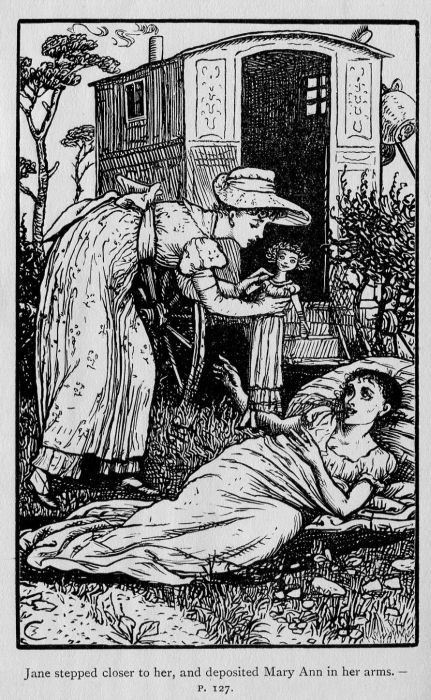
It was a child—a little girl just about her own age, a dark-eyed, dark-haired, brown-skinned, but very, very thin little girl, lying on a heap of old shawls and blankets on the grass by the side of the movable house. She seemed to be quite alone—there was no one in the waggon apparently, no sound to be heard; she lay quite still, one thin little hand under her head, the other clasping tightly some two or three poor flowers—a daisy or two, a dandelion, and some buttercups—which she had managed to reach without moving from her couch. Janet, from under her little green shade, stared at her, and she returned the stare with interest, for all around was so still that the slight rustle made by the little intruder caught her sharp ear at once. But after a moment her eyes wandered down from Janet’s fair childish face, on which she seemed to think she had bestowed enough attention, and settled themselves on the lovely object nestling in the little girl’s maternal embrace. A smile of pleasure broke over her face.
“What’s yon?” she said, suddenly.
“What’s what?” said Janet.
“Yon,” repeated the child, pointing with her disengaged hand to the faithful Mary Ann.
“That,” exclaimed Janet. “That’s my doll. That’s Mary Ann Jolly. Did you never see a doll?”
“No,” replied the brown-skinned waif, “never. She’s awfu’ bonny.”
Janet’s maternal vanity was gratified.
“She’s guid and she’s bonny,” she said, unconsciously imitating, with ludicrous exactness, her own old nurse’s pet expression when she was pleased with her. She hugged Mary Ann closer to her as she spoke. “You’d like to have a dolly too, wouldn’t you, little girl?”
The child smiled.
“I couldna gie her tae ye,” said Janet, relapsing into Scotch, with a feeling that “high English” would probably be lost upon her new friend. “But ye micht tak’ her for a minute in yer ain airms, if ye like?”
“Ay wad I,” said the child, and Janet stepped closer to her and deposited Mary Ann in her arms.
“Canna ye stan’ or walk aboot? Hae ye nae legs?” she inquired.
“Legs,” repeated the child, “what for shud’ I no hae legs? I canna rin aboot i’ the noo; I’ve nae been weel, but I’ll sune be better. Eh my! but she’s awfu’ fine,” she went on, caressing Mary Ann as she spoke.
But at this moment the bark of a dog interrupted the friendly conversation. Caesar appeared, and Janet started forward to reclaim her property, her heart for the first time misgiving her as to “what Hughie would say.” Just as she was taking Mary Ann out of the little vagrant’s arms, Hughie came up. He was hot, breathless, anxious, and, as a natural consequence of the last especially, angry.
“Naughty Janet, bad girl,” he exclaimed, in his excitement growing more “Scotch” than usual. “What for didna ye bide whaur I left ye? I couldna think what had become o’ ye; bad girl. And wha’s that ye’re clavering wi’? Shame on ye, Janet.”
He darted forward, snatched his little sister roughly by the arm, dropping the precious forget-me-nots in his flurry, and dragged Janet away, making her run so fast that she burst out sobbing with fear and consternation. She could not understand it; it was not like Hughie to be so fierce and rough.
“You are very, very unkind,” she began, as soon as her brother allowed her to stop to take breath. “Why should I nae speak to the puir wee girl? She looked sae ill lying there her lane, and she was sae extraordinar’ pleased wi’ Mary Ann.”
“You let her touch Mary Ann, did ye?” said Hughie, stopping short. “I couldna have believed, Janet, you’d be such a fule. A big girl, ten years old, to ken nae better! It’s ‘fare-ye-weel’ to Mary Ann any way, and you have yourself to thank for it.” They were standing near the spot where Hughie had left his sister while he clambered down to the burn, and before Janet had the least idea of his intention, Hughie seized the unfortunate doll, and pitched her, with all his strength, far, far away down among the brushwood of the glen.
For an instant Janet stood in perfect silence. She was too thunderstruck, too utterly appalled and stunned, to take in the reality of what had happened. She had never seen Hughie in a passion in her life; never in all their childish quarrels had he been harsh or “bullying,” as I fear too many boys of his age are to their little sisters. She gazed at him in terrified consternation, slowly, very slowly taking in the fact—to her almost as dreadful as if he had committed a murder—that Hughie had thrown away Mary Ann—her own dear, dear Mary Ann; and Hughie, her own brother had done it! Had he lost his senses?
“Hughie,” she gasped out at last; that was all.
Hughie looked uneasy, but tried to hide it.
“Come on, Janet,” he said, “it’s getting late. We must put our best foot foremost, or nurse will be angry.”
But Janet took no notice of what he said.
“Hughie,” she repeated, “are ye no gaun to get me Mary Ann back again?”
Hughie laughed, half contemptuously. “Get her back again,” he said. “She’s ower weel hidden for me or anybody to get her back again. And why should I want her back when I’ve just the noo thrown her awa’? Na, na, Janet, you’ll have to put up wi’ the loss of Mary Ann; and I only hope you won’t have to put up wi’ waur. It’s your own fault; though maybe I shouldna’ have left her,” he added to himself.
“Hughie, you’ve broke my heart,” said Janet. “What did you do it for?”
“If you’d an ounce of sense you’d know,” said Hughie; “and if you don’t, I’m no gaun to tell.” And in dreary silence the two children made their way home—Hughie, provoked, angry, and uneasy, yet self-reproachful and sore-hearted; Janet in an anguish of bereavement and indignation, yet through it all not without little gleams of faith in Hughie still, that mysteriously cruel though his conduct appeared, there must yet somehow have been a good reason for it.
It was not for long, however, that she understood it. She did not know that immediately they got home honest Hughie went to his father and told him all that had happened, taking blame to himself manfully for having for an instant left Janet alone.
“And you say she does not understand at all why you threw the doll away,” said Janet’s father. “Did she not notice that the little girl had been ill?”
“O yes, but she took no heed of it,” Hughie replied. “She thinks it was just awfu’ unkind of me to get in such a temper. I would like her to know why it was, but I thought maybe I had better not explain till I had told you.”
“You were quite right, Hughie,” said his father; “and I think it is better to leave it. Wee Janet is so impressionable and fanciful, it would not do for her to begin thinking she had caught the fever from the child. We must leave it in God’s hands, and trust no ill will come of it. And the first day I can go to Linnside you shall come with me, and we’ll buy her a new doll.”
“Thank you, father,” said Hughie gratefully. But he stopped as he was leaving the room, with his hand on the door handle, to say, half-laughing, half-pathetically, “I’m hardly thinking, father, that any new doll will make up to wee Janet for Mary Ann.”
Janet heard nothing of this conversation, however, and the silence which was, perhaps mistakenly, preserved about the loss of her favourite added to the mysterious sadness of her fate. The poor little girl moped and pined, but said nothing. To Hughie her manner was gently reproachful, but nothing more. But all her brightness and playfulness had deserted her; she hung about listless and uninterested, and for some days there was not an hour during which one or other of her doting relations—father, mother, sisters, and brothers—did not make up his or her mind that their darling was smitten by the terrible blast of the fever.
A week, ten days, nearly a fortnight passed, and they began to breathe more freely. Then one day the father, remembering his promise, took Hughie with him to the town to buy a new doll for Janet, instead of her old favourite. I cannot describe to you the one they bought, but I know it was the prettiest that money could get at Linnside, and Hughie came home in great spirits with the treasure in his arms.
“Janet, Janet,” he shouted, as soon as he had jumped off his pony, “where are you, Janet? Come and see what I’ve got for you!”
Janet came slowly out of the study, where she had been lying coiled up on the floor, near the low window, watching for her father’s return.
“I’m here, Hughie,” she said, trying to look interested and bright, though the effort was not very successful.
But Hughie was too excited and eager to notice her manner.
“Look here, Janet,” he exclaimed, unwrapping the paper which covered Miss Dolly. “Now, isn’t she a beauty? Far before that daft-like old Mary Ann; eh, Janet?”
Janet took the new doll in her hands. “She’s bonny,” she said, hesitatingly. “It’s very kind of you, Hughie; but I wish, I wish you hadn’t. I don’t care for her. I dinna mean to vex ye, Hughie,” she continued, sadly, “but I canna help it. I want, oh I do want my ain Mary Ann!”
She put the new doll down on the hall table, burst into tears, and ran away to the nursery.
“She’s just demented about that Mary Ann,” said Hughie to his father, who had followed him into the hall.
“I’m sorry for your disappointment, my boy,” said his father, “but you must not take it to heart. I don’t think wee Janet can be well.”
He was right. What they had so dreaded came at last, just as they had begun to hope that the danger was over. The next morning saw little Janet down with the fever. Ah, then, what sad days of anxiety and watching followed! How softly everybody crept about—a vain precaution, for poor Janet was unconscious of everything about her. How careworn and tear-stained were all the faces of the household—parents, brothers and sisters, and servants! What sad little bulletins, costing sixpence if not a shilling each in those days, children, were sent off by post every day to the absent ones, with the tidings still of “No better,” gradually growing into the still worse, “Very little hope.” It must have been a touching sight to see a whole household so cast down about the fate of one tiny, delicate child.
And poor Hughie was the worst of all. They had tried to keep him separate from his sister, but it was no use. He had managed to creep into the room and kiss her unobserved, and then he had it all his own way—all the harm was done. But he could hardly hear to hear her innocent ravings, they were so often about the lost Mary Ann, and Hughie’s strange cruelty in throwing her away. “I canna think what came over Hughie to do it,” she would say, over and over again. “I want no new dollies I only want Mary Ann.”
Then there came a day on which the doctor said the disease was at its height—a few hours would show on which side the victory was to be; and the anxious faces grew more anxious still, and the silent prayers more frequent. But for many hours of this day Hughie was absent, and the others, in their intense thought about Janet, scarcely missed him. He came home late in the summer evening, with something in his arms, hidden under his jacket. And somehow his face looked more hopeful and happy than for days past.
“How is she?” he asked breathlessly of the first person he met. It was one of the elder sisters.
“Better,” she replied, with the tears in her eyes. “O Hughie, how can we thank God enough? She has wakened quite herself, and the doctor says now there is only weakness to fight against. She has been asking for you, Hughie. You may go up and say good-night. Where have you been all the afternoon?”
But Hughie was already half way up the stairs. He crept into Janet’s room, where the mother was on guard. She made a sign to him to come to the bed where little Janet lay, pale, and thin and fragile, but peaceful and conscious.
“Good-night, wee Janet,” Hughie whispered; “I’m sae glad wee Janet’s better.”
“Good-night, Hughie,” she answered softly.
“Kiss me, Hughie.”
“I’ve some one else here to kiss you, wee Janet,” he said.
Janet looked up inquiringly.
“You must not excite her, Hughie,” the mother whispered. But Hughie knew what he was about. He drew from under his jacket a queer, familiar figure. It was Mary Ann Jolly! There had been no rain, fortunately for her, during her exposure to the weather, and she was sturdy enough to have stood a few showers, even had there been any. She really looked in no way the worse for her adventure, as Hughie laid her gently down on the pillow beside Janet.
“It’s no one to excite her, mother,” he said. “It’s no stranger; only Mary Ann. She’s been away paying a visit to the fairies in the glen, and I think she must have enjoyed it. She’s looking as bonny as ever, and she was in no hurry to come home. I had to shout for her all over the glen before I could make her hear. Are you glad she’s come, Janet?”
Janet’s eyes were glistening. “O Hughie,” she whispered, “kiss me again. I can sleep so well now.”
The crisis no doubt had been passed before this, but still it is certain that Janet’s recovery was faster far than had been expected. And for this she and Hughie, and some of the elder ones, too, I fancy, gave the credit to the return of her favourite. Hughie was well rewarded for his several hours of patient searching in the glen; and I am happy to tell you that he did not catch the fever.
He would have been an elderly, almost an old man by now had he lived—good, kind Hughie. But that was not God’s will for him. He died long ago, in the prime of his youthful manhood; and it is to his little grand-nephews and nieces that wee Janet’s daughter has been telling this simple story of a long-ago little girl, and a long-ago doll, poor old Mary Ann Jolly!
Chapter Six.
Too Bad.
“It is the mynd that maketh good or ill, That maketh wretch or happie, rich or poore.” Spenser.
“It’s too bad!” said Miss Judy; “I declare it’s really too bad!” and she came stumping along the road; after her nurse, looking decidedly “put out.”
“It would be something new if it wasn’t too bad with you, Miss Judy, about something or other,” said, nurse coolly.
Miss Judy was a kind-hearted, gentle-mannered little girl. She was pretty and healthy and clever—the sort of child any parents might have been proud of, any brothers and sisters fond of, had not all her niceness been spoiled by one most disagreeable fault. She was always grumbling. The hot days of summer, the cold days of winter, the rain, the wind, the dust, might, to hear her speak, have been expressly contrived to annoy her. When it was fine, and the children were to go out a walk, Miss Judy was sure to have something she particularly wanted to stay in for; when it rained, and the house was evidently the best place for little people, Miss Judy was quite certain to have set her heart upon going out. She grumbled at having to get up, she grumbled at having to go to bed, she grumbled at lessons, she grumbled at play; she could not see that little contradictions and annoyances come to everybody in the world, and that the only way to do is to meet them bravely and sensibly. She really seemed to believe that nobody had so much to bear as she; that on her poor little shoulders all the tiresomenesses and disappointments, and “going the wrong way” of things, were heaped in double, and more than double quantities, and she persuaded herself that everybody she saw was better off in every way than herself, and that no one else had such troubles to bear. So, children, you will not be surprised to hear that poor Miss Judy was not loved or respected as much as some little girls who perhaps really deserved love and respect less. For this ugly disagreeable fault of hers hid all her good qualities; and just as flowers cannot flourish when shaded from the nice bright sun by some rank, wide-spreading weed, so Judy’s pretty blossoms of kindness and unselfishness and truthfulness, which were all really there, were choked and withered by this poisonous habit of grumbling.
I do not really remember what it was she was grumbling at this particular morning. I daresay it was that the roads were muddy, for it was autumn, and Judy’s home was in the country. Or, possibly, it was only that nurse had told her to walk a little quicker, and that immediately her boots began to hurt her, or the place on her heel where once there had been a chilblain got sore, or the elastic of her hat was too loose, and her hat came flopping down on to her face. It might have been any of these things. Whatever it was, it was “too bad.” That, whenever Miss Judy was concerned, you might be quite, quite sure of.
They were returning home from rather a long walk. It was autumn, as I said, and there had been a week or two of almost constant rain, and certainly country lanes are not very pleasant at such times. If Judy had not grumbled so at everything, she might have been forgiven for this special grumble (if it was about the roads), I do think. It was getting chilly and raw, and the clouds looked as if the rain was more than half thinking of turning back on its journey to “Spain,” or wherever it was it had set off to. Nurse hurried on; she was afraid of the little ones in the perambulator catching cold, and she could not spare time to talk to Miss Judy any longer.
Judy came after her slowly; they were just passing some cottages, and at the door of one of them stood a girl of about Judy’s age, with her mouth open, staring at “the little gentry.” She had heard what had passed between Judy and her nurse, and was thinking it over in her own way. Suddenly Judy caught sight of her.
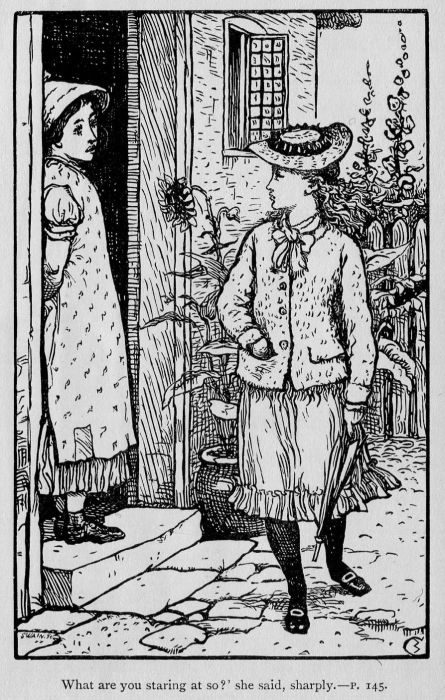
“What are you staring at so?” she said sharply. “It’s too bad of you. You are a rude little girl. I’ll tell nurse how rude you are.”
Judy did not generally speak so crossly, especially not to poor children, for she had really nice feelings about such things, but she was very much put out, and ashamed too, that her ill-natured words to nurse should have been overheard, so she expressed her vexation to the first object that came in her way. The little girl did not leave off staring at her; in fact she did so harder than before. But she answered Judy gently, growing rather red as she did so; and Judy felt her irritation cool.
“I didn’t mean no offence,” she said. “I were just looking at you, and thinking to be sure how nice you had everything, and a wondering how it could be as you weren’t pleased.”
“Who said I wasn’t pleased?” said Judy.
“You said as something was a deal too bad,” replied the child.
“Well, so it was,—it must have been, I mean,—or else I wouldn’t have said so,” answered Judy, who, to tell the truth, had by this time quite forgotten what particular trouble had been the cause of her last grumble. “How do you mean that I have everything so nice?”
“Your things, miss—your jacket and your frock, and all them things. And you live in such a fine house, and has servants to do for you and all. O my! wouldn’t I change with you. Nothing would never be too bad for me if I was you, miss.”
“I daresay you think so,” said Judy importantly, “but that just shows that you don’t know better. I can tell you I have a great, great many troubles and things to bear that you have no idea of. Indeed, I daresay you are far happier than I. You are not bothered about keeping your frocks clean, and not getting your feet wet, and all those horrible things. And about lessons—I daresay you have no trouble at all about lessons. You don’t go to school, do you?”
“Not now, miss. It’s more than six months since I’ve been. Mother’s wanted me so badly to mind baby. Father did say as perhaps I should go again for a bit come Christmas,” answered the little girl, who was growing quite at ease with Judy.
“And do you like going?” said Judy.
“Pretty well, but it’s a long walk—winter time ’specially,” said the child; “not but what most things is hard then to them as lives in places like ours. ’Tisn’t like for you, miss, with lots of fires, and no need for to go out if it’s cold or wet.”
“Indeed I have to go out very often—indeed, always almost when I don’t want,” retorted Judy. “Not that I should mind the walk, to school. I should like it; it would be far nicer than horrid lessons at home, cooped up in the same room all the time, with no change. You don’t understand a bit; I am quite sure you haven’t as many troubles as I.” The little girl smiled, but hardly seemed convinced. “Seems to me, miss, as if you couldn’t hardly know, unless you tried, what things is like in places like ours,” she said.
But before Judy could reply, a voice from inside the cottage called out, “Betsy my girl, what are you about so long? Father’ll be in directly, and there’s the tea to see to.”
The voice was far from unkind, but its effect on Betsy was instantaneous.
“I must go, miss,” she said; “mother’s calling;” and off she ran.
“How nice and funny it must be to set the tea for her father,” thought Judy, as she walked on. “I should like that sort of work. What a silly girl she is not to see how much fewer troubles she has than I. I only wish—”
“What did you say you wished?” interrupted a voice that seemed to come out of the hedge, so suddenly did its owner appear before Judy.
“I didn’t say I wished anything—at least I didn’t know I was speaking aloud,” said the little girl, as soon as she found voice to reply.
The person who had spoken to her was a little old woman, with a scarlet cloak that nearly covered her. She had a basket on her arm, and looked as if she was returning from market. There was nothing very remarkable about her, and yet Judy felt startled and a little frightened, she did not quite know why.
“I didn’t know I was speaking aloud,” she repeated, staring half timidly at the old woman.
“Didn’t you?” she replied. “Well, now I think of it, I don’t remember saying that you did. There’s more kinds of speaking than with tongue and words. What should you say if I were to tell you what it was you were wishing just now?”
“I don’t know,” said Judy, growing more alarmed “I think, please, I had better run on. Nurse will be wondering where I am.”
“You didn’t think of that when you were standing chattering to little Betsy just now,” said the old woman.
“Did you hear us?” asked Judy, her astonishment almost overcoming her alarm. “Where were you standing? I didn’t see you.”
“I daresay not. There’s many things besides what you see, my dear. For instance, you don’t see why Betsy should think it would be a fine thing to be you, and perhaps Betsy doesn’t see why you should think it would be a fine thing to be in her place instead of in your own.”
Judy’s eyes opened wider and wider. “Did you hear all that?” she exclaimed.
The old woman smiled.
“So you really would like to be Betsy for a change?” she said.
“Not exactly for a change,” answered Judy. “It isn’t that I am tired of being myself, but I am sure no other little girl in the world has so many troubles; that is why I would rather be Betsy. You have no idea what troubles I have,” she went on, “and I can never do anything I like. It’s always ‘Miss Judy, you must,’ or ‘Miss Judy, you mustn’t,’ all day long. And if ever I am merry for a little, then nurse tells me I shall wake baby. O! he is such a cross baby!”
“And do you think Betsy’s baby brothers and sisters are never cross?” inquired the old woman.
“O no, I daresay they are; but then she’s allowed to scold them and punish them, and I may never say anything, however tiresome the little ones are. If I might put baby in the corner when he is naughty, I would soon cure him. But I may never do anything I want; it’s too bad.”
“Poor thing, poor thing! it is too bad, a great deal too bad. I do feel for you,” said the old woman.
But when Judy looked up at her there was a queer twinkle in her eyes, which made her by no means sure whether she was laughing at her or not. The little girl felt more than half inclined to be affronted, but before she had time to decide the point, the old woman interrupted her.
“Look here, my dear,” she said, lifting up the lid of the basket on her arm; “to show you that I am in earnest, see what I will do for you. Here is a nice rosy-cheeked apple; put it into your pocket, and don’t let any one see it, and when you are in bed at night, if you are still of the same mind about being Betsy instead of yourself, just take a bite of the apple, then turn round and go to sleep, and in the morning you shall see what you shall see.”
Half hesitatingly, Judy put out her hand for the apple.
“Thank you very much,” she said, “but—”
“But what?” said the old woman rather sharply.
“Must I always be Betsy, if I try being her?”
“Bless the child, what will she have?” exclaimed the old woman. “No, you needn’t go on being Betsy if you don’t want. Keep the apple, take care you don’t lose it, and when you’ve had enough of a change, take another bite. But after that, remember the apple can do no more for you.”
“I daresay I shall not want it to do anything for me once I have left off being myself,” said Judy. “Oh, how nice it will be not to have nurse ordering me about all day long, and not to be bothered about keeping my frock clean, and to have no lessons!”
“I’m glad you’re pleased,” said the old woman. “Now, good-bye; you won’t see me again till you want me.”
“Good-bye, and thank”—“Thank you very much,” she was going to have said, holding out her hand as she spoke—for remember she was not a rude or ill-mannered little girl by any means—but, lo and behold, there was nobody there! the old woman had disappeared! Judy rubbed her eyes, and stared about her in every direction, but there was nothing to be seen—nothing, that is to say, in the least like an old woman, only some birds hopping about quite unconcernedly, and a tiny field-mouse, who peeped up at Judy for an instant with its bright little eyes, and then scurried off to its hole.
It was growing late and dusk, the mists were creeping up from the not far distant sea, and the hills were thinking of putting on their night-caps, and retiring from view. Judy felt a little strange and “eerie,” as she stood there alone in the lane. She could almost have fancied she had been dreaming, but there was the rosy-cheeked apple in her hand, proof positive to the contrary. So Judy decided that the best thing she could do was to run home as fast as she could, and consider at her leisure if she should make use of the little old woman’s gift.
It was nearly dark when she reached the garden gate—at least the trees on each side of the carriage-drive made it seem so. Judy had never been out so late alone before, and she felt rather frightened as to what nurse would say. The side door was open, so she ran in, and went straight up to the nursery. Just as she got upstairs she met nurse, her shawl and bonnet on, her kind old face looking hot and anxious. At sight of the truant she stopped short.
“So there you are, Miss Judy,” she exclaimed; “and a nice fright you’ve given me. It’s my turn to speak about ‘too bad’ now, I think. It really was too bad of you to stay behind like that, and me never thinking but what you were close behind till this moment; at least, that you had come in close behind, and had stayed down in the drawing-room for a little. You’ve frightened me out of my wits, you naughty child; and if only your mamma was at home, I would go straight down-stairs, and tell her it’s more than I can put up with.”
“It’s more than I can put up with to be scolded so for nothing,” said Judy crossly, and with a tone in her voice new to her, and which rather took nurse aback. She had not meant to be harsh to the child, but she had been really frightened, and, as is often the case, on finding there had been no cause for her alarm, a feeling of provocation took its place.
“You should not speak so, Miss Judy,” she said quietly, for she was wise enough not to wish to irritate the little girl, whom she truly loved, further.
But Judy was not to be so easily pacified.
“It’s too bad,” she began as usual; “it’s a great deal too bad, that I should never be allowed to do the least thing I want; to be scolded so for nothing at all—just staying out for two or three minutes;” and she “banged about” the nursery, dragging her hat off, and kicking her boots into the corner in an extremely indignant manner.
Nurse felt much distressed. To Judy’s grumbling she was accustomed, but this was worse than grumbling. “What can have come over the child?” she said to herself, but to Judy she thought it best to say nothing at all. All through tea Judy looked far from amiable; she hardly spoke, though a faint “Too bad” was now and then heard from her direction. Poor nurse had not a very pleasant time of it, for the “cross” infection spread, as, alas! it is too apt to do, and little Lena, Judy’s four-years’-old sister, grew peevish and discontented, and pinched Master Baby, in return for which he, as was to be expected, set up a dismal howl.
“Naughty, horrid little things!” said Judy. “If I had my way with them, they should both be whipped and put to bed.”
“Hush, Miss Judy!” said nurse. “If you would be pleasant and help to amuse them, they would not be so cross.”
“I’ve something else to do than to amuse such ill-natured little things,” said Judy.
“Well I should think it was time you learnt your lessons for to-morrow,” said nurse. “We’ve had tea so late, it will soon be time for you to be dressed to go down to the drawing-room to your papa. There are some gentlemen dining with him to-night.”
“I can’t bear going down when mamma’s away,” said Judy. “It’s too bad of her to go away and leave us.”
“For shame, Miss Judy, to speak so, when you know that it’s only because your poor aunt is so ill that your mamma had to go away. Now get your books, there’s a good girl, and do your lessons.”
“I’m not going to do them,” said Judy, with sudden resolution. “I needn’t unless I like. I don’t think I shall ever do any more. It’s too bad I should never have a minute of time to myself.”
Nurse really began to think the little girl must be going to be ill. Never, in all her experience of her, had she known her so cross. It was the same all the evening. Judy grumbled and stormed at everything; she would not stand still to have her hair brushed, or her pretty white muslin frock fastened; and when she came upstairs she was more ill pleased than before, because, just as she was beginning to amuse herself with some pictures, her papa told her he thought it was time for little girls to be in bed. How often, while she was being undressed, she declared that something or other was “too bad,” I really could not undertake to say. She grumbled at her nice warm bath, she grumbled at her hair being combed out, she grumbled at having to go to bed when she wasn’t “the least bit sleepy,” she grumbled at everything and everybody, herself, included, for she came to the resolution that she really would not be herself any longer! No sooner had nurse and the candle left the room than Judy drew out the apple, which, while nurse was not looking, she had managed to hide under her pillow, took a good big bite of it, turned round on her side, and, notwithstanding that her little heart was beating much faster than usual, half with excitement, half with fear, at what she had done, in two minutes she was sound asleep.
“Betsy, Betsy girl, it’s time you were stirring. Up with you, child; you must look sharp.”
What voice was that? who could it be, shouting so loudly, and waking her up in the middle of the night? Judy for a moment felt very indignant, but she was extremely sleepy, and determined to think she was dreaming; so she turned round, and was just dozing off, when again she heard the cry:
“Betsy, Betsy, wake up with thee. Whatever’s come to the child this morning?”
The voice seemed to come nearer and nearer, and at last a thump on the wall, close to Judy’s head, it seemed to her, fairly startled her awake.
“Up with thee, child,” sounded close to her ear. “Baby’s been that cross all night I’ve had scarce a wink o’ sleep. Thee mustn’t lie snoring there.”
Suddenly all returned to Judy’s memory. She was not herself; she was Betsy.
“I’m coming,” she called out, hardly knowing what she was saying; and then the person on the other side of the wall seemed to be satisfied, for Judy now heard her walking about, clattering fire-irons and pots and pans, evidently employed in tidying the kitchen.
It was still what Judy thought quite dark. She had some idea of calling for a light, but whom to call to she did not know. So, feeling very strange and rather frightened, she got timidly out of bed, and by the little light that came in at the small square window, began to look about her. What a queer little place it was! Not a room really, only a sort of “lean-to” at one side of the kitchen, barely large enough for the narrow, rickety little bedstead, and one old chair that stood beside it, answering several purposes besides its proper one, for on it was placed a cracked basin and jug, and a tiny bit of looking-glass, without a frame, fastened by a piece of string to the only remaining bar. Betsy’s clothes lay in the bed, which was but poorly provided with proper blankets—the sheets were clean—everything in the place was as clean as poverty can be, and indeed Betsy was, and considered herself to be, a very fortunate little girl for having a “room” of her own at all; but to Judy, Judy who had had no training like Betsy’s, Judy who found every crumple in a rose leaf “too bad,” Judy who knew as little of other people’s lives and other people’s troubles as the man in the moon,—you can fancy, my dears, how the room of which little Betsy was so proud looked to Judy! But she had a spirit of her own, ready though she was to grumble. With a little shiver, she began to try to dress herself in the well-mended clothes, so different from her own daintily-trimmed little garments—for washing she felt to be out of the question; it was really too cold, and besides there were no soap, or sponges, or towels to be seen.
“I don’t care,” she said to herself stoutly, as she wriggled first into one garment and then into another. “I don’t care. Any way I shall have no lessons to learn, and I shall not be bothered about keeping my frock clean. But I do wish the fairy had left me my own hair,” she went on regretfully, examining the thick dark locks that hung round her face, and kept tumbling into her eyes, “my hair is much nicer. I don’t believe Betsy ever has hers properly brushed, it is so tuggy. And what brown hands I’ve got, and such crooked nails. I wonder if Betsy’s mother will cut them for me; I wonder if—”
She was interrupted by another summons.
“Betsy, girl, what are you after this morning? I be getting downright cross with you, child. There’s father’ll be back for breakfast directly, and you not helped me by a hand’s turn this blessed morning.” Judy started. She only stopped to fasten the last button of her little dark cotton frock, and calling out, “I’m coming,” opened the rough door of the little bed-room, and found herself in the kitchen. There sat Betsy’s mother, with the baby on her knee, and the baby but one tumbling about at her feet, while she vainly tried to fasten the frock of another little fellow of three, who sturdily refused to stand still.
“You must finish dressing Jock,” she said, on catching sight of Judy; “Jock’s a naughty boy, won’t stand still for mammy to dress him; naughty Jock,” she continued, giving him a little shake as she got up, which sent him howling across the room to Judy. “It’s too bad of you, Betsy, to be so lazy this morning, and me so tired with no sleep, and the little ones all crying; if I tell father he’ll be for giving it thee, lass, to make thee stir about a bit quicker.”
“He’ll give me what?” said Judy, perplexed. “I don’t understand.”
“Hold thy tongue; I’ll have none of that answering back, child,” said Betsy’s mother, tired and out of patience, poor woman, though you must not think she was either harsh or unkind, for she was a very kind, good mother.
“Jock, let me dress you,” said Judy, turning to the little boy, with a vague idea that it would be rather amusing to act nurse to him. Jock came towards her willingly enough, but Judy found the business less easy than she had expected. There was a button missing on his little petticoat, which she did not find out in time to prevent her fastening it all crooked; and when she tried to undo it again, Jock’s patience was exhausted, and he went careering round the kitchen, Judy after him, till the mother in despair caught hold of him, and completed the task.
“Your fingers seem to be all thumbs this morning,” she said testily. “You’ve not swep’ up a bit, nor made th’ fire, nor nothing. Go and fetch water now to fill th’ kettle, or father’ll be in afore it’s on the boil.”
Judy turned to the fireplace, and, with some difficulty, managed to lug the heavy old kettle as far as the front door. Just outside stood the pump, but try as she might she could not get the water to flow. She was ready to cry with vexation, pumping had always seemed such nice easy work; she had often watched the children of these very cottages filling their kettles and jugs, and had envied them the fun; but now when she had it to do she found it very different—very poor fun, if indeed fun at all! At last she got the water to begin to come, a poor miserable little trickle; at this rate the kettle would never be filled, and her tears were preparing to descend, when a rough hearty voice made her jump. It was Betsy’s father.
“Pump’s stiff this morning, is it, my lass?” he called out as he came up the path. “Let’s have a hand at it;” and with his vigorous pull the water quickly appeared. He lifted the kettle into the kitchen, greatly to Judy’s relief; but Betsy’s mother took a different view of the matter.
“I don’t know what’s come to Betsy this morning,” she said. “Lazy’s no word for her. The porridge is ready, but there’ll be no time to make thee a cup of coffee, father. She’s been close upon a quarter of an hour filling the kettle, and baby’s so cross this morning I can’t put her down.”
“I must make my breakfast of porridge then,” said the father; “but Betsy, girl, it’s new for thee to be lazy, my lass.”
Judy felt humbled and mortified, but she said nothing. Somehow she felt as if she could not defend herself, though she knew she had honestly done her best. The words “too bad” rose to her lips, but she did not utter them. She began to wonder how little Betsy managed to get through her daily tasks, easy as she had imagined them to be.
The porridge was not much to her taste, but she tried to eat it. Perhaps it was not so much the porridge itself, for it was good of its kind, which took away her appetite, as the want of the many little things to which she was so accustomed that their absence made her for the first time think of them at all. The nice white tablecloth and silver spoons on the nursery table, the neat, pretty room, and freshly dressed little brothers and sisters—all were very different from the rough board, and the pewter spoons, and Betsy’s father and big brothers hurriedly devouring the great bowls of porridge, while the three little ones cried or quarrelled incessantly. “After all,” thought Judy, “perhaps it is a good thing to have rather a strict nurse, even if she is very fussy about being neat and all that.”
But yet she felt very sorry for Betsy’s mother, when she looked at her thin, careworn face, and noticed how patient she was with the babies, and how cheerfully she answered all “father’s” remarks. And there began to dawn in the little girl’s mind a faint idea that perhaps there were troubles and difficulties in the world such as she had never dreamt of, that there are a good many “too bads” in other people’s lots as well as in Miss Judy’s.
Breakfast over, her troubles began again. It was washing-day, and just as she was looking forward to a ramble in the fields in glorious independence of nurse’s warnings about spoiling her frock, her dreams were put an end to by Betsy’s mother’s summoning her to take her place at the tub. And oh, my dears, real washing is very different work from the dolls’ laundressing—standing round a wash-hand basin placed on a nursery chair, and wasting ever so much beautiful honey-soap in nice clean hot water, and then when the little fat hands are all “crumply” and puffy “like real washerwomen’s,” rinsing out the miniature garments in still nicer clean cold water, and hanging them round the nursery guard to dry, and most likely ending up by coaxing nurse to clear away all the mess you have made, and to promise to let you iron dolly’s clean clothes the next wet afternoon—which you think so delightful. Judy’s arms ached sorely, sorely, and her head ached too, and she felt all steamy and hot and weary, when at last her share of it was over, and, “for a change,” she was instructed to take the two youngest out for a walk up the lane, while mother boiled the potatoes for dinner.
The babies were very tiresome, and though Judy was quite at liberty to manage them in her own way, and to punish them as she had never ventured to punish Lena and Harry at home, she did not find it of much use. She wondered “how ever the real Betsy did;” and I fancy the babies too wondered a good deal in their own way as to what had come over their big sister to-day. Altogether the walk was very far from a pleasure to any of the three, and when at last Judy managed to drag her weary self, and her two hot, cross little charges home again to the cottage, she was by no means in an amiable humour. She would have liked to sit down and rest, and she would have liked to wash her face and hands, and brush her hair—Judy who at home always grumbled at nurse’s summons to “come and be tidied”—but there was no time for anything of the kind. Dinner—the potatoes, that is to say—was ready, and the table must be set at once, ready for father and the boys, and Betsy’s mother told her to “look sharp and bustle about,” in a way that Judy felt to be really a great deal “too bad.” She was hungry, however, and ate her share of potatoes, flavoured with a little dripping and salt, with more appetite than she had sometimes felt for roast mutton and rice pudding, though all the same she would have been exceedingly glad of a little gravy, or even of a plateful of sago pudding, which generally was by no means a favourite dish of hers.
“Me and the boys won’t be home till late,” said the father, as he rose to go; “there’s a piece o’ work master wants done this week, and he’ll pay us extray to stay a couple of hours. Betsy must bring us our tea.”
Judy’s spirits rose. She would have a walk by herself any way, unplagued by babies, and the idea of it gave her some patience for the afternoon’s task of darning stockings, which she found was expected of her. Just at first the darning was rather amusing, but after a while she began to be sadly tired of it. It was very different from sitting still for a quarter of an hour, with nurse patiently instructing her, and praising her whenever she did well; these stockings were so very harsh and coarse, and the holes were so enormous, and the basketful so huge!
“I’ll never get them done,” she exclaimed at last. “I think it’s too bad to make a little girl like me or Betsy do such hard work; and I think her father and brothers must make holes in their horrid stockings on purpose, I do. I’ll not do any more.”
She shoved the basket into a corner, and looked about for amusement. The babies were asleep, and Jock was playing in a corner, and mother, poor body, was still busy in the wash-house—Judy could find nothing to play with. There were no books in the cottage, except an old Farmers’ Almanac, a Bible and Prayer-book, and one or two numbers of a People’s Miscellany, which Judy looked into, but found she could not understand. How she wished for some of her books at home! Even those she had read two or three times through, and was always grumbling at in consequence, would have been a great treasure; even a history or geography book would have been better than nothing.
Suddenly the clock struck, and Betsy’s mother called out from the wash-house,—
“It’s three o’clock—time for you to be going with the tea. Set the kettle on, Betsy, and I’ll come and make it and cut the bread. It’ll take you more nor half-an-hour to walk to Farmer Maxwell’s where they’re working this week.”
Judy was staring out of the window. “It’s beginning to rain,” she said dolefully.
“Well, what if it is,” replied Betsy’s mother, “Father and boys can’t want their tea because it’s raining. Get thy old cloak, child. My goodness me!” she went on, as she came into the kitchen, “she hasn’t got the kettle on yet? Betsy, it’s too bad of thee, it is for sure; there’s not a thing but what’s been wrong to-day.”
Judy’s conscience pricked her about the stockings, so, without attempting to defend herself, she fetched the old cloak she had seen hanging in Betsy’s room, and, drawing the hood over her head, stood meekly waiting, while the mother cut the great hunches of bread, made the tea, and poured it into the two tin cans, which the little girl was to carry to the farm.
It did not rain much when she first set off, so though it was a good two miles’ walk, she was only moderately wet when she got to the farm. One of the boys was on the look-out for her, or rather for their tea, which he at once took possession of and ran off with, advising Judy to make haste home, it was going to rain like blazes. But poor Judy found it no easy matter to follow his counsel; her arms were still aching with the weight of the baby in the morning, and her wrist was chafed with the handle of one of the tin pails, which she could not manage otherwise to carry, the old cloak was poor protection against the driving rain, and, worst of all, Betsy’s old boots had several holes in them, and a sharp stone had made its way through the sole of the left one, cutting and hurting her foot. She stumbled along for some way, feeling very miserable, till at last, quite unable to go farther, she sat down under the hedge, and burst into tears.
“So you haven’t found things quite so pleasant as you expected, eh, Miss Judy? You don’t find walking in Betsy’s shoes quite such an easy matter after all?” said a voice at her side; and, looking up, lo and behold! there, standing before her, Judy saw the old woman with the scarlet cloak.
“I don’t think it is kind of you to laugh at me,” she sobbed.
“It’s ‘too bad,’ is it, eh, Miss Judy?”
Judy sobbed more vigorously, but did not answer.
“Come, now,” said the old woman kindly. “Let’s talk it over quietly. Are you beginning to understand that other people’s lives have troubles and difficulties as well as yours—that little Betsy, for instance, might find things ‘too bad’ a good many times in the course of the day, if she was so inclined?”
“Yes,” said Judy humbly.
“And on the whole,” continued the fairy, “you would rather be yourself than any one else—eh, Miss Judy?”
“Oh yes, yes, a great deal rather,” said Judy eagerly. “Mayn’t I be myself again now this very minute, and go home to tea in the nursery? Oh, I would so like! It seems ever so long since I saw Lena and Harry and nurse, and you said yesterday I needn’t keep on being Betsy if I didn’t like.”
“Not quite so fast, my dear,” said the old woman. “It’s only four o’clock; you must finish the day’s work. Go back to the cottage and wait patiently till bed-time, and then—you know what to do—you haven’t lost your apple?”
“No,” said Judy, feeling in her pocket. “I have it safe.”
“That’s all right. Now jump up, my dear, and hasten home, or Betsy’s mother will be wondering what has become of you.”
Judy got up slowly. “I’m so wet,” she said, “and oh! my foot’s so sore. These horrible boots! I think it’s too—”
“Hush!” said the fairy. “How would you like me to make you stay as you are, till you quite leave off that habit of grumbling. I’m not sure but what it would be a good thing for her,” she added, consideringly, as if thinking aloud.
“O no, please don’t,” said Judy, “please, please don’t. I do beg your pardon; I didn’t mean to say it, and I won’t say it any more.”
“Then off with you; your foot won’t be so bad as you think,” said the fairy.
“Thank you,” replied Judy, fancying already that it hurt her less. She had turned to go when she stopped.
“Well,” said the old woman, “what’s the matter now?”
“Nothing,” answered Judy, “but only I was thinking, if I am myself again to-morrow morning, and Betsy’s herself, what will they all think? nurse and all, I mean; and if I try to explain, I’m sure they’ll never believe me—they’ll say I’m talking nonsense. Nurse always says ‘rubbish’ if we make up fairy stories, or anything like that.”
The old woman smiled curiously.
“Many wiser people than nurse think that ‘rubbish’ settles whatever they don’t understand,” she said. “But never you mind, Judy. You needn’t trouble your head about what any one will think. No one ever will be the wiser but you and I. When Betsy wakes in her own little bed in the morning, she will only think she has had a curious dream—a dream, perhaps, which will do her no harm—and nurse will think nothing but that Miss Judy has been cured of grumbling in a wonderful way. For if you’re not cured it will be my turn to say it’s too bad!—will it not?”
“Yes,” said Judy, laughing. “Thank you so much, kind fairy. Won’t you come and see me again sometimes?”
But the last words were spoken to the air, for while Judy was uttering them the old woman had disappeared, and only the little field-mouse again, with bright sparkling eyes, ran across the path, looking up fearlessly at Judy as it passed her.
And Judy never did see the old woman again. She went back to the cottage, bearing bravely the pain of her wounded foot, which was not so very bad after all, and the discomfort of her wet clothes.
And though Betsy’s mother scolded her for having been so slow about her errand, she did not grumble or complain, but did her best to help the poor woman with the evening’s work. All the same, I can tell you, she was very glad to get to bed at night, and you may be sure she did not forget to take a great big bite of her apple.
“When I am myself again, I’ll spend the six shillings I have in my money-box to buy Betsy a nice new print frock instead of that ugly old one that got so soaked to-day,” was her last thought before she fell asleep.
And oh! my dears, can you imagine how delightful it was to find herself in the morning, her real own self again? She felt it was almost too good to be true. And, since then, it has been seldom if ever, that Miss Judy has been heard to grumble, or that anything has been declared to be “too bad.”
Chapter Seven.
Charlie’s Disappointment.
“O sweet and blessed country That eager hearts expect.”
One cold winter’s evening about Christmas time, Charlie, a little boy of six years old, sat reading with his mother. It was Sunday evening, and he had been looking at the pictures in his “Children’s Bible,” till his mother put down her own book and began to read verses to him out of his real Bible, in explanation of some of the pictures. With one of these especially, Charlie was very much pleased. It represented a great many people, men and women and children, and animals of every kind, all together, looking very peaceful and happy in a beautiful garden. Charlie could not pronounce the word at the foot of the picture; it was so very long.
“The—what is it, mother?” he asked.
“The Millennium,” his mother told him, and then she went on to explain what this long word meant, and read him some strange, beautiful verses about it, out of the big Bible. Charlie sat with his blue eyes fixed on her, listening to every word, and thinking this the most wonderful story he had ever heard yet. “And it is not like a fairy story, is it mother, for it is in the Bible? Oh, I do so wish God would let the millennium come now—immediately—mother, while I am a little boy, and you, just like what you are! I should not care nearly so much for it if you were old, mother, or if I was a big man.”
“I hope, my darling, the bigger you get the more you will care for it,” said his mother. Charlie looked puzzled, but seeing that he was thinking so deeply, that she feared he would think away his sleep (as he sometimes did, and it was nearly bed-time), she went to the piano and sang his favourite hymn—
“Jerusalem the golden, With milk and honey blest.”
Charlie listened with delight; and when it was over went and kissed his mother for good-night, and trotted off to bed, his mind full of the words he had been hearing.
It felt cold at first, in his little crib, and he began thinking how nice it would be if the summer were back again. But he soon fell asleep. It seemed to him that he woke almost in a minute, and he felt surprised to see that there was already broad daylight in the room. Indeed, he felt exceedingly surprised, for these dark winter mornings he always woke before dawn, and now the sun was shining brightly, as if it had been at work for some hours. It looked so pleasant and cheerful that he lay still to enjoy it. Now I must tell you that Charlie had a baby brother, and that both these little boys were taken care of by a good old woman who had been nurse to their mother when she was a little girl. Nurse was very good and kind and true, but I must say that sometimes she was very cross. Perhaps it was that she was getting old, and that little boys teased her, not being always able to remember about being gentle and good: that is to say, Charlie himself, for the baby was really too little either to remember or forget. Nurse’s worst time was first thing in the morning; she nearly always had a cross face on when she came to wake Charlie, and to tell him to get up. He once heard some of the servants saying that nurse very often got out of the wrong side of her bed; and that day he vexed her very much without knowing why, for, after thinking a long time about what it could mean, he went all round her bed to see if there could be any nails or sharp pieces of wood sticking out at one side, which perhaps hurt her feet as she stepped out. Nurse came in while he was examining her bed, and when he told her what he was doing, and what he had heard Anne say, she was really very angry indeed, though he could not see that he had done anything naughty.
But this morning I am telling you about that Charlie lay in bed thinking how pretty the sunlight was, he was quite surprised to see nurse’s face when she came to the bedside to wake him. She spoke so sweetly, and really looked quite pretty. Her face had such a nice smile and looked so kind, and nearly all the wrinkles were gone.
“Dear nurse,” he said, “how nice you look!” This seemed to please her still more, for she kissed him, and then washed and dressed him, without once pulling or pushing him the least little bit; just as if she had never felt cross in her life.
When he was dressed he ran out into the garden, and, to his surprise, it was quite changed from the night before. The grass was bright and green, the trees were all covered with leaves, and the whole garden was full of the loveliest flowers he had ever seen; and the singing of the birds was prettier than he could possibly describe. There were many butterflies and other summer insects flying about, and making a delicious sort of sweet humming, which seemed to join in with the birds’ singing. Indeed Charlie could almost have believed the flowers themselves were singing, for a lovely music filled the whole air, and all the musicians, even the grasshoppers, kept in tune together in a wonderful way. The song sounded to Charlie very like “Jerusalem the Golden,” only there were no words. He ran about the garden so much, that at last he thought he would like a drink of new milk, and he went into the yard to look for the dairy-maid. There was no one there; but he forgot all about the milk, in astonishment at what he saw. “Tiger,” the great fierce watch dog, whom his papa would never let him go near, was unchained, lying peacefully on his back in the sun, and Charlie’s two lovely kittens rolling over and over him, Tiger patting them gently with his paws, and looking so pleased that Charlie almost thought he was smiling. And more wonderful still, his mother’s pet canaries were also loose in the yard, one hopping about close to Tiger’s nose, and the other actually perched on the back of Muff, the tabby cat, whom, all her life, his mother had never succeeded in curing of her sad love of eating canary birds. Charlie’s first thought was to drive away Muff and rescue the birds; but as he ran forward to do so, Muff came and rubbed herself gently against him with a soft, sweet purr, and the canary flew off Muff’s back on to his shoulder, where it gave a little trill of pleasure, and then flew back again to its friend the cat. Suddenly some words flashed into Charlie’s mind: “They shall neither hurt nor destroy,” he said slowly, and then it all seemed plain to him. “The Millennium has come,” he cried, with inexpressible joy, “Oh! how glad I am; I must run and tell mother this minute,” and off he set. But as he ran towards the house, glancing up, thoughtful for others as was his habit, to the window of his mother’s room, he saw that the blind was still drawn down, and remembered that he must not disturb her yet, though his little heart was bursting with impatience to tell her the beautiful news. “I might, any way, run and tell Lily at once,” thought he, and he set off at full speed towards the farm where his little friend lived. But he had not gone half way when he recollected that to get to Lily’s home he must pass the smithy, a place he was frightened to go near even with his nurse, for Black Tom, the smith, was a very terrible person. He was often intoxicated, and used then to swear most awfully; and, indeed, Lily had once told Charlie in confidence that her nurse had said she felt pretty sure Black Tom would not think anything at all of eating little boys and girls. Dreadful as he thought him, Charlie could not believe that Black Tom was quite as wicked as this; but still he trembled as he drew near the smithy. But how amazed he felt, when he got within sight of it, to see Tom standing at the door, washed and brushed up to such an extent, that the child hardly recognised his old aversion!