Chapter I
Reading edition
SCREAMS IN THE NIGHT.
The first of the strange midnight raids was made upon a girls' school on Moose Head Lake, in Maine. It was a summer camp on the lake, with something like eighty girls, almost all between the ages of fifteen and twenty. The affair—which occurred during the night of August 10 and 11, 1950—was kept as secret as possible. It did not get into the newspapers, nor did the newscasters send it over the air until about a week later.
But it terrorized the immediate neighborhood at once. Little wonder! There were ten of the girls missing when, despite the confusion and terror, the others could be counted. Two more were dead. The principal, a Professor White, was wounded. Two of the other men teachers were killed, and one of the matrons.
I heard of the affair about noon of August 1th, I was twenty-five years of age that summer of 1950 when the mysterious attack upon the White Summer Camp in Maine began those fantastic events which brought a menace to two worlds and an utter chaos on one of them.
I am Jack Dean, a newsgatherer for the Broadcasters' Press Association, and occasionally doing some actual newscasting.
I was in the New York studios of the B. P. A., had just been on the air with a routine news account, when the aviator Jimmy Turk called me on long distance from Boston.
"Take your plane and come up," he told me. His voice was vibrant with excitement. "Drop your work. Tell 'em it's business, the biggest piece of news of the year—if you can get a release on it!"
Jimmy Turk was an operative of the newly established Interstate Flying Patrol. A friend from my university days, though of recent years we had not seen much of one another. A short, stocky, red-headed little dare-devil, this Turk—one of the most skillful, wildest flyers in the service.
"Trouble up at Moose Head Lake in Maine," he went on. "Meet you at Bangor—the Lancet Field. We'll go in my Dragon, leave your tub-boat there. What time will you be up? Four o'clock? The devil! If you leave now you can be there by three, or earlier."
"For how long, Jimmy? An overnight job?"
"Tell 'em you don't know. A day or two. A week. Just tell 'em it's the biggest thing ever—if you get it for the air. It's been suppressed so far. I'm in it from the police end. Damn it, Jack, don't make me talk. There's no time."
I flew up the coast and met him at the Lancet Field in mid afternoon. He was wild-eyed; his fiery red hair tousled; his whole little body shaking with excitement. It was the strain of waiting for me. With action Jimmy Turk was cool and calculatingly deliberate.
He hustled me into his fleet little Dragon—the smallest, swiftest thing that flies.
"I've been over there and back. It isn't far; half an hour or so."
We settled down in his tiny oval cockpit. He lifted us and we sped away over the forest reaches toward the famous lake. It was a surprisingly wild country for this day and age—a playground for summer vacationists, yet there were deserted lakes and unbroken stretches of primeval forest.
"Well, Jimmy, now that we're here, what's the trouble?" I put in jovially. "Something drastic?"
"No trouble—nothing at all except about ten young girls abducted, a few killed, and a few other miscellaneous murders."
He told me all he had learned about it. Little enough, in truth. It was wholly confused—a chaos of conflicting accounts, none of which dovetailed to make any rational explanation.
The White Summer Camp for Girls consisted of a group of log-cabin style bungalows set on a promontory of the lake, with a larger cabin as mess-hall. A boathouse with canoes, a dock, float, and diving board were at the end of the point. There was a small stable with saddle horses, and a taxi-runway leading from the lake to a hangar-garage in which several small sport planes of hydroplane type were housed for such of the pupils whose parents would allow and could afford the use of them.
The camp was in one of the wildest portions of the lake. Unbroken forest lay about it, with only a few houses in the neighborhood and a dirt road leading to the nearest village three miles away.
The place was in a turmoil when we arrived. Planes lay thick on the water about the runway. The road was jammed with automobiles. A police cordon was about the camp to keep the crowd back, but inside the lines there was a group of excited officials, investigators, and curiosity-seekers who had the pull to get in there.
The pupils—such of them who were not killed, or vanished—had fled to their homes. Professor White lay unconscious in a Bangor hospital. What he had to tell, if there were anything rational, as yet remained undisclosed.
The affair was secret. It was held off the air, and out of the printed press; but by word of mouth the news had spread like flames before a wind in prairie grass. We got through the lines. Jimmy had a conference with his superior; I wandered about the place, talking with as many of the excited people as I could, picking up a connected story of a sort for use provided they let me give it out.
A weird, disjointed account, indeed. So far as I could piece it together, it ran like this:
At about midnight the previous night the camp was aroused by the wild screaming of some of the girls. The night was dark. This was a period of nearly full moon, but heavy clouds had obscured it. And a night of noises.
A fresh wind off the lake pounded waves on the shore and sang through the forest trees.
But above the noise the screams of terror-stricken girls had sounded. There were evidently screams from everywhere about the camp within a few minutes. But most of it was the panic of terror.
The original alarm came from one of the larger cabin dormitories where twelve girls and a matron were sleeping. The doors and windows were all open; the unbroken forest depths lay only a few paces away. Something or some one, human or otherwise, had made an attack. When it was over—in a few moments, no doubt, and before any one from the adjacent buildings seemed to have reached there—ten of the girls from that cabin had vanished. The matron lay dead just outside the doorway. One of the girls were found dead on the floor beside her bed; the other lay across the road at the edge of the forest.
The two men instructors, and Professor White, were all found on the road; they had evidently been running toward the sound of the screams when they were struck down.
I had an opportunity later to see one of the bodies where it lay in the police station of the near-by village. All the deaths were from the same cause. A hole the size of a lead pencil in the chest, penetrating the heart. Or in the head, piercing the brain. But there was no bullet. Nor had there been any sound of shots—every account agreed on that.
Some weapon wholly soundless had drilled the victims. It seemed like a burn; a blast of intense heat burning a tiny round hole. Through flesh, or the bone of the skull, it was the same.
No one had seen any of the attackers. Hysterical pupils told of vague shadowy forms of men along the road. Men huge; but some said small. There were other girls who claimed that they were not men at all, but weird monsters half like beasts in pseudo-human form. And there was mention of dragging, shuffling footsteps in the underbrush—presumably the fantastic monsters dragging away their screaming victims.
Most of this was discredited by the investigators. The night was too dark and noisy to see anything, or hear very much. But the ten girls were vanished; there were five dead bodies—very tangible evidence! And the wounded, perhaps dying, Professor White.
There may have been strange footprints about the place. But if so, they were trampled upon and obliterated long before the authorities got there. There was another clew which appeared to be fact, since every one agreed in the telling of it. The attackers used no lights; but there had been a few soundless, blue-green flashes in the darkness. Little stabs of light. Tiny beams a few feet in length, instantaneous, like a miniature lightning bolt. Presumably these were the shots of some unknown weapon which had killed the five victims.
Jimmy Turk joined me. "Well, what do you make of it, Jack? Come here and meet Dr. Grenfell."
He inserted us into an excited group near by and detached a short, thick-set middle-aged man with a massive head and a stoop to his wide shoulders which made him look almost like a hunchback.
"Who was that?" I demanded, when, after a moment, Dr. Grenfell had hurried away from us.
"Scientific fellow. Head of the Bolton Astronomical Research Society. He's investigating this—one of the first to get here this morning."
"What's astronomy got to do with it?"
"I'm damned if I know, Jack."
But we were very soon to find out!
Such was the beginning of the mysterious assaults. A heavy guard was placed about the White Camp that night. One or two of the men teachers remained there, and three of the women.
Mrs. White was at her husband's bedside in Bangor. The professor still lay unconscious, hovering between life and death. His lung had been pierced; he had fallen in the road, struck his head and suffered a brain concussion. But the physicians hoped to pull him through.
What had he seen in the darkness of that weird night assault? We were all waiting eagerly for that time when he might be able to tell.
There was one girl pupil who remained in the camp—an orphan, who lived with the Whites both winter and summer. I met her a few days later.
That second night was as dark as the one preceding. The cordon of police and a few State troopers were hidden about the camp and in its buildings. But nothing happened. Jimmy's orders were to fly at about two thousand feet back and forth over the lake. I went with him.
We flew his Dragon without lights and with the engines fully muffled. Both of us realized that the authorities knew more of this thing—or suspected more—than we could guess. We were told to watch for any air vehicle rising or descending over the lake or the near-by forest; or for any strange lights. But there seemed nothing.
At dawn we landed at the village, turned in our report, and went to sleep. At about noon Jimmy woke me.
"By the gods, Jack, listen to this!"
The White Camp had been undisturbed. But from a town thirty miles away came the report that a young girl had vanished from her home during the night. It was an isolated farmhouse, with the girl's room on the lower floor.
Her parents said she had retired as usual; they had heard nothing; but in the morning she was gone. One of her window shutters had been taken off, the wood around its hinges burned as though by a blow torch.
"And there are others, Jack! This damnable, weird business!"
Other reports were coming in. Another girl was found murdered; her heart pierced by the same strange hole burned into her chest. She had screamed in the night; they had found her lying by her bed; a chair had been overturned with evidence of a struggle. And two girls, sleeping together, told of a queerly horrible face at their window—gray, thick-featured, flabby. They had heard dragging, shuffling footsteps outside as the face vanished. One of them said it was like a man paralyzed and trying to walk.
During the next few days a flood of such incidents were reported from all this section of the State. But except for those first two nights there were no missing girls, and no murders. Merely strange things that girls claimed to have seen and heard. Some seemed to have a fair basis of fantastic rationality—but most of the reports were now the product of hysteria.
"The thing is about over," said Dr. Grenfell, as he, with Jimmy, myself and one or two others, sat examining the reports in the dining hall of the White Camp. "There is nothing more undependable than reports from adolescent girls. This is hysteria now."
But there were occurrences which were not the imaginings of hysteria. The aërial patrols had observed strange light-glows down in the forest.
One pilot had even seen a shape rushing upward from the lake. He was some miles away from it and could not reach it with his light. He described it as a shape like a vague silver ball, mounting with tremendous velocity into the leaden clouds overhead. This was reported by one of the air patrols, of which fully fifty were on duty. And there were surface parties constantly searching the forests of the entire State. Every effort was being made to recover the missing girls, but it was all unavailing.
It was about this time that I met the single girl pupil who was living at the White Camp. Her name was Rowena Palisse. Romantic circumstances surrounded her. She was a ward of the Whites. Ten years ago her only relative, an elder brother, Guy, had invented a Space-rocket and endeavored to reach the Moon. It was acknowledged to be a suicidal attempt; he had provided no way of returning.
I had been fifteen then; I still recalled my boyish interest in this Guy Palisse Moon-rocket. It had successfully left the Earth, but never was heard of again. My interest now was renewed by meeting this sister of the adventurer who had so stirred my youthful fancy.
Rowena Palisse was twenty-two years old now. A very tall girl, fully five feet ten or eleven inches. Not slim, but slender, with a regal aspect in her bearing. Her long, brown braids hung forward over her shoulders in the modern fashion. Her modish long skirt and short-waisted jacket made her seem even taller than she was. A handsome girl, rather than beautiful. A girl of so queenly an aspect that she seemed born to command. A Nordic queen; she had a heritage of that, I feel sure.
But there was a gentle, wholly feminine softness about her as well. I understood that she had loved devotedly her brother Guy. As a child of twelve she had watched him with big wondering, frightened eyes as his cumbersome rocket carried him away from her into the mysteries of outer Space.
I found that look in her eyes now. A gentle, wondering softness—a wistfulness. It had spread to mark her whole demeanor. There was a poise in her manner, a calm dignity; but under it, wistfulness.
I stood before her, that first afternoon when Jimmy Turk introduced us. She was a head taller than the wiry little patrol flyer. But I am several inches over six feet; she extended her hand and smiled up at me.
"I have seen you for several days past. I wondered when some one would introduce us."
I was with Rowena Palisse a good deal during those ensuing afternoons. I made the occasions. She was frightened at the events which had transpired, but there was nothing hysterical about her. A matured girl, with a poised intellect which precluded hysteria.
I was more amazed at it when I realized that the investigators—there were a number of them still here, including Dr. Grenfell—still felt that another assault might be made, and they were for some reason using Rowena as a possible decoy. She made herself prominent about the grounds, both by day and night, though always carefully, secretly guarded.
Then there came a night—it was just a week after the original assault—when the trap was sprung. Dr. Grenfell, who was in charge here, had admitted me in the capacity of assistant. Perhaps because Rowena did not hide her friendly interest in me; and because my giant stature made me one who could put up a good fight with any midnight marauder.
This was a black, overcast night. There had been a great show of withdrawal of the guards that afternoon—though after dark many of them had crept back.
Jimmy and I, armed with automatics, crouched with Dr. Grenfell in the forest underbrush just across the road from Rowena's lighted window. She stood at it a moment, braiding her hair. And though there were a dozen armed men lurking close at hand to protect her, I marveled at her poise.
Her light went out. We waited, an hour or two at least. The heavy leaden clouds hung close overhead. The wind swished through the tree-tops; the lake waves pounded the shore; the dark silent buildings of the White Camp stood around us.
It began to rain a little. I was cold and stiff. Beside me the bulk of Dr. Grenfell's figure was a hunched black blob. At my feet Jimmy crouched like a coiled spring. There was a dim vista of the road; the roof-outline of the building near us, and the vague black rectangle of Rowena's open window.
There came at last a sound, different from those of the forest to which we had listened for so long. An eerie, indefinable sound. Quite close to us. We all three heard it. Dr. Grenfell stirred a trifle. Jimmy tensed, ready to leap.
A rustling of the bushes. Or was it out in the road?
I was swept suddenly with the chilling sense that this Unknown was supernatural. Something advancing upon me, invisible, intangible!
From the darkness of the road the sound became clearer. Footsteps. But they were gruesomely unnatural, uncanny. Dragging, shuffling footsteps, like a wounded thing dragging itself heavily along.
A moment or two. Jimmy touched me in warning, but I shoved off his hand. Dr. Grenfell's electric torch was raised. We had arranged not to move, or shoot, until he flashed it on.
Certainly something tangible was out there in the road. I thought I could distinguish a slowly moving, formless shape. Or perhaps two shapes, mingled in the darkness.
Abruptly there was another noise, a swishing, flapping sound. Not on the road, but over it. A monster, flying; or a giant bird. I saw something white, fluttering out there.
Dr. Grenfell's torch flashed on. Figures were disclosed in the road some twenty feet from us. Figures so fantastic the sight of them barely registered on my bewildered brain. A gigantic man-shape. Another, similar but smaller. And a great fluttering white thing behind and above them.
Jimmy leaped, with me after him. My shot and Grenfell's stabbed the darkness together. The forest rang with the other guards rushing and firing. From the road came-an answering "shot"—a tiny stab of blue-green light. It sizzled close past me, withering the shrubbery. The gigantic figure in the road made a slow desperate bound into the underbrush. The smaller figure fell with our shots. The white thing was hit; it came fluttering down; lay quivering—flapping in the dirt of the road.
No one thought, those first moments, of pursuing the escaping figure. With swaying torches we gathered in the road. A man lay there, dead from our shots. A squat, thick-set fellow clad in rude garments of animal skins. His flat-featured face was heavy with pouchy gray skin and goggling, staring dead eyes.
Near him, the wounded white thing lay struggling in death agony. A girl! Her blue-white draperies were stained crimson with her blood. A small, strangely frail-looking girl, with huge blue-feathered wings nearly as long as her body! They flapped, and then were still; she lay sprawled on the road like a great dead bird!
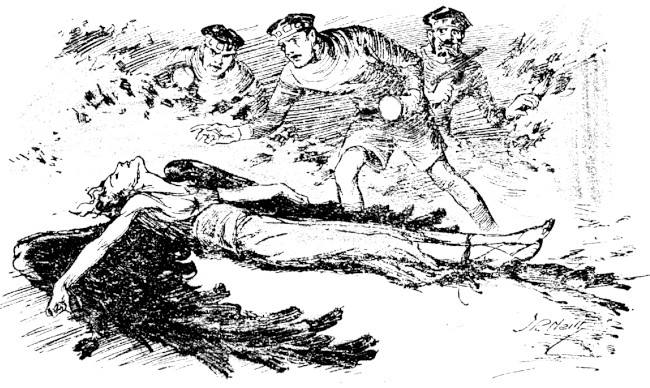
The white creature lay quivering, flapping in the dirt road.
We bent over her. She was still alive. For a moment she tried to speak. It seemed that the words were English! I thought that she gasped, "—warn you—" But we could distinguish nothing else intelligible. And presently she was dead.