Front matter (continued 2)
Reading edition
“That shows you’ve got more sense than a prairie-dog,” said Hank, “which surprises me. Many a time on the South Plains durin’ a sandstorm, I’ve seen them critters ten feet in the air, diggin’ with all their might, tryin’ to git back in their holes.”
“I’ll tell you what I’ve seen,” said Red, “and it was the funniest sight I ever saw caused by a sandstorm. One day in the spring the boss sent me out to pizen prairie-dogs. He was one man I didn’t work for long; he jist couldn’t stand to see a man not doin’ somethin’. So when the wind would git bad and he didn’t want to go out his self, he would send us out to ride fence and pizen dogs and the like.
“Well, this time I rode over to where I knowed there was a big town, and I rode up, and what do you suppose I saw? The sand was all blowed away, and there was them holes stickin’ forty feet in the air. I never knowed before that time how crooked them critters made their residences.”
“The wind’s purty hard on the rodents sometimes,” said Hank. “I knowed a wind, however, that helped out a pore human down on Sulphur Draw that was about to starve. This feller had come in to farm, and he raised a cribful of corn, but the ranchers wouldn’t buy it because it wasn’t shelled, and wouldn’t go in a morral. So the pore farmer was about to starve, and his old lady and kids to boot.
“This feller was jest fresh from the sticks and didn’t have much confidence in anybody, anyway, and he ’lowed the ranchers was waitin’ for a chance to steal his corn. So he nailed up the crib door good and tight. He noticed a knothole in one of the walls, but he saw it was too little for an ear of corn to go through; so he jest let that go.
“One day a wind come up, and the farmer and his folks hid in the dugout like prairie-dogs, and the next day the wind laid, and they crawled out and looked around; and there was corn cobs scattered all alongside the crib. The old man thought shore somebody had stole his corn, but when he got the crib door open, he saw it there all shelled as purty as if he’d done it his self.
“He was a sort of ignorant and superstitious man, and the next day when I happened by, he says to me that the fairies had come and shelled his corn. Well, I never did take no stock in fairies and the like, and I knowed there must be a reasonable and sane explanation somewheres. So I picked up one of the corn cobs and stuck it in the knothole. It was jest a good tight fit. Then I told the old man what must of happened. The wind got up and would of blowed all his corn out of the crib, but the knothole wasn’t big enough for an ear to go through. Hence each ear got shelled, and all the corn was left in the crib. It was jest as simple as that. Perfectly natural. If them old fellers we read about that believed in fairies and witches, and all that crap, had jest of used their heads, they’d found out that everything’s natural and simple enough. They put me in mind of Mex’cans. But as I was about to say, the old man sold his corn and got on purty well.”
“There was a farmer close to us one time,” said Joe, “that lost his milk cows in a curious manner. He had a little patch of pop-corn, and one hot day the cows broke into the patch and started eatin’ it up. All of a sudden that corn begun poppin’ and flyin’ every which away.”
“Did the shooting grains kill the cows?” asked Lanky.
“Naw,” said Joe. “When the fool critters saw all that pop-corn flyin’ through the air, they thought it was snow, and jest naturally froze to death.”
“Do you ever have tornadoes out here?” asked Lanky.
“You mean cyclones?” asked Joe. “Well, yes, sometimes. A queer thing happened to me one time up here jest below the Caprock. We was goin’ up the trail, and one evenin’ it was hot as blazes and sultry and still. The cattle was gittin’ nervous and we was all expectin’ hell to break loose any time. And shore nuff it did. A cloud come up in the northwest and it thundered and lightened, and then the storm struck us. Them steers jest naturally histed their tails and left the country. I was on a good hoss, but it was all I could do to stay in sight of them cattle. My pony was givin’ me all he had, and he wasn’t gainin’ on them steers none. Neither was the other boys gittin’ close to ’em.
“D’rec’ly I looked back over my shoulder like, and there was them clouds bilin’ and whirlin’ around in the sky; then all at once a funnel drops down and takes out after me. I started quirtin’ my hoss. I feel right mean about it yet when I think about it, for he was doin’ his best to ketch that herd, and he couldn’t do no more.
“Well, the next thing I knowed I was up in the air still in the saddle with my hoss under me, whirlin’ round and round like a top. That cyclone carried me around in the air like that for a half an hour or more, me scered all the time that it was goin’ to drop me. But it didn’t. After a while it sets me down jest as gentle as a mother with her baby.
“I looks up, and there’s the herd comin’ hell-bent for election right toward me. I gits off my slicker and fires off my six-shooter and turns them steers and gits ’em to millin’. Purty soon the other boys rides up, and we gits ’em quieted down, and the whole outfit has to set up and sing to ’em all night.
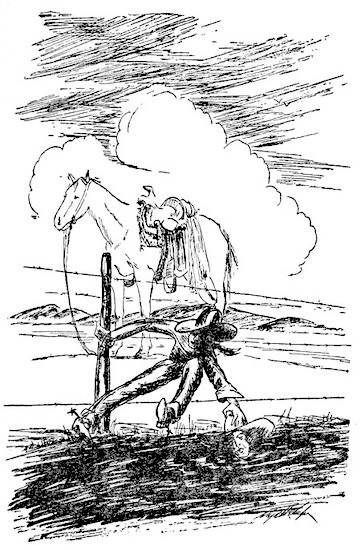
“Jist as I teched the crown a feller yelled out.”
“The next day we counted ’em out, and we hadn’t lost a head; not a single cow-brute was missin’. If it hadn’t been for that cyclone, we’d been gathering cattle for a week, and then likely we wouldn’t of found ’em all.”
“That’s the way it is,” said Red. “Some winds is good and some winds is bad, but I’d rather have sandstorms and risk a cyclone once in a while than to have mud in the rainy season like they have on the Black Land divide.”
“We found lots of mud when we drove through last fall,” said Lanky.
“You jist thought you found mud,” replied Red. “You ought to have seen them flats before they begun makin’ roads. When I first hit that country, they was jist fencin’ off the lanes, and when I got a job, the boss put me to ridin’ fence. One day I was ridin’ along by the lane, and I looked over and there was a good, brand-new Stetson hat layin’ on the top of a mud-hole. I thinks to myself, ‘That’s a good hat, and I might as well have it as the next feller.’ So I got down and got a-holt of a fence-post to steady myself, and reached out to git it. Jist as I teched the crown a feller yelled out: ‘Hey, what you doin’ there?’ he says. Then I noticed for the first time that there was a man’s head stickin’ out of the mud. I asked the feller if he needed any help, but he said he was ridin’ a mighty good hoss, and he guessed he’d make it through all right. He afterwards got to be a mighty good friend of mine. Pete Jackson was his name.”
“Well, sir,” said Joe, “speakin’ of mud, that puts me in mind of one experience I had goin’ up the trail in ’83. We was kinda late in gittin’ through, and the rainy weather had already set in before we crossed the Black Land divide. We hadn’t hardly got across when we begun to notice that our hosses was losin’ all their pertness. The boss’s pet cow-hoss got as lazy as a jackass. My own favorite hoss, Brown Jug, jest got sleepier and sleepier, till finally he jest laid down and went to sleep and never did wake up. We lost half of our remuda jest like that.
“The boss was terribly worried because he didn’t like the idea of trainin’ on foot, and besides he didn’t know whether his hands would stay with him or not if he didn’t have nothin’ for ’em to ride. Well, I figured there must be a cause of hoss sickness jest as there is for everything else. So I begins to take note. I notices that all the sick hosses has mud-balls on their tails. Then I guesses what must be the matter. The weight of the mud on the critters’ tails was makin’ sech a pull on the brutes’ hides that they jest couldn’t shet their eyes. And I figured that bein’ unable to shet their eyes, they was jest naturally dyin’ for sleep. I tells the boss, and we cuts off the balls of mud. As soon as we would cut one off, the critter would fall into a deep sleep, jest like Adam in the Bible. Some of the worst ones slept steady for four days and nights, and then woke up fresh and pert as ever.”
“Still,” said Red, “it ain’t the mud and it ain’t the wind that makes Texas weather bad; it’s the sudden and quick changes.”
“That’s right,” said Hank; “that’s right, as our new boss found out once. He ’lowed he was goin’ to keep a record of the weather. So he comes home with a brand-new thermometer and hangs it up on the front porch, and calls us boys to look at it. Well, sir, while we was standin’ there the mercury runs up to about ninety or a hundred to git a good start. Then all of a sudden, down she goes with sech a jar that she jest naturally knocks the bottom right out of the tube and ruins the boss’s new thingamabob. Good instrument it was too; not jest a mercantile advertisement, but a good one that he had bought and paid money for.
“But that didn’t faze that man none. He sent off back East somewheres and had one made to order with a rubber cushion in the bottom of the tube to take up the jar when the mercury fell. He got a patent on the idear and got rich. His thermometers are in use all over the Southwest. They’re the only kind that’ll stand the climate.
“This feller was jest crazy about his new thermometer. He was always lookin’ to see how cold it was or how hot it was. Once a norther come up in the night, and he jest had to git up and go look at his instrument. He struck a match so he could see, and the match jest froze, and he had to build a fire and warm it up before he could blow it out.”
“That might sound a bit windy to a feller that didn’t know the country,” said Joe, “but it’s probably so. I seen sunshine freeze right on the streets of Amarillo one time. Durin’ one of the long cold spells they had up there, all the chickens died for want of sleep. You see, they couldn’t tell when it was night, and the sunshine stayed froze so long they jest naturally died.”
“Speakin’ of things freezin’,” said Red, “I’ve seen words freeze. Once we was out in a blizzard cuttin’ drift fences, and tryin’ to point the herds to the canyons. And we’d yell and cuss the critters, but we couldn’t even hear ourselves. Well, sir, we finally got the brutes into the brakes and was on our way back when it started moderatin’. All of a sudden we heard the dangest mess of yellin’ and cussin’ and cow-bawlin’ that you ever heard tell of. Presently we recognized the very words we had spoke on the way down.”
“It seems to me,” said Lanky, “that I learned a story something like that from Addison and Steele.”
“Doubtless,” said Red, “doubtless you did. This that I was tellin’ about happened right over here on Addison and Steele’s outfit. I was workin’ for ’em at the time.”
“Yeah,” said Hank, “them northers come mighty sudden at times. One time Bill Anker and me rides up to a tank, and the day’s so warm and purty we decides to go in swimmin’. We was jest ready to strip off, when all of a sudden we notices the bullfrogs all along the dam jumpin’ out of the willows like bats shot out of a cannon. They hit the water all right and went under, but them critters got fooled that time. They poked out their heads like they always do; and there they was froze tight as a hat-band in the ice. All along the side of the tank for about ten feet from the dam, the ice was jest naturally speckled with frog heads.”
“That puts me in mind,” said Joe, “of a tale Bill Bishop used to tell. Bill said one time he started in swimmin’ and dove off of a high bluff into a deep hole of water. But jest as he was leavin’ the bluff, a drought come and dried up all the water. Bill thought shore he’d kill his self on the rock bottom of the creek-bed, but down comes a rise from a rain up above and fills up the hole jest in time to save him.”
“Lucky,” said Lanky.
“Yes,” said Joe, “I guess he was, yet not so powerful lucky, after all. Jest as he was stickin’ up his head, it got froze in the ice like them frogs Hank was tellin’ you about, and he had to stay there all day before the boys come and chopped him out. Leastwise that’s what he used to tell, but he was sech a damn windy that you never knowed when he was tellin’ the truth and when he was tryin’ to load somebody.”
BY THE BREADTH OF A HAIR
Lanky had become intensely interested in the narratives of Joe and his apprentices. He was happy that he had been assigned to the same guard. All during the day he had been trying to think of the most pregnant question to put when the day’s work should be over, and he should again sit with the windy trio around the campfire. He thought of one that he felt sure would elicit an interesting yarn.
“What,” he asked Joe, “was the narrowest escape you ever had?”
Joe pulled out a shuck. He reached leisurely the sack of Bull Durham in his vest pocket. He rolled the cigarette with deliberation. He was not going to play the fool by committing himself in any superlative way until he had heard from his upstart rivals, young men trying to usurp the arts and prerogatives universally recognized as belonging to the old.
“Well,” he said, “that would be hard to say, hard to say. When a man knocks around as much as I have, and in the days when the West was wild, too, he’s bound to of had many a close call, what with Mex’cans, rustlers, bad men, stampedes, blizzards, and the like. However, one of the worst sceres I ever had was once when I got caught in a buffalo stampede. I reckon you know somethin’ about the buffalo?”
“Yes,” said Lanky, “I’ve read a little bit about them.”
“Well,” said Joe, “I can’t say as I’ve read very much about ’em. I seen the plains black with ’em. And I’ve killed a many a one in my day, too.
“Well, I started out to tell you what a close shave I had one time at Buffalo Gap. I was a fool young buck then, and one mornin’ in the spring after I first hit that country, I heard a great roarin’ and bellowin’, and I listened a while, wonderin’ what it was. Then I says to myself, ‘I bet that’s a buffalo herd;’ for I had heard the old-timers tell about ’em, and how they come through the pass called Buffalo Gap every spring, goin’ north.
“I rides up on one of the hills that overlooks the Gap so as I could look right down on the beasts as they come by. There I stops to see ’em pass. I didn’t git there much too soon, for right away the whole pass was choked with buffalo as thick as they could crowd; jammed in closer than steers in a stock car.
“I was ridin’ a fool bronc, and he got to rearin’ and pitchin’, and the first thing I knowed, we was rollin’ down the hill together. Well, the hoss turned three or four cats in the air, and first he was on top and then I was, but the critter lit feet down right on top of the backs of them buffalo; and I was still in the saddle and didn’t have no bones broke. Don’t ask me whether I pulled leather or not, Lanky; don’t ask me that.
“Well, them brutes begun to run, and the first thing I knowed they was in a regular stampede. I seen what was happenin’. They was carryin’ me and that hoss north jest as fast as they could run, which was purty fast. Yes, sir, purty fast.
“I reins the hoss around and turns him south and digs his sides with the rowels; and he runs toward the south jest as fast as he could—and he was a right pert pony, too.
“Well, sir, I rides and I rides, all the time keepin’ my eye peeled for the tail-end of the herd. But I sees nothin’ but buffalo, miles and miles of ’em.
“It was about the middle of the mornin’ when my hoss fell off with me like that, and an hour by sun I was still ridin’ all the time looking for the end of the herd and thinkin’ it shorely would come some time. I happened to look to the side, and what do you think I seen, Lanky? What do you think I seen?”
“Help coming, I suppose,” said Lanky.
“No sech luck,” said Joe; “no sech luck. It was the bushes we broke and the rocks we turned over when me and that hoss rolled down the hill.
“Well, I rides another half hour, I guess, and I begins to feel the hoss quiver and shake under me, and I knowed the jig was about up. When a hoss does that way, Lanky, he’s about ready to drop dead, and I knowed that might happen any time.
“Purty soon I sees an openin’, and jest as that pony jumped off the rump of the last buffalo, damn me if he didn’t drop in his tracks, dead as a hammer. I knowed that was goin’ to happen when I felt him quiver.
“Well, I climbed out on the hill afoot, forgittin’ to git my saddle; and damn lucky it was I forgot, too; for as soon as I got to the top of the hill and set down on a rock to rest, I looked back, and there was the main herd comin’ into sight, roarin’ and bellowin’ like a cyclone.
“I had to walk back to my outfit; and several days later, I rode back to the pass, but all I found of that hoss and saddle was a little greasy spot on the ground.”
“That was a narrow escape,” said Lanky. “I suspect you have had as many close calls as anybody.”
“Well, I couldn’t say about that,” said Joe. “But I know that if that hoss had give out ten minutes sooner, Joe Martin wouldn’t be settin’ here talkin’ to you tonight.”
“Yeah,” said Hank. “Joe always was a lucky cuss. If he was to fall in a sewer, he’d come out with a lily in each hand. Now, me, I was born too late. Land all took up, buffalo all gone; no more trail drivin’ up north. Still, what with reptiles and beasts and Mexico steers and buckin’ hosses, and the like, I’ve had my share of close calls.
“Funny how some little thing you don’t expect jest as like as not comes along and takes you off.”
“Nothin’ ain’t got you yet, Hank,” said Red. “You’re here, ain’t you? What you kickin’ about?”
“I was jest thinkin’ how near I come to bein’ kilt once. And if it hadn’t of been for Zac Weber, I would of been.
“That lad could handle a six-gun, I can tell you. I’ve seen him knock down six flyin’ quail with his old Colt forty-five, ridin’ at a high run. He could turn six pigeons loose at one time and knock ’em every one down before they could git away. When he went duck huntin’ he never packed anything but his old six-shooter. Some of the boys had shot-guns, but Zac said his conscience never would git over it if he turned one of them murderous implements loose on a pore helpless fowl. And he never shot a duck on the water, either. Not Zac. Mighty glad I was that he could shoot like that, too, for he saved my life.”
“Bandit trouble?” asked Lanky.
“Naw, worse,” said Hank, “though I could tell you something about Glen Springs, but that’s not the time Zac saved my life.
“Have you ever seen a centipede, Lanky?”
“No,” said Lanky; “I don’t suppose I have.”
“Well, I’ll tell you what they look like so as you’ll know ’em. And don’t ketch ’em for playthings, Lanky, don’t ketch ’em for playthings. Jest as well pet a rattlesnake. They’re flat yeller worms with a hundred legs, like fringe on each side, and on every foot there’s a little hook that the centipede can hook into things that he walks on. And them hooks is so pizenous that if he walks across your skin while he’s mad, your flesh will putrefy, and you’ll go as crazy as a locoed hoss, and like as not take to the bushes like a jackrabbit unless somebody holds you. That’s how pizenous they are.
“Well, what I started out to tell you was, one time at dinner me and Zac was settin’ on the ground about fifty feet apart facin’ each other eatin’ our beans and sow-belly. All at once I got a glimpse of somethin’ like a yellow streak runnin’ up my vest on my bandanner, but I jest barely did git a glimpse and couldn’t tell what it was.
“‘Is there somethin’ on my neck?’ I says to Zac.
“‘Good God, man!’ says Zac. ‘It’s a centipede!’
“Well, we’d took off our gloves to eat, and I knowed if I tried to knock the critter off, I’d jest make him mad, and he’d git me shore. And I knowed if Zac come over to knock him off with a stick or somethin’, he’d be dead certain to chase him off on my neck.
“‘Let him alone,’ I says, ‘and maybe he’ll crawl off after while.’
“‘Jest be still,’ says Zac. And he whips out his old six-shooter, and I hears the bullet whistle by my ear.
“‘I got him,’ says Zac.
“And I takes off my bandanner, and there is jest a little speck where the bullet had jest barely teched it. I always did feel grateful to Zac after that, for he shore did save my life that day.”
“You think, then, that if the centipede had touched your skin, he would really have killed you?” asked Lanky.
“I don’t think nothin’ about it,” said Hank. “I know it. Why, I tell you what happened. You see, Zac didn’t have time to look what was on the other side of me when he shot, but jest as he pulled the trigger, he noticed an old cow-brute standin’ about fifty yards off chewin’ his cud. Well, this old steer jumped, so Zac said he must of hit him. Still we couldn’t see no wound on him. We roped him and looked at the critter close and found a bullet hole in his dew-lap.”
“In his what?” asked Lanky.
“Why, in his dew-lap,” said Hank. “That’s the grissle thing that hangs down from the neck of a cow-brute jest where it joins on to the breast. They used to vaccinate for the black-leg by makin’ a hole in it. We knowed the steer couldn’t be hurt much there; so we turns him loose, and he gits up, and starts off.
“He hadn’t gone more than twenty steps, when his neck was all swole up, big as a saddle-hoss. Then he begin to rave and charge and beller so pitifully that we jest shot him to git him out of his misery.
“That’s how pizenous them centipedes are. When I saw that pore brute all swole up and out of his head with torment, I knowed what a close call I’d had.”
Lanky’s attention had been divided between Red and the narrator. He had glanced several times at Joe also, who was sitting complacent, but not contemptuous, listening with the respect due a good liar even though a comparatively inexperienced one. But Red, during the first part of Hank’s narrative had been in a deep study. He rolled several cigarettes, only to throw them away after taking a puff or two. He appeared to listen; yet it was obvious that the narrator did not have his full attention. Near the climax to Hank’s tale, however, his countenance brightened up, and from that time he sat quietly as one having an ace in the hole. When Hank finished, he was ready.
“I didn’t have no crack shot, nor no friend of no kind to help me out once when I come near passin’ in my checks out in the Glass Mountains.
“I never did know what was the matter with that fool hoss I was ridin’. He’d always been a mighty sensible animal—fine cow-pony, quarter hoss, single-footer, and the best night hoss on the outfit. I’d rode him hard that day, and I thought maybe he was tired of life and took a sudden notion to kill his self like an English feller that come to our outfit and stayed a while once. Then, again, I thought he might of went blind all at once. I never could figger it out. Anyway, he never acted like that before.”
“What did he do?” asked Lanky.
“What did he do? He done a plenty. Still I don’t blame him, pore brute. There must have been somethin’ the matter.
“You see, I was ridin’ back to the headquarters on a dark night. I was about half asleep, for I knowed that old Frijole—that was his name—would find the way. He always could. Well, I was ridin’ along that way, when all of a sudden I finds us both fallin’ down through empty space. Seemed like we never would hit the ground, and before we got bottom, I figgered out what had happened.
“Out in the edge of the Glass Mountains there was a big sink-hole right out on the mesa. It was as big across as a house, and six lariats deep right straight down—we afterwards measured it—and Frijole had loped off into that dang hole with me, and there we was makin’ for the bottom.
“I thinks to myself, ‘This is where you pass in your checks, Red. Some gits it early and some gits it late, but they all gits it.’ Then we hits bottom.
“I guess I was shook up purty bad, for I woke up after while, and there I was settin’ on a dead hoss. You see, Frijole had broke his neck landin’, pore feller. I always will wonder what was a eatin’ on him to make him lope off into a hole like that. Must of been somethin’.
“Well, I seen there wasn’t nothin’ I could do but wait for daylight and then try to figure out some way to git out; so I jist laid down and took a nap till mornin’.
“When daylight come, I got up and looked around, but the walls was straight up and down, and there wasn’t nothin’ I could git a-holt of to climb out. Then I took the rope off my saddle and begun to look for somethin’ twenty feet or so up that I could rope, thinkin’ I could pull myself up that far, and then maybe rope somethin’ else a little higher up, and pull myself up again, and so on till I was out.
“But there wasn’t a thing, Lanky, not a bush nor a rock, nor nothin’ stickin’ out I could git a loop on. Everything as slick as glass. ‘Well, maybe the boys will come and hunt me,’ I thinks, ‘but how in the hell will they know to look down in here?’
“I waited all day, and not a soul come: and I waited all the next day, and still nobody come. The third day I was still there and no better off than I was in the beginnin’.
“By that time I was wishin’ I was dead, for I had drunk up all the water in my saddle canteen, and I was gittin’ hungry, too.”
“Couldn’t you have eaten some of the horse meat?” asked Lanky.
“Yes, I guess I could of,” said Red, “but at first I wouldn’t out of friendship for the brute—for even if he did git me in there, I always figgered there was somethin’ wrong; he went out of his head or somethin’—and after I got hungry enough to of et him, anyway, his carcass had spoiled and was stinkin’ somethin’ terrible. That’s principally what made it so bad. Every breath I drawed was misery.
“Finally I says, ‘Red, you can’t stand this no longer. You’d shoot a pore dumb brute if you saw him in torment like this.’ And so I cocks my six-shooter and holds it to my head, but somehow I can’t pull the trigger. ‘Stand it a little while longer,’ I says to myself, ‘and if help don’t come, shoot.’ I done that three or four times, I guess.
“After a while buzzards begun flyin’ over the hole—dozens of ’em sailin’ round and round. They knowed there was somethin’ dead somewheres around, but they was havin’ trouble locatin’ it. They kept comin’ lower and lower, till directly one comes down into the sink-hole. Then some more come, and they would fly right down close to me. ‘I reckon you come after Frijole,’ I says, ‘but jist wait a little while and you can have me too.’
“And jist then I had an idear. I picks up my lariat right quiet-like and begins unravelin’ it into little strands. In each little strand I tied a noose. Then I takes my seat by the side of the carcass and jist waits. Directly a big turkey buzzard comes right down close, and I throws a loop over his head and fetches him down. Then I stakes him to my belt, givin’ him about six foot of rope. After a while I gits another one. I keeps on until I gits twenty of the vultures staked to my belt; then I fires off my six-shooter, scerin’ ’em all at once.
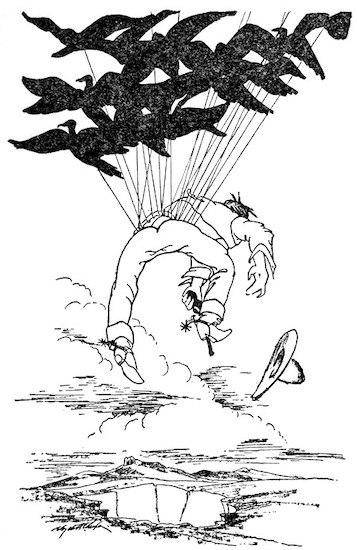
“Well, sir, them birds jist naturally lifted me right out of that sink-hole.”
“Well, sir, them birds jist naturally lifted me right out of that sink-hole.”
“You were lucky,” said Lanky.
“Lucky! Lad, that wasn’t luck; that was head work. You ain’t heard about my luck yet. Them buzzards begun flyin’ away with me, but I seen what direction they was goin’, and I jist let ’em alone and watched the lay of the land. And when they had me right over a big hay-stack at the headquarters of my own outfit, I reached down and unbuckled my belt, and damn me, if I didn’t land right on the hay without any hurtin’ a-tall.
“I walked up to the house and had a square meal—and I et, too, I’ll tell you—and then I felt as fresh and pert as ever.”
“That was a lucky landing,” said Lanky.
“It shore was,” said Red. “I got off light. The worst thing about it was that them vultures carried off my belt; and a cracker-jack it was, too, trimmed with rattlesnake hide and gold studs. Twenty-eight dollars and fifty cents it cost me over the counter at K. C., Misourey.”
Lanky expected Joe to tell the next story, but the veteran smoked placidly, and graciously surrendered his turn to Hank.
“A thing like that nearly happened to me once,” said Hank, “except it was a canyon instead of a sink hole.
“I ought to of had more sense than to ride a fool bronc like the critter I was on around a place like that, but I was green in them days. You see I was ridin’ around a rimrock, lookin’ out for steers in the canyon down below, and down below it was, shore-nuff—five hundred feet straight down—jest as straight as a wall.
“Well, I’d rode along that way for a while, when suddenly I took a fool notion to smoke. So I rolled me a fat tamale, and pulled out a match and struck it on my saddle-horn.
“Jest then that fool bronc bogged his head and begun pitchin’ and bawlin’ like six-bits, and the next thing I knowed he’d fell off that rim-rock. And it was five hundred feet to the bottom if it was an inch. When that hoss hit the bottom, he jest naturally spattered all over the scenery.”
“And you?” asked Lanky.
“Well, you see,” said Hank, “when we went off that rim-rock together, I knowed that that saddle that I had been tryin’ so hard to stay in was no place for me then; so I got off; and I had to be damn quick about it, too. I wasn’t much more than off the brute when he hit the bottom.”
Lanky expected Joe to send him off to bed. There were cattle to gather during the day and to hold at night until all the pastures should be worked, and it was Joe who usually reminded the unseasoned boy that sleep was necessary, even if Lanky preferred the romancing of the older hands.
But Joe merely chunked up the fire.
“That puts me in mind,” said he, “of a hunt I went on once in the Guadalupe Mountains. You see, we was out after big-horn sheep—used to be lots of ’em up there, but they are ’bout all gone now. Few up in the mountains where the tin-horn hunters never go.
“I was follerin’ some of them critters around a ledge, and presently I looked around and seen where I was. The ledge was jest about a foot wide; and I looked down, and there was a bluff right straight down for five hundred feet, and I looked up, and there was a wall five hundred feet straight up. There wasn’t no way to git off that ledge but to go on or to turn back like I come, and in some places the footin’ was mighty ticklish, mighty ticklish.
“Well, I walked along till I come to a slick place, and my foot slipped, and I had to let go my gun to keep from fallin’. I shore hated to lose that thirty-thirty, too, for we had been friends for years, and many a deer and antelope and bear and panther I had fetched down with it. But I jest naturally lost my balance and had to let her go to save my neck.
“Well, not havin’ any gun, I thought I had jest as well go back to the camp; so I started back like I come. I goes around a little bend, and there comes a mountain lion, a-creepin’ along towards me, jest like a cat tryin’ to slip up on a snow-bird.
“Says I, ‘Joe, this ain’t no place for you. I expect you’d better go on the way you first started.’
“So I turns around and goes back around the bend. When I gits about a hundred yards, there I sees a big grizzly bear comin’ to meet me! and when he sees me, he sets up and shows his teeth and growls.
“Says I, ‘Joe, maybe you’d better go back the other way, after all.’ I thought maybe the cougar would be gone. But as soon as I gits turned around—and I had to be mighty careful in turnin’, for the ledge was powerfully narrow—when I turns around, I sees the big cat sneakin’ along toward me. And when I look the other way, there comes the bear. And they are both gittin’ closer and closer, and there I am, and it’s five hundred feet straight down, and it’s five hundred feet straight up.”
“How did you get off?” asked Lanky.
“How did I git off? Why, I couldn’t git off. They got me, but whether it was the bear or the cougar, I never did know.”
Joe finished with a flourish but without a smile.
He pulled out his watch. “Doggone,” he said, “I never had no idear it was so late. We ought to of been asleep before now. Lanky, you ought not to let these boys keep you up so late. They’d talk you to death if you’d jest set here and listen to ’em.”
THE GENESIS OF PECOS BILL
“I suppose,” said Lanky, as he sat by the camp-fire with Red and Hank and Joe, now his fast friends, “that the cowboy’s life is about the most interesting one there is. I’d like it. Live outdoors, plenty of fresh air to breathe, interesting work—that’s the life.”
“I ain’t kickin’,” said Joe. “You see I’m still at it, though I’ve cussed it as much as anybody in my time, and swore off and quit, too, more than once. But somehow when spring comes, and the grass gits green, and I know the calves is comin’, somethin’ jest naturally gits under my hide, and I come back to the smell of burnt hair and the creak of saddle-leather.”
“Yeah,” said Red, “it’s jist like a dream I had once. I dreamt I died and went up to a place where there was big pearly gates, and I walked up and knocked on the door, and it come wide open. I went in, and there stood Saint Peter.
“‘Come in; welcome to our city,’ he says. ‘I’ve been lookin’ for you. Go over to the commissary and git you a harp and a pair of wings.’
“‘All right,’ says I, feelin’ mighty lucky to git in.
“As I walked along on the gold sidewalk, I sees a lot of fellers roped and hobbled and hog-tied.
“‘What’s the matter?’ says I; ‘Saint Peter, you’re not tryin’ to buffalo me, are you?’
“‘Naw,’ he says, ‘what makes you think so? Your record ain’t nothin’ extra good, but you didn’t git cut back, did you? Here you are. You’re in. Ain’t that enough?’
“‘Ain’t this hell?’ I says.
“‘Naw’, says Peter, ‘this ain’t hell a-tall.’
“‘Are you shore this ain’t hell?’ I asks.
“‘Naw,’ he says, ‘this ain’t hell. What makes you think it is?’
“‘Why,’ I says, ‘what you got all them fellers roped and tied down for?’
“‘Oh,’ he says, ‘them fellers over there? You see them’s cowboys from the Southwest, and I have to keep ’em tied to keep ’em from goin’ back. I think maybe they’ll git range broke after while so I can turn ’em loose, but it seems like it’s takin’ a long time.’”
“However,” said Joe, “the cow business ain’t what it used to be, what with barbed wire, windmills, automobiles and trucks, and the like. They don’t want cowhands any more; what they want is blacksmiths, mechanics, and the like. Still, I reckon it’s a good thing, for they couldn’t git cowhands if they did want ’em.
“Now, here’s Red and Hank. Good boys, both of ’em. And I’ve learned ’em a lot about cattle; and they take money at the rodeos, but they ain’t like the old cowhands. I don’t know jest what it is, but they ain’t the same.
“And they ain’t but mighty few real cowmen any more. Now, take the big mogul of this outfit. Good feller, always pays wages every month—which is more than some of the old-timers could do. But he ain’t no cowman. Sets up all day at a big desk in town—has a secretary, stenographer, and the like. Why, if Pecos Bill had a-done a thing like that, he would of been so ashamed of his self, he would of jest naturally laid down and died.”
“Who is this Pecos Bill I’ve heard you mention?” asked Lanky.
“Who is he? Why, ain’t you ever heard of Pecos Bill?”
“Not till I came here.”
“Well, well, I reckon you’ve heard of Sam Houston, and Sam Bass and General Lee and George Washington and Pat Garrett, ain’t you?”
“Oh, yes, I’ve heard a little about them but not anything about Pecos Bill.”
“That jest shows that the fellers that make our books don’t know what to put in ’em. The idear of leavin’ out Pecos Bill.”
“But who was Pecos Bill?”
“Who was he? Why, he was jest about the most celebrated man in the whole dang cow country.”
“What was his real name?”
“So far as I know the only real name he ever had was Pecos Bill. Don’t suppose anybody knows what his daddy’s name was. You see, in his day it wasn’t good manners to ask a feller his name, and besides it wasn’t good judgment either. And it ain’t been so long. Many a greenhorn bein’ ignorant of that little point of good manners has looked down the muzzle of a six-shooter and then died.
“Pecos Bill’s daddy didn’t say what they called him back in the States, and nobody asked him. They jest called him the Ole Man, for he was old—about seventy some odd when he came to Texas.”
“When did he come to Texas?” asked Lanky.
“I couldn’t say about that exactly,” said Joe. “It must of been right about the time Sam Houston discovered Texas. Anyhow, the Ole Man loaded up all his twelve kids and his Ole Woman and his rifle, and all his other stuff in an oxwagon and lit out hellbent for Texas as soon as he found out there was sech a place. They say other people that come later didn’t have no trouble findin’ the way. They jest went by the Indian skeletons that the Ole Man left along his road.
“Well, they finally got to the Sabine River. The Ole Man stops his oxen, old Spot and Buck, he calls ’em, and rounds up all his younguns and has ’em set down and listen while he makes ’em a speech. ‘Younguns,’ he says, ‘that land you see on the other side of the river is Texas, wild and woolly and full of fleas. And if you ain’t that way only more so, you ain’t no brats of mine.’”
“I’d always heard that Pecos Bill was born in Texas,” interrupted Red.
“Jest wait,” said Joe. “Jest wait; have I said he wasn’t? Them was the other kids.
“As I was about to say, they crossed the river and camped for the night. That was in Texas, savvy. And that night Pecos Bill was born. The next mornin’ the Ole Woman put him on a bear’s skin and left him to play with his self while she made the corn-pone for breakfast. And right then’s when they come dang near losin’ Pecos Bill.
“Bears or Indians?” asked Lanky.
“Neither one,” said Joe. “Bears and Indians didn’t mean nothin’ to that old man. He would have et ’em for breakfast. Once later when the Ole Man and the older brats was gone, the Comanches did try to git Bill, but the Ole Woman lit into ’em with the broom-handle and killed forty-nine right on the spot. She never knowed how many she crippled and let git away. No, it wasn’t the Indians. It was miskeeters.”
“Malaria?” said Lanky.
“You guessed wrong again,” said Joe. “This is what happened. The Ole Woman was cookin’ corn-pone, and all of a sudden it got dark, and there was the dangest singin’ and hummin’ you ever heard. Then they seen it was a swarm of big black miskeeters; and they was so thick around Bill that you jest couldn’t see him.
“The Ole Man felt his way to the wagon and got out his gun. He thought he’d shoot it off in the air and scere them miskeeters away. He pointed the muzzle of the gun toward the sky and pulled the trigger. What he seen then was a little beam of light come through. It was jest like bein’ in a dark room and lookin’ out through a piece of windmill pipe. That was jest for a minute, for right away the hole shet up, and them miskeeters swarmed around Pecos, and the Ole Man seen they was goin’ to pack him off if he didn’t do somethin’ right away.
“Then he happened to recollect that he’d brought his hog-renderin’ kettle along; so he fought his way back to the wagon and rolled it out and turned it over the kid. He was scered the lad would git lonesome under there by his self, so he jest slipped the choppin’ axe under the edge of the kettle for the chap to play with.
“Well, them danged miskeeters jest buzzed and buzzed around the kettle, tryin’ to find a way to git in. D’rec’ly they all backed off, and the Old Man and the Ole Woman thought they’d give up and was goin’ away. Then all at once one of them miskeeters comes at that kettle like a bat out of hell. He hit the kettle and rammed his bill clean through it; and he stuck there. Then another one come at the kettle jest like the first one had; and he stuck, too. Then they kept comin’, and every one stuck. The Ole Man and the Ole Woman and the older brats stood there watchin’ them miskeeters ram that kettle. After each one of them varmints (they was too big to be called insects) hit the kettle, there would be a little ring—ding! like that. Purty soon the old folks got on to what was happenin. Every time a miskeeter would ram his bill through the kettle, Pecos would brad it with the choppin’ axe. Well, after while them miskeeters jest naturally lifted that kettle right up and flew off with it. The others thought they had Pecos Bill and follered the kettle off. Of course the Ole Man hated to lose his utensil. He said he didn’t know how the Ole Woman was goin’ to render up the lard and bear’s grease now; but it was worth a hundred kettles to know he had such a smart brat. And from that time the Ole Man would always talk about Bill as a chap of Great Possibilities. He ’lowed that if the brat jest had the proper raisin’, he’d make a great man some day. He said he was goin’ to try to do his part by him; so he begun givin’ him a diet of jerked game with whiskey and onions for breakfast. He lapped it up so well that in three days the Ole Woman weaned him.”
“Did the Ole Man settle there on the Sabine?” asked Lanky.
“Naw,” said Joe. “He squatted on a little sandy hill on the Trinity somewheres east of where Dallas is now. It was jest an accident that he stopped where he did.”
“How was that?” asked Lanky.
“Well,” said Joe, “you see, it was like this. They was travelin’ west in their customary and habitual manner, which was with the Ole Man and the six oldest kids walkin’ alongside Spot and Buck, and the Ole Woman and the seven youngest kids in the wagon. Jest as they was comin’ to the foot of a sandy hill, a big rain come up. It rained so hard that the Ole Man couldn’t see the wagon, but he stuck close to them trusty oxen of his, and they went right up the hill. When he got to the top, he seen that it had about quit rainin’; and he looked back and seen the wagon still at the bottom of the hill, and there was the brats that had been walkin’ with him under it.”
“Did the harness break?” asked Lanky.
“Naw, it wasn’t that,” said Joe. “You see, he was usin’ a rawhide lariat for a log-chain, and it had got wet. I reckon you know what rawhide does when it gits wet, don’t you, Lanky? It stretches. There ain’t no rubber that will stretch like wet rawhide. Well, that’s what happened to that lariat. It stretched so that the Ole Man drove his oxen a mile up the hill without movin’ the wagon an inch. Not an inch had he moved her, by gar.
“Well, the sun was shinin’ now, and it got brighter and brighter, and while the Ole Man was wonderin’ what in the dickens to do next, Ole Spot jest dropped down dead from sunstroke. That sort of got next to the Ole Man, for he said that brute had been a real friend to him, and besides he was worth his weight in gold. Still, he ’lowed he’d might as well skin him. So he got out his old Bowie knife and started to work.
“Well, sir, while he was skinnin’ Spot, a norther came up, and damn me, if Ole Buck didn’t keel over, froze to death.
“So the Ole Man decided he’d jest as well stop there where he was. So he told the Ole Woman to bring up the brats. He throwed the ox yoke over a stump; and the Ole Woman brought up some chuck and some beddin’ from the wagon. Then they et supper and tucked the kids into bed. The Ole Man tried to blow out the lantern, but she wouldn’t blow. He raised up the globe, and there was the flame froze stiff as an icicle. He jest broke it off and buried it in the sand and turned in and went to sleep.
“The next mornin’ when he woke up, it was clear and the sun was warm. Well, the Ole Woman cooked a bite, and while they was eatin’, here come the wagon right up the hill. You see the rawhide was dryin’ out. That’s the way it does.”
“That’s what it does, all right,” said Red. “Once I knowed a clod-hopper that made his self a rawhide hat. It worked fine till one day he got caught out in the rain. Then the sun come out, and that hat drawed up so he couldn’t git it off. And it was drawin’ up and mashin’ his head somethin’ terrible. Lucky for him, it wasn’t very far to a tank, and he got off and stood on his head in the water a few minutes and it come right off.”
“Well,” said Joe, “that’s what the rawhide log-chain done. It dried out, and that wagon come right up the hill; and when it got up to where the Ole Man and the Ole Woman was, the Ole Man got his choppin’ axe and begun cuttin’ down trees to make him a cabin. And that’s where he settled.”
“Did Pecos Bill grow up there in East Texas?” asked Lanky.
“He left when he was a mere lad,” said Joe. “But he lived there a little while. The Ole Man got along fine till his corn give out, because there was plenty of game. But he jest couldn’t do without his corn-pone and his corn whiskey. So he cleared a little patch and put it in corn.”
“And worked it without his steers?” asked Lanky.
“Why not?” said Joe. “He made him a light Georgie-stock out of wood, and the Ole Woman and one of the bigger kids could pull it fine. He made some harness out of the hide of Old Spot, and he’d hitch ’em and plough all day.
“They used to all go out in the field and leave Pecos Bill in the cabin by his self. One day when Bill was about three years old, the Ole Man was ploughin’ and jest as he turned the Ole Woman and the kid he had hitched up with her around to start a new row, the Ole Woman begun yellin’ and tryin’ to get out of the harness.
“‘What’s eatin’ on you, Ole Woman?’ says the Ole Man. ‘I never seen you do like this before. Must have a tick in your ear.’
“The Ole Woman yelled that she seen a panther go in the cabin where Bill was.
“The Ole Man told her not to git excited. ‘It’s a half hour by sun till dinner time yet,’ he says, ‘and that dang panther needn’t expect no help from me nohow. The fool critter ought to of had more sense than to go in there. He’ll jest have to make out the best way he can.’
“So they ploughed on till dinner time, and when they come back to the cabin, there was Pecos Bill a-chewin’ on a piece of raw panther flank.
“They lived there another year or two before the Ole Man taken a notion to leave.”
“I reckon you know how he come to git the idear in his head, don’t you, Joe?” said Red.
“I’ll bite,” said Joe. “Go ahead.”
“Why, this ain’t no sell,” said Red. “I’ve heard Windy Williams tell it a hundred times.
“One time the Ole Man had the Ole Woman and one of the big kids hitched up to the plough in his customary and habitual manner, jist as Joe has been tellin’ about, and all at once here comes a piece of paper blowin’ across the field. The Ole Woman shied a little bit off to one side; then the kid got to prancin’, and then they tore loose and went lickity-split, rearin’ and tearin’ across that corn patch, draggin’ the Ole Man with ’em. The Ole Man stumped his toe on a root, and then they got loose from him and tore up the Georgie-stock. After while they quieted down, and the Ole Man got up and fetched ’em in. Then he went out and picked up the piece of paper where it was hung on a stump. He seen it was an old newspaper. That set him to wonderin’.
“The next mornin’ he got his rifle and begun lookin’ around. About five miles from his place he found some wagon tracks, and he follered the tracks till he come to a new cabin about fifty miles up the creek. Then he come home and told the Ole Woman and the kids to git ready to leave. He calkilated the country was gittin’ too thickly settled for him.”
“How did he get away without a team?” asked Lanky.
“Oh, that was easy,” said Red. “He sent Pecos Bill out to ketch a couple of mustangs, and in about an hour the lad run ’em down. The Ole Man fixed up the harness he’d been usin’ to plough with, and loaded in his stuff and his wife and kids, and pulled out.
“They kept goin’ west till finally they come to the Pecos River, which the Ole Man said he’d ford or bust. He got across all right, but as he was drivin’ up the bank on the west side, the end-gate come out of the wagon, and Pecos Bill fell out. The Ole Man and the Ole Woman never missed him till they got about thirty miles further on; then they said it wasn’t worth while turnin’ back. They said they guessed the chap could take kere of his self, and if he couldn’t he wasn’t worth turnin’ back for nohow. So that’s how Pecos Bill come to be called Pecos Bill.”
“What became of him?” asked Lanky. “What happened to him then?”
“What happened to him then?” said Red. “That would take a long time to tell.”
“We’ll tell you about that some other time, Lanky,” said Joe.
ADVENTURES OF PECOS BILL
“How old was Pecos Bill when he was lost on the Pecos River?” Lanky asked Joe on the next night when supper was finished and the four were sitting around the fire smoking.
“I guess he must of been about four year old,” said Joe. “Some says he was jest a year old, but that can’t be right. The Ole Man made two or three crops down on the Trinity before the country got so thickly settled that he had to leave.”
“What became of the family?” asked Lanky.
“That would be hard to answer,” said Joe; “hard to answer. I don’t suppose there’s a soul that knows for certain. There’s been tales about ’em bein’ et up by wild beasts, but that ain’t likely; and there’s been tales about ’em bein’ killed by the Indians, but that ain’t likely neither. Why, them Red-Skins would run like scered jack-rabbits when they seen the Ole Man comin’, or the Ole Woman either. Then there’s tales about ’em dyin’ for water in the desert, which may be so; but more than likely they settled somewheres and lived a happy and peaceful life.”
“The chances are,” said Red, “that they settled in the Lost Canyon, and their offspring may be livin’ there yet for all anybody knows.”
“Where is the Lost Canyon?” asked Lanky.
“That’s jist what nobody don’t know,” said Red; “but it’s out in the Big Bend Country somewheres, and it opens into the Río Grande. It gits wide, and there’s springs in it, and buffalo a-grazin’ on the grass, and it’s a fine country.”
“How do you know about it?” asked Lanky. “Have you ever been there?”
“Naw,” said Red, “but people has. But you never can find it when you’re lookin’ for it. Them that finds it, finds it accidentally, and then they can’t go back. That’s jist the place that would of suited Pecos Bill’s Ole Man, and the chances are that’s where he stopped. Some day I’m goin’ to happen on that canyon myself, and if I do, I’ll jist stake me out a ranch; that is unless it’s inhabited by Pecos Bill’s race. If it is, I reckon I’ll let ’em have it.”
“And what became of Pecos Bill?” asked Lanky.
“Why,” said Joe, “he jest growed up with the country. There wasn’t nothin’ else he could do. He got to runnin’ with a bunch of coyotes and took up with ’em. He learned their language and took up all their bad habits. He could set on the ground and howl with the best of ’em, and run down a jack-rabbit jest as quick, too. He used to run ahead of the pack and pull down a forty-eight point buck and bite a hole in his neck before the rest of the coyotes got there. But he always divided with the pack, and that’s probably the reason they throwed off on him like they did.”
“Did he ever teach anybody else the coyote language?” asked Lanky.
“Jest one old prospector that befriended him once. That was all. You see the old man couldn’t find no gold and he went to trappin’, and he used the language that Bill had taught him to call up the coyotes and git ’em in his traps. Bill said it was a dirty trick, and he wouldn’t teach nobody else how to speak coyote. Bill would of killed the old prospector if it hadn’t of been that the old man done him a favor once.”
“What did he do?” asked Lanky.
“Why, it was him that found Bill and brought him back to civilization and liquor, which Bill had jest about forgot the taste of.”
“How old was Bill at that time?” asked Lanky.
“Oh, I guess he was about ten years old,” said Joe. “One day this old prospector comes along and he hears the most terrible racket anybody ever heard of—rocks a-rollin’ down the canyon, brush a-poppin’, and the awfullest howlin’ and squallin’ you could imagine; and he looks up the canyon and sees what he first thinks is a cloud comin’ up, but purty soon he discovers it’s fur a-flyin’.
“Well, he decides to walk up the canyon a piece and investigate, and purty soon he comes on Pecos Bill, who has a big grizzly bear under each arm jest mortally squeezin’ the stuffin’ out of ’em. And while the old prospector stands there a-watchin’, Bill tears off a hind leg and begins eatin’ on it.
“‘A game scrap, son,’ says the old prospector, ‘and who be ye?’
“‘Me?’ says Bill. ‘I’m a varmit.’
“‘Naw, ye ain’t a varmit,’ says the old prospector; ‘you’re a human.’
“‘Naw,’ says Bill, ‘I ain’t no human; I’m a varmit.’
“‘How come?’ says the prospector.
“‘Don’t I go naked?’ says Bill.
“‘Shore ye do,’ says the old Prospector. ‘Shore ye’re naked. So is the Indians, and them critters is part human, anyway. That don’t spell nothin’.’
“‘Don’t I have fleas?’ says Bill.
“‘Shore ye do,’ says the old prospector, ‘but all Texians has fleas.’
“‘Don’t I howl?’ says Bill.
“‘Yeah, ye howl all right,’ says the old prospector, ‘but nearly all Texians is howlin’ most of the time. That don’t spell nothin’ neither.’
“‘Well, jest the same I’m a coyote,’ says Bill.
“‘Naw, ye ain’t a coyote,’ says the old prospector. ‘A coyote’s got a tail, ain’t he?’
“‘Yeah,’ says Bill, ‘a coyote’s got a tail.’
“‘But you ain’t got no tail,’ says the old prospector. ‘Jest feel and see if you have.’
“Bill felt and shore nuff, he didn’t have no tail.
“‘Well, I’ll be danged,’ he says. ‘I never did notice that before. I guess I ain’t a coyote, after all. Show me them humans, and if I like their looks, maybe I’ll throw in with ’em.’
“Well, he showed Bill the way to an outfit, and it wasn’t long till he was the most famous and noted man in the whole cow country.”
“It was him,” said Hank, “that invented ropin’. He had a rope that reached from the Río Grande to the Big Bow, and he shore did swing a mean loop. He used to amuse his self by throwin’ a little Julian[2] up in the sky and fetchin’ down the buzzards and eagles that flew over. He roped everything he ever seen: bears and wolves and panthers, elk and buffalo. The first time he seen a train, he thought it was some kind of varmit, and damn me if he didn’t sling a loop over it and dang near wreck the thing.
“One time his ropin’ shore did come in handy, for he saved the life of a very dear friend.”
“How was that?” asked Lanky.
“Well, Bill had a hoss that he thought the world of, and he had a good reason to, too, for he had raised him from a colt, feedin’ him on a special diet of nitroglycerin and barbed wire, which made him very tough and also very ornery when anybody tried to handle him but Bill. The hoss thought the world of Bill, but when anybody else come around, it was all off. He had more ways of pitchin’ than Carter had oats. Lots of men tried to ride him, but only one man besides Bill ever mounted that hoss and lived. That’s the reason Bill named him Widow-Maker.”
“Who was that man?” asked Lanky.
“That was Bill’s friend that I was goin’ to tell you about Bill savin’ his life,” said Hank. “You see this feller gits his heart set on ridin’ Widow-Maker. Bill tried to talk him out of it, but he wouldn’t listen. He said he could ride anything that had hair. It had been his ambition from youth, he said, to find a critter that could make him pull leather. So Bill, seein’ the pore feller’s heart was about to break, finally told him to go ahead.
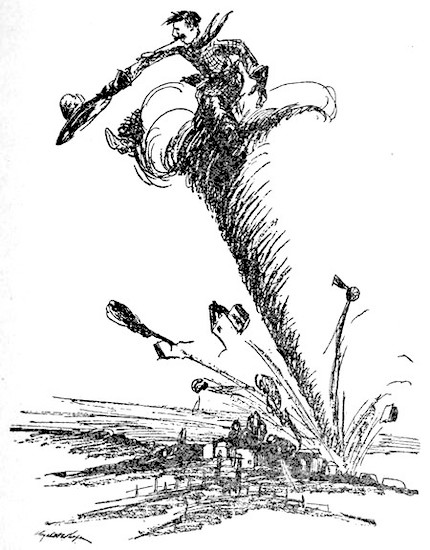
“A-settin’ on that tornado and a-spurrin’ it in the withers.”
“He gits on Widow-Maker, and that hoss begins to go through his gaits, doin’ the end-to-end, the sunfish, and the back-throw; and about that time the rider goes up in the sky. Bill watches him through a spyglass and sees him land on Pike’s Peak. No doubt he would of starved to death up there, but Bill roped him by the neck and drug him down, thus savin’ his life.”
“Yeah,” said Red, “Widow-Maker was jist the sort of hoss that suited Bill exactly. For one thing, it saved him a lot of shootin’, because he didn’t have no trouble keepin’ other people off his mount; and as for Bill, he could ride anything that had hair and some things that didn’t have. Once, jist for fun, he throwed a surcingle on a streak of lightin’ and rode it over Pike’s Peak.
“Another time he bet a Stetson hat he could ride a cyclone. He went up on the Kansas line and simply eared that tornado down and got on it. Down he come across Oklahoma and the Panhandle a-settin’ on that tornado, a-curlin’ his mustache and a-spurrin’ it in the withers. Seein’ it couldn’t throw him, it jist naturally rained out from under him, and that’s the way Bill got the only spill he ever had.
“Yeah,” continued Red, “I reckon Bill was mighty hard to throw. A smart lad he was, and a playful sort of feller, too. In his spare time he used to amuse his self puttin’ thorns on things—bushes and cactuses and the like, and he even stuck horns on the toads so they’d match up with the rest of the country.”
“I see he’s been at work in this country,” said Lanky. “Did he live all his life in Texas?”
“Naw, he didn’t,” said Joe. “Bill was a good deal like his old man. When he had killed all the Indians and bad men, and the country got all peaceful and quiet, he jest couldn’t stand it any longer, and he saddled up his hoss and started west. Out on the New Mexico line he met an old trapper, and they got to talkin’, and Bill told him why he was leavin’, and said if the old man knowed where there was a tough outfit, he’d be much obliged if he would tell him how to git to it.
“‘Ride up the draw about two hundred miles,’ says the old trapper, ‘and you’ll find a bunch of guys so tough that they bite nails in two jest for the fun of it.’
“So Bill rides on in a hurry, gittin’ somewhat reckless on account of wantin’ to git to that outfit and git a look at the bad hombres that the old man has told him about. The first thing Bill knowed, his hoss stumps his toe on a mountain and breaks his fool neck rollin’ down the side, and so Bill finds his self afoot.
“He takes off his saddle and goes walkin’ on, packin’ it, till all at once he comes to a big rattlesnake. He was twelve feet long and had fangs like the tushes of a javelina; and he rears up and sings at Bill and sticks out his tongue like he was lookin’ for a scrap. There wasn’t nothin’ that Bill wouldn’t fight, and he always fought fair; and jest to be shore that rattlesnake had a fair show and couldn’t claim he took advantage of him, Bill let him have three bites before he begun. Then he jest naturally lit into that reptile and mortally flailed the stuffin’ out of him. Bill was always quick to forgive, though, and let by-gones be by-gones, and when the snake give up, Bill took him up and curled him around his neck, and picked up his saddle and outfit and went on his way.
“As he was goin’ along through a canyon, all at once a big mountain lion jumped off of a cliff and spraddled out all over Bill. Bill never got excited. He jest took his time and laid down his saddle and his snake, and then he turned loose on that cougar. Well, sir, the hair flew so it rose up like a cloud and the jack-rabbits and road-runners thought it was sundown. It wasn’t long till that cougar had jest all he could stand, and he begun to lick Bill’s hand and cry like a kitten.
“Well, Bill jest ears him down and slips his bridle on his head, throws on the saddle and cinches her tight, and mounts the beast. Well, that cat jest tears out across the mountains and canyons with Bill on his back a-spurrin’ him in the shoulders and quirtin’ him down the flank with the rattlesnake.
“And that’s the way Bill rode into the camp of the outfit the old trapper had told him about. When he gits there, he reaches out and cheeks down the cougar and sets him on his haunches and gits down and looks at his saddle.
“There was them tough hombres a-settin’ around the fire playin’ monte. There was a pot of coffee and a bucket of beans a-boilin’ on the fire, and as Bill hadn’t had nothin’ to eat for several days, he was hungry; so he stuck his hand down in the bucket and grabbed a handful of beans and crammed ’em into his mouth. Then he grabbed the coffee pot and washed ’em down, and wiped his mouth on a prickly-pear. Then he turned to the men and said, ‘Who in the hell is boss around here, anyway?’
“‘I was,’ says a big stout feller about seven feet tall, ‘but you are now, stranger.’
“And that was the beginning of Bill’s outfit.”
“But it was only the beginnin’s,” said Red; “for it wasn’t long after that that he staked out New Mexico and fenced Arizona for a calf-pasture. He built a big ranch-house and had a big yard around it. It was so far from the yard gate to the front door, that he used to keep a string of saddle hosses at stations along the way, for the convenience of visitors. Bill always was a hospitable sort of chap, and when company come, he always tried to persuade them to stay as long as he could git ’em to. Deputy sheriffs and brand inspectors he never would let leave a-tall.
“One time his outfit was so big that he would have his cooks jist dam up a draw to mix the biscuit dough in. They would dump in the flour and the salt and the bakin’-powder and mix it up with teams and fresnoes. You can still see places where the dough was left in the bottom of the draw when they moved on. Alkali lakes they call ’em. That’s the bakin’-powder that stayed in the ground.
“One time when there was a big drought and water got scerce on Bill’s range, he lit in and dug the Río Grande and ditched water from the Gulf of Mexico. Old man Windy Williams was water boy on the job, and he said Bill shore drove his men hard for a few days till they got through, and it kept him busy carryin’ water.”
“I guess it took about all of Bill’s time to manage a ranch like that,” said Lanky.
“Not all, not all,” said Joe. “That was his main vocation and callin’, but he found time for a good many other things. He was always goin’ in for somethin’ else when the cattle business got slack.
“When the S. P. come through, he got a contract furnishin’ ’em wood. Bill went down into Mexico and rounded up a bunch of greasers and put ’em to cuttin’ wood. He made a contract with ’em that they was to git half the wood they cut. When the time was up, they all had big stacks of cordwood, Mex’can cords, you understand, that they don’t know what to do with. So Bill talked it over with ’em and finally agreed to take it off their hands without chargin’ ’em a cent. Bill always was liberal.
“He done some of the gradin’ on the S. P. too. This time he went out and rounded up ten thousand badgers and put ’em to diggin’. He said they was better laborers than Chinks, because he could learn ’em how to work sooner. Bill had some trouble, however, gittin’ ’em to go in a straight line, and that’s why the S. P. is so crooked in places.
“He also got a contract fencin’ the right-of-way. The first thing that he done was to go out on the line of Texas and New Mexico and buy up all the dry holes old Bob Sanford had made out there tryin’ to git water. He pulled ’em up and sawed ’em up into two-foot lengths for post-holes.”
“I’ve heard that Paul Bunyan did that with dry oil-wells,” said Lanky.
“Paul Bunyan might of for all I know,” said Joe. “But if he did, he learned the trick from Pecos Bill, for this was before oil had been invented.
“However, it cost so much to freight the holes down that Bill give up the plan long before he had used up all of Bob Sanford’s wells, and found a cheaper and better way of makin’ post-holes.”
“What was his new method?” asked Lanky.
“Why, he jest went out and rounded up a big bunch of prairie-dogs, and turned ’em loose where he wanted the fence, and of course every critter of ’em begun diggin’ a hole, for it’s jest a prairie-dog’s nature to dig holes. As soon as a prairie-dog would git down about two feet, Bill would yank him out and stick a post in the hole. Then the fool prairie-dog would go start another one, and Bill would git it. Bill said he found the prairie-dog labor very satisfactory. The only trouble was that sometimes durin’ off hours, the badgers that he had gradin’ would make a raid on the prairie-dogs, and Bill would have to git up and drive ’em back to their own camp.”
“Did Bill have any other occupations?” asked Lanky.
“Well,” said Joe, “he used to fight Indians jest for recreation, but he never did make a business of it like some did, huntin’ ’em for a dollar a scalp. In fact Bill was not bloodthirsty and cruel, and he never scalped an Indian in his life. He’d jest skin ’em and tan their hides.”
“That reminds me,” said Hank, “of another business he used to carry on as a sort of side-line, and that was huntin’ buffalo. You see, it was the hides that was valuable, and Bill thought it was too much of a waste to kill a buffalo jest for the hide; so he’d jest hold the critters and skin ’em alive and then turn ’em aloose to grow a new hide. A profitable business he built up, too, but he jest made one mistake.”
“What was that?” asked Lanky.
“One spring he skinned too early, and a norther come up, and all the buffalo took cold and died. Mighty few of ’em left after that.”
“Did Bill ever get married?” asked Lanky.
“Oh, yes,” said Joe. “He married lots of women in his day, but he never had the real tender affection for any of the rest of ’em that he had for his first wife, Slue-Foot Sue.
“Bill savvied courtin’ the ladies all right; yet he never took much stock in petticoats till he met Slue-Foot Sue; but when he saw that gal come ridin’ down the Río Grande on a catfish, it jest got next to him, and he married her right off.
“I say right off—but she made him wait a few days till she could send to San Antonio for a suitable and proper outfit, the principal garment bein’ a big steel wire bustle, like all the women wore when they dressed up in them days.
“Well, everything would have gone off fine, but on the very day of the weddin’ Sue took a fool notion into her head that she jest had to ride Widow-Maker. For a long time Bill wouldn’t hear to it, but finally she begun to cry, and said Bill didn’t love her any more. Bill jest couldn’t stand to see her cry; so he told her to go ahead but to be keerful.
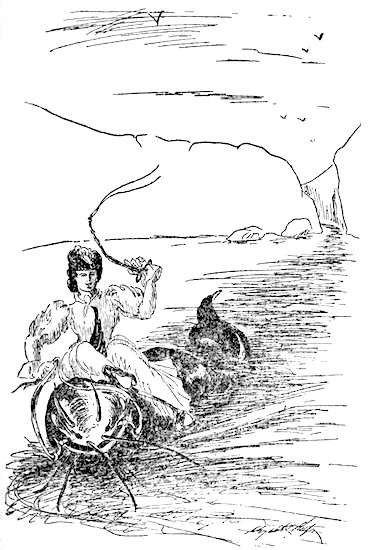
“That gal come ridin’ down the Río Grande on a catfish.”
“Well, she got on that hoss, and he give about two jumps, and she left the saddle. He throwed her so high that she had to duck as she went up to keep from bumpin’ her head on the moon. Then she come down, landin’ right on that steel bustle, and that made her bounce up jest as high, nearly, as she had went before. Well, she jest kept on bouncin’ like that for ten days and nights, and finally Bill had to shoot her to keep her from starvin’ to death. It nearly broke his heart. That was the only time Bill had ever been known to shed tears, and he was so tore up that he wouldn’t have nothin’ to do with a woman for two weeks.”
THE EXODUS OF PECOS BILL
Lanky had been sent for, and this was his last night in camp. His face was tanned; he had gained in weight; he had earned money in his own right. He felt that he was now a man.
He and his cronies sat around the fire in silence. Joe and the boys would miss the kid, and he hated to leave. This silence wouldn’t do.
“What became of Pecos Bill?” asked Lanky.
“That would be hard to say,” said Joe, “hard to say. Everybody knows he’s gone, jest like the open range and the longhorn steer; but jest how and where he passed in his checks, I don’t suppose anybody will ever find out for certain. A lot of the fellers that knowed him are dead, and a lot of ’em has bad memories—a lot of the old-timers has bad memories—and some of ’em are sech damn liars that you can’t go by what they say.”
“You’ve seen Pecos Bill, haven’t you, Joe?” said Lanky.
“Well, yes, that is I seen him when I was a young buck. But I never seen him die, and I never could find out jest how he was took off. I’ve seen some mighty hot arguments on the subject, and I’ve knowed one or two fellers to die with their boots on after gittin’ in a quarrel in jest that way.”
“I heard one account a few years ago,” said Red, “that may be right. There was a feller in Amarillo named Gabriel Asbury Jackson. He’d worked his self out of a job in Kansas and had come to Texas to buck the cigarette evil. One time he cornered a bunch of us that was too drunk to make a git-away and begun talkin’ to us about smokin’.
“‘Young men,’ he says, ‘beware of cigarettes. You think you’re smart to smoke a sack of Bull Durham every day, do you? Well, look at Pecos Bill. A stalwart young man he was, tough as nails, a fine specimen. But he got to foolin’ with cigarettes. What did they do for him?’ he says. ‘Why, nothin’ at first. But did he quit? No!’ he says. ‘He puffed away for ninety years, but they finally got him. And they’ll git you, every mother’s son of you, if you don’t leave ’em alone.’”
“That ain’t so,” said Joe. “That man was jest a liar. Cigarettes never killed Pecos Bill. He was, however, a great smoker, but he never smoked Bull Durham. He made him up a mixture of his own, the principal ingredients bein’ Kentucky home-spun, sulphur, and gun-powder. Why, he would have thought he was a sissy if he’d smoked Bull Durham.
“When the matches was scerce Bill used to ride out into a thunderstorm and light his cigarette with a streak of lightnin’, and that’s no doubt what’s back of a tale you hear every once in a while about him bein’ struck and kilt. But nobody that knows how Bill throwed a surcingle over a streak of lightnin’ and rode it over Pike’s Peak will ever believe that story.”
“I heard it was liquor that killed pore Bill,” said Hank.
“Must of been boot-leg,” said Red.
“Naw,” said Hank. “You see, Bill bein’ brought up as he was from tender youth on whiskey and onions, was still a young man when whiskey lost its kick for him. He got to puttin’ nitroglycerin in his drinks. That worked all right for a while, but soon he had to go to wolf-bait; and when that got so it didn’t work, he went to fish-hooks. Bill used to say, rather sorrowful-like, that that was the only way he could git an idear from his booze. But after about fifty years the fish-hooks rusted out his interior parts and brought pore Bill to an early grave.”
“I don’t know who told you that windy,” said Joe. “It might of been your own daddy. But it ain’t so. It’s jest another damn lie concocted by them damn prohibition men.”
“I heard another tale,” said Red, “which may be right for all I know. I heard that Bill went to Fort Worth one time, and there he seen a Boston man who had jist come to Texas with a mail-order cowboy outfit on; and when Bill seen him, he jist naturally laid down and laughed his self to death.”
“That may be so,” said Joe, “but I doubt it. I heard one tale about the death of Pecos Bill that I believe is the real correct and true account.”
“And what was that?” asked Lanky.
“Well, Bill happened to drift into Cheyenne jest as the first rodeo was bein’ put on. Bein’ a bit curious to know what it was all about, he went out to the grounds to look the thing over. When he seen the ropers and the riders, he begun to weep; the first tears he’d shed since the death of Slue-Foot Sue. Well, finally when a country lawyer jest three years out of Mississippi got up to make a speech and referred to the men on horseback as cowboys, Bill turned white and begun to tremble. And then when the country lawyer went on to talk about ‘keepin’ inviolate the sacred traditions of the Old West,’ Bill jest went out and crawled in a prairie-dog hole and died of solemncholy.”
Lanky looked at Red and Hank. They had not missed the point, but they chose to ignore it.
Joe talked on. “After several years,” he said, “when all Bill’s would-be rivals was sure he was dead, they all begun to try to ruin his reputation and defame his character. They said he was a hot-headed, overbearin’ sort of feller. They was too scered to use the word, even after Bill died, but what they meant was that he was a killer.
“Now, Pecos Bill did kill lots of men. He never kept no tally his self, and I don’t suppose nobody will ever know jest how many he took off. Of course I’m not referrin’ to Mex’cans and Indians. Bill didn’t count them. But Bill wasn’t a bad man, and he hardly ever killed a man without just cause.
“For instance, there was Big Ike that he shot for snorin’, that Bill’s enemies talked up so much. But them that was doin’ the talkin’ would forgit to mention that Bill had been standin’ guard over Mexico steers every night for six weeks and was gittin’ a bit sleepy.
“Then there was Ris Risbone. Ris was one of these practical jokers, and he ramrodded an outfit that fell in behind Bill’s on the trail. Ris had a dozen or so jokes, and when he pulled one, he slapped his knees and laughed and laughed whether anybody else was a-laughin’ or not. One day Ris rode up to Bill’s chuck-wagon when there wasn’t nobody there but the cook, and he was asleep in the shade of the wagon with his head between the wheels. Ris slipped up and grabbed the trace chains and begun rattlin’ ’em and yellin’ ‘Whoa! Whoa!’ The pore spick woke up thinkin’ that the team was runnin’ away, and that he was about to git his pass to Saint Peter. He jumped up and bumped his head on the wagon; then he wakes up and looks around, and there stands Ris slappin’ his knees and laughin’. Jest then Bill rides up, but he never said nothin’.
“When the outfits got to Abilene, Bill was in the White Elephant with some of his men, fixin’ to take a drink. Jest as Bill was about to drop his fish-hooks in his glass, Ris poked his head in at the winder and yelled, ‘Fire! Fire!’—and Bill did.
“In one killin’, however, Bill acted a bit hasty, as he admitted his self. One day he called Three-Fingered Ed out of the saloon, sayin’ he’d like to speak with him in private. Bill led Ed out into a back alley, and there they stopped.
“‘Say, Ed,’ he says, lookin’ him right in the eye, ‘didn’t you say that Mike said I was a hot-headed, overbearin’ sort of feller?’
“‘Naw,’ says Ed, ‘You mistook me. He never said that.’
“‘Well, doggone,’ says Bill, ‘ain’t that too bad. I’ve gone and killed an innocent man.’
“Well, Lanky, maybe your pa’ll let you come back next fall.”
The End
Transcriber’s Note
This book was written in a period when many words had not become standardized in their spelling. Words may have multiple spelling variations or inconsistent hyphenation in the text. These have been left unchanged unless indicated below.
Footnotes were renumbered sequentially and were moved to the end of the chapter in which the anchor occurs. Obvious printing errors, such as backwards, upside down, missing or partially printed letters and punctuation, were corrected.
The following spelling corrections were made:
biggest and the [straighest] straightest
we [liked] lacked one man
we work the canyon [tomorow] tomorrow
I’d jest[made] make him mad
the old [traper] trapper