Chapter III · (continued 3)
Reading edition
Jim was waiting for us, and said he had chased a lion south along the rim till the hounds got away from him.
Spitfire, having already been chained, was the first lion we endeavored to introduce to our family of captives. He raised such a fearful row that we had to remove him some distance from the others.
"We have two dog chains," said Jones, "but not a collar or a swivel in camp. We can't chain the lions without swivels. They'd choke themselves in two minutes."
Once more, for the hundredth time, Emett came to our rescue with his inventive and mechanical skill. He took the largest pair of hobbles we had, and with an axe, a knife and Jones' wire nippers, fashioned two collars with swivels that for strength and serviceableness improved somewhat on those we had bought.
Darkness was enveloping the forest when we finished supper. I fell into my bed and, despite the throbbing and burning of my wrist, soon lapsed into slumber. And I crawled out next morning late for breakfast, stiff, worn out, crippled, but happy. Six lions roaring a concert for me was quite conducive to contentment.
Emett interestingly engaged himself on a new pair of trousers, which he had contrived to produce from two of our empty meal-bags. The lower half of his overalls had gone to decorate the cedar spikes and brush, and these new bag-leg trousers, while somewhat remarkable for design, answered the purpose well enough. Jones' coat was somewhere along the canyon rim, his shoes were full of holes, his shirt in strips, and his trousers in rags. Jim looked like a scarecrow. My clothes, being of heavy waterproofed duck, had stood the hard usage in a manner to bring forth the unanimous admiration of my companions.
"Well, fellows," said Jones, "there's six lions, and that's more than we can pack out of here. Have you had enough hunting? I have."
"And I," rejoined Emett.
"Shore you can bet I have," drawled Jim.
"One more day, boys, and then I've done," said I. "Only one more day!"
Signs of relief on the faces of my good comrades showed how they took this evidence of my satisfied ambition.
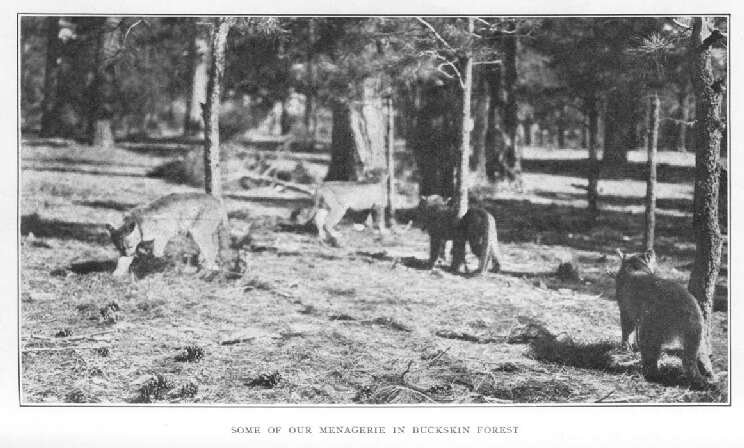
I spent all the afternoon with the lions, photographing them, listening to them spit and growl, watching them fight their chains, and roll up like balls of fire. From different parts of the forest I tried to creep unsuspected upon them; but always when I peeped out from behind a tree or log, every pair of ears would be erect, every pair of eyes gleaming and suspicious.
Spitfire afforded more amusement than all the others. He had indeed the temper of a king; he had been born for sovereignty, not slavery. To intimidate me he tried every manner of expression and utterance, and failing, he always ended with a spring in the air to the length of his chain. This means was always effective. I simply could not stand still when he leaped; and in turn I tried every artifice I could think of to make him back away from me, to take refuge behind his tree. I ran at him with a club as if I were going to kill him. He waited, crouching. Finally, in dire extremity, I bethought me of a red flannel hood that Emett had given me, saying I might use it on cold nights. This was indeed a weird, flaming headgear, falling like a cloak down over the shoulders. I put it on, and, camera in hand, started to crawl on all fours toward Spitfire.
I needed no one to tell me that this proceeding was entirely beyond his comprehension. In his astonishment he forgot to spit and growl, and he backed behind the little pine, from which he regarded me with growing perplexity. Then, having revenged myself on him, and getting a picture, I left him in peace.
XIV
I awoke before dawn, and lay watching the dark shadows change into gray, and gray into light. The Navajo chanted solemnly and low his morning song. I got up with the keen eagerness of the hunter who faces the last day of his hunt.
I warmed my frozen fingers at the fire. A hot breakfast smoked on the red coals. We ate while Navvy fed and saddled the horses.
"Shore, they'll be somethin' doin' to-day," said Jim, fatalistically.
"We haven't crippled a horse yet," put in Emett hopefully. Don led the pack and us down the ridge, out of the pines into the sage. The sun, a red ball, glared out of the eastern mist, shedding a dull glow on the ramparts of the far canyon walls. A herd of white-tailed deer scattered before the hounds. Blue grouse whirred from under our horses' feet.
"Spread out," ordered Jones, and though he meant the hounds, we all followed his suggestion, as the wisest course.
Ranger began to work up the sage ridge to the right. Jones, Emett and I followed, while Jim rode away to the left. Gradually the space widened, and as we neared the cedars, a sharply defined, deep canyon separated us.
We heard Don open up, then Sounder. Ranger left the trail he was trying to work out in the thick sage, and bounded in the direction of the rest of the pack. We reined in to listen.
First Don, then Sounder, then Jude, then one of the pups bayed eagerly, telling us they were hunting hard. Suddenly the bays blended in one savage sound.
"Hi! Hi! Hi!" cracked the cool, thin air. We saw Jim wave his hand from the far side of the canyon, spur his horse into action, and disappear into the cedars.
"Stick close together," yelled Jones, as we launched forward. We made the mistake of not going back to cross the canyon, for the hounds soon went up the opposite side. As we rode on and on, the sounds of the chase lessened, and finally ceased. To our great chagrin we found it necessary to retrace our steps, and when we did get over the deep gully, so much time had elapsed that we despaired of coming up with Jim. Emett led, keeping close on Jim's trail, which showed plain in the dust, and we followed.
Up and down ravines, over ridges, through sage flats and cedar forests, to and fro, around and around, we trailed Jim and the hounds. From time to time one of us let out a long yell.
"I see a big lion track," called Jones once, and that stirred us on faster. Fully an hour passed before Jones halted us, saying we had best try a signal. I dismounted, while Emett rolled his great voice through the cedars.
A long silence ensued. From the depths of the forest Jim's answer struck faintly on my ear. With a word to my companions I leaped on my mustang and led the way. I rode as far as I could mark a straight line with my eye, then stopped to wait for another cry. In this way, slowly but surely we closed in on Jim.
We found him on the verge of the Bay, in the small glade where I had left my horse the day I followed Don alone down the canyon. Jim was engaged in binding up the leg of his horse. The baying of the hounds floated up over the rim.
"What's up?" queried Jones.
"Old Sultan. That's what," replied Jim. "We run plumb into him. We've had him in five trees. It ain't been long since he was in that cedar there. When he jumped the yellow pup was in the way an' got killed. My horse just managed to jump clear of the big lion, an' as it was, nearly broke his leg."
Emett examined the leg and pronounced it badly strained, and advised Jim to lead the horse back to camp. Jones and I stood a moment over the remains of the yellow pup, and presently Emett joined us.
"He was the most playful one of the pack," said Emett, and then he placed the limp, bloody body in a crack, and laid several slabs of stone over it.
"Hurry after the other hounds," said Jim. "That lion will kill them one by one. An' look out for him!"
If we needed an incentive, the danger threatening the hounds furnished one; but I calculated the death of the pup was enough. Emett had a flare in his eye, Jones looked darker and more grim than ever, and I had sensations that boded ill to old Sultan.
"Fellows," I said, "I've been down this place, and I know where the old brute has gone; so come on."
I laid aside my coat, chaps and rifle, feeling that the business ahead was stern and difficult. Then I faced the canyon. Down slopes, among rocks, under piñons, around yellow walls, along slides, the two big men followed me with heavy steps. We reached the white stream-bed, and sliding, slipping, jumping, always down and down, we came at last within sound of the hounds. We found them baying wildly under a piñon on the brink of the deep cove.
Then, at once, we all saw old Sultan close at hand. He was of immense size; his color was almost gray; his head huge, his paws heavy and round. He did not spit, nor snarl, nor growl; he did not look at the hounds, but kept his half-shut eyes upon us.
We had no time to make a move before he left his perch and hit the ground with a thud. He walked by the baying hounds, looked over the brink of the cove, and without an instant of hesitation, leaped down. The rattling crash of sliding stones came up with a cloud of dust. Then we saw him leisurely picking his way among the rough stones.
Exclamations from the three of us attested to what we thought of that leap.
"Look the place over," called Jones. "I think we've got him."
The cove was a hole hollowed out by running water. At its head, where the perpendicular wall curved, the height was not less than forty feet. The walls became higher as the cove deepened toward the canyon. It had a length of perhaps a hundred yards, and a width of perhaps half as many. The floor was mass on mass of splintered rock.
"Let the hounds down on a lasso," said Jones.
Easier said than done! Sounder, Ranger, Jude refused. Old Moze grumbled and broke away. But Don, stern and savage, allowed Jones to tie him in a slip noose.
"It's a shame to send that grand hound to his death," protested Emett.
"We'll all go down," declared Jones.
"We can't. One will have to stay up here to help the other two out," replied Emett.
"You're the strongest; you stay up," said Jones. "Better work along the wall and see if you can locate the lion."
We let Don down into the hole. He kicked himself loose before reaching the bottom and then, yelping, he went out of sight among the boulders. Moze, as if ashamed, came whining to us. We slipped a noose around him and lowered him, kicking and barking, to the rocky floor. Jones made the lasso fast to a cedar root, and I slid down, like a flash, burning my hands. Jones swung himself over, wrapped his leg around the rope, and came down, to hit the ground with a thump. Then, lassos in hands, we began clambering over the broken fragments.
For a few moments we were lost to sights and sounds away from our immediate vicinity. The bottom of the cove afforded hard going. Dead piñons and cedars blocked our way; the great, jagged stones offered no passage. We crawled, climbed, and jumped from piece to piece.
A yell from Emett halted us. We saw him above, on the extreme point of wall. Waving his arms, he yelled unintelligible commands to us. The fierce baying of Don and Moze added to our desperate energy.
The last jumble of splintered rock cleared, we faced a terrible and wonderful scene.
"Look! Look!" I gasped to Jones.
A wide, bare strip of stone lay a few yards beneath us; and in the center of this last step sat the great lion on his haunches with his long tail lashing out over the precipice. Back to the canyon, he confronted the furious hounds; his demeanor had changed to one of savage apprehension.
When Jones and I appeared, old Sultan abruptly turned his back to the hounds and looked down into the canyon. He walked the whole length of the bare rock with his head stretched over. He was looking for a niche or a step whereby he might again elude his foes.
Faster lashed his tail; farther and farther stretched his neck. He stopped, and with head bent so far over the abyss that it seemed he must fall, he looked and looked.
How grandly he fitted the savage sublimity of that place! The tremendous purple canyon depths lay beneath him. He stood on the last step of his mighty throne. The great downward slopes had failed him. Majestically and slowly he turned from the deep that offered no hope.
As he turned, Jones cast the noose of his lasso perfectly round the burly neck. Sultan roared and worked his jaws, but he did not leap. Jones must have expected such a move, for he fastened his rope to a spur of rock. Standing there, revolver gripped, hearing the baying hounds, the roaring lion, and Jones' yells mingled with Emett's, I had no idea what to do. I was in a trance of sensations.
Old Sultan ran rather than leaped at us. Jones evaded the rush by falling behind a stone, but still did not get out of danger. Don flew at the lion's neck and Moze buried his teeth in a flank. Then the three rolled on the rock dangerously near the verge.
Bellowing, Jones grasped the lasso and pulled. Still holding my revolver, I leaped to his assistance, and together we pulled and jerked. Don got away from the lion with remarkable quickness. But Moze, slow and dogged, could not elude the outstretched paws, which fastened in his side and leg. We pulled so hard we slowly raised the lion. Moze, never whimpering, clawed and scratched at the rock in his efforts to escape. The lion's red tongue protruded from his dripping jaws. We heard the rend of hide as our efforts, combined with those of Moze, loosed him from the great yellow claws.
The lion, whirling and wrestling, rolled over the precipice. When the rope straightened with a twang, had it not been fastened to the rock, Jones and I would have jerked over the wall. The shock threw us to our knees.
For a moment we did not realize the situation. Emett's yells awakened us.
"Pull! Pull! Pull!" roared he.
Then, knowing that old Sultan would hang himself in a few moments, we attempted to lift him. Jones pulled till his back cracked; I pulled till I saw red before my eyes. Again and again we tried. We could lift him only a few feet. Soon exhausted, we had to desist altogether. How Emett roared and raged from his vantage-point above! He could see the lion in death throes.
Suddenly he quieted down with the words: "All over; all over!" Then he sat still, looking into space. Jones sat mopping his brow. And I, all my hot resentment vanished, lay on the rock, with eyes on the distant mesas.
Presently Jones leaned over the verge with my lasso.
"There," he said, "I've roped one of his hind legs. Now we'll pull him up a little, then we'll fasten this rope, and pull on the other."
So, foot by foot, we worked the heavy lion up over the wall. He must have been dead, though his sides heaved. Don sniffed at him in disdain. Moze, dusty and bloody, with a large strip of hide hanging from his flank, came up growling low and deep, and gave the lion a last vengeful bite.
"We've been fools," observed Jones, meditatively. "The excitement of the game made us lose our wits. I'll never rope another lion."
I said nothing. While Moze licked his bloody leg and Don lay with his fine head on my knees, Jones began to skin old Sultan. Once more the strange, infinite silence enfolded the canyon. The far-off golden walls glistened in the sun; farther down, the purple clefts smoked. The many-hued peaks and mesas, aloof from each other, rose out of the depths. It was a grand and gloomy scene of ruin where every glistening descent of rock was but a page of earth's history.
It brought to my mind a faint appreciation of what time really meant; it spoke of an age of former men; it showed me the lonesome crags of eagles, and the cliff lairs of lions; and it taught mutely, eloquently, a lesson of life—that men are still savage, still driven by a spirit to roam, to hunt, and to slay.