PART II NORWEST JOHN AND THE VOYAGE OF THE JUNO (continued 2)
Reading edition
Strong westerly winds continued to baffle us until the 14th, when, having no hope of reaching Ochotsk before the autumn was so far spent that we should be obliged to make a winter’s journey across Siberia, we concluded to alter our course, and sail for the harbor of St. Peter and St. Paul, or Petropowlowsk, in Kamtchatka. We made port on the 22d, and anchored abreast the village. We were kindly and hospitably received by the Company’s Superintendent, as well as by the officers of the military department, and especially by Major Antony Ivanah and lady, who showed me many civilities. Madam Lariwanoff and daughter were taken in charge by the Superintendent, and provided with comfortable quarters. The Doctor and myself at once took temporary lodgings on the shore, until we could make permanent arrangements for the winter. Having discharged all the cargo, and dismantled our little craft, we hauled her up on the beach at the first spring tide. Provisions and accommodations were provided at the settlement for the crew as well as ourselves; and in fact the people seemed desirous to do everything in their power to render our stay amongst them as comfortable and agreeable as the nature of the place would admit.
VI.
Settled for another Winter.—Arrival of old Friends.—Dogs and Sledging.—A Russian Christening.
Detained for another winter, we endeavored at once to make the acquaintance of the inhabitants of the village, and to become familiar with the country in its vicinity. We were introduced to all the people of note, and kindly entertained by them. We made pedestrian excursions for several miles in every direction, and visited all the common places of resort. The scenery was picturesque, and the view from the elevations was beautiful and grand. The Awatska Bay, or outer harbor, as it is called, is completely land-locked, and at the same time so extensive, that a thousand ships might ride at anchor in it with safety. The distant mountains, and particularly the high peak Awatska, add greatly to the landscape. The latter presents the imposing spectacle of a volcano in full blast, always overhung with a cloud of smoke, and constantly belching fire and lava.
We had only one source of annoyance at the village during the early part of our stay, and we soon became well used to that. I refer to the barking of the numerous dogs, though it can scarcely be called barking, for they howl like a wolf. At sunset regularly they would begin their serenade at one end of the settlement,—which, by the way, extended all round the harbor,—and in the course of half an hour all the voices would join in the chorus, and keep it up all night long. With this single temporary drawback, we passed our time very pleasantly until the first of November. By then we had visited on foot all the places in the more immediate neighborhood, and we concluded to make a short boat excursion to a small river named Paratunka, to see some warm springs situated several miles from its mouth. This spring issues from the ground in a boiling state, and spreads out over a basin excavated for its reception. It forms an excellent bathing-place, being of suitable depth, with a sandy bottom, and the bather can choose any degree of warmth he pleases. The water is impregnated with sulphur and other minerals. We found here some Russian invalids who had come to enjoy the use of the spring. All the rivers in the neighborhood abounded in salmon, though it was so late in the season; and we protracted our stay for a day or two, hunting and fishing, and boiling our game in the hot water of the spring.
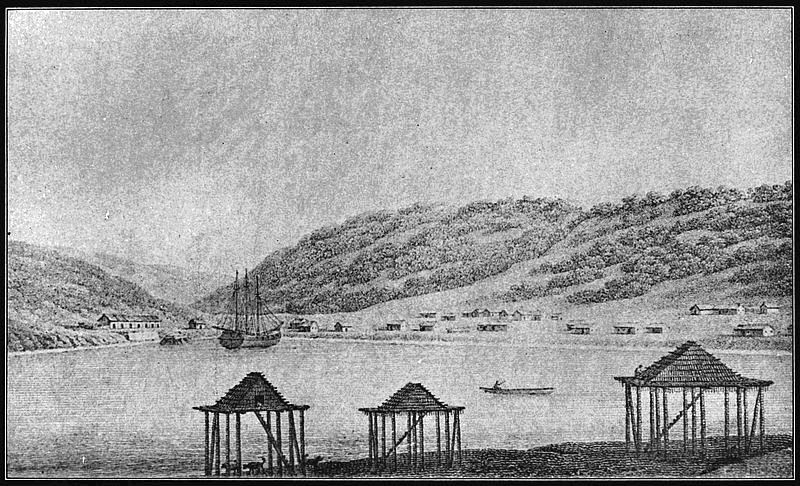
PETROPOWLOWSK IN KAMTCHATKA
On our return to the village we were surprised to find one of our old Norfolk Sound friends, Lieutenant Davidoff, who had arrived at the harbor in command of the little new vessel built at Sitcha, and called the Awos. He had left the Sound in August, accompanied by the Juno, under the command of Lieutenant Schwostoff, and having Baron von Resanoff on board to be carried to Ochotsk. He had parted with them off the Kurile Islands. About the middle of November Lieutenant Schwostoff made his appearance with the Juno. After landing his Excellency about Ochotsk, he received orders to proceed to one of the southernmost of the Kurile Islands, and break up a Japanese settlement reported to have been established there. He found at the place four Japanese, with a large stock of goods for trade with the islanders, consisting of rice, tobacco, fish-nets, lacquered ware, salt, cotton, silk, and many other articles; all of which he seized without opposition, and brought Japanese, goods, and all to Kamtchatka. Thus we met our old friends in a very unexpected manner. As we were doomed to pass another winter in this region, their company was very pleasant, and to have the Juno in sight again was especially agreeable to me.
I now took lodgings in a shanty owned and occupied by a very clever old man, named Andra, and his wife and little boy. I called him in a familiar way Starruk, that is old man, and his wife Starruke, old woman. He was quite thrifty for the place, and was one of the few in the village who owned and kept a cow. This was a fortunate circumstance, for good milk was a rarity in that section. His shanty was warm and comfortable, and was divided into three apartments. In one corner of the largest they made a bunk for me, and curtained it round. My man Parker slept in the same room on a movable bed. In the next room, which was the cooking-room, there was a large brick oven, or furnace, and on the top of this slept Starruk, his wife, and little boy. The third apartment was devoted to the cow and her fodder. At this place I took my meals at night and morning, but dined by general invitation at the Company’s table, at the house of the Superintendent. Comfortably settled in my new quarters, I prepared for a long winter’s siege.
It was necessary to be provided with a set of good dogs and a sledge. With the assistance of Starruk I was soon possessed of five of the best animals of the kind, and had them tied up near the house, that they might get accustomed to me, and be ready for use. In the spring of the year the dogs are turned loose, and left to provide for themselves, in the best way they can. Hence they are great thieves until the herring season comes, when they have an abundant supply of food, which they go into the water and catch for themselves, until they become very fat, and unfit for use.[31] At that season, too, great quantities of the herring are caught by the owners of the dogs, and split and dried in the sun, to feed them in the winter, when they give them nothing else.
I also purchased a first-rate sledge, at once light and handsome, fur garments, Kamtchatka boots, bear-skin, and everything needed to make my equipage complete; and, now fully prepared, I waited impatiently for the snow. There had been already several squalls, but about the last of November the ground was well covered and the winter set in. My dogs were in good travelling condition, and I now made my first essay, with three of them to begin with. The style in which they tumbled me about in the snow was “a caution,” as Paddy says, and furnished great amusement to the villagers. But I persevered, with a determination to make myself master of the business, and at the end of a week was quite an adroit performer. The sledges were so constructed, that it required nearly as much skill and practice to keep in equilibrium as in skating; but when well understood, they afforded a most splendid recreation and agreeable exercise. Being soon able to harness and manage my five dogs with dexterity, we used frequently to make a party, consisting of Langsdorff, Schwostoff, Davidoff, and Miasnikoff, and go out on excursions to the neighboring villages, from ten to twenty miles distant. When the weather was unfavorable, we had balls and parties; and in this way the weeks and months of the long winter passed off quite cheerfully.
About the 1st of January, 1807, the Governor-General, Koscheleff, who resides at Nischney, which is the capital of Kamtchatka, made his annual visit of inspection to all the military posts on the peninsula. His entrance into Petropowlowsk with a long handsome sledge, a Kamtchadale on each side, as conductors, and a string of twenty dogs, was quite a new and pleasing sight to me. During his stay of five days, we had royal feastings and visitings; and when he left, half the village accompanied him to the distance of ten or fifteen miles, myself among the number. We made a string nearly a mile long.
The sledging in Kamtchatka is not without some adverse casualties to the best of managers. One occurred to me which I will narrate. I was coming from Melka, an interior village, with a load of frozen salmon, in company with my landlord, Starruk, and, my dogs being better than his, I got several miles ahead of him. The snow was deep, but the top was crusted, and the underbrush all covered. The surface was perfectly smooth, but interrupted by numerous large trees; and to avoid them our track was serpentine. At last we came to an inclined plane of a mile or so in length, and, my sledge being heavily laden, it became necessary for me to be constantly on my guard, and keep a sharp lookout. Accordingly I took the usual preliminary precaution in such cases, of sitting sideways, with the left hand hold of the fore part, left foot on the runner, and my right leg extended; my foot, slipping over the snow, operated as a sort of an outrigger. The dogs at the same time, fearful lest the sledge should run on to them, went down the declivity like lightning. The trees seemed to grow thicker and thicker, and to avoid them it soon became hard up and hard down with me. At last, coming to a sharp curve to the right, the sledge, shearing to the other side, struck with such force as to scatter my whole establishment, and I received such a blow on the head that it stunned me and laid me out on the snow unconscious. When I came to a little, and looked up, I saw my sledge was partly a wreck, four of my dogs had broken from their harness and gone on, while one, left fast in his gear, was sitting on his haunches, and watching me with wonder, as much as to say, “How came you here?” It was not long before Starruk came up. He asked me what was the matter. I replied that some one in passing had run foul of me. “No,” said he, “I guess you run foul of that tree”; which, on collecting my scattered thoughts I found to be the fact. But as there were no bones broken, I brightened up, and, with the old man’s assistance, caught my dogs again, repaired damages and pursued my journey, not a little worse for my tumble.
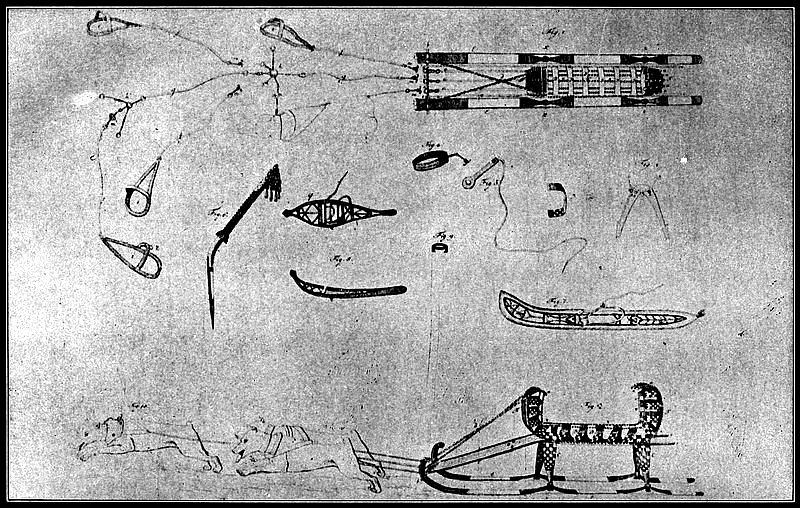
SLEDGE AND EQUIPMENTS IN KAMTCHATKA
I will mention another circumstance which occurred to me,—not that there was anything extraordinary in it, but merely to show the sagacity of dogs, and the convenience of travelling with them. I was coming from a village about ten miles distant. It was dusk when I started, and night soon closed in with Egyptian darkness and an arctic snow-storm. I could not see even my dogs. The new snow soon covered and obliterated the old track. It was difficult to tell whether I was going ahead or standing still, without putting my foot through the new-fallen snow down to the old crust. In this way I went on for an hour or so, the dogs making very slow progress, and very hard work of it. Not being able to see anything, I somehow or other became persuaded that the dogs had inclined to the left of the beaten track, and consequently I kept urging them to the right. Thus I went on for some time, until I found myself in a forest of large trees, and had much difficulty in keeping clear of them. At last I became decidedly bewildered, but convinced that I had lost my way. Not knowing whither I was going, and fearing that I might wander, the Lord knew where, during the long night, I concluded to halt, and make my dogs fast to a tree. I then sat awhile on my sledge, and listened, to see if I could hear anybody, and finally prepared my bear-skin and fur garments for a night’s bivouac. I had not lain more than an hour before I heard the howling of dogs; my own immediately answered them. I found they were approaching, and when I judged them to be within hailing distance, I called out. A man called out in return, and soon drove up. It was a Kamtchadale coming from Petropowlowsk. It appeared that I had urged the dogs a considerable distance from the proper track, which, with the new-comer’s assistance, I regained. He told me not to attempt to guide the dogs, but to let them pick their own way. I accordingly sat on my sledge for an hour or so, scarcely realizing that I was moving, till at last I turned my eyes up, and found myself right under the light of my own window.
These little mishaps occurred while I was yet a novice in the art of sledging; but I soon became acquainted with the habits and dispositions of my dogs, and they became accustomed to me, so that I travelled fearlessly, alone or in company, and made excursions to all the villages in the southern part of the peninsula within a hundred miles of Petropowlowsk. While I was amusing myself in the southern, the Doctor was traversing the northern part of Kamtchatka all by himself, and collecting specimens of natural history.
I was always an admirer of the rigid adherence of the Russians to their religious forms and ceremonies. I never saw a Russian, high or low, who did not, both before and after eating, ask a blessing, and give thanks to God for his bounty, apparently with a sincere and thankful heart. Yet there were some things very absurd in their ceremonies. For instance, I was invited to the christening of a child at the house of the Superintendent, and requested to stand as godfather with Dr. Langsdorff, as it was necessary, I was told, to have two godfathers and two godmothers.[32] At the appointed time we repaired to the house, where we found the pope and numerous guests already assembled. The pope had brought with him a small box, resembling a tea-caddy, containing, as was said, consecrated oil. A large tub full of water was placed in the centre of the room, and the pope’s apparatus near at hand. He then commenced the operation with prayers, after which, he took the child in his arms and plunged it under the water. Then, with a small brush and some oil from the box, he crossed the child all over its body and legs, and afterwards marched round the tub, and we, the godfathers and godmothers, followed, in Indian file, three times around. The child was then given to one of the godfathers, crossed again, and round the tub we went three times more. And so it continued until we all had taken our turns, and made fifteen circuits of the tub. Now I thought this, or the greater part of it, a nonsensical ceremony, and a piece of rigmarole; but it was not my part to find fault or object to it, and I willingly conformed to the custom.
When it was over, the tub was taken away, and a table put in its place, madam, the mother of the child, brought on the goodies, pies of flesh and pies of fish, cakes of various kinds, preserved berries, and many other things; but what astounded me most was that a bottle of real ardent spirits found its way to the table on this extra occasion, an article which had disappeared from among our stores several months previous. The pope paid his respects to it with peculiar unction, and a glowing countenance, and the rest of us were not slow in following suit. This was one of the friendly gatherings to which I made it a point never to refuse an invitation; and I found the Russians very fond of celebrating birthdays, christenings, and as many holidays as they could make an excuse for.
VII.
Voyage to Ochotsk.—Journey from Ochotsk to Yakutsk.
About the last of March the snow began to disappear rapidly, and by the middle of April the ground was so bare that our sledging parties were abandoned. The ice had left the bay, and all hands were at work, under the directions of Lieut. Schwostoff and Davidoff, sawing and breaking up the ice in the inner harbor, in order to extricate the Juno and Awos, which had been preparing to sail for some time. By the 25th the channel was cleared, and the two vessels put to sea, with the four Japanese who had passed the winter with us. Their destination was the northern Japanese Islands, where they intended to land their passengers, and make some further attempts to establish an intercourse with the people.
By this movement I was prompted to get my little craft afloat and prepare for the remainder of my voyage. I was admonished, by those acquainted with the breaking up of the ice in the rivers at the head of the Ochotsk Sea, not to be in a hurry; but my anxiety to be off rendered me deaf to all remonstrances; and on the 22d of May I was ready. At this point I was beset by a number of persons, both male and female, for a passage to Ochotsk. I concluded to take five in addition to Madam Lariwanoff and daughter, viz. one elderly widow woman, one old woman and her daughter, one very respectable young man in the Company’s service, and one other gentleman. Our party now numbered eighteen. We were tolerably well equipped, and had an abundant supply of such provisions as the place afforded. When our arrangements were all completed, Doctor Langsdorff and myself devoted a day to taking leave of the many friends who had entertained us during the winter; and I particularly of my old landlord and landlady, Starruk and Starruke. To the former I paid what he thought a very liberal compensation for the apartment I had occupied at his house. I also made him a present of my sledge, its equipage, and my dogs, with the exception of one, which I took with me. To Starruke I gave my bedding, curtains, and furniture. I then bade good-bye to these warm-hearted people, and left them with their warmest prayers for a prosperous voyage. Our passengers now came on board, and, after making the best accommodations for them our contracted quarters would admit, on the 26th, with fair weather, we bade adieu to Petropowlowsk, and weighed anchor.
Favorable winds continued just long enough to give us a good offing, when they became light and adverse, with calms, and so continued for several days. On the 30th, having just taken a brisk breeze, which was driving us along, for a wonder, at nearly five knots, we ran into a large whale which was lying near the surface. We somehow slid up his back so as to raise our little vessel two or three feet and throw her over on her side four or five streaks. It was like striking a rock, and brought us to a complete standstill. The monster soon showed himself, gave a spout, “kicked” his flukes and went down. He did not appear to be hurt, nor were we hurt, but most confoundedly frightened. I sounded the pump immediately, and found that all was safe as to leakage, and we continued on our course quite satisfied with the result.
June 3d, we passed through between the second and third Kurile Islands from the southern part of Kamtchatka, and entered the Sea of Ochotsk. Here again we were annoyed by the calms, which continued with but little variance until the 14th, when we had reached latitude 58°. We now began to meet ice, at first so scattered that we thought it possible to push through it; but after working in amongst it for a few hours, it became so compact as to be impassable, and extended east, west, and north as far as the eye could reach, even from the masthead a solid mass. Finding it impossible to proceed any farther, and as the ice was closing rapidly around us, I deemed it advisable to avail myself of that better part of valor, discretion, and pole out as we had poled in; for I had soon discovered that our little craft was too slight to deal freely with heavy ice. Having gained the open water, I steered to the eastward all day without finding any passage-way. The wind proving unfavorable for sailing in that direction, we turned and went westward. Thus we continued for ten days, making various attempts to get clear of the ice, and at last succeeded. On the 26th, at meridian, we found our latitude 59°20′, and the land was in sight. On the 27th, we anchored off the mouth of the river Ochota. At 2 P. M., the tide turned, and we crossed the bar, entered the harbor of Ochotsk, and made fast to the Company’s wharf. Thus terminated a long and tedious passage of thirty-three days.
We were told here that the ice had only left the rivers and bays four or five days. We were likewise informed, to our great grief, that his Excellency Baron von Resanoff had died at Krasnojarsk in Siberia, on his route to St. Petersburg. He had fallen from his horse on the road from Ochotsk to Yakutsk, which was supposed to be the cause of his death. The passport and letters I had previously received from his Excellency at once made me acquainted with the Company’s Superintendent, Mr. Petroff; likewise with the commandant of the port, Captain Bucharin. By both these gentlemen I was treated with the utmost kindness and civility; and, knowing my desire to be on my way to St. Petersburg, they were both anxious to afford me every facility in their power. A taboo was immediately put upon a sufficient number of the first horses that arrived from Yakutsk. With the greatest possible despatch, it was necessary to wait a few days, and in the mean time I was taken round the place to see the lions. They did not amount to much. The town was situated on a sand spit, washed by the sea on one side and the river Ochota on the other. The river Kuchtin unites with the Ochota near the harbor’s mouth, which, at the best, is an indifferent one, and not accessible to vessels drawing more than eight feet of water. The town is joined to the mainland by a narrow neck of marshy ground, which is often inundated. In fact, it appeared to me that any extra rise of the river or sea would swamp the whole place. Some ship-building was going on here, and many convicts were employed in the government service.
For my convenience, the privilege was accorded to me by the Company of selecting a Russian subject to accompany me on my road, as a kind of an assistant. A young man by the name of Kutsnetsoff, or Smith, was pointed out as one desirous of going with me, but the Superintendent did not feel authorized to release him from the service, unless I should think proper to select him, and I accordingly did so. He had been ten years at the settlements on the Aleutian Islands, and was anxious to return to Irkutsk, his native place. He had a brother in Moscow, a merchant in high standing, who was at the head of the Company’s establishment there.
On the morning of July 3d, my horses, eleven in number, were brought out. They did not look very promising, as they had been overworked on the route hither. This was rather discouraging, for it was important that they should be in a good condition for a journey of 500 miles, through a country with no signs of a settlement except a few log shanties at great distances asunder, and no road but a serpentine footpath; moreover, we had a fair amount of luggage, and for comfort and convenience we were obliged to carry a tent, cooking-utensils, and bear-skins, &c. for bedding. Bad as they were, these horses were better than none, and I must make the best of them.
Having completed my preparations, I took leave of my highly esteemed friend, Dr. Langsdorff, who intended to remain a week or so for the promotion of his favorite object; also of Madam Lariwanoff and her daughter, my other passengers, and sailors,—particularly of the three Alashka Indians, who had proved themselves excellent men, and rendered me good service.[33] They fell upon their knees and entreated me to take them with me. As this was impracticable, I could only make them a gratuity in rubles, and recommend them to the kindness of Mr. Petroff, in whose employ and charge they were. Having finished our leave-takings, we mounted our horses. There were five of us,—myself and two aids, Parker and Kutsnetsoff, and two Yakutas, the owners of the horses, and acting as guides. Three of the other six horses carried our luggage, and the remaining three were kept in reserve for a change on the road. Dr. Langsdorff, the Superintendent, Captain Bucharin, and other friends, accompanied us to the outskirts of the town to take another and a final farewell, and we then put spurs to our horses, and struck into the woods. We went on at quite a spirited pace until five o’clock, when we arrived at a small clearing called Medwescha Golowa, or Bear’s Head, where there were a few huts. Here we dismounted to lunch, and rest our horses for half an hour; and then resumed our journey. At seven in the evening we pitched our tent, and camped for the night, in a good place for our horses to graze. As we carried no provender, this was a matter of great importance throughout our whole journey. We turned our beasts loose, and the Yakutschians watched them by turns through the night. The distance we travelled this day since eleven o’clock was 45 versts.[34]
Ochotsk is situated in latitude 59°30′, and Yakutsk in about 63°. The direction of our course was west-northwest and the distance in a bee-line 500 miles; but by reason of the tortuous nature of the route we were obliged to pursue, the distance was much increased. In such an extent of wild country there were doubtless many objects that would have attracted the attention of the man of science; but being myself neither naturalist, botanist, nor geologist, I had no call to search to the right or to the left for specimens. My business was to push on as fast as my horses could carry me, having an especial regard for my bills of exchange. I paid but little attention to the names of the numerous small rivers and mountains which we crossed, merely noticing some of the principal. To me the country wore even a greater degree of sameness than other unsettled regions.
July 4th. We collected our horses and struck our tent at 7 A. M., mounted, and continued our journey. Several large caravans of horses passed us in the forenoon, laden with flour and provisions for Ochotsk. In the afternoon, we crossed a ridge of tolerably high mountains, and then came upon swampy ground. At five o’clock we reached a small river; but it was so deep we were obliged to ferry our luggage over in a boat, and swim our horses. We went on until eight in the evening, when we encamped. The distance travelled this day was 47 versts.
July 5th. We had a thick fog and rain through the night. It cleared up in the morning, and we mounted at seven, and continued our journey through valleys and over mountains, with extremely bad travelling, the whole day. The weather growing hot, we were sorely annoyed by the mosquitos, and were obliged to wear leather gloves and a kind of hood in the shape of a sun-bonnet, with a gauze veil to protect the face. Our white horses became perfectly pink with the blood drawn from them by these insects. We pitched our tents at six in the evening. The distance travelled this day was 55 versts.
July 6th. Started at seven, and had pleasant, but rather warm weather. In the course of the day we forded several small rivers without unpacking our horses, and passed four caravans with stores for Ochotsk. At five in the afternoon we came to a small group of shanties where was kept a magazine of provisions and a stud of horses for government emergencies. This place was 190 versts from Ochotsk. Taking tea here, we proceeded until seven o’clock, and then encamped in a tolerably good grazing-place. The distance travelled this day was 55 versts.
July 7th. Started this morning at six. The travelling was extremely bad, and the ground swampy; the horses sank in the mire up to their saddle-girths. By noon we came to better going. Passed to-day, beside caravans, several droves of cattle on the way to Ochotsk. Distance, 60 versts.
July 8th. Fine weather, but the travelling very poor again. At ten in the morning arrived at the banks of the river Allacjun, one of the largest tributaries of the Aldan. We ferried our baggage across, and swam our horses. At three in the afternoon we halted and turned our beasts out to graze. Owing to the uneven and miry road they had passed over, they were much fatigued and galled. Distance this day, 40 versts.
July 9th. Started at six in the morning. Passed several caravans, and at five in the afternoon met the government post for Ochotsk. At nine, pitched our tent on the bank of a small tributary of the Allacjun. Distance this day, 65 versts.
July 10th. Rained all the fore part of the day. Our route was through a gorge between high ridges of mountains. Distance travelled, 50 versts.
July 11th. The weather was pleasant and warm, the country rugged and mountainous. At four in the afternoon we came to the foot of a high and steep mountain, and halted to make preparations for the ascent. Our horses had already become so weak and travel-worn, that it was doubtful whether they would succeed in crossing it. My Yakutschian guides lifted their tails to ascertain their strength. On those that had limber tails the weight of the baggage was reduced, and increased on those that had stiff tails. I noticed them also pulling hair from the manes, and tying it to the branches of trees; whether this was done to invoke the good, or propitiate the evil spirits, I could not make out. After they had adjusted things to suit them, we took off our coats, and started, leading our beasts. The ground was so very springy that it was with great difficulty that we could pick our way. Two of the baggage horses mired before we reached the top, and we were obliged to unload in order to extricate them. We finally gained the summit,—which after all was not so very high,—and, having rested a little, descended. Continuing our course through a narrow valley, at 6 P. M. we crossed the river Allakum, and stopped at a small cluster of shanties on its left bank. There was a ferry for bipeds, but such of the poor horses as were able were obliged to swim. The stream was so rapid, that mine had a hard tug to get across. Distance this day, 50 versts.
It was necessary to make a halt soon for a day or two to recruit, and this was a favorable place. The government had a station and postilion here. Four of my horses were completely broken down, and I left them, and hired six fresh ones. We also replenished our stock of provisions.
July 14th. Mounted at 5 A. M., and passed over a very high mountain, and descended into a narrow, serpentine valley, in which we travelled the better part of the day. We passed several caravans and droves of beef cattle. Distance, 55 versts.
July 15th. Our route this day over boggy ground again, and the travelling was therefore as poor as ever. Our horses’ backs were very sore, and they were all nearly exhausted. We pitched our tent early in the afternoon at a good grazing-place, to give them a little rest. Distance, 40 versts.
July 16th. The weather this day was warm and pleasant, and road not so mountainous as it had been. At 5 P. M., one of our horses gave out, and we left him. Continuing on until seven, we pitched our tent on the banks of the White River. Distance, 50 versts.
July 17th. At 6 A. M. we mustered together our horses, and found that four were missing. We spent half the day in a fruitless search for them, and then concluded that they were either killed or frightened away by the bears, which are very plentiful in this region. We pursued our journey, much of the way through mud and water up to the saddle-girths. Distance, 30 versts.
July 18th. Struck our tent at 7 A. M., and at nine crossed the White River. All the early part of the day, until within twenty versts of the Aldan, we found the road very good. Here we saw before us an extensive morass, to avoid which it would be necessary to go the distance of thirty versts. This morass was about a quarter of a mile in breadth, and partially covered with water, interspersed with little grass knolls, which were soft and unsteady. Disagreeable as the prospect was, we concluded to go straight across. We accordingly fastened on the baggage tighter, stripped off all our clothes but shirt and pants, and secured them to the saddles, and started, leading our horses, each one picking out the way for himself. In about half an hour we succeeded in flouncing through without accident; but it was a tiresome job, and we got well plastered with mud. Putting ourselves and luggage in order, we proceeded until 10 P. M., when we reached the government station on the right bank of the Aldan, having left two of our horses on the road exhausted.
We had now reached the principal station on the route, which was about two thirds the distance to Yakutsk; and I determined to halt for a day or two to recruit, after passing fifteen in the saddle. At first I was quite pleased with the idea of this land excursion, but I found in a very little while that it was no joke. I was sore all over, from head to foot. The clumsy saddles we rode were anything but convenient. The pommels were of wood and raised about six inches, and in the hollow between sat the rider. There was just space enough for an ordinary-sized man; and being myself light and spare of person, there was plenty of room for me to shake in my seat. I soon hit upon an expedient, however, to alleviate my suffering. I bolstered up with pillows, so that by the fourth day my pains and aches subsided, and afterward I was tolerably comfortable. Still the incessant torments of the mosquitos and miry roads were hard to bear. I soon grew sick of this horse-marine navigation, and came to the conclusion that the spray of the sea was far preferable to a mud bath. We made up as well as we could for the annoyance of bad roads, bogs, and small rivers, by taking reasonable care of the inner man. I mentioned before, that we took our cooking apparatus and provisions with us. We had bread and sugar, and the tea-kettle was in constant requisition morning and evening. Sometimes at the shanties on the route we obtained a little milk. At noon we generally had a substantial lunch of Bologna sausage or corned meat, and a glass of schnapps.
Having rested and refreshed ourselves sufficiently, I made an arrangement with the postilion of the station to take us through the remainder of the distance, as from here to the banks of the Lena there were relays of horses at points twenty-five or thirty versts asunder.
July 21st. Being all ready for a move, our horses were gathered together at the river’s side. There was only one small boat belonging to the place, in which we made out to ferry ourselves and baggage over; but the poor horses were obliged to swim. Such was their dislike to the water, that we were detained half a day trying to force them in. At last we succeeded, by taking two of them by the halter, one on each side of the boat, and letting the others, five in number, follow on their own hook. The current was so rapid that they swam the distance of two versts, when the width of the stream at this point was only one, before they reached the opposite shore. They crawled up on the bank quite exhausted, and we were obliged to remain awhile for them to recover. At 2 P. M. we mounted and pursued our journey. At eight in the evening we pitched our tent at the first post-station after leaving the Aldan. The distance travelled was 35 versts.
July 22d. Changed horses and started at 6 A. M. The travelling was much improved, and at 5 P. M. we came to the second stand, on the bank of the Anger, after a ride of 50 versts. We passed over this river in the usual manner, and went on 25 versts more to the third station, where we paused for the night, quite satisfied with our day’s progress.
July 23d. At 9 A. M. started with fresh horses and continued on our route. The travelling was still more improved, and the country generally had a more agreeable appearance. The high mountains had disappeared, and we rode over level prairies, beautifully diversified with grasses and a great variety and profusion of flowers. Among the latter the red pink predominated, the odor of which scented the whole atmosphere, and made the journey delightful. At 1 P. M. we changed our horses at the fourth station, and at six arrived at the fifth, where we passed the night. Distance, 60 versts.
July 24th. We had pleasant weather, and at 7 A. M. started on our route. At 8 P. M. we arrived at the seventh station, where we encamped for the night, and paid the postilion 35 rubles for the use of his horses, this being the last station to which he had authority to take us. Distance, 60 versts.
July 25th. At 7 A. M. we resumed our journey under the charge of another postilion. Our horses, since leaving the Aldan, had generally been very good; but this morning I found myself on a splendid animal, of a cream color, singularly and beautifully marked. A dark brown stripe about a hand’s breadth ran from the crupper to the withers, and then spread over the shoulders in a broad patch; his mane and tail reached nearly to the ground. I could see that he was well groomed and cared for, but I was rather shy about mounting him at first. I was assured, however, that he was well broken and gentle, and I found him so. He was certainly the most perfect creature of the kind I ever rode or set eyes on. The plains over which we travelled this day were dotted over with innumerable cattle and horses grazing. At 9 P. M. we arrived at the tenth station and pitched our tent. Distance, 75 versts.
July 26th. At 7 A. M. we continued on our route, and at 4 P. M. reached the right bank of the river Lena, which I crossed, and was kindly received and entertained at the Company’s establishment at Yakutsk. This town, the capital of the province of the same name, covers a large space of ground. The houses were mostly of logs, but some were spacious and tolerably handsome, and surrounded with large gardens. The churches and other public buildings, with their cupolas, made quite a conspicuous and pleasing appearance as we approached the place, but the streets were irregular, unpaved, and muddy. The latitude of the town is 62°30′ N.
The breadth of the Lena at Yakutsk is about two miles. This magnificent river takes its rise in the southern part of Siberia, in lat. 52°. Its general course is northeast, and it empties into the Arctic Ocean in lat. 75°. With its tributaries it forms the principal channel for the discharge of the great water-sheds of the eastern part of the empire, and the thoroughfare of communication with the provinces of Ochotsk, Kamtchatka and the Aleutian Islands. Down this stream vessels carried the various articles needed in those distant regions, such as bread-stuffs, liquors, and manufactures, and brought up in return the furs and other commodities which found a ready market in China and Russia.
VIII.
Yakutsk.—Different Modes of Travelling.—Voyage up the Lena.—I arrive at Irkutsk.
I determined to remain at Yakutsk a few days, to look around and ascertain the best mode of proceeding up the river to Irkutsk. The distance in a straight line was about 1500 miles, but by following the stream it would be much increased. There were post-stations the whole way, mostly on the left bank, and at intervals of twenty or thirty versts. At these horses were kept by the government, and one mode of making the proposed journey was in a small open boat, which was towed by them after the manner of a canal-boat, except that passengers changed boats at every station. Another mode, and that which I decided to adopt, was to hire a larger craft, with mast and sails, and perform the whole distance without changing; but I was to have the privilege of receiving assistance from the horses whenever necessary, and for this purpose I obtained an order from the government called a deroshner or poderoshner.
As soon as I had come to this conclusion, I commenced a search for a suitable boat, and at the same time I took the opportunity to look round the town. Accompanied by one of the gentlemen of the establishment, who devoted himself to my service, I visited all the public places, including the monastery, churches, and forts. I also called on several families, and was introduced as an American captain. Some of them were very inquisitive, and anxious to know where America was. It was a mystery to them how I got there, if I did not come by the way of St. Petersburg and Moscow. I explained as well as I could without an interpreter, but after all they appeared to be rather sceptical. The Commandant, a cheerful and clever old man, was very kind and obliging, and we exchanged several visits. He asked for information with regard to our government and constitution, which I explained as well as I could; and as he understood no English and I very little Russ, it is quite possible I was taken for a very knowing chap. When I made a call at any one’s house, no matter what time of day it was, if I stayed long enough for the tea-kettle to boil[35] (which, by the way, was almost always kept boiling), I was asked to take a cup of tea, and it was considered almost an insult to refuse. The second cup was usually laced with a little ardent spirits. This tea-drinking I found to be the universal custom in Siberia.
The sables collected in the vicinity of Yakutsk are the finest and most beautiful in the world, and command a much higher price than those from Kamtchatka. As I had already collected a few skins as specimens, in my travels, I requested the Superintendent of the Company’s establishment to supply me with a pair of the very best this district produced, and he kindly complied. They were certainly of great beauty, very dark-colored and shiny, with very long and thick-set fur.
I found a boat in a few days, belonging to a couple of itinerant merchants, who had come down in her from the head-waters of the river, which I thought would answer my purpose. It was quite a nice boat, of about twenty feet in length; a little aft the centre there was a small round-house, with a sleeping-berth on each side. It had a keel, but was of light draft. The mast carried one large square sail; and we could row with two oars forward and two aft. I chartered the boat for the passage, and was to deliver it up to the merchants, or their agent, when we had arrived at head-waters. One man who came down in it was to return with me, on condition he worked his passage; and I found that the owners themselves desired to accompany us to their home. I had no serious objection to this, provided they supplied their own provisions; and, in fact, I thought it might be rather an advantage, as they were acquainted with the river. I gave them to understand at the outset, however, that the cabin must be at my exclusive disposal, and to this they readily agreed. I accordingly sent on board my goods and chattels, cooking utensils, and provisions. The Commandant, at my request, very obligingly appointed a Cossack to go with me, and a smart, energetic little fellow he was.
Having made everything ready, I took leave of my friends in Yakutsk, and assumed the command of my little craft, on the morning of the 30th of July, and thus commenced what was to me an entirely new phase of navigation. The wind being adverse, I had the horses hitched on, and away we went. My crew consisted of my man Parker, Kutsnetsoff, the Cossack, the man who worked his passage, and together with the two merchants and myself made seven of us in all. My weapons of defence (of which, by the way, there did not seem to be much need) consisted of a pair of double-barrelled pistols with spring bayonets, and a large broadsword, with a conspicuous gilt hilt finished off with an eagle’s head. These implements looked dreadfully formidable and warlike, and I deposited them in a convenient place in my cabin. I assigned to Parker, Kutsnetsoff, and the Cossack the berth which I did not use, and they were to turn in and out by watches. The two merchants and the other man were to select the best places to sleep they could find elsewhere. With matters arranged in this way, we went on in good style, the horses going most of the time at a gentle trot. In the course of the day we passed two post-stations.
On the morning of the second day, having accomplished about 150 versts of my journey, I stopped at a post-station, where the official appeared to be a much more wide-awake man than any we had passed. I sent my deroshner to be written on, and my Cossack ordered the horses to be attached. This order not being obeyed at once, I saw there was some difficulty, and sent Kutsnetsoff to see what was the matter. On returning, he asked me to go into the office myself. So, hauling up the collar of my shirt, and, assuming such an air of importance as I thought the case might require, I went and demanded the cause of my detention. “The horses are all ready for you, Sir,” said the postilion, “but those two merchants cannot go in that boat. The government don’t keep horses to accommodate travelling traders. If they want horses, they must pay for them.” There was no alternative, but that the fellows should leave the boat; and, to my surprise, they did it without a word of objection. Perhaps they were conscious that they had taken advantage of my ignorance to get a passage home free of charge. I was not sorry for their removal, although they appeared to be good men; for one of them was a constant singer of love-songs which were all High Dutch to me, and from his proximity to my quarters his well-intended music became very annoying. This difficulty removed, we proceeded again, under three horse-power. By the time we reached the next station, the wind became favorable, we hoisted our sail to the breeze, and cast off from the horses. By keeping near the shore, out of the main current, we made better progress in this way than we had done previously, and passed several stations without stopping. And so we went on by sail or by horse-power, according as the winds were favorable or adverse.
August 6th, we reached Olakminsk, which is about 600 versts from Yakutsk. By this time I began to think the mode of travelling I had chosen very pleasant. The season was delightful, and the scenery as we passed along was diversified with objects of sublimity and beauty. At times we were moving through level country, and at times among high mountains; in some places the river was contracted to a narrow span by precipitous ranges of cliffs, and again its broad expanse embraced many islands. To relieve the monotony of the confinement on board my boat, I occasionally rode on horseback from one station to another, and found the change very agreeable. The country in some places was thick-wooded, chiefly with fir and birch; in others, it was clothed with shrubbery, and I noticed currant and gooseberry bushes, and frequently alighted to refresh myself with the fruit. We passed a number of small clusters of shanties, inhabited by Tunguscans, in the vicinity of which herds of cattle were grazing. Near the houses were domestic reindeer of a large size. The children were playing about in little groups, and the older ones were amusing the younger by holding them on the backs of the deer, and teaching them to ride,—making quite a rural and domestic scene.
We had at no time on our route any lack of good milk, and once we had about a gallon of rich cream given us. The idea struck me that it might be converted into butter; I therefore had it put into a large pot, and with a kind of pudding-stick sat down at my cabin door, and as we were moving along began to stir it. In the course of half an hour I produced a lump of butter that would have put to shame seven eighths of the dairy-maids in this country.
I had long since noticed the great deference shown to the military in these parts, but I saw it particularly illustrated by my Cossack, in exerting his authority among the people at a post-station. He was scolding them for their laziness in hitching on the horses, and I could hear that he was making a very great lion of me. “Start quick, you rascals,” said he, “we have got a great American captain in the boat, going on government business!” And this seemed to accelerate everything, even the horses, for they travelled better after it.
On the 15th, we passed Witim, which is about 1,400 versts from Yakutsk. Here the favorable winds, of which we had availed ourselves for several days past, left us, and we took, as usual, to horse-power. A short time after, we came to a station of some ten or twelve houses, where the inhabitants were in great perturbation on account of the small-pox, which was raging among them. Some had fled from the place, and others would have gone had they not been detained by their families. The disease existed among them in all its stages, from the symptoms to the full pox. I had had considerable experience with it, and thought I might mitigate the suffering by inoculation. They were all desirous that I should do so, and gathered anxiously around me. I called for a needle and thread, and selecting one of the subjects whose pox was ripe, drew the thread through the pustules until it was saturated with matter. Then preparing the maggot (as I believe it is called), by cutting the thread into very short pieces, with my penknife I made a little incision in the upper arm, placed in it one of the maggots and bound it there. I went through this process on seven or eight, and instructed them how to perform it; and as to their diet, to eat no fat or salt meat, but to confine themselves to bread and milk. They were very grateful for the advice, and for what I had done for them, and were desirous of manifesting their gratitude in some more substantial form, but it was declined.
After passing through an extensive grazing country, interspersed with large fields of grain, about 300 versts from Witim we came to rapids, with high precipitous banks on either side, where the velocity of the current was so great that we were obliged to hug the shore to avoid it. In some parts of it we could only get along by sending a small boat ahead to carry a line to warp by. This was a slow and laborious operation, and we were heartily rejoiced when we were through with it. The rapids once passed, the scenery became as interesting as it had been before, and the country, if anything, rather more populous and thriving. We saw, beside farming and grazing, a number of men engaged in fisheries along the banks of the stream. I could not see but that there was as great a degree of happiness here as in any other part of the world. The wants of the people were abundantly provided for by the produce of the soil and the river, and beyond this they seemed to have no desire.
After passing through some more rapids, where we were again obliged to cast off our horses and warp the boat, on the 19th we reached Kirinsk, which is about 1,650 versts from Yakutsk. From here we went on quickly, owing to the good path for the horses on the shore, and on the 26th reached Wercholinsk. This was a considerable town, situated on the right bank of the Lena; but we pushed by it without stopping. We now began to be troubled with the shallowness of the water, but we made out with difficulty to reach Katschuk, beyond which there was hardly enough to float a canoe, and we concluded we had reached the head of navigation. According to agreement I delivered up my boat here, and took a post-carriage for Irkutsk, where I arrived on the afternoon of the 28th of August, 1807, and drove into the court square of the Company’s establishment.
IX.
Irkutsk.—Journey to Tomsk.—New Travelling Companion.—Tobolsk.—Russian Leave-taking.
I presented my letters of introduction from the Chamberlain, Baron von Resanoff, and was kindly welcomed by the Superintendent. He invited me to make his house my home while I remained in the place. I replied that my stay must be short, and begged him to assist me in procuring a convenient vehicle for my journey, so that I might not be obliged to change at every station, as I should if I went in a public conveyance.
I discharged my Cossack when I gave up my boat, and made him a present of fifty rubles, all my cooking utensils, provisions, and some other articles. He took his leave, with many thanks and good wishes, which I cordially returned. I had brought Kutsnetsoff home to his native town, from which he had been absent ten years. He started off immediately to find his mother. The next morning he made his appearance at my room, leading her in. She was a very dignified-looking elderly lady, dressed in black. As he introduced her to me, she dropped upon her knees, and, while the tears from an overflowing and grateful heart were coursing down her cheeks, poured out her thanks for the interest I had taken in the return of her son. It touched me so deeply, that I could scarcely refrain from tears myself. It carried my thoughts home to my poor mother, and I raised her up, and assured her that, if I had done her son a favor, or brought comfort and consolation to her, I was amply compensated by the pleasure and satisfaction the deed itself afforded me. Kutsnetsoff had previously observed that he should like to go on with me to Moscow to see his brother, if his mother were willing. When it was suggested to her, she readily gave her consent, being also desirous that he should see his brother.
While we were talking about the matter, who should drive into the court square but Dr. Langsdorff. I was rejoiced to see him, but could not account for his being so close upon my heels. It appeared that he had arrived at Yakutsk shortly after my departure, and, making but a short stay, had been pushing on in the small boats, hoping to overtake and surprise me on the river. He had gained two days on me, but encountered all kinds of troubles and vexations, such as leaky boats, drunken boatmen, an inefficient Cossack guide, the upsetting of the boat, and loss of papers. He was quite chagrined when I told him that I, by taking a larger craft under my own control, had avoided all these difficulties, and had made quite a pleasant excursion of it.
The Doctor having decided to make a longer stay than I desired to, that he might visit Kiakta, across the Lake Baikal, I purchased a vehicle which I thought would answer my purpose. It was called a pervoshka, and was nothing more than a box rounded at the bottom, and fixed firmly to the axletree without springs. A covered top reached from the back part nearly to the middle, resembling the top of a cradle. The forward part of the box was covered far enough to make a seat for the driver, from which a boot extended to the cradle-top. On the bottom of this outlandish concern I must either lie or sit upright throughout my whole journey. I therefore procured a good substantial feather-bed and put it in, with which and two or three well-stuffed pillows, my luggage, and other wadding, I thought I might get along without much chafing. As this carriage was only calculated for one person, I took a post-carriage of much the same construction for Parker and Kutsnetsoff.
Being now all ready for the road, I decided to stay a day or two, and look round the place with my friend the Doctor. I shall not attempt a description of this large, and I might say handsome town. It is the modern capital of Siberia, and is situated on the banks of the beautiful river Angara, which is one of the largest tributaries of the Yenisei. It was in that day, and I suppose still is, the great commercial emporium of the eastern part of the empire, whence the more distant provinces are supplied, and whither are brought the furs and the products of the fisheries from Kamtchatka, Ochotsk, and the Aleutian Islands; and through the frontier town of Kiakta, across Lake Baikal, the teas, nankins, silks, and other articles which are obtained from the Chinese in exchange for the sea-otter and sable skins, and find such a ready market in Russia.
Having a journey before me of 3,500 miles, and desirous of reaching St. Petersburg before the close of navigation in the autumn, I was prepared to travel day and night, and of course passed many towns and villages without noticing them, only making short halts for a day or two at some of the larger or shire-towns to rest. I was provided with a new deroshner, and a good supply of copper money to pay for fresh post-horses. On the 31st of August, having hitched the horses to our vehicles,—that is, one in the shafts of each, and one on each side,—and having again taken leave of Doctor Langsdorff and the Company’s Superintendent, the Yemshik, as the driver is called, mounted his box, cracked his whip, and away we went, leaving the capital of Siberia behind us. The post-stations were about 25 versts, or 15 miles, asunder, and we were well attended at them. If we desired it, we could obtain something to eat, and I generally availed myself of the opportunity twice a day, taking a substantial meal, and topping off with a cup of tea, preparatory for which we almost always found the kettle boiling. The Yemshik’s signal for starting was the crack of his whip, and at that the horses would bound off at full speed, and he would begin to sing. The song, as well as the speed, was generally kept up from one station to another. The music was sometimes quite pleasant and cheering; the horses, at any rate, seemed to know that it meant “Go ahead.”
In this way we continued night and day. On the 6th of September we passed through Krasnojarsk, where the Chamberlain Baron von Resanoff had died. We continued on without stopping, and on the 7th reached the town of Poim, where I halted a couple of hours to deliver a letter from the young man Chlabnekoff, whom I took as a passenger from Kamtchatka to Ochotsk, to his brother. He called on me, and insisted on my going to his house, if it was only for an hour. His family wanted to see me. I took Kutsnetsoff with me, and we gave them all the information we could about their brother. We found a splendid collation prepared for us, with Madeira wine such as we do not have in these days. After concluding the entertainment with a bottle of champagne, we started off; and whatever the facts may have been, we certainly felt much lighter than before. I merely mention this circumstance to show that there was no lack of “the good stuff” in Siberia. The Maine Law was not enforced there half a century ago.
On the 10th I reached the shire-town of Tomsk, and was constrained to acknowledge myself pretty well used up. I can assure those who have not made a trial of this mode of travelling, that to lay on one’s back in a carriage without any springs, for eight days and nights in succession, is no joke. When I alighted occasionally my whole frame was in a perfect tremor, yet the roads were not stony, but tolerably good. There was no regular hotel in the town, and so after a little inquiry we drove up to a large log-house, with a square enclosure in front, the owner of which was kind enough to entertain us. I immediately set Kutsnetsoff upon the lookout for a more easy and convenient carriage, and told him if he should find one to endeavor to dispose of my old one in part pay. In the mean time, having a letter from my friend Lieutenant Schwostoff to his uncle, who was Governor of the place, I waited on him. I was very cordially received, and invited to dine the next day.
In a short time Kutsnetsoff succeeded in finding a vehicle much better than the old one. It was quite a stylish affair, on springs, and two persons could ride in it conveniently; but I had to pay as much to boot, perhaps, as both carriages were worth. I called upon the Company’s agent to furnish me with 200 rubles, but he had received no particular instructions to advance me money, and was reluctant to do it. He was quite reasonable, however, and was willing to listen to my story. While I was explaining to him who I was, and why I wanted money, there were several persons standing by. Among them was a good-looking, well-dressed man, who spoke up and said he would let me have as large a sum as I wanted, at which the agent said he was willing to supply me. After I had finished my business the gentleman who made the kind offer of his purse informed me that he himself was going to Moscow, and, if I had no objections, would like to take a seat in my carriage, and share the expense. I hardly knew what to answer, and I scrutinized him very closely. His face wore an honest look, and he had about his person two conspicuous orders of merit; so I concluded to accept his proposition. I found no reason afterwards to regret it. He was a Greek by birth, and a merchant of high standing. His name was Dementy Simonitch, and he had done several meritorious acts, for which he received medals from the Emperor Alexander, and likewise a present from him of a splendid gold watch and chain.
Having arranged this matter, I repaired to the Governor’s to dine and take leave of him. I found a great many gentlemen there, but not one who spoke English, so that I was almost a dummy amongst them. I understood enough Russ, however, to learn that they were desirous of inquiring into the nature and organization of our government. I explained all the prominent points as well as I could, and they appeared to understand, for they praised our institutions highly. If I was able, under the circumstances, to form a correct opinion, there was a good deal of the spirit of reform among them. After taking leave of the Governor, I commenced preparations to start the next morning. As I saw but little of the town, I can say but little or nothing of it. It was quite a large place, the houses nearly all of wood, and the streets broad and in some places planked in the centre for the convenience of foot-travel, and yet in others so muddy that there was no comfort in moving round out of a carriage.
On the 12th of September I started with my new companion, and went on at the same breakneck pace as before. My new coach was far superior to the old one. We could sit up or lie down as we chose, and were not annoyed by the intolerable jarring of the body. My companion was very agreeable, and although he could not speak a word of English, and my vocabulary of Russ was too limited to hold a continued, intelligible conversation, we soon became accustomed to each other’s pantomimic gestures, and got along quite understandingly. On the 19th we arrived, without any casualties worthy of remark, at Tobolsk, the ancient capital of Siberia, and put up, as usual, at a private house.
Here my carriage-mate, Dementy, had acquaintances. He introduced me to the family of Mr. Zelinzoff, or Green, a highly respectable and wealthy merchant, and the proprietor of large iron-works at Ekatereinburg. He was himself absent from home, but, together with Dementy, I was invited by his son, who officiated as major-domo, to dine with his family while I remained in the city. I take pleasure in particularizing in regard to this family, on account of their marked civility and kindness to a stranger. It consisted of Madam Zelinzoff, three sons, a daughter, and a young man named Duro, who was a teacher of French, and spoke English fluently. They lived in splendid style, and spread a table for fifteen or twenty persons every day. Among the numerous invited guests was a French military officer in the Russian service, who spoke English well, and with whom I had a good deal of chat. After dinner the ladies and gentlemen retired to a large hall, where there was a billiard-table and a piano, violins and flutes, on which the amateurs displayed their skill. This was the agreeable practice daily while I was there.
Perhaps I may be allowed here to make a few remarks in regard to the city of Tobolsk, though I cannot give a minute description of it. It is very singularly divided into the upper and lower town. The lower town seems to have been once the bed of the river Irtich, which now, uniting with the Tobol, runs through the western part of the valley, leaving both the upper and lower town on the eastern side, but divided distinctly by a steep bank, which was probably in former days the margin of the stream. The lower town is sometimes, though rarely, inundated; and on the other hand the upper town is inconvenienced by a want of water. Taking both sections together they formed a very large place, with a numerous and mixed population of Tartars, Bucharians, and Kalmucks. The public buildings were mostly of stone, but the private houses, with few exceptions, of wood. It was the great mart of trade with the eastern part of the Empire, and all the caravans from China and the distant provinces concentrated here.
This place had formerly been the Botany Bay, or penal settlement, of the Russians, and from the descendants of convicts a great and flourishing city had sprung up, with its wealthy merchants, thrifty traders, and literary and scientific men. The German and French languages were taught and spoken by all the better classes. All kinds of provisions were so cheap, that the poorest inhabitant never need suffer for food; and I could see here, as throughout Siberia, the kindliest feelings manifested toward the lower orders of society.
Having remained at Tobolsk six days, we prepared to continue our journey. Two of the young Mr. Zelinzoffs were to accompany us as far as their father’s estate, at Ekatereinburg. Accordingly, after dining and making some preliminary arrangements for departure, the whole family, with their guests, assembled in the large room for a little chat and to take leave. Now this leave-taking was a somewhat formal piece of business, and I had misgivings as to how I should acquit myself with becoming gallantry. The custom with the gentlemen was for each to lay the right hand on the other’s back, and to kiss each other on both cheeks;[36] not unfrequently the noses came in rude collision. A lady presents you the back of the hand to kiss, and at the same time she kisses you on the cheek. Being all ready for action, the ladies and gentlemen placed themselves in a row round the room, and then the performance was commenced by the two sons who were going with us, and continued by my friend Dementy. By this time the perspiration had begun to start upon my forehead; but I saw it was of no use to be lagging, and so, summoning all my courage, I turned to, and went through the ceremony like a veteran courtier. The last of the ladies I came to was the daughter, a great beauty, and I was greatly tempted, in violation of Russian etiquette, to kiss her cheek, but I managed to restrain myself.
X.
Flying Ferry-Boat.—Ekatereinburg.—Kazan.—A Dinner-Party.—Moscow.—St. Petersburg.—Good News.
After the ceremony described in the last chapter, we took to our carriages and proceeded to the ferry which crosses the Irtich, where we found what was called a flying ferry-boat, of sufficient size to transport several teams at once.[37] The hull of the craft did not swim deep in the water, but was furnished with a very deep keel along its whole length. It had a short mast, placed about as far forward as in sloops, and supported by shrouds. Now an anchor was sunk in the centre of the river some distance above, and from the anchor a rope, sustained on the surface by buoys, was extended and fastened to the bow of the boat. By means of a block and pulley this rope could be elevated about half the distance to the mast-head. When ready for starting, the bow, which was always pointed directly up stream at the landing-place, was pushed off a little, so that the current might strike the keel at an angle. This position was maintained by the use of the rudder; and as the boat could not drift down the river, on account of the anchor to which it was attached, it was driven sideways to the opposite shore. By this ingenious contrivance passengers and freight were carried across without the least trouble or labor.
On the 24th we arrived at Ekatereinburg. During our stay here of one night, our young friends showed us about the iron-works, and we saw all the operations, from smelting the ore to working it up into bar-iron. Gold ore was dug here by the government, and the pure metal extracted by pulverizing, and washing it on an inclined plane covered with ridges, which stopped the gold, while the lighter substances were carried off with the water. It did not appear to be a very money-making process. The next day we took leave of our young friends, and pursued our journey westward to Kazan, on the river Volga, which we reached on the 30th. Here my carriage-mate, Dementy, was quite at home again, and we concluded to halt for a couple of days. The city was large and well built, and the most important place in the eastern part of Russia proper.
I had for some time experienced the good effects of Dementy’s badge of distinction, but it did us especial service here. It procured us an invitation to dine with the military Governor, who was himself of Greek extraction, and somewhat acquainted with my friend. I had no great desire to go among great folks, as my wardrobe was scanty, and the few clothes I possessed had grown pretty threadbare with the wear and tear of my three years’ cruise. I wished to decline, but Dementy said it would give offence. He had probably given an account of my adventures, and of my negotiation with the Chamberlain, Baron von Resanoff; and this, together with the mark of the Emperor’s approbation which he himself wore, had brought us into notice.
At the proper time the military carriage of the Governor came for us, and away we went in fine style. We found a great number of persons assembled at his house, including officers, military and civil, and many ladies. I was introduced as an American captain. I felt a little uncomfortable lest I should be questioned with regard to my official grade, as it might not have been good policy to have explained my claim to a captaincy. It was a splendid entertainment, however, and, as I could not converse very intelligibly, I had little else to do than ply the knife and fork, while Dementy, who had somehow picked up all the particulars about me and my business, gave them my whole story, much to my satisfaction. After dinner we retired to another room, where coffee was served. The ladies questioned me about our country, and to show that they had some knowledge of American history, they spoke of Washington and Franklin in high terms. We conversed upon the subject until I had exhausted my whole stock of Russ in eulogizing those men.
October 2d, we started on our route for Moscow, our next stopping-place. We met with nothing remarkable excepting muddy roads and frequent altercations at the post-stations. There was evidently less respect paid to my friend’s decorations, and less alacrity in attending to us. We, however, reached the great city of Moscow on the 8th, and passed within the first circle, which is called the Zemlänoigorod. We wound along through the streets, as it seemed to me, for miles. At last Dementy pointed out a public house, where we stopped awhile to brush up and make ourselves look respectable,—after which Dementy left us. Kutsnetsoff sought at once the whereabouts of the Company’s establishment, and we started again, passed through the Bale gate into the circle of that name, and drove to the Company’s house. I entered the spacious stone building with Kutsnetsoff, and met his brother, the Superintendent, on the great landing-stair. He was a splendid-looking man. After the brothers had embraced each other, and while tears were rolling down their cheeks, I was introduced. I was cordially welcomed, and led into a large hall, where I was presented to the Superintendent’s lady, and Kutsnetsoff to a sister he had never seen before. She was a very handsome woman, and richly dressed in the latest French style.
After exchanging mutual inquiries, I was told by the Superintendent that his house must be my home while I remained in the city. I replied that I was desirous of reaching St. Petersburg before the close of navigation, and consequently my stay must be short. They concluded that I could well spare a week. In that time I thought I could replenish my wardrobe with the latest European fashions, and at my request, a draper was sent for; he took my dimensions, and I was soon fitted out completely. My Kamtchatka sable-skins were converted into a lining for a great coat,—as something of that kind had now become necessary,—and they made a splendid article.
In the mean time, having leisure, I availed myself of the politeness of a young gentleman of the house, who offered to go round with me and show me the city. I made no note of what I saw at the time, and since then half a century has rolled by. I can only recall some of the leading features of the great metropolis, which may be interesting, as the date of my visit was but a few years before the conflagration which drove Napoleon from the country. The city is situated on an elevation which in shape resembles a turtle’s back. The river Moskva sweeps round nearly two thirds of it, and the land rises gently from the margin to the centre, which is so high as to command a splendid panoramic view of its whole extent. The city was divided into four departments or circles. The first, the Kremlin, situated on the crown of this eminence and enclosed with heavy ramparts of stone, formed a sort of fortress of very ample extent. It embraced within its walls magnificent cathedrals, palaces, and public buildings, all gorgeously decorated. Here also was the great bell, which stands on the ground, with a triangular piece broken out of the rim. Its weight is said to be four hundred thousand pounds.[38] The next circle was the Kitaigorod, or Chinese Town, also containing several cathedrals, convents, parish churches, and many noblemen’s houses, interspersed with mean-looking wooden buildings. The third circle, which surrounded the former, was the Beloigorod, or White Town, and had a white wall. This was the business part of the city, and the streets, though mostly paved, were muddy and filthy. There were here, however, many public edifices, and handsome private houses, the residences of the merchants and traders. The fourth circle, called Zemlänoigorod, or Land Town, was surrounded with an earthen embankment, and enclosed an area of nearly ten miles. In this as in the other circles, there was a great diversity in the cost of the different structures, the very extremes of magnificence and meanness being mingled together promiscuously. I was very much impressed with the grandeur and beauty of the whole city; spread over more than twenty square miles of ground, adorned with a countless number of costly and elegant buildings, with thousands of spires and cupolas covered with silver and gold, when viewed from the Kremlin it afforded one of the most pleasing spectacles I ever gazed upon.[39]
I was loath to leave when the time allotted for my stay had expired, but there was no help for it. So, equipped in the fashionable rig with which the draper furnished me, I turned my face toward St. Petersburg. The Superintendent was kind enough to propose that Kutsnetsoff should accompany me to my journey’s end, which proposal I gladly accepted. On the morning of the 17th, I took leave of the good friends who had shown me so much kindness, and stepped into my carriage, rode through the suburbs, and at noon emerged into the open country. We passed many villages and large towns, but continued on without stopping at any of them except to take our meals.
On the 21st of October, 1807, we reached the gates of St. Petersburg, and, after going through a thorough examination of passports, were permitted to go on. We drove at once to the Company’s establishment, where I was kindly received and entertained by Mr. Booldakoff, the first director of the Russian American Company. It was evening when I arrived, and as neither Mr. B. nor any one in the house could speak English, I remained partially ignorant of the business which most interested me until the next morning. A gentleman then came in who accosted me in good round English, and I was quite overjoyed at the sound. This was Mr. Benedict Cramer, a gentleman with whom I became very intimate in business afterwards. He was the senior partner of the house of Cramer, Smith, & Co., and was also one of the directors of the Company.
He soon threw light upon my whole business by saying that his partner, Mr. Smith, was in the United States, and had seen my owners and assured them that the bills of exchange, the duplicates of which had reached them through the hands of Mr. Moorfield, were good. Mr. Moorfield had been out with a ship in the course of the season, the bills had been accepted and paid with fifteen per cent advance, because Spanish dollars, in which they were payable, commanded that premium. The proceeds had been invested in hemp, iron, and manufactures and sent to America; and the business had been transacted through his house. “You have now nothing to do,” he concluded, “but to take all the pleasure you can while you remain with us.” I shook him heartily by the hand, and made him a low bow; after which we walked out together to his place of business. He introduced me to his brother and Mr. L. Harris, the American Consul, who was connected with his firm; and in the same way I became acquainted with a number of influential gentlemen, from whom I received many civilities.
Mr. Booldakoff, whose house I made my home, showed me every attention. He took me in his carriage to all the places of note in the city, and had an audience with the Count Ramansoff, the Prime Minister, to whom I was presented. In short, every mark of respect that could be accorded to a stranger was shown me.
XI.
I sail down the Baltic in a Dutch Galiot.—Take Passage at Elsinore in the Mary for Portland.—Put in at Liverpool.—Home again.—Conclusion.
Things went on so smoothly and pleasantly at St. Petersburg that I took no note of time. Six days had already slipped by before I began to think of making a further move. There were no American ships at Cronstadt when I arrived, but I was told that there were always opportunities till the last of November to obtain a passage to England, so that I felt quite easy. Just as I commenced preparations for starting, however, war was declared between Russia and England, and all foreign ships left Cronstadt. I now thought it doubtful whether I could obtain a passage to England, but I made all haste for the port, to make a trial, at least. Mr. Booldakoff gave me a letter to the harbor-master, the Consul one to his Vice, the Messrs. Cramer one to Messrs. Belfour, Ellah, & Co., at Elsinore. With these I took leave of my St. Petersburg friends, and started; but when I arrived at the Mole I was quite discouraged to find that there was not a merchant-vessel in sight. I called on the Vice-Consul, but he knew of no way to help me. Though thinking it would be useless, I determined to present my letter to the harbor-master. He read it, and after a little reflection, and a number of questions about my journey, said that I had better go down to the Mole head with him, and see what could be done.
We found, on inquiry, that there was one solitary vessel, a small galiot, lying at anchor below the Tolbeacon, about three miles off. She was bound for London, and he thought I could get a passage in her, if I were willing to try; at the same time he offered to send me aboard. I jumped at the proposition, and told Parker to get our goods and chattels into the boat as soon as possible. Thanking the harbor-master for his assistance, I started off for the galiot. She was a small craft, of seventy or eighty tons burden, loaded with tallow. The skipper was a little old Dutchman, short of five feet in height, and a mate and cook composed his crew. I asked him if he would take me as passenger to London. “Yaw,” says he. “And will you let my man work his passage?” “Yaw, goot,” says he. I paid the officer of the boat for his trouble, and he left us. Being now at leisure, I began to look round to see what kind of a ship and accommodations we had got. She was rather a flat-bottomed vessel, carrying lee-boards, to keep her from drifting to the leeward when sailing by the wind. I questioned the skipper about the provisions, and he believed that there were enough, such as they were. The cabin was a trunk, so called, above the deck, abaft the mainmast, in which there were two boxes with slide-doors. One was his berth, and the other the mate’s. He informed me that I must sleep with him, and my man must turn in and out with the mate. I thought this a fair arrangement, and so we settled it.
It was morning when I went on board; and after dinner, which consisted of beans and buckwheat pudding, we got under way. The wind was light but favorable, so that we crept along down the Gulf at about the same rate we used to go in our little Russian vessel. The weather was moderate and the sea smooth, and after so much land-travel I enjoyed the change very much. We continued to grope along until we reached the island of Bornholm, in the Baltic. Here we took a westerly gale, which would have put a stop to our progress if we had not fortunately got under the lee of the island, and continued sailing from one end to the other of it for two days, when the gale abated, and the wind changed. This enabled us to continue on our course, so that on the 13th of November we reached Elsinore. Here I presented my letters from the Messrs. Cramer, and was kindly received by Messrs. Belfour, Ellah, & Co.
Though the galiot was detained by contrary winds, as long as there was no alternative, I concluded to stick by her; but on the second day I was standing on the pier and looking up the sound towards Copenhagen, when I saw a ship coming down with a large American ensign flying, at the sight of which my heart leaped right up into my throat. I waited until she came to anchor, and then called a shore-boat and went off to her. She proved to be the Mary of Portland, Captain David Gray, and was homeward bound. This was joyful news, and affected me so deeply that I could hardly tell the Captain my story. At last, after making known who I was, and from whence I came, I asked him if he would take me as passenger, and he readily consented. I went immediately to the galiot to settle with the little Dutch skipper. To the question, how much was I to pay him, he answered that he only wanted “Was billig ist, das ist mir recht.” Not knowing exactly what that was, I tendered him twenty Spanish dollars, with which he was well satisfied, and made him a bonus of a pair of leather breeches, which he had worn ever since we left Cronstadt. Wishing him a prosperous voyage, I took my leave and my baggage and went on board the Mary. She was a fine ship, in ballast, and had a splendid cabin for the times. The captain was a social, clever fellow, and we soon became well acquainted. We left Elsinore on the 20th, and proceeded down the Kattegat. When we got down as far as Gottenburg, we found the wind blowing in heavily through the Sleeve, which obliged the pilot to put into Marstrand, a small port in Sweden. Here we lay two days.
On the 24th, we put to sea again. We passed the Naze of Norway, and steered for the Orkney Islands; but, owing to adverse winds and stormy weather, it was the 2d of December before we got through the Fair Isle Passage. We then encountered a series of westerly gales, in the course of which it was discovered that one of the ship’s rudder-braces had worked loose. It was deemed unsafe to pursue our course across the Atlantic, and Captain Gray accordingly altered his course for Liverpool, where we arrived on the 15th. This was a great disappointment to me, particularly as my pecuniary resources were exhausted, and I saw before me unavoidable expenses; at the same time, I had no relish for the storms of a northern passage and a winter’s coast. I reconciled myself, however, with the prospect of seeing England; and as Captain Gray offered to supply me with money until I reached Portland, I was quite content. I went with him to a boarding-house, where we remained while the ship was undergoing repairs. In the mean time, I made myself acquainted with the city and its environs. At the end of two months the Mary was ready for sea again, and having taken on board a quantity of salt, we sailed on the 7th of February. We had a pleasant voyage, and arrived at Portland on the 25th of March. Here I settled with the Captain, to whom I was indebted for my passage, board, and sundry loans, the whole amounting to the sum of two hundred and fifty dollars. I gave him a draft on Mr. John Park, of Boston, and it proved quite fortunate for him that I did so. His owners had failed just before our arrival, and, as they were indebted to him, he would have been a loser but for this draft.
You may suppose that I started with as little delay as possible for Bristol. I arrived there on the 1st of April, 1808, and thus terminated an absence of three years and eight months. In two years and six months from the time of my departure, the owners were in receipt of the proceeds of the voyage, which resulted in a clear profit of ONE HUNDRED THOUSAND DOLLARS.
I have now reached the end of my story; but before I lay down my pen, let me say a word more of the friends mentioned in the preceding pages. I continued in the Russian trade, in which I had made so successful a beginning, and returned to St. Petersburg in 1809. It so happened that I found Dr. Langsdorff and Lieutenants Schwostoff and Davidoff there. The latter two gentlemen, since we last met, had been engaged in the war with Sweden, and had become honorably distinguished. While I was visiting the Doctor, they came over to pass an evening with us, and we sat talking of old times until two in the morning. They then started for their own lodgings, which were on the other side of the river. Langsdorff and myself accompanied them to the drawbridge, which was open for ships to pass in the night. Our friends, therefore, passed over a plank which lay from the bridge to a vessel in the river and regained the other side of the bridge by another plank, calling to us and wishing us good-night, when they were safe over, and we then went back to our quarters. The next morning we received the melancholy intelligence that two naval officers had been drowned in the Neva during the night, and, upon further inquiry, we learned that they were our friends. After we had parted from them, they became desirous, God knows for what purpose, to return to us again, and, in order to get over quicker, they attempted to spring from the bridge upon a bark that was going through. They mistook a sail for the deck of the vessel, and both fell into the water. The people in the bark endeavored to rescue them, but the night was so dark, and the current so strong, that they went under before they received any assistance. Though fifty years have gone by since the death of these young men, I cannot forbear to recall their many virtues and lament their untimely end.