PREFACE
Reading edition
The far-away little island of Tahiti is the gem of the South Pacific Ocean. If any place in this world deserves to be called a paradise, Tahiti can make this claim. This charming spot in the wide expanse of the peaceful ocean has attractions which we look for in vain anywhere else. From a distance, the grandeur of its frowning cliffs rivets the eye, and, in coming nearer, its tropic beauty charms the visitor and imprints upon his memory pictures single and panoramic that neither distance nor time can efface. The scenic beauty of this island is unsurpassed. The calming air, redolent with the perfume of fragrant flowers of exquisite beauty, on the seashore, in the valleys and on the precipitous mountain sides; the luxuriant vegetation; the forest fruit-gardens and the sweet music of the surf remind one of the original habitation of man. The natives, a childlike people, friendly, courteous and hospitable, are the happiest people on earth, free from care and worries which in other less favored parts of the world make life a drudgery.
Tahiti is the only place in the world where the people are not obliged to work. The forests furnish bread and fruit and the sea teems with fish. The climate is so mild that the wearing of clothing is rather a matter of choice than of necessity, and the bamboo huts that can be made with little or no expense in half a day with the willing help of the neighbors, meet all the requirements of a home. The stranger will find here throughout the year a climate and surroundings admirably adapted to calm his nervous system and procure repose and sleep.
In writing this little book I have made free use of the "Memoirs of Arrii Taimai E., Marama of Eimeo, Terii rere of Tooarai, Terii nui of Tahiti, Tauraatua I Amo" (Paris, 1901). The authoress was the mother of Tati, one of the most influential present chiefs of Tahiti, and, as her several titles show, she was of noble birth. She was an eye-witness of many of the most stirring political events in the history of the island. Only fifty copies of this book were printed and only three remained in possession of her son. He was kind enough to give me one of them, which, after making liberal use of it, I presented to the library of the University of Chicago, through its late lamented president, Dr. W. R. Harper. I also acknowledge my indebtedness to the works of Captain Cook, "A Voyage to the Pacific" (London, 1784), and to the book of Baron Ferd. von Mueller, "Select Extra-tropical Plants" (Melbourne, 1885).
N. Senn.
Chicago, 1906.
Contents
PREFACE
TAHITI THE ISLAND PARADISE
THE ISLAND OF TAHITI
OCEAN VOYAGE
THE ATOLL ISLANDS
THE LANDING AT PAPEETE
THE CITY OF PAPEETE
TOPOGRAPHY OF THE ISLAND
THE CLIMATE
HISTORY OF THE ISLAND
POMARE, THE ROYAL FAMILY OF TAHITI
MISSIONARY RULE
WARS BETWEEN PROTESTANT AND CATHOLIC MISSIONARIES
THE LAST WAR
THE NATIVES
FOREIGNERS IN TAHITI
BUSINESS IN TAHITI
OLD TAHITI
RELIGION OF THE NATIVES
THE INSIGNIA OF TAHITIAN ROYALTY
DISEASES OF TAHITI
PRESENT PREVAILING DISEASES
THE KAHUNA OR NATIVE DOCTOR
PHYSICIANS IN TAHITI
HÔPITAL MILITAIRE
THE ISLAND OF PLENTY
TAHITI'S NATURAL BREAD SUPPLY
THE COCOANUT, THE MEAT OF THE TAHITIANS
THE COCOA-PALM
THE FORESTS OF TAHITI
NOTED FOREST TREES OF TAHITI
VANILLA CULTIVATION IN TAHITI
THE RURAL DISTRICTS
POINT VENUS
FAUTAHUA VALLEY
VILLAGE OF PAPARA
IORANA!
ADDENDA
THE STORY OF ARIITAIMAI OF TAHITI
LIST OF ILLUSTRATIONS
The Royal Family
Harbor and Principal Port of Papeete
Lighthouse, and Cook Monument at Haapape
King Pomare V
Pomare IV
View of Moorea
Tahiti from the Harbor of Papeete
In the Shadow of the Palm Forest
The S. S. "Mariposa" Leaving the Harbor of Papeete
Royal Palace (Headquarters of the Governor)
Avenue of Purranuia, Papeete
Native Village by the Sea
Native Hut close by the Sea
Prince Hinoi
A Tahitian Home
Tahitian Bamboo House
Tomb of the Last King of Tahiti, Pomare V
Tahitian Women in Ancient Native Dress
Tahiti Girls in Native Dress
A Group of Native Girls
Native Girl in Modern Dress
Tahitian Ladies in Zulu Dress
Native Musicians and Native Dance
Tahitian Girl in Native Festive Dress
At Home
A Home by the Sea — Raiatea
Fisherman's Home
Native Settlement
Group of Tahitian Children
A Case of Far-Advanced Leprosy Affecting All Limbs
A Leper of Tahiti
Military Hospital in Papeete
Tahitian Fruit Vender
Preparing Breadfruit
Sapodilla
Copra Establishment
Government Wharf — Papeete
Corner in Papeete
A View of Fautahua Valley
Avenue of Fautahua
Cascade of Fautahua
Bridge across Fautahua near Waterfall
Lagoon and Reef on the Ninety-Mile Road
On the Ninety-Mile Road
Fishermen of Papeete
Tahitian Canoe with Outrigger
Two Papaya Trees
Picking Cocoanuts
Alligator Pear Tree
Ancient Masked Warriors
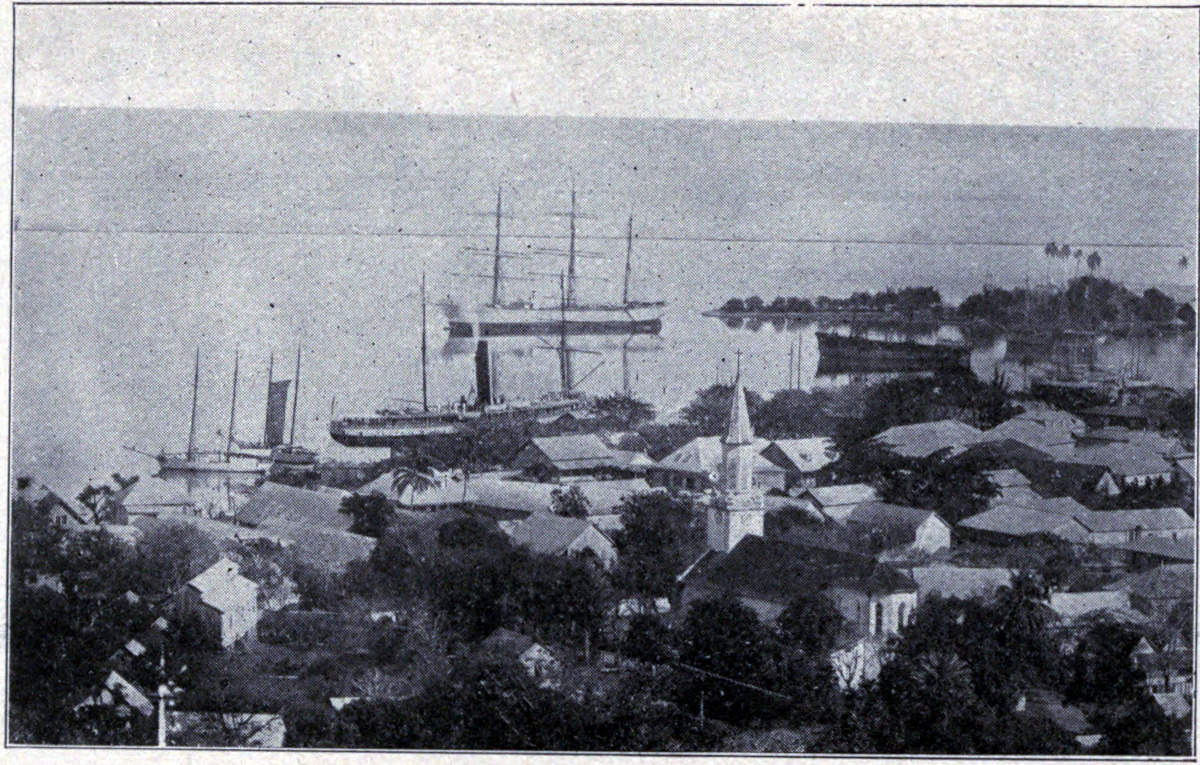
HARBOR AND PRINCIPAL PORT OF PAPEETE (Steamer Mariposa leaving the port)
TAHITI THE ISLAND PARADISE
When the Almighty Architect of the universe created the earth we inhabit, He manifested His wisdom, goodness and foresight in adapting, in a most admirable manner, the soil, climate, and animal and vegetable life for the habitation of man, the supreme work of creation. By the gradual and progressive geographical distribution of man over the surface of the earth, he has become habituated to diverse climates and environments, and has found conditions most congenial to his comfort and the immediate necessities of life.
In cold, laborious climes, the wintry North
Brings her undaunted, hardy warriors forth,
In body and in mind untaught to yield,
Stubborn of soul, and steady in the field;
While Asia's softer climate, form'd to please.
Dissolves her sons in indolence and ease.
LUCANUS.
It required centuries for the Esquimau to become acclimated to the inhospitable polar regions, and make them his favorite abode; the people who drifted toward the equator gradually became inured to the climate of the tropics and accustomed to the manner of living in countries where the perennial heat paralyzes the physical and mental energies, and undermines the health of strangers coming from a more temperate climate. Nature has made ample provision for man in all habitable parts of the earth. The regions of ice and snow are inhabited by fur-bearing animals, and, at certain seasons of the year, are frequented by a large variety of aquatic birds in great abundance, which supply the natives with food and clothing, while in the tropics, man has little or no need of fuel and clothing, and, with very little exertion, he can subsist on the fruits of the forests, and on the food so liberally supplied by the sea.
The intensity of the struggle for life increases with the distance north and south from the temperate zones, where climatic conditions necessitate active exercise and where the necessities of life can only be obtained by the hardest kind of labor. The climate of the tropics, on the other hand, is very generous to man. The forests are rich in fruit yielding trees which Nature plants, which receive little or no care, yet which bear fruit throughout the year. Wherever the cocoa-palm grows in abundance, there can be no famine, because this tree yields a rich harvest of nutritious fruit from one end of the year to the other without fail, as it is never affected to any considerable extent by drouth and other conditions which so often bring failure to the orchards in more temperate climates. The continuous summer and the wonderful fertility of the soil in tropic and subtropic countries reward richly the labor of the husbandman by two and sometimes three harvests a year, as nature's forces require no rest, no slumber there.
Life in a changeable, severe climate is full of hardships; in the tropics, of ease and leisure. The nearer we come to the tropics, the closer we approach the conditions of primitive man. The necessities of life increase as we recede on either side of the equatorial line. The dreamy, easy, care-free life in the tropics is in strong contrast with the severe and arduous struggles for existence in countries less favored by the resources of nature.
Among the trees in the Garden of Eden, the palm tree was undoubtedly the most beautiful, and it remains to-day the queen of the forests of the seacoast in the tropics. The palm-clad isles of the South Sea bear a closer resemblance to the description of the Garden of Eden than any other of the many parts of the world that I have ever seen; and of these, Tahiti is a real paradise on earth. There is no country nor other isle where Nature has been so liberal in the distribution of her gifts. No other island can compare in natural beauty with Tahiti, the gem of the South Pacific Ocean. It is the island where life is free of care. It is the island where the natives are fed, clothed and housed by nature. It is the island where man is born, eats his daily bread without being forced to labor, sleeps and dreams away his life free from worry, and enjoys the foretaste of the eternal paradise before he dies. It is the island which must have been born
In the morning of the world,
When earth was nigher heaven than now.
BROWNING.
It is the island of which the poet must have been musing when he wrote:
Amid an isle around whose rocky shore
The forests murmur and the surges roar,
A goddess guards in her enchanted dome.
POPE.