TACHYHIPPODAMIA. (continued 2)
Reading edition
The same pen you make for one mule, may serve for others which are of about the same size; and thus you may break, in a very few days, a great many mules, so as to go immediately to work with them, without laming them by blows and rough usage, which is often the cause of their being refractory the rest of their lives. I have broken a sufficient number of them to bear witness of the truth of this assertion. All those persons who may have learnt any part of my secret of breaking horses in a few hours, have remained perfectly silent with regard to mules, though they have undoubtedly tried their skill upon them, but in vain.
HOW THALES, ONE OF THE SEVEN WISE MEN OF GREECE, CORRECTED A MULE OF THE HABIT OF LYING DOWN EVERY TIME IT PASSED A CERTAIN RIVER.
Thales, one of the seven wise men of Greece, had a mule which used to carry loads of salt from one place to another, in consequence of which, it had to cross a very wide, but rather shallow river. It so happened one day, that whilst it was crossing the river, being heavily loaded, it stumbled and fell down, and remained some time in the middle of the water, which soon melted and washed away the salt that was in the bags. The animal, finding itself thus alleviated and discharged of its load, was able to jump up and pursue its journey without fatigue: from thence it concluded that the said fall and immersion in the river had been favorable and beneficial to it; therefore, when it had to cross the river a second time with a load of salt, it stopped in the midst of the river, and plunged in such a manner that its load soon melted away; and this happened every time it passed the stream; nor was it possible to break it of this trick, either by words or blows, though vigorously and well-applied. At last, the wise Thales bethought himself of this stratagem: He loaded the beast with a very bulky load of sponge; the mule, according to custom, plunged into the water, and remained some time; but, when it got up, it could hardly stagger under the weight of its load, and, instead of relief, found itself oppressed to such a degree, that it ever after crossed the river with the greatest care, so as not to fall in the water and increase the weight of its load.
HOW TO MAKE A DULL HORSE APPEAR METTLESOME AND FULL OF FIRE FOR A SHORT TIME.
Take of red pepper, of the strongest kind, a small handful. Pound it fine, and add half a spoonful of vinegar to it. Put the whole into a small bag, made of linen, and tie it to that part of the crupper which goes immediately under the horse’s tail. Buckle the crupper rather short, so that it will press upon the little bag, as the horse trots off. The juice will flow out of the bag, and come in contact with a certain part, which will immediately have the most wonderful effect upon the horse imaginable. He will champ his bit, if you hold him in, and appear to be all fire and mettle. When you ride off, he will hold up his head, stick his ears forward, lift his feet with agility, and caper about like a young colt. In a word, he will act the part of a fiery, mettlesome horse, full of vigor and spiritedness.
THAT PART, OR THOSE PARTS OF THE MEXICAN STATES IN WHICH THE BEST RACE OF HORSES IS TO BE FOUND, AND SOME OF THEIR QUALITIES.
The horses that are brought to Louisiana, under the name of Spanish horses, generally come from Caahuila, Tamaulipas, and Neuvo Leon. They are of a pretty good size, and commonly of a vicious disposition. They are very much affected by the change of climate. They are likewise used to a better kind of grass than that growing in Louisiana. They are much larger than the creole horses, and when acclimated live longer. When mixed with the creole horses, they form a good race, far better than the creole horses. Planters generally suffer great loss in purchasing northern horses, which are so much affected by the climate that hundreds of them die every year. A better and more serviceable race of horses may be raised, by procuring northern mares, and putting them with creole studs. They will not only stand the climate as well as the creole horses, but will render more service than the northern horses, and do not require half so much care. But a race of horses, far superior to either of the above-mentioned, can be raised, by procuring some of those beautiful Andalusian studs, and putting them with northern mares. This would be really improving the race of horses in this country. I would likewise advise the planters to procure both mares and horses, and raise at least some elegant riding horses from this Andalusian race. I have more than once mounted upon a fiery Arabian steed, that hardly seemed to touch the ground, as he bounded over the plains—I have likewise ridden upon some of the finest horses raised in New Spain—and, for my life, I have found it difficult to distinguish the difference between the former and the latter. They are of the same size—their shape is the same—their long, floating mane the same—their beautiful, small and well turned hoof the same, and so hard that they travel over vastly high and rocky mountains, without being shod. Add to this, their hardiness to undergo fatigue. I have ridden one of these horses for twenty days together, going from fifty to fifty-five miles a day, and frequently changing from a cold to a hot climate, and vice versa; for in New Spain, climates are hot or cold, according as they are higher or lower; and this I have done, without my horse ever appearing in the least jaded, or the leaner for it. The rider himself feels much more at his ease, than he does when riding a heavy, clumsy horse, that moves along like a camel, and is remarkable only on account of his unwieldliness, and is, as a Kentuckian would say, “waste timber!” Besides, the Andalusian or Arabian breed are the most elegant easy-going horses in the world. They have no resemblance to those Spanish horses which are brought to this country.
Now, as I have mentioned some of their qualities, I will inform the amateur where he can best procure them. In going by land to the Mexican states, the first horses of this kind to be met with, are raised upon the Hacienda del Xaral, (pronounced Haral, and often written with a J, Jaral,) two hundred and sixty miles this side of the city of San Louis Potosi, in the state of the same name. Still further on, in the states of Guanajuato and Quenetaro, the same race of horses is to be found, and likewise in other places: but, those I here mention, would be by far the most convenient places to procure them, as they are not so far distant as others from Tampico, should one wish to bring them by sea to New Orleans, nor so far from this state, should one prefer bringing them by land. All of these fine horses, I here mention, are raised upon the table-lands, where excessive heat is never felt: and yet, if you take them down to the hot countries upon the coast, they will, even there, do double the service of one of the hot-country horses, in their own climate. I speak from experience, for I have tried both. They likewise possess another good quality, which is that of being the most sure-footed animals in the world, of the horse kind; not even excepting a mule.
CAUTION TO BE OBSERVED, IN CUTTING OR PARING THE HOOFS OF YOUR HORSES IN THIS COUNTRY, WHERE HORSES GENERALLY GO UNSHOD.
When you cut or pare the hoofs of your horses, be careful to cut them so as not to let that soft part, which is in the middle of the foot, commonly called the frog, rise above the outside of the hoof; for if you do, it will undoubtedly make the horse limp. When it is too big, it must be cut off. Nobody will do it so efficaciously as a blacksmith, and it is better to pay such a one some trifle than to lame your horse.
CAUTION TO THOSE WHO RAISE HORSES OR MULES.
He that would raise a good stock of horses or mules, must have good pasture-ground, and take special care that the colts do not want for food in the winter time, and more particularly the first two years. More depends upon the first two years, than any thing that can be done afterwards; for a colt that is badly fed, and allowed to suffer hunger and cold while he is young, will rarely or never make a large horse; whereas, if he has been well fed for two years, he is more able to support hardship afterwards, though I by no means advise any one to neglect him at any time.
TO ACCUSTOM A HORSE TO STAY IN A PLACE.
If you buy a horse in one part of the country, and take him to another, and the horse returns of his own accord to his former abode, cause another person, (if the person be his old master, so much the better,) to take your horse and tie him up, and whip him severely, and let him stand all night without eating any thing whatever. In the morning, let the same person come again to the horse, and give him another good discipline: immediately afterwards, go to your horse, mount him, and ride him back to the place where you wish him to stay, and give him some salt, and plenty to eat. Keep him inclosed for two days, well fed, handled and caressed. Then cause him to be taken to his first place of residence. Let any person catch him, tie him up, and whip him, as at first, leaving him tied all night, without eating. Go to him, get upon him, and ride him home; caress and feed him well, and give him a little salt. Let him loose, at the end of two days, upon trial; if he does not return at the end of four days, have him caught, caressed and fed, and salt given to him, and then let loose. But should he return a third time, which would be a rare case, repeat the discipline. I seldom or never knew this remedy to fail.
TO MAKE A GENTLE HORSE, NOT USED TO A CARRIAGE, GO IN IT.
Harness your horse: handle him in the forehead a few minutes. Let some one lead him, whilst you hold the reins and go behind him with a whip in your hand. Make him advance, by speaking to him; then speak to him to stop, at the same time you pull upon the reins. Exercise him a few minutes in this way, then handle him again in the forehead. Make him advance: let the person who led him now go before, at a little distance, then further off, till at last the horse will suffer himself to be driven, without any one being before him. Now let him drag a small piece of wood, with some one going before as at first, till he suffers himself to be driven without. Exercise him a few minutes, in this way, then with something larger, that will make considerable noise. I have always made use of a barrel, fixed so that it would roll round, and in which I put a quantity of round stones; but, as stones are difficult to be procured in this part of the country, their place can be supplied by something else. Give the horse a good exercise, in the same gentle, progressive manner as above, till he will suffer himself to be driven with this last load in every direction, without the necessity of any one going before him. Then put him to an empty cart, and continue on, in the same progressive manner. Never pull upon the reins, to stop your horse, without speaking to him. I have never yet failed of success in putting a horse to a coach or gig; but, it is certain, that there are some horses so fiery and vicious, that few persons would have patience enough to succeed. I here speak of those horses that have contracted vicious habits, after having been broken for a long time. Never fail to give your horse a very small quantity of salt, after having exercised him to go in a cart or gig. Do not give him more than a thimble-full at a time. He will generally go well the first day; but he ought to have a few hours exercise each day, for a few days.
A HORSE THAT STOPS, AND REFUSES TO GO, WHEN IN A CARRIAGE.
If a horse stops, and refuses to go, or runs back, go up before him, handle him in the forehead and coax him. If he is not an old offender, he will go off in about fifteen minutes. If he has been spoiled for a long time, it requires more patience to correct him.
THE HORSE TAMED.
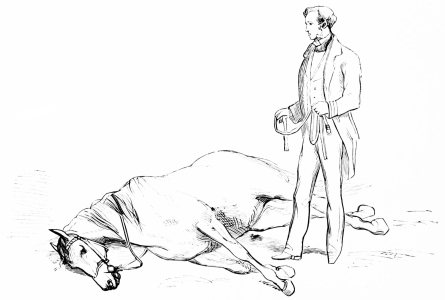
A MODE OF BREAKING WILD HORSES, VERY DIFFERENT FROM THAT DISCOVERED BY ME.
I have seen a wild horse taken and shut up in a stable. The man who was to gentle or tame him, took a whip, such as a coachman uses, and went in to him; and, as the horse was frightened, and ran away from him, he fell to whipping him most unmercifully. At the end of half an hour, the horse, seeing it impossible to escape the whip by running away, advanced towards the man who had been his persecutor. The man threw down his whip, and began to handle him; but the horse, at the end of a few minutes, began to be refractory, when he took it up again, and repeated the lesson with so much severity, that the horse soon came back to him. This he continued for some time; when, at the end of about two hours, he saddled the horse and drove him about with his whip, making him come up to him every now and then, till at last he mounted him and rode off very well. I observed, that the horse frequently trembled, when he went to get on him, notwithstanding he rode him off pretty well; he appeared to be afraid of many objects he met with, and was far, very far from being that gentle, docile animal, tamed by the simple, natural means made use of in my method of breaking horses. Besides this, those horses do not remain gentle. I speak from experience.
ANOTHER MODE OF BREAKING A HORSE FOR A FEW HOURS.
Stop up the horse’s ears, so that he cannot hear at all, and you can very soon handle him as if he were a gentle horse; but, when you unstop his ears, he will become as wild as ever. If you perform this two or three times upon the same horse, it will have no effect upon him at last.
ADVICE TO FARMERS, CONCERNING THE GENTLING OF YOUNG COWS.
Though I did not intend to say any thing about horned cattle, it may not, perhaps, be amiss to relate what I have experienced and been eye-witness to, in the state of Louisiana, concerning the gentling of young cows, since I discovered the secret of breaking horses in a few hours. Whenever I have had a heifer or young cow to gentle, (it must be observed, that they are much wilder here than in the northern states,) I have made it a practice to have them tied by the horns to a post, and have made a servant begin to handle them well all over, speaking to them uninterruptedly; and this he did for two or three mornings, before milking them, always finishing by giving them a little salt. At the end of three or four days, they never failed of becoming gentle, and could be milked without being tied. Though I have seen by experience, that horned cattle, especially bulls, are much less sensible to the touch than horses, a part of which may possibly be owing to the thickness of their skin, yet even with them I have done much. Let any one who will, do more.
THE ASTONISHING MANNER IN WHICH I TAMED OR GENTLED A WILD DEER.
The second day after my arrival in the town of Tantoyuca, I presented myself to the first Alcade, or chief magistrate of the town. I showed him the documents I had brought with me from the President and other authorities, and expressed a desire of putting in practice, in that town the ability I possessed of taming, in a few hours, wild horses. The Alcade seemed to be of a morose, surly temper, and answered me, saying, he did not believe in witches, nor miracles, and though he said he respected the President’s document, yet he believed he had been imposed upon, &c. He appeared not even disposed to give me a trial. He had a brother-in-law, a Spaniard, a genteel, wealthy gentleman: this man was very much disposed to favor my undertaking. He possessed numerous herds of wild horses. He gave me one of his houses to live in, whilst I staid in the town, for I had my wife and family with me. About six o’clock, (this was in February, 1826,) whilst we were all sitting at the door, taking the air, a wild deer came bouncing by us. It had been chased out of the woods by a leopard or a tiger. The large spotted tiger and leopard are both natives of this country, and are often seen within half a mile of the towns in the Guanteca. The deer ran down opposite the Alcade’s house: there, a man threw a rope upon it, and caught it. I immediately went to the man, bought the deer, and told him to tie it and bring it up to my house. He accordingly did so. I untied it, and shut it up in a room, where it remained all night. The next morning, before sun-rise, I went to it, and began the operation of gentling; and, at nine o’clock, I made it follow me to the Alcade’s, accompanied by his brother-in-law. The Alcade was so delighted at seeing the deer follow me into his house, that he gave me every facility to perform in that town, which I did, and brought away a fine purse of doubloons, which he and his friends gave me, as a gratification for having broken a wild horse in their presence.
This deer having been shut up all night, as I have observed, I got up early in the morning, and went to the room in which it was confined. As I opened the door, it appeared almost frightened to death. I shut the door, however, and remained perfectly still for some time. The deer had retired to the further corner of the room, which was very small: it had turned round, and was looking at me. I kept my position, with my left hand stretched out, for half an hour before I began to move, as slow as possible, towards the deer, which kept its eyes fixed steadfast upon me, and never stirred, till I got nigh enough to touch it. I moved my hand for some time, before I dared to let it fall upon its head: at last, I ventured to let the end of my fingers fall, as lightly as possible, upon its head; it trembled and flinched a little; I repeated, with the greatest rapidity, those very light touches, and in less than five minutes, as I suppose, (for it was impossible for me to look at my watch without frightening the deer,) I began to rub it upon the head; and, in less than half an hour, I took its head under my arm, and handled it all over in two hours from the time I went in to it. I made my servant and several others go to it, and stroke and rub it. It was a full-grown deer, and not less than two or three years old. The mode of taming it consisted in stroking it gently, and taking its head in my arms, &c. I relate this circumstance more to prove the astonishing effect the tact has upon some animals, and to point out the different ways of applying it, than from any benefit resulting from taming this latter kind of animals.
A REMEDY FOR AN OX THAT LIES DOWN, AND WONT GET UP.
I have seen some oxen lie down, when put before the plough, and show so much obstinacy, that they suffered themselves to be whipped most unmercifully, and even burnt, without showing signs of obedience. If an ox lies down and will not get up, either by gentle or rough means, tie him in such a manner that it will be impossible for him to get up. Let him remain in this situation, without eating or drinking, for ten hours: then untie him, and he will not fail to go off. Let him go two or three rounds, and then feed him well. It is not common for him to return to his former offence, unless he has been an old offender; in which case, let him remain tied two or three hours longer, and he will not fail of leaving off his old tricks.
A CURIOUS METHOD OF TEACHING TURKIES TO DANCE AT THE SOUND OF THE TRIANGLE OR ANY OTHER MUSICAL INSTRUMENT.
It is a well known fact, that in the East Indies, camels are often taught to dance at the sound of music. I knew that this was done by putting them upon hot floors, &c. They are afterwards exhibited at public spectacles. I never had learned the precise course pursued; yet notwithstanding, I undertook to teach a dog to dance. I heated large pieces of tin plate, put the dog upon them, and at the same time struck upon a triangle, that being the easiest instrument I knew of. I tried this several times, without any other success than having most miserably burnt two or three dogs’ feet in the experiments. At last, in one of my chemical operations, (for I was then teaching chemistry to a few young gentleman,) I made use of the sand-bath. It immediately occurred to me, that in teaching an animal to dance by means of heat, the heat ought to be tempered by something similar to the sand-bath. I therefore determined to make a new trial; and, having no dog at hand, I made choice of four good-looking turkies, two males and two females. I made two cages; the bottom of one was made of tin plates, upon which I strewed a certain portion of fine sand. Then I put fire under the cage. The turkies were in the other cage, which had a door of communication with the one having a tin bottom. When I thought the bottom of the cage sufficiently hot, I drove the turkies from the one to the other, shut the door, and began to strike rapidly and loudly upon the triangle, which I held in my hand. The sensation of heat which the turkies experienced, caused them to skip about as if they had been possessed with some evil spirit. After letting them continue their exercise for a quarter of an hour or so, I opened the door and drove them back into the first cage, and at the same time stopped playing. Then I fed them well, and lastly turned them loose in the yard. The next day, I made them go through the same ceremony, before I gave them any thing to eat, and so on, for a quarter of an hour or more every day, for ten days; at the end of which, I struck upon the triangle before I turned them into the hot cage. Only one of them, more docile than the other three, began to jump about a little. The others, it is true, looked up, and seemed, as it were, astonished. I was then fully convinced that they would all shortly learn to dance, if I continued the same method of giving them lessons. I accordingly continued on, in the same manner, for twenty days more; at the end of which, I let them loose one day in a room, and began to strike violently upon the triangle. All four of the turkies began to skip and run about, keeping pretty close to one another, and changing every minute their position. It was the most ludicrous, and, at the same time, entertaining sight imaginable. The impression which the sound of the triangle had made upon them, on account of their having felt the heat at the bottom of the cage, every time they had heard that music, became a lasting one; and they would begin to dance, ever after, though in the yard amidst the other turkies, whenever they heard the sound of that instrument. They generally separated themselves from the others, and run together. They may be taught with any other instrument, as well as with the triangle. It will take much longer to teach a dog, than a turkey. The reason is, as I suppose, that the dog is not so easily deceived. The only difficulty attending this mode of teaching turkies to dance is, to keep your tin plates neither too hot nor too cold; for, if too hot, they will get their feet burnt; and, if too cold, they won’t dance. I sold the four above-mentioned turkies, for four doubloons, to a man who went about exhibiting various curiosities.
REMEDY FOR THE GRIPES, OR COLIC.
Give to the horse a pint of port or claret wine, with a small nutmeg grated fine, and half a spoonful of powdered ginger, all well mixed, and given rather hotter than lukewarm. The best method is to get ready some boiling hot water, then put the nutmeg and ginger, together with a little loaf sugar, into a vessel, and pour the hot water upon them, and cover it for three minutes; then add the wine, and give this dose to the horse pretty warm. It generally gives relief in a short time. My intention is not to say any thing upon farriery, except two or three of the most common diseases to which horses are subject. Much has already been written by able professors.
CONCERNING THE BOTS.
In twenty-seven years time, I never had a horse die of the bots. I believe that almost every body is convinced that the bots come from the eggs or knits, which are deposited upon the horse’s hair, by that troublesome fly, resembling a bee in color. This has always been my opinion. Now, as it is generally known, that a horse that has the bots, does not appear to suffer, till he is too far gone to be cured, to prevent the fatal effects of this disease, I have made it a practice to give my horses, in the month of September, the following remedy: Of olive oil, honey and lemon-juice, each, two ounces and a half: mix and give these to the horse; the next day purge well. Whether a horse be inclined or not to have the bots, this remedy will do him no hurt.
THE BLIND STAGGERS.
It is believed, that the disease called STAGGERS, is generally occasioned by a diseased state of the stomach. Copious and timely bleeding is the sheet-anchor on which we must depend. I shall, however, give the following recipe, which has often proved serviceable: Take of oil of peppermint, one scruple; tincture of valerian, one ounce; assafœtida, five drachms: mix for a dose.