TABBY'S TRAVELS (continued 2)
Reading edition
This and much more did conscience whisper into the ear of Agnes Warrington on that Christmas morning, while she lay on the sofa—while thousands of God's people, all over the land, were gathered in His courts to praise Him for the gift of His dear Son, sent us on that day for the salvation of the world—born of a woman, and coming in the shape of a little child, that children might realize how the Son of God could feel for the peculiar trials of children.
When Mrs. Warrington came home from church, she found Agnes very unwell indeed, and suffering greatly both from headache and oppression of the lungs. Agnes herself tried to make light of it, and assured her mother that it was only a little cold and that her headache was caused by something she had eaten the night before.
"Some of the cake was very rich," remarked Barbara, "and I rather think Agnes ate a good deal."
"Perhaps it was Virginia's cake that disagreed with her," said Dora in a half-whisper to Theresa; "I should think it would."
Tessy took no notice of the unkind remark, but Agnes heard it, and gave her sister a look which told of anything but sisterly feelings.
"I think it is very wrong to give such rich cake to children," said Mrs. Warrington, "but I do not believe it is that which now troubles Agnes. She seems to have taken a severe cold, and I am really afraid it will make her sick. Had you not better go to bed, Aggy, and not try to sit up to dinner?"
"Oh no, mother, I would rather not. I think I shall feel better by and by." Agnes exerted herself to sit up as she said this, and began to talk quite gaily with her cousin and sisters about the party and the presents they had received, though her contracted brow and now and then a deep sigh, showed how much it cost her.
"Oh! And by the way!" exclaimed Tessy. "We saw Ella and Marian going into church, and they said they would call for the kitten this afternoon, when they came from their grandmother's, where they were going after church. Do you know where Tabby is, Agnes?"
"No," replied Agnes, putting her hand to her head, "I have not seen her since you went away."
"You had better find her and feed her, Tessy," said Mrs. Warrington, as she gathered up her bonnet and furs. "I should not like Mrs. Merriam think that we starved her while she was here."
Tessy hunted the house and barn all over, calling "Kitty! Kitty!" and seeking in vain for her favourite.
"Isn't it queer, Agnes?" she said, returning to the parlour where her cousin was now lying on the sofa, with her face turned away from the light. "I cannot find Tabby anywhere. I have called her all over the house and in the barn, and looked in the cellar and every place for her. I wonder where she can be. She was lying here, I thought, when we went away."
"She wanted to go out a little while ago," said Agnes, "and I got up and opened the door for her. She went out towards the barn, and I daresay she is curled up on the hay somewhere, or watching for a mouse."
If Tessy had suspected anything wrong, her suspicions might have been strengthened by two circumstances, first, from her cousin's very confused and hesitating manner, and secondly, from the fact that her two statements contradicted each other, for Agnes had declared in the first place that she had not seen Tabby. Thinking no evil, however, she attributed her cousin's manner to her obviously increasing illness, and went out to take another look for the missing kitten.
Not so Barbara. Accustomed to her sister's manner, she perceived that something was wrong, and guessed at once that Agnes was concerned in the kitten's disappearance. She said nothing, however, till she had herself looked all over the house and grounds, satisfying herself that Tabby was not upon the premises.
"How sorry I am!" said Tessy, as they were all assembled in the parlour, waiting for the bell to ring for dinner. "How disappointed Ella and Marian will be! I wish they had come for her this morning."
"It is very strange," remarked Mrs. Warrington. "The kitten seemed so happy and contented here, I should hardly think she would have gone away of her own accord."
"She has never gone away without hands, I am certain, mother," remarked Barbara emphatically.
"What nonsense!" said Agnes peevishly. "Who do you suppose would trouble themselves to put her out of the way?"
"Whoever it is, will be found out sooner or later," replied Barbara; "you may depend upon that." She was about to add more, but was interrupted by a ring at the door-bell.
"There is Ella now," said Dora, looking out of the window. "I see Fanny and Sophia in the carriage."
"Miss Fanny and Miss Sophia," corrected her mother.
"How often shall I tell you, Dora, not to speak in that familiar way of ladies older than yourself? Ask the little girls to come in, Tessy."
"Don't bring them up here, I beg of you," said Agnes. "My head aches so, their chattering will drive me crazy."
But she spoke too late, and in a moment Ella and Marian were ushered into the room. Like well-bred little girls as they were, they replied politely to Mrs. Warrington's greeting, and repeated a message from their mamma to her, but their eyes were wandering about the room in search of their favourite.
Mrs. Warrington remarked it, and said kindly:
"You are looking for Tabby, my dears, and I wish she were here to greet you, but I am sorry to say she is not to be found. She was here at church time, apparently perfectly contented and happy, but she has disappeared in the most mysterious manner, and I am afraid she has run away."
The girls' eyes filled with tears. They had so confidently counted on seeing their dear little Tabby again, that they could hardly keep from crying at the disappointment. They asked about the circumstances, and Agnes again repeated her story, but with such slight variations as more and more to convince Barbara that her suspicions were well founded.
"Well, never mind," said Ella, after they had heard all that was to be said on the subject of Tabby's disappearance, and Mrs. Warrington had exhausted her praises of Tabby's beauty and docility. "I am sure we are all very much obliged to you, for taking such good care of her while she was here. If I only knew that she had a good home somewhere, I should not care so much, but I cannot bear to think of her being lost in the snow, and perhaps—" But Ella's voice failed her, and the eyes of both sisters filled with tears, as they pictured to themselves their little petted favourite starved to death, or lying frozen stiff and stark under some fence or deserted building.
Agnes turned suddenly, as if stung with pain, and almost groaned aloud.
"Is your head so very bad, dear?" asked Marian, diverted at once from her own grief by the thought of another's suffering. "How sorry I am! I hope you are not going to be sick."
She put her hand into her little muff as she spoke, and after exchanging a look with her sister, she pulled out a very large and beautiful orange—a welcome sight at Christmas time.
"Please take this orange, Aggy," said she. "Perhaps it will do your throat good. Aunt Hastings gave it to us, but I am sure she would rather you had it. Such things taste so good when one is feverish."
She laid the orange down by Agnes, who uttered some indistinct words in reply, and then repeating their thanks to Mrs. Warrington, they took their leave.
"Well, I will say, Agnes, notwithstanding what you say about them, I do think they are two of the sweetest girls in town," exclaimed Dora, as soon as the door was shut.
"Wasn't it kind in them, mother, to give Aggy their orange?"
"Very kind indeed," replied Mrs. Warrington, with more than usual animation. "I perfectly agree with you, Dora, and only wish you and Aggy would imitate them. I am afraid neither of you would have been willing to do the same, if the case had been yours."
"I shouldn't, I know," said Dora, who was much more straightforward than her sister. "Not unless any one was very sick indeed, I mean."
Mrs. Warrington sighed, as she thought of the difference between her children and those of her friend, and wondered what could be the cause of it; for that it was in any degree owing to her she never imagined. Perhaps if she had considered longer, she might have come to some correct conclusion upon the subject, but it was always a great deal of trouble for Mrs. Warrington to think, and besides, she was interrupted by a call to dinner.
Agnes went down with the rest though her head was giddy, and she had such a sharp pain in her chest, that she could hardly breathe without crying out. But she was determined not to confess herself sick if she could help it. Pain was too much for her, however; she could eat nothing, and before dinner was over, she burst into tears and declared she could sit up no longer.
Nothing had power to rouse Mrs. Warrington so effectually as the illness of any of her children. She hastened to put Agnes to bed, and sent off an express for the doctor. While helping her sister to undress, Barbara chanced to feel the hem of her petticoat, which was still quite wet.
"Why, Aggy," she exclaimed, "how wet all your clothes are, and your stockings and boots are quite wet through! Where have you been to get them into such a state?"
"I am sure I don't know," said Agnes, now really speaking with difficulty. "Perhaps I got snow on them when I opened the door for the kitten. I wish you would not talk, Barbara, it hurts my head so."
Barbara said no more, but her suspicions were now fully confirmed. It was some time before the doctor arrived, and when he did come, Agnes was so much worse that her mother was very much alarmed about her, nor did the doctor's opinion tend to soothe her. He pronounced the disorder to be a violent attack of inflammation of the lungs, requiring the most active treatment. Agnes was bled, which somewhat relieved the pain and oppression at her chest, but they returned with redoubled violence in the evening, and it seemed almost doubtful whether she would live through the night. Her head was very much disturbed, and her mind wandered at times, but though she was very anxious to talk, they could not understand what she said.
At last Tessy, who was sitting by her, distinguished the words, "Throw away the kitten."
"There is no kitten here, dear Aggy," she said soothingly, thinking that Agnes imagined the kitten to be on the bed. "That is only a fancy of yours; the kitten is not here."
But Agnes was not satisfied, and kept trying to make herself understood, repeating the word "kitten" again and again, with painful emphasis.
"She must not talk so," said Barbara. "The doctor said she must not speak a word. Never mind, Aggy," she added, answering to the thought she believed to be in her sister's mind. "Don't talk about it now, I daresay we can find the kitten in the morning, and then it shall be sent home directly."
"And tell Ella I am sorry," said Agnes, more calmly.
"Yes, we will tell her so. Now do try to go to sleep like a good girl."
For a little time Agnes seemed more composed, but soon her delirium returned, and she kept begging Theresa and Barbara to go and find the kitten before it froze to death in the snow. She got no rest till nearly daylight, when she fell into a troubled slumber, and George coming in, sent the girls up stairs to take some rest.
"What made you speak so to Agnes?" asked Theresa, as they parted at the top of the stairs. "Do you think she knows anything about Tabby's disappearance?"
"I am quite sure of it," said Barbara. "Her stories about it did not agree at all, and her manner was very confused, which led me to suspect something wrong. And when I came to undress her, I found her clothes all wet round the bottom, as though she had been out in the snow. Poor child! I am afraid she will pay dearly for her malice. The doctor admitted to me that he thought her in great danger."
Barbara kissed Theresa, and turned into her own room, while Theresa went on to the apartment which she occupied together with her cousins. Her entrance aroused Dora.
"Why, Tessy, are you up already?" said she, sitting up and rubbing her eyes. "It must be ever so early."
"Half-past five," said Tessy, setting down her candle. "I am up because I have not been in bed; I have been sitting up with Aggy."
"Sitting up!" said Dora, rousing herself. "She is not very sick, is she? I thought it was only a cold."
"She is very sick, indeed, and the doctor says she has inflammation of the lungs," replied Theresa. "I am afraid—" She could not finish the sentence.
Dora sprang up, and began to dress herself.
"What are you going to do?" asked Tessy.
"I am going to Agnes," was the reply. "You ought to have called me before."
"If you go down, Dora, you must be very still," said Theresa, stopping her cousin, whose trembling hands showed her excitement, as she vainly endeavoured to fasten her frock. "You must be composed, and not speak one word to Agnes, nor let her talk to you. It is as much as her life is worth."
Dora promised, and went hastily down stairs.
Agnes was still in a troubled sleep, and George allowed her to come in and look at her sister, whose countenance was already very much changed. Dora thought she should hardly have known her.
"Can I do anything for her, George?" she asked in a choked whisper.
"I don't know that you can," replied George. "Nurse is here, and I shall stay till the doctor comes. But you can run and get what is wanted," he added kindly, seeing how distressed Dora looked. "I am afraid it won't do for you to stay in the room much, for Aggy begins to talk as soon as any one comes near her."
The event proved that George was right, for the moment Agnes waked and saw Dora, she began to talk again; sometimes about the kitten, sometimes going over the events of the party, and accusing her of unkindness about the cake. It was too much for Dora's fortitude; she left the room hastily, and burst into tears when she got into the passage. George followed her out, and shut the door.
"You must be very quiet, my dear Dora, if you want to be of use to Aggy or any one," he said kindly but firmly. "You can be of much service if you can control yourself, for there is a great deal to be done. Mother is down with nervous headache, and Tessy and Barbara were up all night."
"Do you think Aggy will die, George?" asked Dora, making a great effort to restrain her sobs.
"I don't know," replied George, turning away his face. "She is very ill, and nobody can tell how it may turn out, but we will hope and pray for the best. Will you go up to mother's door very quietly, and see if she is awake and wants anything?"
Dora glided up stairs, and listened at her mother's door, but all was still; so she went down again, and took her seat on the stairs to be ready if she should be wanted in the sickroom. It was yet early morning—the gaslights were burning in the hall, and the servants were just beginning to set about their duties. It seemed an age afterwards to Dora that she sat meditating upon the top of the stairs. Her head was bent down, and rested on her hands, and she sat so still that one might have thought her asleep, but it was not so. She was going over and over her past life and conversations with the sister who was now to all appearance fast passing away—where?
Dora did not like to think of that. How mean and little did all their quarrels appear to her now—how every malicious ill-tempered word and action appeared in their true colours! The very last words to her sister had been words of unkindness, and they had parted in anger. Now, Agnes did not even know her, and perhaps would never speak to her again—would go away into that other unknown world, where Dora felt they might never meet, and she would never have the opportunity of making it up—never, never see her any more. She did not cry now. She was too miserable for tears. She did not know where to look for comfort and support, and help to do better, for Dora was not a religious child. It is true she had been taught to say her prayers as soon as she could speak, and she had always been to church and to Sunday-school, but she had never thought of religion as anything that concerned herself personally. She had thought there would be time enough for that when she was grown up.
So had Barbara always thought, and now that she was grown up, she found less time than ever. George and Tessy were the only persons in the family who really made Christian principles the rule of their lives, and that sympathy was a bond of union between them, stronger even than Tessy's helplessness, and George's thoughtful kindness of disposition.
All that dreary day, Dora wandered about the house restless and miserable, finding her only comfort in running up and down stairs, and waiting upon her mother, who was almost prostrated by one of the severe attacks of nervous headache, to which she was subject.
Renewed search was made for the kitten, as Agnes still continued very anxious about it, but no trace of her was to be found.
Agnes continued to grow worse. And at night-fall, the doctor had almost given up the hope of saving her life.
Just before dark, Ella Merriam came in to inquire for her. Dora burst into tears as Ella came in, and in answer to her questions, could only shake her head and sob. Ella cried in sympathy.
"She will never get well, Ella—the doctor says so. Oh! What shall I do when she is dead?"
"I don't know what I should do if Marian were to die," said Ella.
"You would not feel so bad as I do," replied Dora, "because you and Ella never quarrel. I don't believe you ever struck one another in your lives."
"No, indeed!" said Ella, shocked at the very idea. "We have not quarrelled for ever so long—not since we were little children. Nobody could quarrel with Marian, she is so sweet tempered. But is Aggy very ill?"
"The doctor says he has very little hope of saving her," replied Dora sadly, "but it seems to me as though she must be better, because she is not crazy as she was this morning. She seems to know everything now." The little girls were talking in the hall, when the door of Agnes's room was opened for a moment, and she caught the sound of their voices.
"Is not that Ella Merriam's voice?" she asked of Barbara, who was with her. "Do let her come in a moment; I want to see her so much. Oh, do please!"
She pleaded so earnestly that Barbara was afraid to oppose her, and called Ella in, giving her a caution to be very quiet. The two girls came in together, and stood by the bedside. Ella was terrified by the change in her playmate's appearance. She had never seen any one so sick before, and as Agnes struggled for breath, she almost expected to see her expire before her eyes. She stooped and kissed her, but did not speak. Agnes held her hands fast.
"I want to tell you about the kitten," she began, but Barbara interposed.
"You must not talk, Agnes. I will tell Ella."
"But you don't know, Barbara."
"I know you did something to the kitten to put her away."
"Threw her away in the snow in the meadow," Agnes explained. "It was very wicked—I am so sorry. Won't you—"
Her voice failed, but she still held Ella's hand tightly, and looked earnestly in her face.
Ella did not think at first what she meant to say, till Theresa whispered to her, "She wants you to forgive her, Ella."
"Yes, yes," was all Agnes could say, fixing her eyes upon those of her companion, as though she would read her very soul. At such a time no one could be angry, and it was hard for Ella at any time. She stooped and kissed Agnes, saying earnestly, "I do forgive you, Aggy; and so I am sure will Marian, and I hope God will forgive you too. Yes, if you are sorry, He will. Mother says so, and it is in the Bible, I know. Don't you remember what the minister reads in church:
"'If we confess our sins, He is faithful and just to forgive us our sins, and to cleanse us from all unrighteousness.'"
Barbara was afraid to have the little girls remain longer, and took them out of the room while Theresa stayed with Agnes. They were afraid the excitement might have injured her, but on the contrary, she seemed more quiet and composed than she had done before since the commencement of her illness. She had almost a comfortable night, and when the doctor called in the morning, he announced that there was a slight, but decided improvement in all her symptoms.
When Ella turned to go home, she could not help going round by the meadow to see if she could find any trace of poor Tabby. But it had snowed all the morning, and the common was all one sheet of unbroken white. Ella thought of the poor kitty lying stiff and cold under the drifted snow, and her tears started afresh, as she turned slowly away, convinced that search was hopeless. She did not feel quite so much like forgiving Agnes then as she had done when standing by her bedside, and holding her feverish hand, but she knew that the feeling was wrong, and struggled against it.
"After all, if poor dear Tabby is dead, that is the last of her," she said to herself. "She will never suffer any more, and she has had a very happy life of it so far—but for Agnes and Dora! Oh! How glad I am that Marian and I have never quarrelled, though I am sure it is no thanks to me that we have not."
Then she remembered an instance that very morning, when they were putting their room in order, in which she had insisted on having her own way, and Marian had quietly given up to her, and how only the day before she had been angry at sister Sophia, for showing her that she had not wiped the tea-cups dry. She felt very much ashamed as she recalled these and similar instances of unkind temper and feelings, and it no longer seemed so hard for her to forgive Aggy.
When Ella and Marian said their prayers that night, they did not omit to remember Agnes and Dora, nor did they forget to ask that they might always live as little children should, in peace and unity.

CHAPTER FIFTH.
THE HARD ROAD.
WE must now return to Tabby, of whom we have almost lost sight. She was at first so stunned and amazed by her sudden change of circumstances, as hardly to understand what had happened to her. But by degrees she collected her senses, and shaking the snow from her eyes, she raised herself on her hind legs and looked about her. She was almost in the midst of a wild lonesome common, which was covered with snow, now about a foot deep, but not frozen sufficiently hard to allow of travelling on the crust.
At one side of this piece of ground lay a street or alley, and on the other some barns and several small houses. It was towards these, after some consideration, that Tabby directed her course. She thought it probable that she might find some sort of a home in one of the houses, and if not, she believed she should be able to make her living in a barn, as she had lately acquired some experience in mousing.
The snow was deep and powdery, and the bleak wind sweeping over it whirled it into the face and eyes of the poor kitten. Her little paws ached with the cold, and her ears felt as though they were being burned off, but still she toiled painfully along, directing her course towards the best-looking of the houses. She had just got into something like a path, made by some one who had crossed a little before, and was congratulating herself on finding easier travelling, when she heard a voice exclaim:
"Look, Fred! What is that over in the snow?" And looking up she saw two lads watching her from the window of a barn not very far off.
"It is a cat," replied the other. "See how neatly I'll fetch her over." And taking aim at poor Tabby, he threw with all his force a hard apple which he held in his hand. His aim was only too true. The missile struck her on the side, and laid her breathless on the ground.
"There now, you have killed the poor thing, I hope you feel better," said the other boy. "I do wonder what pleasure any fellow finds in tormenting everything that comes within his reach."
"Oh, nonsense!" returned the other, looking rather ashamed. "It is not so easy to kill a cat, I can tell you. I daresay she is only pretending, and if she is dead, there are more cats in the world. Come, I am going into the house. It is cold enough to freeze a dog out here."
"And I am going home," said the boy who had spoken for Tabby; "I have got my lessons to prepare yet."
"I haven't any lessons to prepare, thank you," said Fred.
"Maybe it would be better for you if you had," returned his companion. "But I must get mine done; so, good-night."
Tabby was not killed, but it was some minutes before she recovered her senses, and still longer before she was able to walk or even stand. The hard apple had hurt her cruelly, and it was with difficulty that she pursued her way, drawing her breath with increased difficulty at every step she made. More than once she felt as though she must give up the attempt, and lie down and die where she was, but as we have said before, she had a remarkable amount of perseverance, and besides, she had not quite given up the hope of finding her way home again, though her chances of doing so were growing smaller and smaller every day.
She was often obliged to stop and rest, and the short day was drawing to a close by the time that she found herself close behind one of the houses she had been approaching. She made several attempts before she was able to jump over the low wall at the back of the yard, but succeeding at last, she went slowly up the walk, and ascended the steps. There was a smell of cooking perceptible, and a clatter of plates and knives told Tabby that some one was engaged in setting a table.
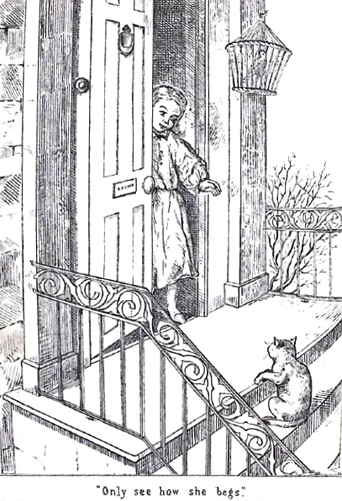
"Only see how she begs."
"The servants are getting their dinner 'at home,'" she thought, "and dear mother and Tody are having theirs. O dear! If I had only stayed with them. I would not mind anything if I could only see them, and tell them how much I love them, but, O dear! I am afraid I never shall."
With these thoughts passing through her mind, it is no wonder that her modest mew for admittance took a very piteous tone. A little girl opened the door.
"It is a little cat," said she, speaking to some one within. "Shall I let her in?"
"Oh! No, child," replied the woman's voice. "We don't want any cats around the house. Shut the door, it is as cold as Greenland."
"It looks very cold and hungry," said the little girl compassionately, "and it is a real pretty kitten. Just come and look at it, mother!"
The woman came to the door accordingly, and as soon as Tabby saw her, she stood on her hind legs and put her paws over her nose, as Ella had taught her to do when she wanted anything.
"Only see how she begs," said the little girl. "Do let her come in, mother, just for a little while."
Seeing the effect produced, Tabby lay down and rolled over, and then sneezed, which exhausted the list of her accomplishments. "O dear!" she said to herself, as she performed these feats: "How I do wish I had learned more of the other things Miss Ella used to try so hard to teach me. But it is too late now."
At this moment the cry of a baby was heard from the inner room, and the woman turned away without making any reply to the little girl, who, profiting by the implied permission, allowed Tabby to slip in, and then shutting the door, went on in haste with her occupation of setting the table. Tabby found herself in a kitchen, small but neat and comfortable. There was a cooking stove with a good coal fire, enough of plain furniture, and a general air of respectability. The next room was handsomely furnished for a parlour, and through the open door of a pantry Tabby could perceive a handsome set of china with nice glass dishes and other matters, such as she had been accustomed to see in daily use at home. But the dishes which her little friend was putting on the table were very different, being coarse, mismatched, and scanty, with bits broken out here and there, and an abundance of cracks.
The little girl, whose name she discovered was Polly, was clothed in a forlorn old merino dress which had once been handsome, with a good many patches and darns, and need of more, and her hair was tucked up behind with a broken horn comb. Her face was not very pretty, nor even very amiable in its expression, and yet there was something about it that Tabby liked.
She made all these observations as she was warming herself under the stove. Presently the woman made her appearance from the other room with a baby of ten months old, which she set down upon the floor, and then proceeded in her preparations for supper. She placed upon the table a moderate supply of bread and butter, the latter of very doubtful quality, some brown sugar in a bowl, and a small pitcher full of bluish milk. Then she put a very little black tea into a small tin teapot, which looked as if it might have seen service since the time of the last war, and having filled it up to the top with water, she set it on the stove. Hungry as she was, Tabby did not think the meal very inviting in its appearance, and Polly seemed to be of the same opinion.
"Father will want some cold meat," she said as her mother turned round. "He had nothing but bread and milk for his dinner."
"He cannot have what is not in the house," was the short reply.
"There is the dried beef, at any rate," persisted Polly, "and the smoked halibut that father brought home on Monday night. We haven't had a bit of that."
"I want that for tea to-morrow night," replied Mrs. Webster. "I am going to have company to tea, and I want something decent."
"And then I suppose we shall have down the china cups and all the rest, and make a grand display," muttered Polly to herself, as her mother went into the other room for something. "For my part, I should like to have something comfortable for ourselves once in a while. I don't see the use of keeping everything for company. Here comes father, mother," she added in a louder tone as the door opened. "Shall I put the tea on the table?"
Mr. Webster, a tall, thin, rather amiable-looking man, apparently several years younger than his wife, made his appearance as Polly spoke, with his dinner-pail in one hand, and several bundles in the other.
"Here, Polly, there's something for you," said he good-naturedly, as he chucked a good-sized bundle at her, which she caught with dexterity. "So don't say I didn't give you a Christmas present at last."
"What is it?" asked Mrs. Webster coming out of the bedroom, and looking on as Polly proceeded to unfold the parcel, and display to view a very pretty piece of dark calico. "Now, Mr. Webster, what in the world did you go and get that child a calico dress for? She doesn't want it the least in the world, and she does want a nice dress to wear to church and dancing-school. I meant to get her a silk dress this time, and her old frocks do well enough to wear about home. And what is the use of all those new school-books?" as another paper displayed several neat-looking volumes, at sight of which Polly's eyes sparkled. "She has more books now than she ever studies. I do wish you would let me spend the money. I can make it go twice as far as you do."
"Why, yes," replied Mr. Webster, unwinding his comforter and taking off his great-coat, "you make it go rather too far, quite out of sight, in fact. Now I like to see the girl look pretty about home, even if she is not quite so smart abroad, hey, Polly?"
"Yes, indeed," said Polly heartily. "Sarah Ann Bond never had a silk frock in her life, but she has real nice calico ones for every day, and always looks fit to be seen, and so does Mrs. Bond. She has not to run and change her dress if she sees any one coming. And I am sure I needed the new school-books. I have used Sarah Ann's till I am ashamed, and Miss Parker says we must all have books of our own after this."
"Well, well, that will do," said Mrs. Webster, not in the best humour. "I wish you would not be always quoting the Bonds, as if they were the eighth wonder of the world. I think you might find some other models than a policeman's wife and daughter."
"I don't care whose daughter she is," returned Polly. "She is the nicest girl I know, and the best scholar in our school. What else have you got, father?"
"There is some beefsteak—I should like a bit of that cooked for my supper, and there are the coffee and the sugar, and baby's dress. I believe that is all, wife. They will send the flour in the morning."
"You did not get the goblets then?" said his wife, a deep shade of disappointment coming over her face.
"Why, no, I could not buy them and Polly's things too, and still have the money to meet my payments. I think our glasses are good enough—too good for use, it appears," he added, looking at the cracked ones on the table.
"Mrs. Cox had beautiful goblets the last time I was there to tea," replied Mrs. Webster. "I should not have asked her here to-morrow, if I had not supposed I should have things as good as she had at home."
"Come, come, don't fret, wife: your friends, since you call them so, will take us as they find us, or leave us alone. When I get as good a salary as Cox, it will be time enough for you to spend as much as his wife. In the meantime, I want you to cook my steak, or let Polly do it. Oh! Come, take a good big piece," as his wife cut off what was a scanty allowance for one. "Enough for all round. I daresay Polly will be glad of a bit."
"Beefsteak is a very genteel dish for tea, isn't it?"
"Who cares for gentility? Not you, I think, considering the table furniture you use every day. Give the cat a bit too—here, puss, where did you come from?"
"Now, Mr. Webster, I won't have that," interposed Mrs. Webster. "I'll feed her after supper, if there is any left. Take up the baby if you can't find anything else to do. Polly, get the gridiron."
Mr. Webster was a printer, and earned good wages in the office of a daily paper. He had, when very young, married a young woman several years older than himself, with one child—the little girl to whom we have just been introduced. He was an industrious, easy, good-tempered man, very steady, and fond of his wife and children, especially of Polly, who, on her part, worshipped her step-father, and fully believed him to be the very best man in the world.
Mrs. Webster was an active, stirring woman, strong, neat, and economical, and they might have been one of the happiest families in the world, but for one circumstance. That circumstance was Mrs. Webster's intense desire to be fashionable—to make as much display on her husband's moderate salary as her friend and model, Mrs. Cox, did upon twice the sum. To this end, she pinched herself and her family in everything that did not make an outside show.
Mr. Webster loved his comfort, and would have enough to eat, such as it was, but Mrs. Webster "took it out," upon herself and Polly, who was kept at the lowest point, both of provisions and clothes when at home that she might go to church, Sunday-school, and dancing-school, in a silk frock, fine shoes, and worked skirts and drawers, and, as her mother expressed it, "look as if she was somebody." Now Polly cared nothing at all for worked skirts or silk frocks, and very little for dancing-school, but she did love books, both story-books and school-books, and she liked to be neat every day. She could not help feeling very much ashamed when her dear friend, Sarah Ann Bond, came in to see her of a morning before school, to be caught in a dirty old merino frock, worn and faded, and patched to the last degree, and shoes down at heels.
Sarah Ann had no silk dress. Her very best frock was a plaid merino, which cost two shillings and sixpence a yard: but she always wore nice calico frocks and white aprons every day, and subscribed for the 'Children's Magazine' and the 'Penny Gazette,' and she had a convenient satchel in which to carry her books to and from school. She had a nice collection of story-books, which Polly would have given all her nice frocks to possess, and she had a canary bird and a cat, and a play-house which her father had made for her out of an old cupboard.
When Polly asked for any of these things, her mother always said, either that it was too much trouble, or that she could not afford it. But she could afford to buy an expensive set of china, and a dozen of cut-glass tumblers, and a set of fine knives and forks, all of which were quite too good for family use, and never made their appearance except when she had company. And now she was out of conceit with her tumblers, because Mrs. Cox had goblets, and dissatisfied with her ivory-handled forks, because Mrs. Cox had silver ones; and she had been straining every nerve to accomplish the purchase of those very essential articles, when Mr. Webster disappointed all her calculations by subscribing for a daily paper, and buying two new frocks and a set of new and expensive school-books for Polly.
The first of these items she did not mind so much—it sounded genteel to take a daily paper, and Mrs. Cox had two, but the latter seemed perfectly useless to her mind, and she thought herself entitled to indulge in at least a week of sulkiness in consequence. Accordingly, she never spoke one word during supper except to reprove Polly, first for taking so much butter, and then for sharing her bit of steak with poor Tabby, who gratefully accepted her piece, small and gristly though it was, and purred over it as she had never done over her nice breakfasts and dinners at home.
"What a disagreeable woman," she thought to herself. "I don't see how such a nice man came to marry her." And then she remembered how often she had been sullen at home, when things did not go to please her, and how, the very day she came away, she had refused to play with dear little Miss Ella, who had always been so kind to her. And now she was far away from them all, and they would never know how much she loved them, though she had been so naughty. All her cheerfulness vanished as these thoughts passed through her mind; moreover, she was very tired and sleepy, and her side still gave her a good deal of pain; so she went and sat down under the stove, and was soon asleep.
But she was not destined to sleep long. The baby, who had been set down on the floor to amuse himself as he best could during supper-time, spied her place of refuge, and crawling to a convenient distance, he stretched out his little hand, and, grasping Tabby by the tail, attempted to pull her towards him. Suddenly aroused by this rough treatment, and by the pain it gave to her sore side, Tabby forgot both prudence and good temper, and thought only of defending herself; and extending her too-ready claws, she gave the little fellow a severe scratch on the hand. Baby screamed of course, and his mother hastened to take him up, and examine the extent of the mischief.
"There, Miss Polly, see what your fine new pet has done—scratched poor baby's hand almost off: that is always the way with cats—nasty, treacherous creatures, you can never tell when they are going to scratch. Scat, you hateful, cross thing." And opening the door, she took the broom and drove poor Tabby out into the snow, which was now falling fast, giving her a slap with the broom as a parting present.
Polly remonstrated, but her objections were met by a box on the ear, and a command to go to bed if she could not behave herself. Polly knew by experience there was no use in opposing her mother while in such a mood as this. So she washed up the dishes in silence, and then, taking a new book which Sarah Ann had lent her, she sat down to read, but was informed that there was enough to be done without wasting time over nonsensical story-books, and commanded to take her sewing till eight o'clock, when she was sent to bed in the dark.
Poor Tabby, meanwhile, after spending some time in vainly mewing at the door for admittance, began to look about her for some place of shelter for the night from the blinding snow and the keen north wind, which seemed to pierce her through and through. At last, after much searching, she found a hole in the wall under a barn, and was just crawling into it, when she was made aware that the place had another occupant, by hearing a growl, and the words, "Who's there?" from the farthest corner.
"It is only a kitten," answered Tabby, trembling both from cold and fear. "Please, do let me come in! I am so very cold."
"Come in, and welcome," said the cat who had spoken, rising and stretching himself. "There is room enough, and we can help to keep each other warm."
Tabby gladly availed herself of the permission, and snugged down by the side of her new acquaintance, who proved to be a very large and powerful Maltese cat, fat, and in good condition, but bearing the marks of more than one battle, in his scarred nose and ragged ears.
"Why, what a little thing you are!" said the big cat compassionately. "You are only a kitten, in good earnest, and you don't look like a wild one either. I should think your folks might have let you sleep in the house in such a bitter night as this."
"I only came to this house to-night," said Tabby. "At my own house, they would never have turned me out, but that is a very different place from this. I am afraid there are not many such people in the world."
"How did you come to leave your house if it was such a good one?" naturally inquired the grey cat.
"Because I was a discontented little fool, and did not know when I was well off," replied Tabby.
And in answer to some further questions, she proceeded to relate her whole history to her new friend, greatly cheered by his sympathy, and by his beginning to lick her all over as her own mother used to do.
"And what are you going to do now?" asked the grey cat, as he concluded.
"I am sure I don't know," replied Tabby, mournfully. "I have all the while been hoping to get home again, but I am afraid there is not much chance of it now. I suppose I must look-out for some place where I can have a home and be well-treated. I have learned to catch mice since I came from home, and I would do my best to be useful."
"I suppose it would be the best way for you," said the grey cat thoughtfully. "You are hardly old enough or strong enough to get your living in a barn. I prefer that way of life to any other, now that I am used to it; though I confess, on such a night as this, I cannot help longing for my old cushion by the fire."
"So you have not always lived in a barn!" remarked Tabby, in an inquiring tone.
"Oh! No, I was brought up in the house, and very much petted, till I was two years old and more. I used to have a cushion by the parlour fire, and another in the kitchen, and stayed where I pleased, and I always had a plate set down on the floor-cloth for me after dinner, besides what the cook gave me. Everybody was kind to me, and nobody could be happier than I was for those two years. Then the house was sold, and the family moved away, and there was the end of my comfort for a while."
"But I should have thought they would have taken you with them!" said Tabby. "Why didn't they?"
"Just on account of the silliest nonsense in the world," replied the grey cat. "My mistress was what is called a superstitious woman—that is, she believed in all sorts of stuff about signs, and things being lucky and unlucky—and some one as foolish as herself persuaded her that it was unlucky to move a cat. So she went away, and left me to take care of myself or to starve, whichever I liked best. I stayed about a good while, but the people that bought the place did not like cats, and drove me out whenever I attempted to make my way into the house. So at last, in despair, I took to the barns, and now that I am used to it and have learned to provide for myself, I like it very well."
"I do not think I should ever like to live in a barn," said Tabby.
"No, I daresay not. It 'is' pretty hard, especially as one has to fight one's way among the other cats, and some of them are very ugly. I think the best way for you will be to find a place in some nice family, where they want a cat to pet. How do you like the look of things here?"
"Not at all!" returned Tabby, and she described the views she had witnessed since her arrival.
"That is just the idea I had of her," said the Maltese cat, whose name, he told Tabby, was Bold. "She has such a sharp voice. Mr. Webster seems a nice man enough. I wonder why he doesn't make his wife behave herself."
"Perhaps he can't!" suggested Tabby.
"Very likely," returned the grey cat, yawning. "It is not so easy always to make people behave themselves, especially when they have not much sense to begin with. But come, Tabby, since that is your name, curl down here by me, and let us see if we can keep each other warm for the night."
Tabby was only too glad to obey, and soon forgot all her troubles and perplexities in sleep.
CHAPTER SIXTH.
THE RIVER.
THE next morning Tabby was awakened early by the cold, and at first could hardly remember where she was, but the stinging of her ears and paws soon brought her to her senses. Her companion had left her side, and on going to the entrance of the hole where she had passed the night, she saw by the footprints in the new-fallen snow that he had gone to a large barn at some distance, where he was probably engaged in catching his breakfast. At first she thought she would follow him, but she reflected that she might easily miss him, and fall in with some of those evil-disposed cats of which he had spoken the night before. At another time, perhaps, this idea would not have deterred her, but she felt weak and dispirited from the fatigues of the day before, and thought she would make one more effort to ingratiate herself with the mistress of the house, at least so far as to get some breakfast, after which she thought she might feel more like resuming her travels.
She reached the house-door accordingly, and congratulating herself on finding it ajar, she slipped in quietly, and took her seat on the floor under the stove, taking care to retreat into the farthest corner, out of reach of the baby. Having established herself safely, as she hoped, she looked eagerly round for some signs of breakfast, but none were to be seen except the dirty dishes, which Polly, with the signs of recent tears on her face, was washing up at the sink. Mrs. Webster herself was in the pantry, engaged in some cooking operations, to judge from the sound of stirring and beating of eggs which issued from the open door.
"Come, Polly, have you almost finished those dishes?" said she, coming into the kitchen with a dish in her hand. "You have been long enough about them to wash every dish in the house. I want you to go up to Martin's, and get some cinnamon and some essence of lemon."
"Father said he didn't want me to go to Martin's," said Polly.
"Never mind that," returned her mother. "You are my girl and not his, and you have got to do as I say: so make haste!"
This was one of Mrs. Webster's favourite modes of "aggravation," as Polly called it. Whenever she was particularly bent upon venting her ill-humour upon the child, she reminded her that she was not the father's own daughter. The fact was, though perhaps she hardly confessed it to herself, that she was exceedingly jealous of Polly's affection for her step-father, and thought it exceedingly unnatural in the child to like him better than herself. This was one of her "peculiar trials," as she was wont to say in her confidential conversations with her dear friend, Mrs. Cox. According to her own account, Mrs. Webster had a great many peculiar trials, and no one could say that she was not extremely liberal in sharing them with her friends.
"Come, make haste," repeated Mrs. Webster impatiently. "You get lazier and lazier every day. I have a great mind to keep you at home from school the rest of the winter, and try to teach you to work. You will never be good for anything at the rate you go on."
Polly wiped the suds from her hands, and put on her bonnet without replying to this threat, which she knew to be a vain one, as her father would never consent to her being kept out of school.
"You are not going in that old frock!" exclaimed her mother. "What if Mrs. Cox should see you? Put on your green dress."
"I thought you were in such a hurry," began Polly.
But her mother cut short her answer by a smart slap on the shoulder, and an injunction not to be impudent. The fact was, Mrs. Webster was in a thoroughly bad humour. She expected her friend and model, Mrs. Cox, to tea in the evening, and had been bent upon surprising her with the elegance of her entertainment, which she had intended should be fully equal to anything Mrs. Cox ever had at home. And now not only had her husband expended the money she had destined for plated forks and goblets in clothes and school-books, but that very morning he had absolutely refused to let her have a few shillings to purchase materials for plum-cake and macaroons, declaring that the times were too hard for poor people to indulge in such luxuries, and that he must put by every halfpenny he could spare from absolute necessaries to make the payments on his house and lot. In vain she had talked and reasoned, and even cried. Mr. Webster would not be convinced, but departed with his money folded in a paper with his savings-bank book, ready to be deposited at noon.
But more annoyance was in store for her. Polly presently returned with her hands empty. "Martin says that father told him not to let any one get things there unless they brought the money."
"Your father is enough to provoke a saint," said Mrs. Webster. "I declare, if I could contrive any decent excuse, I would send to tell Mrs. Cox not to come. We shall not have anything fit to be seen—nothing but plain pound-cake and sponge-cake, without a bit of seasoning, and no preserves but raspberry jam. I would not have done it for anything, if I had not supposed we could have things decent. Mrs. Cox is so observing, too, she is sure to see everything. As for Mrs. Randall, she never seems to know what she eats."
Tears of vexation actually stood in Mrs. Webster's eyes. Polly tried to console her.
"Why, mother, I was up at Miss Augusta's one night, and went into the dining-room just before tea. They had only then bread and butter, and sponge-cake, and a little dried beef on the table—no plum-cake or preserves at all; and they had company to tea, too, I know, for I saw the ladies in the parlour; and you know Mrs. Cox herself says they are the most elegant people in town."
"To be sure," said Mrs. Webster, a little comforted, "they ought to know what's what as well as anybody, and they are as rich as Jews too. But I suppose they had very handsome table furniture."
"It was just what they use every day," persisted Polly, "for I have been there before at meal-times."
"Well, they are queer folks, those Fords," said Mrs. Webster. "I don't pretend to understand them. Everybody looks up to them, and thinks them the grandest people in town, and yet they never seem to care a bit about style or fashion, or any such thing. They are very different from the Lambs; 'they' do make a dash worth while."
"Yes, and who thinks any more of them for it?" interrupted Polly. "Mr. Lamb is not half so much of a gentleman as father or Mr. Bond, and Mrs. Lamb does not look like a lady, with all her fine clothes; and as for manners, the Miss Lambs laugh and talk so loud on the street that people turn round to look at them. I would rather be Miss Augusta Ford than Miss Lamb, any day."
"Oh! You think Miss Augusta is perfect because she is your Sunday-school teacher. I must allow, though, that she has much manners, but I cannot understand how she can run about on foot to see all sorts of people as she does. I should not think her mother would let her."
"Her mother does just so," replied Polly. "So I would not mind about the cake, mother. I daresay everything will be nice enough, and Mrs. Cox knows that father does not get as high wages as her husband."
"Don't say wages—salary sounds far better. And another thing, Polly, while I think of it, I was quite ashamed the other afternoon, when Mr. Larned asked you your name, to hear you answer 'Polly Anne' so loud that every one in the church might hear you. Why didn't you say Marianne, as I told you?"
"Because you told me yourself that I was christened Polly Anne after grandma, and I didn't want to tell a lie in the church."
"Don't be impudent!" said her mother sharply. "Come, be smart now, and clean up the fireside before you sweep, and then I want you to put down the floor-cloth."
"Hadn't I better leave the fireside till after dinner?" asked Polly.
"I am not going to get any dinner," was the reply. "Your father has taken his, and it is not worth while to cook anything just for us two.—Turn that cat out! I am not going to have her near the fire."
"It is so cold," said Polly, pityingly. "Can't I put her down stairs? There is a rat down there, I heard him the other day, and he has gnawed some potatoes."
"Well, I don't care if you do, but I won't have her here. Come, be smart now; we shan't be through to-day."
Tabby was accordingly turned out of her warm corner, where she had been trying to forget that she was hungry, and soon found herself in a damp cold cellar in company with a heap of potatoes, and a coal-box. This last object renewed her home-sick longing, which seemed to grow stronger and stronger as the chance of reaching home grew more remote.
"O mother, mother!" she said to herself. "Shall I ever see you and dear Tody again, and do you ever think of poor, naughty Tabby?"
Overcome by these sad reflections, she sat down upon the lower stair, and cried a long time, and then, somewhat relieved by having given free vent to her sorrows, she set herself seriously about finding something to eat. But hour after hour of patient watching was all in vain. Neither rat nor mouse made its appearance, nor, though she searched in every corner, could she find so much as a dry crust of bread to satisfy the cravings of her appetite. What would she not now have given, even for some of the cold potatoes she used to disdain? She returned again and again to the only rat-hole she could find, but it was of no use; and faint with hunger and misery, she could not even forget her troubles in sleep. The cellar-door was opened once or twice, but it was always shut again so quickly that she had no chance of escape, and the windows were all tightly fastened.
She had finally fallen into a doze, and was just dreaming that she was at home with her mother and Tody, eating cold chicken off a plate under the dining-room table, when she was awakened once more by the opening of the door.
"Dear me!" she said peevishly. "It seems I am not even to sleep in peace."
But as she spoke, she looked up and saw by the light of a candle, which shot through the chink, that the door had been left ajar. She hastened up the stairs, and gently pawing against it, she succeeded in noiselessly pushing it open, and found herself again in the same kitchen, which had undergone such a change that she hardly knew it again. The grate had been blacked and polished, till it shone like the ebony shelves in Miss Sophia's cabinet; full white muslin curtains were up at the windows, and a handsome green and red floor-cloth covered the dingy rag carpet. The table was set with a fine damask cloth and handsome china, and furnished with an abundance of cakes, preserves, and dried beef, which looked so tempting to Tabby's hungry eyes that she could hardly keep her paws off them. There was no one in the room but Polly, who was tending the baby and keeping an eye on the biscuits, which were baking in the oven. The door was half-opened into the parlour, and lights and voices proclaimed that Mrs. Webster's company had arrived.
"Oh!" thought Tabby. "If I could only have a little bit of that cake or some of that beef, or even a scrap of bread!"
This was not a very good thought for a hungry kitten to cherish in sight of a well-furnished table; and the said table being left for the moment without any guard, she mounted upon a chair and carefully abstracted a small piece of beef, which she thought would not be missed. She had hardly jumped down with her prize, and secreted herself behind the closet-door, before Mrs. Webster entered the room. Tabby shrunk into the smallest possible compass, and was careful not to make the least particle of noise in devouring her morsel, which seemed, from its smallness, to increase her hunger, as it certainly did her thirst.
Mrs. Webster cast a vigilant eye upon the table, altered the arrangement of things a little, and then proceeded to take the biscuits out of the oven and to make tea. This done, she washed her hands, settled her very handsome silk dress and head-dress a little, and invited the ladies who were her guests to sit down. Polly did not make her appearance, but stayed in the bedroom to tend the baby, and Mr. Webster had not come in. Indeed, he rather avoided his wife's tea-parties, for he did not particularly like her fine friends, and could not help thinking that they sometimes amused themselves at her attempts to be genteel, in which conjecture he was perfectly right, at least so far as regarded Mrs. Cox.
"I had a call from one of your neighbours the other day, Mrs. Webster," said Mrs. Cox, as she was buttering her biscuit.
"From one of my neighbours?" repeated Mrs. Webster. "Who could it be? I did not know that there was any one here who visited you."
"Neither more nor less than Mrs. Bond, the policeman's lady," replied Mrs. Cox, laughing heartily. "Only think how honoured I felt!"
"You don't mean to say that woman actually came to call on you!" said Mrs. Webster, in a tone intended to express the utmost surprise at the said woman's audacity.
"She certainly did. I thought she came on an errand at first, of course, and waited patiently to find out what she wanted, not dreaming, of course, that she intended a visit. I did not even ask her to sit down, but she helped herself to a chair, and sat talking as freely as you please. Presently there was a ring at the door, and in walked Mrs. Lamb. I felt ashamed enough, I can tell you, especially as Mrs. Bond never offered to go, but sat talking in her calico frock and hood, as composedly as if she were the grandest lady in the land. However, I took care to tell Mrs. Lamb, after she had gone, that she was only a poor person who had come on an errand."
"I suppose you will hardly return her visit," said Mrs. Webster, and both the "ladies" laughed, as though the idea was a very ridiculous one. "She is always running in here," continued Mrs. Webster, "and, I am sorry to say, my Marianne has got up a wonderful intimacy with her oldest daughter. I have tried to break it up, but find it difficult, as they go to school together, and are in the same class in Sunday-school. I think it has a very unfavourable effect upon Marianne's manners."
"I never allow 'my' children to associate with 'common' children," said Mrs. Cox, drawing herself up. "There are only two families in the street that I permit them to play with at all. I should not think I was performing the duties of a parent if I allowed them to form improper associations."
"I saw your Fred out in the barn with Tom Bond the other day," said the other lady, who had hitherto been rather silent. "They were amusing themselves with stoning a kitten that was making its way through the snow—at least Fred was, for I did not see Tom throw anything. I think the Bond children very nice well-trained little things, for my part."
"I think you must be mistaken, Mrs. Randall," said Mrs. Cox, colouring, and looking extremely offended. "My Frederick is too obedient to his parents' commands to form improper associations, and he and his brothers have been particularly enjoined to avoid any intimacy with the Bonds."
"I think I shall take some more decided steps to break off Marianne's intimacy with them," remarked Mrs. Webster; "and I certainly shall discourage Mrs. Bond's running in here as often as she does. It is very disagreeable."
"What a mean woman!" thought Tabby. "Just as if I did not hear her send Polly over there to borrow things, at least three times this morning."
But if even Tabby's indignation was roused, we may be sure Polly's was to the boiling-point. She could only find relief by talking to herself.
"Yes, it is all very well to talk about breaking off with the Bonds. I wonder who went over to Mrs. Bond's yesterday to get her to cut out a cap for Tommy, and stayed all the morning, though Mrs. Bond's baby was sick, and she was just as busy as she could be washing? And who sends to her for all sorts of things every day in the week? I should think they would be ashamed."
But Mrs. Cox was again holding forth in her oratorical tones:
"Yes, we always dine late—at four o'clock. I would not dine a moment earlier on any account. Mr. Cox comes home from the counting-house at that time, and I always intend to have my dinner ready, and of the best quality. We usually have soup. Mr. Cox is exceedingly fond of soup and dessert;" which Mrs. Cox pronounced "desert," as though she had meant a sandy waste. "Mr. Cox says he enjoys his dessert more than all the rest of his dinner. Mrs. Lamb dines at six o'clock, but as Mr. Cox is obliged at present to return to the counting-house at five, that hour is not convenient for him."
"There she goes!" said Polly. "I never saw Mrs. Cox in the world that she did not say something about dinner. I must say, I don't think it is very genteel to talk so much about eating and drinking."
Mrs. Webster now offered her guests a bit of the smoked halibut which she had been reserving for this grand occasion. Mrs. Randall accepted it, and expressed herself fond of it, but Mrs. Cox declined.
"I never eat such things at tea," she said in her emphatic and decided manner. "Relishes for tea are entirely out of fashion, quite out of date in fact, and so are warm biscuits. They are considered by many very unwholesome, and Mr. Cox never eats them at tea. This bread and butter is all the go," she concluded elegantly. "Mrs. Lamb has this bread and butter."
"Well, I call that polite!" thought Tabby. "Just after she has been eating them!"
Poor Mrs. Webster! The want of the goblets and silver forks was nothing to this. After she had taken such pains to provide nice light biscuits, and had cut her dried beef so thin, and cooked her halibut to a turn, to be told upon a Mrs. Lamb's high authority, indorsed by a Mrs. Cox, that relishes were out of fashion, and that nobody ate hot rolls! She felt herself reduced to the level of a nobody at once.
"Indeed, I think the biscuits are very nice," said quiet Mrs. Randall, helping herself to another, "and so is the fish. What signifies whether things are fashionable or not, so long as they are good and convenient?"
But Mrs. Webster was not to be consoled by one who held such views as these, and applied herself to Mrs. Cox with the intention of gaining such further information as should prevent her making such fatal mistakes in future.
"And for breakfast, Mrs. Cox? What do you think about breakfast?"
"Oh! Hot rolls for breakfast by all means, and toast and eggs."
"I like that woman," said Tabby to herself. "I wish I knew where she lived, and I would go there to-morrow. As for that other woman, she is just fit to be the mother of that hateful boy who threw the apple at me."
"Much she knows about gentility!" was Polly's comment. "Mrs. Bond is as good as she is, any day, and ten times as much of a lady. I should like to know why she should not call on Mrs. Cox if she wants to do so, though why she should I can't imagine. And for mother to talk so about her, when she is for ever sending there for things, and getting Mrs. Bond to do things for her, and to help her about her work! I would not ask favours of people that I was ashamed of associating with, for my part."
Polly's soliloquy was interrupted by a call to supper, and having at last succeeded in getting the baby to sleep, she laid him on the bed, sitting by him a few moments to pat and hush him; for she loved her little brother dearly, and never grudged the time she spent in tending him.
Meanwhile Tabby was left alone in the kitchen. The table was still standing, with its attractive-looking plates of meat and cakes, and the cellar-door was open. The temptation was too much for Tabby. She sprang upon the table, and Mrs. Webster, coming in from the other room, was just in time to see Tabby finish a drink out of the cream-jug, and seize the piece of fish in her mouth. She sprang forward, but the four feet were too nimble for her two, and puss and fish vanished through the cellar-door.
"What a naughty kitten!" some of my young readers will doubtless exclaim. "I don't care what becomes of such a little thief."
It is doubtless very naughty to steal, but let me ask you one question: Were you ever in all your life very hungry? I daresay you have been hungry enough to have your dinner or supper taste very good to you, but did you ever go without food till your head turned round with giddiness, and ached as though it would split, and your limbs trembled, and your eyes seemed full of black and green spots, and there was a pain in your stomach as though a rat was gnawing through it? Unless you have experienced a sensation like this, you can hardly form a correct estimate of the temptation presented to poor Tabby, who had been almost entirely without food for thirty-six hours. Suppose you had eaten nothing since yesterday morning at breakfast, and had been more than half that time out of doors, with the thermometer below zero! And then suppose that, under such circumstances, you had been left alone in the room with a piece of cake, what do you suppose would become of the cake?
I am not saying that it was not wrong for Tabby to steal. It was very wrong, and very short-sighted besides; for Polly had fully intended to divide her supper with the kitten, in which case not only would she have fared better, but she would have escaped the consequences of her theft, which, as we shall see, very nearly cost her her life. Some misgivings, indeed, passed through Tabby's own mind, as she was devouring her prize behind the pork-barrel, whither she had fled for safety.
"I know mother would say I ought not to have taken it," she said to herself, "but I was so hungry, it seemed as though I could not wait another minute. Well, they will not do anything to me to-night, because of the company, and to-morrow I will surely find some way of escape."
But Tabby reckoned without her host. Mrs. Cox and Mrs. Randall took their leave about half-past seven; and no sooner were they gone, than Mrs. Webster went down to the cellar, armed with broom and candle, drove Tabby from her place of refuge, and after more than once chasing her round the cellar, seized her by the back of the neck, and despite her struggles and scratches, bore her to the upper air. Tabby mewed piteously, and Polly cried and expostulated, but all in vain.
Mrs. Webster carried her to the fence, and shouted "David!"
A rough-looking man, with a pipe in his mouth, made his appearance from the next house, which was not much more than a hut.
"Here, I want you to take this cat, and throw her over the bridge. I will give you an old bag to tie her in, and be sure you put a good heavy stone in it. Do it directly, and I will give you sixpence."
The bag was produced and handed to David, who promised to execute the command, and poor Tabby soon found herself enveloped in a warm, ill-smelling old bag, and going she knew not whither, or rather, alas she knew too well. In all her previous adventures, she had never given up the expectation of reaching home, and seeing all her dear friends again, but now hope itself seemed to forsake her. Her head whirled round. All sorts of confused thoughts and images passed through her mind: the happy home she had deserted so wilfully; the kind and self-sacrificing mother whom she had rewarded with such base ingratitude, though she had so carefully tended her, and never thought she could do too much for her; the dear little brother, who loved her in spite of her unkindness to him.
She seemed to see herself a little helpless being, unable to move a limb in her own defence, or even to get her eyes wide open, and her good mother watching and guarding her with the tenderest solicitude. Then when she began to creep out of her basket, and play about with Tody, how careful her mother was to keep her out of danger, and how many hours she had spent in amusing her, and teaching her the use of her limbs; how she had always given her the best morsels on their common plate, and how much pains she had taken to teach her to catch mice for herself. Remembrances of Ella and Marian and all their kindness, of Tessy's affection and Agnes Warrington's cruelty, mingled with these reflections, and all seemed confusedly mixed up with Carlo's bark and the neighing of horses, with the conversation she had lately heard, and the sobs and entreaties of Polly, interceding with her hard-hearted mother for the life of her favourite. In the midst of it all, she heard a rushing sound—knew that the river was near—felt a sudden shock, and a swift descent, and lost all consciousness as the cold waters closed over her head, apparently for ever.
CHAPTER SEVENTH.
THE POLICE OFFICE.
IN a few moments Tabby recovered her senses, astonished to find herself still alive. Alive she certainly was, though thoroughly wet and cold, and entirely in the dark. She heard the water rushing around her, and at first she thought she was floating down the stream, but a minute or two of observation convinced her that she must be stationary, and, with her usual energy of character, she began to make some desperate struggles to get out. After much fruitless scratching and biting, she at last succeeded in making a hole, through which she thrust first her paws, then her head, and finally her whole body. As soon as she was out of her prison, she looked around, and discovered to what she owed her preservation. David, who as usual was more than half-tipsy, had forgotten to put a stone in the bag, which had consequently floated instead of sinking, and being swept down by the rapid current, had lodged upon a long tongue of ice which projected from the shore.
But Tabby did not spend much time in observation, for she felt that her situation was a very precarious one; and miserable as she was, the instinct of self-preservation was strong within her. After two or three ineffectual attempts, she got upon her feet, and began slowly and cautiously to make her way toward the land. The ice was wet and slippery, and perhaps no other animal than a cat could have kept footing upon it; even Tabby found some difficulty in doing so, and had several falls, at each of which she gave herself up for lost, till, finding that she was not in the water, a renewed effort was made again to struggle on. She had almost reached the shore, when a terrible crack and a violent concussion caused great alarm, and the piece of ice slowly separated from the bank, and floated down the stream. Tabby made one more effort for life. Collecting all her little strength, she made a desperate spring, and, much to her astonishment, found herself safely on dry land, while the ice which had been the means of saving her life went rapidly down with the current.
"Well done, little pussy!" said a not unkind voice near her. "That wasn't a bad jump. A moment more, and it would have been all over with you."
Tabby looked up in amazement.
The speaker was a boy of twelve or thirteen years old, very poorly dressed in ragged and coarse clothes, and with an indescribable forlorn air about him. He was sitting on a log by the river side, and seemed to have been employed in watching her efforts, for he added: "I didn't think, when I first spied you out there, that you would ever get safe to land. Come here and let me dry you off, or you'll freeze to death. Poor little toad! It isn't so nice to be out in a winter's night with nothing to eat, and no place to go to—is it, pussy?"
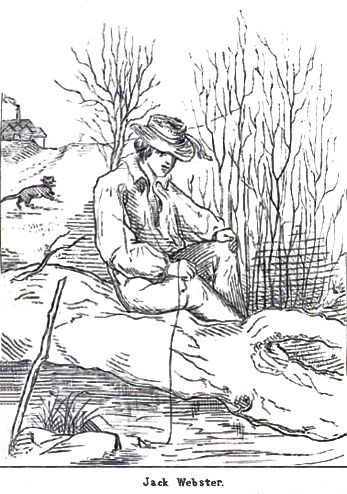
Jack Webster.
Rough-looking subject as the boy was, his tone of sympathy attracted Tabby at once. She crept up to him with some difficulty, for she was growing very cold and stiff, and made a feeble attempt to jump up on his knee. He took her up tenderly enough, and after rubbing her as dry as he could with a very ragged handkerchief, he put her in his breast, and buttoned his loose jacket over her. His kindness and the genial warmth revived poor Tabby's fast-failing strength, and as the chill passed off her benumbed limbs, she began feebly to purr her thanks.
"I daresay you are as hungry as I am," said the boy, patting her head, which she was rubbing against his chin: "but I have nothing to give you, pussy. But never mind, I guess we can stand it till morning, and then if I get anything to eat, you shall go shares. Hallo!"
At this moment a hand was laid upon his shoulder, and looking up, he saw a policeman standing behind him. He rose rather hastily, and Tabby shrank into her place of concealment.
"Now, my lad, what are you doing here?" was the policeman's first question.
"Nothing!" was the short answer.
"You have chosen a cold place to do it in, seems to me. Why don't you go home?"
"For the best reason in the world: because I have no home to go to."
"That's bad, certainly," said Mr. Bond, not unkindly. "But haven't you any place where you stay?"
"No," was the answer, in a voice which trembled a little. "I don't know a living soul in this place."
"How did you come here, then?" was the natural question.
"I came here from Buffalo yesterday. My father and mother are dead, and I haven't got any one to take care of me, or teach me anything, and I want—" he paused a little, and then went on more firmly—"I want to go to the House of Refuge."
"To the House of Refuge," repeated the policeman, rather taken aback. "Well, I have taken a good many boys to the House of Refuge in my time, but I don't remember of any one's wanting to go of his own accord. But you know that's where they take the bad boys—you're not a bad boy, are you?"
"I suppose I am," said the child, without looking up. "Everybody says so, and when I come to think about it, I guess they are about right."
"You come along with me," said Mr. Bond, "and we'll see what can be done for you. You can't stay out all night, that's certain, because you'll freeze to death, and we can't have people freezing to death in our streets."
"So you want to get an education, do you?" said he, as they trudged along together, the boy having some trouble to keep up with the long strides of his tall companion. "Well, an education is a first-rate thing, there's no doubt about that; I tell my boys and girls so when they get a little tired of going to school. If I had had the chance that you have, says I, I should have been glad enough of it."
"If I had had any one to send me to school, I don't think I should ever have been tired of it," said the boy rather sadly.
"Oh! Well, cheer up. Maybe there's better days coming. It never rains always, you know, and I'll tell you what—what did you say your name was?"
"Jack Fletcher," was the answer.
"Well, Jack, it's half the battle with a boy, or a man either, for that matter, to make a good resolution. You say you're not a good boy,—eh?"
"No," replied Jack. "I haven't had much chance to be good. My father and mother both drank," he continued, after a little pause, and lowering his voice, "and one day my mother drank so much that she got crazy and killed herself. Then my father was taken up for murdering her, and put in jail, and there he took sick and died. He was sober then, of course, and when I went to see him, he—he told me to go off to some place where I wasn't known, and try to make an honest living. I knew a boy who had been to the House of Refuge, and he told me how they learned trades there, and what kind of times they had, and I thought that would be just the place for me. So I begged a passage on a waggon, and got here yesterday."
"But suppose you could get a place to learn a trade without going there, wouldn't you like that better?" asked Mr. Bond.
"I don't know about that," replied Jack thoughtfully. "I am afraid I should not be steady. You see I have been brought up to run in the street all day long, and it's not easy to settle down to work, unless one must. It is likely I should get into some scrape, and do something bad, and so have to be put there, and I would rather go of my own accord."
"That's very sensible, too," replied Mr. Bond. "Well, here we are at the police office, and I daresay you won't be sorry to get warm. It is a bitter night."
"Hallo, Bond, what have you got there?" was the salutation that greeted them as they entered the room, where the gas-light and coal fire gave out an amount of light and warmth which seemed little short of miraculous to Tabby, who had all the time remained close under Jack's arm. "He doesn't look like a very dangerous customer."
"It's a boy that says he wants to go to the House of Refuge," said Mr. Bond, setting a stool by the side of the fire as he spoke. "Here, Jack, sit down and get warm. You must be about frozen through, I should think."
Jack was glad to sit down, for his knees trembled, and he felt a strange sensation creeping over him which was not exactly sleepiness or fatigue. He had been seated only a moment, when the lights seemed to grow dim and the voices indistinct—his head dropped on his bosom, and one of the men sprang forward and caught him just in time to prevent his falling on the floor. The boy had fainted away. They laid him on a seat that stood at a distance from the fire, brought water and sprinkled his face, and one of them unbuttoned his jacket.
"Hallo, here's two of them," said he, as poor Tabby became visible, vainly trying to shrink out of sight. "He's got his cat here. Whittington and his cat. Well, I've seen lots of cats out at nights, but this is the first time I ever heard of one being taken up for a vagrant."
"Don't hurt her, please," feebly pleaded Jack, who was now recovering his senses.
"Don't you be frightened! Who wants to hurt her? But I say, Bond, you'll make a great figure in the report to-morrow. Officer Bond arrested a tortoise-shell kitten on a charge of vagrancy. The kitten was accompanied by a small boy—how do you feel now, Jack?"
"Better," said Jack faintly, but he could not raise his head without turning giddy.
Mr. Bond and his companion exchanged glances.
"Have you had any supper, Jack?"
"No, sir."
"Nor dinner either, perhaps?"
"No, nor breakfast either," said Jack, exerting himself to speak. "I haven't had anything to eat since yesterday noon, when a lady gave me some bread and butter."
"You just hand me that pan behind you, Foster. My wife put me up some soup for my supper, and it will be just the thing for him." He set the pan on the fire, and proceeded to break some sticks into it. "But why didn't you go in somewhere, and ask for something to eat? Almost any one would have given you a dinner."
"I didn't want to beg if I could help it," said Jack rather shortly. "I have had enough of that way of living."
"That's a good principle, too," said Mr. Bond, taking his cookery from the fire and tasting it. "Now see if you can sit up and eat something."
"May I feed the kitten?" asked Jack, after he had taken a couple of mouthfuls of the savoury soup. "I expect she is as hungry as I am."
"You eat your supper and I'll take care of the cat," said Mr. Foster, taking down his own dish, and apparently greatly amused by the whole affair—"Here, Puss, Puss!"
Tabby had been sadly frightened at first on finding herself in the police office, a place which she had learned to connect with all manner of harm, but she had by this time made up her mind that police officers were very kind-hearted people, and worthy of confidence. She came forth from her hiding-place under Jack's arm, and sat up on her hind legs to beg, greatly to the amusement of the two men, who fed her with bread and cold meat till she could eat no more. She then set seriously about the task of washing herself, and having put her fur in as neat order as she could, proceeded to make herself as agreeable as she knew how, playing off for the entertainment of her hosts all the antics that her mother and the children had taught her, till finally, wearied out by her adventures, she crept up to the side of Jack, who was now snoring on the sofa, and was soon fast asleep.
"O my dear mother!" was her last waking reflection. "What would you say if you knew that your daughter was spending the night in the police office?"
"Well, Jack, have you had your sleep out?" asked Mr. Bond, about half-past six the next morning. "If you have, I think you had better come home with me, and get some breakfast, and then we will see what is to be done with you. Never mind your clothes," he added, seeing Jack carefully surveying his torn and ragged garments. "We will find a way to set that to rights before long."
"May I take the cat?" asked Jack, looking wistfully at Tabby, who sat purring by the stove. "I don't like to leave her. When I saw her crawling over the ice last night, trying to make her way to land, I thought she was a good deal like myself, trying to make a living, and when she made that last jump from the water and got safe to shore, I felt encouraged, as though things would go right with me yet."
"Oh! Yes, bring her along," said Mr. Bond, who seemed all once to have got something in the corner of his eye. "My children like nothing better than a kitten. Children have got to play with something, and I have a notion that it makes them tender-hearted to have animals about."
"Unless they abuse them," remarked Jack as he once more fastened Tabby under his jacket. "Some young ones are so awful cruel to cats and dogs."
"Not mine!" said Mr. Bond emphatically. "I never would let any child abuse an animal if I could help it. But my children are pretty good children, though I say it."
Jack thought within himself that they had no excuse for being otherwise, and intimated as much.
"Well, I don't know about that. There is a wonderful deal in bringing up, no doubt, but there are many children who have good and kind mothers and fathers, and yet turn out anything but well. We have had young chaps brought to the office as drunk as beasts, whose parents are some of the first as well as the best people in this town."
"They must be great fools," said Jack.
"That they are, and worse than fools. Some of them reform and make pretty decent sort of men, after all, but the chances are very much against it. A great many go to swift destruction, and even if they seem to do well for a time, they easily fall into bad courses again. We hear a good deal about young fellows sowing their wild oats. I have seen too much of that kind of farming, and I can tell you, that folks that sow wild oats have got to reap wild oats, and a bitter harvest it is too. A reformed drunkard is never safe. The first temptation overcomes him, and there are plenty of rascals who want no better fun."
"I know that," said Jack. "My father broke off drinking several times, and was as steady as any one for two or three months. Then we did pretty well, for he was an excellent workman, and could always have plenty to do. But sooner or later his old cronies would get hold of him, and coax or force him to drink, and the moment he tasted a drop, he was gone. I think he might have done better, if things had been different at home, but there was not much encouragement, when all he earned was wasted, and worse. Many's the time I've wished there was not a drop of spirits in the world."
"Many a one has wished that besides you," said Mr. Bond. "But here we are at home in good time. I smell the coffee and fried pork even here."
Mr. Bond, as he spoke, stopped at the gate of a neat little white house, with green blinds, and a garden in front, every inch of which seemed to be under cultivation. Three or four little heads were visible at the front windows, all of which disappeared on the instant, each one trying to be first to tell mother that father had come, and a strange boy with him. Mrs. Bond met them at the door, and the first glance at her kind motherly face reassured poor Jack, who had had many misgivings as to the reception he was likely to meet with. Mr. Bond spoke a few words to her in a low tone, and then turning to Jack invited him to enter.
"Yes, come in, boy, and get some breakfast," said Mrs. Bond heartily. "You'd like to wash yourself first, I daresay—well, come in here," opening, as she spoke, the door of a small bedroom, already put in neat order for the day. "I'll give you some hot water and soap directly. Tom, get that suit of clothes I mended up the other day. I think they will fit him."
Washed and combed, and dressed in a suit of old but neatly patched clothes, Jack was a very different-looking boy from the forlorn vagrant who had been brought to the police office the night before. The consciousness of having found friends, and being treated with kindness, had brought a light to his eye and a different expression to his mouth, and Mr. Bond felt his first impression confirmed, that he was a very good-looking boy.
"You see," he had just been saying to his wife, "I have had a good deal of experience with these subjects, and I think I can tell pretty well when a boy is telling the truth, and when he is not. Now, I took a liking to this fellow from the first, and I did not think any the worse of him for his kindness to the kitten. Come, Jack, if you are ready; put the cat down for the present."