Key to Genera (continued 2)
Reading edition
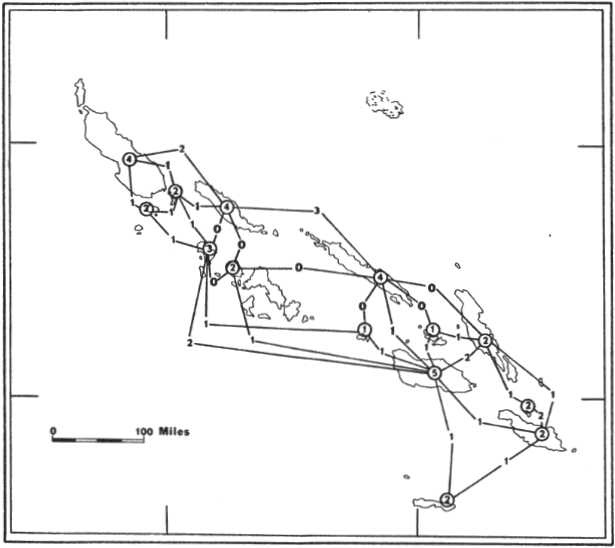
Fig. 17. The number of subspecies of megachiropterans known from individual islands (number within a circle) is compared with the number of subspecies common to different islands (number without a circle). For names of islands see Fig. 2.
Distributions of subspecies of polytypic species are summarized in Table 6 and Figure 17. Generally, more subspecies are known from the larger islands than from the smaller islands (Guadalcanal with 5, Bougainville, Choiseul, and Santa Ysabel with 4, Fauro with 2.) The distributions of some subspecies can be used to judge the differential effectiveness of water gaps between islands. The distribution of Pteropus rayneri lavellanus and P. rayneri rubianus is an example.
Choiseul and Santa Ysabel are separated by about 50 miles of water (see Fig. 17) but have three subspecies in common (Pteropus rayneri grandis, Dobsonia inermis minimus, and Nyctimene albiventer minor.) Choiseul is about 50 miles from Kolombangara and about 35 miles from Vella Lavella, but shares no subspecies with these smaller islands although some species are shared (Tables 5 and 6). From these data one can conclude that exchange of genes between populations on Choiseul and populations on Santa Ysabel is frequent but for some reason exchange of genes between populations on Vella Lavella and Choiseul and Kolombangara and Choiseul is infrequent. A series of small islands (Rob Roy, Wagina, and the Arnavon Islands, not named on the maps) connect Choiseul and Santa Ysabel in stepping-stone fashion (see Fig. 17). Possibly these small islands enhance movement of megachiropterans between Choiseul and Santa Ysabel.
Table 6. A Summary of Distribution of Polytypic Species of Megachiropteran Bats in the Solomon Islands. Only Islands Well Known Faunistically Are Listed.
Subspecies


P. atrata atrata X X
P. atrata anceps X X
Pt. a. solomonis X X X
Pt. a. colonus X
Pt. a. grandis X
Pt. r. rayneri X X
Pt. r. grandis X X X
Pt. r. rubianus X
Pt. r. lavellanus X
Pt. r. monoensis X
Pt. r. cognatus X X
Pt. r. rennelli X
D. i. inermis X X X X X X X X X X
D. i. minimus X X
N. a. bougainville X X X
N. a. minor X X X
Totals 4 4 4 1 2 1 2 2 3 2 1 5 2 2 2 1
Florida, of the Nggela Group, is approximately halfway between Santa Ysabel and Guadalcanal. Pteralopex atrata anceps occurs on Santa Ysabel and on Guadalcanal but is unknown from Florida. Fauro lies between Bougainville and Choiseul. Pteralopex atrata atrata and Pteropus rayneri grandis occur on Choiseul and on Bougainville but are unknown from Fauro. As suggested earlier, small islands like Fauro and Florida possibly cannot support large fruit bats, although they probably would utilize these small islands when in transit between larger islands.
Fauro apparently is important to the distribution of the two subspecies of Dobsonia inermis and Nyctimene albiventer in the Solomons (see Figs. 9 and 13). In both species, one subspecies is found in the eastern chain of islands and one subspecies is found in the western chain. Specimens of Dobsonia inermis from Fauro and Bougainville can be identified as the subspecies inermis whereas those from Choiseul are assignable to the subspecies minimus. Nyctimene albiventer bougainville occurs on Bougainville but specimens of N. albiventer from Fauro and Choiseul can be identified as the subspecies minor. Although interchange of genes occurs between populations on Bougainville and Fauro in the case of D. inermis, the population of N. albiventer on Fauro is at least partially isolated from the population on Bougainville.
Rennell and Ontong Java are relatively isolated from other islands in the Solomons (see Fig. 17). Only one kind of bat (Pteropus howensis) is known from Ontong Java and apparently is endemic to that atoll. Pteropus tonganus geddiei, one of the megachiropterans that occurs on Rennell (Table 5), also is found in the New Hebrides and on New Caledonia (Table 4). This makes P. t. geddiei the only megachiropteran bat in the Solomons that is more closely related to bats on islands to the southeast of the Solomons than to bats on other islands of the Solomons, the Bismarcks, or New Guinea, to the north and west. The other species of megachiropterans (Dobsonia inermis and Pteropus rayneri) on Rennell are found also on other islands in the Solomons. It is to be noted that Mayr (1931) regarded the avifauna of Rennell as most nearly like that of the New Hebrides and New Caledonia. He suggested that the prevailing winds from the southeast have been important for birds that have reached Rennell. The New Hebrides and New Caledonia are four and a half times farther from Rennell than are San Cristobal and Guadalcanal. On first consideration a person might doubt that the winds would be favorable enough to compensate for the great distance between Rennell and the New Hebrides and New Caledonia. Darlington (1938) has used the formula X n/m to obtain a comparison of barriers of different widths. [X = the probability of an individual crossing a barrier of width m; the probability of an individual crossing a similar barrier of width n is the ratio n/m.] If this formula is applied here, one finds that winds from the southeast (that is, from the New Hebrides and New Caledonia) would have to be more than 100 times more favorable than winds from the northeast (from Guadalcanal and San Cristobal) in order to compensate for the distance of Rennell from the New Hebrides and New Caledonia. Even so, tropical storms with unusually strong winds, frequent during some parts of the year, possibly account for the present distributional pattern of bats and birds that live on Rennell.
Whatever the means by which bats of the species P. tonganus reached Rennell, the fact remains that specimens from Rennell cannot be distinguished from specimens of P. tonganus geddiei from the New Hebrides and New Caledonia, more than 500 miles to the southeast.
Note: An important and interesting paper on zoogeography of bats, which was published too late to be included here, is: Krzanowski, A., 1967, The magnitude of islands and the size of bats (Chiroptera), Acta Zool. Cracoviensia, 12:281-348.
LITERATURE CITED
Anonymous.
1944. Gazetteer of Solomon Islands, Bismarck Archipelago, and Islands of the south-eastern end of New Guinea. Hydrographic office of the United States Navy Department, No. 881.
Andersen, K.
1908. Twenty new forms of Pteropus. Ann. Mag. Nat. Hist., ser. 8, 2:361-370, October.
1909a. On the characters and affinities of "Desmalopex" and Pteralopex. Ann. Mag. Nat. Hist., ser. 8, 3:213-222, February.
1909b. Two new bats from the Solomon Islands. Ann. Mag. Nat. Hist., ser. 8, 3:266-270, March.
1909c. On the fruit-bats of the genus Dobsonia. Ann. Mag. Nat. Hist., ser. 8, 4:528-533, December.
1911. Six new fruit-bats of the genera Macroglossus and Syconycteris. Ann. Mag. Nat. Hist., ser. 8, 7:641-643, June.
1912. Catalogue of the Chiroptera in the collection of the British Museum, British Mus. (Nat. Hist.), London, 1:ci + 1-854, 79 figs.
Bader, R. S., and Hall, J. S.
1960. Osteometric variation and function in bats. Evol., 14:8-17, 3 figs., March 21.
Baker, R. H.
1951. The avifauna of Micronesia, its origin, evolution, and distribution. Univ. Kansas Publ., Mus. Nat. Hist., 3:1-359, 16 figs., June 12.
Beaufort, L. E. De.
1951. Zoogeography of the land and inland waters. Sidgwick and Jackson, London, viii + 208 pp., maps.
Belkin, J. N.
1962. The mosquitoes of the South Pacific (Diptera, Culicidae). Univ. California Press, Berkeley, 1:xii + 1-608, July 18.
Benedict, F.
1957. Hair structure as a generic character in bats. Univ. California Publ. Zool., 59:285-548, 9 pls., 4 figs., October 10.
Brigham, W. T.
1900. An index to the islands of the Pacific Ocean. Mem. Bernice P. Bishop Mus., Honolulu, 2:1-170, maps.
Cranstone, B. A. L.
1961. Melanesia: a short ethnography. British Mus., London, 115 pp., 26 pls., 43 figs., map.
Darlington, P. J.
1938. The origin of the fauna of the Greater Antilles, with discussion of dispersal of animals over water and through the air. Quart. Rev. Biol., 13:274-300, 5 figs.
Deignan, H. G.
1963. Birds in the tropical Pacific, pp. 263-269, in Pacific Basin biogeography (J. L. Gressitt, ed.). Bernice P. Bishop Mus. Press, Honolulu, xi + 563 pp.
Dobson, G. E.
1878. Catalogue of the Chiroptera in the ... British Museum. British Mus., London, xlii + 567 pp., 30 pls.
Dobzhansky, T. G.
1941. Genetics and the origin of species. Columbia Univ. Press, New York, 2nd. ed., rev., ix + 466 pp., 24 figs.
Durham, J. W.
1963. Paleogeographic conclusions in light of biological data, pp. 355-365, 4 figs., in Pacific Basin biogeography (J. L. Gressitt, ed.). Bernice P. Bishop Mus. Press, Honolulu, xi + 563 pp.
Ellerman, J. R., and Morrison-Scott, T. C. S.
1966. Checklist of Palaearctic and Indian mammals, 1758-1946. British Mus. (Nat. Hist.), London, 2nd. ed., 810 pp., July.
Felten, H.
1964a. Flughunde der Gattung Pteropus von den Neuen Hebriden (Mammalia, Chiroptera). Senck. biol., 45:87-92, 6 figs., May 15.
1964b. Flughunde der Gattung Pteropus von Neukaledonien und den Loyalty-Inseln (Mammalia, Chiroptera). Senck. biol., 45:671-683, December 21.
Hall, E. R.
1946. Mammals of Nevada. Univ. California Press, Berkeley, xi + 710 pp., frontispiece, 11 pls., 485 figs., July 1.
Hill, J. E.
1956. The mammals of Rennell Island. The natural history of Rennell Island, British Solomon Islands, Copenhagen, 1:73-84, November 28.
1962. A little-known fruit-bat from Rennell Island. The natural history of Rennell Island, British Solomon Islands, Copenhagen, 4:7-9, February 15.
1963. A revision of the genus Hipposideros. Bull. British Mus. (Nat. Hist.), 2:1-129, October.
Koopman, K. F.
1957. Evolution in the genus Myzomela (Aves: Meliphagidae). The Auk, 74:49-72, 5 figs., January.
1958. Land bridges and ecology in bat distribution on islands off the northern coast of South America. Evol., 12:429-439, 2 figs., December.
Lack, D. L.
1947. Darwin's finches. Cambridge Univ. Press, Cambridge, x + 209 pp., 8 pls., 27 figs.
Laurie, E. M. O., and Hill, J. E.
1954. List of land mammals of New Guinea, Celebes, and adjacent islands. British Mus. (Nat. Hist.), London, 175 pp., June 30.
Lawrence, B.
1945. Three new Pteropus from New Caledonia and the Solomons. Proc. New England Zool. Club, 23:59-69, March 26.
Lever, R. J. A. W.
1934. Notes on mosquitoes of the British Solomon Islands. British Solomon Islands Agr. Gaz., 2:16.
Lewis, A. B.
1951. The Melanesians: People of the South Pacific. Chicago Nat. Hist. Mus. Press, Chicago, 259 pp., 56 figs., maps, September.
Matschie, P.
1899. Die Megachiroptera des Berliner Museums für Naturkunde. Druck und verlag von George Reimer, Berlin, viii + 102 pp., 14 figs.
Mayr, E.
1931. A systematic list of the birds of Rennell Island with descriptions of new species and subspecies. Amer. Mus. Novit., 486:1-29, August 29.
1940. The origin and the history of the bird fauna of Polynesia. Proc. 6th Pacific Sci. Cong., 1939, 4:197-216.
1942. Systematics and the origin of species from the viewpoint of a zoologist. Columbia Univ. Press, New York, xiv + 334 pp., 29 figs.
Miller, A. H.
1966. Animal evolution on islands, pp. 10-16, in The Galapagos (R. I. Bowman, ed.), Univ. California Press, Berkeley.
Miller, G. S.
1907. The families and genera of bats. Bull. U. S. Nat. Mus., 57:xvii + 282, 14 pls., 49 figs., June 29.
Phillips, C. J.
1966. A new species of bat of the genus Melonycteris from the Solomon Islands. Jour. Mamm., 47:23-27, 1 fig., March 12.
1967. A new subspecies of horseshoe bat (Hipposideros diadema) from the Solomon Islands. Proc. Biol. Soc. Washington, 80:35-40, 2 figs., March 24.
Pohle, H.
1953. Über die Fledertiere von Bougainville. Z. Säugetierk., 17:127-137, October 27.
Ridgway, R.
1912. Color standards and color nomenclature. Washington, D. C., iv + 44 pp., 53 pls.
Sanborn, C. C.
1931. Bats from Polynesia, Melanesia, and Malaysia. Publ. Field Mus. Nat. Hist., Zool. Ser., 18:7-29, February 12.
Sanborn, C. C., and Beecher, W. J.
1947. Bats from the Solomon Islands. Jour. Mamm., 28:387-391, November 19.
Sanborn, C. C., and Nicholson, A. J.
1950. Bats from New Caledonia, the Solomon Islands, and New Hebrides. Fieldiana (Zool.), 31:313-338, 6 figs., August 31.
Simpson, G. G.
1945. The principles of classification and a classification of mammals. Bull. Amer. Mus. Nat. Hist., 85:xvi + 350, October 5.
Tate, G. H. H.
1934. An apparently new fruit bat of the Pteropus hypomelanus group from Gower Island, Solomon Islands. Amer. Mus. Novit., 718:1-2, May 4.
1942. Pteropodidae (Chiroptera) of the Archbold Collections. Bull. Amer. Mus. Nat. Hist., 80:331-347, December 31.
Thomas, O.
1887a. Diagnoses of two new fruit-eating bats from the Solomon Islands. Ann. Mag. Nat. Hist., ser. 5, 60:147, February.
1887b. On the bats collected by Mr. C. M. Woodford in the Solomon Islands. Proc. Zool. Soc. London, 23:320-328, 3 figs., 2 pls., March 15.
1888a. Diagnoses of six new mammals from the Solomon Islands. Ann. Mag. Nat. Hist., ser. 6, 2:155-158, February.
1888b. The mammals of the Solomon Islands, based on the collections made by Mr. C. M. Woodford during his second expedition to the Archipelago. Proc. Zool. Soc. London, 33:470-484, 3 pls., December 4.
Trouessart, E. L.
1904. Catalogus Mammalium tam viventium quam fossilium. Quinquennale Supplementum, Berlin, vii + 929 pp.
Troughton, E. LeG.
1931. Three new bats of the genera Pteropus Nyctimene, and Chaerephon from Melanesia. Proc. Linn. Soc. New South Wales, 56:204-209, June 15.
1936. The mammalian fauna of Bougainville Island, Solomons Group. Rec. Australian Mus., 14:341-353, April 7.
Wright, S.
1931. Evolution in Mendelian populations. Genetics, 16:97-159, 21 figs.
Transmitted August 10, 1967.
Transcriber's Notes
Obvious typographical and punctuation errors repaired. The "Key to Pteropus in the Solomon Islands" was moved above the beginning of the listing for Pteropus Brisson. Where figures or tables split paragraphs, they were moved above or below the split.
Typographical Corrections
Page Correction
797 Liuinuwu → Liuniuwu
809 intermis → inermis
824 adbiventer → albiventer
832 Gaudalcanal → Guadalcanal