3. TAR-ACID RESINS
Reading edition
The tar-acid resins were the first true synthetic resins to appear in commerce, but they were preceded by two plastics, celluloid and casein. Probably the first successful attempt to make a semisynthetic or modified natural product as a substitute for natural materials was the discovery of celluloid in 1868 by John Wesley Hyatt. By treating cotton with nitric acid he obtained a material which could be substituted for ivory in billiard balls. The Celluloid Corporation grew out of this discovery and the product was widely used to replace amber, ivory, mother-of-pearl, tortoise shell and other materials.
The discovery of casein plastic took place in 1890. Adolph Spitteler of Hamburg, Germany, in trying to make a white blackboard, found that casein (from milk) could be hardened by treating it with formaldehyde. Casein plastics are now widely used in buttons, buckles, and other ornaments.
As early as 1872 the reactions between coal-tar acids and aldehydes were being studied, and by 1900 many research workers were investigating phenol-formaldehyde condensation products. During the period 1900-1910, the study of these products increased greatly, both with regard to process of production and to applications, such as its substitution for shellac and other natural resins. United States Patents Nos. 942,699 and 942,809 issued December 7, 1909, to Dr. L. H. Baekeland and commonly known as the heat and pressure patents were probably the basic patents on phenol-formaldehyde resins. Baekeland so modified these resins by methods of hardening under heat and pressure that rigid molded articles could be made. The range of uses of tar-acid-formaldehyde molding compositions has steadily widened. Molded articles such as pencil and pen barrels, ash trays, bottle closures, parts for automobiles, cameras, precision instruments, dynamos, motors, and other electrical equipment, cafeteria trays, table and counter tops are well known to the public.
During the life of these and other basic patents issued about 1909 the domestic production of phenol-formaldehyde molding compositions was practically restricted to one company. Since the expiration of these patents in 1926 a number of other producers have been established. In 1937 there were 36 domestic makers of tar-acid-formaldehyde resins for molding, laminating, and surface coating applications.
The early work done on phenol-formaldehyde resins gave dark-colored products which were too hard and brittle to be machined or worked on a lathe. Investigations by F. Pollak and A. Ostersetzer, in Vienna, resulted in a process for the manufacture of cast phenolic resin with a range of color possibilities from water-white transparency through all shades and degrees of translucency and opaqueness. This product is cast into sheets, rods, tubes, and special castings, all of which may be turned or milled on automatic machines. United States Patent No. 1,854,600, issued April 19, 1932, to F. Pollak and A. Ostersetzer and assigned to Pollopas, Ltd., London, is considered the basic patent for cast phenolic resins. American rights under this and related patents are owned by the Catalin Corporation of America who have licensed other domestic makers. The German equivalent of rights under this patent is owned by a subsidiary of I. G. Farbenindustrie Aktiengesellschaft and rights under the French equivalent by Établissements Kuhlmann.
In the early days of the phenol-formaldehyde resin industry (1909-16) there was considerable uneasiness about the supply of phenol. World production was not large and Germany and England controlled most of it. The output of the United States was almost entirely for medicinal use, although our potential production was large (see p. 111). This situation caused many research workers to study the resins made from other tar acids, principally meta and para cresols and the xylenols. The investigations resulted in many new types of resins and in modifications of the phenol-formaldehyde type. The World War changed conditions materially. Imports of phenol were shut off and prices soared. Production of synthetic phenol was begun, and, although the wartime production went into explosives, its development had an important bearing on the synthetic resin industry. Unusual demand for phenol, toluene, and other coal-tar crudes resulted in a great expansion of production. With the cessation of hostilities there was an ample supply of cheap phenol and the expansion of the coal-tar industry continued so that the supply of tar acids kept pace with the new demand for use in the production of synthetic resin.
In 1926, the early patents on resins from tar acids began to expire and the second era of the industry began. Since that year most of the research work has been for materials that would give different properties to the resultant resins. The past 10 years have seen a greater diversification in the manufacture of resins from tar acids and substantial reductions in their prices. Tar-acid resins averaged $1.29 per pound in 1920, 23 cents per pound in 1934, and 19 cents per pound in 1937. The production of certain resins of this class which are soluble in drying oils has been an important achievement. They yield varnishes of improved type that are quick-drying.
The three stages of a tar-acid resin.
About 28 years ago the Journal of Industrial and Engineering Chemistry published the original paper of Dr. Leo H. Baekeland on the Synthesis, Constitution, and Uses of Bakelite. According to Baekeland’s theory, the reaction between phenol and formaldehyde consists of condensation and polymerization taking place in three stages. The first product formed, called “initial condensation product A” is usually a liquid or semisolid which on continued heating is converted to “intermediate condensation product B.” B is an insoluble solid which can be softened by heat, and is the material used by molders, laminators, and other fabricators.
The final stage, known as “final condensation product C,” is probably the result of polymerization of B, by heat and pressure. C product is infusible, indifferent to all solvents, and cannot be distilled or melted; hence the tar-acid resins belong to the thermosetting group. The conversion to C takes place in the presses of the molder or final fabricator of the resin. This theory is generally accepted and the designations of the several stages are in universal use in the trade.
Classification of tar-acid resins.
All the synthetic resins obtained by the condensation of a tar acid, or a mixture of tar acids, with an aldehyde are popularly called phenolic resins, regardless of whether they are made from phenol, the isomeric cresols, xylenols, other high boiling tar acids, or any mixture of these materials. A more accurate designation and that used in this survey is tar-acid resins, reserving the term phenolic resins for those made from pure phenol.
The tar-acid resins might be classified in a number of ways; for example, by composition, physical form, or general application. Each of these has its shortcomings. To classify them by composition, that is, by the kind of tar acid used, is not satisfactory because of the vast number of types made from mixed tar acids. For the purpose of this discussion it seems best to classify the tar-acid resins by their general application into six groups: for molding, for casting, for laminating, for surface coating (paints, varnishes, and lacquers), for adhesives, and for miscellaneous uses.
In 1937 approximately 66 percent of the United States production of tar-acid resins was made from phenol; 18 percent from phenol-cresol mixtures; 13 percent from cresol-cresylic acid mixtures; and 3 percent from cresol-xylenol mixtures. Table 2 shows for recent years production and sales of tar-acid resins by type of raw material. Pure phenol is used for cast resins. Molding resins are usually made from pure phenol or from tar-acid mixtures, chiefly phenol. Laminating and coating resins are usually made from mixtures containing substantial amounts of the cresols and xylenols (frequently spoken of by the trade as cresylic acid).
Table 2.—Tar-acid resins: United States production and sales, by type of raw material, 1933-37
Year Phenol Tar-acid mixtures1
Production (net resin content) Sales Production (net resin content) Sales
Quantity (net resin content) Value Quantity (net resin content) Value
1,000 pounds 1,000 pounds 1,000 dollars 1,000 pounds 1,000 pounds 1,000 dollars
1933 25,163 21,851 5,383 6,535 6,152 1,182
1934 29,777 27,995 7,332 10,887 8,091 1,705
1935 36,323 34,597 6,568 16,654 12,371 2,200
1936 51,603 49,053 9,419 18,747 12,908 2,325
1937 52,472 50,209 8,616 27,373 23,337 4,685
Phenol-cresol mixtures Cresol-cresylic acid mixtures Cresol-xylenol mixtures
Production (net resin content) Sales (net resin content) Production (net resin content) Sales (net resin content) Production (net resin content) Sales (net resin content)
1,000 pounds 1,000 pounds 1,000 pounds 1,000 pounds 1,000 pounds 1,000 pounds
1937 14,046 13,238 10,702 8,467 2,625 1,632
1 Includes phenol-cresol mixtures, cresol-cresylic acid mixtures, and cresol-xylenol mixtures. For 1937, where it is possible, the totals of tar-acid mixtures are broken down into these three groups.
Source: Dyes and Other Synthetic Organic Chemicals in the United States, U. S. Tariff Commission.
Processes of resin manufacture.
The processes of and patents for the manufacture of tar-acid-formaldehyde resins are numerous. No attempt is made here to describe in detail the several processes of manufacture or the endless number of variations and modifications. In general the processes in operation may be designated (a) one stage wet, (b) two stage wet, and (c) dry.
The one-stage wet process consists in heating molecular proportions of tar acid and formaldehyde (40-percent solution) in the presence of an acid or alkaline catalyst. The formaldehyde is added all at once and the reaction proceeds with the elimination of water. The difficulty with this process is that of obtaining uniform batches because it cannot be controlled exactly.
The two-stage process is probably the one most widely used today and consists in introducing formaldehyde in two or more stages as the reaction progresses. Much better process control and more uniform results are so obtained. A soluble, fusible resin is formed from which the water is easily removed. Fillers and pigments may be added during the latter part of the operation.
The dry process is the least important and is used only where cast resins are being made. Light-colored, transparent resins are obtained and the operation is carried on to the final stage (C resin). In this process the aldehyde used is solid paraformaldehyde or hexamethylenetetramine. These materials are more costly than formaldehyde solution.
Proportions of raw materials used vary widely—Baekeland suggested 7 mols of formaldehyde and 6 mols of phenol (210 parts of 100-percent formaldehyde to 564 parts of phenol), with a yield of resin equivalent to 118 percent of the phenol. Larger proportions of formaldehyde are said to increase the yield to as much as 140 percent of the phenol.
Catalysts used to aid in the condensation of the reacting bodies may be acids or bases. Certain properties of the resins may be varied by the kind and quantity of catalyst used. Large proportions of basic or acidic catalysts may affect the filler or metal inserts. Basic catalysts used include caustic soda, caustic potash, ammonia, carbonates, and alkali sulphites. Acid catalysts are usually one of the mineral acids such as hydrochloric acid or sulphuric acid.
While formaldehyde in the form of a 40-percent solution is the principal aldehyde used with the tar acids, certain other aldehydes are used in small amounts. Among these are acetaldehyde, butyraldehyde, benzaldehyde, and others. Resins from furfural and phenol are discussed as “Furfural Resins,” page 51.
Production in the United States.
The production of tar-acid resins in the United States has increased markedly in the last 10 years. Table 3 shows the production and sales of all coal-tar resins in 1927 and 1928 (when there was no further break-down available but when this classification was made up chiefly of tar-acid resins) and of tar-acid resins from 1929 to 1937. The figures given are in net resin content and do not include fillers, modifiers, or pigments. From 1929 to 1937 production increased from 26 million pounds to 80 million pounds; sales from 25 million pounds valued at 9.9 million dollars to 74 million pounds valued at 13.3 million dollars; the value per pound dropped from 39 cents to 19 cents.
In 1937 the production of tar-acid resins for molding accounted for about 40 percent of the total; those for surface coatings, about 25 percent; those for lamination, about 20 percent; and those for miscellaneous uses, about 15 percent.
Table 3. Tar-acid resins: United States production and sales 1927-37
Year Production (net resin content) Sales
Quantity (net resin content) Value Unit value
Pounds Pounds
19271 13,452,230 13,084,313 $6,094,656 $0.47
19281 20,411,465 20,778,856 7,211,958 .35
19292 26,235,792 25,129,701 9,869,274 .39
19302 18,338,389 17,428,687 6,576,023 .38
19312 22,647,000 21,496,000 6,646,000 .31
19322 17,163,000 15,042,000 3,946,000 .26
19332 31,697,780 28,002,799 6,564,670 .23
19342 40,663,565 36,086,008 9,037,861 .25
19352 52,731,728 46,733,378 8,730,438 .19
19362 70,349,328 61,961,200 11,743,978 .19
19372 79,844,825 73,545,880 13,300,870 .19
1 All coal-tar resins.
2 Resins from tar acids only.
Source: Compiled from annual reports of the Tariff Commission on dyes and other synthetic organic chemicals in the United States.
Imports into the United States.
Imports of tar-acid resins into the United States are dutiable under paragraph 28 at 7 cents per pound and 45 percent ad valorem based upon American selling price. Discussion of this rate, other restrictions upon imports in the earlier years, and of the rates upon articles made of these resins will be found on pages 59 to 61.
Imports of tar-acid resins are not shown separately in official statistics; the classification under which such imports are entered includes all synthetic resins of coal-tar origin. Table 4 shows the quantity and value of imports of all coal-tar resins since 1918, and table 5 shows the principal sources of imports for certain years.
Invoice analyses of imports in the last 3 years show only very small quantities of phenolic resins being imported. In 1934 there was an importation of 950 pounds of Bakelite molding compound; in 1935 imports of 100 pounds of molding compound and 22 pounds of aminophenol resin are recorded, and in 1936 imports of Bakelite filament compound totaled 250 pounds and other resins 8,851 pounds.
Even if in the years up to 1933 all of the imports of resins of coal-tar origin were tar-acid resins, imports of tar-acid resins have been negligible when compared with production. The smallness of imports may be accounted for by a combination of factors, (1) the prohibition of imports of certain types, which conflicted with patent rights; (2) the rate of duty upon imports; (3) the fact that the manufacture of tar-acid resins developed more rapidly in the United States than in most foreign countries; and (4) the allocation of markets through agreements between affiliated producers in different countries. (See p. 58.)
Table 4.—Synthetic resins of coal-tar origin: United States imports for consumption, 1919-37
Year Quantity Dutiable value Value per pound Computed ad valorem rate Computed specific rate
Pounds Percent Per pound
1919 1,114 $2,860 $2.57 32.0 $0.82
1920 2,479 2,681 1.08 34.6 .37
1921 1,420 2,366 1.67 33.0 .55
1922 2,518 3,498 1.39 52.3 .73
1923 3,183 10,512 3.30 62.1 .20
1924 8,756 4,183 .48 68.9 .33
1925 1,537 889 .58 57.1 .33
1926 1,649 1,298 .79 53.9 .42
1927 11,359 4,266 .38 63.6 .24
1928 60,547 10,984 .18 83.6 .15
1929 67,529 17,503 .26 72.0 .19
1930 46,464 10,417 .22 76.2 .17
1931 6,074 6,180 1.02 51.9 .53
1932 6,403 3,905 .61 56.5 .34
1933 3,776 2,508 .66 55.5 .37
1934 15,711 8,680 .55 57.7 .32
1935 18,015 6,075 .34 65.8 .22
1936 18,598 13,643 .73 54.5 .40
19371 18,977 14,278 .75 54.3 .41
1 Preliminary.
Source: Foreign Commerce and Navigation of the United States.
Table 5.—Synthetic resins of coal-tar origin: United States imports for consumption, by principal sources, in specified years, 1929-37
Imported from— 1929 1931 1933 1934 1935 1936 19371
Quantity (pounds)
Germany 50,770 3,166 2,724 9,801 2,220 10,750 13,950
France 20 2,331 740 297 168
United Kingdom 336 1,065 13,242 1,979 2,215
Switzerland 3,473 1,781 4,384 1,716
Canada 1,372 135 1,266 594
All other countries 16,403 577 312 340 51 502
Total 67,529 6,074 3,776 15,711 18,015 18,598 18,977
Value
Germany $11,771 $4,053 $1,913 $5,303 $1,959 $9,700 $11,960
France 21 1,760 465 236 177
United Kingdom 2,235 255 2,476 1,090 659
Switzerland 2,621 1,308 2,154 1,197
Canada 501 46 486 214
All other countries 3,476 367 130 50 36 248
Total 17,503 6,180 2,508 8,680 6,075 13,643 14,278
Unit value
Germany $0.23 $1.28 $0.70 $0.54 $0.88 $0.90 $0.86
France 1.05 .76 .63 .79 1.05
United Kingdom 6.65 .24 .19 .55 .30
Switzerland .75 .73 .49 .70
Canada .37 .34 .38 .36
All other countries .21 .64 .42 .15 .71 .49
Average .26 1.02 .66 .55 .34 .73 .75
Percent of total quantity
Germany 75.2 52.1 72.1 62.4 12.3 57.8 73.5
France .1 38.4 19.6 1.6 .9
United Kingdom .5 6.8 73.5 10.6 11.7
Switzerland 22.1 9.9 23.6 9.1
Canada 8.7 .8 6.8 3.1
All other countries 24.2 9.5 8.3 1.9 .3 2.6
1 Preliminary.
Source: Foreign Commerce and Navigation of the United States.
Exports from the United States.
Appreciable quantities of phenolic resins are exported annually in the form of molding compounds and as finished articles of wide variety. Statistics of these exports are not compiled separately by the Department of Commerce.
Exportation is limited by a number of factors, such as licensing agreements, patents, allocation of markets, and high tariffs or embargoes in certain countries. The largest domestic maker is affiliated with producers in Great Britain, Germany, France, Italy, Canada, and Japan. Other domestic firms have agreements as to patents and markets with producers in England, Germany, and other countries.
TAR-ACID RESINS FOR MOLDING
The tar-acid resins were first developed for molding and they are still used in large volume in this way. An article produced in large quantity is more likely to be made of molded resin. The cost of the mold, which may amount to several thousand dollars, then becomes very small per unit produced. If the article is of such a shape that it would require a great deal of labor to produce in metal or wood, it may be produced in quantity much more cheaply from resin, since it will come from the mold almost in finished form.
A few of the large molders find it economical to make their own resins when they use one type in large volume or desire some special modification. Most of the molders buy resins for molding in the form of either powder or pre-formed pellets ready for use.
Molding powders and pellets.
Molding powder is made from B-stage resin (see p. 13), a filler, a pigment, a lubricant, and a plasticizer. These materials are mixed and put through rolls at a moderate heat and pressure. The resin softens and amalgamates with the other materials. It hardens upon cooling and is ground to powder. A pre-formed pellet may be made from the powder by pressure; use in this form saves the time of the molder when filling the mold, since he is not required to measure the powder.
The proper selection of the filler in a molding powder is important in influencing the quality of the molded article. Fibrous fillers improve the mechanical strength and shock resistance of the finished article. Wood flour is the most widely used filler in tar-acid resins as well as in other thermosetting resins. Pine, spruce, and fir are the principal kinds used, and consideration must be given to the bulk, gum content, color, and the size and shape of the wood particles. Color is the least important since most of the tar-acid resins give brown or black moldings. When the molding must withstand high temperatures, asbestos fiber is used as a filler. In articles requiring high shock resistance, such as golf club heads, a filler of paper pulp is used. Where high electrical insulation and dielectric properties are required, ground mica is used as the filler. Certain inorganic fillers such as powdered slate, gypsum, barium sulphate, calcium sulphate, china clay, zinc oxide, and infusorial earths, are sometimes used. Large proportions of these may be used where hardness is more important than strength, as in phonograph records. Other materials used include rubber, graphite, horn, bone, starch, pumice, and cork.
Coloring matter used may be coal-tar dyes or pigments such as bone black, carbon black, and iron oxides. Pigments are usually more satisfactory, although dyes are sometimes preferred in articles for insulation.
A lubricant is added to the molding mixture to overcome the tendency to stick in the mold. Metallic soaps, stearates, and stearic acid are those most commonly used.
Sometimes a plasticizer is included, its function being to act as a solvent for the resin, thus increasing the flow of the material in the mold. The plasticizer should be one which will become infusible or at least remain solid in the molded article.
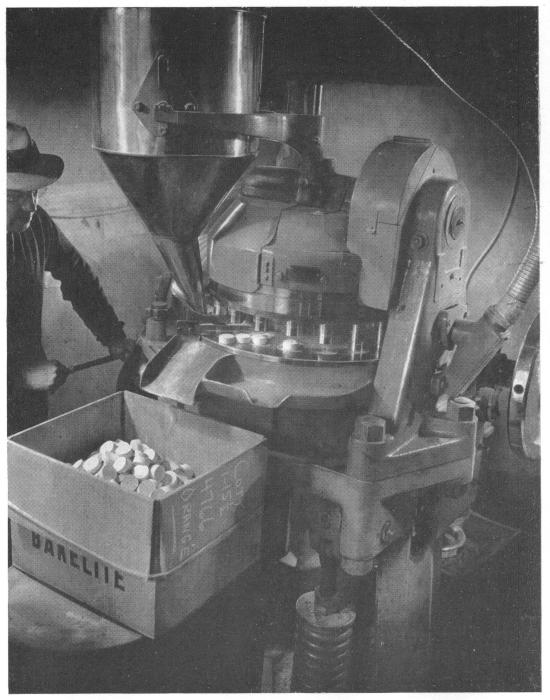
Preform Press Making Pellets for Use in Molding.
Source: Bakelite Corporation, 247 Park Avenue, New York, N. Y.
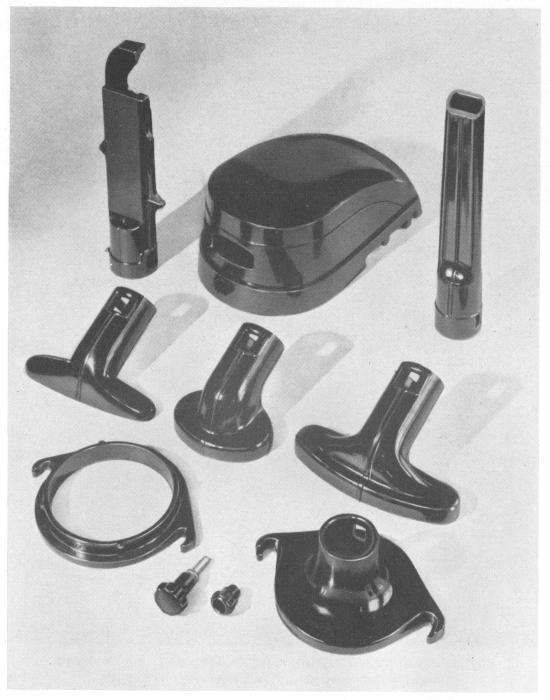
Vacuum Cleaner Parts of Tar-Acid Resin Illustrating the Intricate Molded Shapes Possible.
Source: Bakelite Corporation, 247 Park Avenue, New York, N. Y.
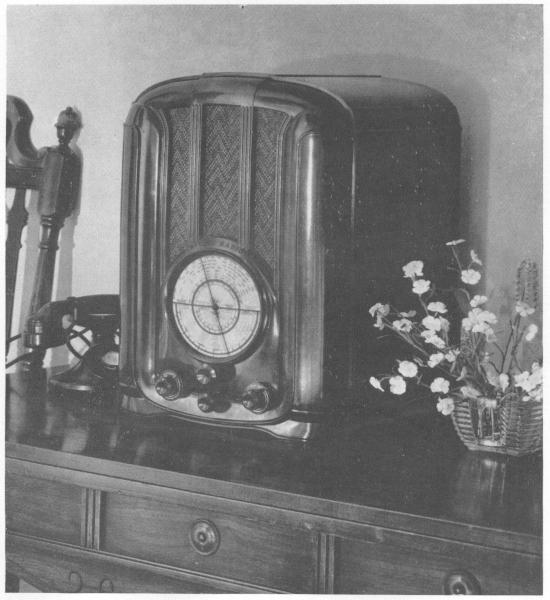
Radio Cabinet and Telephone Set of Molded Tar-Acid Resin.
Source: Bakelite Corporation, 217 Park Avenue, New York, N. Y.
A typical molding powder or pre-form pellet will contain by weight:
Resin 40 to 50 percent
Filler 35 to 50 percent
Plasticizer 5 percent
Lubricant 1 percent
Pigment 1 percent
The molding of tar-acid resins.
Ordinarily the molds used are made of hardened steel, highly polished. They must stand working pressures of several thousand pounds per square inch. The mold is placed in a hydraulic press, heated by steam, electricity, or gas, and the molding material is placed in the mold. The press is closed and heat and pressure are applied. The temperatures used range between 250° F. and 365° F., and the pressures between 1,000 and 8,000 pounds per square inch. The molding time depends on the shape and size of the article and on the composition of the molding material. As little as one-half minute is required for small objects and as long as 10 minutes for large objects. Average molding time is about 3 minutes. The article is removed from the mold, allowed to cool, and is then trimmed, sanded, filed, or polished. Since the mold is highly polished, the finishing operation is usually needed only to remove the flash. Inserts, such as metal parts (binding posts, electrical contacts, etc.), or inlays of polished metal in name plates, and signs, are often molded in; gear shift knobs are molded over a hollow metal core; rubber inserts are used in castors, electrical plugs, and similar objects.
The molding operation is an art, and has made remarkable progress in recent years. Many articles molded of tar-acid resins are well-known to the public. The automotive industry is the best customer, using such molded parts as gear shift knobs, horn buttons, accelerator pedals, light switches, ignition parts, and distributor heads. Other well-known applications are builders’ hardware, electrical switch plates, switches and fixtures, fountain pens, radio parts, telephone parts, handles for stoves, vacuum cleaners, and other appliances, buttons, buckles, costume jewelry, camera cases, radio cabinets, small containers, and hundreds of others.
The importance of tar-acid resins in molded articles is shown by the fact that more than 75 percent of all synthetic resin molded articles made in 1937 used this type of resin as a binder.
Production of tar-acid molding resins.
Domestic production of tar-acid molding powders and pellets was reported to the Tariff Commission by 15 makers in 1937. Most of these firms have specialized in resin development and manufacture. Among the well-known brands are Bakelite, Durez, Durite, Resinox, Indur, and others (see p. 153 for list of trade names).
Statistics of production and sales of tar-acid resins used in molding were collected separately for the first time in 1935. They show a net resin output of about 21,000,000 pounds, with sales of 18,000,000 pounds or about 40 percent of the total tar-acid resins. The average unit value was 17 cents per pound. In 1937 the production of tar-acid resins for molding exceeded 32,000,000 pounds, again about 40 percent of the total. These statistics are based on net resin and do not include fillers, modifiers, pigments, or inert material of any kind.
CAST PHENOLIC RESINS
Process of manufacture.
The production of cast phenolic resins requires pure materials, expensive equipment, and extreme care in the control of the operation. A mixture of phenol and formaldehyde and a catalyst (usually sodium or potassium hydroxide) is charged into a nickel-lined reaction kettle and heated until the water separates and is removed. The reaction is then allowed to proceed to the desired point. Glycerin is added to aid in forming a transparent product. All equipment, including pipe lines, valves, and pumps, is nickel or nickel lined except that used for formaldehyde, which is made of aluminum.
The resin is usually made in 1,000 pound batches, and the reaction cycle ranges from 6 to 18 hours. It is colored with soluble coal-tar dyes and cast into lead molds. These are placed in a heated room and allowed to cure for 3 to 6 days. The resin is removed from the mold with air hammers, and the lead molds are melted.
The appearance of the resin may be changed by varying its water content, by the addition of dyes and fillers, and by the addition of other substances to produce some desired effect, such as imitation ivory or marble. The clarity of the resin depends upon its water content—the greater the degree of dehydration the clearer the product. Range of colors is complete, from crystal clear to the darker shades, with any degree of transparency, translucency, or opaqueness.
Casting is in the form of sheets, rods, tubes, or special forms suitable for the production of buckles, jewelry, and other small products. Molds of complicated shape cannot be used, which means that most articles if produced of cast resin must be produced from standard shapes by subsequent working. Recently small radio cabinets have been cast.
Uses.
Cast phenolic resin can be machined in the same manner as hard wood. It must be polished after machining, usually by tumbling with shoe pegs and pumice or with muslin wheels. The smooth finish and low degree of heat conduction give the material a pleasant feel, not cold to the touch as is metal. The coloring is not superficial and therefore does not chip or wear off. Electrical properties are excellent. A slow polymerization continues for some time after fabrication, resulting in slight shrinkage.
Cast phenolic resins are marketed by the producers as rods, sheets, cylinders, and special castings. Standard round rods range from ⅜ inch to more than 5 inches in diameter. Special rods are available in such forms as square, hexagon, octagon, and fluted. Standard sheets are in sizes from 12 by 24 inches to 36 by 72 inches, and from ⅛ to 1 inch thick. Stock cylinders are available in a wide range of inside and outside diameters.
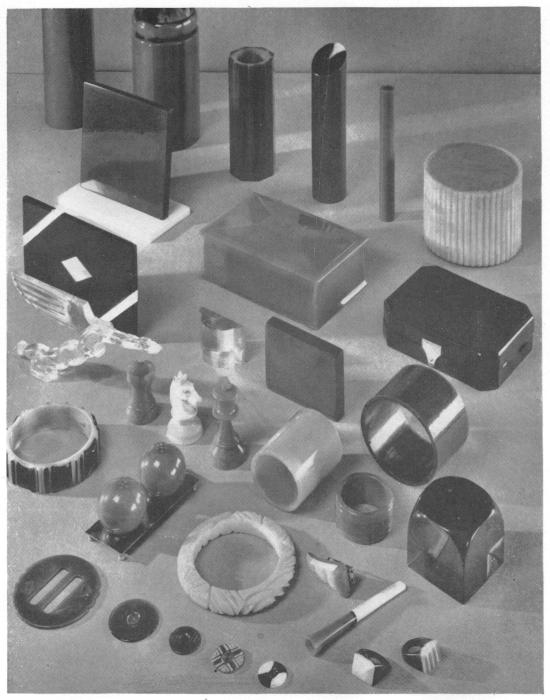
Cast Phenolic Resins, Standard Shapes and Small Articles Fabricated From Them.
Source: Bakelite Corporation, 247 Park Avenue, New York, N. Y.
Stock material is fabricated by a number of firms into an endless variety of articles. Among these are toilet articles such as combs, backs for brushes, cosmetic containers, and trinkets; fittings for automobiles, electrical appliances, furniture, and display fixtures; jewelry, dress ornaments, clock cases, handbag frames, vanity cases, smokers’ articles, signs and advertising specialties, picture frames, handles for cutlery, chessmen, pens, desk penholders, pencils, and many others. Probably the largest consumption is in the making of buttons and buckles.
The cast phenolic resins are odorless, tasteless, nonflammable, resistant to oils and greases, and practically nonbreakable.
Patents and licensing.
The basic patent covering the manufacture of cast phenolic resins is United States Patent No. 1,854,600, issued April 19, 1932, to F. Poliak and A. Ostersetzer, of Vienna, and assigned to Pollopas, Ltd., of London. Many other patents have been granted on variations and modifications of this one. The basic process is also patented in England, France, Germany, and other countries.
United States and Canadian patent rights were purchased by the American Catalin Corporation; German rights by the Interessen Gemeinschaft Industrie A. G. (German I. G.); French rights by Kuhlmann Co., and British rights by the Imperial Chemical Industries. These licensing arrangements limited the licensee to sales in his own and, in some instances, nearby countries.
The American Catalin Corporation has successfully defended the validity of this patent and has licensed a number of domestic manufacturers to produce cast phenolic resins on a royalty basis.
In 1937 there were seven domestic makers of cast phenolic resins located in New Jersey, New York, Massachusetts, and Pennsylvania. These firms produce and market resins under the following trade names: Catalin, Prystal, Joanite, Fiberlon, Phenolin, and Marblette.
Production of cast phenolic resins.
Production was initiated about 1929 by the American Catalin Corporation. The output increased substantially every year from that year through 1933. Statistics of production and sales are not publishable for the years prior to 1934 because they would reveal the operations of individual firms; they are given in table 6 for subsequent years.
Table 6.—Cast phenolic resins: United States production and sales, 1934-37
Year Production Sales
Quantity Value Unit value
Pounds Pounds
1934 4,968,445 4,793,658 $2,099,035 $0.44
1935 5,566,621 5,454,490 2,205,879 .40
1936 6,111,632 6,013,855 2,476,619 .41
1937 5,459,654 5,335,746 2,180,620 .41
Source: Dyes and Other Synthetic Organic Chemicals in the United States, U. S. Tariff Commission.
Imports and exports.
The licensing agreements, as outlined above, provide for the allocation of markets for cast phenolic resins. Because of this arrangement there are little or no imports and exports of this material.
TAR-ACID RESINS FOR LAMINATING
By laminating is meant the impregnation of sheets of paper, fiber, or cloth with a solution of synthetic resin and the building up of these layers into sheets of reinforced synthetic resin of various thicknesses. When a tar-acid resin is used the paper or cloth is immersed in or coated with a solution of the B-stage resin, dried, and layers of the material are compressed and consolidated, under heat and pressure to form sheets, rods, tubes, blocks, and other forms, in the infusible C-stage.
The coating of sheets of paper with solutions of natural resin and the compacting of these sheets by heat and pressure is an old practice, especially for electrical uses. Shellac and copal have been widely used and yield a laminated board of good electrical and mechanical properties when used at temperatures under 70° C. Above 70° C. the resin softens and the desirable properties are lost. Since temperatures above 70° C. are not uncommon in electrical equipment, the limitations of these natural resins in this use can readily be seen. The use of tar-acid resins to impregnate insulation material removes the temperature limitation and otherwise improves the product; insulators so made are widely used in all sorts of electrical and radio equipment.
Uses of tar-acid resin laminated products.
Laminated sheets of tar-acid resin are made with paper, canvas, duck, linen, pulpboard, vulcanized fiber, plywood, and other materials. Paper is the material generally used for electrical insulation, although cloth is sometimes used when greater strength is needed. Canvas is used where maximum strength is required, as in gears for automobiles and industrial machinery. Impregnated linen is adapted to punched parts and small gears.
These laminated materials are uniformly dense, tough, resilient and light in weight. They are nonabsorptive, have low thermal conductivity, and a low coefficient of expansion. Their dielectric strength is excellent and chemically they are inert to oils, brine, most acids, weak alkalies, and many solvents. Structurally they are strong under tension, compression, flexion, or impact; they are easy to machine and are sound absorbing.
Gears made of laminated canvas are widely used; they are silent and outwear those made of metal. The development of such gears was brought about by the demand for a positive drive without the clash and clatter resulting from metal to metal contact. The laminated gear absorbs vibrations, eliminates noise, and reduces wear. The laminated material is one-seventh the weight of brass, one-sixth the weight of steel, one-fifth the weight of cast iron and one-half the weight of aluminum. Laminated gear blanks may be cut on automatic machines into helical, spur, bevel, or worm gears.
Timing gears in automobiles are frequently of this type; they require no adjustment and seldom need replacement during the life of the motor. The light weight of the material reduces to a minimum flywheel effect on the camshaft. Where lubrication is difficult a graphite impregnated blank may be used.
Bearings made from laminated fabric are successfully used in heavy rolling mills where they reduce replacement costs and decrease power consumption. The laminated material possesses strength, smooth surface, density, good load carrying capacity, high impact resistance, nonscoring properties, and is practically frictionless. Power consumption is said to be reduced as much as 40 to 60 percent of that of metal bearings and the life of the laminated bearing has been as much as 10 times that of the metal ones. It replaces Babbitt metal, brass, bronze, white metal, gun metal, or lignum vitae in this application.
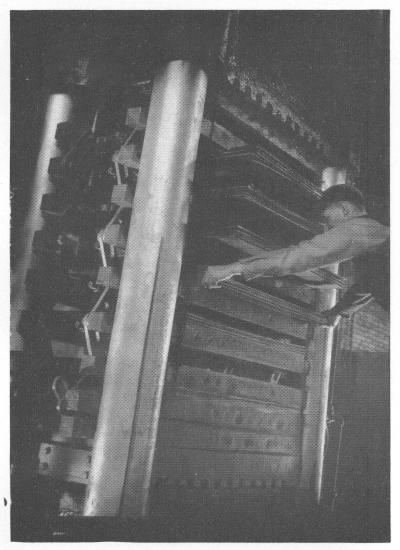
Laminating Sheet Press.
Source: Bakelite Corporation, 247 Park Avenue, New York, N. Y.
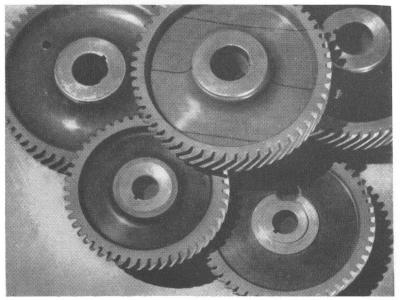
Gears Made of Laminated Tar-Acid Resin.
Source: Bakelite Corporation, 247 Park Avenue, New York, N. Y.
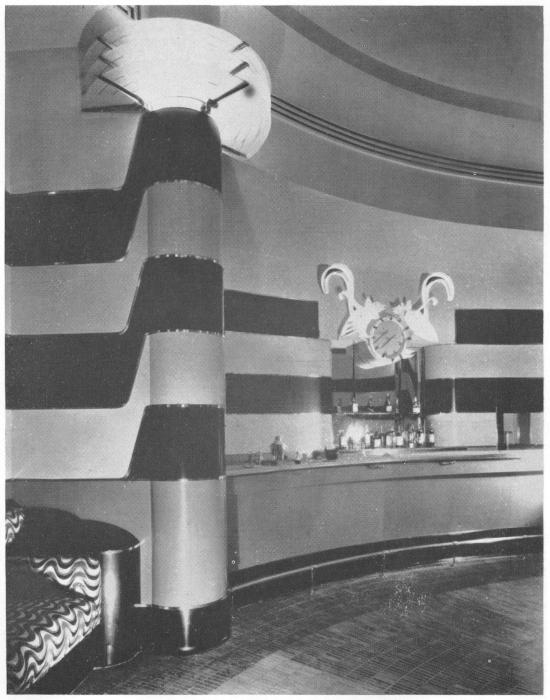
Cocktail Lounge Using Tar-Acid Laminated Decorative Material.
Source: Bakelite Corporation, 247 Park Avenue, New York, N. Y.
In decorative uses, laminated materials have made remarkable progress in recent years. In this application the material made from laminated paper is veneered on wood or fiber board, and the surface is so durable that refinishing is probably not necessary during the life of the equipment. Table tops for public rooms such as restaurants, cafeterias, and bars are widely used because of the beautiful designs obtainable and because the material is not discolored by lighted cigarettes, alcohol or other liquids, and does not chip or crack. Laminated sheets are used for bathroom and kitchen walls, doors, window sills, store and theater fronts, lobby walls in hotel and office buildings, and counter tops in banks and post offices. The liner Queen Mary is equipped with panels of this material as is also the new Library of Congress Annex. Most of the leading hotels have installed bar and cocktail lounges of laminated materials because of the range of color and the ease with which novel designs may be carried out.
Almost any solid color, design, or imitation of another material may be given the laminated sheet simply by printing it upon the top sheet of paper used in the impregnated assembly. Thus a beautiful piece of walnut or mahogany may be photographed, inexpensively reproduced upon paper, and the finished laminated sheet will closely imitate the polished wood. The combination of beauty with long life should permit the widespread use of this type of material in all sorts of building and equipment. It has been suggested as a possibility in automobile body construction.
Other important uses are in trim and door strips for mechanical refrigerators, in cafeteria trays, buckets and special containers, tires for factory trucks, textile spools, miners’ safety helmets, gaskets, valve discs and rings for pumps, pulleys, besides many others.
Production of tar-acid resins for laminating.
Statistics of production and sales of synthetic resins for laminating were not separately compiled prior to 1935. Since that year the resins made from cresylic acid have been used to the greatest extent in laminating, followed by those made from phenol. Tar-acid resins reported as “used in paints, varnishes, and lacquers” may include appreciable quantities of resin varnishes used for laminating. The total production and sale in 1937 of tar-acid resins used in laminating, therefore, would be the sum of the 20 percent of the total (see table 3) reported for laminating plus some part of the 25 percent reported for surface coatings.
Domestic producers of tar-acid resins for laminating are located in Delaware, New Jersey, New York, Illinois, Massachusetts, and Pennsylvania. The makers of the laminated materials are located in Delaware, New Jersey, New York, Ohio, Illinois, Pennsylvania, Indiana, and Connecticut. Their products are marketed under a number of trade names, including Micarta, Dilecto, Celoron, Formica, Textolite, Phenolite, Insurok, Spauldite, Synthane and Phenol Fibre.
Imports into the United States.
There has been practically no importation of synthetic resins for laminating. Imports of laminated products (rods, tubes, blocks, strips, blanks, or other forms) of which synthetic resin is the chief binding agent totaled only 215 pounds, valued at $612 in 1931 (principally from the United Kingdom); 13 pounds, valued at $71 in 1932; none in 1933 and 1934; 609 pounds, valued at $579 in 1935 from Canada, Germany, and the Netherlands; and 3,260 pounds, valued at $9,468 in 1936 from Austria, Germany, and the United Kingdom.
Exports from the United States.
Exports of phenolic or other synthetic resins for laminating and of laminated articles are not separately recorded in official statistics. It is known that appreciable quantities of laminated articles are exported to Canada, England, and other countries.
TAR-ACID RESINS FOR SURFACE COATINGS
Synthetic resins are widely used for surface coatings, chiefly because of the ease with which new types can be produced to meet special requirements and because of their uniformity. Tar-acid resin coatings may be varied in composition and properties to meet a particular purpose. Possible variations depend on the type or mixture of tar acid used (phenol, cresols, xylenols, tertiary amyl phenol, tertiary butyl phenol, phenyl phenol), whether the condensation takes place in the presence of an acid or an alkali, and on the proportion of formaldehyde used. The resin so formed may be modified with natural resins, synthetic resins of the alkyd type, fatty acids, or other materials. The almost endless opportunities for different types can, therefore, readily be appreciated.
Types of resin used and the resultant coatings.
The tar-acid resins used in varnishes and other surface coatings are usually oil-soluble types. They may be divided into three general classes: (1) Phenol-formaldehyde condensation products rendered oil-soluble by chemical combination or physical dispersion in other materials, such as rosin and copal; (2) condensation products made from tar acids other than simple phenol, which are themselves soluble in drying oils and thinners; and (3) products from the condensation of the substituted phenols and formaldehyde. These three classes of oil-soluble tar-acid resins differ widely in their chemical and physical properties and in their functions. The first group are usually called modified phenolic resins, the second group are referred to as unmodified or 100-percent soluble, and the third group are known as substituted phenolic resins.
The unmodified resins are extensively used in long-oil tung varnishes, to which they impart greater drying speed, durability, and resistance to alkalis and gases. The modified types impart the same properties to tung oil varnishes but to a lesser extent. In addition the modified types possess considerable hardness so that greater gloss and fullness are obtained. Modifiers are either drying oils or natural resins; tung oil is the most widely used oil and rosin the principal natural resin. Substituted phenols such as para tertiary amyl phenol and para tertiary butyl phenol may be used in place of simple phenol; while these are relatively high priced components, the resins made therefrom have increased in recent years to an appreciable volume because of their improved properties.
Other synthetic resins, such as those of the alkyd, petroleum, urea, and vinyl types, are sometimes incorporated with the phenolics in the same surface coating to obtain some desired property. The addition of a plasticizer, such as tricresyl phosphate or dibutyl phthalate, improves the flexibility of the film.
Spirit varnishes, in which the synthetic resin is dissolved in a solvent, are also available. In this type the soluble fusible resin (form A) is dissolved in an organic solvent such as acetone or the various alcohols, and conversion of the resin to the insoluble, infusible state (form C) is effected by baking the film.
Coatings made from tar-acid resins are widely used in so-called 4-hour enamels and varnishes, for both interior and exterior application. They are also used in the manufacture of linoleum, artificial leather, adhesives, and printing inks. When incorporated with nitrocellulose or cellulose acetate lacquers they improve the adhesion, luster, and resistance to alkalies.
Production in the United States.
In 1937 the output of tar-acid resins for surface coatings exceeded 20 million pounds (net resin). Those from phenol and the substituted phenols accounted for a very large part of the total. They were followed by resins from cresylic acids and the xylenols in that order.
In 1937 there were about 20 domestic makers of this type of synthetic resin, with factories located in California, Connecticut, Illinois, Indiana, New Jersey, New York, Massachusetts, Michigan, Missouri, Ohio, Pennsylvania, and Rhode Island.
Imports into and exports from the United States.
Imports of oil-soluble phenolic resins have been negligible. This is due, in part, to licenses and agreements between certain domestic and foreign makers, to the remarkable advancement and pioneering work done in this country, to the holding of many basic patents by Americans, and to the relatively high duty on imports.
Exports of these products, usually in the form of enamels, varnishes, and lacquers, have been appreciable and are probably increasing each year. Official statistics are not reported separately.
TAR-ACID RESINS IN ADHESIVES
A comparatively new use for tar-acid resins is in the manufacture of wood adhesives. Ordinary vegetable and animal glues have long been used, although their deficiencies in certain characteristics are well known. These include (a) their inability to produce uniform products, (b) the tendency of most alkaline glues to stain wood, (c) the bad effects of moisture on them, and of bacteria and fungi in the case of animal glues. The tar-acid resins have none of these objectionable qualities. Being chemically inert they are free from attack by fungi and bacteria. Moisture does not affect them, and they do not stain wood.
Three types of resins are used as wood adhesives, principally in bonding plywoods and veneers: (1) Hot press liquid, (2) cold press liquid, and (3) resin film. Furniture, radio cabinets, games, and building products constructed from plywoods bonded with resins can be shipped to tropical countries, the bond not being affected by extreme climatic conditions.
These resin adhesives are more expensive than the usual animal and vegetable glues, a factor which has limited their application. Their advantages may, however, open up to resin bonded plywoods uses in which the more ordinary types are not satisfactory.
TAR-ACID RESINS FOR OTHER USES
The application of tar-acid resins in casting, molding, laminating, surface coatings, and adhesives has been described. There are many other uses, but most of them approach the types of application dealt with.
Impregnation of all sorts of materials with tar-acid resins is an increasing use; such applications are in fabrics for aircraft, crease resistant textiles, wood, asbestos, concrete, and electrical coils. Wood with resin forced into the fiber under pressure is used for furniture, flooring, heads for golf clubs, and handles for utensils. Resin is used as a binder in the manufacture of brake linings for automobiles, as well as in the manufacture of abrasive and grinding wheels.
An interesting application is in the construction of corrosion-resistant chemical plant equipment. In 1922 the German firm of Saureschutz Gesellschaft was incorporated to fabricate equipment composed of a special acid-resisting type of phenolic resin and asbestos. Sometime later its manufacture was started in the United States. All sorts of industrial plant equipment is now available, including cylindrical and rectangular tanks up to 9 feet in diameter and 12 feet high, piping for corrosive liquids and gases, valves, pumps, fans and ventilators, filter press plates and frames, buckets, dippers, etc.
Another new use is for making matrices in which to mold rubber printing plates. Such plates are used at present chiefly in printing cotton and paper bags but extensive experimentation promises to broaden their use. The matrix is made of fiber board of very open structure impregnated with tar-acid resin in the process of manufacture.