Chapter V · (continued 2)
Reading edition
“What be you doin' here, Paul?”
He never got up, nor moved a mite. That is one of the peculiarities of the boy, you can't surprise him: nothin' seems to startle him.
He lay still, and spoke out for all the world as if I had been there with him all day.
“I am lookin' to see if I can see it. I thought I got a glimpse of it a minute ago, but it wus only a white cloud.”
“Lookin' for what?” says I.
“The gate of that City that comes down out of the heavens. You know, uncle Josiah read about it this morning, out of that big book he prays out of after breakfast. He said the gate was one pearl.
“And I asked mamma what a pearl was, and she said it was just like that ring she wears that papa gave her. And I asked her where the City was, and she said it was up in the heavens. And I asked her if I should ever see it; and she said, if I was good, it would swing down out of the sky, sometime, and that shining gate would open, and I should walk through it into the City.
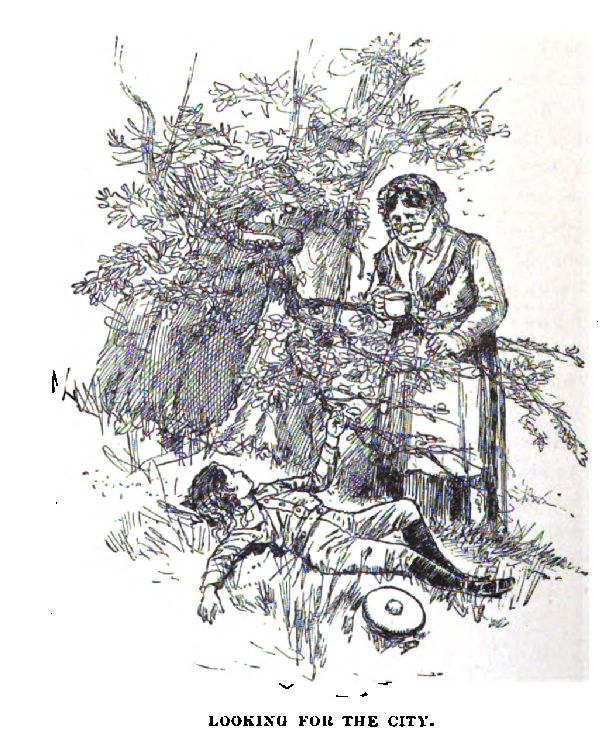
“And I went right to being good, that minute; and I have been good for as many as three hours, I should think. And say, how long have you got to be good before you can go through? And say, can you see it before you go through? And SAY”—
But I had got most out of hearin' then.
“And say”—
I heard his last “say” just as I got out of hearin' of him.
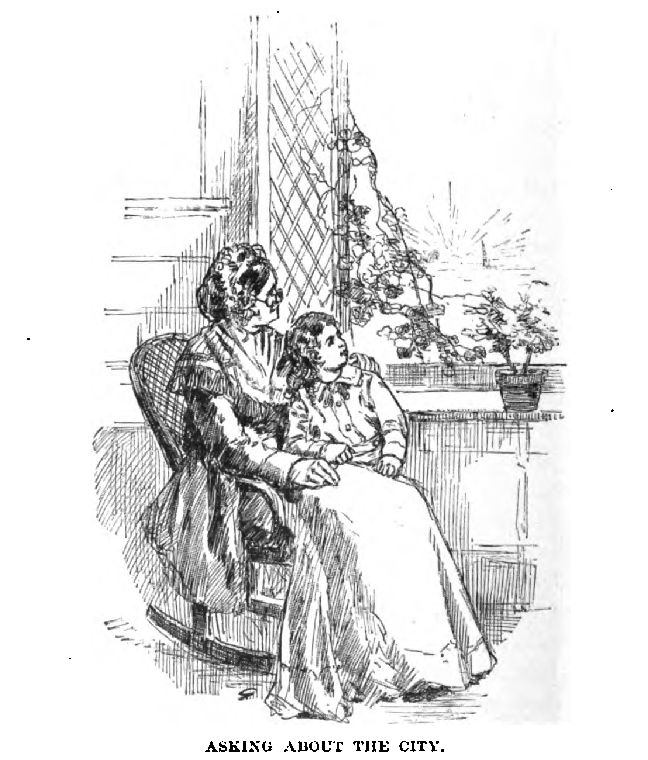
He acted kinder disappointed at dinner-time, and said “he wus tired of watchin', and tired out of bein' good;” and he wus considerable cross all that afternoon. But he got clever agin before bedtime. And he come and leaned up aginst my lap at sundown, and asked me, I guess, about 200 questions about the City.
And his eyes looked big and dreamy and soft, and his cheeks looked rosy, and his mouth awful good and sweet. And his curls wus kinder moist, and hung down over his white forehead. I did love him, and couldn't help it, chin or no chin.
He had been still for quite a spell, a thinkin'; and at last he broke out,—
“Say, auntie, shall I see my father there in the City?”
And I didn't know what to tell him; for you know what it says,—
“Without are murderers.”
But then, agin, I thought, what will become of the respectable church members who sell the fire that flames up in a man's soul, and ruins his life? What will become of them who lend their votes and their influence to make it right? They vote on Saturdays, to make the sale of this poison legal, and on Sundays go to church with their respectable families. And they expect to go right to heaven, of course; for they have improved all the means of grace. Hired costly pews, and give big charities—in money obtained by sellin' robberies, murders, broken hearts, ruined lives.
But the boy wanted an answer; and his eyes looked questioning but soft.
“Say, auntie, do you think we'll find him there, mamma and I? You know, that is what mamma cries so for,—she wants him so bad. And do you think he will stand just inside the gate, waiting for us? Say!”
But agin I thought of what it said,—
“No drunkard shall inherit eternal life.”
And agin I didn't know what to say, and I hurried him off to bed.
But, after he had gone, I spoke out entirely unbeknown to myself, and says,—
“I can't see through it.”
“You can't see through what?” says Josiah, who wus jest a comin' in.
“I can't see through it, why drunkards and murderers are punished, and them that make 'em drink and murder go free. I can't see through it.”
“Wall, I don't see how you can see through any thing here—dark as pitch.” Here he fell over a stool, which made him madder.
“Folks make fools of themselves, a follerin' up that subject.” Here he stubbed his foot aginst the rockin'-chair, and most fell, and snapped out enough to take my head off,—
“The dumb fools will get so before long, that a man can't drink milk porridge without their prayin' over him.”
Says I, “Be calm! stand right still in the middle of the floor, Josiah Allen, and I'll light a lamp,” which I did; and he sot down cleverer, though he says,—
“You want to take away all the rights of a man. Liquor is good for sickness, and you know it. You go onto extremes, you go too fur.”
Says I calmly, “Do you s'pose, at this late hour, I am goin' to stop bein' mejum? No! mejum have I lived, and mejum will I die. I believe liquor is good for medicine: if I should say I didn't, I should be a lyin', which I am fur from wantin' to do at my age. I think it kep' mother Allen alive for years, jest as I believe arsenic broke up Bildad Smith's chills. And I s'pose folks have jest as good a right to use it for the benefit of their health, as to use any other pizen, or fire, or any thing.
“And it should be used jest like pizen and fire and etcetery. You don't want to eat pizen for a treat, or pass it round amongst your friends. You don't want to play with fire for fun, or burn yourself up with it. You don't want to use it to confligrate yourself or anybody else.
“So with liquor. You don't want to drink liquor to kill yourself with, or to kill other folks. You don't want to inebriate with it. If I had my way, Josiah Allen,” says I firmly, “the hull liquor-trade should be in the hands of doctors, who wouldn't sell a drop without knowin' positive that it wus needed for sickness, or the aged and infirm. Good, honest doctors who couldn't be bought nor sold.”
“Where would you find 'em?” says Josiah in a gruff tone (I mistrust his toe pained him).
Says I thoughtfully, “Surely there is one good, reliable man left in every town—that could be found.”
“I don't know about it,” says he, sort o' musin'ly. “I am gettin' pretty old to begin it, but I don't know but I might get to be a doctor now.”
Says he, brightenin' up, “It can't take much study to deal out a dose of salts now and then, or count anybody's pult.”
But says I firmly, “Give up that idee at once, Josiah Allen. I have come out alive, out of all your other plans and progects, and I hain't a goin' to be killed now at my age, by you as a doctor.”
My tone wus so powerful, and even skairful, that he gin up the idee, and wound up the clock, and went to bed.