PART II THE HISTORICAL DEVELOPMENT OF SUSSEX (continued 2)
Reading edition
We have seen that upon the prehistoric origin of which we know hardly anything came Rome. We have seen that the Italian race laid down the bed upon which all the rest was to rise—a bed, firm, hard, and even, like their own concrete. It was a process occupying in this island some four hundred years.
Upon Britain, as upon every other western province, fell the barbarian invasions of the fifth century. We have seen that they were somewhat more severe here than in other provinces, and that Sussex in particular was swept clean by them, not indeed of her race, but of her religion and her civilisation. The darkness resultant upon this catastrophe lasted for little more than a hundred years, but in that hundred years everything which gives dignity to mankind had disappeared, and the countryside, from Romney Marsh westward away to Chichester Haven, had gone savage. We have seen that it was slowly re-Christianised and recivilised, but that the planting of good stems upon such a devastated soil was for long a difficult and an unfruitful business. The mission of St. Wilfrid coincides with the close of the eighth century. It is not till the middle of the eleventh that Sussex really re-enters the European unity; it is not till the close of it that the influence of that unity begins to be largely felt after the Norman Conquest.
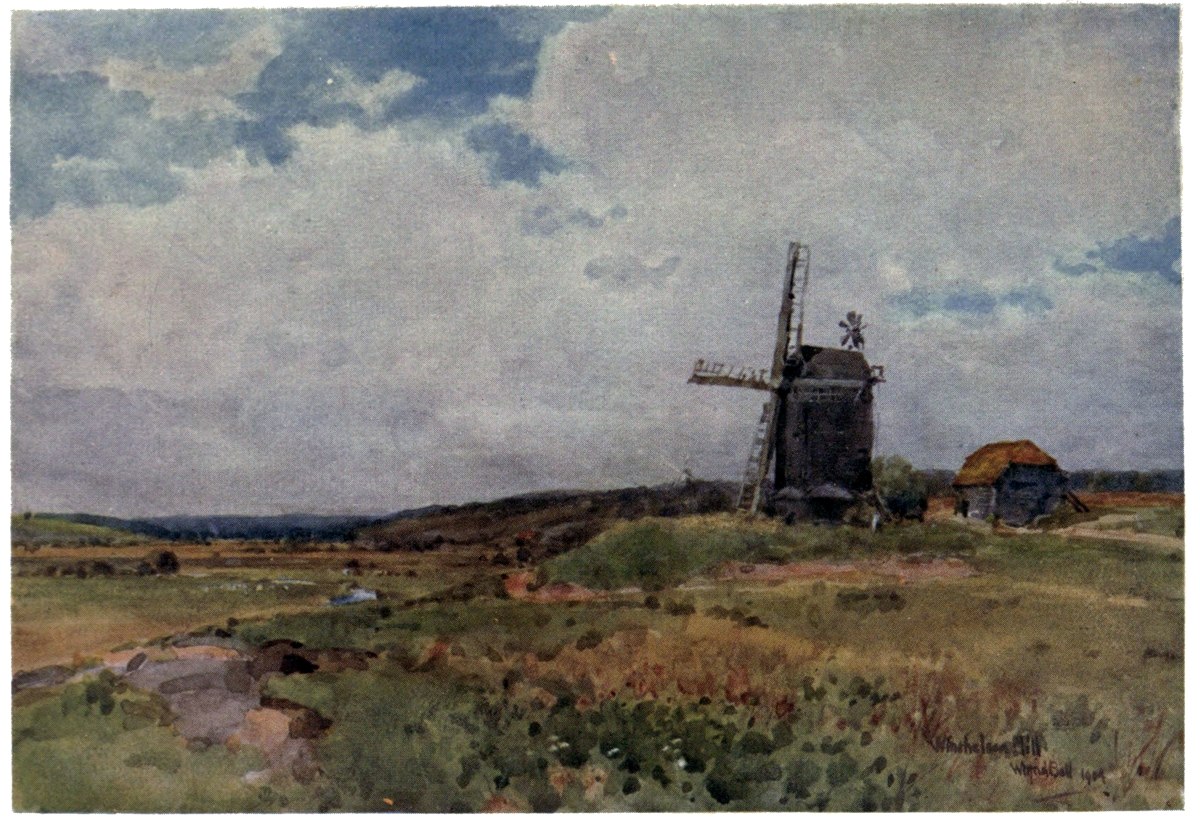
WINCHELSEA MILL
THE RISE OF THE SQUIRES
Two hundred and fifty years pass, during which the social development of England and of Sussex keeps the main lines laid down by the Conquest; the central government is still strong, the conception of tenure still weighs upon the wealthy class, and all men are responsible somewhere to some lord. Briefly, the mediæval system is during that period alive; here, as in northern France. And this island and northern France form, between them, until the close of the thirteenth century, the heart of Christendom. It is in them that arise the great philosophic discussions of the new universities, the Gothic architecture, the feudal scheme, the true co-operative industry of the mediæval manor.
For as long as that society could endure, that society was organised; and in Sussex the organisation, or, to use a better word, the sense of authority, is to be discovered in the great “Rape” overlordships, Hastings, Pevensey, Lewes, Bramber, Arundel, and Chichester, whose growth has been already sketched.
It so happened that that mediæval system grew old and failed.
The period of time between its failure and the present day is comparatively short, as the history of mankind goes. Its break-down is only apparent to the historian with the middle of the fourteenth century; it is not suspected by its own victims till the middle of the fifteenth. We are to-day but in the beginning of the twentieth. It may be said, roughly, that four hundred years of change alone separate us from that organic unity which had survived for fifteen hundred years from the civilisation that the Mediterranean brought us. We feel a world away from that organic unity of the Middle Ages, because these last four centuries have been so full of an active intelligence and of an increasing material knowledge, that these take up nearly the whole horizon of our minds; but our detachment is but apparent and illusory. At bottom our morals, in so far as they are permanent, our conception of civic life, our modern appetite for economic justice, are all rooted in the Middle Ages; and the more a modern man learns of them the more he feels that they are his native place.
The process of disintegration which the mediæval system suffered took in Britain a peculiar form, and in this most typical district of Britain, in Sussex, that form is clearly to be traced. The village, which was the unit of mediæval life, was essentially co-operative. As the segregation of individual industry arose, either the lord was certain
THE RISE OF THE SQUIRES
to become, from the head official of a corporation, a proprietor of the whole, or the villein, his tenant, was bound to become, from a member of a co-operative society, a proprietor of his part. There was not room for both. Elsewhere, in all northern France, and to some extent in the valley of the Rhine, the break-up of the mediæval system is the attack of the peasant upon his lord. It is (spread over a much longer period) something like the campaign which the Irish have inaugurated in our own time. It is a movement towards peasant proprietorship.
In England the development is very different. Feudalism in England, even when it was highly organised, as in Sussex, had to fight against a force which is almost inherent in the soil. For that force it is difficult to find a name, though it is a tendency clearly observable in the whole of English history. It may, perhaps, best be defined as the tendency of the English village group to submit to one lord, coupled with the lack of any tendency among these lords to coalesce under a superior. The system is essentially oligarchic, and its foundations were laid in the natural crystallisation of society during the anarchy of the Anglo-Saxon centuries. With his inheritance of law weakened, and his memory of a protecting government destroyed, the small man had not the wit or the courage to fight against the big man; hence the English squire. The big men had not the necessity forced upon them to unite in defence of an antique civilisation and a strong Roman tradition; hence the permanent insecurity and ultimate abasement of the English monarchy.
The latter of these two forces you see at work continually in the history of England during that space which lies between the Norman Conquest and the Barons’ Wars, when the attempt to govern from a centre was made and failed. The village aristocracy is always stronger than the Crown, and in some sense expresses a national action against the Crown. At first this aristocracy merely supported the barons (who were their nominal overlords) in the joint attack upon monarchy, but as the centuries pass the overlords themselves lose their hegemony. At last, round about the period of the Reformation, the lords of single manors, the squires, become completely independent, and their final, wholly successful effort matures when the Tudors are no longer there with their violent personalities to defend the symbol, the remaining symbol, of a central authority.
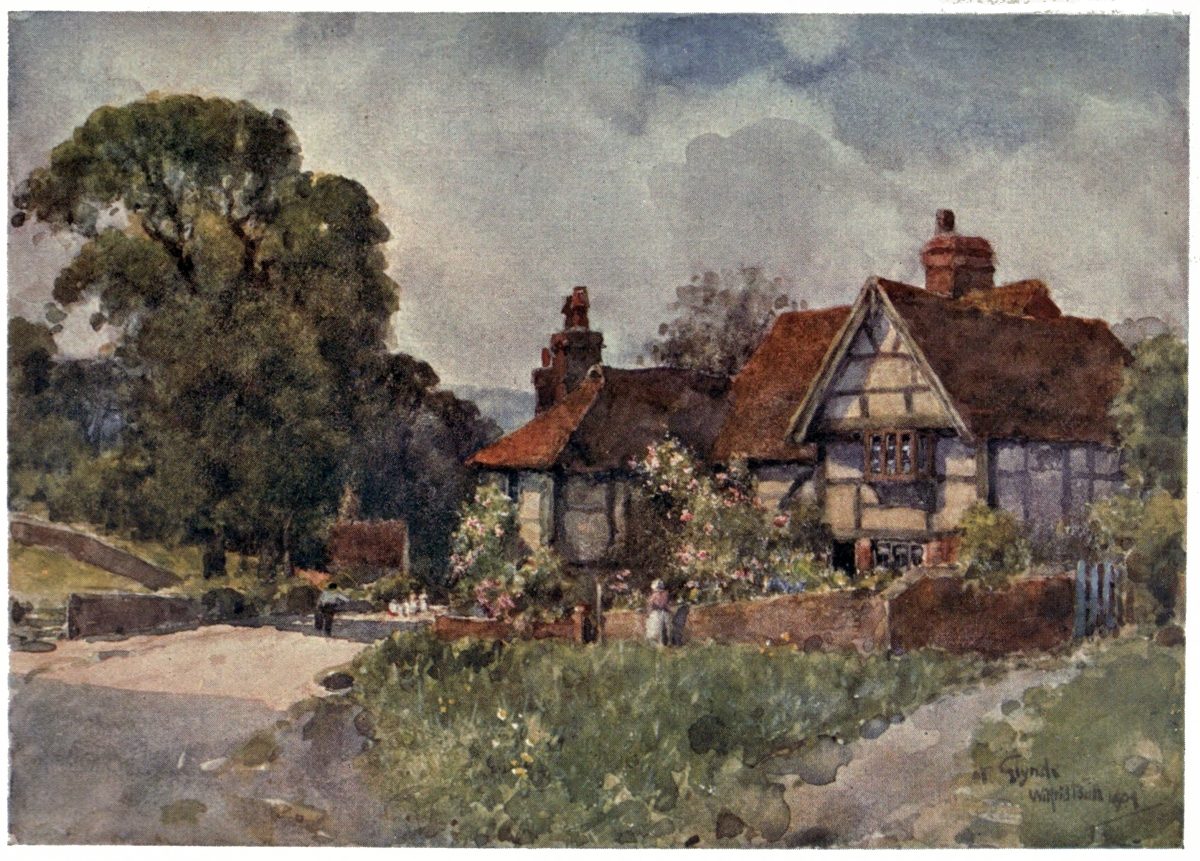
GLYNDE
THE SUSSEX FAMILIES
The Stuarts break down. The squires arm. The Crown is defeated. A king is beheaded. From thence onward a process which was easily apparent in the fourteenth and fifteenth centuries, which had taken on strength with the dissolution of the monasteries in the sixteenth, which had become of further importance with the large transfers of land at the end of Elizabeth’s reign, is completed. The seventeenth century sees in Sussex, as throughout England, the final victory of the village landlords, their complete possession of the soil and of the people who dwell upon it, and their complete independence from any authority over them.
There are many brief historical surveys which illustrate the rise of the landed families. Among the easiest for a general reader to take, and also the most instructive, is the list of the public offices of the county. We have a fairly complete calendar of the sheriffs from the purely feudal times to our own, and there we may trace the dignity falling more and more into the hands of county men. The local patriotism and its result, the strong local oligarchy, which are between them the warp and the woof of England, are exhibited here at one glance. The names mentioned are not always those of sheriffs for Sussex alone, especially in the earlier times; but their names and their places of origin are significant.
We begin that list not quite a hundred years after the Conquest, in the reign of Henry II. The names are drawn from all over England. They are merely royal officers and they do not concern us. But as the Middle Ages come to their end, the names which we can identify as those of the local gentry begin to tell. You get, just at the beginning of the Wars of the Roses, the Ashburnhams and the Stricklands. In Edward IV.’s reign you find for the first time a Goring (who was then not even a knight). You get the Gainsfords of Crowhurst, and the Coombes (honoured name!), presumably of Coombes in the vale of the Adur. Just before the Reformation the Oxenbridges of Brede and the Dawtreys of Petworth, who founded Hardham Priory, and whose name proceeds from the high banks (“d’Haute Rive”) of the water meadows of Arun. You get again that good Sussex name, the Palmers of Angmering, and so on to the Civil Wars. There are further Gorings and Morleys, also a Glynde, and, just before the struggle, a bishop a knight of Parham.
It is after the Restoration, of course, when the
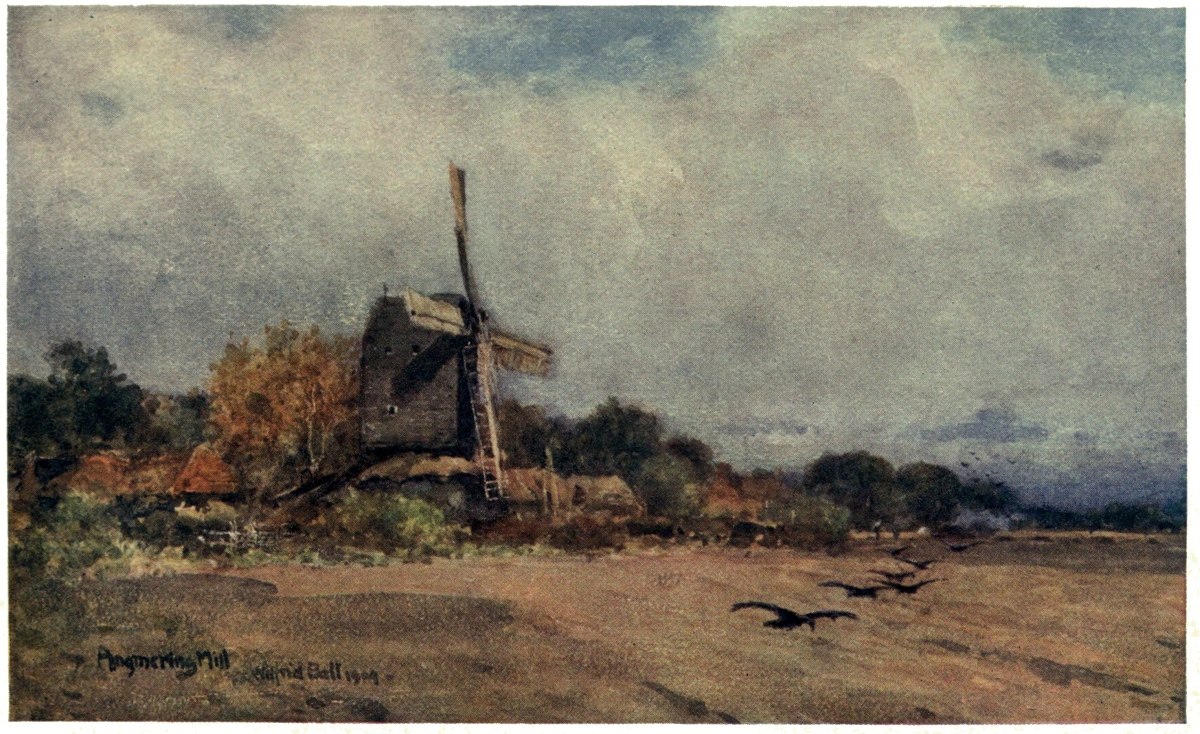
ANGMERING MILL
THE SUSSEX FAMILIES
victory of the squires was complete and final, that the habit becomes fixed, and that you find (until quite recent times) nothing but Sussex names in the great roll of the sheriffs. There is a sort of gap under William and Mary, who were usurpers and disturbed the order of England; but with Anne reasonable things returned. The names of Blunt and Shelley appear, which still adorn the county; and under the Hanoverians, the Bartelotts of Stopham, and many another family which still holds land within the centre and in the west of the county, are to be found upon the rolls.
Not until the Reform Bill does the tradition begin to change. Then you find a Curzon coming in out of nowhere; and since then, one must dare say, many another man who is simply rich, and who simply happens to have settled upon Sussex land.
We may now turn to examine in detail those Sussex families which have become bound up with the history of the county; some of them originally territorial; some of them professional, acquiring wealth in their professions, and achieving territorial rank; many of them passing from one part of the county to another, but all remaining a true framework for the countryside.
Alongside with them we shall be able to trace a most deplorable vicissitude in the ownership of certain manors which has, most unfortunately, not ceased to-day, but has rather increased, and which very seriously menaces the future integrity of the county.
It is impossible, of course, to give a complete survey of the process in these few pages, but the consideration of a few typical manors and, after that, of a few typical families will suffice to fill in that general impression of the county which it is the object of this book to convey.
Consider, for example, the Manor of Cuckfield, and see the way in which the squirearchy develops. One may presume that throughout the true Middle Ages it preserved at least a semblance of depending upon the overlordship of the Rape, and the Fitz Alans can count themselves its masters.
But as the Lancastrian usurpation breaks the great families a local consideration comes in. In the eighteenth year of Henry VI. the manor was divided between four co-heiresses, and so remained divided into four pieces (each still held by great families, but each holding the germ of a future squire in its small limits), until the last half of the sixteenth century, when two men, Bowyer and Covert, introduce (in the sixteenth and twenty-third
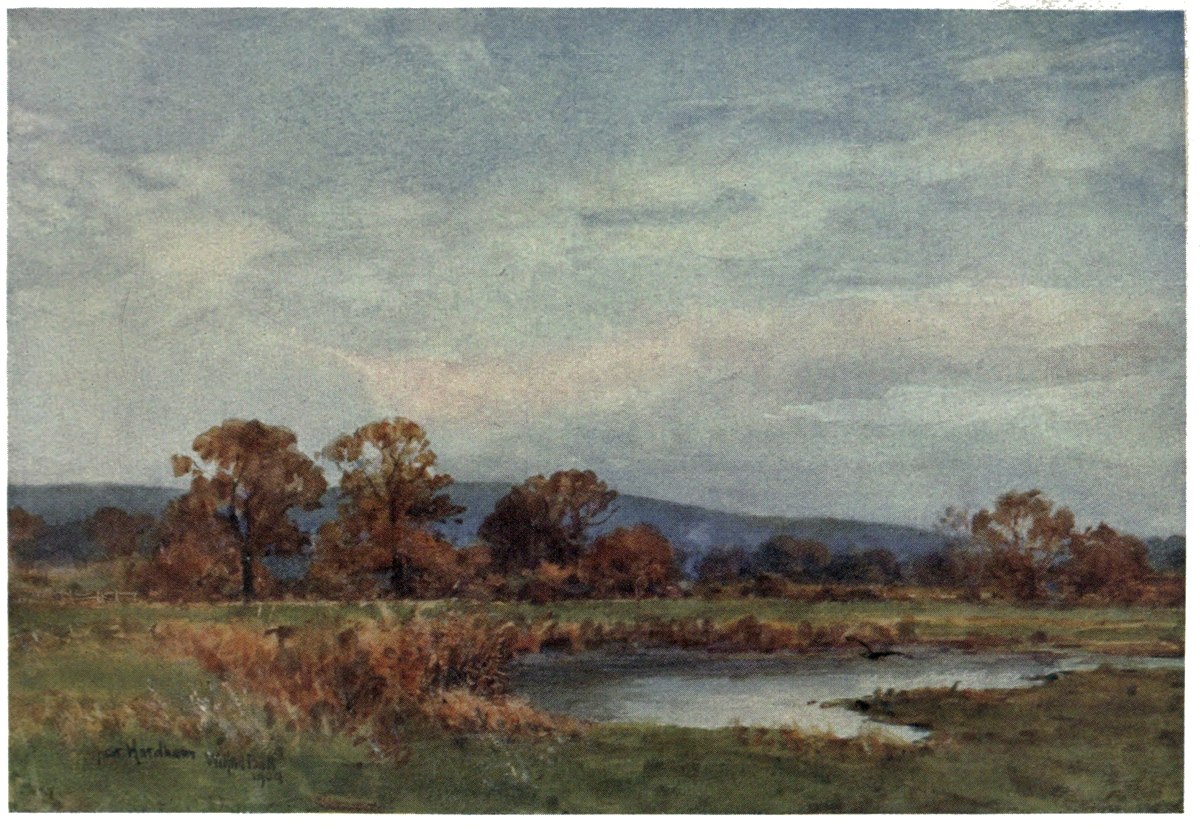
NEAR HARDHAM
GRAFFHAM AND LAVINGTON
years of Elizabeth respectively) a new stock upon the old land.
Within a hundred years there comes in one Sigerson, perhaps of the middle class, a Commissioner of the Navy; he buys the estate, his family hold it throughout the eighteenth century, and are the principal owners at this day.
This tendency of lands to remain in the same hands till the close of the Middle Ages, and then to be bought up by a new race of squires, may be traced in many another parish. There is Graffham, which does not change hands until after the Armada, when a certain Garter of London buys it; it then passes by the marriage of an heiress to the first of the Sargeants; an heiress of the Sargeants after many generations marries the man who was afterwards Cardinal Manning; another heiress (by this time the family held Lavington close by) marries Wilberforce, the bishop, and, right in our own time, his son sells it to a Scotch distiller.
Or consider again Madehurst which, until the reign of Elizabeth, holds of the Arundel earls; then one Dixse has it in fee; then it passes to the Kemps, and they sell it to Sir George Thomas (whose family sold it again), after which it passes by a second sale in 1825 to John Smith; and at last we see it in the middle and end of the nineteenth century in the hands of a manufacturing family who had chosen to assume the ancient name of Fletcher.
Eartham (to quote another example) went to King Henry VIII. in exchange for Michelham Priory; in the middle of the eighteenth century a Chichester man bought it, one Hayley; a generation later, Huskisson, the politician; then the Milbankes; and then again, quite recently, a man whose name is connected with a custard powder.
Singleton went down traditionally until the Reformation; nay, till that year after the Armada, when Graffham also had slipped; then, in 1589, it changes hands, passing from a noble to a squire. It remained in his family till the beginning of the eighteenth century; it is sold and re-sold, passing from hand to hand. Within present memory first a squire, and then a northern Quaker, and at last a wealthy racing family have held it, one after the other.
As might be imagined, the Church lands, their lineage abruptly torn apart at the Reformation, suffered fates even more revolutionary, and produced a squirearchy even more tenacious by its
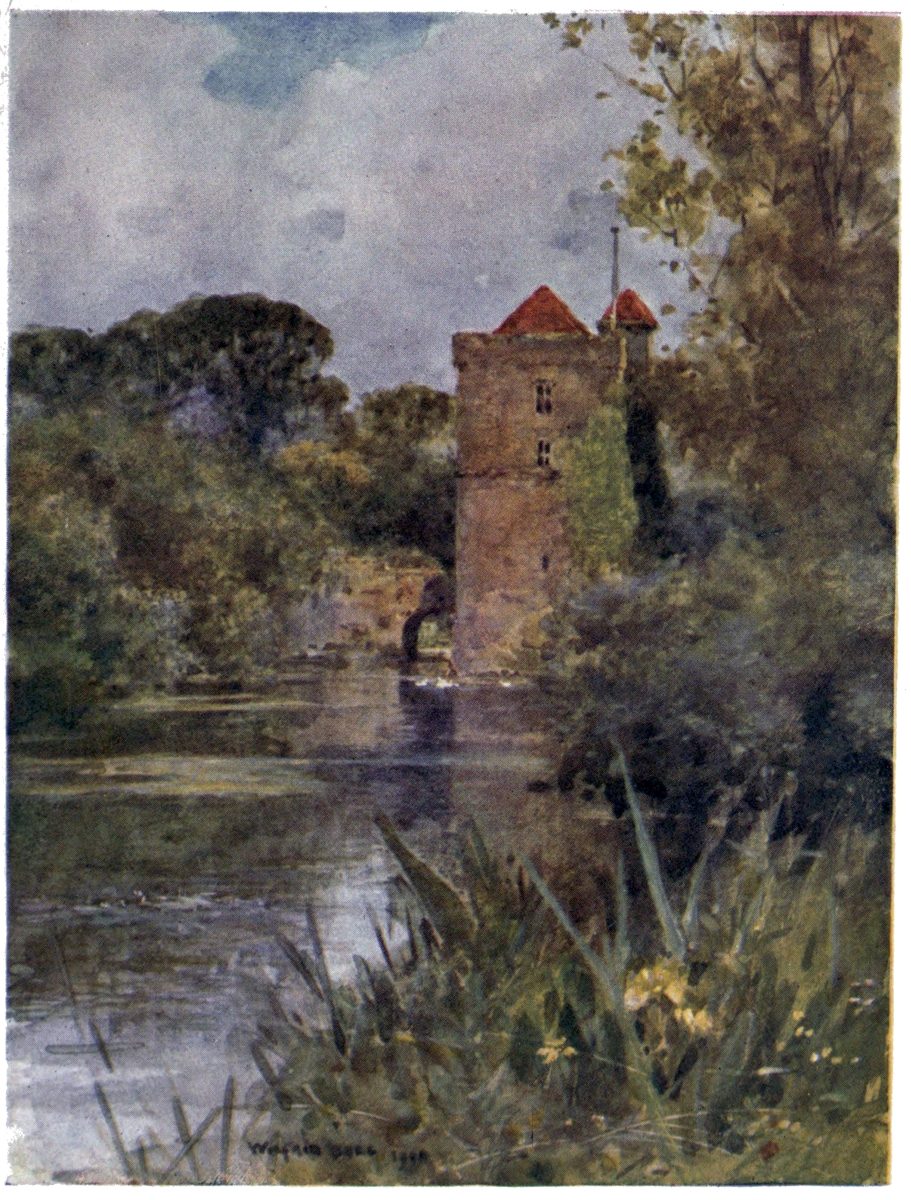
MICKLEHAM PRIORY
NEWTIMBER
wealth, and even less attached by tradition to the county of Sussex. Thus Newtimber, which had come down from Doomsday, is seized by Thomas Cromwell. The King chucks it to Anne of Cleves; then you find a Darrell in possession; then a Bellingham (holding of Lord Abergavenney in the sixteenth year of Charles I.) It is left to one Woodcock, whose daughter, after the Restoration, marries a Cust; and then, following the universal fate, it is sold to a yeoman of Poynings, one Osborne, whose grandson in 1741 sells it to a Newnham, whose grandson, again, early in the last century, sells it to a Gordon, etc.
An historian might make many exceptions. The fortified places have most of them held out (as it is their nature to hold out) against change. We have already pointed out that Bramber and Arundel have had a continuous tenure. Bosham goes right down from the confiscation after the Conquest to the nineteenth century without alienation. But take Sussex land as a whole: the sixteenth century first and the Restoration afterwards have dug an impassable gulf.
It is pleasant for those who love certitude to pass from such vicissitudes to something allied to the tradition of the land, but more permanent than it: the tradition of the owners of the land. It is pleasant to note the continuity of certain Sussex families, their origin, and their grip upon the soil.
Thus the Shelleys have not only glorified Sussex by producing at the end of their line her chief poet, but have also welded themselves into the soil of this happy county.
Shelley, whose great name might almost add something to the splendour of the land upon which he was born, will be remembered because that birth of his was next to Horsham. The story of his family will show how widely it was spread over Sussex land, and how worthy it was of inheriting such skies and such a landscape as could produce a master of verse.
The name, oddly enough, is from Kent; indeed there has been, since the centuries after the Conquest, a continual movement westward from Kent into Sussex of which the Shelleys are but one example.
Long before family names arose, while men were still called by their Christian names and their land was mentioned after them, the men of Shelley in Kent were lords of Shelley. They were there in the end of the thirteenth century, they were there until the middle of the fourteenth; at that epoch
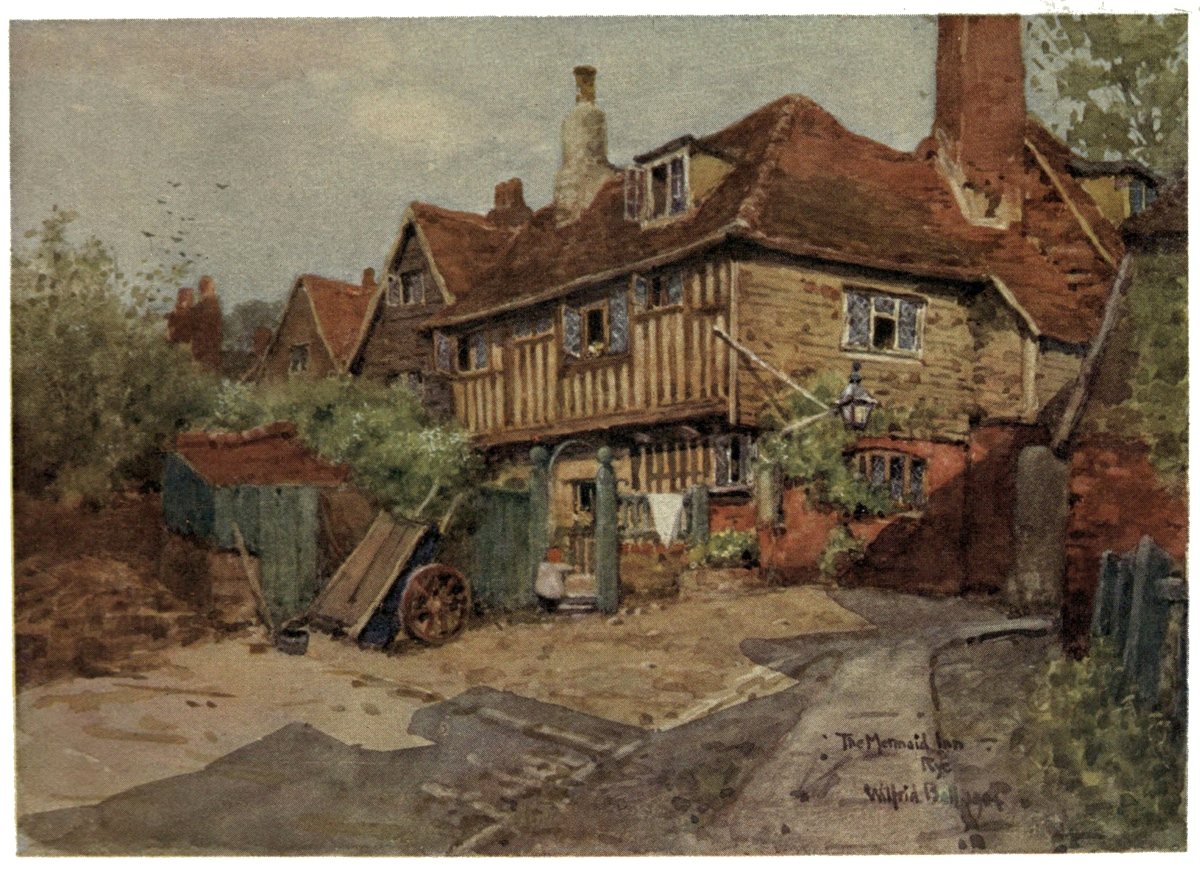
THE MERMAID INN, RYE
THE SHELLEYS
one John Shelley went westward, for the good of England. The Lancastrian usurpation, that watershed in our social history, is apparent here. John Shelley is returned for the Commons of Rye, just after Agincourt. He had a son who went still farther west, and, coming to Mitchegrove, married the daughter and the heiress of the lord of that place, a certain John, who took his name, as was right, from his own land. This settlement of the family endured through the Reformation. After this latter date the Shelleys marry into Buckhurst; still further on before the Civil Wars they exchange their Warwickshire lands for further Sussex holdings; in the eighteenth century one finds them marrying into Maresfield. Already they had a hold upon Findon. Up on St. Leonard’s Forest you find their name in one of the first of the ploughed lands which open that deserted belt, and they remain to-day Sussex in name, place, and position.
To take but one other example, and that of a very different kind, the Blunts of Crabbet Park are Sussex, though of a later stock. Here also we have a westward movement coming in with the last migration of the squires. For Thomas Blunt (a Collector of Customs in Kent) had a grandson, Elyas, fixed at Bolney; his name is not without significance of the time in which he lived. This man married the heiress of New Buildings after the Restoration, and perhaps in the Civil Wars the family acquired those waste spaces of the Crown which now make up the larger part of their holdings. At any rate that family has produced at the end of its line to-day another poet, and again a poet of Sussex.
The list might be multiplied, but it will be of little purpose to develop it in so short a summary as this. It is our purpose rather to show how, until quite recent years, Sussex lands ran into the hands of a group of families who perpetually interchanged their holdings, and who yet remained full of the county air, until there came that modern diversion by which so much of the county has fallen to those who have nothing of its spirit, and who only come into it as into a sort of park, for their momentary pleasure.
For until the last two generations nothing was more tenacious than the Sussex squire to his soil. Long after the Reform Bill, nay, right into our own time, Sussex land was not sold to outsiders, and Sussex social conservatism was unbroken. The moral health of its villages was keen and singular; the squire was of no excessive wealth, the farmer
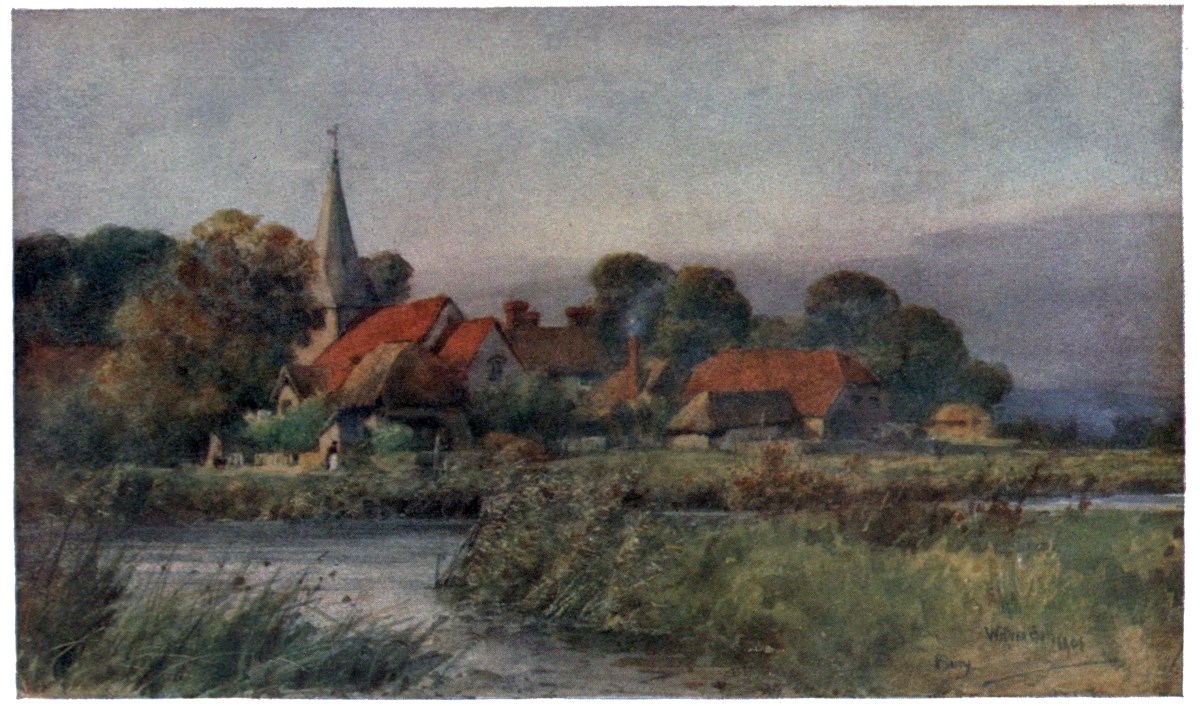
BURY CHURCH
SUSSEX JUST PAST
securing his tenancy, the labourer glad of his wage, and living on from grandfather to grandson, secure also of his position in the village. The old arts, which are the test of vitality in any commonwealth, survived—to this day there are villages where the thatcher can thatch as he can in no other part of England; for instance, in Walberton he can do so. To this day Sussex retains in some of her remoter hamlets, for instance in Bury, the true Broadcast Sower.
There is a phase of English history which all lovers of England look back upon with regret; it is a phase whose complete literary expression is to be found in Gray’s Elegy; it was in the purpose of whatever guides this county that such a phase should not be very long-lived, but while it lasted perhaps the happiness of the English countrysides was higher than it had been before within our historical memory, or will be again within the limits of our continuous tradition. Of this happiness it can be almost proved that Sussex presented the chief example, but just because the county had reached such a goal it was destined to a measure of change.
When Sussex had fallen into what seemed a permanent phase of large agricultural estates, held by the most contented gentry and tenantry in England, there fell upon this state of affairs a foretaste of what was to happen throughout the county with the great economic revolution of the nineteenth century; a great town began to arise and to grow with startling rapidity in one devoted portion of the countryside.
It is curious that Sussex, whose character and whose pleasure it has always been to live its own life, and to stand apart from the development of the rest of the island, or at least to develop only after the rest of the island has made its particular experiments, and has proved its experiments wise,—it is curious that Sussex should in this one case, and that a most important one, have gone before the rest of England. For Sussex was the county to develop the great watering-places and the great centres of population (as apart from the centres of industry) which first created, then were so vastly increased by, the railway system.
The reason is, of course, not far to seek. Sussex possessed the nearest coast-line to London, and presented that coast in an aspect most attractive to Londoners.
No very considerable harbours disfigure it. The trade with France was not a trade of such a
THE WATERING TOWNS
volume as that which has created Liverpool or long ago created Bristol. It was a busy, small agricultural trade.
Again, all along the coastal plain there is a beach; and a beach, when people once begin to take their pleasure by the sea, is a necessity for that pleasure.
Again, the line to this coast was close and direct. Every one who has bicycled or walked from London to the Kentish shores knows what a different task it is compared to a half-day’s run to the South Coast—the Sussex Coast is the “South Coast” for London, and the only one.
The first town to be developed in this manner was Brighton, and Brighton was not so much created by the fashion of the Prince Regent as by the fact of its proximity to London. It is the nearest point which Londoners can reach when they desire to enjoy the sea. It grew up in a manner to be paralleled nowhere else in England.
There are other characters in connection with the extension of this great town far more remarkable than the rapidity of its growth or the vastness of its population, as, for example, that it has affected to so slight a degree the neighbouring country around it; still the contemporaries of its growth were more struck by its rapidity than by any other feature. It began as a fishing town of 2000 souls. At the close of the last century it already counted 5000, in the year 1850 it measured 40,000—all this before the railway. When the effect of the railway was at its height, before the common use of the bicycle or the motor car, the development of Brighton was the most characteristically modern impress which the nineteenth century had made upon the landscape and nature of the county. It retains this pre-eminence in our own generation, but in a degree which is very probably to be lessened.
Somewhat later the other coast towns began to develop, and so long as the railway controlled that development, their growth was regular and almost according to a set law. Fashion or the doctors would recommend some point upon the coast. The long coastal railway from Brighton to Portsmouth afforded a station at the place, and the town increased in regular fashion, not with the station as the centre, but as the point from which branches spread out to the sea, so that these towns all more or less resemble a tree spreading from the railway station, and trippers hurrying from that station to the beach are like the deployment of a regiment
THE WATERING TOWNS
from column into line. These towns are, of course, stretched out along the beach; for their separate and successive organisation, the continual presence behind them of the coastal plain, with its railway parallel to the shore, has afforded admirable opportunities. That plain from Brighton to Bosham is perfectly flat; the crossing of the rivers has presented the only obstacle, and that obstacle was insignificant. The railway could run pretty well in a straight line and build up the towns along the sea.
Even to-day the villages are linking up with the towns. Rustington is full of bricks. Rottingdean, for twenty years a sort of suburb, has now long been full of painters and others. A curious collection of bungalows has sprung up on the long pebbly beach which shuts out the Adur from the sea. Opposite these barracks lies Lancing; and even upon the extremity of old Selsea a new settlement, now nourished by a light railway from Chichester, is arising. At Seaford, which is saved a little by its hills, the same attempt at rapid building is made.
There is one feature in this string of houses all along the coast of the county which Sussex men note with a pleasure not unmixed with malice. It is this, that while places of absolutely no commercial use and of no historical importance in the growth of the county are thus gradually being turned into appendages of London (so that all the way from Beachy Head to Chichester Harbour you have within the space of some fifty miles at least sixteen miles of houses), yet the places characteristically Sussex, the places upon the sea-line, which have gone to the building up of the county, and in which the population naturally gathered, continue to resist with extraordinary tenacity.
You can do nothing with Newhaven except leave it a port. Littlehampton refuses to be the pleasure ground that its landlord desires it to be. Bosham is still the ancient harbour and village which its history demands that it should be. Shoreham will not consent to become a lesser Worthing or a second Brighton, and this is the more remarkable from the fact that these harbour towns and villages are geographically more in touch with London than those other towns whose special character it is to lie sheltered by the hills and far from the gaps by which a railway could approach them from the north.
One may discover precisely the same state of affairs upon the eastern coast of the county
THE WATERING TOWNS
beyond Beachy Head. Here, for example, is the enormous development of Eastbourne, in a place which was useless for sailors, but sheltered from the winds by the neighbouring hill. Bexhill has increased along a beach which was not used until speculation had built the new town. Pevensey between them, upon its flat inland, is still deserted.
To this list Hastings is a very considerable exception, because its beach and hill made it during the Middle Ages, and for very different reasons to-day, a necessary sea-town. But, with the exception of Hastings, every other town follows a general rule, that the new growth of watering-places along the south coast is extraneous.
This long series of new towns grates upon men who have known and loved the county throughout their lives. There is little of Sussex about them; they have not the Sussex method of building nor any of the Sussex industries. Even their permanent population is largely drawn from other parts of England, and you do not hear the full warm accent of the south country often enough in their streets. The only consolation which the county can give itself as it watches this increasing line of new buildings is that, a mile or two behind them, their very presence seems to be forgotten.
A closer observer has another consolation, which is that the new methods of communication are perhaps beginning to check the tendency which existed throughout the nineteenth century to over-populate the sea coast. If men, foreign to the place, are trying to spoil the Weald, at least they are applying a counter-irritant to their too great success in spoiling the coastal plain, and in the Weald they have a larger area over which to spread their limited faculties for evil.
It is even possible that the power which the county has shown itself possessed of for so many centuries to digest and to absorb new-comers, will save it altogether from these latter invasions—possible, but doubtful. Then the descendants of those who now own Brighton, Worthing, and the rest, the children of the men who build villas on Crowboro’ top, and the heirs of the new-comers who have purchased, one would think, at least a third of the great old houses under the Downs, will be worthy of the soil which their ancestors certainly did not understand, and the historical development of Sussex will continue.
It is more likely that that development has already come to an unfruitful end.
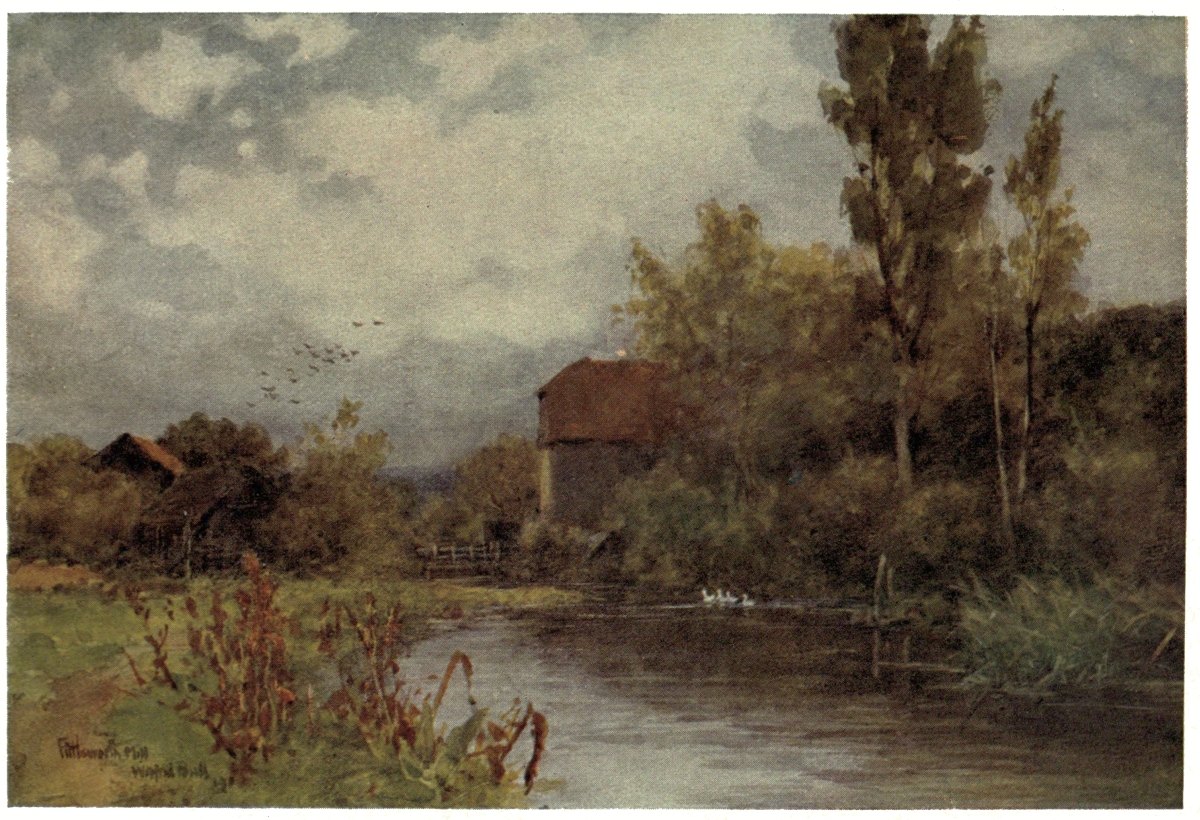
FITTLEWORTH WATER MILL