Front matter
Reading edition
A Complete Novel
By W. C. Tuttte
Author of “Just For a Laugh,” “Rustler’s Roost,” etc.
“Brick” Davidson hooked his spurred heels over the edge of his desk, shifted his position slightly and began rolling a cigaret, his eyes half-shut, as if deep in thought.
Brick was of medium height, with a thin, freckled face and red hair. It was red hair—not auburn at all; red hair, the color of a new brick. His mouth was wide, his eyes blue and ears rather prominent. Just now his faded blue shirt hiked up around his ears and his overalls threatened to withdraw from his short-topped high-heeled boots.
Over the wetting of his cigaret he squinted at the wall across from him, where a collection of reward notices covered the rough boards. There were many notices in this collection, with rewards ranging from fifty dollars to a hundred times that amount. Some bore photographs of those wanted, but the majority were mere descriptions, which might fit any one.
There were three other men in the office with Brick, seated in chairs near the desk; three serious-faced men who waited for Brick to speak. One of them was Bill Grant, a tall, sour-faced, middle-aged man, with a wispy mustache and a nervous manner. Another was Al Hendricks, heavy-set, dark-complexioned, slow of speech; while the third was Sam Leach, slight of physique, bat-eared and inclined to be sarcastic. Grant and Hendricks were ranchers, while Leach was a cattle-buyer. And the three of them composed the Board of Commissioners of Sun Dog County, of which Brick Davidson was the sheriff.
Brick lighted his cigaret and shifted his eyes to the three men.
“Well,” he said slowly, “I reckon yuh think that comin’ to see me will change things a lot, don’tcha?”
Grant cleared his throat, causing the wispy mustache to vibrate, and Brick grinned openly. The mustache amused him. He had remarked anent that futile effort of Grant’s, assuring him that he was too stingy to fill his soul with enough fertilizing to grow hair. And Grant was sensitive.
“We just came,” said Grant coldly, “to kinda talk to yuh about it, Davidson.”
“Sure, sure,” interposed Hendricks quickly. “We’ve been talkin’ among ourselves, Brick.”
Brick squinted at Leach, as if expecting some statement from him, but Leach’s sarcastic smile was his only response.
“There was that Red Hill hold-up,” said Hendricks suggestively.
“And the bank robbery at Silverton,” added Brick.
Leach laughed, but his laugh ended in a yawn, when Brick jerked his heels off the desk and turned in his chair.
“What in do yuh find to laugh at in that, Sam?” he demanded.
“Nothin’.” Leach was almost apologetic.
“’Course it ain’t nothin’ to laugh about,” said Grant. “It’s pretty serious, I’d say. In fact, it’s so serious that we’ve sent for a professional range detective to try and hang the crime onto the guilty parties.”
“Ye-e-eah?” Brick’s red mane of hair lifted slightly, as he inhaled deeply to control his temper.
“Yeah,” nodded Grant. “Of course he won’t interfere with yore office in any way, Brick. You jist go along like you’ve been goin’, and let him work it out in his own way. Them detectives sabe criminals.”
Brick grinned in spite of his anger. A wave of crime had swept across the Sun Dog country in the past few weeks, causing the sheriff’s office to ride the hoofs off their horses, but without results.
It began with the hold-up of the Red Hill stage, when the bandits had stolen the treasure-box, which held several bars of gold, from the Red Hill mine. A few days later the Redrock stage was robbed, netting the robbers several hundred dollars. Then, to cap the climax, two masked men entered the bank at Silverton and forced the cashier to hand them over five thousand dollars.
And they had left no clues. Descriptions varied until Brick was of the opinion that the jobs had been done by three different outfits. The driver of the Red Hill stage swore that there were only two men. One was a big man and the other rather below medium height. The tall man was the spokesman.
In the Redrock robbery, the driver declared that there were two men, one rather tall and slender, the other medium-sized. The medium-sized man was the spokesman. And the cashier of the bank, frightened almost into a panic, could not be positive that there were two or three men, but he did know that the slim one did the talking.
The peculiar feature of the bank robbery was the fact that a fire had started in a shack down at the other end of the town, and that while every one was down there, trying to put out the fire, the robbery had taken place. No one had seen the robbers enter or leave, except the cashier, who admitted that he was so frightened that he did not know which way they went after leaving the bank, nor whether they were on foot or mounted.
And now the county commissioners were employing a professional thief-catcher. Brick reshaped his cigaret and smiled.
“He’ll prob’ly catch ’em,” Brick mused aloud.
“Y’betcha!” Sam Leach got to his feet, indicating that as far as he was concerned the meeting was over.
The others got to their feet as a man entered the doorway and halted just inside.
It was “Harp” Harris, the deputy sheriff. Harp was about two inches over six feet in height, but so thin that he looked much taller. His face was set in lines which combined both hope and despair—with despair predominating. His mouth was wide, his nose thin and almost transparent, while his ears grew at right angles to his face, giving him a perpetual listening expression.
Harp squinted at the three commissioners and shifted his eyes to Brick.
“Havin’ a li’l party, Brick?” he asked softly.
Harp was not any too popular with the commissioners.
“Democrat,” replied Brick, grinning.
Grant and Hendricks forced a smile, as they walked past Harp, but Leach gave Harp a sarcastic squint, bestowed upon him a look of disgust and walked past, with his nose in the air. Harp turned and pursed his lips as he watched Leach disappear. Brick grinned, as Harp turned and snorted softly.
“Some day I’m goin’ t’ just about squirsh that jasper,” said Harp slowly. “Jist squirsh him absolute and final. What did them three fried aigs want, Brick?”
“Their main object was to see if I’ve forgotten that there’s crime among us,” replied Brick.
“Oh!”
Harp’s nose twitched slightly and he sat down against the wall, ignoring the three vacant chairs. From his pocket he took a jew’s-harp, fitting it carefully between his teeth. Brick squinted at him thoughtfully, shaking his head.
“Don’t,” said Brick pleadingly. “My , ain’t there enough misery in the world without you addin’ to it, Harp?”
Harp removed the offending instrument and dangled it across his knee, clutched in a bony hand. He nodded understandingly, his serious eyes considering the troubled sheriff. It was not often that Harp would quit playing until he was ready. He was not musical, but seemed to derive much enjoyment from his own efforts.
“Aw right, Brick—I won’t regale yuh with music now. Sad music cheers me up, don’tcha know it? Sometimes, I wonder—” Harp rubbed the palm of his hand on the tightly drawn knee—“I wonder why paw didn’t educate me for the undertakin’ business. Man, I’d ’a’ sure been a dinger. I jist love to hear them singin’ ‘Rock of Ages,’ and by golly, I—”
Brick reached for his gun and Harp threw up both hands.
“You danged pall-bearer!” snorted Brick. “You keep up that kind of talk and there’ll be singin’—but you won’t hear it.”
“That’s right—jump onto me.” Harp grew indignant. “You big bully! I s’pose you’d strike me, wouldn’t yuh? Huh! It’s brutes like you that makes this world hard for us frail critters. I do everythin’ I can for yuh, and this is the treatment I get.”
Brick slumped down in his chair and began rolling a cigaret, as someone came clumping along the wooden sidewalk up to the office door. Then a head, surmounted by an ornate sombrero, was shoved inside from an angle that would indicate the man to be of abnormal height. The face beneath the sombrero was both broad and long, serious, except for the wide brown eyes. Brick glanced up at him, but showed no recognition. Harp squinted at the door, looked back at Brick and slapped himself on the knee.
“Now, jump onto me,” he invited Brick. “Abuse me, cowboy. Go ahead and try to be cruel. Ha, ha! Succor is at hand.”
“Sucker?”
The big man came inside and started slowly toward Harp, who threw both hands up to his face, as if to shut out the sight.
“Who’s a sucker?” demanded the big man, shaking himself until the silver conchos of his bat-wing chaps creaked under the strain.
He slapped a big palm against his holster and halted in the middle of the floor.
“Love of gosh!” exclaimed Harp. “It’s little Lord Fauntleroy! Welcome home.”
The big man started toward Harp, but Brick slid between them and he halted.
“You danged cow-town comedians can’t bust up my office,” declared Brick. “Set down, ‘Silent’—you runt.”
Silent Slade flapped his big arms dismally and sank down in the nearest chair.
“I seen them three deuces walk out of here; so I come over to see what the rest of the deck was doin’,” said Silent. “I can smell trouble when I see them three pelicans together.”
“Brick’s so danged dumb that they has to come over here every week to remind him he’s the sheriff,” offered Harp seriously.
“Ought to pin his star on the wall,” observed Silent. “Might nail her to the door, so every time he comes up to the place he’ll know what he’s comin’ here for.”
But Brick did not take offense at their jokes. They knew that Brick was capable, honest, and was doing everything in his power to keep the peace of Sun Dog County. Silent Slade worked for the Nine-Bar-Nine cattle outfit, located about twelve miles southeast of Marlin City, where Brick had been foreman before he had been elected sheriff. Harp Harris had also been one of the Nine-Bar-Nine cowpunchers.
Old Lafe Freeman, owner of the Nine-Bar-Nine, had sworn to high heaven that the gods were against him when he lost Brick and Harp. Old Lafe was a little, old, grizzled cow-man; one of the fast-disappearing type of old-timers, who had carved out a niche in cowland with the combination of a six-shooter and square-dealing.
After an appreciable period of silence, the big Nine-Bar-Nine cowboy yawned widely and audibly.
“Didja ever try sleep for that?” queried Harp.
“That has all the earmarks of a jest,” observed Silent. “Some day I’m goin’ to date time from the minute yuh made me laugh.”
Silent turned to Brick, opened his mouth to capacity and yelled loud enough to shake the windows—
“How in are yuh?”
“Kinda downcast,” replied Brick softly.
“Uh-huh. Yuh ought to be. Say, old Lafe’s been down to Silverton—kinda ridin’ around—and he says it don’t look a of a lot like you was goin’ to be reelected, Brick.”
“Thasso?” Brick showed interest. It was nearing the first of October, and in November the primary election would be held.
“Dang right, it’s so,” nodded Silent. “Lafe says that you ain’t noways as popular as yuh was a few weeks ago.”
“What have I done?” queried Brick, grinning.
“Well,” Silent grinned widely, “they seem to think yuh ain’t done nothin’. I s’pose them three high-and-mighties were over here to kinda invigorate yuh, wasn’t they?”
Brick nodded. He realized now that these robberies were happening at a very inopportune time for him. The Sun Dog voters were very likely to judge him on present showings instead of on his past records; and the sheriff’s office was the one big issue in cow-land politics.
His opponent, Henry Stagg, known as “Hank,” had been considered more or less of a joke as a candidate. He operated the stage lines from an office in Silverton, where he could be found at nearly all times, reciting his own deeds of valor.
Hank was tall and angular, with a raspy voice and a wonderful vocabulary of profanity, gained from driving stage teams. He wore his gun in a shoulder-holster, because his hips were too thin to support a belt, and his favorite amusement was shooting magpies on the wing with a thirty-thirty rifle. This latter branded him as a fairly good rifle shot.
“They brought me some very good news,” said Brick. “When it comes to bringin’ good cheer, they’re a fine flock of buzzards. Sun Dog County is to be investigated by a professional detective and I’m to just go along in my own dumb way and let him do the lookin’ through the knot-holes.”
“Is—thasso?” Silent exploded and his mouth remained open.
“Relax!” snorted Harp. “My gosh, anybody’d think by yore face that it was in the dead of Winter instead of fly-time, Silent.”
“Hm-m-m! I’m dead amazed.” Thus Silent seriously.
“Settled fact,” grinned Brick. “I dunno who he is nor how many of ’em is to come among us; so don’t question me. I didn’t know that the commissioners took my job so seriously.”
“And they don’t even ask us to help him,” added Harp.
“Well, you hadn’t ought to let that worry yuh,” grinned Silent. “As far as the detective is concerned, somebody will probably kill him before he gets far into the mystery; but things are sure breakin’ bad for our li’l sheriff.
“Lafe was talkin’ with ‘Soapy’ Caswell, and Soapy is kinda inclined to the opinion that Brick ain’t exertin’ himself none to speak about. He didn’t come right out and say it, but that’s the impression he handed Lafe.”
“And he swings the vote of Silverton,” said Harp sadly. “He dang near swings Sun Dog County, as far as that’s concerned. He owns the bank here in Marlin, the Silverton bank and the Redrock bank; and when yuh own enough banks, yuh kinda controls a lot of them X’s that folks mark down on their ballot.”
Brick straightened up in his chair and reached for his tobacco.
“You two jiggers must ’a’ got up on the wrong side of the bunk this mornin’, didn’t yuh? Mebbe I better order all flags at half-mast and put crape on the door. All I’ve got to do is to beat Hank Stagg for the nomination.”
“Yeah, that’s all,” said Silent dryly. “Just beat Hank for the nomination, tha’sall. And then you’ve got to beat the nominee on the other ticket. But let me tell yuh somethin’, red feller: If you don’t put the deadwood on these stick-up jaspers pretty danged quick, you couldn’t beat a drum.
“I ain’t raggin’ yuh, Brick. knows, I’m for yuh. But it’s a cinch that there ain’t another man in Sun Dog County that can do more than you’ve done; but folks don’t stop to consider that part of it. Yo’re hired to catch criminals—so you’ve got to catch ’em, tha’sall.”
“Tha’sall,” nodded Brick seriously. “I remember when I was a little kid I had to recite a poem in school. It was somethin’ about Napoleon Bonaparte. It had a line like this—
“A very easy thing to plan, but difficult to do; As Wellington made clear to him one day at Waterloo.”
“Or it might be kinda like the Frenchman’s flea-powder, in which the directions said, ‘First catch the little flea.’”
“Still, it might be a danged good thing for me and Brick, if he did get beat,” observed Harp. “Livin’ in the city this-a-way is plumb ruinin’ both of us.”
Brick grinned at his deputy, but the lanky one was serious. Marlin City was a city in name only. By virtue of its central location, it was the county-seat of Sun Dog County, but this honor had never caused it to advance beyond the small, cow-town stage.
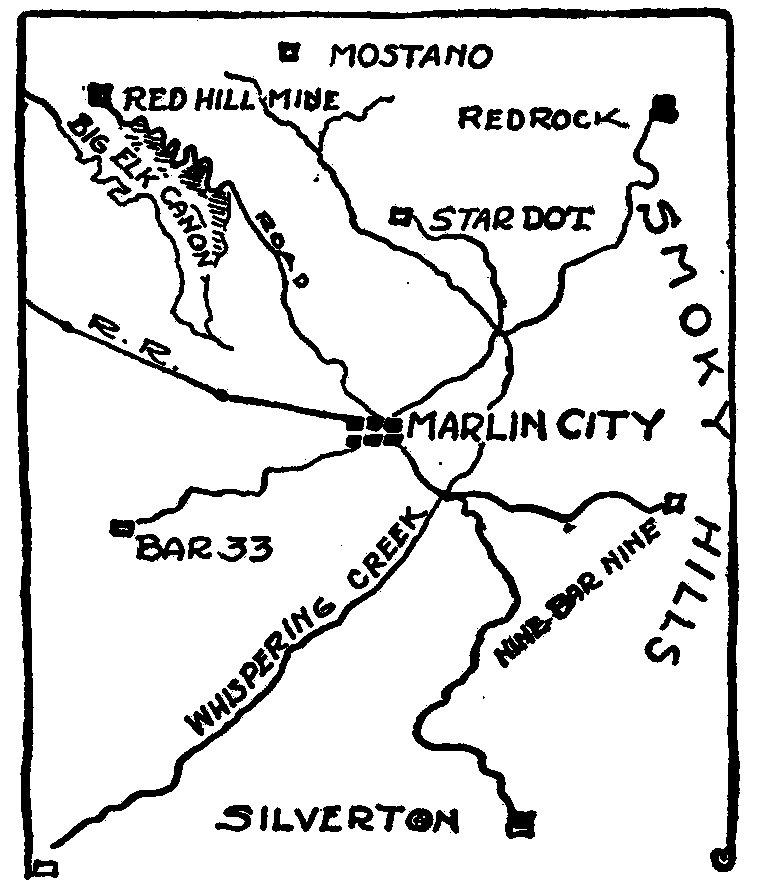
It had one street, not too straight and not too long, bordered with unpainted buildings, which were mostly of the false-fronted style of architecture. The wooden sidewalks, four feet in width, oozed pitch in the Summer; and in the Winter the excessive cold caused the nails to snap out of the two-by-four girders, leaving the top-boards free to rattle and clatter underfoot, like walking over an unmusical xylophone.
Of shade-trees there was none. In fact, someone had said that there was only one tree between Marlin City and the North Pole. A branch line of the C. P. Railroad had recently been completed into Marlin City, giving them transportation for stock and mining products; but the advent of a railroad had not caused any perceptible boom in the country.
Brick Davidson had been sheriff of Sun Dog County for two years, during which time both Silent and Harp had worked as deputies; not because they liked the work, but because Brick had needed the services of trustworthy men. Silent Slade had won his nickname because of his ability to talk continuously. He was never short on conversation, except when asleep. Silent was slow of movement, because of his great size, except when the occasion demanded speed; but he was not slow of temper.
Harp Harris was slow to anger, but loved trouble. He could ride anything he could saddle, and rope with deadly accuracy. But his favorite occupation was playing the jew’s-harp. And no one except Harp could recognize his tunes; but there was something about that weird tung-g-ging that soothed the soul of the lean, angular cowpuncher and caused him to relax and close his eyes in ecstasy.
Just now he placed the instrument between his teeth, relaxed against the wall and struck a preliminary note.
“My !” exclaimed Silent, getting to his feet. “That thing is about to start agin’, Brick. C’mon; I’ll buy yuh a drink.”
“All right,” grinned Brick.
They walked outside, leaving Harp humped against the wall, moaning through the vibrating tongue of the harp, his right hand fanning slowly past one of his bat-ears, his eyes shut; while one of his upturned feet jerked an occasional accompaniment, all out of time with the beat of his alleged tune.
“By Gosh, you bettair keep away from de grizz-a-lee,” warned Mose La Clede, a gaunt, bearded Canadian-Frenchman, hitching his belt higher about his hips and shifting the huge quid of tobacco in his cheek.
“She’s de bad wan, and she’s ’ongry for little boy.”
Little “Whizzer” Malloy, five years of age, lifted his inquiring brown eyes and backed away so quickly that the dragging spur on his little foot tripped him and he fell flat in the dirt.
“Ho, ho, ho!” laughed the big man, as he picked the little fellow up and stood him on his feet.
The big grizzly in the pole cage rumbled deeply and flung his chest against the front of the cage, biting at the barrier. The semicircle of curious onlookers grinned as the youngster backed away, trying to straighten the spur and watch the bear at the same time. A horse, tied to one of the hitch-racks, snorted as the bear-scent assailed its nostrils, and snapped the tie-rope on a backward surge.
A cowboy spat out a curse, ran into the street from a saloon and cornered the animal before it had a chance to leave for parts unknown. That the idle population of Silverton was interested in Mose La Clede’s grizzly was attested by the fact that most of them were already crowding around the cage, which was placed in the street in front of the stage-office.
La Clede had trapped the animal in the Smoky Hills, where he had kept it until making a deal with an Eastern zoo. It was a full-grown specimen, savage as a tiger and as powerful as any four-legged animal could be. The pole cage creaked under its lunges, and the crowd shifted uneasily.
“How much does he weigh, La Clede?” asked Hank Stagg, who stood at a respectful distance.
Hank was in charge of the stage lines, and it was one of his vehicles that was to transport the grizzly to the railroad at Marlin City.
“By gosh, I’m dunno,” replied La Clede, scratching his head. “We weigh her on de hay-scale and she’s twelve hundred, forty pound. De cage weigh—I’m dunno how much, but I’m t’ink de bear mak’ ’bout ten hun’red.”
“Then how in are we goin’ to load it?” queried Hank. “There ain’t enough of us to lift that weight.”
“I’m know how,” grinned La Clede. “We tak’ two, t’ree plank and some round pole for de roller, sabe? We block de wagon, hitch team to cage by de rope, and pull her up.”
“All right,” growled Hank. “Get yore planks and rollers.”
The crowd, ever ready to assist, went in search of the required articles, while “Baldy” Malloy, the Whispering Creek stage-driver, went to the livery-stable to get the team, followed closely by Whizzer, whose spur tripped him every few feet.
But Whizzer did not whimper. He felt that the spur made him a cowpuncher, and he would wear that spur if it was the last thing he ever did. Whizzer’s mother had died shortly after he was brought into the world, and Whizzer had soon learned that there was little sympathy in the world for a cry-baby.
Not that Baldy did not love his son. He thought that the sun arose and set especially for Whizzer, and they were inseparable when Baldy’s trip was finished. Baldy was short, fat and bald, with weak, blue eyes and an insipid, rope-colored mustache.
Back they went from the stable with the team of half-wild bronchos, almost unmanageable when they scented the bear. Whizzer carried his spur in both hands, as he trotted along behind in the dust, his brown eyes wide with anticipation.
Two heavy planks had been secured, and some men were coming with a pole, which would be cut into short roller-lengths. One end of the cage was lifted onto the planks, which extended into the rear of the wagon-box, up which the cage was to be dragged.
At risk of losing one or both of his hands, La Clede managed to insert a rope through the bottom and side of the cage, tied it tightly and flung the loose end out over the front of the wagon.
The cage was tilted slightly and a roller inserted beneath.
“By , I don’t like that cage!” declared “Slim” Hunter, a sad-faced cowpuncher. “Them there poles ain’t fastened with nothin’ but rawhide.”
“By gosh, dey hold,” panted La Clede. “Plenty rawhide. She’s put on wet, an den she’s dry hout. Bettair den de nail.”
Baldy was having trouble with the team, which were frantic from the bear-scent and from the angry, deep-throated rumble of the big beast. With the help of two more men he managed to fasten the rope to the double-tree, and was ready for the loading.
“Keep ’way from de cage,” warned La Clede. “Dat bear she’s reach hout. All right—hup she’s go!”
There was no chance for a steady pull. The frightened team surged into their collars, fairly jerking Baldy off his feet, and the bear-cage went slithering up the planks and into the wagon-box, catching one corner of the box and ripping it loose from the wagon-bed.
“Whoa!” yelped La Clede. “Stop de team!”
But the team had ideas of their own. They swung sidewise, kicking, plunging, with Baldy digging his heels into the hard surface of the street, trying to stop them. Further around they swung, until at right angles to the wagon they straightened out the rope and fairly yanked the bear-cage through the side-board of the wagon.
For a moment it seemed to hang in midair, then crashed down to the hard earth, striking on one corner. Came the snapping of overwrought rawhide, the splintering of poles, and the grizzly, dazed, fighting mad, shook the poles off his roached neck and stood forth as free as he was the day before La Clede’s trap cut off his freedom.
Brick Davidson was riding into Silverton, and drew up his horse about a hundred feet away from the scene of action. He did not know what was being done until the grizzly emerged from the shattered cage.
In the excitement Baldy let loose of his lines and the team bolted with the remnants of the cage bounding and crashing along behind them. Horses broke away from the hitch-racks and dashed wildly about the street, but no one paid them any heed. The crowd had scattered for places of safety, except little Whizzer Malloy, and now they fairly screamed their warnings to the little, brown-faced, brown-eyed baby, who stood there in the middle of the street, spur in hand, facing a blood-hungry grizzly.
They were not over six feet apart. Somewhere a six-shooter cracked, fired by a nervous hand, and the bullet spouted dust between the baby and the bear. With almost incredible speed for such an unwieldy-looking animal, the grizzly closed the gap, knocking little Whizzer flat on his back.
“Don’t shoot!” screamed Baldy Malloy. “My God, don’t shoot!”
The big bear was master of the situation now. With mane erect, rumbling defiance at those who had attempted to send him into captivity, he crouched lower over the dazed child. Suddenly his head dropped and he gathered the child in his mouth. As he swung up his head Brick Davidson was running toward him, six-shooter in his hand.
Someone yelled a warning at the red-headed sheriff, but he did not hesitate. Brick was making his attack from the rear and he was making it at top speed. Someone in the crowd threw a sombrero in the direction of the bear, which swung its head, as though to meet this new danger; and at that moment Brick fairly leaped through the air and landed on the grizzly.
It was so unexpected that the bear remained motionless for a second; and in that moment Brick twisted his left hand into that roached mane and set his spurs deeply into the powerful shoulders of the animal.
With a flip of its neck the grizzly flung little Whizzer aside and the little boy started crawling blindly away. Quick as a flash the bear whirled completely around, seeking to dislodge this new enemy, but Brick was all set for the ride.
Two powerful lunges failed to unseat the rider, and then the bear reared upright, clawing wildly, roaring with rage. Brick was, in range parlance, “pullin’ leather,” but none of the audience denied him that right. It was the first time that any of them had seen a bucking grizzly.
But no one came to his assistance; no one wanted to get within reach of that terrible mount. And as the grizzly, upright on its hind legs, threatened to fall backward, Brick’s six-shooter spouted flame and lead into the animal’s brain.
Twice the big .45 roared dully before the grizzly plunged forward from its upright position. It went flat in the dirt, surged to all fours, but went down again from the third shot, sprawling in a grotesque heap. Brick fell off, rolled over once and came back to his feet, ready for more.
But the grizzly was finished. The three big slugs of lead had done their work, and the Eastern zoo would never see the big grizzly from the Smoky Hills.
The crowd surged into the street, too amazed for words. They quickly surrounded Brick and the grizzly, trying to congratulate Brick and to alibi themselves at the same time.
“I throwed the hat,” announced Slim Hunter proudly. It was like the sparrow’s announcement of, “I killed Cock Robin.”
Baldy Malloy, hatless, his face streaked with perspiration and dust, carrying little Whizzer under his arm, broke through the crowd and halted in front of Brick. He was breathing too heavily for words, and could only stare at Brick, who grinned widely at the serious expression on little Whizzer’s face.
Baldy did not offer to shake hands with Brick; just stared at him in a dazed way. The crowd was silent now. Then the youngster shoved out two little grimy hands, clutching at the big spur, and announced in a triumphant treble—
“By golly, I held onto her, y’betcha!”
Baldy glanced down at the two hands, shifted the boy to where he could grasp him with both hands, hugged him tightly to his breast and stumbled away with the one muttered exclamation—
“God!”
The crowd stared after him for a moment and turned back to Brick, whose eyes were suspiciously moist. Mose La Clede’s big, bony hand was thrust out to Brick, and his voice boomed:
“By gosh, dat was nervy treek! I’m los’ de bear, but I’m glad for save de leetle keed. You mak’ de good ride, sheriff; by gosh, you mak’ de good ride!”
“I sure throwed that hat,” announced Slim again. If there was any glory to spare, Slim wanted some of it.
“I’m sure glad yuh thought of doin’ that, Slim,” said Brick warmly. “It attracted him long enough to give me a chance to make my mount.”
“I knowed it,” grinned Slim, “and I sure timed m’ throw. It takes quick thinkin’ in a case like that.”
“I’m buyin’ a drink for everybody!” yelled Otto Falk, proprietor of the Short Horn saloon. “Come and get it.”
The crowd was willing. They needed something strong now.
“I’ve got a perfectly good team out there some’ers, draggin’ what used to be a bear cage,” complained Hank Stagg. “They’ll prob’ly be plumb ruined; but I’m goin’ to have a drink. By , I’m through with grizzly bears. That big son-of-a-gun was jist about to glom that poor little kid.
“Wasn’t he sore? Whoo-ee! I betcha that grizzly could ’a’ whipped all the lions in Africky. Might as well try to stop a railroad ingine. Quick, too; quick as ”
“My hat’s ruined, too,” complained Slim ruefully. “That bear done his war-dance on it and then some of these heavy-heeled cow-persons walked all over it. They’re so ignorant that they don’t know what a hat is, ’less it’s on somebody’s head.”
Baldy Malloy headed straight toward his own shack, going down the main street, clinging tightly to Whizzer, who was willing to ride, even if he did not understand what it was all about.
As they came past McGill’s saloon, McGill, a portly, hard-faced man, stopped them and asked Baldy what had caused all the excitement up the street. There were three other men with McGill.
“Didn’t yuh see it?” asked Baldy hoarsely.
“Wouldn’t ask you, if we did?” growled McGill. “We was playin’ poker and heard them shots fired.”
Baldy stood the boy up on the sidewalk while he hastily sketched out what had been done.
“And he rode that bear, straight-up, made him let go of Whizzer, and then killed the bear with his six-gun,” finished Baldy.
McGill spat thoughtfully and squinted at the three men in the doorway.
“Made a hero out of himself right in front of a crowd,” said McGill sarcastically. “Pretty good advertisin’, eh?”
McGill laughed hoarsely and turned to Baldy, just in time to receive Baldy’s right fist square in his nose; and the fist had every ounce of weight and strength that Baldy possessed behind it.
Baldy’s one punch was sufficient. McGill fell into his own doorway, his shoulders striking the edge of the step and the back of his head fairly bouncing off the floor. None of the three men made any move to assist McGill. Baldy blew on his bruised knuckles, picked Whizzer off the sidewalk, and went on toward his own shack.
McGill recovered sufficiently to get back on his feet, spat out a tooth, along with a weird assortment of profanity, and went back into the saloon to try and find out, with the aid of a mirror, just why his nose seemed so out of proportion to the rest of his face.
“You touched Baldy on a tender spot, Mac,” said one of the men. “Yuh see, Brick Davidson jist saved Baldy’s kid.”
“All right,” growled McGill, like a man suffering from a heavy cold. “There can’t nobody hit me and get away with it.”
“As far as Baldy is concerned, you better let things go as they lie,” advised one of the men.
“Yeah, I s’pose,” said McGill darkly, squinting at himself in the mirror. “Didja ever see a nose like that? And I lost a good tooth, too.”
Brick accepted several drinks, along with the adulations of the crowd. Every one had a different version of the affair, and Brick knew that inside of an hour there would be a dozen men who would swear that he had killed at least fifty grizzly bears single-handed.
Slim Hunter had reached the crying stage—sobbing over the ruination of his new sombrero; so Brick managed to sneak out during a heated argument. Across the street, in a general store, he encountered Soapy Caswell and Sam Leach.
Soapy was a typical cattleman; as gray as a badger, and with a similar disposition. He had acquired control of the banking business of Sun Dog County, with banks at Marlin City, Silverton and Redrock; but his personal interests ran stronger to draw poker than to finances. He owned the Circle Cross ranch, located about three miles east of Silverton.
Soapy and Leach had heard of the grizzly incident, and Soapy congratulated Brick with:
“Hear yo’re ridin’ ’em savage these days, Brick. Ha, ha, ha! By golly, yuh ought to get a medal for that. Shore took a lot of nerve. How are yuh?”
He held out his hand to Brick, but Leach merely lifted his brows slightly and busied himself with looking into a fly-specked showcase. They shook hands and Soapy indicated with a gesture that he wanted to see Brick outside.
Brick bought some tobacco and moved out of the store with Soapy, halting out near the hitch-rack. Soapy was not one to beat about the bush.
“Brick, if you don’t slap the deadwood on some of these stick-up jaspers, yore cake’ll be all dough at the primaries. There’s a lot of folks that has an idea that a sheriff must be smarter’n ; don’tcha know it?”
“I’m smart,” said Brick seriously.
Soapy nodded quickly.
“I know yuh are, Brick. The smartest man I ever knowed was a plumbed ed fool.”
“Who was he?” queried Brick.
“Well,” Soapy spat thoughtfully, “I hate to give him away like this, but bein’ as yuh asked kinda point-blank—it’s me.”
Soapy chuckled at his own wit and slapped Brick on the shoulder.
“That Redrock stage hold-up cost me five thousand dollars, Brick. I’m not sendin’ any more money by stage, y’betcha. That other hold-up cost the Red Hill mine a nice piece of change, and that bank robbery here nicked me for a nice little pot.
“I sabe that yo’re doin’ everythin’ yuh can. Don’tcha get the idea that Soapy Caswell is ridin’ yuh, son. I’m just tellin’ yuh how the voters stand. Right now you’d carry Silverton, cause they remember the grizzly. T’morrow they quit thinkin’ bear.”
Brick nodded. He knew that Soapy was right. Sun Dog County wanted a sheriff to do things right now. Past performances did not count.
“Have you got any idea, Soapy?” asked Brick.
“Not a danged idea, Brick. From the three descriptions, there’s a big man, a medium-sized one and one that’s kinda tall and thin. Of course you’ve got to kinda discount descriptions, ’cause the human eye ain’t noways accurate after it’s looked down the muzzle of a cocked gun. Anyway, I know danged well mine ain’t.”
“Would they nominate Hank Stagg and then elect him?” queried Brick.
“If they nominate him, they’ll sure elect him. He wouldn’t be worth a plugged dime as a sheriff, but that don’t count now.”
“Well,” Brick yawned wearily, “I dunno as I care a lot, Soapy. I’ve had two years of misery for two hundred and twenty dollars per month. I suppose it would be kinda tough to go back to the old forty a month, punchin’ cows.”
“Now you get the idea out of yore mind,” advised Soapy. “Sun Dog needs a reg’lar sheriff—not a chilblain like Hank Stagg.”
“Soapy, do yuh think that Bill Grant, Hendricks and Leach will be nominated?”
“Leach don’t have to—he’s a hold-over, Brick. But I reckon Grant and Hendricks will be elected ag’in. They’re as good as we can pick.”
“They don’t like me, Soapy.”
“Well, my , what do you care? Are yuh gettin’ so that folks has to send yuh vi’lets?”
Brick laughed widely at the serious expression on Soapy’s face.
“Listen, Soapy,” he said softly, “they’ve hired a professional detective to come here to unravel our troubles.”
“No! A—a—well, that’s fine. I suppose we’ll have to take up a collection to send his body back to Iowa, or to some other ed seaport. By golly, that’s fine! Well—” Soapy cuffed his hat sideways on his head, and bit off a generous chew of tobacco—“that settles all our troubles. You can just set down and let him bring yuh the criminals.
“I wonder whose idea that was? Mebbe all three. By , if their combined brains were turned into dynamite and loaded into a .22 shell, it wouldn’t have power enough to kick the bullet out of a two-inch barrel. Professional detective, ! I’m goin’ to find me a poker game, Brick. I crave action, I do. So-long!”
Brick stood at the hitch-rack and grinned at Soapy, who was bow-legging his way across the street toward the Short Horn saloon. Sam Leach came out of the store, started to turn the other way, but noticed Brick and came over to him.
“You remember we spoke to you about that expert investigator the other day, Davidson?” said Leach.
Brick nodded slowly.
“He will be here almost any day now,” continued Leach. “We told you this in strict confidence, and—well, we want you to keep the information to yourself. His value is gone, if his identity is known.”
“Yeah?” Brick grinned.
“You can see that for yourself, can’t you? He will probably go to work as a cowpuncher.”
“He ought to be worth forty a month,” mused Brick.
Leach scowled slightly. He had crossed verbal swords with Brick before, and he knew that the red-headed sheriff carried a sharp weapon in range-repartee. Brick looked up quickly.
“Seems to me that yo’re takin’ a of a lot of interest in my office, Leach.”
“Not in your office—in the good of the county, Davidson.”
“Yeah? She was a pretty good county before you came here, Leach. Mebbe she’ll be a good county after yo’re gone.”
“I don’t think I understand you, Davidson.”
“Don’tcha? Well, that’s all right then. What yuh don’t understand won’t worry yuh none.”
Brick turned and crossed the street to a hitch-rack, where he mounted his horse and rode back toward Marlin City. Leach watched him ride away, shrugged his shoulders indifferently and walked down the street toward McGill’s saloon.
Sam Leach had lived in Sun Dog County about four years and had prospered in his cattle buying. For nearly two years he had held office as a commissioner and had proved himself a capable man, although his disposition had gained him few friends.
He knew the cattle business well, having been a cowboy, cattle-raiser, and previous to his coming to Sun Dog he had been a range detective. He lived alone in a little house on the outskirts of Silverton, but spent a great part of his time in riding over the range, looking at the stock.
As Leach went down the street, Bill Grant came out of the livery-stable, where he had just left his horse, and crossed over to Leach. Jimmy McKeever, the stableman, had told Grant of how Brick had saved Baldy Malloy’s youngster.
“Hello,” greeted Grant, “I guess I showed up too late to see the fun, eh? Did you see Brick ride the grizzly?”
“No, I didn’t see it,” replied Leach a trifle sullenly.
“Wish I had,” laughed Grant. “Jimmy tells me that it was worth seein’. Brick’s got plenty of nerve.”
“Yes, that’s a cinch.”
“Hear anythin’ more from that detective, Sam?”
“Not a word. But that don’t bother me. Santel said he’d be here as soon as he could make the trip, and he’ll be here.”
“Good man, eh?” reflectively. “Yuh know we’re kinda leavin’ this up to you, Sam. I know that Brick didn’t like the idea, and I don’t know that I do. I had a talk with Hendricks”
“Want me to send him back?” queried Leach, “, I thought you fellows”
“No, we’ll let him go ahead, Sam. If he cleans up this gang, it will be fine. Still, I wonder if Brick”
Two men were coming from McGill’s saloon and Grant stopped with his question unasked. It was two of the men who had been there when Baldy had knocked McGill down. They were Bud Keller and Ed Smeed, two cowboys from over in the Smoky Hills.
“Did you fellers see it?” asked Keller, laughing.
“No, we got here too late,” replied Grant. “Brick must have made a good ride.”
“Oh, not that,” laughed Smeed. “We didn’t see that either. We meant, did yuh see Baldy Malloy knock McGill down?”
“Eh?” grunted Leach. “Knock McGill down?”
“Uh-huh. Baldy was comin’ past, packin’ his kid, when McGill asked Baldy what was goin’ on up the street. Yuh see, we was all playin’ poker and didn’t know anythin’ unusual was goin’ on, until we hears the shots.
“Baldy was kinda excited and his eyes was like saucers, when he tells us how Brick saved his kid’s life. Anyway, McGill makes a remark about Brick tryin’ to make a hero out of himself, and then Baldy almost ruins McGill’s nose. Honest to gosh, he laid McGill stiff.”
“And,” added Smeed, “if yuh meet Baldy, don’t say nothin’ ag’in Brick Davidson. I never knowed that that fat stage-driver had that kind of a wallop. Whoo-ee! He sure caressed McGill.”
Grant laughed widely. He did not like McGill. But Leach did not see anything humorous in the incident.
“What did McGill do?” asked Leach.
“Aw, he spat out a tooth and soaked his smeller in cold water,” grinned Keller. “It sure was right good to look upon.”
“It must have been,” said Leach dryly.
“C’mon up to the Short Horn, and I’ll buy a drink,” offered Keller.
“No thanks,” Leach shook his head. “I’m going home.”
“How about you, Grant?” queried Keller. Grant grinned and started up the street.
“Just to show that I’m a hail-feller-well-met, c’mon.”
Leach looked after them, a half-sneer on his face, and went slowly down to McGill’s saloon, where he went inside.
Tung-g-g, hung-g-g-g, bong-g-g, bong-g-g-g, zung-g-g-g.
Mrs. Wesson lifted her head from the pillow and strained her ears, trying to figure out what was making the peculiar noise. She had been listening to it for quite a while. It was a weird noise, half-metallic, half-human.
She reached over to a chair, where an alarm clock ticked loudly, and, in the dim light, took note of the time.
“Four o’clock,” she said aloud.
“Eh?”
Cale Wesson, her husband, lifted himself on one elbow and squinted at her.
“Whazzamatter?”
“That danged noise,” she replied. “Didn’t yuh hear it?”
Cale yawned audibly and turned his pillow over. He was not interested.
Hung-g-g, bong-g-g, zung-g-g-g, zung-g-g, bong-g-g-g.
“What the is that?” demanded Cale, sitting up in bed.
“That’s what I’ve been talkin’ about,” said Mrs. Wesson. “I’ve been hearin’ it for quite a while. Sounds like a tight wire in a wind.”
“Um-m-m.”
Cale slid out of bed and went to a window. The sounds seemed to come from almost directly below them.
“It’s sure got me,” declared Cale. “I’m danged”
“I care not for the star-r-r-rs that shi-i-ine.”
The voice was singing softly, unmusically; dwelling with fervor and longing upon the higher registers.
“I only ho-o-ope that you’ll be-e-e mi-i-i-ine.”
Cale Wesson slid the window up softly and looked down.
Harp Harris was sitting against a corner of the porch, his face lifted in the moonlight, eyes closed, as he poured out his soul in his own kind of melody—
“I only know I lo-o-o-ove you-u-u-u; Love me-e-e-e-e and the wor-r-r-rld is mi-i-i-i-ine.”
The last wailing note died away. Cale Wesson turned and looked at his wife. Mrs. Wesson was a big, raw-boned woman, with a sense of humor, and just now the curl-papers on her head were jerking from excess mirth.
She shoved Cale aside and leaned out of the window.
“Harp!” she called softly.
“Eh?” Harp’s eyes opened and he gasped up at the window above him.
“You ought to go home and git some sleep,” said Mrs. Wesson.
“Huh?” Harp’s vocal cords creaked slightly.
“We like yore music,” said Mrs. Wesson seriously, “but Cale’s got to have sleep, if he’s going to run a store. Pers’nally, I kinda like it. Yuh better try it ag’in some night when Cale ain’t at home.”
“Uh,” replied Harp.
He stepped off the porch, as if to sneak away, but summoned up a little nerve.
“Ain’t Miss Miller to home?” he asked. “I—I told her I was goin’ to serenade her sometime, yuh know.”
“Gosh, I thought yuh was serenadin’ me.” Mrs. Wesson was sadly serious. “Well, I s’pose I should have known better. Nope, Miss Miller ain’t home, Harp. She went to Silverton to a dance last night.”
“Uh-huh? She did? Who’d she go with?”
“Mister Leach.”
“Oh! Well, I’m much obliged, Mrs. Wesson.”
“No, yuh ain’t, Harp; but it’s the best I can do for yuh.”
“Sa-a-ay!” Cale Wesson’s voice rasped out angrily. “What in do yuh mean by singin’ love songs around my winder at this time in the mornin’? I’ve got a danged good notion”
“No, yuh ain’t got no notion,” retorted Mrs. Wesson. “You never had any kind of a notion. You let the boy alone.”
The window slammed down, cutting off the argument. Harp put the offending instrument in his pocket and went back to the deserted street, where he slouched despondently along the sidewalk.
“Gone t’ Silverton with Leach, eh?” he muttered aloud. “And me wastin’ m’ melody on the Wesson fambly. My ! Now, everybody in town will know about it. Sam Leach!”
Miss Miller was the new school-teacher in Marlin City, a tall, angular sort of girl; rather good-looking and with a pleasant disposition. She boarded and roomed with the Wesson family, which place, according to Mrs. Wesson, “was gittin’ to be a cowpuncher’s headquarters.”
Harp Harris had been fancy free until he had seen Della Miller. But in one month, Dan Cupid had riddled his heart with arrows of love; ruined his perspective, until he lost all track of time. Hence the four a.m. serenade.
He sat down on the sidewalk in front of the sheriff’s office and held his chin in his hands, while he mentally picked a quarrel with Sam Leach. It was a dandy quarrel, ending in a fight, in which Harp beat Sam Leach to within an inch of his life.
There was also a big audience cheering Harp on to kill his opponent, but Harp spared his miserable life. He did not want Leach’s blood on his head. Anyway, he could afford to be generous. The crowd was cheering him now. Crowds are peculiar things.
Then he hugged his elbows to his sides and started the argument all over again. This time it was man to man, but with guns. The crowd had scattered. It was a tense moment. Harp knew that he was quicker on the draw, a better shot than Leach.
“Pull yore gun, Leach,” he said calmly. “Cock it, if yuh wish. Are yuh ready, Leach? All right. I’m givin’ yuh an even break. Now, you give the word yourself.”
And as the hero waited for the signal that would cause him to draw swiftly and send shot after shot into the heart of his hated rival, a horse and buggy came into town.
Harp lifted his head and watched Sam Leach drive past him, with Della Miller beside him. They turned off the main street, going toward Wesson’s house. Harp spat angrily and tried to conjure up another big fight, but the spell was broken.
In a few minutes Leach drove past him again, went into the livery-stable and was gone for some time. Harp knew that the stableman was asleep and that Leach would have to stable his own horse. After a time, Leach came out, leading a saddle-horse, which he mounted. It was still too dark to distinguish objects clearly. Leach lighted a cigar or cigaret and rode slowly up the street, going past Harp once more and heading North.
Harp thought that Leach might be going back to the Wesson house, but he continued out of town.
“In that last fight,” said Harp to himself, “I let him draw and cock his own gun. Huh! In that fist-fight I let up on him, when I had him where I wanted him. But if I ever get at him ag’in he’s got to look out for himself. Bein’ a hero is all right, but I’m all through heroin’ around that danged jigger, y’betcha.”
Harp went into the office and sat down on his cot. Brick was asleep in the back room, so Harp went cautiously. He knew that Cale Wesson would spread the news and that everyone in Marlin City would be informed of the fact that Harp Harris had serenaded Mrs. Wesson at four a.m.
Brick awoke at eight o’clock and found Harp fully dressed. It was not like Harp to be up and doing at that time in the morning. He had left Harp in a poker game in the Dollar Down at midnight, and took it for granted that the game had just broken up.
Cale Wesson was just opening his general merchandise store as they went up the street to the restaurant. Cale saw them coming, and began a clumsy imitation of a troubadour. Brick squinted at him, wondering what it was all about; but Harp knew.
Cale pointed his nose toward the sky and began singing in a voice that was even worse than the one owned by Harp Harris—
“I care not for the sta-a-ars that shi-hine.”
Cale paused and seemed to be searching for the proper note.
“Well, tha’sall right,” observed Brick. “I never had much use for stars that shine either. I like mine kinda dim, Cale.”
Harp’s ears were very red, his jaws shut tight. Brick glanced at him curiously, but Harp remained silent.
“What’s the idea, Cale?” queried Brick.
“Li’l love-bug, Brick. I can’t tell yuh much more, ’cause I don’t want no scandal in my own family. Me and Ma has been married seventeen years; livin’ peaceful-like with nothin’ to mar our happiness—but things are changin’. Ma’s romantic. I s’pose—” Cale yawned widely, seriously— “I s’pose I’ve got to learn to play some ed instrument and lose a lot of sleep, playin’ and singin’ beneath her winder—or take a chance on losin’ her.”
“Oh, yeah,” Brick grinned widely, but did not look at Harp. “Well, good luck to yuh, Cale. If yuh want to learn the jew’s-harp, I can put yuh next to a master of the thing. C’mon, Harp.”
They went to the restaurant and ordered breakfast. Harp was silent and thoughtful, but Brick did not question him. Cale had told enough for Brick to have a fair idea of what had happened.
As they came out of the restaurant they met Mrs. Wesson and Della Miller. Harp stood stock-still and wished himself miles away, because at a glance he knew that Mrs. Wesson had told the school-teacher all about it.
“Hello, Brickie,” greeted Mrs. Wesson.
“Hello, folks,” grinned Brick.
Mrs. Wesson squinted at Harp, frowned heavily, as though trying to remember him. Then:
“By golly, that’s Harp Harris, ain’t it?”
“Yeah,” nodded Brick, “this is Harp himself. You’ve met these ladies, ain’t yuh, Harp?”
Harp grunted something unintelligible.
“Wouldn’t hardly knowed him,” declared Mrs. Wesson. “Yuh see, I ain’t used to seein’ him in daylight.”
She turned to Miss Miller—
“This is Mister Harris, Miss Miller.”
“Aw-w-w, dog-gone it, I’ve met yuh and—and I—I—” Harp stammered to a stop, his face red.
“I think I have met Mr. Harris,” smiled the school-teacher.
“That’s right!” exclaimed Mrs. Wesson. “Come to think of it, yuh have. Why don’t you boys come over and see us once in a while? We like company. Come over any evenin’. Harp can bring his music along and entertain us.”
“Oh, do you play, Mr. Harris?” asked Miss Miller.
“Does he play?” Mrs. Wesson seemed surprised that the girl should ask such a question. “Does he? He not only plays, but he sings. Sings and plays his own accompaniment on a jew’s-harp. Writes his own stuff, too, don’tcha, Harp?”
“Aw-w-w, for gosh sake!” Harp swallowed heavily and looked around for a place to put his hands.
“Well, we must be going along,” said Mrs. Wesson. “Pleased to have seen you in daylight, Harp. Come and see us, won’t yuh?”
“Sure be pleased to,” grinned Brick.
The two ladies went on down the street and Harp heaved a sigh of relief.
“Now,” said Brick grinning, “what happened, Harp?”
“Aw, !” Harp shoved his hands deep in his pockets and glared at the sidewalk. “I forgot what time it was, Brick; and like a ed fool, I—I”
“You tried to serenade Miss Miller, eh?”
“Yeah. She wasn’t home either. I woke up Cale and his wife.”
“My ! Didja sing?”
“Yeah.”
“Uh-huh. Where was Miss Miller?”
“She went to a dance at Silverton, with Sam Leach.”
“Tha’sso? With Sam Leach, eh? Well, don’t let that worry yuh. She’ll soon find out that he can’t neither sing nor play.”
“Brick,” Harp’s voice was strained, “are you tryin’ to be funny?”
“Not intentionally, cowboy. Miss Miller is educated and she’s bound to recognize talent. I could tell by the way she was lookin’ at yuh that she admires yuh a heap. In fact, she had tears in her eyes. By golly, that’s appreciation. And she ain’t even heard yuh yet.”
“Yeah, I know all about them tears,” snorted Harp. “Mrs. Wesson told her what happened.”
“Well,” hopefully, “mebbe they was tears of sympathy, Harp.”
“Like ! I suppose I’ll never hear the last of this. What do we do today, Brick?”
“I dunno. I’ve got a danged good notion to ride up to the Red Hill mine today. I want to have a little talk with Barney Devine. He might have an idea, and I haven’t seen him since that hold-up. Want to go along?”
“Yeah, I’d like to.”
Harp was willing to go anywhere. He wanted to get out of Marlin City.
“All right. We’ll bust out of here about noon, Harp.”
It was about eleven o’clock when the stage came in from Silverton, on its way to the Red Hill Mine. Little Whizzer sat beside Baldy on the driver’s seat, as proud as a peacock. It was several days since the grizzly episode, during which time Baldy had taken the child with him everywhere. It was a new experience for Whizzer.
Baldy shook hands with Brick, who picked Whizzer off the seat and carried him into Wesson’s store after candy.
“Where’s yore spur?” asked Brick, noting that Whizzer was not wearing it.
Whizzer removed the candy long enough to gasp for breath and inform Brick that—
“I ain’t no puncher now. Stage drivers don’t wear spurs.”
“By golly, that’s my mistake,” laughed Brick. “I’m sure an ignorant jigger.”
“Yeah,” nodded Whizzer seriously, much to Harp’s delight.
He put the boy back on the seat and waved his hat at him, as they swept out of town. It was about two hours later when Brick and Harp saddled their horses and headed north.
It was eighteen miles from Marlin to the Red Hill mines. For a greater part of the distance the road followed the cañon, but about five miles from the mines it led to higher ground, winding along the sides of the mountain where, as Brick expressed it, “a driver is only allowed one mistake.”
As they rode out of the cañon and began climbing, a rider came into view, coming down the grade. He was a medium-sized man, possibly forty years of age, slightly stooped in his saddle.
He drew up at their approach, removed his sombrero to wipe his forehead, disclosing a mop of tow-colored hair. His face was bony of contour, nose slightly crooked. Neither Brick nor Harp had ever seen the man before, but there was something familiar about him—a resemblance to someone they had known.
He was wearing a faded blue shirt, nondescript vest, chaps that were heavy with nickel and brass trimmings, matching the design on his cartridge-belt and holster. The horse was a tall, powerfully built sorrel.
“Is this the road to Marlin City?” he asked.
“Y’betcha,” nodded Brick. “Stay on it and you’ll hit Marlin.”
“Good! By golly, I’ve been on so many wrong roads that it’ll sure be a surprize to hit the right one once. Say, have yuh got any smokin’?”
Brick handed him a package.
“Gosh, that’s fine, stranger. I tried to buy some Durham back at that mine, but they didn’t have any. I reckon them hon-yocks all chaw or snuff. Much obliged.”
He handed back the package, but Brick shook his head.
“You keep it. You’ll need another smoke soon.”
“Well, all right—thanks.”
He put the package into his pocket, and his eyes squinted at the sheriff’s star on Brick’s shirt.
“Sheriff, eh?” he queried.
“Uh-huh,” smiled Brick. “We have to carry our label—like a can of tomatoes.”
“Or a box of dynamite,” added the stranger dryly. “Well, I reckon I’ll be driftin’ on. Much obliged for the tobacco, sheriff. Adiós.”
Brick and Harp nodded and rode on up the grades. At the top of the long climb they drew up their horses and looked back. The stranger was but a tiny speck, moving slowly down the cañon.
“Didja ever see him before, Brick?” queried Harp.
“Nope. But there’s somethin’ about him that reminds me of somebody.”
“Me too,” nodded Harp. “I ain’t got the slightest idea who he looks like though. Sure wears a fancy lot of leather. I hate to see a feller hammer his chaps full of rivets that-a-way.”
They rode on along the narrow grades and drew up at the Red Hill mine office. Barney Devine, a slight, hatchet-faced, nervous sort of a person, met them at the office door and greeted them effusively.
“How’s tricks, Barney?” asked Brick, stretching his legs in one of Barney’s comfortable chairs and accepting a cigar.
“Pretty good,” replied the mine superintendent. “Everything is going along pretty fine. Property is getting richer all the time. We just cut a new vein that runs pretty high. How is everything in Marlin City?”
“So, so. Nothin’ much new goin’ on.”
“I heard about you and the grizzly,” smiled Devine. “Baldy Malloy sure told everybody about it. He seems to think it was the greatest thing that was ever done.”
“It was fun while it lasted,” smiled Brick.
“It must have been.” Devine shook his head. “Some folks have queer ideas of fun. Anyway, what brought you up here, Brick?”
“Oh, just to see if you had dried up and blowed away yet. You get thinner every day, Barney.”
“I knew that was why you came,” said Barney dryly. “But that wasn’t all, was it?”
“Just a little information,” confided Brick. “How much did that hold-up nick you, Barney?”
“Thirty-eight hundred dollars.”
“Uh-huh. How often do you ship by stage?”
Barney shook his head slowly.
“Not any more. Anyway, nobody will know when we do.”
“Who knew about this shipment?”
“Not a darned soul, Brick. Baldy Malloy carries one of those old treasure-boxes for small packages. I gave him this box and told him to deliver it to the bank at Silverton. It was just a plain wooden box, with the cover just nailed on. There wasn’t a thing to indicate what was in it.”
“Whole thing would weigh about fourteen or fifteen pounds, wouldn’t it? And it was consigned to the bank?”
“Yes. If the stage was held up the robbers would probably investigate that old treasure-box. But how do you suppose they knew when it was to be shipped?”
Brick shook his head.
“That wasn’t the first shipment you’ve made, was it?”
“No. But there was no schedule, Brick. We shipped when it was ready.”
A man came into the office and deposited a suit-case on the floor. It was one of the office men and Devine introduced him to Brick and Harp. Devine glanced at his watch.
“Baldy will be getting out of here rather late, if he don’t hurry,” observed Devine.
“He’s usually on time,” replied the man. “Anyway, I can’t get a train out of Marlin until near midnight.”
“Goin’ for a trip?” asked Brick.
“Going to Frisco. My folks live there. I’ve been here at the mine for almost two years without a vacation; so I think it is about time to see the old folks.”
“That’s right,” smiled Brick. “I wish I could see mine. Goin’ out on the stage, eh?”
“If it ever shows up.”
“If it ever shows up?” parroted Brick. “Hasn’t it been here?”
“Not today.”
Brick and Harp stared at each other. They could hardly believe that statement.
“Why, it went through Marlin City about eleven o’clock,” stated Brick.
“And we just came over the road,” added Harp wonderingly.
“Well, it never came here, that’s a sure thing,” declared Devine.
“The little kid was with Baldy,” said Brick, getting to his feet. “What do yuh reckon has happened to ’em?”
“I don’t see how anything could happen to them.”
Brick strode to the door, but turned to Devine.
“Barney, was there a stranger here today—a man on a tall sorrel?”
“Yes. He wanted to buy some Durham tobacco, but we didn’t have any. He didn’t say who he was, but he did say that he picked the wrong road.”
Brick and Harp mounted and rode out of the camp, heading back toward Marlin City. They rode at a swift gallop, with Brick riding at the outer edge of the grades, watching the road closely.
There were many sharp curves, where they were forced to slacken their pace; but only long enough to obviate the danger of running into some one coming toward them. About three miles from the mines, Brick jerked his horse to a stop and dismounted. Harp whirled and rode back to him, peering down the steep side of the hill, where the underbrush grew in a tangle among the tall timber.
“Here’s where they went over,” said Brick rather shakily, pointing at the wheel tracks, which had cut deeply into the outer edge of the road.
They could see where the stage had torn into the dirt of the side-hill, like the gash of plow-shares.
“My !” gasped Harp. “They tore plumb down through that brush! I’ll betcha they went clear to the bottom of the cañon.”
They dropped their bridle-reins and began the descent. The going was rough and the hill so steep that they were forced to cling to the rocks and brush. Down they went through the brush, following the marks of the stage.
A smashed wheel, driven into the side of a pine-tree, was the first evidence of the crash. Then a dead horse, upside down in a tangle of laurel, its harness stripped from its body. Beyond that was another horse and the wreck of the stage. It had turned over and crashed into a tree, splintering the body. There was no sign of the other two wheels.
Brick and Harp stood silently, gazing at the wreckage.
“Good , what a smash!” breathed Brick. “They must have fell two hundred feet. C’mon.”
They moved down to the stage. Just beyond it, huddled in a bush, they found Baldy Malloy. His clothes were almost torn from his body, and it did not take an expert to tell that Baldy had made his last trip.
“Poor ,” said Brick sadly. “He stayed with her until they hit the tree. But where is Whizzer?”
“That’s right,” nodded Harp. “The kid was with him.”
They separated and began their search. Twice they combed every inch of ground between the stage and the grade. They went far down in the cañon below the stage, searching closely for any sign, but there was nothing to show that the little boy had wandered down the hill.
After two hours of determined search, Brick sat down and admitted himself beaten.
“He just ain’t here, Harp.”
“He ain’t,” declared Harp. “By golly, we’ve sure looked over every inch of this mountain. But where in is he?”
Brick wiped his brow and shook his head.
“That’s the queer part of it, cowboy. He must be—and ain’t. We’ll pack old Baldy up to the horses and take him to town. It’s barely possible that Whizzer wasn’t hurt, and that he got back to the grade and headed for town.”
“That’s right,” agreed Harp hopefully. “By jinks, that’s right.”
It was a big task to get the body up to the grade, and both men were tired out, when they swung onto their horses, with the body on Brick’s saddle. They were unable to travel fast, but they did not overtake Whizzer. There were no tracks from his little feet in the dusty road, and Brick’s eyes squinted painfully as he visualized the little fellow wandering alone in that deep cañon, looking for a way out.
Their arrival caused a sensation in Marlin City. Brick turned the body over to Doctor Meyers and went back to the Dollar Down saloon, where he told them about the missing boy. There were several men there who had seen the boy with Baldy that day, and in about thirty minutes a group of twelve riders, including Harp, Brick and Silent Slade, were heading back for the scene of the wreck.
Several of them carried lanterns, and there were enough blankets along to wrap up a dozen children. Even Le Blanc, the blacksmith, borrowed a horse and went along. It was almost dark when they arrived, and in a short time there were lanterns bobbing around the timbered sides of Elk Cañon, as the men searched in every possible and impossible place.
Some went far down into the bottom of the cañon, while the others examined places far to the sides of where the stage had been wrecked. It was almost daylight when the last of the searchers arrived at the grade, tired and discouraged.
“By gosh, she’s not be here!” panted Le Blanc. “Not’ing on de hill. H’even de brush is clear h’off. I’m h’even dig a little.”
They mounted their horses and rode back toward Marlin City, with every man still straining his eyes for a sight of the boy. The women of the town were waiting for them, hoping that their search had not been in vain. Mrs. Wesson had a mighty pot of coffee waiting for them and they attacked it with a will.
Doctor Meyers drew Brick aside and spoke softly—
“Has any one ever threatened Baldy Malloy, Brick?”
“Threatened him?” Brick gulped some strong coffee. “Not that I know of, doc. Why do you ask?”
“He was shot.”
“Shot?”
“Yes. When Baldy Malloy drove off the Elk Cañon grade, he was dead, Brick. There was a bullet through his heart.”
Brick’s jaw set tightly and the hand that held the cup of coffee dropped to his side, spilling the fluid onto the floor.
“He was shot before he went off the grade, eh? Shot through the heart.”
“Yes. It was either a revolver bullet, or possibly a rifle, fired at long range. The bullet was still in him, Brick. It is a .45 caliber.”
Brick glanced quickly around. The men were busy with the coffee and none of them had heard what the doctor had told.
“Doc, can yuh keep this a secret?” queried Brick. “Mebbe we better let Harp in on it. Can yuh do this? It might be easier that-a-way.”
“You are the sheriff,” replied the doctor softly. “I am ready to do as you say. Every one thinks that Malloy accidentally ran off the grade. We can always exhume the body, you know.”
“All right,” nodded Brick. “And I’m much obliged, doc.”
“That’s all right, Brick. And there was no sign of the child?”
Brick shook his head wearily and went back after more hot coffee. Miss Miller and Mrs. Wesson were talking to Harp, who was too tired to even be bashful. But they were not joking him now.
The men gradually drifted away to get a few hours sleep before renewing the search. Brick, Harp and Silent went down to the office, with the intention of going to bed, but they had only been there a few minutes when Bill Grant came in, accompanied by the stranger who had met Brick and Harp on the road.
“Hello, Brick,” greeted Grant. “I want yuh to meet Mr. Santel.”
“I’ve met the sheriff before,” grinned Santel. “In fact I owe him a sack of tobacco.”
Brick introduced Santel to Harp and Silent.
“Can we talk to yuh alone for a few minutes, Brick?” asked Grant.
“Sure thing.”
Brick grabbed his hat and followed them outside. They walked up the street a short distance and stopped.
“Mr. Santel is the man we told yuh about, Brick,” said Grant.
“The detective?”
Santel smiled.
“Not exactly a detective. Leach seemed to think that I could kinda clean up some of the crime around here; so here I am.”
“You with the Cattle Association, Santel?” queried Brick.
“No. I’m not connected with any outfit right now. The men in the association are too well known.”
“I s’pose,” nodded Brick thoughtfully. “Still yuh wasn’t able to find the right road, yuh know.”
Santel laughed softly.
“That’s right, sheriff.”
“Grant, you heard about Baldy Malloy, didn’t yuh?”
Grant hadn’t. He and Santel had just ridden in from Grant’s ranch, the old Star-Dot, located about six miles due north from Marlin City, on Whispering Creek.
It did not take Brick long to tell of the wreck, the finding of Malloy’s body and of their futile search for the youngster.
“Well, how in the did Malloy happen to drive off the grade?” wondered Grant. “He was a good driver.”
“I dunno,” sighed Brick. “It was one awful smash-up.”
“Was it back on those grades beyond where I met yuh?” asked Santel.
“Uh-huh. About the highest point.”
“Where’s the body?” asked Grant.
“Down at Doc Meyers’ office.”
“Let’s go and look at it,” suggested Santel.
They walked down to the office and the doctor met them at the door. Malloy’s body had been laid out on some planks, and a heavy sheet thrown over it. The doctor threw back the sheet enough to disclose the head, but not enough to show any of the body.
Santel stepped in close and peered at the face of the dead man. Brick noticed the muscles of Santel’s jaw set tightly and the blood quickly drained from his face. Grant was talking to the doctor and did not notice this.
For several moments Santel stared into the face of the dead man before he slowly drew back and turned away. Grant had stepped in closer and was looking closely. Then he grasped the sheet and drew it down, exposing the bare chest and arms.
“What the is this?” he grunted, turning to the doctor. “This man has been shot.”
Santel whirled quickly and leaned forward, looking at the blue circle on the dead man’s breast. Grant had turned and was staring at Brick and the doctor.
“We both knew it, Grant,” said Brick slowly. “Somebody shot Baldy through the heart before he went off the grade; and we thought it might be easier to find out who done it, if it wasn’t generally known that such a thing was done.”
Grant squinted thoughtfully, half-nodding in agreement.
“He never knew what hit him,” said the doctor softly. “It was a center shot.”
“A forty-five,” added Brick quickly.
Santel’s right hand dropped to his holster, but jerked away.
“You shoot a forty-five?” asked Brick.
Santel’s eyes slowly turned to Brick, a narrow-eyed stare and a slow nod.
“Yeah,” he said hoarsely. “I shoot a forty-five.”
“A lot of us do, Santel,” said Brick slowly.
“Do yuh think it was a hold-up?” queried Grant.
“We won’t know until we find out what Baldy was carryin’ from Silverton.”
“How long has he been driving this stage?” asked Santel.
“About seven or eight months, I think,” replied Brick.
“What did he do before he got this job?”
“I dunno, do you, Grant?”
“No. I never seen Baldy until he started drivin’ stage. Prob’ly the only job he ever had in Sun Dog.”
“Have any enemies?” queried Santel.
“Never heard of any,” said Brick. “Baldy was kind of an inoffensive jigger.”
“Not exactly,” Grant smiled slowly. “He knocked McGill down the day you rode the grizzly, Brick.”
“I heard about that,” smiled Brick. “Still a poke in the nose wouldn’t cause a man to do murder—not this long afterward, anyway.”
“Who is McGill?” asked Santel.
“A saloon-keeper in Silverton. Not exactly a worthy citizen, but tolerated. No, I don’t reckon that McGill shot Baldy.”
They left the doctor’s office and walked back to the street. Grant offered to buy a drink, but the other two men declined with thanks. Santel was very serious, and Brick thought very sad.
“Is Santel goin’ to stay with you, Grant?” asked Brick.
They had halted in front of Wesson’s store, and as Brick spoke Mrs. Wesson and Miss Miller came out of the store and walked past them. Brick and Grant spoke to the ladies. Miss Miller glanced keenly at Santel, but he did not pay them the slightest attention.
“Yeah, he is goin’ to stay at my ranch,” replied Grant, after the women were out of ear-shot. “I’ve hired him to punch cows.”
“Well, he looks capable,” grinned Brick.
Santel looked up quickly. He straightened his shoulders and shifted his heavy cartridge-belt slightly.
“Are they goin’ to hunt for the kid again today?” he asked.
Brick nodded.
“Y’betcha. I’ve got to grab a little sleep. We’ll probably pull out of here about noon. The boys were kinda fagged out, but they’ll be on deck.”
“I’ll go along,” volunteered Santel.
“Me, too,” said Grant quickly. “By grab, I hope we find that poor kid. He was a dinger of a little feller, Brick—him and his spurs.”
“He quit wearin’ spurs,” said Brick sadly. “He told me yesterday that stage-drivers didn’t wear spurs.”
“What was his name?” asked Santel.
“I dunno. Baldy called him ‘Whizzer.’”
Santel looked curiously at Brick, his eyes narrowed to slits, as if looking into a strong light. Then he turned away and looked across the street.
“Well, you go and grab an eye-full of sleep, Brick,” said Grant. “We’ll be ready to ride when you show up.”
Brick nodded and went back to the office. Harp and Silent were already stretched out on the two cots and were snoring a duet. Brick went into the back room and kicked off his boots. He was half-asleep before he stretched out on the bed, but his mind was running in wide circles.
“Who is Santel?” he asked himself. “Why did he act that-a-way when he looked at Baldy Malloy?”
Brick yawned widely and drew the blanket up around his neck.
“I dunno how much of a detective he is,” decided Brick, “but he’s a gun-man, if there ever was one. Mister Santel, me and you may not travel well together, but I ain’t goin’ to choose you in case I’m lookin’ for trouble. You’re a salty son-of-a-gun, even if yuh do decorate yore leather panties with dude buttons; and if you don’t mind I’d kinda like to be on yore side.”
The search for Whizzer Malloy was a failure. Several men came from Silverton and Barney Devine sent out a big crew from the Red Hill mine, but to no avail. Every inch of the big cañon and the mountains surrounding it had been explored, but there was not even a footprint to show where the little fellow had passed.
“She’s not leave de track,” declared Mose La Clede, who had joined the search. “Up de cañon ’bout mile be-ond where de stage go bus’, I’m find de track of beeg griz-i-lee. By gosh, she may be so dat de griz-i-lee find her firs’.”
“Aw !” snorted Silent. “Even if a grizzly caught the kid, we’d sure find some evidence of it, Mose.”
“I’m be not so sure. Griz-i-lee pick her up jus’ like you pick up ol’ hat. Dat bear she’s strong. She’s pick up de sheep—w’y not de leetle keed, eh?”
“Well,” growled Silent, “you don’t need to get such pleasant thoughts.”
It was hard for the men to give up the search, but there was nothing else to do; so they went back to town. Santel had been with the searchers, as had Grant, Leach and Hendricks. Brick had told Harp and Silent who Santel was, and both of them, while they did not admire Santel, admitted that he looked able to take care of himself.
Hank Stagg hired another stage-driver in the person of Sidney Howley, who had formerly been a “swamper” in the Short Horn saloon. In other words, Howley had been employed to clean up the place.
Howley was an angular-built young man, with a bony face, long nose and lack-luster eyes; sort of a colorless person, with only enough initiative to roll cigarets and use a mop. Stage driving was not exactly a lucrative occupation, and perhaps Hank might have been forgiven for adding Howley to his staff.
And, anyway, Hank was too busy electioneering to spend his valuable time in examining applicants for the position. From a word dropped here and there, Brick felt that Sam Leach was behind Hank’s campaign.
“Still there ain’t nothin’ funny about that,” decided Brick. “Me and Hank and Sam all belong to the same political party—and Sam don’t like me. Naturally he picks Hank.”
“Well,” remarked the philosophic Harp, “if yo’re beat, mebbe I’ll get a little rest. This here ed deputy job costs me a lot of sleep. And I’ve always got to be goin’ around, lookin’ like I knowed somethin’, when I don’t know a thing.”
“There’s a difference of sixty dollars a month between yore present job and punchin’ cows,” reminded Brick.
“Lot of difference in the sleep, too. By golly, I can go back to the old Nine-Bar-Nine and play m’ jew’s-harp unmolested, too.”
“Nobody stoppin’ yuh from moanin’ it around here, is there?”
“Yeah—moanin’! By golly, you ain’t got no appreciation for music, Brick. Moanin’ ! Yuh got to sing through it. How in do yuh expect me to play it, if I don’t sing into it?”
“I don’t expect yuh to play it, Harp. Nobody hankers for yuh to play it. Hang the thing up and let the wind play it.”
“Uh-huh.”
“Or go over and serenade Mrs. Wesson. She speaks highly of yore ability. I’d be ashamed to let Sam Leach beat me out of a girl.”
“The you would? Well, he’s beatin’ yuh out of a job.”
“I reckon that’ll hold me for a while,” grinned Brick.
Harp had got to his feet and was starting for the door, when Silent Slade came stomping inside. He advanced to Brick’s desk and slapped a piece of fairly fresh cow-hide down on its polished top. It landed with a wet thud and the concussion knocked several papers to the floor.
“Get that dirty thing off my desk!” snapped Brick. “What do yuh think this is—a tannery?”
“Look at that!” snorted Silent, pointing at the offending object. “Look at that piece of hide, dog-gone yuh!”
“All right, I’m lookin’!” retorted Brick.
“Do yuh see it? Yuh do? See the Nine-Bar-Nine brand on that section of cow skin? See the edge has been burned? Yuh do? Huh!”
“Yeah, I see all them things,” grinned Brick. “Why didn’t yuh herd the cow in here? The sample looks all right.”
“Funny, ain’tcha?” Silent poked his finger at the piece of hide carefully as though expecting it to snap at him.
“Well, what’s the joke?” asked Harp. “You’ve made a lot of medicine over that piece of eppy-der-mis. What was the matter with the old critter—have dandruff?”
“’s delight!” roared Silent. “That’s a Nine-Bar-Nine cow. Somebody killed it and burned the hide. But they missed on the important part of the thing. See where it was burnt?”
“Where did yuh find it, Silent?” queried Brick seriously.
Silent sat down and rolled a cigaret. He had excited their curiosity and now he was going to take his own sweet time in answering their question.
“Yuh hadn’t ought to have asked him that, Brick,” said Harp. “He prob’ly don’t remember.”
“Yeah?” Silent shaped his cigaret and scratched a match on the sole of his boot.
“I found that hide in Big Elk Canon.”
“Yo’re the one that’s tellin’ the story,” reminded Brick.
“I got to thinkin’ about that poor little kid,” stated Silent thoughtfully. “I knowed it wasn’t no use lookin’ for him after all this time, but I went anyway. I rode in close to the mouth of the cañon and took plenty of time. About a mile or so up the bottom I cut into one of them side gulches, kinda lookin’ around.
“I seen horse-tracks and cow-tracks, and I got to figurin’ that was why the grizzly was hangin’ around the cañon. Pretty soon I runs onto the remains of an old fire. It’s several days old, and right there I discovers a piece of cow-hide.
“It looks like it’s been burned, don’tcha know. I turns it over with my foot, and that old Nine-Bar-Nine brand looks up at me. The ground is kinda hard, and I can’t find no tracks, but I sure finds where an animal has been butchered.”
“Somebody needed meat, eh?” mused Brick.
“That’s all right,” nodded Silent. “There ain’t nobody goin’ to begrudge a hungry person a hunk of beef; but whoever killed that animal didn’t set down there and eat it. They burned the hide, and took the rest of the animal away with them.”
“Well,” grinned Brick, “it was probably somebody that needed meat pretty bad. The loss of a cow won’t break Lafe Freeman.”
Silent shook his head slowly and blew rings at the ceiling.
“Nope,” he said slowly. “Losin’ one cow won’t hurt him none, Brick. I don’t reckon there’s a man in Sun Dog that would yelp less over the loss of one cow. After I found that piece of hide I rode on up the cañon.
“There’s half-a-dozen of them side gulches that come in from the west, and in most every one of them there’s places where hides have been burnt. I tell yuh, Brick, somebody is grabbin’ off a lot of slow-elk meat. I dunno whether it’s all Nine-Bar-Nine stock or not—but one of ’em was, that’s a cinch.”
Brick frowned at his boot toes and shifted restlessly.
“Meat burglars, eh?” he said slowly. “My gosh, what a place to butcher! If yuh herd a cow into Big Elk Cañon she’s yore meat.”
“Cinch,” agreed Harp. “A cow ain’t goin’ to climb out. She’d head into one of them side gulches and they ain’t much more than blind cañons. I’ve been in there, but quite a while ago.”
“I’m glad yo’re interested,” said Silent dryly. “When a sheriff takes up ridin’ grizzlies and his deputy spends his nights serenadin’ married wimmin, it’s sure hard to interest ’em in such common things as rustlin’ cows.”
“If yuh don’t like our stock of goods, yuh might go and see what Mister Santel has to offer,” replied Harp.
“That hard-faced pelican!” snorted Silent. “I met him out there between here and the Star-Dot. He jist nodded and rode on.”
“What did yuh expect him to do—kiss yuh?”
Silent made a dive for Harp and they went rolling across the floor in a grunting tangle, colliding with one of the cots, each one striving with muscle and voice to stay on top of the other. Silent finally managed to secure the advantage and proceeded to straddle Harp and bounce his head on the floor.
“Get smart with me, will yuh?” panted Silent.
“Leggo my ears!” yelped Harp. “Leggo, I tell yuh!”
“Get up, you two-year-olds!” snorted Brick. “What do yuh think this place is—a saloon?”
“Mind papa,” chuckled Harp.
His indifference to the situation caught Silent off his guard and he managed, with a sudden twist of his body to dump Silent sidewise into the cot, and they both stumbled to their feet.
Harp made a feint to grab a chair and Silent ducked for the doorway; but Harp turned from the chair, grasped the piece of cow-hide off Brick’s desk, and hurled it at Silent.
The piece of heavy, wet hide sailed like a blue-rock shot from a trap, missed Silent by two feet and stopped with a dismal splat, after it had passed through the doorway.
Silent ducked back inside, his mouth wide with astonishment, while from without came a vitriolic curse, and Sam Leach stepped just inside the door, wiping his face with the sleeve of his coat.
“Who in hit me?” he demanded.
“Hit yuh?” queried Harp, choking back his laughter.
“Some thing,” Leach looked back, spitting angrily.
“Oh, it must ’a’ been that piece of hide,” said Harp slowly. “I throwed it outside. It—it was kinda spoiled, Leach.”
“Um-m-m!”
Leach felt of his face and sniffed disgustedly. Then he whirled on his heel and went away, while the three men proceeded to relieve their feelings with tears.
“Hit him right in the mouth!” choked Silent. “Ker-splat!”
“I wonder what he was coming here for?” panted Brick.
“He wasn’t,” Silent shook his head. “He was just goin’ past. When I came to the door he kinda slowed up and looked at me—and that’s when the old hunk of hide hit him dead center. Didn’t yuh hear it splat?”
“Hear it?” chortled Harp. “Never heard sweeter music in my whole life. The only thing I’m sorry about is that I didn’t hit him with the whole cow.”
“And it didn’t smell none too sweet,” chuckled Silent. “He sure acted plumb distressed over it, and he’ll likely be gunnin’ for our little playmate, eh, Brick?”
“Tha’sall right,” Harp grinned widely. “That jasper can’t start trouble none too soon to suit me, by golly.”
“They’re rivals,” Brick whispered to Silent. “Leach thinks that Harp is tryin’ to beat him out of his girl. Harp don’t want her a-tall.”
“Certainly not!” thus Silent indignantly. “Harp ain’t got no use for a girl. Why, he can’t even support himself.”
“The I can’t!”
Harp started for Silent, who ducked out of the door, heading for the Dollar Down with Harp close behind him. Brick grinned and sat down in the doorway.
Brick knew that Sam Leach had gone to the Dollar Down, and that Harp and Silent had gone over there to have a drink and to sympathize with Sam Leach. Their sympathy would be with a reverse English, as usual. A couple of little kids were coming from school and behind them came Miss Miller, carrying an armload of books.
“When yuh teach the young idea how to shoot, you’ve sure got to pack a lot of ammunition, ain’t yuh?” smiled Brick, as she came up to him.
“Yes indeed,” replied the teacher, a trifle wearily.
“Let me pack them books,” offered Brick, taking them from her. “I’ll walk down and see Mrs. Wesson.”
“But I can carry them,” she protested.
“Sure yuh can—but not just now,” grinned Brick.
They walked slowly up the street and were opposite the Dollar Down, when Harp and Silent came outside. The two cowpunchers stopped at the edge of the sidewalk and stared at Brick and the teacher. Brick grinned covertly. He could tell by their attitude that Harp and Silent were making uncomplimentary remarks about him.
A horseman was riding into town, heading for the rack at the Dollar Down. It was Santel. Miss Miller looked toward him and turned to Brick.
“Mr. Davidson, do you know that man?” she asked.
“Yes’m. His name is Santel.”
“What is he doing here?”
“Well, I reckon he’s workin’ for the Star-Dot outfit, ma’am.”
“For Mr. Grant?”
“Yes’m.”
“Do you know anything about him?”
“No, ma’am—not a thing. Did you ever see him before?”
“Yes. It was about a year ago, I think—in Idaho. This man was mixed up in some cattle and sheep trouble. It seems that he was hired as gun-man by the sheep interests. Anyway, a couple of cowboys were murdered, and every one seemed to think that this man was the guilty party. But he left the country ahead of the sheriff.”
“Tha’sso?” Brick was interested. “Are yuh sure this is the same man?”
“As sure as I can be. I have never met him, and he probably does not remember ever seeing me.”
“Well, that kinda makes him worth watchin’,” grinned Brick, as they went up to Wesson’s porch. “You just kinda keep still about this will yuh, ma’am? It won’t help none to scatter that kind of information; but I’m sure much obliged to yuh for tellin’ me about it.”
“You are certainly welcome, I am sure.”
Mrs. Wesson opened the door. She had seen them from the window, but simulated great surprize.
“Heavenly dove!” she exclaimed. “Brick Davidson!”
“’Lo, Mrs. Wesson.”
Mrs. Wesson squinted at Miss Miller, shaking her head slowly.
“My, my! You girls sure do swing a wide loop. A new one every day. It wasn’t that way in my time. Well, I reckon you can take a look at Cale Wesson and see that I didn’t have much choice.”
“I heard Cale say about the same thing one day,” offered Brick innocently.
“Yuh did? Did that lantern-jawed—say, he picked me out of a whole herd. Ha, ha, ha, ha! Come on in, Brickie.”
“Can’t do it, Mrs. Wesson. I’ve got to go back now and square myself with Harp.”
Miss Miller thanked Brick and went into the house.
“No sign of the little Malloy boy?” asked Mrs. Wesson softly.
Brick shook his head.
“No, I guess the kid is a goner, Mrs. Wesson. I don’t sabe it at all. He was a dinger of a little feller. Kinda up and comin’ all the time.”
They considered the mystery silently for a while. Then:
“Well, I’ll be goin’,” said Brick. “There’s a lot of work to bein’ a sheriff.”
“Like packin’ schoolbooks and all that.”
“Uh-huh,” grinned Brick. “So-long, Mrs. Wesson.”
“G’-by, Brick.”
Brick went to the Dollar Down, but did not find Harp and Silent. A poker game was in progress and Leach was in the game. Santel was one of the spectators. He nodded to Brick pleasantly, but not so Leach. He scowled at Brick and devoted the rest of his attention to his cards.
Brick went back to his office and found Silent and Harp, lying on the cots, reading some year-old magazines. Neither of them paid any attention to Brick, who rolled a cigaret and sat down on top of his desk.
“Miss Miller is a danged nice girl,” offered Brick.
“Yeah?” Thus Harp sarcastically.
“Yeah. I don’t care much for a girl that talks all the time about another feller.”
“Who’d she talk about?” demanded Harp quickly.
“If you don’t know, I’m not goin’ to tell yuh.”
“Leach?”
“Nope; never mentioned his name.”
“Huh!” Harp arose and yawned widely. “Is Mrs. Wesson at home?”
“I don’t think so.”
“I think yo’re a liar, Brick.”
“Well, why don’tcha go and find out for yourself, Harp?”
Harp grinned and sauntered into the back room, from whence came the sounds of razor stropping and splashing water. Silent groaned aloud.
“You touch my red tie and I’ll massacree yuh,” warned Brick.
“Where do yuh think I’m goin’—to a bull-fight?” spluttered Harp. “I’ve got a green one.”
“You must have,” observed Silent meaningly. “She must have astigmatism, too.”
Silent sneaked softly out and Brick went out behind him, while Harp swore softly and searched for something to throw at them.
The following day Brick rode through Big Elk Cañon alone. He found plenty of evidence that cattle had been butchered, but was unable to find anything that would show who owned the animals nor who had done the killing.
It was well past noon when he arrived at the Red Hill mine and found Sam Leach and Hank Stagg in Barney Devine’s office. They were all smoking cigars, and a half-empty whisky bottle was on the table. Brick knew that Hank Stagg was electioneering.
The men were all civil enough, but Brick knew that Leach and Stagg were not at all pleased at his appearance.
“How’s the sheriff?” queried Hank Stagg thickly. Hank had imbibed much of his own liquor.
“He’s just about right,” grinned Brick.
“It’s a good thing that he thinks well of himself,” observed Sam Leach sarcastically.
“’Cause nobody else does, eh?” grinned Brick.
“You said it yourself,” reminded Leach, helping himself to a drink.
Brick laughed and stretched his legs.
“There’s no use of quarrelin’, Leach. You don’t like me, and I sure hate out of you; so let’s let it go as it lays.”
“What’d I ever do to you?” demanded Leach.
“Some folks don’t have to do anythin’ to me,” said Brick coldly. “I’m not that particular.”
“Aw, let’s be friends,” suggested Hank Stagg. “Have a drink, Brick. There ain’t none of us perfect. Sam has had too many shots out of the old bottle today, and it’s kinda soured on him.”
But Brick grinned and declined the drink. Sam got to his feet and picked up his hat.
“You don’t mind if we go and talk to some of the men, do yuh, Devine?” he asked.
“Go to it,” smiled Barney. He had imbibed enough to make him feel kindly toward every one.
Hank corked the bottle, shoved it into his hip-pocket and followed Leach outside, where they headed for the mine bunkhouse. Devine laughed and held out a handful of cigars to Brick.
“Might as well smoke on Hank Stagg, Brick. I’ve tried five of ’em, and not one will draw. But that hooch has authority.”
Brick accepted one, lit and discarded it in a moment for a cigaret.
“What’s on your mind?” queried Barney.
“You use a lot of meat don’tcha, Barney?”
“Darned right we do. You can’t feed a crew like we’ve got and not use a lot of fresh meat.”
“Who do yuh buy from?”
“Hm-m-m.” Barney frowned thoughtfully, reached for a book and skipped through the pages. “Here it is—Mostano; J. Mostano. I think they call him Joe.”
“Joe Mostano, eh? He’s that ’breed back on Lick Creek. Bought out that old Hopper ranch, didn’t he? Brands with a big H. Covers half the animal.”
“I don’t know,” replied Barney. “Art Fields runs the commissary and takes care of the buying. You got some beef to sell, Brick?”
Brick shook his head and got to his feet.
“I wonder if I could have a little talk with Fields?”