Introductory material (continued 3)
Reading edition
I feel very differently about these foreigners from Americans; American men and women are inexcusable if they do not bring up children so as to be fit for vicissitudes; that is the meaning of our star, that here all men being free and equal, all should be fitted for freedom and an independence by his own resources wherever the changeful wave of our mighty stream may take him. But the star of Europe brought a different horoscope, and to mix destinies breaks the thread of both. The Arabian horse will not plough well, nor can the plough-horse be rode to play the jereed. But a man is a man wherever he goes, and something precious cannot fail to be gained by one who knows how to abide by a resolution of any kind, and pay the cost without a murmur.
Returning, the fine carriage at last fulfilled its threat of breaking down. We took refuge in a farm house. Here was a pleasant scene. A rich and beautiful estate, several happy families, who had removed together, and formed a natural community, ready to help and enliven one another. They were farmers at home, in western New York, and both men and women knew how to work. Yet even here the women did not like the change, but they were willing, "as it might be best for the young folks." Their hospitality was great, the housefull of women and pretty children seemed all of one mind.
Returning to Milwaukie much fatigued, I entertained myself for a day or two with reading. The book I had brought with me was in strong contrast with the life around me. Very strange was this vision of an exalted and sensitive existence, which seemed to invade the next sphere, in contrast with the spontaneous, instinctive life, so healthy and so near the ground I had been surveying. This was the German book entitled:
Die Scherin von Prevorst.—Eröffnungen über das innere Leben des Menschen und über das hereinragen einer Geisterwelt in die unsere. Mitgetheilt von Justinus Kerner.
The Seeress of Prevorst.—Revelations concerning the inward life of man, and the projection of a world of spirits into ours, communicated by Justinus Kerner.
This book, published in Germany some twelve years since, and which called forth there plenteous dews of admiration, as plenteous hail-storms of jeers and scorns, I never saw mentioned till some year or two since, in any English publication. Then a playful, but not sarcastic account of it, in the Dublin Magazine, so far excited my curiosity that I procured the book intending to read it so soon as I should have some leisure days, such as this journey has afforded.
Dr. Kerner, its author, is a man of distinction in his native land, both as a physician and a thinker, though always on the side of reverence, marvel, and mysticism. He was known to me only through two or three little poems of his in Catholic legends, which I much admired for the fine sense they showed of the beauty of symbols.
He here gives a biography, mental and physical, of one of the most remarkable cases of high nervous excitement that the age, so interested in such, yet affords, with all its phenomena of clairvoyance and susceptibility of magnetic influences. I insert some account of this biography at the request of many who have been interested by slight references to it. The book, a thick and heavy volume, written with true German patience, some would say clumsiness, has not, probably, and may not be translated into other languages. As to my own mental position on these subjects it may be briefly expressed by a dialogue between several persons who honor me with a portion of friendly confidence and of criticism, and myself expressed as Free Hope. The others may be styled Old Church, Good Sense, and Self-Poise.
Good Sense. I wonder you can take any interest in such observations or experiments. Don't you see how almost impossible it is to make them with any exactness, how entirely impossible to know anything about them unless made by yourself, when the least leaven of credulity, excited fancy, to say nothing of willing or careless imposture, spoils the whole loaf. Beside, allowing the possibility of some clear glimpses into a higher state of being, what do we want of it now? All around us lies what we neither understand nor use. Our capacities, our instincts for this our present sphere are but half developed. Let us confine ourselves to that till the lesson be learned; let us be completely natural, before we trouble ourselves with the supernatural. I never see any of these things but I long to get away and lie under a green tree and let the wind blow on me. There is marvel and charm enough in that for me.
Free Hope. And for me also. Nothing is truer than the Wordsworthian creed, on which Carlyle lays such stress, that we need only look on the miracle of every day, to sate ourselves with thought and admiration every day. But how are our faculties sharpened to do it? Precisely by apprehending the infinite results of every day.
Who sees the meaning of the flower uprooted in the ploughed field? The ploughman who does not look beyond its boundaries and does not raise his eyes from the ground? No—but the poet who sees that field in its relations with the universe, and looks oftener to the sky than on the ground. Only the dreamer shall understand realities, though, in truth, his dreaming must not be out of proportion to his waking!
The mind, roused powerfully by this existence, stretches of itself into what the French sage calls the "aromal state." From the hope thus gleaned it forms the hypothesis, under whose banner it collects its facts.
Long before these slight attempts were made to establish as a science what is at present called animal magnetism, always, in fact men were occupied more or less with this vital principle, principle of flux and influx, dynamic of our mental mechanics, human phase of electricity. Poetic observation was pure, there was no quackery in its free course, as there is so often in this wilful tampering with the hidden springs of life, for it is tampering unless done in a patient spirit and with severe truth; yet it may be, by the rude or greedy miners, some good ore is unearthed. And some there are who work in the true temper, patient and accurate in trial, not rushing to conclusions, feeling there is a mystery, not eager to call it by name, till they can know it as a reality: such may learn, such may teach.
Subject to the sudden revelations, the breaks in habitual existence caused by the aspect of death, the touch of love, the flood of music, I never lived, that I remember, what you call a common natural day. All my days are touched by the supernatural, for I feel the pressure of hidden causes, and the presence, sometimes the communion, of unseen powers. It needs not that I should ask the clairvoyant whether "a spirit-world projects into ours." As to the specific evidence, I would not tarnish my mind by hasty reception. The mind is not, I know, a highway, but a temple, and its doors should not be carelessly left open. Yet it were sin, if indolence or coldness excluded what had a claim to enter; and I doubt whether, in the eyes of pure intelligence, an ill-grounded hasty rejection be not a greater sign of weakness than an ill-grounded and hasty faith.
I will quote, as my best plea, the saying of a man old in years, but not in heart, and whose long life has been distinguished by that clear adaptation of means to ends which gives the credit of practical wisdom. He wrote to his child, "I have lived too long, and seen too much to be incredulous." Noble the thought, no less so its frank expression, instead of saws of caution, mean advices, and other modern instances. Such was the romance of Socrates when he bade his disciples "sacrifice a cock to Aesculapius."
Old Church. You are always so quick-witted and voluble, Free Hope, you don't get time to see how often you err, and even, perhaps, sin and blaspheme. The Author of all has intended to confine our knowledge within certain boundaries, has given us a short span of time for a certain probation, for which our faculties are adapted. By wild speculation and intemperate curiosity we violate his will and incur dangerous, perhaps fatal, consequences. We waste our powers, and, becoming morbid and visionary, are unfitted to obey positive precepts, and perform positive duties.
Free Hope. I do not see how it is possible to go further beyond the results of a limited human experience than those do who pretend to settle the origin and nature of sin, the final destiny of souls, and the whole plan of the causal spirit with regard to them. I think those who take your view, have not examined themselves, and do not know the ground on which they stand.
I acknowledge no limit, set up by man's opinion, as to the capacities of man. "Care is taken," I see it, "that the trees grow not up into heaven," but, to me it seems, the more vigorously they aspire the better. Only let it be a vigorous, not a partial or sickly aspiration. Let not the tree forget its root.
So long as the child insists on knowing where its dead parent is, so long as bright eyes weep at mysterious pressures, too heavy for the life, so long as that impulse is constantly arising which made the Roman emperor address his soul in a strain of such touching softness, vanishing from the thought, as the column of smoke from the eye, I know of no inquiry which the impulse of man suggests that is forbidden to the resolution of man to pursue. In every inquiry, unless sustained by a pure and reverent spirit, he gropes in the dark, or falls headlong.
Self-Poise. All this may be very true, but what is the use of all this straining? Far-sought is dear-bought. When we know that all is in each, and that the ordinary contains the extraordinary, why should we play the baby, and insist upon having the moon for a toy when a tin dish will do as well. Our deep ignorance is a chasm that we can only fill up by degrees, but the commonest rubbish will help us as well as shred silk. The God Brahma, while on earth, was set to fill up a valley, but he had only a basket given him in which to fetch earth for this purpose; so is it with us all. No leaps, no starts will avail us, by patient crystallization alone the equal temper of wisdom is attainable. Sit at home and the spirit-world will look in at your window with moonlit eyes; run out to find it, and rainbow and golden cup will have vanished and left you the beggarly child you were. The better part of wisdom is a sublime prudence, a pure and patient truth that will receive nothing it is not sure it can permanently lay to heart. Of our study there should be in proportion two-thirds of rejection to one of acceptance. And, amid the manifold infatuations and illusions of this world of emotion, a being capable of clear intelligence can do no better service than to hold himself upright, avoid nonsense, and do what chores lie in his way, acknowledging every moment that primal truth, which no fact exhibits, nor, if pressed by too warm a hope, will even indicate. I think, indeed, it is part of our lesson to give a formal consent to what is farcical, and to pick up our living and our virtue amid what is so ridiculous, hardly deigning a smile, and certainly not vexed. The work is done through all, if not by every one.
Free Hope. Thou art greatly wise, my friend, and ever respected by me, yet I find not in your theory or your scope, room enough for the lyric inspirations, or the mysterious whispers of life. To me it seems that it is madder never to abandon oneself, than often to be infatuated; better to be wounded, a captive, and a slave, than always to walk in armor. As to magnetism, that is only a matter of fancy. You sometimes need just such a field in which to wander vagrant, and if it bear a higher name, yet it may be that, in last result, the trance of Pythagoras might be classed with the more infantine transports of the Seeress of Prevorst.
What is done interests me more than what is thought and supposed. Every fact is impure, but every fact contains in it the juices of life. Every fact is a clod, from which may grow an amaranth or a palm.
Do you climb the snowy peaks from whence come the streams, where the atmosphere is rare, where you can see the sky nearer, from which you can get a commanding view of the landscape. I see great disadvantages as well as advantages in this dignified position. I had rather walk myself through all kinds of places, even at the risk of being robbed in the forest, half drowned at the ford, and covered with dust in the street.
I would beat with the living heart of the world, and understand all the moods, even the fancies or fantasies, of nature. I dare to trust to the interpreting spirit to bring me out all right at last—to establish truth through error.
Whether this be the best way is of no consequence, if it be the one individual character points out.
For one, like me, it would be vain From glittering heights the eyes to strain; I the truth can only know, Tested by life's most fiery glow. Seeds of thought will never thrive Till dews of love shall bid them live.
Let me stand in my age with all its waters flowing round me. If they sometimes subdue, they must finally upbear me, for I seek the Universal—and that must be the best.
The Spirit, no doubt, leads in every movement of my time: if I seek the How, I shall find it, as well as if I busied myself more with the Why.
Whatever is, is right, if only men are steadily bent to make it so, by comprehending and fulfilling its design.
May not I have an office, too, in my hospitality and ready sympathy? If I sometimes entertain guests who cannot pay with gold coin, with "fair rose nobles," that is better than to lose the chance of entertaining angels unawares.
You, my three friends, are held in heart-honor, by me. You, especially, Good-Sense, because where you do not go yourself, you do not object to another's going, if he will. You are really liberal. You, Old Church, are of use, by keeping unforgot the effigies of old religion, and reviving the tone of pure Spenserian sentiment, which this time is apt to stifle in its childish haste. But you are very faulty in censuring and wishing to limit others by your own standard. You, Self-Poise, fill a priestly office. Could but a larger intelligence of the vocations of others, and a tender sympathy with their individual natures be added, had you more of love, or more of apprehensive genius, (for either would give you the needed expansion and delicacy) you would command my entire reverence. As it is, I must at times deny and oppose you, and so must others, for you tend, by your influence, to exclude us from our full, free life. We must be content when you censure, and rejoiced when you approve; always admonished to good by your whole being, and sometimes by your judgment. And so I pass on to interest myself and others in the memoir of the Scherin von Prevorst.
Aside from Löwenstein, a town of Wirtemberg, on mountains whose highest summit is more than eighteen hundred feet above the level of the sea, lies in romantic seclusion, surrounded on all sides by woods and hills, the hamlet of Prevorst.
Its inhabitants number about four hundred and fifty, most of whom support themselves by wood-cutting, and making charcoal, and collecting wood seed.
As is usual with those who live upon the mountains, these are a vigorous race, and generally live to old age without sickness. Diseases that infest the valley, such as ague, never touch them; but they are subject in youth to attacks upon the nerves, which one would not expect in so healthy a class. In a town situated near to, and like Prevorst, the children were often attacked with a kind of St. Vitus's dance. They would foresee when it would seize upon them, and, if in the field, would hasten home to undergo the paroxysms there. From these they rose, as from magnetic sleep, without memory of what had happened.
Other symptoms show the inhabitants of this region very susceptible to magnetic and sidereal influences.
On this mountain, and indeed in the hamlet of Prevorst, was, in 1801, a woman born, in whom a peculiar inner life discovered itself from early childhood. Frederica Hauffe, whose father was gamekeeper of this district of forest, was, as the position and solitude of her birthplace made natural, brought up in the most simple manner. In the keen mountain air and long winter cold, she was not softened by tenderness either as to dress or bedding, but grew up lively and blooming; and while her brothers and sisters, under the same circumstances, were subject to rheumatic attacks, she remained free from them. On the other hand, her peculiar tendency displayed itself in her dreams. If anything affected her painfully, if her mind was excited by reproof, she had instructive warning, or prophetic dreams.
While yet quite young, her parents let her go, for the advantages of instruction, to her grand-father, Johann Schmidgall, in Löwenstein.
Here were discovered in her the sensibility to magnetic and ghostly influences, which, the good Kerner assures us, her grand-parents deeply lamented, and did all in their power to repress. But, as it appears that her grandfather, also, had seen a ghost, and there were evidently legends in existence about the rooms in which the little Frederika saw ghosts, and spots where the presence of human bones caused her sudden shivering, we may be allowed to doubt whether indirect influence was not more powerful than direct repression upon these subjects.
There is the true German impartiality with regard to the scene of appearance for these imposing visiters; sometimes it is "a room in the Castle of Löwenstein, long disused," à la Radcliffe, sometimes "a deserted kitchen."
This "solemn, unhappy gift," brought no disturbance to the childish life of the maiden, she enjoyed life with more vivacity than most of her companions. The only trouble she had was the extreme irritability of the optic nerve, which, though without inflammation of the eyes, sometimes confined her to a solitary chamber. "This," says Dr. K. "was probably a sign of the development of the spiritual in the fleshly eye."
Sickness of her parents at last called her back to the lonely Prevorst, where, by trouble and watching beside sick beds, her feelings were too much excited, so that the faculty for prophetic dreams and the vision of spirits increased upon her.
From her seventeenth to her nineteenth year, when every outward relation was pleasant for her, this inward life was not so active, and she was distinguished from other girls of her circle only by the more intellectual nature, which displayed itself chiefly in the eyes, and by a greater liveliness which, however, never passed the bounds of grace and propriety.
She had none of the sentimentality so common at that age, and it can be proved that she had never an attachment, nor was disappointed in love, as has been groundlessly asserted.
In her nineteenth year, she was by her family betrothed to Herr H. The match was desirable on account of the excellence of the man, and the sure provision it afforded for her comfort through life.
But, whether from presentiment of the years of suffering that were before her, or from other hidden feelings, of which we only know with certainty that, if such there were, they were not occasioned by another attachment, she sank into a dejection, inexplicable to her family; passed whole days in weeping; scarcely slept for some weeks, and thus the life of feeling which had been too powerful in her childhood was called up anew in full force.
On the day of her solemn betrothal, took place, also, the funeral of T., the preacher of Oberstenfeld, a man of sixty and more years, whose preaching, instruction, and character, (he was goodness itself,) had had great influence upon her life. She followed the dear remains, with others, to the church-yard. Her heart till then so heavy, was suddenly relieved and calmed, as she stood beside the grave. She remained there long, enjoying her new peace, and when she went away found herself tranquil, but indifferent to all the concerns of this world. Here began the period, not indeed as yet of sickness, but of her peculiar inward life, which knew afterward no pause.
Later, in somnambulic state, she spoke of this day in the following verses. The deceased had often appeared to her as a shape of light, protecting her from evil spirits.
(These are little simple rhymes; they are not worth translating into verse, though, in the original, they have a childish grace.)
What was once so dark to me, I see now clearly. In that day When I had given in marriage myself away, I stood quite immersed in thee, Thou angel figure above thy grave mound. Willingly would I have exchanged with thee, Willingly given up to thee my earthly luck, Which those around praised as the blessing of heaven. I prayed upon thy grave For one blessing only, That the wings of this angel Might henceforward On the hot path of life, Waft around me the peace of heaven. There standest thou, angel, now; my prayer was heard.
She was, in consequence of her marriage, removed to Kürnbach, a place on the borders of Würtemberg and Baden. Its position is low, gloomy, shut in by hills; opposite in all the influences of earth and atmosphere to those of Prevorst and its vicinity.
Those of electrical susceptibility are often made sick or well by change of place. Papponi, (of whom Amoretti writes,) a man of such susceptibility, was cured of convulsive attacks by change of place. Penriet could find repose while in one part of Calabria, only by wrapping himself in an oil-cloth mantle, thus, as it were, isolating himself. That great sense of sidereal and imponderable influences, which afterward manifested itself so clearly in the Seherin, probably made this change of place very unfavorable to her. Later, it appeared, that the lower she came down from the hills, the more she suffered from spasms, but on the heights her tendency to the magnetic state was the greatest.
But also mental influences were hostile to her. Already withdrawn from the outward life, she was placed, where, as consort and housekeeper to a laboring man, the calls on her care and attention were incessant. She was obliged hourly to forsake her inner home, to provide for an outer, which did not correspond with it.
She bore this seven months, though flying to solitude, whenever outward relations permitted. But longer it was not possible to conceal the inward verity by an outward action, "the body sank beneath the attempt, and the spirit took refuge in the inner circle."
One night she dreamed that she awoke and found the dead body of the preacher T. by her side; that at the same time her father, and two physicians were considering what should be done for her in a severe sickness. She called out that "the dead friend would help her; she needed no physician." Her husband, hearing her cry out in sleep, woke her.
This dream was presage of a fever, which seized her next morning. It lasted fourteen days with great violence, and was succeeded by attacks of convulsion and spasm. This was the beginning of that state of bodily suffering and mental exaltation in which she passed the remaining seven years of her life.
She seems to have been very injudiciously treated in the first stages of her illness. Bleeding was resorted to, as usual in cases of extreme suffering where the nurses know not what else to do, and, as usual, the momentary relief was paid for by an increased nervousness, and capacity for suffering.
Magnetic influences from other persons were of frequent use to her, but they were applied without care as to what characters and constitutions were brought into connexion with hers, and were probably in the end just as injurious to her as the loss of blood. At last she became so weak, so devoid of all power in herself, that her life seemed entirely dependent on artificial means and the influence of other men.
There is a singular story of a woman in the neighborhood, who visited her once or twice, apparently from an instinct that she should injure her, and afterwards, interfered in the same way, and with the same results, in the treatment of her child.
This demoniacal impulse and power, which were ascribed to the Canidias of ancient superstition, may be seen subtly influencing the members of every-day society. We see persons led, by an uneasy impulse, towards the persons and the topics where they are sure they can irritate and annoy. This is constantly observable among children, also in the closest relations between grown up people who have not yet the government of themselves, neither are governed by the better power.
There is also an interesting story of a quack who treated her with amulets, whose parallel may be found in the action of such persons in common society. It is an expression of the power that a vulgar and self-willed nature will attain over one delicate, poetical, but not yet clear within itself; outwardly it yields to a power which it inwardly disclaims.
A touching little passage is related of a time in the first years, when she seemed to be better, so much so as to receive an evening visit from some female friends. They grew merry and began to dance; she remained sad and thoughtful. When they stopped, she was in the attitude of prayer. One of her intimates, observing this, began to laugh. This affected her so much, that she became cold and rigid like a corpse. For some time they did not hear her breathe, and, when she did, it was with a rattling noise. They applied mustard poultices, and used foot and hand baths; she was brought back to life, but to a state of great suffering.
She recognized as her guardian spirit, who sometimes magnetized her or removed from her neighborhood substances that were hurtful to her, her grandmother; thus coinciding with the popular opinion that traits reappear in the third generation.
Now began still greater wonders; the second sight, numerous and various visits from spirits and so forth.
The following may be mentioned in connection with theories and experiments current among ourselves.
"A friend, who was often with her at this time, wrote to me (Kerner): When I, with my finger, touch her on the forehead between the eyebrows, she says each time something that bears upon the state of my soul. Some of these sentences I record.
"Keep thy soul so that thou mayst bear it in thy hands."
"When thou comest into a world of bustle and folly, hold the Lord fast in thy heart."
"If any seek to veil from thee thy true feeling, pray to God for grace."
"Permit not thyself to stifle the light that springs up within thyself."
"Think often of the cross of Jesus; go forth and embrace it."
"As the dove found a resting-place in Noah's ark, so wilt thou, also, find a resting-place which God has appointed for thee."
When she was put under the care of Kerner, she had been five years in this state, and was reduced to such weakness, that she was, with difficulty, sustained from hour to hour.
He thought at first it would be best to take no notice of her magnetic states and directions, and told her he should not, but should treat her with regard to her bodily symptoms, as he would any other invalid.
"At this time she fell every evening into magnetic sleep, and gave orders about herself; to which, however, those round her no longer paid attention.
I was now called in. I had never seen this woman, but had heard many false or perverted accounts of her condition. I must confess that I shared the evil opinion of the world as to her illness; that I advised to pay no attention to her magnetic situation, and the orders she gave in it; in her spasms, to forbear the laying of hands upon her; to deny her the support of persons of stronger nerves; in short, to do all possible to draw her out of the magnetic state, and to treat her with attention, but with absolutely none but the common medical means.
These views were shared by my friend, Dr. Off, of Löwenstein, who continued to treat her accordingly. But without good results. Hemorrhage, spasms, night-sweats continued. Her gums were scorbutically affected, and bled constantly; she lost all her teeth. Strengthening remedies affected her like being drawn up from her bed by force; she sank into a fear of all men, and a deadly weakness. Her death was to be wished, but it came not. Her relations, in despair, not knowing themselves what they could do with her, brought her, almost against my will, to me at Weinsburg.
She was brought hither an image of death, perfectly emaciated, unable to raise herself. Every three or four minutes, a teaspoonful of nourishment must be given her, else she fell into faintness or convulsion. Her somnambulic situation alternated with fever, hemorrhage, and night-sweats. Every evening, about seven o'clock, she fell into magnetic sleep. She then spread out her arms, and found herself, from that moment, in a clairvoyant state; but only when she brought them back upon her breast, did she begin to speak. (Kerner mentions that her child, too, slept with its hands and feet crossed.) In this state her eyes were shut, her face calm and bright. As she fell asleep, the first night after her arrival, she asked for me, but I bade them tell her that I now, and in future, should speak to her only when awake.
After she awoke, I went to her and declared, in brief and earnest terms, that I should pay no attention to what she said in sleep, and that her somnambulic state, which had lasted so long to the grief and trouble of her family, must now come to an end. This declaration I accompanied by an earnest appeal, designed to awaken a firm will in her to put down the excessive activity of brain that disordered her whole system. Afterwards, no address was made to her on any subject when in her sleep-waking state. She was left to lie unheeded. I pursued a homoeopathic treatment of her case. But the medicines constantly produced effects opposite to what I expected. She now suffered less from spasm and somnambulism, but with increasing marks of weakness and decay. All seemed as if the end of her sufferings drew near. It was too late for the means I wished to use. Affected so variously and powerfully by magnetic means in the first years of her illness, she had now no life more, so thoroughly was the force of her own organization exhausted, but what she borrowed from others. In her now more infrequent magnetic trance, she was always seeking the true means of her cure. It was touching to see how, retiring within herself, she sought for help. The physician who had aided her so little with his drugs, must often stand abashed before this inner physician, perceiving it to be far better skilled than himself."
After some weeks forbearance, Kerner did ask her in her sleep what he should do for her. She prescribed a magnetic treatment, which was found of use. Afterwards, she described a machine, of which there is a drawing in this book, which she wished to have made for her use; it was so, and she derived benefit from it. She had indicated such a machine in the early stages of her disease, but at that time no one attended to her. By degrees she grew better under this treatment, and lived at Weinsberg, nearly two years, though in a state of great weakness, and more in the magnetic and clairvoyant than in the natural human state.
How his acquaintance with her affected the physician, he thus expresses:
"During those last months of her abode on the earth, there remained to her only the life of a sylph. I have been interested to record, not a journal of her sickness, but the mental phenomena of such an almost disembodied life. Such may cast light on the period when also our Psyche may unfold her wings, free from bodily bonds, and the hindrances of space and time. I give facts; each reader may interpret them in his own way.
The manuals of animal magnetism and other writings have proposed many theories by which to explain such. All these are known to me. I shall make no reference to them, but only, by use of parallel facts here and there, show that the phenomena of this case recall many in which there is nothing marvellous, but which are manifestly grounded in our common existence. Such apparitions cannot too frequently, if only for moments, flash across that common existence, as electric lights from the higher world.
Frau H. was, previous to my magnetic treatment, in so deep a somnambulic life, that she was, in fact, never rightly awake, even when she seemed to be; or rather, let us say, she was at all times more awake than others are; for it is strange to term sleep this state which is just that of the clearest wakefulness. Better to say she was immersed in the inward state.
In this state and the consequent excitement of the nerves, she had almost wholly lost organic force, and received it only by transmission from those of stronger condition, principally from their eyes and the ends of the fingers. The atmosphere and nerve communications of others, said she, bring me the life which I need; they do not feel it; these effusions on which I live, would flow from them and be lost, if my nerves did not attract them; only in this way can I live.
She often assured us that others did not suffer by loss of what they imparted to her; but it cannot be denied that persons were weakened by constant intercourse with her, suffered from contraction in the limbs, trembling, &c. They were weakened also in the eyes and pit of the stomach. From those related to her by blood, she could draw more benefit than from others, and, when very weak, from them only; probably on account of a natural affinity of temperament. She could not bear to have around her nervous and sick persons; those from whom she could gain nothing made her weaker.
Even so it is remarked that flowers soon lose their beauty near the sick, and suffer peculiarly under the contact or care of some persons.
Other physicians, beside myself, can vouch that the presence of some persons affected her as a pabulum vitae, while, if left with certain others or alone, she was sure to grow weaker.
From the air, too, she seemed to draw a peculiar ethereal nourishment of the same sort; she could not remain without an open window in the severest cold of winter. 1
The spirit of things, about which we have no perception, was sensible to her, and had influence on her; she showed this sense of the spirit of metals, plants, animals, and men. Imponderable existences, such as the various colors of the ray, showed distinct influences upon her. The electric fluid was visible and sensible to her when it was not to us. Yea! what is incredible! even the written words of men she could discriminate by touch. 2
These experiments are detailed under their several heads in the book.
From her eyes flowed a peculiar spiritual light which impressed even those who saw her for a very short time. She was in each relation more spirit than human.
Should we compare her with anything human, we would say she was as one detained at the moment of dissolution, betwixt life and death; and who is better able to discern the affairs of the world that lies before, than that behind him.
She was often in situations when one who had, like her, the power of discerning spirits, would have seen her own free from the body, which at all times enveloped it only as a light veil. She saw herself often out of the body; saw herself double. She would say, "I seem out of myself, hover above my body, and think of it as something apart from myself. But it is not a pleasant feeling, because I still sympathize with my body. If only my soul were bound more firmly to the nerve-spirit, it might be bound more closely with the nerves themselves; but the bond of my nerve-spirit is always becoming looser."
She makes a distinction between spirit as the pure intelligence; soul, the ideal of this individual man; and nerve-spirit, the dynamic of his temporal existence.
Of this feeling of double identity, an invalid, now wasting under nervous disease, often speaks to me. He has it when he first awakes from sleep. Blake, the painter, whose life was almost as much a series of trances as that of our Seherin, in his designs of the Resurrection, represents spirits as rising from, or hovering over, their bodies in the same way.
Often she seemed quite freed from her body, and to have no more sense of its weight.
As to artificial culture, or dressing, (dressur,) Frau H. had nothing of it. She had learned no foreign tongue, neither history, nor geography, nor natural philosophy, nor any other of those branches now imparted to those of her sex in their schools. The Bible and hymn-book were, especially in the long years of her sickness, her only reading: her moral character was throughout blameless; she was pious without fanaticism. Even her long suffering, and the peculiar manner of it, she recognized as the grace of God; as she expresses in the following verses:
Great God! how great is thy goodness, To me thou hast given faith and love, Holding me firm in the distress of my sufferings. In the darkness of my sorrow, I was so far led away, As to beg for peace in speedy death. But then came to me the mighty strong faith; Hope came; and came eternal love; They shut my earthly eyelids. When, O bliss! Dead lies my bodily frame, But in the inmost mind a light burns up, Such as none knows in the waking life. Is it a light? no! but a sun of grace!
Often in the sense of her sufferings, while in the magnetic trance, she made prayers in verse, of which this is one:
Father, hear me! Hear my prayer and supplication. Father, I implore thee, Let not thy child perish! Look on my anguish, my tears. Shed hope into my heart, and still its longing, Father, on thee I call; have pity! Take something from me, the sick one, the poor one. Father, I leave thee not, Though sickness and pain consume me. If I the spring's light, See only through the mist of tears, Father, I leave thee not.
These verses lose their merit of a touching simplicity in an unrhymed translation; but they will serve to show the habitual temper of her mind.
"As I was a maker of verses," continues Dr. Kerner, "it was easy to say, Frau H. derived this talent from my magnetic influence; but she made these little verses before she came under my care." Not without deep significance was Apollo distinguished as being at once the God of poesy, of prophecy, and the medical art. Sleep-waking develops the powers of seeing, healing, and poesy. How nobly the ancients understood the inner life; how fully is it indicated in their mysteries?
I know a peasant maiden, who cannot write, but who, in the magnetic state, speaks in measured verse.
Galen was indebted to his nightly dreams for a part of his medical knowledge.
The calumnies spread about Frau H. were many and gross; this she well knew. As one day she heard so many of these as to be much affected by them, we thought she would express her feelings that night in the magnetic sleep, but she only said "they can affect my body, but not my spirit." Her mind, raised above such assaults by the consciousness of innocence, maintained its tranquillity and dwelt solely on spiritual matters.
Once in her sleep-waking she wrote thus:
When the world declares of me Such cruel ill in calumny, And to your ears it finds a way, Do you believe it, yea or nay?
I answered:
To us thou seemest true and pure, Let others view it as they will; We have our assurance still If our own sight can make us sure.
People of all kinds, to my great trouble, were always pressing to see her. If we refused them access to the sick room, they avenged themselves by the invention of all kinds of falsehoods.
She met all with an equal friendliness, even when it cost her bodily pain, and those who defamed her, she often defended. There came to her both good and bad men. She felt the evil in men clearly, but would not censure; lifted up a stone to cast at no sinner, but was rather likely to awake, in the faulty beings she suffered near her, faith in a spiritual life which might make them better.
Years before she was brought to me, the earth, with its atmosphere, and all that is about and upon it, human beings not excepted, was no more for her. She needed, not only a magnetizer, not only a love, an earnestness, an insight, such as scarce lies within the capacity of any man, but also what no mortal could bestow upon her, another heaven, other means of nourishment, other air than that of this earth. She belonged to the world of spirits, living here herself, as more than half spirit. She belonged to the state after death, into which she had advanced more than half way.
It is possible she might have been brought back to an adaptation for this world in the second or third year of her malady; but, in the fifth, no mode of treatment could have effected this. But by care she was aided to a greater harmony and clearness of the inward life; she enjoyed at Weinsberg, as she after said, the richest and happiest days of this life, and to us her abode here remains a point of light.
As to her outward form, we have already said it seemed but a thin veil about her spirit. She was little, her features of an oriental cast, her eye had the penetrating look of a seer's eye, which was set off by the shade of long dark eyelashes. She was a light flower that only lived on rays.
Eschenmayer writes thus of her in his "Mysteries."
"Her natural state was a mild, friendly earnestness, always disposed to prayer and devotion; her eye had a highly spiritual expression, and remained, notwithstanding her great sufferings, always bright and clear. Her look was penetrating, would quickly change in the conversation, seem to give forth sparks, and remain fixed on some one place,—this was a token that some strange apparition fettered it,—then would she resume the conversation. When I first saw her, she was in a situation which showed that her bodily life could not long endure, and that recovery to the common natural state was quite impossible. Without visible derangement of the functions, her life seemed only a wick glimmering in the socket. She was, as Kerner truly describes her, like one arrested in the act of dying and detained in the body by magnetic influences. Spirit and soul seemed often divided, and the spirit to have taken up its abode in other regions, while the soul was yet bound to the body."
I have given these extracts as being happily expressive of the relation between the physician and the clairvoyant, also of her character.
It seems to have been one of singular gentleness, and grateful piety, simple and pure, but not at all one from which we should expect extraordinary development of brain in any way; yet the excitement of her temperament from climate, scenery, the influence of traditions which evidently flowed round her, and a great constitutional impressibility did develop in her brain the germs both of poetic creation and science.
I say poetic creation, for, to my mind, the ghosts she saw were projections of herself into objective reality. The Hades she imagines is based in fact, for it is one of souls, who, having neglected their opportunities for better life, find themselves left forlorn, helpless, seeking aid from beings still ignorant and prejudiced, perhaps much below themselves in natural powers. Having forfeited their chance of direct access to God, they seek mediation from the prayers of men. But in the coloring and dress3 of these ghosts, as also in their manner and mode of speech, there is a great deal which seems merely fanciful—local and peculiar.
To me, these interviews represent only prophecies of her mind; yet, considered in this way, they are, if not ghostly, spiritual facts of high beauty, and which cast light on the state of the soul after its separation from the body. Her gentle patience with them, her steady reference to a higher cause, her pure joy, when they became white in the light of happiness obtained through aspiration, are worthy of a more than half enfranchised angel.
As to the stories of mental correspondence and visits to those still engaged in this world, such as are told of her presentiment of her father's death, and connexion with him in the last moments, these are probably pure facts. Those who have sufficient strength of affection to be easily disengaged from external impressions and habits, and who dare trust their mental impulses are familiar with such.
Her invention of a language seems a simply natural motion of the mind when left to itself. The language we habitually use is so broken, and so hackneyed by ages of conventional use, that, in all deep states of being, we crave one simple and primitive in its stead. Most persons make one more or less clear from looks, tones, and symbols:—this woman, in the long leisure of her loneliness, and a mind bent upon itself, attempted to compose one of letters and words. I look upon it as no gift from without, but a growth from her own mind.
Her invention of a machine, of which she made a drawing, her power of drawing correctly her life-circle, and sun-circle, and the mathematical feeling she had of her existence, in correspondent sections of the two, are also valuable as mental facts. These figures describe her history and exemplify the position of mathematics toward the world of creative thought.
Every fact of mental existence ought to be capable of similar demonstration. I attach no especial importance to her circles:—we all live in such; all who observe themselves have the same sense of exactness and harmony in the revolutions of their destiny. But few attend to what is simple and invariable in the motions of their minds, and still fewer seek out means clearly to express them to others.
Goethe has taken up these facts in his Wanderjahre, where he speaks of his Macaria; also, one of these persons who are compensated for bodily infirmity by a more concentrated and acute state of mind, and consequent accesses of wisdom, as being bound to a star. When she was engaged by a sense of these larger revolutions, she seemed to those near her on the earth, to be sick; when she was, in fact, lower, but better adapted to the details and variations of an earthly life, these said she was well. Macaria knew the sun and life circles, also, the lives of spirit and soul, as did the forester's daughter of Prevorst.
Her power of making little verses was one of her least gifts. Many excitable persons possess this talent at versification, as all may possess it. It is merely that a certain exaltation of feeling raises the mode of expression with it, in the same way as song differs from speech. Verses of this sort do not necessarily demand the high faculties that constitute the poet,—the creative powers. Many verses, good ones, are personal or national merely. Ballads, hymns, love-lyrics, have often no claim differing from those of common prose speech, to the title of poems, except a greater keenness and terseness of expression.
The verses of this Seherin are of the simplest character, the natural garb for the sighs or aspirations of a lonely heart. She uses the shortest words, the commonest rhymes, and the verses move us by their nature and truth alone.
The most interesting of these facts to me, are her impressions from minerals and plants. Her impressions coincide with many ancient superstitions.
The hazel woke her immediately and gave her more power, therefore the witch with her hazel wand, probably found herself superior to those around her. We may also mention, in reference to witchcraft, that Dr. K. asserts that, in certain moods of mind, she had no weight, but was upborne upon water, like cork, thus confirming the propriety, and justice of our forefathers' ordeal for witchcraft!
The laurel produced on her the highest magnetic effect, therefore the Sibyls had good reasons for wearing it on their brows.
"The laurel had on her, as on most sleep-wakers, a distinguished magnetic effect. We thus see why the priestess at Delphi, previous to uttering her oracles, shook a laurel tree, and then seated herself on a tripod covered with laurel boughs. In the temple of Aesculapius, and others, the laurel was used to excite sleep and dream."
From grapes she declared impressions, which corresponded with those caused by the wines made from them. Many kinds were given her, one after the other, by the person who raised them, and who gives a certificate as to the accuracy of her impressions, and his belief that she could not have derived them from any cause, but that of the touch.
She prescribed vegetable substances to be used in her machine, (as a kind of vapor bath,) and with good results to herself.
She enjoyed contact with minerals, deriving from those she liked a sense of concentrated life. Her impressions of the precious stones, corresponded with many superstitions of the ancients, which led to the preference of certain gems for amulets, on which they had engraved talismanic figures.
The ancients, in addition to their sense of the qualities that distinguish the diamond above all gems, venerated it as a talisman against wild beasts, poison, and evil spirits, thus expressing the natural influence of what is so enduring, bright, and pure. Townshend, speaking of the effect of gems on one of his sleep-wakers, said, she loved the diamond so much that she would lean her forehead towards it, whenever it was brought near her.
It is observable that these sleep-wakers, in their prescriptions, resemble the ancient sages, who culled only simples for the sick. But if they have this fine sense, also, for the qualities of animal and mineral substances, there is no reason why they should not turn bane to antidote, and prescribe at least homeopathic doses of poison, to restore the diseased to health.
The Seherin ascribed different states to the right and left sides of every body, even of the lady moon. The left is most impressible. Query: Is this the reason why the left hand has been, by the custom of nations, so almost disused, because the heart is on the left side?
She also saw different sights in the left from the right eye. In the left, the bodily state of the person; in the right, his real or destined self, how often unknown to himself, almost always obscured or perverted by his present ignorance or mistake. She had also the gift of second sight. She saw the coffins of those about to die. She saw in mirrors, cups of water; in soap-bubbles, the coming future.
We are here reminded of many beautiful superstitions and legends; of the secret pool in which the daring may, at mid-moon of night, read the future; of the magic globe, on whose pure surface Britomart sees her future love, whom she must seek, arrayed in knightly armor, through a difficult and hostile world.
A looking-glass, right wondrously aguized, Whose virtues through the wyde world soon were solemnized. It vertue had to show in perfect sight, Whatever thing was in the world contayned, Betwixt the lowest earth and hevens hight; So that it to the looker appertayned, Whatever foe had wrought, or friend had fayned, Herein discovered was, ne ought mote pas, Ne ought in secret from the same remayned; Forthy it round and hollow shaped was, Like to the world itselfe, and seemed a World of Glas. Faerie Queene, Book III.
Such mirrors had Cornelius Agrippa and other wizards. The soap-bubble is such a globe; only one had need of second sight or double sight to see the pictures on so transitory a mirror. Perhaps it is some vague expectation of such wonders, that makes us so fond of blowing them in childish years. But, perhaps, it is rather as a prelude to the occupation of our lives, blowing bubbles where all things may be seen, that, "to the looker appertain," if we can keep them long enough or look quick enough.
In short, were this biography of no other value, it would be most interesting as showing how the floating belief of nations, always no doubt shadowing forth in its imperfect fashion the poetic facts with their scientific exposition, is found to grow up anew in a simple, but high-wrought nature.
The fashioning spirit, working upwards from the clod to man, proffers as its last, highest essay, the brain of man. In the lowest zoophyte it aimed at this; some faint rudiments may there be discerned: but only in man has it perfected that immense galvanic battery that can be loaded from above, below, and around;—that engine, not only of perception, but of conception and consecutive thought,—whose right hand is memory, whose life is idea, the crown of nature, the platform from which spirit takes-wing.
Yet, as gradation is the beautiful secret of nature, and the fashioning spirit, which loves to develop and transcend, loves no less to moderate, to modulate, and harmonize, it did not mean by thus drawing man onward to the next state of existence, to destroy his fitness for this. It did not mean to destroy his sympathies with the mineral, vegetable, and animal realms, of whose components he is in great part composed; which were the preface to his being, of whom he is to take count, whom he should govern as a reasoning head of a perfectly arranged body. He was meant to be the historian, the philosopher, the poet, the king of this world, no less than the prophet of the next.
These functions should be in equipoise, and when they are not, when we see excess either on the natural (so called as distinguished from the spiritual,) or the spiritual side, we feel that the law is transgressed. And, if it be the greatest sorrow to see brain merged in body, to see a man more hands or feet than head, so that we feel he might, with propriety, be on all fours again, or even crawl like the serpent; it is also sad to see the brain, too much excited on some one side, which we call madness, or even unduly and prematurely, so as to destroy in its bloom, the common human existence of the person, as in the case before us, and others of the poetical and prophetical existence.
We would rather minds should foresee less and see more surely, that death should ensue by gentler gradation, and the brain be the governor and interpreter, rather than the destroyer, of the animal life. But, in cases like this, where the animal life is prematurely broken up, and the brain prematurely exercised, we may as well learn what we can from it, and believe that the glimpses thus caught, if not as precious as the full view, are bright with the same light, and open to the same scene.
There is a family character about all the German ghosts. We find the same features in these stories as in those related by Jung Stilling and others. They bear the same character as the pictures by the old masters, of a deep and simple piety. She stands before as, this piety, in a full, high-necked robe, a simple, hausfrauish cap, a clear, straightforward blue eye. These are no terrible, gloomy ghosts with Spanish mantle or Italian dagger. We feel quite at home with them, and sure of their good faith.
To the Seherin, they were a real society, constantly inspiring good thoughts. The reference to them in these verses, written in her journal shortly before her death, is affecting, and shows her deep sense of their reality. She must have felt that she had been a true friend to them, by refusing always, as she did, requests she thought wrong, and referring them to a Saviour.
Farewell, my friends, All farewell, God bless you for your love— Bless you for your goodness. All farewell! And you, how shall I name you? Who have so saddened me, I will name you also—Friends; You have been discipline to me. Farewell! farewell! Farewell! you my dear ones, Soon will you know4 How hard have been my sufferings In the Pilgrim land. Farewell! Let it not grieve you, That my woes find an end; Farewell, dear ones, Till the second meeting; Farewell! Farewell!
In this journal her thoughts dwell much upon those natural ties which she was not permitted to enjoy. She thought much of her children, and often fancied she had saw the one who had died, growing in the spirit land. Any allusion to them called a sweet smile on her face when in her trance.
Other interesting poems are records of these often beautiful visions, especially of that preceding her own death; the address to her life-circle, the thought of which is truly great, (this was translated in the Dublin Magazine,) and descriptions of her earthly state as an imprisonment. The story of her life, though stained like others, by partialities, and prejudices, which were not justly distinguished from what was altogether true and fair, is a poem of so pure a music; presents such gentle and holy images, that we sympathize fully in the love and gratitude Kerner and his friends felt towards her, as the friend of their best life. She was a St. Theresa in her way.
His address to her, with which his volume closes, may thus be translated in homely guise. In the original it has no merit, except as uttering his affectionate and reverent feeling towards his patient, the peasant girl,—"the sick one, the poor one." But we like to see how, from the mouths of babes and sucklings, praise may be so perfected as to command this reverence from the learned and worldly-wise.
Farewell; the debt I owe thee Ever in heart I bear; My soul sees, since I know thee, The spirit depths so clear. Whether in light or shade, Thy soul now dwelling hath; Be, if my faith should fade, The guide upon my path. Livest thou in mutual power, With spirits blest and bright, O be, in death's dark hour, My help to heaven's light. Upon thy grave is growing, The plant by thee beloved,5 St. Johns-wort golden glowing, Like St. John's thoughts of love. Witness of sacred sorrow, Whene'er thou meet'st my eye, O flower, from thee I borrow, Thoughts for eternity. Farewell! the woes of earth No more my soul affright; Who knows their temporal birth Can easy bear their weight.
I do confess this is a paraphrase, not a translation, also, that in the other extracts, I have taken liberties with the original for the sake of condensation, and clearness. What I have written must be received as a slight and conversational account, of the work.
Two or three other remarks, I had forgotten, may come in here.
The glances at the spirit-world have none of that large or universal significance, none of that value from philosophical analogy, that is felt in any picture by Swedenborg, or Dante, of permanent relations. The mind of the forester's daughter was exalted and rapidly developed; still the wild cherry tree bore no orange; she was not transformed into a philosophic or poetic organization.
Yet many of her untaught notions remind of other seers of a larger scope. She, too, receives this life as one link in a long chain; and thinks that immediately after death, the meaning of the past life will appear to us as one word.
She tends to a belief in the aromal state, and in successive existences on this earth; for behind persons she often saw another being, whether their form in the state before or after this, I know not; behind a woman a man, equipped for fight, and so forth. Her perception of character, even in cases of those whom she saw only as they passed her window, was correct.
Kerner aims many a leaden sarcasm at those who despise his credulity. He speaks of those sages as men whose brain is a glass table, incapable of receiving the electric spark, and who will not believe, because, in their mental isolation, they are incapable of feeling these facts.
Certainly, I think he would be dull, who could see no meaning or beauty in the history of the forester's daughter of Prevorst. She lived but nine-and-twenty years, yet, in that time, had traversed a larger portion of the field of thought than all her race before, in their many and long lives.
Of the abuses to which all these magical implements are prone, I have an instance, since leaving Milwaukie, in the journal of a man equally sincere, but not equally inspired, led from Germany hither by signs and wonders, as a commissioned agent of Providence, who, indeed, has arranged every detail of his life with a minuteness far beyond the promised care of the sparrow. He props himself by spiritual aid from a maiden now in this country, who was once an attendant on the Seeress, and who seems to have caught from her the contagion of trance, but not its revelations.
Do not blame me that I have written so much about Germany and Hades, while you were looking for news of the West. Here, on the pier, I see disembarking the Germans, the Norwegians, the Swedes, the Swiss. Who knows how much of old legendary lore, of modern wonder, they have already planted amid the Wisconsin forests? Soon, soon their tales of the origin of things, and the Providence which rules them, will be so mingled with those of the Indian, that the very oak trees will not know them apart,—will not know whether itself be a Runic, a Druid, or a Winnebago oak.
Some seeds of all growths that have ever been known in this world might, no doubt, already be found in these Western wilds, if we had the power to call them to life.
I saw, in the newspaper, that the American Tract Society boasted of their agents' having exchanged, at a Western cabin door, tracts for the Devil on Two Sticks, and then burnt that more entertaining than edifying volume. No wonder, though, they study it there. Could one but have the gift of reading the dreams dreamed by men of such various birth, various history, various mind, it would afford much more extensive amusement than did the chambers of one Spanish city!
Could I but have flown at night through such mental experiences, instead of being shut up in my little bedroom at the Milwaukie boarding house, this chapter would have been worth reading. As it is, let us hasten to a close.
Had I been rich in money, I might have built a house, or set up in business, during my fortnight's stay at Milwaukie, matters move on there at so rapid a rate. But, being only rich in curiosity, I was obliged to walk the streets and pick up what I could in casual intercourse. When I left the street, indeed, and walked on the bluffs, or sat beside the lake in their shadow, my mind was rich in dreams congenial to the scene, some time to be realized, though not by me.
A boat was left, keel up, half on the sand, half in the water, swaying with each swell of the lake. It gave a picturesque grace to that part of the shore, as the only image of inaction—only object of a pensive character to be seen. Near this I sat, to dream my dreams and watch the colors of the Jake, changing hourly, till the sun sank. These hours yielded impulses, wove webs, such as life will not again afford.
Returning to the boarding house, which was also a boarding school, we were sure to be greeted by gay laughter.
This school was conducted by two girls of nineteen and seventeen years; their pupils were nearly as old as themselves; the relation seemed very pleasant between them. The only superiority—that of superior knowledge—was sufficient to maintain authority—all the authority that was needed to keep daily life in good order.
In the West, people are not respected merely because they are old in years; people there have not time to keep up appearances in that way; when they cease to have a real advantage in wisdom, knowledge, or enterprise, they must stand back, and let those who are oldest in character "go ahead," however few years they may count. There are no banks of established respectability in which to bury the talent there; no napkin of precedent in which to wrap it. What cannot be made to pass current, is not esteemed coin of the realm.
To the windows of this house, where the daughter of a famous "Indian fighter," i.e. fighter against the Indians, was learning French and the piano, came wild, tawny figures, offering for sale their baskets of berries. The boys now, instead of brandishing the tomahawk, tame their hands to pick raspberries.
Here the evenings were much lightened by the gay chat of one of the party, who, with the excellent practical sense of mature experience, and the kindest heart, united a naiveté and innocence such as I never saw in any other who had walked so long life's tangled path. Like a child, she was everywhere at home, and like a child, received and bestowed entertainment from all places, all persons. I thanked her for making me laugh, as did the sick and poor, whom she was sure to find out in her briefest sojourn in any place, for more substantial aid. Happy are those who never grieve, and so often aid and enliven their fellow men!
This scene, however, I was not sorry to exchange for the much celebrated beauties of the Island of Mackinaw.
CHAPTER VI.
MACKINAW.
Late at night we reached this island, so famous for its beauty, and to which I proposed a visit of some length. It was the last week in August, when a large representation from the Chippewa and Ottowa tribes are here to receive their annual payments from the American government. As their habits make travelling easy and inexpensive to them, neither being obliged to wait for steamboats, or write to see whether hotels are full, they come hither by thousands, and those thousands in families, secure of accommodation on the beach, and food from the lake, to make a long holiday out of the occasion. There were near two thousand encamped on the island already, and more arriving every day.
As our boat came in, the captain had some rockets let off. This greatly excited the Indians, and their yells and wild cries resounded along the shore. Except for the momentary flash of the rockets, it was perfectly dark, and my sensations as I walked with a stranger to a strange hotel, through the midst of these shrieking savages, and heard the pants and snorts of the departing steamer, which carried away all my companions, were somewhat of the dismal sort; though it was pleasant, too, in the way that everything strange is; everything that breaks in upon the routine that so easily incrusts us.
I had reason to expect a room to myself at the hotel, but found none, and was obliged to take up my rest in the common parlor and eating-room, a circumstance which ensured my being an early riser.
With the first rosy streak, I was out among my Indian neighbors, whose lodges honey-combed the beautiful beach, that curved away in long, fair outline on either side the house. They were already on the alert, the children creeping out from beneath the blanket door of the lodge; the women pounding corn in their rude mortars, the young men playing on their pipes. I had been much amused, when the strain proper to the Winnebago courting flute was played to me on another instrument, at any one fancying it a melody; but now, when I heard the notes in their true tone and time, I thought it not unworthy comparison, in its graceful sequence, and the light flourish, at the close, with the sweetest bird-songs; and this, like the bird-song, is only practised to allure a mate. The Indian, become a citizen and a husband, no more thinks of playing the flute than one of the "settled down" members of our society would of choosing the "purple light of love" as dye-stuff for a surtout.
Mackinaw has been fully described by able pens, and I can only add my tribute to the exceeding beauty of the spot and its position. It is charming to be on an island so small that you can sail round it in an afternoon, yet large enough to admit of long secluded walks through its gentle groves. You can go round it in your boat; or, on foot, you can tread its narrow beach, resting, at times, beneath the lofty walls of stone, richly wooded, which rise from it in various architectural forms. In this stone, caves are continually forming, from the action of the atmosphere; one of these is quite deep, and with a fragment left at its mouth, wreathed with little creeping plants, that looks, as you sit within, like a ruined pillar.
ARCHED ROCK FROM THE WATER
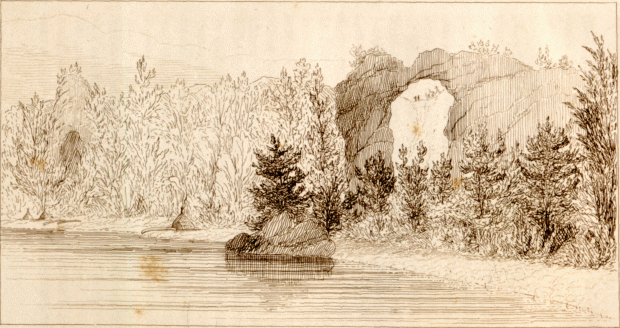
The arched rock surprised me, much as I had heard of it, from the perfection of the arch. It is perfect whether you look up through it from the lake, or down through it to the transparent waters. We both ascended and descended, no very easy matter, the steep and crumbling path, and rested at the summit, beneath the trees, and at the foot upon the cool mossy stones beside the lapsing wave. Nature has carefully decorated all this architecture with shrubs that take root within the crevices, and small creeping vines. These natural rains may vie for beautiful effect with the remains of European grandeur, and have, beside, a charm as of a playful mood in nature.
The sugar-loaf rock is a fragment in the same kind as the pine rock we saw in Illinois. It has the same air of a helmet, as seen from an eminence at the side, which you descend by a long and steep path. The rock itself may be ascended by the bold and agile. Halfway up is a niche, to which those, who are neither, can climb by a ladder. A very handsome young officer and lady who were with us did so, and then, facing round, stood there side by side, looking in the niche, if not like saints or angels wrought by pious hands in stone, as romantically, if not as holily, worthy the gazer's eye.
The woods which adorn the central ridge of the island are very full in foliage, and, in August, showed the tender green and pliant leaf of June elsewhere. They are rich in beautiful mosses and the wild raspberry.
From Fort Holmes, the old fort, we had the most commanding view of the lake and straits, opposite shores, and fair islets. Mackinaw, itself, is best seen from the water. Its peculiar shape is supposed to have been the origin of its name, Michilimackinac, which means the Great Turtle. One person whom I saw, wished to establish another etymology, which he fancied to be more refined; but, I doubt not, this is the true one, both because the shape might suggest such a name, and that the existence of an island in this commanding position, which did so, would seem a significant fact to the Indians. For Henry gives the details of peculiar worship paid to the Great Turtle, and the oracles received from this extraordinary Apollo of the Indian Delphos.
It is crowned most picturesquely, by the white fort, with its gay flag. From this, on one side, stretches the town. How pleasing a sight, after the raw, crude, staring assemblage of houses, everywhere else to be met in this country, an old French town, mellow in its coloring, and with the harmonious effect of a slow growth, which assimilates, naturally, with objects round it. The people in its streets, Indian, French, half-breeds, and others, walked with a leisure step, as of those who live a life of taste and inclination, rather than of the hard press of business, as in American towns elsewhere.
On the other side, along the fair, curving beach, below the white houses scattered on the declivity, clustered the Indian lodges, with their amber brown matting, so soft, and bright of hue, in the late afternoon sun. The first afternoon I was there, looking down from a near height, I felt that I never wished to see a more fascinating picture. It was an hour of the deepest serenity; bright blue and gold, rich shadows. Every moment the sunlight fell more mellow. The Indians were grouped and scattered among the lodges; the women preparing food, in the kettle or frying-pan, over the many small fires; the children, half-naked, wild as little goblins, were playing both in and out of the water. Here and there lounged a young girl, with a baby at her back, whose bright eyes glanced, as if born into a world of courage and of joy, instead of ignominious servitude and slow decay. Some girls were cutting wood, a little way from me, talking and laughing, in the low musical tone, so charming in the Indian women. Many bark canoes were upturned upon the beach, and, by that light, of almost the same amber as the lodges. Others, coming in, their square sails set, and with almost arrowy speed, though heavily laden with dusky forms, and all the apparatus of their household. Here and there a sail-boat glided by, with a different, but scarce less pleasing motion.
It was a scene of ideal loveliness, and these wild forms adorned it, as looking so at home in it. All seemed happy, and they were happy that day, for they had no firewater to madden them, as it was Sunday, and the shops were shut.
From my window, at the boarding house, my eye was constantly attracted by these picturesque groups. I was never tired of seeing the canoes come in, and the new arrivals set up their temporary dwellings. The women ran to set up the tent-poles, and spread the mats on the ground. The men brought the chests, kettles, &c.; the mats were then laid on the outside, the cedar boughs strewed on the ground, the blanket hung up for a door, and all was completed in less than twenty minutes. Then they began to prepare the night meal, and to learn of their neighbors the news of the day.
The habit of preparing food out of doors, gave all the gipsy charm and variety to their conduct. Continually I wanted Sir. Walter Scott to have been there. If such romantic sketches were suggested to him, by the sight of a few gipsies, not a group near one of these fires but would have furnished him material for a separate canvass. I was so taken up with the spirit of the scene, that I could not follow out the stories suggested by these weather-beaten, sullen, but eloquent figures.
They talked a great deal, and with much variety of gesture, so that I often had a good guess at the meaning of their discourse. I saw that, whatever the Indian may be among the whites, he is anything but taciturn with his own people. And he often would declaim, or narrate at length, as indeed it is obvious, that these tribes possess great power that way, if only from the fables taken from their stores, by Mr. Schoolcraft.
I liked very much to walk or sit among them. With the women I held much communication by signs. They are almost invariably coarse and ugly, with the exception of their eyes, with a peculiarly awkward gait, and forms bent by burthens. This gait, so different from the steady and noble step of the men, marks the inferior position they occupy. I had heard much eloquent contradiction of this. Mrs. Schoolcraft had maintained to a friend, that they were in fact as nearly on a par with their husbands as the white woman with hers. "Although," said she, "on account of inevitable causes, the Indian woman is subjected to many hardships of a peculiar nature, yet her position, compared with that of the man, is higher and freer than that of the white woman. Why will people look only on one side? They either exalt the Red man into a Demigod or degrade him into a beast. They say that he compels his wife to do all the drudgery, while he does nothing but hunt and amuse himself; forgetting that, upon his activity and power of endurance as a hunter, depends the support of his family; that this is labor of the most fatiguing kind, and that it is absolutely necessary that he should keep his frame unbent by burdens and unworn by toil, that he may be able to obtain the means of subsistence. I have witnessed scenes of conjugal and parental love in the Indian's wigwam from which I have often, often thought the educated white man, proud of his superior civilization, might learn an useful lesson. When he returns from hunting, worn out with fatigue, having tasted nothing since dawn, his wife, if she is a good wife, will take off his moccasons and replace them with dry ones, and will prepare his game for their repast, while his children will climb upon him, and he will caress them with all the tenderness of a woman; and in the evening the Indian wigwam is the scene of the purest domestic pleasures. The father will relate for the amusement of the wife, and for the instruction of the children, all the events of the day's hunt, while they will treasure up every word that falls, and thus learn the theory of the art, whose practice is to be the occupation of their lives.
Mrs. Grant speaks thus of the position of woman amid the Mohawk Indians:
"Lady Mary Montague says, that the court of Vienna was the paradise of old women, and that there is no other place in the world where a woman past fifty excites the least interest. Had her travels extended to the interior of North America, she would have seen another instance of this inversion of the common mode of thinking. Here a woman never was of consequence, till she had a son old enough to fight the battles of his country. From that date she held a superior rank in society; was allowed to live at ease, and even called to consultations on national affairs. In savage and warlike countries, the reign of beauty is very short, and its influence comparatively limited. The girls in childhood had a very pleasing appearance; but excepting their fine hair, eyes, and teeth, every external grace was soon banished by perpetual drudgery, carrying burdens too heavy to be borne, and other slavish employments considered beneath the dignity of the men. These walked before erect and graceful, decked with ornaments which set off to advantage the symmetry of their well-formed persons, while the poor women followed, meanly attired, bent under the weight of the children and utensils, which they carried everywhere with them, and disfigured and degraded by ceaseless toils. They were very early married, for a Mohawk had no other servant but his wife, and, whenever he commenced hunter, it was requisite he should have some one to carry his load, cook his kettle, make his moccasons, and, above all, produce the young warriors who were to succeed him in the honors of the chase and of the tomahawk. Wherever man is a mere hunter, woman is a mere slave. It is domestic intercourse that softens man, and elevates woman; and of that there can be but little, where the employments and amusements are not in common; the ancient Caledonians honored the fair; but then it is to be observed, they were fair huntresses, and moved in the light of their beauty to the hill of roes; and the culinary toils were entirely left to the rougher sex. When the young warrior made his appearance, it softened the cares of his mother, who well knew that, when he grew up, every deficiency in tenderness to his wife would be made up in superabundant duty and affection to her. If it were possible to carry filial veneration to excess, it was done here; for all other charities were absorbed in it. I wonder this system of depressing the sex in their early years, to exalt them when all their juvenile attractions were flown, and when mind alone can distinguish them, has not occurred to our modern reformers. The Mohawks took good care not to admit their women to share their prerogatives, till they approved themselves good wives and mothers."
The observations of women upon the position of woman are always more valuable than those of men; but, of these two, Mrs. Grant's seems much nearer the truth than Mrs. Schoolcraft's, because, though her opportunities for observation did not bring her so close, she looked more at both sides to find the truth.
Carver, in his travels among the Winnebagoes, describes two queens, one nominally so, like Queen Victoria; the other invested with a genuine royalty, springing from her own conduct.
In the great town of the Winnebagoes, he found a queen presiding over the tribe, instead of a sachem. He adds, that, in some tribes, the descent is given to the female line in preference to the male, that is, a sister's son will succeed to the authority, rather than a brother's son.
The position of this Winnebago queen, reminded me forcibly of Queen Victoria's.
"She sat in the council, but only asked a few questions, or gave some trifling directions in matters relative to the state, for women are never allowed to sit in their councils, except they happen to be invested with the supreme authority, and then it is not customary for them to make any formal speeches, as the chiefs do. She was a very ancient woman, small in stature, and not much distinguished by her dress from several young women that attended her. These, her attendants, seemed greatly pleased whenever I showed any tokens of respect to their queen, especially when I saluted her, which I frequently did to acquire her favor."
The other was a woman, who being taken captive, found means to kill her captor, and make her escape, and the tribe were so struck with admiration at the courage and calmness she displayed on the occasion, as to make her chieftainess in her own right.
Notwithstanding the homage paid to women, and the consequence allowed her in some cases, it is impossible to look upon the Indian women, without feeling that they do occupy a lower place than women among the nations of European civilization. The habits of drudgery expressed in their form and gesture, the soft and wild but melancholy expression of their eye, reminded me of the tribe mentioned by Mackenzie, where the women destroy their female children, whenever they have a good opportunity; and of the eloquent reproaches addressed by the Paraguay woman to her mother, that she had not, in the same way, saved her from the anguish and weariness of her lot.
More weariness than anguish, no doubt, falls to the lot of most of these women. They inherit submission, and the minds of the generality accommodate themselves more or less to any posture. Perhaps they suffer less than their white sisters, who have more aspiration and refinement, with little power of self-sustenance. But their place is certainly lower, and their share of the human inheritance less.
Their decorum and delicacy are striking, and show that when these are native to the mind, no habits of life make any difference. Their whole gesture is timid, yet self-possessed. They used to crowd round me, to inspect little things I had to show them, but never press near; on the contrary, would reprove and keep off the children. Anything they took from my hand, was held with care, then shut or folded, and returned with an air of lady-like precision. They would not stare, however curious they might be, but cast sidelong glances.
A locket that I wore, was an object of untiring interest; they seemed to regard it as a talisman. My little sun-shade was still more fascinating to them; apparently they had never before seen one. For an umbrella they entertain profound regard, probably looking upon it as the most luxurious superfluity a person can possess, and therefore a badge of great wealth. I used to see an old squaw, whose sullied skin and coarse, tanned locks, told that she had braved sun and storm, without a doubt or care, for sixty years at the least, sitting gravely at the door of her lodge, with an old green umbrella over her head, happy for hours together in the dignified shade. For her happiness pomp came not, as it so often does, too late; she received it with grateful enjoyment.
One day, as I was seated on one of the canoes, a woman came and sat beside me, with her baby in its cradle set up at her feet. She asked me by a gesture, to let her take my sun-shade, and then to show her how to open it. Then she put it into her baby's hand, and held it over its head, looking at me the while with a sweet, mischievous laugh, as much as to say, "you carry a thing that is only fit for a baby;" her pantomime was very pretty. She, like the other women, had a glance, and shy, sweet expression in the eye; the men have a steady gaze.
That noblest and loveliest of modern Preux, Lord Edward Fitzgerald, who came through Buffalo to Detroit and Mackinaw, with Brant, and was adopted into the Bear tribe by the name of Eghnidal, was struck, in the same way, by the delicacy of manners in the women. He says, "Notwithstanding the life they lead, which would make most women rough and masculine, they are as soft, meek and modest, as the best brought up girls in England. Somewhat coquettish too! Imagine the manners of Mimi in a poor squaw, that has been carrying packs in the woods all her life."
McKenney mentions that the young wife, during the short bloom of her beauty, is an object of homage and tenderness to her husband. One Indian woman, the Flying Pigeon, a beautiful, an excellent woman, of whom he gives some particulars, is an instance of the power uncommon characters will always exert of breaking down the barriers custom has erected round them. She captivated by her charms, and inspired with reverence for her character, her husband and son. The simple praise with which the husband indicates the religion, the judgment, and the generosity he saw in her, are as satisfying as Count Zinzendorf's more labored eulogium on his "noble consort." The conduct of her son, when, many years after her death, he saw her picture at Washington, is unspeakably affecting. Catlin gives anecdotes of the grief of a chief for the loss of a daughter, and the princely gifts he offers in exchange for her portrait, worthy not merely of European, but of Troubadour sentiment. It is also evident that, as Mrs. Schoolcraft says, the women have great power at home. It can never be otherwise, men being dependent upon them for the comfort of their lives. Just, so among ourselves, wives who are neither esteemed nor loved by their husbands, have great power over their conduct by the friction of every day, and over the formation of their opinions by the daily opportunities so close a relation affords, of perverting testimony and instilling doubts. But these sentiments should not come in brief flashes, but burn as a steady flame, then there would be more women worthy to inspire them. This power is good for nothing, unless the woman be wise to use it aright. Has the Indian, has the white woman, as noble a feeling of life and its uses, as religious a self-respect, as worthy a field of thought and action, as man? If not, the white woman, the Indian woman, occupies an inferior position to that of man. It is not so much a question of power, as of privilege.
The men of these subjugated tribes, now accustomed to drunkenness and every way degraded, bear but a faint impress of the lost grandeur of the race. They are no longer strong, tall, or finely proportioned. Yet as you see them stealing along a height, or striding boldly forward, they remind you of what was majestic in the red man.
On the shores of lake Superior, it is said, if you visit them at home, you may still see a remnant of the noble blood. The Pillagers—(Pilleurs)—a band celebrated by the old travellers, are: still existant there.
"Still some, 'the eagles of their tribe,' may rush."
I have spoken of the hatred felt by the white man for the Indian: with white women it seems to amount to disgust, to loathing. How I could endure the dirt, the peculiar smell of the Indians, and their dwellings, was a great marvel in the eyes of my lady acquaintance; indeed, I wonder why they did not quite give me up, as they certainly looked on me with great distaste for it. "Get you gone, you Indian dog," was the felt, if not the breathed, expression towards the hapless owners of the soil. All their claims, all their sorrows quite forgot, in abhorrence of their dirt, their tawny skins, and the vices the whites have taught them.
A person who had seen them during great part of a life, expressed his prejudices to me with such violence, that I was no longer surprised that the Indian children threw sticks at him, as he passed. A lady said, "do what you will for them, they will be ungrateful. The savage cannot be washed out of them. Bring up an Indian child and see if you can attach it to you." The next moment, she expressed, in the presence of one of those children whom she was bringing up, loathing at the odor left by one of her people, and one of the most respected, as he passed through the room. When the child is grown she will consider it basely ungrateful not to love her, as it certainly will not; and this will be cited as an instance of the impossibility of attaching the Indian.
Whether the Indian could, by any efforts of love and intelligence from the white man, have been civilized and made a valuable ingredient in the new state, I will not say; but this we are sure of; the French Catholics, at least, did not harm them, nor disturb their minds merely to corrupt them. The French they loved. But the stern Presbyterian, with his dogmas and his task-work, the city circle and the college, with their niggard concessions and unfeeling stare, have never tried the experiment. It has not been tried. Our people and our government have sinned alike against the first-born of the soil, and if they are the fated agents of a new era, they have done nothing—have invoked no god to keep them sinless while they do the hest of fate.
Worst of all, when they invoke the holy power only to mask their iniquity; when the felon trader, who, all the week, has been besotting and degrading the Indian with rum mixed with red pepper, and damaged tobacco, kneels with him on Sunday before a common altar, to tell the rosary which recalls the thought of him crucified for love of suffering men, and to listen to sermons in praise of "purity"!!
My savage friends, cries the old fat priest, you must, above all things, aim at purity.
Oh, my heart swelled when I saw them in a Christian church. Better their own dog-feasts and bloody rites than such mockery of that other faith.
"The dog," said an Indian, "was once a spirit; he has fallen for his sin, and was given by the Great Spirit, in this shape, to man, as his most intelligent companion. Therefore we sacrifice it in highest honor to our friends in this world,—to our protecting geniuses in another."
There was religion in that thought. The white man sacrifices his own brother, and to Mammon, yet he turns in loathing from the dog-feast.
"You say," said the Indian of the South to the missionary, "that Christianity is pleasing to God. How can that be?—Those men at Savannah are Christians."
Yes! slave-drivers and Indian traders are called Christians, and the Indian is to be deemed less like the Son of Mary than they! Wonderful is the deceit of man's heart!