Front matter
Reading edition
Transcriber's note: Unusual and inconsistent spelling is as printed.
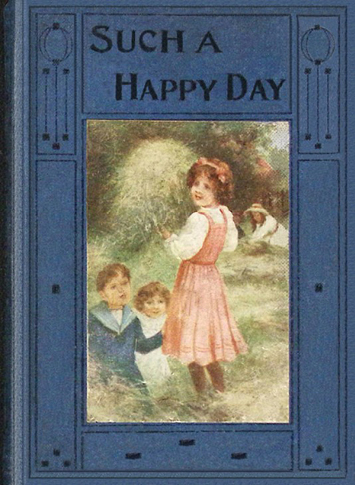
Such a Happy Day.
BY
CATHARINE SHAW.
AUTHOR OF
"DICKIE'S SECRET," "NELLIE ARUNDEL," "SOMETHING FOR SUNDAY," "SUNDAY SUNSHINE," ETC.
London: John F. Shaw & Co., Ltd. 3, Pilgrim Street, E. C.
CONTENTS. ————
Chapter.
I. Such a Happy Day
II. Such a Happy Afternoon
III. Such a Happy Evening
Such a Happy Day.
SUCH A HAPPY DAY.
————
"GOOD morning, Father!"
"Good morning, my little son! Where have you been? Your face is as fresh and cool as my cucumbers, though your cheeks are not green, but are as rosy as apples."
"I've been out with my mother!"
"With 'your mother,' have you?"
Cyril smiled. "We've been picking flowers, but you don't know what for—"
"Do I not? Shall I guess?"
"No, don't guess, Father, 'cause I like secrets!"
"Very well. And what did my 'early birds' find when they were out?"
Cyril's mother came in at the window with her basket of flowers in her hand. She looked down upon them with her gentle eyes, but left her little son to speak.
"We saw—we saw lots of dew!"
"Oh, so you did. I love dew; that shows how early you were up."
"And we saw Eddie and Effie out picking flowers too. And then—What else do you suppose we saw?"
"You have a great many 'saws' in your yard," said his father, laughing at him. "But go on."
Cyril looked puzzled for a moment, and then meeting his mother's eyes, went on—
"We did see a very funny thing! One of our hens wasn't satisfied with the hen-house for her nest, and has made one for herself under a hedge. Mother called it—"
"Stolen a nest?" suggested Cyril's father.
"Yes, but I do not see that. When Eddie and Effie went on, I sat down on a bank to think about it. I call it 'made a nest' not 'stolen.' The poor hen thought she could make it much better out there in the sweet air, than in that stuffy hen-house."
"Did you see which hen it was?" asked his father.
"Yes. While I was waiting and watching a frog that was jumping about, she came up through the hedge all wet and draggled, and got right on to the nice eggs: I thought she would spoil them."
"That's what they do," said his father; "and they say it is what makes the eggs hatch so well."
"Do they?" asked Cyril, opening his blue eyes very wide. "Anyway, she frightened away the frog that had come to have a look at me. It did hop so, Father."
"I should think we had better hop in to breakfast, Cyril," said Mr. Forde, "for we have plenty to do before ten o'clock, early as we are."
"Eddie and Effie are going by train at the same time as we are," nodded Cyril, getting off his perch and taking his father's hand. "'I' don't think they're old enough, but they said they were going to walk to the station and sit there till uncle and aunt came."
"They won't hurt," said Mr. Forde. "If your sweet mother did not coddle you, Cyril, you could go to London by yourself! Boys always turn up right-side-up!"
"Yes," said Cyril eagerly, "that's what I say. I'm six, and I should turn up all right, I know."
Mrs. Forde did not answer her husband's quizzical look. As she moved towards the door, she was gazing on the little darling, who was the very light of her eyes.
That day was to be a wonderful day to some people, for Cyril's grandfather and grandmother were to celebrate their fiftieth wedding-day, while all the children and grandchildren were to meet at the pretty house near London, to spend the happy day together.
Plenty of people got up early that morning! Some of them, like Cyril and his cousins, Effie and Eddie, knew all about the Golden Wedding-day, and some knew nothing about it, and yet were preparing for it all the same.
Far away in the country two boys were busy picking the sweet flowers for the London market. And when they had gathered a large basket full, one of them hastened to the station so as to catch the earliest train which steamed away to the great city.
By-and-by, in one of the courts in that great city, a little girl raised her head from her couch, and said in a sleepy voice, "Good morning, sir!"
"Why, child!" said her mother. "Do ye think ye're out in the street already! But get up, do; it's late, and if you're not there, somebody else will have the best flowers, that they will!"
The child roused herself then, and with many a yawn, put on her little dress and apron, and after but a slight breakfast, hurried off to the market with her few pence, making as clever a bargain as any other little girl of her age.
Then she went out into the streets, and made her way to the spot near the Bank where she always took her stand.
Many were the "Good morning, sirs," which passed her rosy lips. But some were too busy to turn towards her, and some not inclined to buy, so that her basket did not get empty very fast.
But Bella stood patiently enough. She did not thrust her flowers into people's faces, nor did she whine or beg.
Well she knew that her brothers and sisters needed all she could earn for them; well she knew that her ailing father needed food and medicine, and that her mother "could" not work harder than she did already. But Bella had found out the best way to empty her basket was to keep a cheerful face and a sharp look-out. And among the many who passed her each day to their business near, there were some who made a point of buying of her rather than any one else.
One young lady, who had just come from a visit to the happy country near Reigate, and had there picked flowers with her cousins, turned as she passed Bella's tasteful bunches, and paused for an instant.
"I wish—" she said, and stopped.
"Only a penny, miss!" said Bella eagerly. "The whole bunch, miss, just as it is. I don't cheat, miss!"
"I was thinking," said the young lady slowly, "I wish I had brought one of my bunches with me from home."
Bella looked inquiringly; she wondered why the young lady hesitated to buy. Such a sweet young lady, with such a bright, calm look, that somehow reminded the little flower-girl of a clear, cloudless sky on a summer day.
"I think I will have one," was her final decision. Then her eyes met Bella's: "I was going to see a little sick boy on my way home, and I wished I had brought one of my own bunches of flowers. But I think yours will please him just as much."
She did not add that the penny which she paid for it would have to come out of the money which had been set apart for her dinners; for her little income had to go a long way. When she took Bella's pretty flowers in her hand, she looked into the clear childish eyes with a soft expression, as she said,—
"I shall give these to a little boy who is going to heaven very soon. Have you ever heard of heaven?"
Bella nodded.
"Do you know how we can get there?"
Bella shook her head, then added quickly, "Ain't it by being honest?"
It was the young lady's turn to shake her head.
"It's just because the Lord Jesus died—instead of us,—bore our sins, and all the punishment of them, so that we can go free."
Bella sat down and looked at her earnestly. "I never heard that afore," she said slowly.
"Shall you be here on Monday?" asked the young schoolmistress, preparing to hasten on.
"Yes, I shall."
"I'll come earlier, and tell you," she said; "I must not stop now. But you can think of this: 'Jesus' is the only way to heaven!"
She hurried away, while Bella's eyes followed her curiously.
It was no wonder that the young schoolmistress was loved so much.
As she sat in her dull schoolroom that morning, with her flowers placed in a glass of water, she noticed one of her little pupils in the oldest class looking dull and listless.
The rest were busy over sums, when the teacher's voice was heard calling,—
"Nellie, my dear, come here!"
The child looked up startled, and then hastened to her side.
"Is anything wrong, Nellie? Are you not well?"
"Yes, I'm quite well, Miss Archer."
"Cannot you do your lesson?"
"Yes, Miss Archer."
"Then what is it, dear?"
Now what it was, was this. The night before, when Nellie had been going to bed, her sister Mary had said,—
"Miss Archer makes a favourite of you, so of course you get on with your lessons."
"She doesn't!" Nellie had answered indignantly. "She never makes the least difference."
"I know she does, for the other girls have noticed it," Mary had said.
And then poor Nellie had knelt down to pray. But instead of being able to speak to God, all her sister's words had come over her again, and at last, she had crept into bed full of sorrow and resentment.
So when Miss Archer asked her what was the matter, and looked so lovingly in her face, she remembered all this, and knew that the other girls would make up their minds more than ever that she was a favourite.
"Cannot you tell me?" her teacher was saying.
And then Nellie gave one shy glance at her and whispered,—
"I don't think I can; but—it was my fault—being angry with Mary! I ought to have helped that."
Miss Archer kissed her in silence, and then, as it was just the end of school, she asked Nellie to walk with her as far as their roads went together.
Before Nellie had quite got through her story of her fear of being a favourite, Miss Archer came to the house where she was to take the bunch of flowers she had bought of Bella.
So she wished the little schoolgirl good-bye, and ran up to the invalid, only waiting for one whispered word, before she flew down again; for to-day was a great day for her, and to her joy a half-holiday. For this was her grandparents' Golden Wedding-day, and like Eddie and Effie in the country, or like Cyril and his parents, her heart was full of plans and thoughts as to how the large party would go off.
Only yesterday a man had come to the dining-room window of her London home, and had held up a pretty pot of flowers for her to buy. Then she had thought, "That will do for my present. It isn't much, but they all know I am not rich."
For Miss Archer was an orphan, and she boarded with some friends, and kept herself by her teaching. Many a home had been offered her, but she always shook her head.
To-day, her friend's little girl ran to greet her with her picture book.
And as she took her on her knee, she said,—
"Do you remember, Mabel, that, poor man who came to the window yesterday?"
"I know," nodded Mabel.
"Well, he said he had a little girl almost as young as you, who stands all day with a basket of flowers. He said that in the cold spring weather, when the palm first comes out, the poor parents make most of their living by what she sells."
"Poor little girl!" said Mabel softly. "I'd like to give her my pudding!"
But Miss Archer had not time to tell her the whole story just then, so she carried her up all the long flights of stairs to her little room at the top of the house, to watch her change her dress for her grandmamma's Golden Wedding-day.
Meanwhile, some of the other grandchildren had been busy on this auspicious morning. Already the train was bringing Eddie, Effie, and Cyril, those happy children, towards London. While nearer the pretty house where the grandparents lived, there were other boys and girls who were up early too, and long before their elders were awake had picked baskets of fruit as a present from their father's orchard.
Then what a grand changing of clothes there was, and combing and brushing, and tying and fastening!
How the girls had to be arrayed in all their prettiest things! And how the boys were anxious about certain neckties, and took quite as long as the girls to turn themselves out as "spic and span" as they did!
"How many will there be of us?" had been a frequent question in all the families. But there were so many to count, and so many to be counted, that one never seemed to come at the right number.
"Well, there's Cousin Lily Archer—she's one at any rate," the boys said, and everybody was glad of that; for wherever she went, Lily was a great favourite.
"Then there's all the boys from Reigate," said some one, regardless of his good English in his excitement; "and there's that fellow whose father is in India, who's staying with them, Claude Champion—he's invited. And there's—"
But nobody would wait to hear. There were, all were agreed, seven families to bring their different members to the gathering, and their numbers varied from poor Lily Archer, who was the sole representative of her dead parents, down to the blooming twelve children of the eldest son and daughter.
Many a "Good morning!" sounded that day as the parties began to arrive. And their dear grandmother had her cheeks kissed into a pretty pink, as one and another came up to her, bringing tokens of love and greeting.
When the first excitement was over, there was a general assent to the proposal of the elders that as many as liked should go to meet the train by which the next party was expected.
The girls ran for their hats, the boys sauntered out on to the lawn to wait for them, while the little ones eagerly said they should not be tired, and that the cool lanes would be better than the gardens.
Though the elders smiled at this little fiction, it was allowed to go uncontradicted, and the troop set off in the best of spirits.
"May I come too?" asked Claude, who was living with the Reigate family.
"Of course you may!" said some one.
Now their friend from India remembered the pleasant summer holiday he had just spent, and thought of the weeks when Lily Archer had been among them, and he considered the greatest attraction of the Golden Wedding-day was that he should see her sweet, quiet face. So he gladly availed himself of the boy's permission to go and meet her, and made himself so bright and interesting that he was the centre of attraction all the way to the station.
When they returned with a fresh accession to their numbers, there were more greetings and more presents. Flowers, from far and near, seemed the order of the day.
"Who is this?" said grandpapa roguishly, as one of his darlings came up to him with her frock filled with fruit and flowers. "Do I know this little girl?"
"Please, I'm Effie," said a little voice, "and Eddie is here too—at least, he was in the conservatory just now; he's too shy to come in."
"Shy, is he?" said her grandfather. "Then we must go and fetch him. Nobody must be shy on Golden Wedding-days, must they, Effie?"
"I'm not shy at all," said Effie, at which everybody laughed.
And then Effie turned shy in good earnest, and hung her head.
But everybody was too busy and too happy to notice her, and in another moment, she found herself being led through the window at the end of the room into the pretty conservatory, where the profusion of the flowers nearly took away her breath. But her hand was in her grandfather's, and who could be as dear, as interesting, as loving as he?
There they found Eddie gazing at a rose-coloured camellia which had grown far above his head.
"Eddie, Eddie!" exclaimed his little sister. "Grandpa says you mustn't be shy on Golden days—'cause—I don't know why—but—here's grandpa come to find you. It's awfully nice in here, isn't it, Eddie?"
"Yes," said Eddie shortly, looking as he would very much have preferred that they should have kept away. "Yes, it's nice when—when I can see all the flowers."
"Can't you see?" asked Effie, opening her eyes.
But the children soon found out where their grandfather was, and flocked round him begging for a story.
"Hey-dey!" he said. "I can't make stories like I used when I was younger; I haven't the imagination now."
"But you can tell us real ones, sir," said Claude Champion, who stood behind the rest arranging some flowers into a little posy.
"Eh?" said the old gentleman.
"Yes, something true, Grandfather," exclaimed one of the Reigate boys.
So he sat down on a green iron seat and the rest crowded round; till the story-telling getting wind, everybody gathered near, filling in the doorways and drawing-room windows; such an audience as moved the old man to see.
"All my own," he murmured, his observant eyes going round from one to another; "all my own, except Claude Champion,—and he's the son of a dear friend. Almost as good as my own anyway."
A smile passed over his face, which no one understood, unless it were grandmamma, who understood most things!
"Are you goin' to begin, Grandfather?" asked Cyril, who was seated on the knee of one of his cousins.
The old gentleman hemmed and cleared his throat, and then began in good earnest:—
"Once upon a time—"
"That's the way," murmured one of the Reigate boys, and got a punch in the ribs from another of them as a stopper.
"Once upon a time, not very far from here, in a great smoky city, there lived a happy young mother. "Every day, when she had sent her little girl off to school, and had dressed her baby boy, she would take him to the window where she kept her flowers, and would water them and attend to them while she sang a bright, cheerful hymn. "Presently, if her boy were very good, she would reward him with a bunch for his very own. Oh, what infinite joy it gave that mother's heart to do anything for her baby, to deny herself that he might have pleasure! "When her little girl, whom we will call Minnie, came back from school, she would take her little brother for a walk or play with him in the court, where she chose the only corner on which the sun shone down; for like her mother, and the flowers and the canary (and like all of us!), she loved sunshine! "But dark, sad days came upon those happy children. "All at once Minnie discovered that her mother was sick. It came upon her with a blank despair she had never even dreamed of before. One morning when she got up, she found her mother was unable to rise from her bed. "'Minnie!' said the panting voice of the fever-stricken woman. 'I'd thought we would all have met your father when he came home from his voyage—so happy—but—it's not to be. Minnie, we'll meet in the Home above; and God 'll take care of you somehow, though I can't see how. Minnie, take care of baby, and write to your grandfather and grandmother.' "The poor mother paused there. "'Minnie, you'll tell your father as I did my best for you, and always loved him, at home or away, just the same; and write—mind you write—to your grandmother.' "Soon after that, she got too ill to arrange anything, and Minnie could only sit by and whisper what she had learned of the Home above, and say over and over again to her dying mother, the words which seemed to quiet her more than any others, 'I will never leave thee nor forsake thee.' "Soon after that, she had need to remember those words for herself, for she was left alone in the world, with only her little brother and far-away father who had not been heard of for many a long day. "She wrote, as her mother had told her, to her grandparents, and the poor old couple knew not what to say. They had hard work to keep a fire on their own hearth. While they were thinking it over, their son's wife came in, and she listened to all they had to say without any remark. But when she got home, she told her husband all about it, and how she had been watching her hen gathering its chickens under its wings, and how she had thought she should like to gather the little orphans under her wings till a home could be found for them. "Her husband was a very bluff man, and he did not answer many words, but as he went off to his work, he gave her a rarely tender kiss as he said shortly, 'You may ask 'em for a bit—anyway—Pollie.' "So Pollie wrote the letter of welcome, and poor little Minnie received it the next morning, just as she had come to her very last halfpenny after paying her week's rent. "The letter contained an order for enough money to bring the two children into the country, and there were plenty of kind neighbours to pack up their few clothes and get them off. "As one motherly woman took her leave of them, she said to Minnie,— "'Well—anyways, my dear—you've cared for yer brother pretty near as well as his mother, and that's sayin' a great deal.' "Almost as soon as Minnie's answer could get to Pollie, the two children had started, and were on their way. "But Pollie was not surprised. She liked things done quickly. And when she had read the letter which the postman had brought, she just ran into her cottage and 'spun round,' as she called it, putting her little plans into execution which she had just formed while she sat thinking about them yesterday. "Yes! She would keep some more hens, and Minnie should help her in the care of them. And the child should take the eggs round to some houses she knew, where the gentlefolks would have as many as she could spare them. And Minnie should sleep in the little attic with her baby brother, and should be made welcome till her father came home to see about her. And if he never came home—why, there was another Almighty Father who would help the orphans and find food and clothes for them in His wonderful way! "That was what Pollie thought, while all the time she was 'spinning round' making her neat cottage neater still. "So the children came. Minnie with her mournful eyes and thin, sorrowful face, and the baby with that pathetic, motherless look which went to Pollie's heart. "But Pollie thought the best plan would be to take the baby into her heart instead of letting him make it ache. So the little fellow sat on her knee, was fed by her hand, and delighted her by growing stronger every day. She taught Minnie to make a frock for him, and out of her own pocket bought some new boots in which he could run about. "After a few weeks of country sunshine had passed over their heads, the woebegone look went away from Minnie's face, and though she never forgot her mother—never, never,—she forgot her sorrow, and began to be the light of her uncle's home. "How the baby learned to walk and play and dig! How he laughed all day long and gambolled with the dog! How he, by-and-by, trotted into his grandfather's cottage and lisped out 'Dood-mornin',' like all of you have done to-day! "But Minnie did not get to be a selfish little girl, only anxious to enjoy herself. Of that you may be sure! "When the Lord Jesus reigns in anybody's heart, He drives selfishness out, as surely as sunshine drives out darkness! "By-and-by Minnie and her little brother sent up some country flowers to the neighbours who had been so kind to her. And then she saved up some eggs which Pollie gave her for her own, and sent them to another poor little girl, named Rose, who had no mother. And in a letter, she told her how nice it was to learn to grow flowers, and advised her to try to get a geranium for her window, and take care of it till there should be a flower-show for poor people. "And Rose took her advice, and spent the next penny she had on a little plant, and so made a beginning. "Then she took her baby-sister to a certain place where she knew some flowers were to be seen, and stood long and watched them, and then went home with fresh heart to save up for another larger pot, which in due time she obtained. "Minnie's old grandparents thought there were never two such children as these loving ones who had dropped from the skies, as it were, at their feet. But they told their son that it was a good day that ever his young wife thought of such a thing, and they blessed her for it. "As to Pollie, the blessing came to her, too; for her little poultry farm throve wonderfully, and as to the people that came far and near for her eggs, she said it was quite surprising! "Then Minnie and Bobbie were so loving! They seemed to fill up her hungry heart, and she only wondered how she had ever got on without them. "At last, their father did come back to London, but when he found his home broken up, his sorrow was very great. "But the neighbours directed him to where his children were being sheltered, and he hastened down to Bickley."
"Bickley!" interrupted a half-a-dozen voices. "Why, that's here!"
"Does anything prevent it's being here?" said their grandfather smiling.
"Well, don't interrupt," said the girl who held Cyril on her knee. "Do go on, Grandfather!"
"I've just done. When he came down to Bickley and found how happy the children were, and how Tom and Pollie did not want to part with them, he shed tears of joy, and went on his next voyage with less sorrow in his heart than he had had for many a long day."
*******
The old gentleman paused.
"Is that all?" asked some one.
"Yes, all—except that the eggs which you will eat at tea to-night were laid by Minnie's hens!"
"Oh!"
There was a general move, and a general "Thank you, Grandfather—very much!" from at least twenty voices.
Claude Champion had been making and remaking his bouquet all this time, and when the story was finished, he passed it to Lily with a smile.
"Not for me?" she asked.
"Yes—certainly; for whom else did you suppose?"
"I'll have just one flower," she answered.
It was almost dinner time. But all were waiting for one more train to bring the rest of the party from a distance.
So once more, the garden was the scene of merry groups of bright colours flitting about among the trees. Some of the younger ones playing hide-and-seek, while some wheeled their aunt's dolls, where they could pace up and down undisturbed.
The grandparents sat down under the great elm watching all with happy faces, their own children—the fathers and mothers of the party—gathering round them, enjoying and entering into it all in their different ways.
"Who would have thought, my dear—fifty years ago—that we should have such a party as this?" said the grandfather, taking his wife's hand in his.
She only shook her head, smiling peacefully. Whatever storms life had brought, sunshine had come at the end—the sunshine "which shineth more and more unto the perfect day."
In the half-hour before the rest had arrived, Lily had been persuaded to accept the offer of a home, by some one who had set his heart very much upon it. So that grandfather was right, and Claude Champion did bid fair to be one of his own after all, on this Golden Wedding-day.