X. THE YOUNG DRAUGHTSMAN. (continued 2)
Reading edition
Habit, too, continues to assert its dominion. The tendency noticeable now and again, even among English children, to treat the feet after the manner of the hands illustrates this. Habit is further illustrated in the tendency to a transference of forms appropriate to the man to the animal; or, when (owing to the interposition of the instructor) the drawing of animals is in advance of the other, in the reverse process; as when a cat is drawn with two legs, or a horse is given a man’s face, or the human form develops a horse’s ears, or a bird’s feet. With these may be compared the transference of a bird-like body and tail to a quadruped in Fig. 45 (i), p. 377. The accompanying two drawings by a child of six show how similar forms are apt to be used for the man and for the animal (Fig. 52).
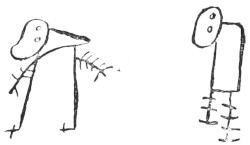
Man. Bird. Fig. 52.
But the really noticeable thing in this later sophisticated treatment is the bringing into view of what in the original is invisible, as the front view of the eye as well as both eyes into what otherwise looks a side view of the face, the two legs of the rider and so forth. Here, no doubt, we may still trace the influence of technical limitations and of habit. The influence of the former is seen in the completing of the contour of the head before or after drawing the hat: for the child would not know how to start with the lines which form the commencement of the visible part of the head. The 393influence of habit is also recognisable here. A child having learned first of all to draw the front view of the eye, the two eyes and the two legs side by side, tends partly as the result of organised hand-trick, partly in consequence of ‘association of ideas,’ to go on drawing in the same fashion in the new circumstances. A specially clear illustration of this effect of habit already alluded to is the introduction of the front view of the nose in the mixed scheme. These cases are exactly paralleled by the Egyptian drawing in which while one shoulder is pulled round the other is left in square front view (see above, p. 369, Fig. 39 (b)). Still, habit does not account for everything here. It does not, for example, explain why the child brings into view three sides of a house. The technical deficiencies of the small draughtsman, his want of serious artistic purpose, seem an insufficient explanation of these later sophistries. They appear to point plainly to certain peculiarities of the process of childish conception. We are compelled then to inquire a little more closely into the characteristics of children’s observation and of their mental representation of objects.
We are apt to think that children when they look at things at all scrutinise them closely, and afterwards imagine clearly what they have observed. But this assumption is hardly justified. No doubt they often surprise us by their attention to small unimportant details of objects, especially when these are new and odd-looking. But it is a long way from this to a careful methodic investigation of objects. Children’s observation is for the most part capriciously selective and one-sided. They apprehend one or two striking or especially interesting features and are blind to the rest. This is fully established in the case of ordinary children by the wondrous ignorance they display when questioned about common objects. It is hardly necessary to add that their spontaneous untrained observation is quite unequal to that careful analytical attention to form-elements in their relations which underlies all clear grasp of the direction of 394linear elements, the relative position of the several parts of a figure, and proportion.
This being so it maybe said that defects of observation are reflected in children’s drawing through all its phases. Thus the primitive bare schematism of the human face answers to an incomplete observation and consequently incomplete mode of imagination, just as it answers to a want of artistic purpose and to technical incapacity. How far defective observation assists at this first stage I do not feel sure. Further experimental inquiries are needed on this point. I lean to the view already expressed, that at this stage manual reproduction is far behind visual imagination.
When, however, we come on to the delineation of an object under its different aspects the defects of mental representation assume a much graver character. We must bear in mind that a child soon gets beyond the stage of recalling and imagining the particular look of an object, say the front view of his mother’s face, or of his house. He begins as soon as he understands and imitates others’ language to synthesise such pictorial images of particular visual presentations or appearances into the wholes which we call ideas of things. A child of four or five thinking of his father or his house probably recalls in a confused way disparate and incompatible visual aspects, the front view as on the whole the most impressive being predominant, though striking elements of the side view may rise into consciousness also. With this process of synthesising aspects into the concrete whole we call a thing there goes the further process of binding together representations of this and that thing into generic or typical ideas answering to man, horse, house, in general. A child of five or six, so far from being immersed in individual presentations and concrete objects, as is often supposed, has carried out a respectable measure of generalisation, and this largely by the help of language. Thus a ‘man’ reduced to visual terms has come to mean for him (according to his well-known 395verbal formula) something with a head, two eyes, etc., etc., which he does not need to represent in a mental picture because the verbal formula serves to connect the features in his memory.
Hence when he comes to draw he has not the artist’s clear mental vision of the actual look of things to guide him. He is led not by a lively and clear sensuous imagination, but by a mass of generalised knowledge embodied in words, viz., the logical form of a definition or description. This, I take it, is the main reason why with such supreme insouciance he throws into one design features of the full face and of the profile; for in setting down his linear scheme he is aiming not at drawing a picture, an imitative representation of something we could see, but rather at enumerating, in the new expressive medium which his pencil supplies, what he knows about the particular thing. Since he is thus bent on a linear description of what he knows he is not in the least troubled about the laws of visual appearance, but setting perspective at naught compels the spectator to see the other side, to look through one object at another, and so forth.
Since the process at this sophisticated stage is controlled by knowledge of things as wholes and not by representations of concrete appearances or views, we can understand why the visible result does not shock the draughtsman. The little descriptor does not need to compare the look of his drawing with that of the real object: it is right as a description anyhow. How strongly this idea of description controls his views of pictures has already been pointed out. Just as he objects to a correct profile drawing as an inadequate description, so he objects to a drawing of the hind part of a horse entering the stable, and asks, ‘Where is his head?’ We may say then that what a lively fancy did in the earlier play-stages childish logic does now, it blinds the artist to the actual look of what his pencil has created.
Use soon adds its magic force, and the impossible 396combination, the two eyes stuck on at the side of the profile nose, the two legs of the rider untroubled by the capacious trunk of the animal which he strides, the man wholly exposed to view inside the boat or carriage, gets stereotyped into the right mode of linear description.
All this shows that the child’s eye at a surprisingly early period loses its primal ‘innocence,’ grows ‘sophisticated’ in the sense that instead of seeing what is really presented it sees, or pretends to see, what knowledge and logic tell it is there. In other words his sense-perceptions have for artistic purposes become corrupted by a too large admixture of intelligence. This corruption is closely analogous to what we all experience when we lose the primal simplicity of the eye for colour, and impart into our ‘visual impressions,’ as we call them, elements of memory and inference, saying, for example, that a distant mountain side is ‘green’ just because we can make out that it is grass-covered and know that grass when looked at nearer is of a green colour.
I have dwelt on what from our grown-up standpoint we must call the defects of children’s drawing. Yet in bringing this study to a close it is only just to remark that there are other and better qualities well deserving of recognition. Crude, defective, self-contradictory even, as these early designs undoubtedly are, they are not wholly destitute of artistic qualities. The abstract treatment itself, in spite of its inadequacy, is after all in the direction of a true art, which in its essential nature is selective and suggestive rather than literally reproductive. We may discern, too, even in these rude schemes a nascent sense of values, of a selection of what is characteristic. Even the primitive trunkless form seems to illustrate this, for though, as we have seen in a previous essay, the trunk plays an important part in the development of the idea of self, it is for pictorial purposes less interesting and valuable than the head. However this be, it is clear that we see this impulse 397of selection at work later on in the addition of the buttons, the pipe, the stick, the parasol and so forth.
It is to be noted, too, that even in these untutored performances, where convention and tradition exercise so great a sway, there are faint indications of a freer individual initiative. Witness, for example, the varying modes of representing hair, hands, and feet. We may say then that even rough children in elementary schools who are never likely to develop artistic talent display a rudiment of art-feeling. It is only fair to them to testify that in spite of the limitations of their stiff wooden treatment they express a certain individuality of feeling and aim, that like true artists they convey a personal impression. These traits appear most plainly in the later representations of action, but they are not altogether absent from the earlier statuesque figures. Compare, for example, the look of alert vigour in Fig. 5 (a) (p. 339), of grinning impudence in Fig. 6 (a) (p. 341), of provoking ‘cheekiness’ in Fig. 20 (b) (p. 350), of a seedy ‘swagger’ in Fig. 32 (p. 362), of inebriate gaiety in Fig. 17 (p. 348), of absurd skittishness in Fig. 24 (b) (p. 354), of insane flurry in Fig. 26 (a) (p. 355), of Irish easy-goingness even when somebody has to be killed in Fig. 34 (p. 363), of wiry resoluteness in Fig. 29 (a) (p. 359), of sly villainy in Fig. 38 (p. 365), and of demure simplicity in Fig. 26 (c) (p. 356); and note the delicious variety of equine character in Fig. 45 (f) (p. 376) and following.
If a finer æsthetic feeling is developed the first rude descriptive drawing loses its attractions. A friend, a well-known psychologist, has observed in the case of his children that when they try to draw something pretty, e.g., a beautiful lady, they abandon their customary mode of description and become aware of the look of their designs and criticise them as bad. This seems to me a most significant observation. It is the feeling for what is beautiful which makes a child attend closely to the bare look of things, and the beginning of a finer observation of forms commonly takes 398its rise in this nascent sense of beauty. Indeed, may one not say that only when a germ of the æsthetic feeling for beauty arises, and a child falls in love with the mere look of certain things, can there appear the beginnings of genuinely artistic work, of a conscientious endeavour to render on paper the aspect which pleases the eye?
399