Part II. ON THE FINAL CAUSES OF TRANSFORMATION. (continued 3)
Raphael Meldola translation
These experiments were always made in the presence of several persons, in order to guard myself against too subjective an interpretation of the phenomena; but they all invariably considered the conduct of the birds to be as I have here represented it.146
If it be admitted that the ocelli of caterpillars are thus means of exciting terror, the difficulty of their occurring in protectively coloured species at once vanishes. They do not diminish the advantage of the adaptive colouring, because they do not make the caterpillars conspicuous, or at least any more easily visible at a distance, excepting when the insects have assumed their attitude of alarm. But these markings are of use when, in spite of protective colouring, the larva is attacked by an enemy. The eye-spots accordingly serve the caterpillar as a second means of defence, which is resorted to when the protective colouring has failed.
By this it must not be understood that the ocelli of the Chærocampa larvæ invariably possess only this, and no other significance for the life of the insect. Every pattern can be conceived to render its possessor in the highest degree conspicuous by strongly contrasted and brilliant colouring, so that it might be anticipated that perfect eye-spots in certain unpalatable species would lose their original meaning, and instead of serving for terrifying become mere signals of distastefulness. This is perhaps the case with Chærocampa Tersa (Fig. 35), the numerous eye-spots of which make the insect easily visible. Without experimenting on this point, however, no certain conclusion can be ventured upon, and it may be equally possible that in this case the variegated ocelli with bright red nuclei resemble the blossoms of the food-plant (Spermacoce Hyssopifolia).147 I here mention this possibility only in order to show how an inherited form of marking, even when as well-defined and complicated as in the present case, may, under certain circumstances, be turned in quite another direction by natural selection, for the benefit of its possessor. Just in the same manner one and the same organ, such, for instance, as the limb of a crustacean, may, in the course of phyletic development, perform very different functions—first serving for locomotion, then for respiration, then for reproduction or oviposition, and finally for the acquisition of food.
I now proceed to the consideration of the biological value of incomplete eye-spots, or, as I have termed them, ring-spots. Are these also means of terrifying, or are they only signals of distastefulness?
I must at the outset acknowledge that on this point I am able to offer but a very undecided explanation. The decision is only to be arrived at by experiments conducted with each separate species upon which one desires to pronounce judgment. It is not here legitimate to draw analogical inferences, and to apply one case to all, since it is not only possible, but very probable, that the biological significance of ring-spots changes in different species. Nothing but a large series of experiments could completely establish this. Unfortunately I have hitherto failed in obtaining materials for this purpose. I would have deferred the publication of this essay for a year, could I have foreseen with certainty that such materials would have been forthcoming in sufficient quantity during the following summer; but this unfortunately depends very much upon chance, and I believed that a preliminary conclusion would be preferable to uncertainty. Perhaps some entomologist to whom materials are more easily accessible, may, by continuing these experiments, accomplish this object.
The experiments hitherto made by other observers, are not sufficient for deciding the question under consideration. Weir,148 as is well known, showed that certain brightly coloured and conspicuous larvæ were refused by insectivorous birds; and Butler149 proved the same for lizards and frogs. These experiments are unfortunately so briefly described, that in no case is the species experimented with mentioned by name, so that we do not know whether there were any Sphinx caterpillars among them.150 I have likewise experimented in this direction with lizards, in order to convince myself of the truth of the statement that (1) there are caterpillars which are not eaten on account of their taste, and (2) that such larvæ possess bright colours. I obtained positive, and on the whole, very decided results. Thus, the common orange and blue striped caterpillars of Bombyx Neustria enjoyed complete immunity from the attacks of lizards, whilst those of the nearly allied Eriogaster Lanestris and L. Pini were devoured, although not exactly relished. That the hairiness is not the cause of their being unpalatable, is shown by the fact that L. Pini is much more hairy than B. Neustria. The very conspicuous yellow and black ringed caterpillar of Euchelia Jacobææ gave also most decided results. I frequently placed this insect in a cage with Lacerta Viridis, but they would never even notice them, and I often saw the caterpillars crawl over the body, or even the head of the lizards, without being snapped at. On every occasion the larvæ remained for several days with the lizards without one being ever missed. The reptiles behaved in a precisely similar manner with respect to the moth of E. Jacobææ, not one of which was ever touched by them. The yellow and black longitudinally striped caterpillars of Pygæra Bucephala were also avoided, and so were the brightly coloured larvæ of the large cabbage white (Pieris Brassicæ), which when crushed give a disagreeable odour. This last property clearly shows why lizards reject this species as distasteful. Both caterpillar and butterfly possess a blood of a strong yellow colour and oily consistency, in which, however, I could not detect such a decided smell as is emitted by that of the Heliconinæ and Danainæ.151
I next made the experiment of placing before a lizard a caterpillar as much as possible like that of E. Jacobææ. Half grown larvæ of Bombyx Rubi likewise possess golden yellow (but narrower) transverse rings on a dark ground, and they are much more hairy than those of E. Jacobææ. The lizard first applied its tongue to this caterpillar and then withdrew it, so that I believed it would also be avoided; nevertheless it was subsequently eaten. The caterpillars of Saturnia Carpini were similarly devoured in spite of their bristly hairs, and likewise cuspidate larvæ (Dicranura Vinula), notwithstanding their extraordinary appearance and their forked caudal horn.152 These lizards were by no means epicures, but consumed large numbers of earth-worms, slugs, and great caterpillars, and once a specimen of the large and powerfully biting Orthopteron, Decticus Verucivorus. Creatures which possessed a strongly repugnant odour were, however, always rejected, this being the case with the strongly smelling beetle, Chrysomela Populi, as also with the stinking centipede, Iulus Terrestris, whilst the inodorous Lithobius Forficatus was greedily eaten. I will call particular attention to these last facts, because they favour the supposition that with rejected caterpillars a disgusting odour—although perhaps not always perceptible by us—is the cause of their being unpalatable.
Striking colours are of course only signals of distastefulness, and the experiment with Bombyx Rubi shows that the lizards were from the first prejudiced against such larvæ, the prejudice only being overcome on actually trying the specimen offered. A subsequent observation which I made after arriving at this conclusion, is most noteworthy. After the lizard had learnt by experience that there might be not only distasteful caterpillars (E. Jacobææ), but also palatable ones banded with black and yellow (B. Rubi), it sometimes tasted the Jacobææ larvæ, as if to convince itself that the insect was actually as it appeared to be, viz., unpalatable!
A striking appearance combined with a very perceptible and penetrating odour is occasionally to be met with, as in the caterpillar of the common Swallow-tail, Papilio Machaon. I have never seen a lizard make the slightest attempt to attack this species. I once placed two large specimens of this caterpillar in the lizard vivarium, where they remained for five days, and finally pupated unharmed on the side of the case.
I have recorded these experiments, although they do not thus far relate to Sphinx-caterpillars, with the markings of which we are here primarily concerned, because it appeared to me in the first place necessary to establish by my own experiments that signals of distastefulness did occur in caterpillars.
I now come to my unfortunately very meagre experience with Deilephila larvæ, with only two species of which have I been able to experiment, viz., D. Galii and Euphorbiæ.
The first of these was constantly rejected. Two large caterpillars, one of the black and the other of the yellow variety, were left for twelve hours in the lizard vivarium, without being either examined or touched. It thus appears that D. Galii is a distasteful morsel to lizards; and the habits of the caterpillar are quite in accordance with this, since it does not conceal itself, but rests fully exposed by day on a stem, so that it can scarcely escape being detected. It is almost as conspicuous as D. Euphorbiæ.
I was much surprised to find, however, that this last species was not rejected by lizards. On placing a large caterpillar, six to seven centimeters long, in the vivarium, the lizard immediately commenced to watch it, and as soon as it began to crawl about, seized it by the head, and, after shaking it violently, commenced to swallow it. In spite of its vigorous twisting and turning, the insect gradually began to disappear, amidst repeated shakings; and in less than five minutes was completely swallowed.153 With regard to lizards, therefore, the prominent ring-spots of this larva are not effective as a means of alarm, nor are they considered as a sign of distastefulness.
Unfortunately I have not hitherto been able to make any experiments with birds. It would be rash to conclude from the experience with lizards that ring-spots were of no biological value. There is scarcely any one means of protection which can render its possessor secure against all its foes. The venom of the most poisonous snakes does not protect them from the attack of the secretary bird (Serpentarius Secretarius) and serpent eagle (Spilornis Cheela); and the adder, as is well known, is devoured by hedgehogs without hesitation. It must therefore be admitted that many species which are protected by distastefulness, may possess certain foes against which this quality is of no avail. Thus, it cannot be said that brightly coloured caterpillars, which are not eaten by birds and lizards, are also spared by ichneumons. It is readily conceivable therefore, that the larva of D. Euphorbiæ may not be unpalatable to lizards, because they swallow it whole; whilst it is perhaps distasteful to birds, because they must hack and tear in order to swallow it.
From these considerations it still appears most probable to me that D. Euphorbiæ, and the nearly allied D. Dahlii and Mauritanica, bear conspicuous ring-spots as signs of their being unpalatable to the majority of their foes. The fact that these species feed on poisonous Euphorbiaceæ, combined with their habit of exposing themselves openly by day, so as to be easily seen at a distance, may perhaps give support to this view. As these insects are not protectively coloured, this habit would long ago have led to their extermination; instead of this, however, we find that in all situations favourable to their conditions of life they are among the commonest of the Sphingidæ.
Thus, D. Euphorbiæ occurs in large numbers both in South and North Germany (Berlin); and Dr. Staudinger informs me that in Sardinia the larvæ of D. Dahlii were brought to him by baskets full.
But if the conspicuous ring-spots (combined of course with the other bright colours) may be regarded as signals of distastefulness in many species of Deilephila, this by no means excludes the possibility that in some species these markings play another part, and are effective as a means of alarm. It even appears conceivable to me that in one and the same caterpillar they may play both parts against different foes, and it would certainly be of interest to confirm or refute this supposition by experiment.
In the light yellow variety of the caterpillar of D. Galii the ring-spots may serve as means of alarm, and still more so in that of D. Nicæa, the resemblance of which to a snake has struck earlier observers.154
In those species of Deilephila which conceal themselves by day, the ring-spots cannot be considered as signals of distastefulness, and they must therefore have some other meaning. As examples of this class may be mentioned D. Vespertilio, which is protectively coloured both in the young and in the adult stages; and likewise D. Hippophaës, in which this habit of concealment is associated with adaptive colouring. In the case of the first-named species, it appears possible that the numerous large ring-spots may serve to alarm small foes, but the truth of this supposition could only be decided by experiment. In D. Hippophaës, on the other hand, such an interpretation must be at once rejected, since most individuals possess but a single ring-spot, which shows no resemblance whatever to an eye.
I long sought in vain for the meaning of this ring-spot, the discovery of which would in this particular case be of the greatest value, because we have here obviously the commencement of the whole development of ring-spots before us—the initial stage from which the marking of all the other species of Deilephila has proceeded.
I believe that I have now found the correct answer to this riddle, but unfortunately at a period of the year when I am unable to prove it experimentally. I consider that the ring-spots are crude imitations of the berries of the food-plant. The latter are orange-red, and exactly of the same colour as the spots; the agreement in colour between the latter and the berries is quite as close as that between the leaves and the general colouring of the caterpillar. I know of no species which more closely resembles the colour of the leaves of its food-plant, the dark upper side and light under side corresponding in the leaves and caterpillars. The colour of the Hippophae is not an ordinary green, but a grey-green, which shade also occurs, although certainly but rarely, in the larvæ. I may expressly state that I have repeatedly shown to people as many as six to eight of the large caterpillars on one buckthorn branch, without their being able at once to detect them. It is not therefore mere supposition, but a fact, that this species is protected by its general colouring. At first the orange-red spots appear rather to diminish this protection—at least when the insects are placed on young shoots bearing no berries. But since at the same time when the berries become red (end of July and the beginning of August) the caterpillars are in their last stage of development (i.e. possess red spots), it appears extremely probable that these spots are vague representations of the berries. For the same reason that these caterpillars have acquired the habit of feeding only at dusk and during the morning twilight, or at night, and of concealing themselves by day, it must be advantageous for them to have the surface of their large bodies not only divided by white stripes, but also interrupted in yet another manner. How could this be better effected than by two spots which, in colour and position, represent the grouping of the red berries on the branches? When feeding, the insect always rests with the hind segments on a branch, the front segments only being more or less raised and held parallel to the leaves; the red spots thus always appear on the stem, where the berries are likewise situated. It might indeed be almost supposed that the small progress which the formation of secondary ring-spots on the other segments has made up to the present time, is explicable by the fact that such berry-like spots on other portions of the caterpillar would be rather injurious than useful.
It may, however, be asked how an imitation of red berries, which are eaten by birds just as much as other berries, can be advantageous to a caterpillar, since by this means it would rather attract the attention of its enemies?
Two answers can be given to this. In the first place, the berries are so numerous on every plant that there is but a very small chance of the smaller and less conspicuous berry-spots catching the eye of a bird before the true berries; and, secondly, the latter, although beginning to turn red when the caterpillars are feeding, do not completely ripen till the autumn, when the leaves are shed, and the yellowish-red clusters of berries can be seen at a distance. The caterpillar, however, pupates long before this time.
I have considered this case in such detail because it appears to me of special importance. It is the only instance which teaches us that the rows of ring-spots of the Deilephila larvæ proceed from one original pair—the only instance which permits of the whole course of development being traced to its origin. Were it possible to arrive at the causes of the formation of these spots, their original or primary significance would thereby be made clear.
I will now briefly summarise the results of the investigation of the biological value of the Deilephila ring-spots.
In the known species of the genus now existing these spots have different meanings.
In some species (certainly in Galii, and probably in Euphorbiæ and Mauritanica) the conspicuous ring-spots serve as signals of distastefulness for certain enemies (not for all).
In a second group of species they serve as a means of alarm, like the eye-spots of the Chærocampa larvæ (Nicæa? light form of Galii?).
Finally, in a third group, of which I can at present only cite Hippophaës, they act as an adaptive resemblance to a portion of a plant, and enhance the efficacy of the protective colouring.
5. Subordinate Markings.—If, from the foregoing considerations, it appears that the three chief elements of the Sphinx-markings—longitudinal and oblique stripes, and spot formations—are not purely morphological characters, but have a very decided significance with respect to their possessors, there should be no difficulty in referring the whole of the markings of the Sphingidæ to the action of natural selection, supposing that these three kinds of marking were the only ones which actually occurred.
In various species, however, there appear other patterns, which I have comprised under the term “subordinate markings,” some of which I will select, for the purpose of showing the reasons which permit of their being thus designated.
I ascribe to this category, for example, that fine network of dark longitudinal streaks which often extends over the whole upper side of the caterpillar, and which is termed the “reticulation.” This character is found chiefly in the adult larvæ of Chærocampa, being most strongly pronounced in the brown varieties: it occurs also in Deilephila Vespertilio, Pterogon Œnotheræ, and Sphinx Convolvuli. As far as I know, it is only associated with adaptive colours, and indeed occurs only in those caterpillars which rest periodically at the base of their food-plants among the dead leaves and branches. I do not consider this reticulation to be a distinct imitation, but only as one of the various means of breaking up the large uniform surface of the caterpillar so as to make it present inequalities, and thus render it less conspicuous. There can be no doubt as to the dependence of this character upon natural selection.
There is, however, a second group of markings, which must be referred to another origin. To this group, for instance, belong those light dots in Chærocampa Porcellus and Elpenor which have been termed “dorsal spots.” I know of no other explanation for these than that they are the necessary results of other new formations, and depend on correlation (Darwin), or, as I may express it, they are the result of the action of the law governing the organization of these species.
As long as we are confined to the mere supposition that the character in question may be the outward expression of an innate law of growth, it is permissible to attempt to show that a quite similar formation in another species depends upon such a law.
Many of the dark specimens of Sphinx Convolvuli show whitish dots on segments six to eleven, one being situated on the front edge of each of these segments, at the height of the completely vanished subdorsal line (Fig. 52). These spots vary much in size, lightness, and sharpness of definition. Now it might be difficult to attribute any biological significance to this character, but its origin becomes clear on examining light specimens in which the oblique white stripes are distinct on the sides and the subdorsal line is retained at least on the five or six anterior segments. It can then be seen that the spots are located at the points of intersection of the subdorsal and the oblique stripes (Fig. 16, Pl. III.), and they can accordingly be explained by the tendency to the deposition of light pigment being twice as great in these positions as in other portions of the two systems of light lines. Light spots are thus formed when the lines which cross at these points are partially or completely extinct throughout their remaining course.
A marking is therefore produced in this case by a purely innate law of growth—by the superposition of two ancient characters now rudimentary. Many other unimportant details of marking must be regarded as having been produced in a similar manner, although it may not be possible to prove this with respect to every minute spot and stripe. The majority of “subordinate markings” depend on the commingling of inherited, but now meaningless, characters with newly acquired ones.
It would be quite erroneous to attribute to natural selection only those characters which can be demonstrated to still possess a biological value in the species possessing them. They may be equally due to heredity. Thus, it is quite possible that the faint and inconspicuous ring-spots of Deilephila Vespertilio are now valueless to the life of the species—they may be derived from an ancestral form, and have not been eliminated by natural selection simply because they are harmless. I only mention this as a hypothetical case.
In the case of markings of the second class, i.e. oblique stripes, a transference to later phyletic stages can be demonstrated, although the stripes thereby lose their original biological value. Thus, the Chærocampa larvæ, when they were green throughout their whole life and adapted to the leaves, appear to have all possessed light oblique stripes in imitation of the leaf-ribs. All the species of the older type of colouring and marking, such as Chærocampa Syriaca (Fig. 29) and Darapsa Chœrilus (Fig. 34), and also the light green young forms of C. Elpenor (Fig. 20), and Porcellus (Figs. 25 and 26), show these oblique stripes. In these last species the foliage imitation is abandoned at a later stage, and a dark brown, or blackish-brown, ground-colour acquired. Nevertheless the oblique stripes do not disappear, but show themselves—in the fourth stage especially, and sometimes in the fifth—as distinct dirty yellow stripes, although not so sharply defined as in the earlier stages. These persistent stripes, in accordance with their small biological value, are very variable, since they are only useful in so far as they help to break up the large surface presented by the caterpillar, and are of no value as imitations of surrounding objects.
The oblique stripes of Sphinx Convolvuli offer a precisely similar case; and it may be safely predicted that the young forms of this species would possess sharply defined light oblique stripes, since more or less distinct remnants of these markings occur in all the adult larvæ, and especially in the green form. The entire pattern of this caterpillar depends essentially on the commingling of characters persisting from an earlier period, i.e. of residues of the subdorsal and oblique stripes, both these markings being extraordinarily variable. The black reticulation was added to the ground-colour as a new means of adaptation, this character appearing only in the phyletically younger brown form, and being entirely absent, or only faintly indicated, in the older green variety.
VI. Objections to a Phyletic Vital Force.
It has been shown in the previous section that the three elements composing the markings of the Sphinx-larvæ originally possessed a distinct significance with respect to the life of the species, and that they were by this means called into existence. It has likewise been shown, that in most of the species which possess these characters at the present time they still have a decided, although sometimes a different use, for their possessors, so that from this point of view no objection can be raised to their being considered as having arisen by natural selection.
On looking at the phenomenon as a whole, however, certain instances occur which appear quite irreconcilable with this view.
The most formidable objection is offered by the genus Deilephila. The row of ring-spots which nearly all the existing species have more or less developed, has arisen from a simple subdorsal line. It would not, therefore, be surprising if a species were discovered which possessed this line without any ring-spots as its only marking. If D. Hippophaës were thus marked, there would be no objection to the theoretical assumption that this155 was the ancestor of the other species. It would then be said that ring-spots were first developed in a later species by natural selection, and that they had been transmitted to all succeeding and younger species.
Certain individuals of D. Hippophaës, however, possess small ring-spots, some of which are well developed on several segments. In this species the row of ring-spots is therefore comprised in the development. The remaining species, which are much younger phyletically than Hippophaës, could not have inherited their ring-spots from the latter, since this species itself only possesses them occasionally, and, so to speak, in a tentative manner. The spots would therefore appear to have arisen spontaneously in this species, and independently of those in the other species. But if this were the case, how should we be able to prove that in the other species also the ring-spots did not arise independently; and if, moreover, a large number of species showed the same character without its being referable to inheritance from a common ancestor, how could this be otherwise explained than as the result of a force innate in these species and producing similar variations? But this is nothing but Askenasy’s “fixed direction of variation”—i.e., a phyletic vital force.
The only escape from this difficulty is perhaps to be found in proving that D. Hippophaës formerly possessed ring-spots, and that these have been subsequently either partially or completely lost, so that their occasional appearance in this species would therefore depend upon reversion. The ontogeny, however, teaches us that this is not the case, since the young caterpillar does not possess a greater number of more distinct ring-spots, but wants them altogether with the exception of a red spot on the eleventh segment, which is, however, much fainter than in the last stage.
This last-mentioned fact contains the solution of the problem. The premises from which this reasoning set out were all incorrect—the one red spot on the eleventh segment is likewise a ring-spot, and indeed the most important one of all, being primary, or the first to come into existence. Now all specimens, without exception, possess this first ring-spot, which is useful, and has therefore been called forth by natural selection; it is not inherited, but newly acquired by this species; at least, if the explanation of these spots which I have previously offered is correct.
The primary pair of spots may have been transferred from this to later species by heredity; and since, in all segmented animals there is a tendency for the peculiarities of one segment to be repeated on the others, this repetition must have occurred with greater frequency and more completely in the later species—the more so if the process were favoured by natural selection, i.e. if the row of ring-spots which originated in this manner could in any way be turned to the use of the species.
In Hippophaës itself there must also be a tendency to the formation of secondary ring-spots, and indeed in a number of specimens we actually see series of such ring-spots, the latter being present in varying numbers, and in very different states of development. The fact that the ring-spots have not become a constant and well-developed character, is simply explained by the circumstance that as such they would have endangered the existence of the species.
In this case there is therefore no necessity for assuming a phyletic vital force. The ring-spots of the genus Deilephila rather furnish us with an excellent explanation of a fact which might otherwise have been adduced in support of a phyletic vital force, viz., the strict uniformity in the development of larval markings.
Before I had been led to the discovery, by the study of the marking and development of Hippophaës, that the spots of the genus Deilephila originated on one segment only, from which they were transferred secondarily to the others, this astonishing regularity appeared to me an incomprehensible problem, which could only be solved by assuming a phyletic vital force. If it be attempted, for the ten species here considered, to construct a genealogical tree based on the supposition that it is the rows of spots which have been inherited in cases where they occur, and not the mere tendency to their production by the transference of the one originally inherited primary spot to the remaining segments, the attempt will fail. The greater number of the species would have to be arranged in one row, since one species always bears a perfected form of marking, which appears in the young stages of the following species. But it is very improbable that nine different species, derived directly the one from the other, would contemporaneously survive.156 One species, D. Vespertilio, could not be inserted at all in the genealogical tree, since it wants one character which occurs in all the other species, viz., the caudal horn, which is absent even in the third stage, and must therefore have been lost at a very early period of the phyletic development, so that we may consider it to be on this account genetically allied to the oldest known form. But the markings of this larva pass through precisely the same stages of development as do those of the other species. Now if the ring-spots were inherited as such, the existence of a hornless species with ring-spots would be an insoluble riddle, and would favour the admission of parallel developmental series, which again could be scarcely otherwise explained than by a “fixed direction of variation.” We have here one of that class of cases which the supporters of a phyletic vital force have already so often made use of in support of their view.
The explanation of such a case—i.e. its reference to known causes of species transformation—is never easy, and is indeed impossible without a precise knowledge of the ontogeny of many species, as well as of the original significance of the characters in question. In the case of the Deilephila larvæ, however, such knowledge is still wanting. It is true that they present us with parallel developmental series, but these do not depend on an unknown phyletic force—the parallelism can be referred to the action of the imperfectly known laws of growth innate in segmented organisms. Because the characters of one segment have a tendency to repeat themselves on the others, from one parent-form possessing ring-spots on one segment only, there may have proceeded several developmental series, all of which developed rows of such spots independently of each other.
From these considerations we may venture to construct the following genealogical tree:—
Possible genealogical tree of the Genus Deilephila
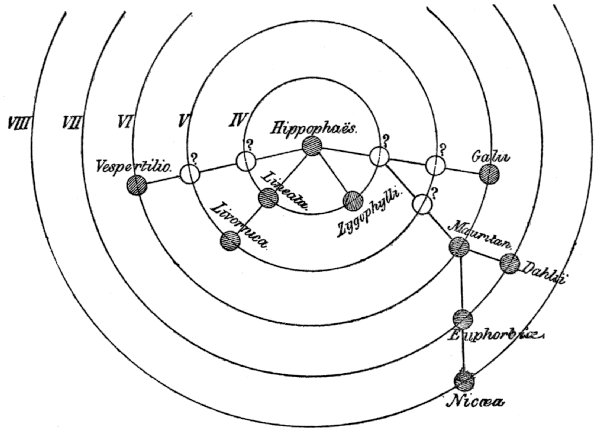
The circles indicate the phyletic stages IV.-VIII.; the eighth is only reached by Nicæa, and is distinguished from the seventh chiefly by the ontogeny, in the third stage of which the seventh phyletic stage is reached, whilst in Euphorbiæ and Dahlii this stage is reached in the fourth ontogenetic stage. The phyletic stages indicated by queries are extinct, and only known through the ontogeny of existing species. It must be understood that this pedigree expresses only the ideal and not the actual relations of the species to one another. Thus, it is possible that Hippophaës is not the parent-form, but an unknown or extinct species, which must, however, have possessed the same marking, and so on.
Four parallel series here proceed from the parent-form Hippophaës; there may have been five, or possibly only three, but the incomplete state of our knowledge of the ontogeny does not permit of any certain conclusion. For the point under consideration this is, however, quite immaterial. The distance from the central point (the parent-form) indicates the grade of phyletic development which the respective species have at present reached.
There is another case which is no less instructive, because it reveals, although in a somewhat different manner, the action of a law of growth innate in the organism itself, but which can nevertheless by no means be regarded as equivalent to a phyletic vital force. I refer to the coloured edges of the oblique stripes which occur in most of the species of the genus Sphinx. It has already been insisted upon in a previous section, that the mode in which this character originates negatives the assumption of a phyletic force, because these coloured edges are gradually built up out of irregularly scattered spots. There is no occasion for a “developmental force” to grope in the dark; if such a power exists, we should expect that it would add new characters to old ones with the precision of a master workman.
If, however, the coloured edges certainly depend on natural selection, this agency causing the scattered spots to coalesce and become linear, we have here the proof that such spots first arose in a precisely similar manner in several species, quite independently of one another—that, in fact, a “fixed direction of variation” in a certain sense exists.
In three species of Smerinthus-larvæ, red spots appear towards the end of the ontogeny; in S. Populi and Ocellatus in only a minority of individuals, and always separate (not coalescent), and in S. Tiliæ in a majority of specimens, the spots frequently becoming fused into one large, single, longish marking. These three species cannot have inherited the spots from a common ancestor, since they are absent in the younger ontogenetic stages, or occur only exceptionally, becoming larger and more numerous in the last stage; they obviously form a character which must be considered as a case of “anticipated development.”
How is it then that three species vary independently of each other in an analogous manner? I know of no other answer to this question than that similar variations must necessarily arise from similar physical constitutions—or, otherwise expressed, the three species have inherited from an unknown parent species, devoid of spots, not this last character itself, but a physical constitution, having a tendency to the formation of red spots on the skin.157 The case offers many analogies to that of the colour varieties of Lacerta Muralis, to which Eimer158 briefly calls attention in his interesting communications on the blue lizard of the Faraglioni Rocks at Capri. The South Italian lizards, although having differently formed skulls, show the same brilliantly coloured varieties as those of North Italy; and Eimer believes that these parallel variations in widely separated localities, some of which have long been isolated, must be referred to a tendency towards fixed directions of variation innate in the constitution of the species.
I long ago insisted159 that it should not be forgotten that natural selection is, in the first place, dependent upon the variations which an organism offers to this agency, and that, although the number of possible variations may be very great for each species, yet this number is by no means to be considered as literally infinite. For every species there may be impossible variations. For this reason I am of opinion that the physical nature of each species is of no less importance in the production of new characters than natural selection, which must always, in the first place, operate upon the results of this physical nature, i.e. upon the variations presented, and can thus call new ones into existence.
It requires but a slight alteration of the definition to make out of this “restricted” or “limited variability,” which is the necessary consequence of the physical nature of each species, a “fixed direction of variation” in the sense of a phyletic vital force. Instead of—the Smerinthus-larvæ show a tendency to produce red spots on the skin, it is only necessary to say—these larvæ tend to produce red borders to the oblique stripes. The latter statement would, however, be incorrect, since the red borders first arose by the coalescence of red spots through the action of natural selection. It is not even correct to say that all the species of Smerinthus show this tendency to produce spots, since this character does not seem to occur either in S. Quercus or S. Tremulæ.
The distinction between the two modes of conception will become clear if we ask, as an example, whether those Chærocampa-larvæ which do not at present possess eye-spots will subsequently acquire these markings, supposing that they maintain their existence on the earth for a sufficient period?
The supporters of a “fixed direction of variation” would answer this question in the affirmative. Ocelli constitute a character which occurs in nearly all the species of the group—they are the goal towards which the phyletic force is urging, and which must sooner or later be reached by each member of the group. On the other hand, I cannot express so decidedly my own opinion, viz., that such complicated characters as the many-coloured oblique stripes or eye-spots are never the results of purely internal forces, but always arise by the action of natural selection, i.e. by the combination of such minute and simple variations as may present themselves. It may be replied that the formation of eye-spots in those species which are at present devoid of them, cannot indeed be considered impossible, but that they would only appear if the constitution of these species had a tendency to give rise to the production of darker spots on the edge of the subdorsal line, and if at the same time, the possession of eye-spots would be of use to the caterpillar under its special conditions of life.
The condition of affairs would be quite different if we were simply concerned with the transference of a character from one segment on which it was already present, to the remaining segments. The transference would, in this case, result from causes purely innate in the organism—from the action of laws of equilibration or of growth (correlation), and the external conditions of life would play only a negative part, since they might prevent the complete reproduction of a character, such, for example, as eye-spots, on all the segments, in cases where it was disadvantageous to the species. The fact that our species of Chærocampa have only faint indications, and not a completely-developed eye-spot, on the remaining segments, may perhaps be explained in this manner. It is conceivable that the two pairs of ocelli on the front segments are more effective as a means of alarm than if the insects were provided with two long rows of such markings; but nothing can be stated with certainty on this point until experiments have been made with caterpillars having rows of eye-spots.
The question raised above—whether the species of Chærocampa at present devoid of eye-spots are to be expected to acquire this character in the course of their further phyletic development—brings with it another point, which cannot be here passed over.
If the utility of the four kinds of markings in their perfected form is demonstrated, their origination through natural selection is not, strictly speaking, thereby proved. It must also be shown that the first rudiments of these characters were also of use to their possessors. The question as to the utility of the “initial stages” of useful characters must here be set at rest.
In the case of markings such as longitudinal and oblique stripes, it is quite evident that the initial stages of these simple characters do not differ greatly from the perfected marking, but this is certainly not the case with eye- and ring-spots. The most light is thrown upon this question by the latter, because a species which has remained at the initial stage of the formation of ring-spots here presents itself for examination, viz. Deilephila Hippophaës.
I have attempted to show that the orange-red spots, which, as a rule, adorn only the eleventh segment, enhance the adaptive colouring of this caterpillar by their resemblance to the berries of the sea-buckthorn, whilst the general surface resembles the leaves in colour. If this be admitted, the origination of these spots by natural selection offers no difficulty, since a smaller spot, or one of a fainter red, must also be of some use to its possessor.
This case is of importance, as showing that a “change of function” may occur in markings, just as it does in certain organs among the most diverse species of animals, in the course of phyletic development. The spots which in Hippophaës are imitations of red berries, in species which have further advanced phyletically play quite another part—they serve as means of alarm, or signals of distastefulness.
It appears to me very improbable, however, that the perfect ocelli of the Chærocampa-larvæ have also undergone such a “functional change” (Dohrn). I rather believe that the first rudiments of these markings produced the same effect as that which they now exercise, viz., terror. We are certainly not so favourably circumstanced in this case in knowing a species which shows the initial steps of this character in its last stage of life; but in the initial steps which the second stage of certain species present, we see preserved the form under which the eye-spots first appeared in the phylogeny, and from this we are enabled to judge with some certainty of the effect which they must have produced at the time.
In the ontogeny of C. Elpenor and Porcellus we see that a small curvature of the subdorsal line first arises, the concavity of which becomes filled with darker green, and soon afterwards with black; the upwardly curved piece of the subdorsal then becomes detached and more completely surrounded by black. The white fragment of the subdorsal which has become separated, in the next place broadens, and a black (dark) pupil appears in its centre.
Now the first rudiments of the eye-spot certainly appear very insignificant in a caterpillar two centimeters long, but we must not forget that in the ancestors of the existing Chærocampa-larvæ this character appeared in the adult state. If we conceive the curvature of the white subdorsal with the underlying dark pigment to be correspondingly magnified, its importance as a means of alarm can scarcely be denied, particularly when we consider that this marking stands on the enlarged fourth segment, which alone invests the caterpillar with a singular, and, to smaller foes, an alarming appearance. We know that in the case of those Chærocampa-larvæ which possess no eye-spots, the distension of this segment is employed against hostile attacks. (See the illustration of Darapsa Chærilus, Pl. IV., Fig. 34.) Those markings which even only remotely resembled an eye must, in such a position, have increased the terrifying action. On these grounds I believe that it may be safely admitted, that this kind of marking possessed the same significance in its initial stages as it now does when fully perfected. No functional change has here taken place.
Among all the facts brought together in the first section I only know of one group of phenomena which at least permit of an attempt to refer them to a phyletic vital force. This is the occurrence of dark ground-colours in adult larvæ which are of light colours in their young condition. I have already attempted to show that in the Chærocampa-larvæ this change of colour depends on a double adaptation, the young caterpillars being adapted to the green colour of the plant and the adults to the soil and dead leaves. This interpretation appears the more correct when we find the same process, viz. the gradual replacement of the original green by brown colours, among species of widely different genera, which, with the dark colouring, possess the necessarily correlated habit of hiding themselves by day when in the adult condition. This is the case with Sphinx Convolvuli, Deilephila Vespertilio, and Acherontia Atropos.
Thus far all has been easily explicable by natural selection; but when we also see a “tendency” to acquire a dark colour in the course of development, in those species which neither conceal themselves nor are adaptively coloured, but are very conspicuously marked—and if, further, it can be shown that these species, such for instance as Deilephila Galii, actually possess immunity from the attacks of foes,—how can this tendency to the formation of a dark colour be otherwise explained than by the admission of a phyletic vital force urging the variations in this direction?
Nevertheless I believe that also on this point an appeal to unknown forces can be dispensed with. In the first place, dark ground-colours can be of use to a species otherwise than as means of adaptation. In D. Galii, as well as in D. Euphorbiæ, the light ring-spots appear rather at their brightest on the pitchy-black ground; and if this caterpillar must (sit venia verbo!) become conspicuous, this purpose would be best attained by acquiring a dark ground-colour, such as that of D. Euphorbiæ.
The tendency, apparently common to all these Sphingidæ, to acquire a dark colour with increasing age, depends therefore on two quite distinct adaptations—first, in species sought by enemies, on an adaptation to the colour of the soil; and secondly, in species rejected by foes, on the endeavour to produce the greatest possible contrast of colour.
Moreover, the supposition from which this last plea for a vital force set out is not universally correct, since there are species, such for instance as D. Nicæa, which never acquire a dark colour; and in D. Galii also, although all the individuals abandon the protective green of the young stages, they by no means all acquire a dark hue in exchange for this colour; many individuals in their light ochreous-yellow colouring rather strikingly resemble the snake-like caterpillar of D. Nicæa.
VII. Phyletic Development of the Markings of the Sphingidæ: Summary and Conclusion.
If, from the form possessed by many of the caterpillars of the Sphingidæ on their emergence from the egg, we may venture to draw a conclusion concerning the oldest phyletic stage, these larvæ were originally completely destitute of marking. The characteristic caudal horn must be older than the existing markings, since it is present in the younger stages (except in cases where it is altogether wanting), and is generally even larger than at a later age.
There is, however, further evidence that there were once Sphinx-larvæ without any markings. Such a species now exists. I do not mean the boring caterpillars of the Sesiidæ,160 which live in the dark, and are therefore colourless, but I refer to a large larva (over six centimeters long) preserved in spirit in the Berlin Museum,161 which, from its form, belongs to the Smerinthus group. It possesses a caudal horn, and on the whole upper surface is covered with short and sparsely scattered bristles, such as occur in the Sesiidæ. The colour of this unknown insect appears to have been light green, although it now shows only a yellowish shade. Every trace of marking is absent, and it thus corresponds exactly with the youngest stages of the majority of the existing Sphinx-larvæ—even to the short bristles sparsely scattered over the whole upper surface of its body. We have therefore, so to speak, a living fossil before us, and it would be of great interest to ascertain its history.
All the data furnished by the developmental history go to show that of the three kinds of markings which occur in the Sphingidæ, viz., longitudinal and oblique stripes and spots, the first is the oldest. Among the species which are ornamented with oblique stripes or spots there are many which are longitudinally striped in their young stages, but the reverse case never occurs—young larvæ never show spots or oblique stripes when the adult is only striped longitudinally.
The first and oldest marking of the caterpillars of the Sphingidæ was therefore the longitudinal striping, or, more precisely speaking, the subdorsal, to which dorsal and spiracular lines may have been added. That this second stage of phyletic development has also been preserved in existing species has already been sufficiently shown; the greater portion of one group, the Macroglossinæ, has indeed remained at this stage of development.
From the biological value which must be attributed to this kind of marking, its origination by natural selection presents no difficulty. The first rudiments of striping must have been useful, since they must have broken up the large surface of the body of the caterpillar into several portions, and would thus have rendered it less conspicuous to its enemies.
Thus it is not difficult to perceive how a whole group of genera could have made shift with this low grade of marking up to the present time. Colour and marking are not the only means of offence and defence possessed by these insects; and it is just such simply-marked larvæ as those of the Macroglossinæ which have the protective habit of feeding only at night, and of concealing themselves by day. Moreover, under certain conditions of life the longitudinal stripes may be a better means of protection, even for a Sphinx-larva, than any other marking; and all those species in which this pattern is retained at the present time live either among grasses or on Coniferæ.
It cannot be properly said that the second form of marking—the oblique stripes—has been developed out of the first. If these had arisen by the transformation of the longitudinal stripes, the two forms could not exist side by side. This is the case, however, both in certain species in the adult state (Calymnia Panopus162), as well as in others during their young stages (most beautifully seen in Smerinthus Populi, Fig. 56). Various facts tend to show that the oblique stripes appeared in the phyletic development later than the longitudinal lines. In the first place they appear later than the latter in the ontogeny of certain species. This is the case with Chærocampa Elpenor and Porcellus, in which, however, they certainly do not reach a high state of development. Then again, the longitudinal lines disappear completely in the course of the ontogeny, whilst the oblique stripes alone maintain their ground. Thus, the subdorsal line vanishes at a very early stage, with the exception of a small residue,163 in all native species of Smerinthus. I have already attempted to show that new characters are only acquired in the last stage, and that if still newer ones are then added, the former disappear from the last stage, and are transferred back to a younger one. Characters vanish therefore from a stage in the same order as they were acquired.
Finally, among the genera with longitudinal stripes (e.g. Macroglossa) we know certain species which, when at an advanced age, possess oblique stripes (M. Fuciformis), although these slant in a direction opposite to those of most of the other larvæ of the Sphingidæ. These are, however, always species which differ from their allies in their mode of life, not feeding on grasses or low plants, but on large-leaved shrubs. If we were able to ascertain the ontogeny of these species, we should find that the oblique stripes appeared late in life, as has already been shown in the case of Pterogon Œnotheræ.
If it be asked why the longitudinal lines were first formed, and then the oblique stripes, it may be replied that the physical constitution of these caterpillars would be more easily able to give rise to simple longitudinal lines than to complicated oblique stripes crossing their segments.164 It may perhaps also be suggested that the oldest Sphingidæ lived entirely on low plants among grasses, and in the course of time gradually took to shrubs and trees. At the present time the majority of the Sphinx-larvæ still live on low plants, and but few on trees, such caterpillars generally belonging to certain special genera.
The character of oblique stripes becomes perfected by the addition of coloured edges, the latter, as is self-evident, having been added subsesequently.
The third chief constituent of the Sphinx-markings, i.e. the spots—whether perfect ocelli or only ring-spots—in two of the special genera here considered, arise on the subdorsal, where they are either deposited (Deilephila), or built up from a fragment of this line (Chærocampa). That these markings can, however, also originate independently of the subdorsal, is shown by the ocellus of Pterogon Œnotheræ, situated on the segment bearing the caudal horn. In this case, however, the ontogeny teaches us that the spot also succeeds the subdorsal, so that we can state generally that all these spot-markings are of later origin than the longitudinal striping.
The question as to the relative ages of the oblique stripes and the spot-marking does not admit of a general answer. In some cases (C. Elpenor and Porcellus) the oblique stripes disappear when the ocelli reach complete development, and we may therefore venture to conclude that in these cases the former appeared earlier in the phylogeny. But it is very probable that oblique stripes arose independently at different periods, just as longitudinal lines occur irregularly in quite distinct families. It would be a great error if we were to ascribe the possession of oblique stripes solely to descent from a common ancestor. The oblique markings found on certain species of Macroglossa (M. Corythus from India) have not been inherited from a remote period, but have been independently acquired by this or by some recent ancestral species. They have nothing to do genetically with the oblique stripes which occur in some species of Chærocampa (e.g. in C. Nessus, from India), or with those of the species of Smerinthus and Sphinx. They depend simply on analogous adaptation (Seidlitz165), i.e. on adaptation to an analogous environment.
The case is similar with the spot-markings. I have already shown that under certain conditions ring-spots may assume the exact appearance of eye-spots by the formation of a nucleus in the “mirror,” such as occurs occasionally in Deilephila Euphorbiæ (Fig. 43), more frequently in D. Galii, and as a rule in D. Vespertilio. Nevertheless, these markings arise in quite another manner to the eye-spots of the Chærocampinæ, with which they consequently have no genetic relation; the two genera became separated at a time when they neither possessed spot-markings. Further, in Pterogon Œnotheræ we find a third kind of spot-marking, which is most closely allied to the ocelli of the Chærocampa-larvæ, but is situated in quite another position, and must have originated in another manner, and consequently quite independently of these eye-spots.
It can also be readily understood why the first and second elements of the markings of the Sphingidæ should be mutually exclusive, and not the second and third or the first and third.
A light longitudinal line cutting the oblique stripes, considerably diminishes that resemblance to a leaf towards which the latter have a tendency, and it is therefore only found in cases where an adaptive marking can be of no effect on account of the small size of the caterpillar, i.e. in quite young stages. (See, for instance, Fig. 56, the first stage of S. Populi.) At a later period of life the old marking must give way to the new, and we accordingly find that the subdorsal line vanishes from all the segments on which oblique stripes are situated, and is only retained on the anterior segments where the latter are wanting. In some few cases both elements of marking certainly occur together, such as in Calymnia Panopus and Macroglossa Corythus; but the oblique stripes are, under these circumstances, shorter, and do not extend above the subdorsal line, and in Darapsa Chœrilus even become fused into the latter.166
In certain cases there may also be a special leaf structure imitated by the longitudinal lines, but on the whole the latter diminish the effect of the oblique stripes; and we accordingly find that not only has the subdorsal disappeared from those segments with oblique stripes, but that most larvæ with this last character are also without the otherwise broad spiracular and dorsal lines. This is the case with all the species of Smerinthus167 known to me, as well as with all the species of the genera Sphinx, Dolba, and Acherontia.
Oblique stripes and spot-markings are not, however, necessarily mutually exclusive in their action, and we also find these in certain cases united in the same larva, although certainly never in an equal state of perfection. Thus, Chærocampa Nessus168 possesses strongly marked oblique stripes, but feebly developed ocelli; and, on the other hand, Chærocampa Elpenor shows strongly developed eye-spots, but the earlier oblique stripes are at most only present as faint traces. This is easily explained by the mode of life. These caterpillars—at least such of them as are perfectly known—do not live on plants with large, strongly-ribbed leaves, and are even in the majority of individuals adapted to the colour of the soil; the oblique stripes have therefore in these cases only the significance of rudimentary formations.
That the first and third forms of markings also are not always mutually prejudicial in their action is shown by the case of Chærocampa Tersa, in which the eye-spots certainly appear to possess some other significance than as a means of causing terror. In most of the Chærocampa-larvæ the subdorsal line disappears in the course of the phylogeny, and it can be understood that the illusive appearance of the eye-spots would be more perfect if they did not stand upon a white line.
If we consider the small number of facts with which I have here been able to deal, the result of these investigations will not be deemed unsatisfactory. It has been possible to show that each of the three chief elements of the markings of the Sphingidæ have a biological significance, and their origin by means of natural selection has thus been made to appear probable. It has further been possible to show that the first rudiments of these markings must also have been of use; and it thus appears to me that their origin by means of natural selection has been proved to demonstration. Moreover, it has not been difficult to understand the displacement of the primary elements of the markings by secondary characters added at a later period, as likewise an essential effect of natural selection. Finally, it has been possible to explain also the subordinate or accessory elements of the markings, partly by the action of natural selection, and partly as the result of markings formerly present acting by correlation.
From the origin and gradual evolution of the markings of the Sphingidæ we may accordingly sketch the following picture:—
The oldest Sphinx-larvæ were without markings; they were probably protected only by adaptive colouring, and a large caudal horn, and by being armed with short bristles.
Their successors, through natural selection, became longitudinally striped; they acquired a subdorsal line extending from the horn to the head, as well as a spiracular, and sometimes also a dorsal, line. The caterpillars thus marked must have been best hidden on those plants in which an arrangement of parallel linear parts predominated; and we may venture to suppose that at this period most of the larvæ of the Sphingidæ lived on or among such plants (grasses).
At a later period oblique stripes were added to the longitudinal lines, the former (almost always) slanting across the seven hindmost segments from the back towards the feet in the direction of the caudal horn. Whether these stripes all arose simultaneously, or, as is more probable, whether only one at first appeared, which was then transferred to the other segments by correlation assisted by natural selection, cannot, at least from the facts available, at present be determined.
On the whole, as the oblique stripes became lengthened towards the back, the longitudinal lines disappeared, since they injured the deceptive effect of the stripes. In many species also there were formed dark or variegated coloured edges to the oblique stripes, in imitation of the shadow lines cast by the leaf-ribs.
Whilst one group of Sphingidæ (Sphinx, Smerinthus) were thus striving to make their external appearance approximate more and more to that of a ribbed leaf, others of the longitudinally striped species became developed in another manner.
Some of the latter lived indeed on bush-like leaved plants, but no oblique stripes were developed, because these would have been useless among the dense, narrow, and feebly-ribbed leaves of the food-plants. These caterpillars, from the earlier markings, simply retained the longitudinal lines, which, combined with a very close resemblance to the colour of the leaves, afforded them a high degree of protection against discovery. This protection would also have been enhanced if other parts of the food-plant, such as the berries (Hippophaës), were imitated in colour and position in such a manner that the large body of the caterpillar contrasted still less with its environment. In this way the first ring-spot probably arose in some species on only one—the penultimate segment.
As soon as this first pair of ring-spots had become an established character of the species, they had a tendency to become repeated on the other segments, advancing from the hind segments towards the front ones. Under certain conditions this repetition of the ring-spots might have been of great disadvantage to the species, and would therefore have been as far as possible prevented by natural selection (Hippophaës); in other cases, however, no disadvantage would have resulted—the caterpillar, well adapted to the colour of its food-plant, would not have been made more conspicuous by the small ring-spots, which might thus have become repeated on all the segments (Zygophylli). In cases like the two latter, striking colours must have been eliminated when inherited from an immediate ancestor; but on this point nothing can as yet be said with certainty.
In other cases the repetition of the ring-spots with strongly contrasted colours was neither prejudicial nor indifferent, but could be turned to the further advantage of the species. If a caterpillar fed on plants containing acrid juices (Euphorbiaceæ) which, by permeating its alimentary system, rendered it repulsive to other animals, the ring-spots commencing to appear (by repetition) would furnish an easy means for natural selection to adorn the species with brilliant colours, which would protect it from attack by acting as signals of distastefulness.
But if the dark spots stood on a light ground (Nicæa), they would present the appearance of eyes, and cause their possessors to appear alarming to smaller foes.
From the developmental histories and biological data at present before us, it cannot with certainty be said which of these two functions of the ring-spots was first acquired in the phylogeny, but we may perhaps suppose that their significance as a means of causing alarm was arrived at finally.
It may also be easily conceived that as the ring-spots became more and more complicated, they would occasionally have played other parts, being fashioned once again in these stages into imitations of portions of plants, such as a row of berries or flower-buds. For this, however, there is as yet no positive evidence.
As the ring-spots became detached from the subdorsal line out of which they had arisen, the latter disappeared more and more completely from the last ontogenetic stage, and receded towards the younger stages of life of the caterpillar—it became historical. This disappearance of the subdorsal may also be explained by the fact that the original longitudinal stripe imitating the linear arrangement of leaves would become meaningless, even if it did not always diminish the effect of the ring-spots. But characters which have become worthless are known in the course of time to become rudimentary, and finally to disappear altogether. I do not believe that disuse alone causes such characters to vanish, although in the case of active organs it may have a large share in this suppression. With markings it cannot, however, be a question of use or disuse—nevertheless they gradually disappear as soon as they become meaningless. I consider this to be the effect of the arrest of the controlling action of natural selection upon these characters (suspension of the so-called “conservative adaptation,” Seidlitz). Any variations may become of value if the character concerned is met with in the necessary state of fluctuation. That this process of extinction does not proceed rapidly, but rather with extreme slowness, is seen in the ontogeny of several species of Deilephila, which retain the now meaningless subdorsal line through a whole series of stages of life.
In another group of Sphinx-larvæ with longitudinal stripes, an eye-spot became developed independently of the subdorsal line, in the position of the caudal horn, which has here vanished with the exception of a small knob-like swelling. This character—which we now see perfected in Pterogon Œnotheræ—undoubtedly serves as a means of causing terror; but whether the incipient stages possessed the same significance, cannot be decided in the isolated case offered by the one species of the genus Pterogon possessing this marking.
In a third group of longitudinally striped caterpillars, the younger genus Chærocampa, eye-spots were developed directly from portions of the subdorsal line, at first only on the fourth and fifth segments. It can be here positively asserted that this character served as a means of alarm from its very commencement. It is certainly for this reason that we see the subdorsal line in the immediate neighbourhood of the spots disappear at an early stage, whilst it is retained on the other segments for a longer period. A portion of the younger (tropical) species of this group then developed similar, or nearly similar, ocelli on the remaining segments by correlation; and it may now have occurred that in solitary cases the eye-spots acquired another significance (C. Tersa?), becoming of use as a disguise by resembling berries or flower-buds. It is also conceivable that the eye-spots may in other cases have been converted into a warning sign of distastefulness.
In all those larvæ which possessed purely terrifying markings, however, not only was the original protective colouring preserved, but in most of them this colour gradually became replaced by a better one (adaptation of the adult larva to the soil). The oblique stripes imitating the leaf-ribs also are by no means lost, but are almost always present, although but feebly developed, and often only temporarily.
The pattern formed by the oblique stripes may also be retained, even with perfect adaptation to the soil, and may be converted to a new use by losing its sharpness, and, instead of imitating definite parts of plants, may become transformed into an irregular and confused marking, and thus best serve to represent the complicated lights and shadows, stripes, spots, &c., cast on the ground under low-growing plants from between the stems and dead leaves.
Just as in the case of ocellated species where caterpillars without eye-spots may retain and newly utilize their older markings, so larvæ having oblique stripes with the most diversely coloured edges may show the same markings in allied (younger?) species, both in a rudimentary and in a transformed condition. These markings may thus contribute to the formation of a latticed or reticulated pattern. Even the oldest marking, the subdorsal line, may still play a part, since its remnants cause certain portions of the complicated pattern to appear more strongly marked (S. Convolvuli). Finally, when an adaptation to a changing environment intersected by lights and shadows is required, new markings may be here added as in other cases, viz., dark streaks extending over the light surface of the whole caterpillar.
In concluding this essay, I may remark that, with respect to the wide and generally important question which gave rise to these investigations, a clearer and simpler result has been obtained than could have been expected, considering the complexity of the characters requiring to be traced to their causes, as well as our still highly imperfect knowledge of ontogenetic and biological facts.
For a long time I believed that it was not possible to trace all the forms of marking and their combinations to those causes which are known to produce transformation; I expected that there would be an inexplicable residue.
But this is not the case. Although it cannot yet be stated at first sight with certainty in every single instance how far any particular element of marking may have a biological value in the species possessing it, nevertheless it has been established that each of the elements of marking occurring in the larvæ of the Sphingidæ originally possessed a decided biological significance, which was produced by natural selection.
In the case of the three chief elements of the markings of the Sphingidæ, it can be further shown that not only the initial stages but also their ultimate perfection—the highest stages of their development, are of decided advantage to their possessors, and have a distinct biological value, so that the gradual development and improvement of these characters can be traced to the action of natural selection.
But although natural selection is the factor which has called into existence and perfected the three chief forms and certain of the subsidiary markings, in the repetition of the local character on the other segments, as well as in the formation of new elements of marking at the points of intersection of older characters now rudimentary, we can recognize a second factor which must be entirely innate in the organism, and which governs the uniformity of the bodily structure in such a manner that no part can become changed without exerting a certain action on the other parts—an innate law of growth (Darwin’s “correlation”).
Only once during the whole course of the investigations was it for an instant doubtful whether a phyletic vital force did not make itself apparent, viz., in the red spots accompanying the oblique stripes in several Smerinthus-larvæ. Closer analysis, however, enabled us to perceive most distinctly the wide gulf that separates “analogous variation” from the mystic phyletic vital force. Nothing further remains therefore for the action of this force in respect to the marking and colouring of the Sphingidæ, since several even of the subordinate markings can be traced to their causes, only the “dorsal spots” of our two native species of Chærocampa having been referred to correlation without decided proof. From the temporary inability to explain satisfactorily such an insignificant detail, no one will, however, infer the existence of such a cumbrous power as a phyletic vital force.
The final result to which these investigations have led us is therefore the following:—The action of a phyletic vital force cannot be recognized in the marking and colouring of the Sphingidæ; the origination and perfection of these characters depend entirely on the known factors of natural selection and correlation.
II. ON PHYLETIC PARALLELISM IN METAMORPHIC SPECIES.
INTRODUCTION.
In the previous essay I attempted to trace a whole group of apparently “purely morphological” characters to the action of known factors of transformation, to explain them completely by these factors, and in this manner I endeavoured to exclude the operation of an internal power inciting change (phyletic vital force).
In this second study I have attempted to solve the problem as to whether such an innate inciting power can be shown to exist by comparing the forms of the two chief stages of metamorphic species, or whether such a force can be dispensed with.
Nobody has as yet apparently entertained the idea of testing this question by those species which appear in the two forms of larva and imago (insects), or, expressed in more general terms, by those species the individuals of which successively possess quite different forms (metamorphosis), or in which the different forms that occur are distributed among different individuals alternating with and proceeding from one another (alternation of generation). Nevertheless, it is precisely here that quite distinct form-relationships would be expected according as the development of the organic world depended on a phyletic vital force, or was simply the response of the specific organism to the action of the environment.
Assuming the first to be the case, there must have occurred, and must still occur, what I designate “phyletic parallelism,” i.e. the two stages of metamorphic species must have undergone a precisely parallel development—every change in the butterfly must have been accompanied or followed by a change in the caterpillar, and the systematic groups of the butterflies must be also found in a precisely corresponding manner in a systematic grouping of the caterpillars. If species are able to fashion themselves into new forms by an innate power causing periodic change, this re-moulding cannot possibly affect only one single stage of development—such as the larva only—but would rather extend, either contemporaneously or successively, to all stages—larva, pupa, and imago: each stage would acquire a new form, and it might even be expected that each would change to the same extent. At least, it cannot be perceived why a purely internal force should influence the development of one stage more than that of another. The larvæ and imagines of two species must differ from one another to the same extent, and the same must hold good for the larvæ and imagines of two genera, families, and so forth. In brief, a larval system must completely coincide with the system based entirely on imaginal characters, or, what amounts to the same thing, the form-relationships of the larvæ must correspond exactly with the form-relationships of the imagines.
On the other hand, the condition of affairs must be quite different if an internal power causing phyletic remodelling does not exist, the transformation of species depending entirely on the action of the environment. In this case dissimilarities in the phyletic development of the different stages of life must be expected, since the temporary, and often widely deviating, conditions of life in the two stages can and must frequently influence the one stage whilst leaving the other unacted upon—the former can therefore undergo remodelling while the latter remains unchanged.169
By this means there would arise an unequal difference between the two stages of two species. Thus, the butterflies, supposing these to have become changed, would bear a more remote form-relationship to each other than the caterpillars, and the differences between the former (imagines) would always be greater than that between the larvæ if the butterflies were, at several successive periods, affected by changing influences whilst the larvæ continued under the same conditions and accordingly remained unaltered. The two stages would not coincide in their phyletic development—the latter could not be expressed by parallel lines, and we should accordingly expect to find that there was by no means a complete congruity between the systems founded on the larval and imaginal characters respectively, but rather that the caterpillars frequently formed different systematic groups to the butterflies.170
Accordingly, the problem to be investigated was whether in those species which develope by means of metamorphosis, and of which the individual stages exist under very different conditions of life, a complete phyletic parallelism was to be found or not. This cannot be decided directly since we cannot see the phyletic development unfolded under our observation, but it can be established indirectly by examining and comparing with each other the form-relationships of the two separate stages—by confronting the larval and imaginal systematic groups. If the phyletic development has been parallel and perfectly equal, so also must its end-results—the forms at present existing—stand at equal distances from one another; larval and imaginal systems must coincide and be congruent. If the course of the phyletic development has not been parallel, there must appear inequalities—incongruences between the two systems.
I am certain that systematists of the old school will read these lines with dismay. Do we not regard it as a considerable advance in taxonomy that we have generally ceased to classify species simply according to one or to some few characters, and that we now take into consideration not merely the last stage of the development (the imago), but likewise the widely divergent young stages (larva and pupa)? And now shall it not be investigated whether caterpillars and butterflies do not form quite distinct systems? In the case of new species of butterflies of doubtful systematic position was not always the first question:—what is the nature of the caterpillars? and did not this frequently throw light upon the relationships of the imago? Assuredly; and without any doubt we have been quite correct in taking the larval structure into consideration. But in so doing we should always keep in mind that there are two kinds of relationship—form- and blood-relationship—which might possibly not always coincide.
It has hitherto been tacitly assumed that the degree of relationship between the imagines is always the same as that between the larvæ, and if blood-relationship is spoken of this must naturally be the case, since the larva and the imago are the same individual. In all groups of animals we have not always the means of deciding strictly between form- and blood-relationship, and must accordingly frequently content ourselves by taking simply the form-relationship as the basis of our systems, although the latter may not always express the blood-relationship. But it is exactly in the case of metamorphic species that there is no necessity for, nor ought we to remain satisfied with, this mode of procedure, since we have here two kinds of form-relationship, that of the larvæ and that of the imagines, and, as I have just attempted to show, it is by no means self-evident that these always agree; there are indeed already a sufficient number of instances to show that such agreement does not generally exist.
This want of coincidence is strikingly shown in a group of animals widely remote from the Insecta, viz. the Hydromedusæ, the systematic arrangement of which is quite different according as this is based on the polypoid or on the medusoid generation. Thus, the medusoid family of the oceanic Hydrozoa springs from polypites belonging to quite different families, and in each of these polypoid families there are species which produce Medusæ of another family.
Similarly, the larvæ of the Ophiuroidea (Pluteus-form) among the Echinodermata are not the most closely related in form to those of the ordinary star-fishes, but rather to the larvæ of quite a distinct order, the sea-urchins.
I will not assert that in these two cases the dissimilarity in the form-relationship, or, as I may designate it, the incongruence of the morphological systems, must depend on an unequal rate of phyletic development in the two stages or generations, or that this incongruence can be completely explained by the admission of such an unequal rate of development: indeed it appears to me probable that, at least in the Ophiureæ, quite another factor is concerned—that the form-relationship to the larvæ of the sea-urchins does not depend upon blood-relationship, but on convergence (Oscar Schmidt), i.e. on adaptation to similar conditions of life. These two cases, however, show that unequal form-relationship of two stages may occur.
From such instances we certainly cannot infer off-hand that a phyletic force does not exist; it must first be investigated whether and to what extent such dissimilarities can be referred to unequal phyletic development and, should this be the case, whether deviations from a strict congruence of the morphological systems are not compatible with the admission of an internal transforming power. That a certain amount of influence is exerted by the environment on the course of the processes of development of the organic world, will however be acceded to by the defenders of the phyletic vital force. It must therefore be demonstrated that deviations from complete congruence occur, which, from their nature or magnitude, are incompatible with the admission of innate powers, and, on the other hand, it must likewise be attempted to show that the departures from this congruence as well as the congruence itself can be explained without admitting a phyletic vital force.
In the following pages I shall attempt to solve this question for the order Lepidoptera, with the occasional assistance of two other orders of insects. Neither the Echinodermata nor the Hydromedusæ are at present adapted to such a critical examination; the number of species in these groups of which the development has been established with certainty is still too small, and their biological conditions are still to a great extent unknown. In both these respects they are far surpassed by the Lepidoptera. In this group we know a large number of species in the two chief stages of their development and likewise more or less exactly the conditions under which they exist during each of these phases. We are thus able to judge, at least to a certain extent, what changes in the conditions of life produce changes of structure. Neither in the number of known species of larvæ, nor in the intimate knowledge of their mode of life, can any of the remaining orders of insects compete with the Lepidoptera. There is no Dipterous or Hymenopterous genus in which ten or more species are so intimately known in the larval stage that they can be employed for the purposes of morphological comparison. Who is able to define the distinctions between the life-conditions of the larvæ of twenty different species of Culex or of Tipula? The caterpillars of closely allied species of Lepidoptera, on the other hand, frequently live on different plants, from which circumstance alone a certain difference in the life-conditions is brought about.
The chief question which the research had to reply to was the following:—Does there exist a complete phyletic parallelism among Lepidoptera or not? or, more precisely speaking:—Can we infer, from the form-relationships which at present exist between larvæ on the one hand and imagines on the other, an exactly parallel course of phyletic development in both stages; or do incongruences of form-relationship exist which point to unequal development?
Before I proceed to the solution of this question it is indispensable that one point should be cleared up which has not been hitherto touched upon, but which must be settled before the problem can be formally stated in general terms. Before it can be asked whether larvæ and imagines have undergone a precisely parallel development, we must know whether unequal development is possible—whether there does not exist such an intimate structural relationship between the two stages that every change in one of these must bring about a change in the other. Were this the case, every change in the butterfly would cause a correlative change in the caterpillar, and vice versâ, so that an inequality of form-relationship between the larvæ on one hand and the imagines on the other would be inconceivable—systems based on the characters of the caterpillars would completely coincide with those based on the characters of the butterflies and we should arrive at a false conclusion if we attributed the phyletically parallel development of the two stages to the existence of an internal phyletic force, whilst it was only the known factor, correlation, which caused the equality of the course of development.
For these reasons it must first be established that the larva and imago are not respectively fixed in form, and the whole of the first section will therefore be devoted to proving that the two stages change independently of one another. Conclusions as to the causes of change will then be drawn, and these will corroborate from another side a subsequent inquiry as to the presence or absence of complete congruence in the two morphological systems. The two questions the answers to which will be successively attempted are by no means identical, although closely related, since it is quite conceivable that the first may be answered by there being no precise correlation of form, or only an extremely small correlation, between the caterpillar and the imago, whilst, at the same time, it would not be thereby decided whether the phyletic development of the two stages had kept pace uniformly or not. A perfect congruence of morphological relationships could only take place if transformations resulted from an internal power instead of external influences. The question:—Does there exist a fixed correlation of form between the two stages? must therefore be followed by another:—Do the form-relationships of the two stages coincide or not—has their phyletic development been uniform or not?