Part I. ON THE SEASONAL DIMORPHISM OF BUTTERFLIES. (continued 3)
Raphael Meldola translation
In explanation of the present case Dr. Weismann wrote to Mr. Edwards:—“Marcia is the old primary form of the species, in the glacial period the only one. Tharos is the secondary form, having arisen in the course of many generations through the gradually working influence of summer heat. In your experiments cold has caused the summer generation to revert to the primary form. The reversion which occurred was complete in the females, but not in all the males. This proves, as it appears to me, that the males are changed or affected more strongly by the heat of summer than the females. The secondary form has a stronger constitution in the males than in the females. As I read your letter, it at once occurred to me whether in the spring there would not appear some males which were not pure Marcia, but were of the summer form, or nearly resembling it; and when I reached the conclusion of the letter I found that you especially mentioned that this was so! And I was reminded that the same thing is observable in A. Levana, though in a less striking degree. If we treated the summer brood of Levana with ice, many more females than males would revert to the winter form. This sex is more conservative than the male—slower to change.”
The extreme variability of P. Tharos was alluded to more than a century ago by Drury, who stated:—“In short, Nature forms such a variety of this species that it is difficult to set bounds, or to know all that belongs to it.” Of the different named varieties, according to Mr. Edwards, “A appears to be an offset of B, in the direction most remote from the summer form, just as in Papilio Ajax, the var. Walshii is on the further side of Telamonides, remote from the summer form Marcellus.” Var. C leads from B through D directly to the summer form, whilst A is more unlike this last variety than are several distinct species of the genus, and would not be suspected to possess any close relationship were it not for the intermediate forms. The var. B is regarded as nearest to the primitive type for the following reasons:—In the first place it is the commonest form, predominating over all the other varieties in W. Virginia, and moreover appears constantly in the butterflies from pupæ submitted to refrigeration. Its distinctive peculiarity of colour occurs in the allied species P. Phaon (Gulf States) and P. Vesta (Texas), both of which are seasonally dimorphic, and both apparently restricted in their winter broods to the form corresponding to B of Tharos. In their summer generation both these species closely resemble the summer form of Tharos, and it is remarkable that these two species, which are the only ones (with the exception of the doubtful Batesii) closely allied to Tharos, should alone be seasonally dimorphic out of the large number of species in the genus.
Mr. Edwards thus explains the case under consideration:—“When Phaon, Vesta, and Tharos were as yet only varieties of one species, the sole coloration was that now common to the three. As they gradually became permanent, or in other words, as these varieties became species, Tharos was giving rise to several sub-varieties, some of them in time to become distinct and well marked, while the other two, Phaon and Vesta, remained constant. As the climate moderated and the summer became longer, each species came to have a summer generation; and in these the resemblance of blood-relationship is still manifest. As the winter generations of each species had been much alike, so the summer generations which sprung from them were much alike. And if we consider the metropolis of the species Tharos, or perhaps of its parent species, at the time when it had but one annual generation, to have been somewhere between 37° and 40° on the Atlantic slope, and within which limits all the varieties and sub-varieties of both winter and summer forms of Tharos are now found in amazing luxuriance, we can see how it is possible, as the glacial cold receded, that only part of the varieties of the winter form might spread to the northward, and but one of them at last reach the sub-boreal regions and hold possession to this day as the sole representative of the species. And at a very early period the primary form, together with Phaon and Vesta, had made its way southward, where all three are found now.”
Experiments with Grapta Interrogationis.64
[Communicated by Mr. W. H. EDWARDS, November 15th, 1879.]
The experiments with this species were made in June, 1879, on pupæ from eggs laid by the summer form Umbrosa of the second brood of the year, and obtained by confining a female in a bag on a stem of hop. As the pupæ formed, and at intervals of from six to twenty-four hours after pupation (by which time all the older ones had fully hardened), they were placed in the ice-box. In making this experiment Mr. Edwards had three objects in view. 1st. To see whether it was essential that the exposure should take place immediately after pupation, in order to effect any change. 2ndly. To see how short a period would suffice to bring about any change. 3rdly. Whether exposing the summer pupæ would bring about a change in the form of the resulting butterfly. Inasmuch as breeding from the egg of Umbrosa, in June, in a former year,64 gave both Umbrosa (11) and Fabricii (6), the butterflies from the eggs obtained, if left to nature, might be expected to be of both forms. The last or fourth brood of the year having been found up to the present time to be Fabricii, and the 1st brood of the spring, raised from eggs of Fabricii (laid in confinement), having been found to be wholly Umbrosa, the latter is probably the summer and Fabricii the winter form. The two intervening broods, i.e. the 2nd and 3rd, have yielded both forms. This species hibernates in the imago state.
After the pupæ had been in the ice-box fourteen days they were all removed but 5, which were left in six days longer. Several were dead at the end of fourteen days. The temperature most of the time was 1°-2° R.; but for a few hours each day rose as the ice melted, and was found to be 3°-6° R.
From the fourteen-day lot 7 butterflies were obtained, 3 males and 4 females. From the twenty-day lot 4 males and 1 female; every one Umbrosa. All had changed in one striking particular. In the normal Umbrosa of both sexes,65 the fore wings have on the upper side on the costal margin next inside the hind marginal border, and separated from it by a considerable fulvous space, a dark patch which ends a little below the discoidal nervule; inside the same border at the inner angle is another dark patch lying on the submedian interspace. Between these two patches, across all the median interspaces, the ground-colour is fulvous, very slightly clouded with dark.
In all the 4 females exposed to cold for fourteen days a broad black band appeared crossing the whole wing, continuous, of uniform shade, covering the two patches, and almost confluent from end to end with the marginal border, only a streak of obscure fulvous anywhere separating the two. In the case of the females from pupæ exposed for twenty days, the band was present, but while broad, and covering the space between the patches, it was not so dark as in the other females, and included against the border a series of obscure fulvous lunules. This is just like many normal females, and this butterfly was essentially unchanged.
In all the males the patches were diffuse, that at the apex almost coalescing with the border. In the 3 from chrysalides exposed fourteen days these patches were connected by a narrow dark band (very different from the broad band of the females), occupying the same position as the clouding of the normal male, but blackened and somewhat diffused. In the 4 examples from the twenty-day pupæ, this connecting band was scarcely as deeply coloured and continuous as in the other 3. Beyond this change on the submarginal area, whereby a band is created where naturally would be only the two patches, and a slight clouding of the intervening fulvous surfaces, there was no difference of the upper surface apparent between these examples of both sexes, and a long series of natural ones placed beside them.
On the under side all the males were of one type, the colours being very intense. There was considerably more red, both dark and pale, over the whole surface, than in a series of natural examples in which shades of brown and a bluish hue predominate. No change was observed in the females on the under side.
It appears that fourteen days were as effective in producing changes as a longer period. In fact, the most decided changes were found in the females exposed the shorter period. It also appears that with this species cold will produce change if applied after the chrysalis has hardened. The same experiments were attempted in 1878 with pupæ of Grapta Comma. They were put on ice at from ten minutes to six hours after forming, and subjected to a temperature of about 0°-1° R. for eighteen to twenty days, but every pupa was killed. Chrysalides of Papilio Ajax in the same box, and partly exposed very soon after pupation, were not injured. It was for this reason that none of the Interrogationis pupæ were placed in the box till six hours had passed.
It appears further that cold may change the markings on one part of the wing only, and in cases where it does change dark or dusky markings melanises them; or it may deepen the colours of the under surface (as in the females of the present experiment). The females in the above experiment were apparently most susceptible to the cold, the most decided changes having been effected in them.
The resulting butterflies were all of one form, although both might have been expected to appear under natural circumstances.
Dr. Weismann’s remarks on the foregoing experiments.—The author of the present work has, at my request, been good enough to furnish the following remarks upon Mr. Edward’s experiments with G. Interrogationis:—
The interesting experiments of Mr. Edwards are here principally introduced because they show how many weighty questions in connexion with seasonal dimorphism still remain to be solved. The present experiments do not offer a direct but, at most, only an indirect proof of the truth of my theory, since they show that the explanation opposed to mine is also in this case inadmissible. Thus we have here, as with Papilio Ajax, two out of the four annual generations mixed, i.e., consisting of summer and winter forms, and the conclusion is inevitable that these forms were not produced by the gradual action of heat or cold. When, from pupæ of the same generation which are developed under precisely the same external conditions, both forms of the butterfly are produced, the cause of their diversity cannot lie in these conditions. It must rather depend on causes innate in the organism itself, i.e., on inherited duplicating tendencies which meet in the same generation, and to a certain extent contend with each other for precedence. The two forms must have had their origin in earlier generations, and there is nothing against the view that they have arisen through the gradual augmentation of the influences of temperature.
In another sense, however, one might perceive, in the facts discovered by Edwards, an objection to my theory.
By the action of cold the form Umbrosa, which flies in June, was produced. Now we should be inclined to regard the var. Umbrosa as the summer form, and the var. Fabricii, which emerges in the autumn, hibernates in the imago state, and lays eggs in the spring, as the winter form. It would then be incomprehensible why the var. Umbrosa (i.e., the summer form) should be produced by cold.
But it is quite as possible that the var. Umbrosa as that the var. Fabricii is the winter form. We must not forget that, in this species, not one of the four annual generations is exposed to the cold of winter in the pupal state. When, therefore, we have in such cases seasonal dimorphism, to which complete certainty can only be given by continued observations of this butterfly, which does not occur very commonly in Virginia, this must depend on the fact that the species formerly hibernated in the pupal stage. This question now arises, which of the existing generations was formerly the hibernating one—the first or the last?
Either may have done so à priori, according as the summer was formerly shorter or longer than now for this species. If the former were the case, the var. Fabricii is the older winter form; were the latter the case, the var. Umbrosa is the original winter form, as shall now be more closely established.
Should the experiments which Mr. Edwards has performed in the course of his interesting investigations be repeated in future with always the same results, I should be inclined to explain the case as follows:—
It is not the var. Fabricii, but Umbrosa, which is the winter generation. By the northward migration of the species and the relative shortening of the summer, this winter generation would be pushed forward into the summer, and would thereby lose only a portion of the winter characters which it had till that time possessed. The last of the four generations which occurs in Virginia is extremely rare, so that it must be regarded either as one of the generations now supposed to be originating, or as one now supposed to be disappearing. The latter may be admitted. Somewhat further north this generation would be entirely suppressed, and the third brood would hibernate, either in the imago state or as pupæ or caterpillars. In Virginia this third generation consists of both forms. We may expect that further north, at least, where it hibernates as pupæ, it will consist entirely, or almost entirely, of the var. Umbrosa. Still further north in the Catskill Mountains, as Edwards states from his own observations, the species has only two generations, and one might expect that the var. Umbrosa would there occur as the winter generation.
Should the foregoing be correct, then the fact that the second generation assumes the Umbrosa form by the action of cold, as was the case in Edward’s experiments, becomes explicable. The new marking peculiar to this form produced by this means must be regarded as a complete reversion to the true winter form, the characters of which are becoming partly lost as this generation is no longer exposed to the influence of winter, but has become advanced to the beginning of summer.
The foregoing explanation is, of course, purely hypothetical; it cannot at present be asserted that it is the correct one. Many investigations based on a sufficiently large number of facts are still necessary to be able to attempt to explain this complicated case with any certainty. Neither should I have ventured to offer any opinion on the present case, did I not believe that even such a premature and entirely uncertain explanation may always be of use in serving the inventive principle, i.e., in pointing out the way in which the truth must be sought.
As far as I know, no attempt has yet been made to prove from a general point of view the interpolation of new generations, or the omission of single generations from the annual cycle, with respect to causes and effects. An investigation of this kind would be of the greatest importance, not only for seasonal dimorphism, but also for the elucidation of questions of a much more general nature, and would be a most satisfactory problem for the scientific entomologist. I may here be permitted to develope in a purely theoretical manner the principles in accordance with which such an investigation should be made:—
On the change in the number of generations of the annual cycle.—A change in the number of generations which a species produces annually must be sought chiefly in changes of climate, and therefore in a lengthening or shortening of the period of warmth, or in an increase or diminution of warmth within this period; or, finally, in both changes conjointly. The last case would be of the most frequent occurrence, since a lengthening of the period of warmth is, as a rule, correlated with an elevation of the mean temperature of this period, and vice versâ. Of other complications I can here perceive the following:—
Climatic changes may be active or passive, i.e., they occur by a change of climate or by a migration and extension of the species over new districts having another climate.
By a lengthening of the summer, as I shall designate the shorter portion of the whole annual period of warmth, the last generation of the year would be advanced further in its development than before; if, for instance, it formerly hibernated in the pupal state, it would now pass the winter in the imago stage. Should a further lengthening of the summer occur, the butterflies might emerge soon enough to lay eggs in the autumn, and by a still greater lengthening the eggs also might hatch, the larvæ grow up and hibernate as pupæ. In this manner we should have a new generation interpolated, owing to the generation which formerly hibernated being made to recede step by step towards the autumn and the summer. By a lengthening of the summer there occurs therefore a retrogressive interruption of generations.
The exact opposite occurs if the summer should become shortened. In this case the last generation would no longer be so far developed as formerly; for instance, it might not reach the pupal stage, as formerly, at the beginning of winter, and would thus hibernate in a younger stage, either as egg or larvæ. Finally, by a continual shortening of the summer it would no longer appear at the end of this period but in the following spring; in other words, it would be eliminated. By a shortening of the summer accordingly the interruption of generations occurs by advancement.
The following considerations, which submit themselves with reference to seasonal dimorphism, are readily conceivable, at least, in so far as they can be arrived at by purely theoretical methods. Were the summer to become shorter the generation which formerly hibernated in the pupal stage would be advanced further into the spring. It would not thereby necessarily immediately lose the winter characters which it formerly possessed. Whether this would happen, and to what extent, would rather depend upon the intensity of the action of the summer climate on the generation in question, and on the number of generations which have been submitted to this action. Hitherto no attempts have been made to expose a monomorphic species to an elevated temperature throughout several generations, so as to obtain an approximate measure of the rapidity with which such climatic influences can bring about changes. For this reason we must for the present refrain from all hypothesis relating to this subject.
The disturbance of generations by the shortening of summer might also occur to a species in such a manner that the generation which formerly hibernated advances into the spring, the last of the summer generations at the same time reaching the beginning of winter. The latter would then hibernate in the pupal state, and would sooner or later also assume the winter form through the action of the cold of winter. We should, in this case, have two generations possessing more or less completely the winter form, the ancient winter generation now gradually losing the winter characters, and the new winter generation gradually acquiring these characters.
In the reverse case, i.e., by a lengthening of the summer, we should have the same possibilities only with the difference that the disturbance of generations would occur in a reverse direction. In this case it might happen that the former winter generation would become the autumnal brood, and more or less preserve its characters for a long period. Here also a new winter generation would be produced as soon as the former spring brood had so far retrograded that its pupæ hibernated.
I am only too conscious how entirely theoretical are these conjectures. It is very possible that observation of nature will render numerous corrections necessary. For instance, I have assumed that every species is able, when necessary, to adapt any one of its developmental stages to hibernation. Whether this is actually the case must be learnt from further researches; at present we only know that many species hibernate in the egg stage, others in the larval state, others as pupæ, and yet others in the perfect state. We know also that many species hibernate in several stages at the same time, but we do not know whether each stage of every species has an equal power of accommodation to cold. Should this not be the case the above conjectures would have to be considerably modified. To take up this subject, so as to completely master all the facts connected therewith, naturalists would have to devote their whole time and energy to the order Lepidoptera, which I have been unable to do.
From the considerations offered, it thus appears that the phenomena of seasonal dimorphism may depend on extremely complex processes, so that one need not be surprised if only a few cases now admit of certain analysis. We must also admit, however, that it is more advantageous to science to be able in the first place to analyze the simplest cases by means of breeding experiments, than to concern oneself in guessing at cases which are so complicated as to make it impossible at present to procure all the materials necessary for their solution.
Plate I.
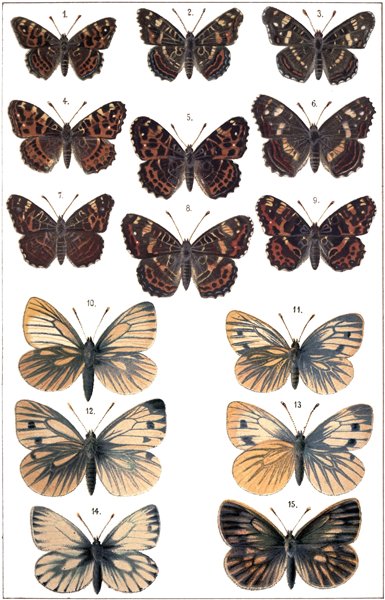
Aug. Weismann pinx.
Lith. J. A. Hofmann, Würzburg.
Plate II.
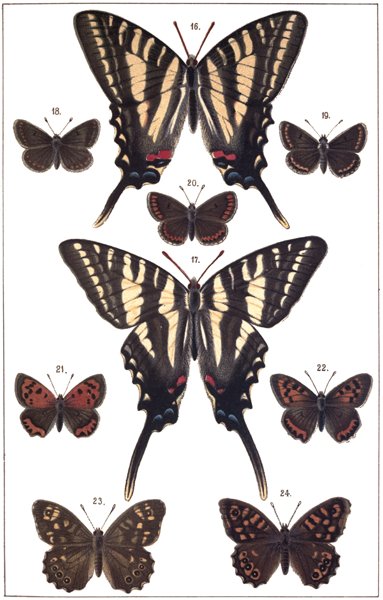
Aug. Weismann pinx.
Lith. J. A. Hofmann, Würzburg.
EXPLANATION OF THE PLATES.
Plate I.
Fig. 1. Male Araschnia Levana, winter form.
Fig. 2. Female A. Levana, winter form.
Fig. 3. Male A. Levana, artificially bred intermediate form (so-called Porima).
Fig. 4. Female A. Levana, intermediate form (Porima), artificially bred from the summer generation, agreeing perfectly in marking with the winter form, and only to be distinguished from it by the somewhat darker ground colour.
Fig. 5. Male A. Levana, summer form (Prorsa).
Fig. 6. Female A. Levana, summer form (Prorsa).
Figs. 7 to 9. Intermediate forms (Porima), artificially bred from the first summer generation.
Figs. 10 and 11. Male and female Pieris Napi, winter form, artificially bred from the summer generation; the yellow ground-colour of the underside of the hind wings brighter than in the natural winter form.
Figs. 12 and 13. Male and female Pieris Napi, summer form.
Figs. 14 and 15. Pieris Napi, var. Bryoniæ, male and female reared from eggs.
Plate II.
Fig. 16. Papilio Ajax, var. Telamonides, winter form.
Fig. 17. P. Ajax, var. Marcellus, summer form.
Fig. 18. Plebeius Agestis (Alexis, Scop.), German winter form.
Fig. 19. P. Agestis (Alexis, Scop.), German summer form.
Fig. 20. P. Agestis (Alexis, Scop.), Italian summer form. (The chief difference between figs. 19 and 20 lies on the under-side, which could not be here represented.)
Fig. 21. Polyommatus Phlæas, winter form, from Sardinia; the German winter and summer generations are perfectly similar.
Fig. 22. P. Phlæas, summer form, from Genoa.
Fig. 23. Pararga Ægeria, from Freiburg, Baden.
Fig. 24. P. Meione, southern climatic form of Ægeria from Sardinia.
END OF PART I.