Front matter (continued 2)
Reading edition
"It seemed whole weeks before my signal was discovered, though from the length of the ash upon my Vevey fine I knew that it could not have been more than five minutes at the outside. At last I began to hear voices, though I failed to distinguish the words, and realised that tools were at work upon my living tomb. In spite of the awful nausea, I puffed away harder than ever, pressing upwards with my hand, so as to lift the lid the very moment it was loosened.
"At last it yielded. I thrust it off, not waiting for it to be lifted, and with the stump of my cigar still between my fingers sprang to my feet, exclaiming—
"'It is time that I was out of this. I have no business here.'
"The guards and porters and policemen who were standing round turned pale, as though they had seen a ghost, and nearly fell into each other's arms.
"'Who the——' one of them ejaculated in his consternation, and I answered reassuringly—
"'Fear nothing! No harm will happen to you. I am Jean Antoine Stromboli Kosnapulski.'
"Then I stepped out of my box and looked around me. We were at Basle. On the platform I saw my old enemy of the Third Section—the same man whose forehead I had gashed—offering explanations to two policemen, who held him fast and did not seem at all disposed to listen to him.
"I pointed at him with the finger of denunciation.
"'There he is,' I cried. 'That is the culprit; that is the man who fired the bomb. He was making bombs in the woods near Montreux, and because I caught him at it he kidnapped me and threatened me with this living death. It is a voice from the dead that now convicts him of his crime.'
"You can imagine the effect that followed from my words. The crowd rushed forward as one man, vowing that it would tear the miscreant limb from limb; the police, as one man, formed up to save him for more formal and deliberate justice, and I found myself standing alone and unobserved upon the platform.
"'This is a good opportunity of retiring unobtrusively,' I said to myself, 'If I remain to give evidence, I shall be the mark of the vengeance of the Third Section for the remainder of my life. Better that an ocean should roll between us; better that I should disappear mysteriously and leave no trace behind.'
"So, taking advantage of the confusion, I bought a ticket and slipped unnoticed into the Paris train en route for Havre and America.
"Afterwards, from the papers, I learnt that my enemy of the Third Section—whose Government naturally could not help him—had been sentenced to imprisonment with hard labour."
THE COUNTER-REVOLUTION.
Stromboli smoked a cigar, slowly and meditatively, in my chambers. The dreamy yet earnest look in his eyes indicated that he was following an important train of thought. At last he spoke.
"What," he asked, "is your candid opinion of me as a story-teller?"
I smiled my admiration and replied—
"My friend, I find many notable qualities in your stories, but the quality which pleases me best is the modesty of the narrator."
For the first time the revolutionist flashed a suspicious glance at me, ejaculating—
"My modesty? What do you mean, then?"
"I refer," I said, "to the readiness with which you acknowledge that your appearance in revolutions has sometimes been more picturesque than dignified. Take that Nihilist story," I explained. "It seems that all that you did for the cause was to smoke a cigar in your coffin."
"But you know that my rôle has not often been so humble as on that occasion. If I have sunk low, I have also risen high. Listen, and I will tell you. I was once the President of a republic."
"You don't say so?" was the feeble remark I blurted out.
"I say so," he replied with gentle dignity, "for no other reason than because it happens to be the fact. I suppose I should still be the President of a republic if it had not been for the counter-revolution. A counter-revolution," he added, philosophically, "is no unusual incident in the history of the republics of Central America."
I nodded my acquiescence.
"Still," I urged, "it would be a good idea for you to tell the story. It exhibits you, no doubt, in a heroic light."
"I leave you to be the judge of that," Stromboli answered, and forthwith began upon—
THE ADVENTURE OF THE COUNTER-REVOLUTION.
"On escaping from my coffin, as I have told you, I hurried by way of Havre to New York—a city where revolutionists are treated with respect, and may even obtain municipal office by means of the Irish vote. I make no doubt I should have risen to some distinction of the kind, if another employment had not been found for me by private enterprise.
"It happened in an underground saloon bar—a 'dive' as it was called—which I frequented. I used to sit there in the company of some large-hearted Irishmen who had got into trouble with the British Government. We told each other stories of adventures, and I flatter myself that, as a story-teller, I held my own among them. But the crisis in my career arrived when I heard a strange but friendly voice at my elbow, speaking the one word—
"'Cocktail?'
"I accepted the invitation and turned round to inspect my host. As he was well-dressed, my first impression was that he was a young man of fashion—a 'dude,' in fact—engaged in seeing life. His manner, however, was not languid enough for that, and the look in his eyes was too keen.
"He watched me closely and drew to the other end of the saloon, where we could talk without being overheard. Then he jerked out—
"'Say, now! Those stories you've been tellin'—partly true, s'pose?'
"'Sir,' I said, 'if you have only offered me hospitality for the purpose of throwing doubt upon my word——'
"The stranger apologised, and, after a pause, approached the subject from a fresh point of view.
"'Say, though. You're by way of being a desperate character, anyhow, reckon?' and added, dropping the words as if what he said was of no particular importance, 'Lookin' out for employment, likely?'
"It seemed kindly meant, though crudely put; the conjecture was correct. Before I could enlarge upon the extent and nature of my qualifications he cut me short again.
"'Drop round on me at two o'clock to-morrow afternoon, and we'll fit up a deal right there. Here is my card. Now, as it's getting late, I'll say "Good-night" to you and get on the car. Glad to have made your acquaintance. Hope to renew it in the morning.'
"He shook my hand and hurried off. I examined his card and found it thus inscribed—
HIRAM P. VAN SCHUYLER, 115, Broadway.
It was a name that I knew—a name that everybody knew. Hiram P. Van Schuyler was a millionaire—a railroad king. It puzzled me to think what he could want in seeking the acquaintance of a revolutionist. Did he desire to buy me over to constitutional causes? If so——
"'There is some mystery here,' I said to myself, 'and I will probe it to the bottom.'
"So out of curiosity, rather than from any higher motive, I decided to keep the appointment which Mr. Van Schuyler had made.
"His offices occupied the whole of an enormous block of buildings; his own private room was on the highest floor. An elevator carried me up to it, a clerk showed me in, and Mr. Van Schuyler shook me warmly by the hand.
"'Glad to see you. Take a seat, Mr.——'
"'Jean Antoine Stromboli Kosnapulski,' I explained.
"'That's so. I think you were saying that you're in favour of revolutions?'
"I had not, in fact, said anything of the kind; but as he had said it for me, I replied—
"'My services—such as they are—have always been at the disposition——'
"'That's the notion, sir. Now, I'm going to make you a square offer.'
"Now, I was quite sure that he wished to bribe me to abandon my political opinions, and I prepared an appropriate reply. But I had no use for it.
"'My offer is—subject, of course, to certain conditions,' Mr. Van Schuyler continued—'to put up the dollars for a revolution in the Republic of Nicaragua.'
"Once more I breathed freely; and Mr. Van Schuyler proceeded to explain, as coolly as though he were discussing the most simple matter of business routine.
"'You see, it's this way. There are concessions to be had in Nicaragua, and I want the handling of them—concessions for railroads, concessions for gold-mining, concessions for street-lighting, and plenty more. The existing Government does not see its way to offer me sufficiently remunerative terms. Therefore, the existing Government has to go, and my nominee has to be elected President. If he can see his way to being elected Emperor, so much the better. The main thing is that, after election, he must afford me the necessary facilities for developing the resources of the country. Possibly there is no money in those resources; but that doesn't matter. There's money in the concessions, and I mean getting them. The question is, therefore: Will you accept my nomination to the Nicaraguan Presidency? Don't decide in a hurry. Think it over carefully for two minutes while I write a letter, and then let me know.'
"During the allotted interval I turned the matter over carefully in my mind.
"'Your proposal is of a somewhat unusual character,' I said.
"'If it were usual, there wouldn't be money in it,' Mr. Van Schuyler answered; and the argument impressed me favourably.
"'Then I am willing to act for you,' said I.
"'Then we'll consider it fixed up,' said he. 'Go home and draft your plan of action, and drop round again this time to-morrow. In the meantime, don't go gassing about it in the saloons, or Jacob Van Tine'll get hold of the notion and put up a rival nominee.'
"I swore that I would be as silent as the grave.
"'Right,' said Mr. Van Schuyler. 'Good afternoon, Mr.——'
"'Jean Antoine Stromboli Kosnapulski,' I prompted.
"'That is so. Good afternoon, sir.'
"So we shook hands again and I departed to mature my schemes; for there was much to be thought over and little time for thinking.
"'I will be methodical,' I said to myself, 'and begin at the beginning. First of all, I must find out where is Nicaragua, and how one gets there—whether by rail or steamer. Some further particulars as to the population, and national defences, and the present political condition of the country, will also be of service to me. They will know these things at the State Library. I will go there and inquire. But I will be careful not to divulge my secret to the librarian. Doubtless it will suffice to make him communicative if I throw out mysterious hints.'
"Then I rode down to the Library on the cars, and though I made only the most obscure references to the delicate mission with which I was entrusted, all the vast resources of the establishment were instantly placed at my disposal. In the course of a couple of hours I had probed the question to the bottom, and by the time of my next appointment with Mr. Van Schuyler was thoroughly master of my subject.
"'I have discovered,' I told him, 'that the Republic of Nicaragua contains more than a quarter of a million of inhabitants.'
"'The precise number, according to the last census, was 259,800,' said Mr. Van Schuyler. 'Fire ahead.'
"'I calculate that an army of ten thousand trustworthy volunteers——
"'Would eat up all my margin of profit and a bit more besides. Try again.'
"'I was about to say, when you interrupted me,' I proceeded, 'that such an army was obviously out of the question. On the other hands, I should have no confidence in any smaller army. Consequently——'
"'Consequently, you're going to turn up the job?'
"I drew myself up proudly in my indignation.
"'No, sir,' I replied. 'Your suggestion shows that you do not know Jean Antoine Stromboli Kosnapulski.'
"'What, then?'
"'I propose to go to Nicaragua alone, trusting to the operation of that law of Nature which, in a troubled country, invariably brings the strong man to the front.'
"Mr. Van Schuyler's face brightened.
"'Can you start right now?' he asked.
"'I can,' I answered.
"'Then I'll open you a credit of fifty thousand dollars in the bank of Nicaragua to go on with. Take another fifty thousand dollars in bills on New York, in case you need them. When you want to cable, use my private code, which I'll give you. That's all, I think.'
"It was a great undertaking, was it not, to overthrow the Government of a republic with no other weapon than my strength of character? Yet I was confident of success—so much so that, feeling that secrecy no longer mattered, I brightened my journey to San Francisco by discussing my prospects with a fellow passenger.
"He was a big, burly man, red-bearded, tanned by the sun, attired in corduroy breeches and a blue serge shirt, and he told me that he passed by the name of Colorado Charlie. If I had desired a lieutenant to aid me in any daring enterprise, he was the very type of man I should have chosen; and as I was resolved to go alone, it seemed the most natural thing in the world to confide in him.
"'I am as brave as you are, but more cunning,' I said to him. 'Mark my words and you shall see. Like Joshua, I will blow my own trumpet, and the wall shall fall down flat. I am Jean Antoine Stromboli Kosnapulski.'
"'Stranger,' he responded cordially, 'I cotton to you. It sounds a one-sided arrangement, and rather rough on the Nicaraguans; but I take it that in the hour of victory you will be merciful as you are strong.'
"'I will,' I cried enthusiastically.
"'In that case, sir,' said Colorado Charlie, 'I will, with your permission, call for drinks, and we will lower them together in honour of your enterprise.'
"So he called for Bourbon whisky and persuaded me to drink it raw. Raw Bourbon whisky burns the throat, but comforts the stomach and unties the tongue. Until the bottle was empty I talked freely of Nicaraguan affairs. When I had finished it I fell asleep, and when I awoke I found that my companion had descended at a wayside station, leaving me alone, a sufferer from a splitting headache.
"As for the further incidents of my journey, I need not trouble you with them, for they were of no importance. There was a certain delay at San Francisco while I waited for a steamer; and the boat, when it started, travelled slowly and pitched more than I liked. Ultimately, however, I reached Managua, the capital of the country and the seat of the government which I had undertaken to overthrow with no other force than my unaided strength of character. I put up at the best hotel, where I made a favourable impression by engaging the best apartments and—contrary to my usual habit—paying for them in advance. Then I visited the bank, established my identity, furnished an example of my signature, and provided myself with a large book of cheques payable to bearer. Then I dined sumptuously, and after dinner began my campaign by summoning the landlord to my presence. In private life he was, I believe, a colonel in the army; but in his public capacity he stood before me with obsequious bows and smirks.
"'Señor Landlord,' I said to him, 'will you be kind enough to tell me the exact name of the President of this Republic?'
"He told me. It was a long name—longer even than my own—but the essential part of it was Don Juan.
"'Then, Señor Landlord,' I proceeded, 'will you kindly send a boy round to the Palace with my compliments—the compliments of Jean Antoine Stromboli Kosnapulski—to say that it will give me great pleasure if the President will step round and smoke a cigar.'
"The landlord smiled, and shrugged his shoulders, and looked the picture of despair.
"'Alas! milord, it is impossible,' he answered. 'It is now three months since the President last went outside the Palace gates.'
"'How, then? Is he ill?' I asked sympathetically.
"'It is not that, milord. It is that when he shows himself, the leaders of the constitutional party shoot at him. They are bad marksmen, it is true; but the President fears that, as there are so many of them, one of them, by accident, might hit him.'
"I reflected, and, with the instinctive rapidity of genius, formed a plan.
"'In that case,' I said, 'you may inform the President that I propose to do myself the honour of calling upon him in the morning.'
"'But the President receives no one,' replied the landlord. 'It is now two months since he received anyone. When he found that so many visitors only called for the purpose of attempting to assassinate him, his Excellency decided that it would be better to give up receiving them.'
"Once more I meditated. Evidently there was a good deal of dissatisfaction felt with the existing Nicaraguan Government. The discovery quieted any qualms that might otherwise have hampered my attempt to overthrow it. It also showed me that one way of making a revolution there would be to take a side and lead it to victory; but I preferred the more manly course of independent action.
"'Then you need say nothing to the President,' I told the landlord. 'I will call upon him unannounced and take my chance of finding him.'
"'Of course milord will drive. Will four horses be sufficient for milord?' the man inquired.
"I told him I should need no horses, but should go on foot. He looked disappointed, having doubtless intended to charge me heavily for the hire of horses; but I cheered him up by writing him out a cheque payable to bearer. It was a negotiable instrument little used by Nicaraguans, and it was a part of my plan to familiarise them with the fact that the bank would hand money over the counter in exchange for them. When, early the next morning, I looked out of my window and saw my landlord in the centre of the plaza, attired in his military uniform, hugging a bag of silver dollars to his breast, and explaining the nature of the transaction to an animated group of fellow-citizens, my confidence in the scheme which I had devised rose high.
"'An ass laden with gold captured cities in ancient Greece,' I said to myself. 'Shall not a man carrying a cheque-book be able to do as much in modern Nicaragua?'
"I waited patiently, smoking my cigar, while the reputation of the cheque-book spread itself through the city. Then I wrote out a number of other cheques for various sums, all payable to bearer, and, putting on the evening dress and the white kid gloves which are usual for visits of ceremony, walked over to the Palace, where the President resided. As I had expected, I found the entrance barred by a couple of sentinels who were playing cards and smoking cigarettes.
"'Is the President at home?' I asked them politely.
"They sprang to their feet, thrust their cigarettes between their teeth, took up their rifles, and pointed their fixed bayonets truculently towards my stomach.
"I calmed them with a friendly gesture.
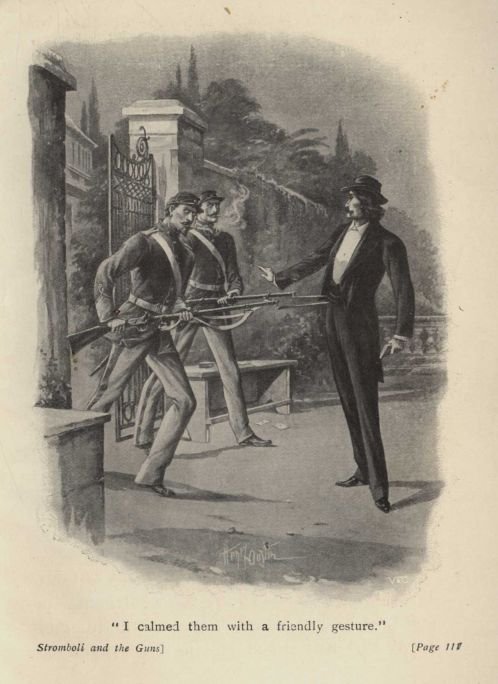
"I calmed them with a friendly gesture."
"'I mean your President no harm; and, as a token of the integrity of my purpose, I would like to present you with these little cheques. You will observe that they are payable to bearer.'
"The men took the slips of pale green paper, and looked carefully at them, at me, and at each other. Smiles came out upon their faces and gradually broadened into grins. With slow and deliberate movement they leant their rifles up against the walls, and then, without a word of explanation, or even of thanks, they started together at the double for the bank.
"'It is a good beginning,' I said to myself, and walked on up the Palace garden to the front door.
"Two other sentinels were on guard here; and they also were smoking cigarettes and playing cards. To them, too, I handed cheques with a few sympathetic words, and had the satisfaction of seeing them run off, like happy children, in chase of their fellow-soldiers.
"'We are making progress,' I said to myself, and passed on unimpeded into the entrance-hall.
"There, various servants—first footmen in livery, and then cooks and housemaids—came out and crowded round me. I had expected it and I was prepared. The cheques to bearer, as I have told you, were already filled up and signed. It was only the work of a minute to sit down at a table, tear them out of the book, and push them into the eager, outstretched hands. The reputation of my cheques to bearer had reached them perhaps a quarter of an hour before. They snatched them from me, and, without waiting to put on their hats, men, women, and even boys, started off in rapid procession down the street towards the bank.
"Once more I was alone. But not for long. The noise made by my rapid distribution of cheques had evidently been overheard. A door opened and there issued from it a little man in a magnificent scarlet uniform, with magnificent white plumes in his cocked hat.
"'Carramba! Who are you, and what are you doing here?' was his ferocious greeting.
"I advanced towards him courteously.
"'I am Jean Antoine Stromboli Kosnapulski,' I answered, gently but firmly. 'May I, in my turn, inquire to whom I have the honour of speaking?'
"'Carramba! I am the General Montojo del Rio Grande del Norte, Minister of War to the Republic of Nicaragua,' he retorted, laying his hand upon his sword.
"In defence I laid my hand upon my cheque-book.
"'The honour is entirely mine,' I said. 'In evidence of the pleasure which I feel in making your acquaintance, you will perhaps permit me to present you with this small cheque. You will perceive that it is an open cheque for 2,000 dollars, made payable to bearer.'
"For the first time in the course of my adventure I experienced a rebuff.
"'Carramba!' the War Minister repeated for the third time, and flung my cheque scornfully on the floor and trampled on it, half drawing his sabre from the scabbard.
"But I was a match for him.
"'Pardon me,' I said. 'I see I have given you the wrong cheque by mistake. This was the cheque that I intended for you. It is payable to bearer, like the other, but it is for the sum of 5,000 dollars.'
"General Montojo del Rio Grande del Norte took the cheque from me and examined it; he picked up the first cheque from the floor and examined that also; Then he stuffed both cheques into his pocket and said abruptly—
"'Excuse me! I have an important appointment, and I must go and keep it.'
"And he turned on his heel with dignity and left me. A minute later I caught another glimpse of him through one of the windows. He was running—I never saw a man run so fast.
"'I think I may take it that that fixes the price of a Cabinet Minister at 5,000 dollars. The other 2,000 dollars were of the nature of a windfall which the rest will not expect.'
"Scarcely had I said it when the hall was full of Cabinet Ministers, who had apparently broken up a Cabinet Council in order to come and look for their colleague. I received them with empressement, and cut short their demand for explanations by the immediate production of my cheque-book. I gave cheques for 5,000 dollars each to the Minister of the Interior, the Minister for Foreign Affairs, the Finance Minister, the Minister of Education, and the Minister of Agriculture; and as they warmly shook my hand I added—
"'No doubt you would like to go and cash your cheques at once. Pray do not stand on ceremony.'
"And they did not stand; they ran. Not being in uniform, they ran, I fancy, faster even than General Montojo del Rio Grande del Norte, the War Minister himself.
"In this way, by my force of character, and my knowledge of human nature, I had at last cleared my path of obstacles. Nothing but a door now stood between me and a private interview with the President. I knocked, and was answered with the usual—
"'Come in!'
"As I had expected, the President was surprised to see me. He wore many orders and decorations; but his face had a tired and haggard look, and he shrank visibly, as though he expected me to strike him. It was an obvious relief to him when I sat down and commenced a friendly conversation.
"'Fear nothing,' I said. 'I am Jean Antoine Stromboli Kosnapulski, and I shall not assassinate you unless it is absolutely necessary.'
"Perceiving that he was at my mercy, he bowed his head with all the dignity that he could muster and waited for me to proceed.
"'I conjecture, sir,' I went on, 'that it is less for your pleasure than for your profit that you have assumed the onerous position of President of this Republic.'
"He opened his eyes wide. My candour evidently puzzled him. He did not seem to know whether to take offence at it or not.
"'If my impression is correct,' I continued, 'we have already found the basis of an arrangement which will be equally satisfactory to both of us. Do not beat about the bush, but confide in me frankly. Tell me, as nearly as you can, what the Presidency is worth to you, and I will see what sort of an offer I can make you for it.'
"His face exhibited a strange mixture of emotions, his first impulse being to ring the bell for his servants to eject me.
"'It is useless,' I explained. 'All the members of your household, and all the members of your Cabinet, have gone to the bank to cash the cheques which I have given them.'
"The President spoke for the first time.
"'Really,' he said, 'this is a very extraordinary situation.'
"'Try to realise it,' I replied, 'and avail yourself of the advantage which it offers you.'
"'I am not quite sure,' he objected, 'that I grasp your Excellency's meaning.'
"I explained myself in greater detail, and had the satisfaction of seeing gleams of intelligence flash in rapid succession across his features. It was my desire, I pointed out, to become President of the Nicaraguan Republic instead of him; and I was willing to pay him (in hard cash) not only reasonable, but even generous, compensation for disturbance. And I concluded, laying my hand in a friendly, and almost fatherly, fashion on his shoulder—
"'Come, now, speak to me, as between man and man. Tell me how much you are expecting to make out of it?'
"At last I had coaxed him into giving me his confidence.
"'It isn't the salary that's of importance,' he said, 'but there are certain perquisites.'
"'So I had imagined,' I interposed encouragingly.
"'I get a commission of ten per cent. on the salaries of the Cabinet Ministers; and there are other commissions—tax-collectors have to pay me for their appointments, and there's always a little something to be made by pardoning political offenders. As fast as the money comes in, I send it to London to lie as deposit in the Bank of England. On the whole, I'm doing pretty nicely, but I haven't saved enough yet. Still, it's a wearing life. There's a certain amount of discontent about; and though our social reformers aren't very good marksmen as a rule——'
"'How much?' I interrupted, for his elaborate explanations were beginning to pall upon me.
"'I think I might say 50,000 dollars,' replied the President of Nicaragua.
"To his amazement, I did not haggle, but produced New York bills for the amount and spread them on the table.
"There,' I said. 'Now tell me what is the next step to be taken, according to the constitution of the country.'
"He took pen and ink, and a sheet of paper, and wrote something.
"'This,' he explained, 'is a decree, appointing you Provisional President during my indisposition, and announcing that there will be a plébiscite to elect my successor on Sunday next. In the meantime, if you cultivate the friendship of the Minister for War——'
"'Certainly. I will give him another cheque payable to bearer,' I interposed.
"'In that case he will send soldiers to see that the result of the plébiscite is favourable to you.'
"'And this decree?'
"'Shall be sent to the Government printers at once, and placarded in the course of half an hour. In the meantime, as I see that the members of my household are now returning from the bank, I trust that your Excellency, the Provisional President, will have lunch with me.'
"Need I say that I accepted the invitation. It was a magnificent meal, served in a large and stately dining-hall. I sat at the head of the table, with the ex-President on my right and the War Minister on my left. It was, perhaps, the supreme moment of my life—the moment when I attained the zenith of my earthly fortune. But alas for the mutability of human beings!
"We lunched at leisure like epicures, slowly enjoying the flavour of the soup, the fish, the cutlets, the poultry, and the salad. In two hours' time we had arrived at the dessert without any untoward incident; but just as we had got to the bananas and the sweet champagne, we heard the loud noise of a disturbance outside the Palace walls—a noise of firearms and of vigorous human voices.
"I looked inquiringly at the ex-President.
"'Excuse me,' he said. 'I have left my handkerchief upstairs, and I will go and fetch it.'
"He rose and vanished, and I turned to the Minister for War.
"'Your Excellency will excuse me,' he said. 'This is a matter which requires my immediate attention.'
"And he also rose and disappeared in the direction of the back door.
"So I sat alone in the great dining-hall and awaited the intruders as calmly as the Roman senators in olden times awaited the invasion of the Gauls. My arms were folded and I hugged my cheque-book to my bosom.
"The noise came nearer, there were heavy footsteps in the hall, the door burst open, and the strangers entered.
"Imagine my consternation! They were Americans—serge-shirted, corduroy-breeched desperadoes from California, and their leader was no other than my old friend, Colorado Charlie, he to whom I had confided the secret of my plans when I made his acquaintance in the train. They advanced, firing their guns as they came, picking off the glass pendants of the chandeliers, as though to keep their hands in or test their accuracy of aim. Colorado Charlie, however, signalled to them to stop, and stepped up and spoke to me, saying simply—
"'Game's up, sonnie. You've got to git.'
"I still sat on my carved mahogany chair, like the Roman senator in the story, waiting for the Gaul to pluck his beard. Colorado Charlie continued—
"'Seems you've been making a revolution for Van Schuyler. I'm here to make a revolution for Van Tine. Our methods were diverse, but our object was the same. First it was you that came out on top, and now it's me. I ain't goin' to shoot unless compelled, and if you git at once, I'll give you a free passage back to Frisco'.
"My anger was aroused, but I felt that I still held a trump card. With a flourish of my arm I drew my cheque-book and waved it in the air.
"'Let us waste no time in bandying idle words,' I said. 'I am here and I wish to stay here; but I am willing to make it worth your while to go.' For I had guessed that money, and not honour, was the object of Colorado Charlie's expedition; and his next words showed that I had guessed rightly.
"'How much, sonnie?' he asked me curtly.
"I ran my eye rapidly over the counterfoils to calculate the balance standing to my credit.
"'Sixty-one thousand two hundred and ninety-nine dollars,' I replied.
"'Right, sonnie. Hand up the draft.'
"I gave it to him and once more breathed freely. He did not hurry like the Nicaraguans, but strolled off slowly towards the bank with about a dozen members of his company. The others remained, presumably to keep an eye upon my movements. I invited them to drink my health—a thing which, otherwise, they would doubtless have done without my invitation—and promised to treat them generously as soon as I had the opportunity of cabling to New York for further funds. The idea appealed to them; they were all willing to enlist under my banner. My cup of glory and happiness was full.
"And then Colorado Charlie re-entered and dashed it from my lips.
"'It's no use, sonnie. You've got to git,' he said, handing me back my cheque.
"I protested energetically.
"'They refuse to honour my cheque?' I exclaimed. 'There is some mistake here. Come round to the bank with me and we will see the manager.'
"Without further circumlocution he blurted out the truth.
"'There ain't no manager, sonnie, and there ain't no bank. Seems you've been dealing out drafts very freely all the morning, and the holders have lost no time in cashing them. The sight of the crowd outside the bank doors created a panic among the inhabitants. They started a run on the bank for the purpose of withdrawing their deposits, and the resources were unequal to the strain.'
"'You mean to say——'
"'I mean to say that the bank is broke. The manager and the clerks have gone up country on important business, and a deputation of the leading citizens is now engaged in breaking up the premises.'
"So I perceived that I had played my trump card without result. I gasped and my head fell forward on my chest. Then I made an effort and pulled myself together. Though I had lost everything else, there was no reason why I should lose my dignity as well.
"'I bow to fate,' I said. 'I yield to circumstances. History will do justice to my memory. In the meantime, sooner than be a cause of bloodshed and dissension, I agree to abdicate.'
"'Is abdicate the same as git?' asked Colorado Charlie.
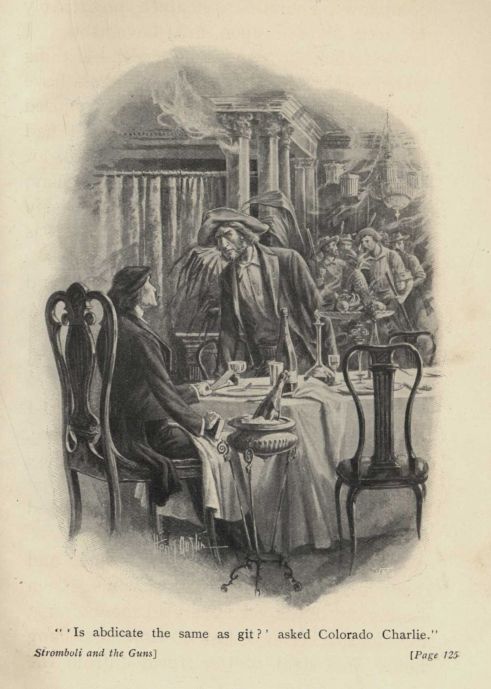
"'Is abdicate the same as git?' asked Colorado Charlie."
"I answered that the difference between the two things was immaterial; and, dipping my pen with dignity in the inkpot, I slowly wrote as follows:—
"'In order to save my country from the unspeakable horrors of a civil war, I hereby abdicate the position of President to which I was about to be called on Sunday next by the unfettered choice of the free and independent citizens of the Republic of Nicaragua. Je ne boude pas; je me recueille.
'Given under my hand and seal.
'JEAN ANTOINE STROMBOLI KOSNAPULSKI.'
"It was done. Colorado Charlie took up the paper, and read it through and expressed his satisfaction.
"'That's the notion, sonnie,' he said. 'Shake hands on it, to show there's no ill feeling'; and when I merely bowed stiffly, holding my hand behind my back, he added—
"'Well, never mind about that, sonnie. I understand your feelings. Anyhow, I'm going to give you a free passage back to Frisco; and if you think that 500 dollars will be of any use to you——'
"Though my pride was in revolt, I fought it down and took the money, knowing that, if I did not take it, I should land in San Francisco penniless—a contingency which it was desirable to avoid at any cost.
"And so my adventure ended—sad, yet leaving a trail of glorious memory behind it. For I had made a revolution single-handed, and enjoyed from twelve to three o'clock in the afternoon the dignity of President of a Republic."
THE MAN WITH THE ULTIMATUM.
Stromboli burst in upon me in a state of exceptional excitement. "Listen!" he cried, gesticulating energetically; and I answered that I had anticipated his wishes and was already listening.
"I have news for you," he continued.
"What news?" I asked.
"I was already telling you when you interrupted me," he replied. "I have had an idea, and with the rapidity of genius I have carried it into execution."
"What sort of idea?"
"Voyons! an idea that was at once brilliant and simple. Let me explain."
"By all means do so."
"Then listen! The great popularity of the stories which I have been telling you inspired me with the idea. It occurred to me, while I was occupied with my toilet, that I might profitably address a larger audience. I completed my toilet. I put on my hat. I chased an omnibus. It conveyed me to the Waterloo Road, where I descended from it."
"A strange neighbourhood to seek," I interposed.
"You think so? But I had my plan. I descended from the omnibus at a door whereupon was a brass plate bearing the words, 'Musical and Dramatic Agent.'"
"Heavens!" I ejaculated, beginning to understand, and Stromboli proceeded—
"The door was open, and I walked in. I found myself in an antechamber, surrounded by men with blue chins, and young women with blue eyes and fair hair, who stared at me curiously. I took no more notice of them than if they had been waxwork models, but walked on to another door, leading to an inner room. A young man—a clerk of some kind—presumed to bar my progress. I swept him before me and so forced my passage into the presence of the 'Dramatic and Musical Agent.'"
"I presume," I said, "that the 'Dramatic and Musical Agent' was surprised to see you."
"Naturally. 'Who the dickens are you, sir?' was his brusque but kindly greeting. 'Who should I be but Jean Antoine Stromboli Kosnapulski?' I replied. 'What do you want here?' he asked inquisitively. 'I am here to do business with you to our mutual advantage,' I explained. And with that I sat down affably in his arm-chair and engaged him in a serious conversation."
"What!" I explained. "You don't mean to tell me that you are going on the music-halls in the character of a performing Revolutionist?"
Stromboli seemed hurt.
"It has been arranged," he said, "that I am to give a series of lectures on my experiences at certain Palaces of Varieties. The general title of the series is to be, 'Disturbances that I have Made.' It is not precisely what I contemplated in my youth; but it is a way, like another, of making provision for my age."
"Precisely," I said, seeing that it was useless to argue with him. "With which of your thrilling experiences are you meaning to begin?"
"With a certain further experience of a Central American republic," Stromboli answered.
"Your exploits in that quarter of the world do not seem to have been of a very satisfactory character," I objected.
"I certainly had my ups and downs there," Stromboli admitted. "Central America is a place where the unexpected happens on the smallest provocation. But that, I take it, is no disadvantage from the story-teller's point of view."
I frankly allowed that it was not.
"Then I will tell my new audiences," said Stromboli, "how I once acted, in Central America, in the capacity of a diplomatic representative of Her Britannic Majesty."
"Good," said I. "Will you rehearse the lecture now?"
"It is for that very purpose that I have come to see you," said Stromboli.
"Proceed," said I, and he proceeded with
THE ADVENTURE OF THE MAN WITH THE ULTIMATUM.
"It has to be admitted—it has been admitted—that my experiences as President of the Republic of Nicaragua were not entirely to my satisfaction. It was also easy for me to perceive that they were likely to entail a coolness between myself and the confiding capitalist whose money I had spent—a thing to be avoided if I hoped to have the spending of more of his money at some future time.
"'This must not be,' I said to myself. 'Something must turn up—if not in Nicaragua, then elsewhere. There are other Central American republics besides Nicaragua, and in all of them the career is open to the talents. But the adventure in which I next engage must not be one involving the outlay of large sums of ready money, seeing that five hundred dollars is my present worldly wealth.'
"Even as I was soliloquising, my opportunity occurred. Without immodesty I may take some credit to myself for having recognised that opportunity at a glance. The man who introduced it to my notice did not; but, as I required his help, I soon explained it to him.
"His name was Captain Shagg—which, when you come to think of it, is every bit as good a name as Cavendish—and he commanded the little trading steamer on which Colorado Charlie had given me my free passage back to San Francisco. Hardly had we cleared Managua Harbour than he began to beguile the time by passing criticisms on Central American republics generally.
"'They're lively places, sir, lively places. They may not be caught in the great whirlpool of European complications; but they don't stagnate, sir, they don't stagnate. If anyone was to come alongside and ask them to stagnate, I sort of reckon they'd say they'd see him hanged first. Here in Nicaragua they seem to be raising Cain with the generous help of imported Amurrican citizens. Over in Salvador, from what they tell me, they're raising Cain by their own individual efforts.'
"'This is very interesting,' I said. 'What's happening in San Salvador?'
"'A revolution, sir—with trimmings.'
"'With what?' I repeated.
"'With trimmings, sir. And when I say trimmings, I mean shootings. And I also mean destruction of property and outrages on British and Amurrican subjects.'
"'Did you hear the story in any detail, captain?' I inquired.
"'Detail, sir? Yards of it, from a dago employed in the Amurrican Consulate, who deserted his duties and came along here because he was peaceably inclined. He told me that the American Consul was all right, having started for his annual holiday just before the bust up began, but the British Vice-Consul had his house wrecked and escaped to the mountains in his nightshirt. He was only a dago, so I suppose the other dagos thought they could do what they liked with him.'
"'And has the British Navy no word to say?' I interposed, and Captain Shagg replied reflectively.
"'Wal,' he said, 'I guess there'll be a tea party, not to say a picnic, when the British Navy comes along. But it ain't there yet, and in the meantime the dago in the nightshirt will be taking cold. Strange as it may seem, the Pacific Squadron is not permanently stationed off the coast of Salvador."
"The outlines of my scheme had already begun to sketch themselves in my brain.
"'I'll put another question to you, captain,' I said. 'A well-informed man like yourself might know where the nearest British cruiser or gunboat is, and how soon it is likely to arrive.'
"Captain Shagg mopped his brow and spat upon the deck, as is the habit of American seafarers when engaged in thought.
"'So far as I know,' he answered, 'the nearest British gunboat is way down off Colombia. When it arrives at Libertad will nat'rally depend upon when it starts. Anyhow, I reckon it won't come alongside quite so soon as the dago in the nightshirt would like to see it. And I also reckon that dago wants to see it just as badly as he ever wanted to see anything.'
"'You think it likely, then,' I continued, 'that we shall be off Libertad before the gunboat?'
"'Why, certainly,' said Captain Shagg.
"Then I was able to fill in the outlines of my scheme.
"'Voyons!' I said, 'the voice of duty calls. It would be possible, I take it, to make such alterations in the appearance of this steamer as would cause it to be mistaken for a gunboat by persons whose acquaintance with gunboats was not particularly extensive?'
"The captain spat again on the deck. He also half closed one of his eyes and concentrated the other upon me.
"'Stranger,' he said, 'I reckon that you did not put that question to me merely out of idle curiosity.'
"I half closed one of my own eyes, and admitted that I had been actuated by a higher motive.
"'You have a notion, likely?' he continued.
"'I do not waste words,' I rejoined impatiently. 'I do not talk for the sake of talking. I am Jean Antoine——'
"'Jest so,' said Captain Shagg. 'You have a notion. I have no notions myself, but I have grit. And I'm a judge of notions—more particularly over a glass of rum. The rum, stranger, is in my cabin.'
"He led the way to his cabin, and I followed him. He produced the rum, and would not let me follow up the subject until we had both drunk two stiff glasses of it, explaining that, for a proper appreciation of notions a clear head was necessary. Then, having filled the glasses for the third time, he got to business.
"'Now, stranger, what is your notion?' he inquired encouragingly.
"I answered by repeating my previous question—
"'I must first know whether you can do anything to this steamer to make it pass, at a reasonable distance, and among comparatively ignorant people, for a gunboat.'
"'Wal, yes,' said Captain Shagg. 'There's Union Jacks; there's paint; there's timber to make dummy guns. Allowing that it was worth while, I reckon it could be done. But what's your notion, stranger?'
"I explained that my notion was that we should disguise the trading steamer as a gunboat, fly the Union Jack, and proceed to the port of Libertad as the plenipotentiary representatives of the British Government.
"Captain Shagg tossed off his glass of rum and shook hands with me in his enthusiasm. "'And bring off the dago in the nightshirt? And arrest the President? And drill a hole in him if he argues? Sir, your notion is equally creditable to your heart and to your head. Sir, it appeals to my chivalrous instincts as an Amurrican citizen. Sir, I tumble.'
"I was not positive that he had caught my meaning quite so completely as he fancied. For, as you shall see, the rescue of the British Vice-Consul was not the only object that I had in view. As I had secured his co-operation, however, it seemed superfluous to puzzle him with further details, lest he should raise objections. It would be better, I felt, to spring those details on him later, when there was no time for argument. In the meantime we had plenty to do in deciding how certain obvious obstacles should be overcome.
"First of all, I suggested, there were the feelings of the crew to be considered; but it appeared that this difficulty was not serious.
"'You leave the crew to me, stranger,' said Captain Shagg. 'They're spoiling for a fight, every man of them; and if they weren't, I'd put a sense of dooty into them till they were.'
"Thus reassured, I lifted my hat and bowed in homage to this terrible disciplinarian. He acknowledged the compliment by filling up my glass, and then raised an objection of his own.
"'Those dagos aren't very spry, he said, 'but they aren't absolute durned fools, either, and it's more than likely they'll expect us to show some sort of papers, just by way of proving who we are, more especially as you yourself, if I may say so, look more like a Smoky Mountain prophet than a British naval officer.'
"This time it was my turn to acknowledge a compliment and reassure the captain.
"'What can have led you to imagine that I propose to figure in the ridiculous light of an ambassador without credentials? It would be too absurd. Of course we shall present credentials.'
"'Wal, we ain't got the real thing aboard this ship, anyhow, I reckon,' said Captain Shagg; and his stupidity amazed me.
"'Do you imagine that the newly elected provisional President of the Republic of Salvador would be likely to recognise the real thing if it were shown to him?' I retorted.
"Maybe not,' said the captain, cautiously. 'But I'd guess it's likely there'd be somebody mouching around who'd recognise the substitute.'
"'You think so?'
"'Wal, why no? There's the ship's papers—they'd know those. There's the log-book—they'd know that. There's my master's certificate—that won't flummox 'em, either.'
"He was apparently intending to recite the complete list of more or less official documents on board his vessel; but I interrupted him impatiently, drawing a document from my own pocket.
"'No doubt they would know those documents,' I said. 'No doubt they would also recognise your Post Office Savings Bank book, and your marriage settlement, and your receipts for harbour dues, and your tailor's bills, if those are documents which you are in the habit of carrying about with you. But do you suppose the average newly elected provisional President of the Republic of Salvador is likely to recognise this?'
"And I unfolded my paper, which was mounted on canvas, and read with solemn emphasis—
"Dieu et Mon Droit.
"We, John, Earl of Kimberley, Baron Wodehouse, a Peer of the United Kingdom of Great Britain and Ireland, and a Baronet, a Member of Her Britannic Majesty's Most Honourable Privy Council, a Knight of the Most Noble Order of the Garter, Her Majesty's Principal Secretary of State for Foreign Affairs, etc., etc., etc.
"Request and require in the name of Her Majesty all those whom it may concern to allow Jean Antoine Stromboli Kosnapulski (British subject) travelling on the Continent to pass freely without let or hindrance and to afford him every assistance and protection of which he may stand in need.
"Given at the Foreign Office, London.
"The American skipper listened and was visibly impressed. It looked as though his eyeballs would start from their sockets in his astonishment. He banged the cabin table with his first, exclaiming—
"'Snakes alive, man! that is the real thing, ain't it?'
"I explained that it was merely an ordinary Foreign Office passport, which I had acquired through my banker when, for a brief period, I had a bank account in London; but Captain Shagg was not disheartened.
"'Wal,' he said, 'it bluffed me, anyhow. And I conclude that what is good enough to bluff me is good enough to bluff the dagos. I'm with you, stranger, in your gallant enterprise. Full speed ahead!'
"I further pointed out that, in order to carry conviction to the eye as well as to the ear, the credentials of an envoy extraordinary and minister plenipotentiary must be tied up in green ribbon and fastened with green sealing-wax; and Captain Shagg, with the natural adroitness of the sailor man, showed me how this could be managed.
"'I have no ribbon,' he said, 'but I can make some out of the lining of my hat. I have no green sealing-wax, but I have plenty of green paint. It won't be the real thing, any more than the papers are, but it will be near enough for the dagos. And now we'll pipe all hands on deck and tell the crew just what it's needful they should know."
"So, our plan being arranged, the preparations for carrying it through were set in hand at once. We hove to in mid-ocean and gave the ship a new coating of black paint; we holystoned the deck: we smartened up the vessel's rig; we painted some spare spars and fixed up dummy guns; we lettered H.M.S. Terror on the caps of the crew of the gig; and we hoisted the Union Jack conspicuously.
"The result was satisfactory. I do not say we could have stood inspection by an admiral; but there was no admiral to inspect us. Captain Shagg, at any rate, was gratified and confident.
"''Tain't the real thing,' he repeated, 'but it's near enough to bluff the dagos. No dago will express doubts as to the genuineness of this show—more especially when he observes that my hand is deep down in my revolver pocket.'
"And he added, summing up the situation generally—
"'The proceedings may not be precisely regular, but they are regular enough for dagos. On an errand of mercy, for the purpose of rescuing a poor cuss catching cold on the hillside in his nightshirt, other considerations besides those of regularity must be weighed. I stand in with you, sir, in this enterprise, which, as I have remarked, does equal credit to your heart and to your head: and if, as I venture to anticipate, the British Government rewards you for your noble conduct, I look to stand in with you in that little matter also.'
"For Captain Shagg, as I have hinted, was less quick-witted than myself. He had not yet gathered in what manner I proposed to make the adventure profitable, and I did not think it necessary to inform him before the hour for taking profits came.
"As we conversed, however, we were quickly nearing the Port of Libertad, and the hour for stirring action was at hand.
"Steaming slowly, we selected a point of vantage from which, if our guns had been real guns, we could readily have shelled all the principal public buildings of the town—yet so far out that we could not be too critically examined. Then we manned a boat with the most presentable of our sailors and rowed ashore.
"'You do the palavering, stranger,' said Captain Shagg. 'When the shooting begins, I'll take a hand. I may not have the distinguished manners of an ambassador, but I am uncommonly quick on the draw.'
"'You have only to put your trust in me, and there will be no need for you to shoot,' I replied.
"'Shooting is a language that goes without the need of an interpreter,' Captain Shagg protested.
"'So is my Spanish,' I answered proudly.
"'Go ahead, then!' said the captain; and we went ahead.
"A courteous official in a ragged uniform received us on the quay. He represented the Custom-house, and inquired whether we had anything to declare.
"'Better shoot now, hadn't I, just to clear the air a bit?' whispered the captain under his breath; but I checked his enthusiasm with an authoritative gesture and explained the situation to the Custom-house official.
"The sight of the passport, with its green ribbon and green paint, impressed him as we had expected. He bowed like a footman and said he would summon a guard of honour to conduct us to the presence of the President. While we awaited the arrival of the guard of honour I conversed with him, in order to inform myself of the precise position of affairs.
"'I understand,' I said gravely, 'that there has lately been a change in the personnel of your Executive. Be good enough to tell me exactly what has happened.'
"He told me, supplementing the story which I had heard from Captain Shagg. There had been a revolution—as I knew. A President named Gomez had been succeeded by a President named Gonzalez. As the President named Gomez had shown some reluctance to retire, the President named Gonzalez had been obliged to have him stood against a wall and shot. There had been other rioting, but order was now restored. The President named Gonzalez would unquestionably be very happy to receive the accredited representative of Her Britannic Majesty's Government, and regard it as a specially fortunate occurrence that he happened to be at Libertad at the moment of our arrival, so that he could see us there, without troubling us to travel to San Salvador.
"'The pleasure will be mutual,' I replied politely; and I had hardly made my answer before the guard of honour came.
"It consisted of ten ragged soldiers smoking cigarettes, and an officer, with plenty of tattered gold braid, smoking a Mexican cheroot. I showed the officer my embellished passport. He examined the outside of it, and, being satisfied that it was in order, introduced himself.
"'I am Colonel Sombrero, of the President's bodyguard.' he said. 'If your Excellency will do me the great honour of accepting a cigar——' I took one. Captain Shagg said that he preferred a pipe, and lighted up. The colonel seemed surprised at his choice, but shrugged his shoulders in a friendly manner, making allowance for the peculiar tastes of foreigners. He also said he was sorry we had not announced our intention of visiting the President, as in that case there would have been a carriage waiting for us. In reply, I said that we were willing to dispense with ceremony, because our business was of a pressing character. 'In that case,' said Colonel Sombrero, 'may I venture to invite your Excellencies to be so infinitely condescending as to ride with me to the Plaza in a tramcar.'
"'A tramcar drawn by mules,' I answered, 'is a somewhat unusual conveyance for an ambassador; but, our business being urgent, we will waive the point.'
"So we got into the car with the officer, while the men stationed themselves on the platform beside the driver, and rattled through the streets.
"It was only a ten minutes' ride. Looking out of the window as we jolted along we saw many signs of the recent disturbances; wrecked houses, pillaged shops, and here and there a dead body being removed for burial. But the disturbances themselves were over; we had been correctly informed that order was restored.
"A few minutes later we were ushered into the presence of the man who had restored it. He was a civilian, some five feet high, dressed in a frock-coat that did not fit him, and a pair of shabby trousers that had seen better days; his collar and tie testified to a toilet made in our honour. The expression of his face was not devoid of vigour, but cunning was even more prominently marked upon it. I towered conspicuously above him.
"'Attention!' called the colonel to his men, and they arranged themselves in rows on the two sides of the hall, still smoking cigarettes—to smoke on duty being, as I am told, the privilege of the soldiers in all the Central American republics.
"President Gonzalez and I bowed to each other with distinguished courtesy; Captain Shagg also bowed after the usual careless fashion of a seafaring man. The colonel pulled at his cheroot; the soldiers puffed their cigarettes; and I proceeded to my business without delay.
"'Here is the letter accrediting me to the Government of your Excellency,' I said. 'If your Excellency does not read English——'
"To my relief he shook his head.
"'Your Excellency will at least recognise the British arms, and the sign manual of the British Minister for Foreign Affairs.'
"His Excellency bowed again. He said he always had been and always should be animated by the most friendly sentiments towards Her Britannic Majesty's Government; and as he said this he handed me back my passport, which I thrust into my pocket.
"'Your Excellency,' I proceeded, affably but firmly, 'has now an opportunity for demonstrating the genuineness of those amicable sentiments.'
"He made a gesture as though to signify that his entire possessions were at Her Britannic Majesty's disposal.
"'The object of my mission,' I continued, 'is to draw the attention of your Excellency to an outrage committed upon the person of Her Britannic Majesty's Vice-Consul, and to require immediate satisfaction.'
"To my amazement the President was not at all embarrassed. He smiled on me more graciously than ever.
"'The outrage to which you refer,' he said, 'was committed by the party of the President whom I have succeeded. I am happy to inform you that ex-President Gomez has already paid the penalty of his crime; and your Vice-Consul—a gentleman for whom I personally have a great affection and respect—is now reinstated in his honourable office.'
"It was not what I had expected; and Captain Shagg, to whom I interpreted the speech, was absolutely dumfoundered by the turn affairs were taking.
"'Why, durn,' he said, 'this dago's a white man, after all. We've come on a fool's errand, and the sooner we quit, the better for our health. Else he'll fetch the other dago along, and the game'll be blown upon, and we'll have to start the shooting without the moral support of a clear conscience.'
"I checked him, however, and introduced the necessary modification into my plan.
"'Captain,' I said, 'it was arranged, I think, that it was I who was to take control of the details of this piece of business.'
"And to the President I replied—
"'Your Excellency must understand that my instructions require me to verify your Excellency's statement.'
"'Naturally,' he answered, with more gracious affability than ever.
"'It is necessary that I should see and speak with our Vice-Consul.'
"'Naturally. He shall be fetched.
"'It will be necessary for me to speak with him in private.'
"'By all means. A room will be placed at your disposition.'
"'And, after the interview, it will be desirable that I should speak with your Excellency again.'
"'You will add to the favour for which I am already indebted to you by doing so.'
"The man's politeness was absolutely irritating. To Captain Shagg it seemed to foreshadow danger.
"'Now what's this fool-game, stranger?' he protested.
"'Wait,' I answered; 'the game is not finished yet.'
"For, as I have said already, this captain was a dull-witted though a determined man.
"My calm words quieted him, however; he waited patiently, with his eye on the President, and his hand in his revolver pocket, while I conversed apart with the Vice-Consul, and took him, as far as was necessary, into my confidence.
"It would be superfluous to report our rapid dialogue; it is enough to give the Vice-Consul's answer to my arguments.
"'Señor,' he said, 'President Gonzalez is my friend. But justice is more to me than friendship—especially as I am a poor man with expensive tastes.'
"Strange words, you think? Their meaning will be clear enough when I relate what happened at my second interview with the President of the Republic.
"'Your Excellency,' I said, returning with the Vice-Consul by my side, 'I have the honour to inform you that I have now completed my inquiries, and can give you my decision in the matter.'
"His Excellency bowed and showed his white teeth smilingly. The soldiers stood at attention, lighting fresh cigarettes from the stumps of the old ones as they did so. And then I showed my hand, and, so to say, threw my bombshell.
"'The personal behaviour of your Excellency in connection with the unfortunate contretemps which has brought me here has been beyond all praise. I have the honour to thank your Excellency in the name of Her Britannic Majesty.'
"There was another bow and a fresh display of gleaming teeth.
"'But,' I continued, 'I have the honour to address your Excellency at the present moment, not as private individual, but as the representative of the State. It must be obvious to your Excellency that, in a civilised country like the Republic of Salvador, the responsibility for an outrage that has been perpetrated does not disappear in consequence of a change of Government. Changes of Government are too frequent in the Republic of Salvador for that political doctrine to be accepted, even by the representative of a friendly Power. On the contrary, the liability remains, and the indemnity must still be paid. In consideration, however, of the correct behaviour of your Excellency in the matter, I am prepared to fix that indemnity at the very moderate sum of 50,000 dollars.'
"A word or two whispered in his ear by the Vice-Consul had caused Captain Shagg to listen carefully to my speech. He did not understand much of it, but he caught the essential words, '50,000 dollars,' and his dull intelligence at last grasped the true nature of the business which he was assisting me to carry through. He went so far as to withdraw his hand from his revolver pocket and slap his thigh, exclaiming—
"'Bully for you, stranger! You're a dandy! Durned if I ever guessed——'
"'Hush!' I said, fearing lest his strange manners should arouse suspicion; and he stopped and put his hand back into his revolver pocket in readiness for emergencies, while I turned to the President, saying, 'Your Excellency's reply?'
"He shrugged his shoulders, laughed, pretended to think that I was joking with him. I went on sternly—
"'Your Excellency must understand that, though I speak in the polished phrases of diplomatic intercourse, my demand is, in fact, of the nature of an ultimatum, failure to comply with which will entail a rupture of amicable relations.'
"Not knowing what else to say, the President said that the rupture of friendly relations would be painful to him.
"'It will be the more painful,' I said, pointing through the open window to where our steamer flew the Union Jack. 'It will be the more painful in that its first consequence will be the bombardment of this port, and the destruction of all the public buildings.'
"For the first time in the course of the interview the President began to show his temper.
"'It might also result,' he said, 'in your being taken straight out into the courtyard, blindfolded, and shot.'
"Captain Shagg caught the essential word 'shot,' and once more interposed.
"'Shall I draw?' he said. 'It's wonderful how reasonable a man'll get sometimes when you have got the draw on him.'
"'Keep quiet!' I urged. 'There won't be any shooting.'
"And I once more eyed the President carefully and took his measure.
"He hardly looked a coward. Beneath the manners of an attorney he probably concealed the natural ferocity of the average Spanish American. Unless the captain got the draw on him, and deterred him, it was conceivable (though not very likely) that he might carry out his threat. There was also the chance that he might be just obstinate enough to refuse to give way until the shells actually began to burst about his ears—which would have been awkward, as we had neither shells nor guns on board the little San Francisco trading steamer.
"Once more, therefore, it was necessary for me to modify my plan; and I modified it on the spur of the moment on lines suggested by my recent Nicaraguan experiences.
"'Your Excellency,' I began, 'our lives are no doubt in your hands. But the whole might of the British Empire is behind us, and if you lay a finger on us, you are putting your own head into the hangman's noose.'
"He was obviously frightened. But it still was not quite certain that he would give way. He might merely escort us politely to our boat, and then withdraw out of the range of shell-fire, leaving the buildings to take care of themselves. So I played the last trump card.
"'On the other hand, if we were alone, your Excellency,' I added, with the sort of smile that the Central American understands, 'if we were alone, I might be able to suggest——'
"He motioned to the soldiers to go and smoke their cigarettes outside, and then I spoke to him quite frankly, without troubling to wrap up my meaning in nice diplomatic phrases.
"'You're not President of this Republic for the benefit of your health, I take it,' I said. 'No. You've taken the Presidency for what you can make out of it. The salary is not large, but there are perquisites.'
"He smiled, beginning to catch my meaning, which I soon made absolutely clear.
"'Very well,' I continued. 'Your Excellency imagined, perhaps, that it was the intention of Her Britannic Majesty's Government to fine your country without recognising the service which you yourself have rendered. I hasten to inform your Excellency that this is not the case.'
"His Excellency's smile was now broadening to a grin.
"'My proposal is, therefore,' I proceeded, 'to increase the damages to the sum of 60,000 dollars—this sum to include a sum of 10,000 dollars by way of honorarium for your Excellency.'
"The President of the Republic of Salvador stroked his chin reflectively.
"'If you had said 75,000 dollars——' he began at length. I paused, weighed the point, and answered gravely.
"'Including 25,000 for your Excellency? It is a great deal. But I suppose I must strain the point—on condition, of course, that the money is brought to me immediately, and in cash.'
"'I was hoping,' said the President, 'that my own cheque for the amount——'
"'I said cash, your Excellency,' I repeated.
"'Or our notes? they are so much less cumbersome than our dollars.'
"'Cash, your Excellency. And it must be fetched from the bank and wheeled down to the quay for us at once.'
"'You drive a hard bargain, but I must perforce accept it,' said his Excellency.
"'And my gun'll cover the dagos in charge of it, by way of keeping them out of temptation,' said Captain Shagg. And then he clapped me on the back, crying——
"'Fifty thousand dollars to cut up between three of us! You're a dandy, stranger, you're a dandy!'
"But alas! his tone was different when, a few hours later, having steamed far away from the Port of Libertad, we had hauled down the Union Jack and assembled in his cabin to apportion the indemnity. For then he stamped upon the floor, and banged upon the table, and knocked the glasses over, and used words which I must not repeat.
"'Compose yourself, captain. What is it?' I inquired.
"'What is it? Why, in the whole of this pile of dollars there ain't one honest piece. I mean to say that they ain't the real thing, any more than your papers and my ship were. They're just struck to unload on gambling-hells. It's one of the industries of that cursed country.'
"It was my turn to be angry.
"'You knew that,' I cried, 'and you never warned me! You dolt! You thickhead! You unconscionable scoundrel!'
"My passion got the better of me. I flew at him, and we wrestled together on the floor, while the Vice-Consul whom we had rescued pointed out a better way.
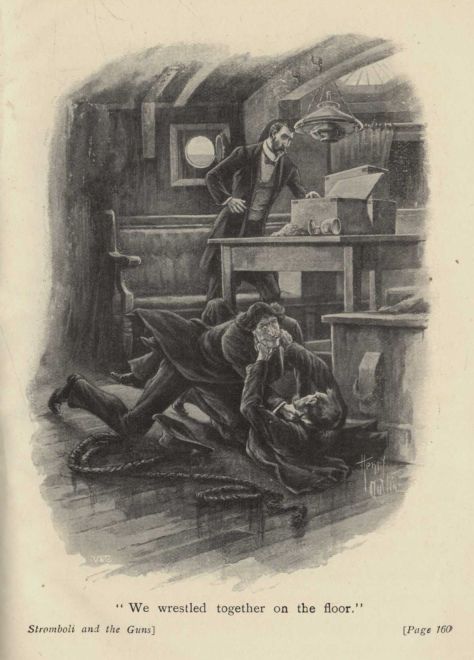
"We wrestled together on the floor."
"'Listen to me! Listen to me!' he cried. 'I know the gambling-houses where they buy those moneys. I'll take you there to sell them! I'll get you a good price.'
"And so he ultimately did. He got us, in fact, a good deal more than we should have expected. But Captain Ulysses P. Shagg and Jean Antoine Stromboli Kosnapulski were never very good friends afterwards."
THE FRIEND OF THE POLICEMAN.
It was the morning after the Anarchist Club had been raided by the police. I was sitting up in my bed, reading the graphic account of the occurrence in the morning paper, when the door opened and Stromboli himself burst into my bed-chamber.
"Hullo!" I ejaculated. "So you have found bail! I was rather expecting that you would come to me for it!"
"I should have," was the reply, "if I had needed it."
"You did not need it? You mean that you managed to escape?"
"Precisely. Do I not know the tramp of a policeman when I hear it? Are not his boots made so that all the world shall know it?"
"Ah! then——"
"I was wise in time. Leaping on to a table, I shouted to my friends: 'We are discovered. This way for the back door. Follow me, and I will lead you to a place of safety.' Then I fled, and, as you see, I reached a place of safety. But alas! I reached it alone. The others, my followers, were caught. I weep for them."
"It is unnecessary," I explained. "The English law is lenient in these matters. A small fine will see them through their troubles."
My words failed to produce the comforting effect which I intended.
"If only I had known that!" Stromboli answered, and hung his head dejectedly.
"Yes? In that case?" I asked.
"In that case," he answered, "I should not have been in so great a hurry; and if I had not been in so great a hurry, I should not have left my purse on the piano."
"You did that?"
"I did that, having just taken it from my pocket for the purpose of paying for some refreshments. It contained the money which I had set aside for the satisfaction of the claims of my more pressing creditors. I shall have sleepless nights in consequence."
"So, I dare say, will they," I interposed; and the remark seemed to exhibit the situation to Stromboli in a light in which he had never previously looked at it.
"You really think so?" he answered sympathetically. "Then I am indeed distressed for them. I should have remembered that creditors as well as debtors might have their pecuniary embarrassments. If I could be of any service to them—if, for example, by telling another story——"
"Then you still know other stories?"
Stromboli jerked his head disdainfully, saying—
"If I know other stories! When I tell you that it was I who, at the time of the Commune of Paris—— But—voyons, mon cher—I have not yet breakfasted."
I took the hint and rang the bell.
"I thank you," said Stromboli. "I will have bacon and eggs for breakfast. It is a comestible of your country for which I have acquired a taste. Though I eat while telling you my story, yet I am an artist, and you may depend upon it that my mouth will not be full at any climax of my narrative."
"Then fire ahead!" said I, and Stromboli fired ahead, plying his knife and fork diligently while he unfolded—
THE ADVENTURE OF THE FRIEND OF THE POLICEMAN.
"You think it singular that a revolutionist should have feelings of friendship for a policeman? Singular it is, and only possible upon one condition—that the policeman's daughter is beautiful, and that the revolutionist is in love with her. I myself—I, whom policemen yesterday pursued through the kitchen and offices to the back door, was at the time of the siege of Paris in love with the daughter of a sergent de ville.
"Her name was Fifine, and she was more beautiful than I can tell you—dark, with bright eyes, and a complexion like a peach in bloom, and the tender, coaxing manner which a man delights in. Her father, the Père Dubois, occupied an apartment in the same house with me at Montmartre; and as he was aware of my desire for the regeneration of the world, ferocious pleasantries used to pass between us.
"'Voyons, rascal!' he used to say to me. 'If it were not that Fifine would cry, I would march you straight off to the depôt and have you locked up there, so that you could do no harm.'
"'Old man!' I answered. 'If it were not that Fifine would cry, then I would pluck you by that nose of yours and drag you along the boulevard, an object of derision to all Paris.'
"'Name of a dog!' he retorted.
"'Name of a pipe!' I rejoined. And then I conciliated him.
"'Come now,' I said. 'For Fifine's sake, let us be friends. For Fifine's sake, let us swear a great oath, like the Homeric heroes, that if ever we meet in a battle, or even in a riot, we will spare each other.'
"The Père Dubois knew but little of the Homeric heroes, though he understood that they had distinguished themselves in the Napoleonic wars. None the less, he swore the oath over a good bottle of red wine, concluding philosophically—
"'Fifine is a good girl. I trust her. I shall tell her what to say to you, and she will reclaim you and make a good citizen of you yet.'
"To which I replied—
"'Père Dubois, you are very amiable. In compliance with your wishes, I will take quiet walks with Mademoiselle Fifine in the sheltered woods of the Buttes Chaumont, so that she may have every opportunity of converting me to your views. If the weather is fine, we will take such a walk to-morrow.'
"He grunted, but agreed. Perhaps, if he could have foreseen—but it is seldom given to a policeman to see as far into the future as a revolutionist. And now, perhaps, you picture Fifine imploring me with persuasive tears to turn my back upon the revolution and apply for a post in the gendarmerie! Then you do not know human nature; you do not know women; you do not know Jean Antoine Stromboli Kosnapulski!
"What is it that a woman likes in a man? She likes him to be different from all other men. She likes him to be strong and masterful, taking his own course and towing her like a little pinnace in his wake. If need be, she will even pique him to perversity; though, in my case, that necessity did not arise. So you must not be astonished when I tell you what Fifine actually said to me was—
"'How wonderful to be a revolutionist! Please tell me all about revolutions. I never met a revolutionist before.'
"She said it, clinging trustfully to my arm, while we walked together on the high, green hill of the Buttes Chaumont. All Paris was stretched out below us like a map. The blue smoke floated upwards from the chimneys in the autumn air. A misty haze obscured the view beyond the ramparts, and the booming of the big guns of Mont Valerien was the only sign of war; but from the streets ascended a confused hum of angry voices—the noise which, in Paris, expresses the discontent which the man of action can turn into a revolution almost by a gesture. In truth, it was high time for another revolution, and here was Fifine pressing me with her questions—
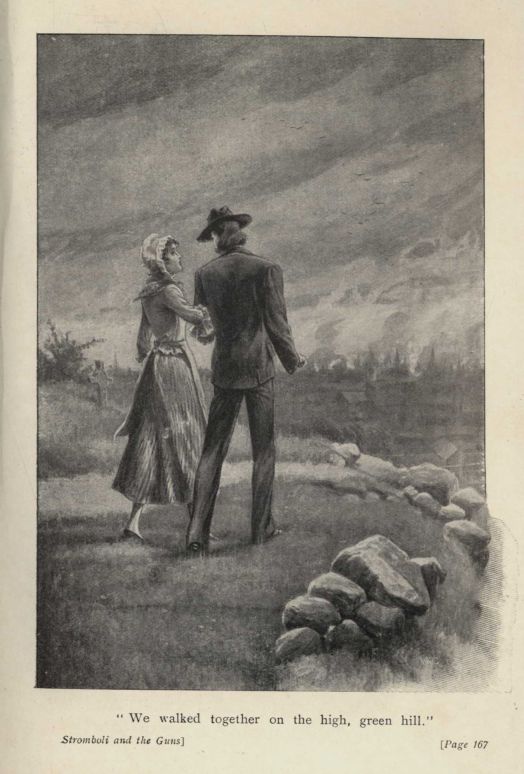
"We walked together on the high, green hill."
"'Please tell me all about revolutions. Please tell me what a revolution looks like.'
"Curious, is it not, that by such artless speeches women win men's hearts? One wonders if they know it. I answered, half in jest, while pondering a project in my mind—
"'A revolution, amie chérie? It is the simplest matter in the world. You get up in the morning feeling discontented, and decide that the Government must be overthrown. Other people are of the same opinion. You leap upon a café table and harangue them until you have stirred them to the depths of their souls; then you say, "To the Hôtel de Ville!" Some of you march thither, while others go into the churches and ring bells. The procession swells in volume; you call upon the soldiers to fraternise with you; the constituted authorities disappear through the back door. You write names on slips of paper and toss them out of the window. This is the list of the new Government. It is all over in the twinkling of an eye.'
"'How wonderful!' Fifine ejaculated, opening her eyes wide.
"A sudden idea came to me, and I acted upon it.
"'My angel!' I cried. 'I have told you what a revolution looks like. Now come with me, and I will show you one.'
"She looked amazed; it may be that she had reason to. It was such a chance as does not often come the way of the daughter of a sergent de ville. But I appealed to her curiosity.
"'Listen!' I said. 'You hear that noise?'
"She nodded.
"'Well, sweetheart,' I continued, 'whenever I hear that noise in Paris, I can turn it into a revolution in ten minutes.'
"'How wonderful!' she once more repeated.
"'Come and see,' I answered, and her curiosity prevailed over her years. We ran down the hill together, and in a few minutes were in the stormy streets of Paris.
"It was as I thought. The people of Paris were angry because the pinch of hunger was making itself felt. They were gathering in little knots, and someone was already haranguing them from a café table; but he was unworthy of the occasion, being drunk, so I pushed him down gently, amid applause, and took his place.
"'Why do we talk,' I cried, 'when the hour for action has arrived? The Government does nothing. Instead of driving away the Prussians, it deliberates. It is in no hurry, because it possesses secret stores of food; but we, in the meantime, what have we to eat?'
"'Rats! En voilà un!' one of my audience shouted, tossing a choice specimen across to me.
"I caught it dexterously and put it in my pocket. Then I went on—
"'You tolerate such a Government! You are willing that it should continue to rule you—to betray you! No, no! A thousand times no. You will sweep it away and govern Paris by yourselves. But there is no time to lose. To the Hôtel de Ville, my comrades! To the Hôtel de Ville!'
"Tame words, you may think, as I recite them to you now, in times of peace; but then they were burning words that caused men's blood to boil.
"'To the Hôtel de Ville!' the Belleville workmen echoed, and the mob became organic, and we marched.
"Imagine that march! Beginning as a small procession, it grew into a mighty mob, with red flags flying and a brass band playing; and at the head of it, Fifine and I walked, arm-in-arm. She was afraid, but she was curious; her curiosity was stronger than her fears. Ah, she was a true woman, was Fifine!
"'Oh! it is wonderful,' she kept repeating. 'I suppose it is wrong; but it is wonderful, all the same.'
"And no one laughed to see her. For those were sentimental days, when every revolutionist rejoiced to have a woman associated with him in his enterprise. It was as though some master of the ceremonies had said—
"'Your partners, gentlemen! Take your partners for the Carmagnole.'
"So we swayed on, in ever-swelling numbers, until the Hôtel de Ville was reached. A crowd was already besieging its doors and swarming up its stairs. It seemed, for the moment, as though I—I who had instigated this revolution—should be unable to get access to the building. But I called in a commanding tone—
"'Room there! Room for a lady! Room for Jean Antoine Stromboli Kosnapulski!'
"They fell back, as far as it was possible, and cleared a space for me. With Fifine still upon my arm, I jostled my way into the famous Hall of the Mayors. It took time, but at last we got there. Let me try and draw the picture for you.
"A large, long room, with portraits of celebrated citizens of Paris hanging on its walls. At one end of the room a large semi-circular table with the Mayors of Paris seated at it; the President in the midst of them, pale and indignant. The rest of the room packed with a crowd of revolutionists, women as well as men, all talking loudly at once, and a few sergents de ville among them, disarmed and overmastered, but unable to escape. And, struggling against the tumult, the rumour gradually spread itself from mouth to mouth—
"'The Breton Mobiles! They are coming to the rescue of the Mayors.' One saw the point of that. At all events, I saw it, even if the others did not. The Breton Mobiles understood no word of French—understood nothing but their own uncouth Celtic tongue. It would be useless to harangue them on the sacred right of insurrection and appeal to them to fraternise with people. They would sweep on, with fixed bayonets, driving the Parisians before them, blind, deaf, implacable as Destiny itself. For once in my life I perceived failure in front of me, and I felt that I owed Fifine an apology.
"'Dear angel,' I said to her, 'this is not so brilliant a revolution as I could wish, but it shall have its dramatic climax, all the same. Observe!'
"Then I continued to elbow my way to the front, exclaiming—
"'Room there! Room for a lady! Room for Jean Antoine Stromboli Kosnapulski.'
"The crowd parted as before, and I found myself close to the table of the Mayors, with the pale face of the President immediately in front of me. I pulled the rat out of my pocket and tossed it to him, saying—
"'Thanks to your incapacity, the people of Paris are eating rats. In the name of the Republic, I call upon you to eat a rat yourself.'
"The people who heard me cheered, but the Mayor of Paris tried to fling the rat back into my face. I caught it in my right hand and tendered it to him again with dignity.
"'Be reasonable,' I said. 'It is a present from Jean Antoine Stromboli Kosnapulski. As those English say, you must put the gift-horse in your mouth. In the name of the Republic, I call upon you to eat the rat before us all, and to pretend that you enjoy it.'
"A tremendous cheer broke from the assembled revolutionists. They shook their fists in his face and roared—
"'Let him eat the rat! Let him eat the rat!'
"He ate it, and we cheered him. Perhaps he was hungry, and needed it, for, owing to the disturbances, he had been a long time without refreshment; and though, to do him justice, he made little pretence of appetite, one of the women—a good, thrifty soul—could not resist exclaiming—
"'What a waste of a good rat! Why do you throw it away on him, when the people of Paris are hungry?'
"That, however, was a question which, in spite of its importance, I had no time to answer. At last the Mobiles were coming—the Breton Mobiles, with whom it was impossible for the Revolutionists to fraternise, because they did not know their language. There was no purpose to be served by staying any longer, the more especially as I had a lady in my charge.
"'Dear angel,' I whispered to Fifine, 'there is no more revolution to be seen to-day. I will make haste and take you home.'
"It was more easily said than done, but I was not a man to be deterred by obstacles. I shouted as before—
"'Room there! Room for a lady! Room for Jean Antoine Stromboli Kosnapulski!'
"And room was made. I myself helped to make it, by pushing vigorously with my strong arms. As the Bretons were entering by one door, Fifine and I were issuing by another.
"It was all over—for the time. Many arrests were made; but, in the confusion, Fifine and I escaped arrest, and it was not until the next day that I knew that my behaviour had been remarked by any public functionary. Then, however, I had a passage of arms with the Père Dubois.
"'Rascal!' he said. 'I saw you.'
"'How now? What do you mean, Père Dubois?' I asked.
"'I was in the Hôtel de Ville, disarmed and helpless. But I saw you, and now I go to denounce you to the Government.'
"I looked him straight and fearlessly in the eyes.
"'Remember your pact with me, Père Dubois,' I said.
"'My pact?' he repeated.
"'The pact we swore, like the Homeric heroes, that, even in a revolution, we would spare each other. This time, as the revolution has failed, it is I who am the gainer by it. Presently, when the revolution is successful, it will be your turn to profit.'
"His eyes fell before my gaze as he replied—
"'If it were not for Fifine's sake, I would not do it.'
"To which I answered—
"'If it were not for Fifine's sake, I would not ask you.'
"'You think, then,' he continued scornfully, 'that the day will come when it will be in your power to serve me?'
"'I am quite sure of it,' I answered, 'and when it comes, you may rely upon me. Let us shake hands.'
"So we shook hands, and an armed truce was restored between us; and the days rolled by, until the last great day came when I was called upon to fulfil my obligations.
"Most of the events of those days belong to history. You know how the Prussians at last starved Paris into surrender. You know how we Communists seized the reins of Government in the month of March. You know how Paris was besieged a second time, and how the barricades sprang up, and how there were bloody battles in the streets. I have nothing new to tell you of these things. I have only to tell you of the service which I, at the last, rendered to the father of Fifine.
"Fifine herself had been sent to visit friends in the country. Safe-conducts being hard to get, it had been necessary to lower her in a basket over the ramparts after nightfall. I well remember my last talk with her before, with no more luggage than she could carry on her arm, she disappeared into the darkness.
"'Sweetheart,' she said, 'I thought that revolutions were wonderful, but now I only find them terrible.'
"'Sweetheart,' I answered, quoting the proverb, 'how shall we make an omelette without breaking eggs?'
"That was too deep for her. She did not even ask whether the omelette was worth the broken eggs, but came to the point without either metaphor or simile.
"'Dearest,' she pleaded, 'I saw you begin the revolution. Can't you promise, for my sake, that you will stop it?'
"I shook my head sadly. It was hard for me, as you can judge, to confess that she had asked me a thing which it was beyond my power to do for her.
"'Dear angel,' I answered, 'the revolution is irresistible as the rising tide. A man may have the power to start it, but no man has the power to stay it.'
"'But my father!' she pleaded. 'Tell me! The revolutionists have no love for the police?'
"I was obliged to own, however regretfully, that they had not. For what have policemen ever done, that revolutionists should love them?
"'But, dear angel,' I added, 'one may make exceptions, if only for the sake of proving rules. I wield influence, as you have seen, and I will use it. They shall not hurt one hair upon the Père Dubois's head.'
"Then we kissed each other and said good-bye. Fifine disappeared, lowered over the ramparts by a sentinel; and it was only two days afterwards that the Versailles soldiers entered Paris, and the fighting in the streets began. I do not describe it to you. I do not boast. One brave man behind a barricade, I take it, is very like another. The tide of battle rolled us back from street to street. The traitors slunk away and hid themselves. The day came when we were only a handful of men, hemmed in by an army. Driven from my lodging in Montmartre, I found a garret to sleep in in Belleville. I was there, snatching the few hours' rest which I had earned, when a child found me, and thrust a note, hastily scrawled in pencil, into my hand.
"It was from the Père Dubois. How he had found the means of sending it I do not know; but this is what he said—
"'I am a prisoner of the Commune, locked up with forty other sergents de ville at La Roquette. Your Communists are murdering their prisoners. For the love of God remember your promise to me before it is too late!'
"My mind was made up instantly. Until then I had supposed that a prison was the safest place in Paris in which a sergents de ville could find himself; but since this was not so, I knew how to act.
"Springing from my truckle-bed, upon which I lay only half undressed, I put on my frock-coat and my silk hat, and knotted my red sash round my waist. Then I hurried down seven flights of stairs and almost ran into the arms of our leader, Citizen Ferré.
"'Well, Ferré, how goes it now?' I asked him.
"'Badly,' he answered. 'It is all over with us. The Versaillais press us hard. We have only just time to kill the prisoners.'
"At first I did not take him seriously.
"'Is that the way to raise the tone of revolutions?'
"He answered grimly—
"'Perfectly. We have dealt with the Archbishop; we have dealt with the gendarmes. If we make haste, we shall just have time to deal with the sergents de ville.'
"His brutal words horrified me, but I temporised. Time was precious, and I would waste none of it in wrangling. If it had only been the life of an ordinary hostage—an archbishop, for example—that was at stake, I do not say; but the life at issue was the life of the father of Fifine. Therefore, as I have said, I temporised.
"'You are right, Citizen Ferré,' I replied. 'We must indeed be quick. Let us see which of us can be the quicker. I will race you to the prison of La Roquette.'
"'Good,' he replied, and we both began to run with all our speed. Picture us; for the picture must indeed have been a strange one. The enemy surrounded us, and the crack of rifles and the screech of mitrailleuses sounded from the barricades on every side. The rival batteries on the Buttes Chaumont and the Buttes Montmartre hurled their shells all over Paris. Red flames and black clouds of smoke arose from the Tuileries, from La Villette, from the Hôtel de Ville, from blazing buildings in every quarter of the city. Dead bodies of men and horses lay here and there upon the pavements. Mattresses were piled up at the windows to serve as a screen against the bullets. And, in the midst of this, Citizen Ferré and I—he in his soldier's uniform, and I in my frock-coat and silk hat—raced each other to the prison of La Roquette. I was fleet of foot in those days, and I outstripped him. Dashing through the open gate in the prison yard, I called—
"'Where are the prisoners of the Commune? Where are the sergents de ville?'
"There was no need to ask the question. I could see the heads of several of them at the windows of the cells. So I continued—
"'I have the order for them to be shot. Let me go up to them and I will tell them to come down.'
"The words were saluted by a bloodthirsty cheer. It occurred to no one to dispute my authority or ask a question. The key was handed to me and I went up to the second storey and entered the door of the long corridor in which their cells were situated.
"'Gentlemen,' I began. 'I am Jean Antoine——'