KINDS OF TREES SUITABLE FOR CITY STREETS.
Reading edition
QUALITIES NECESSARY.
Compared with the whole number of trees used for ornamental planting, the number of kinds suitable for street planting is very small. For use under city conditions a tree must be adapted to the climate and to the soil upon which it is to be grown. It must have healthy foliage that withstands dust and smoke and a root system not easily affected by unusual soil conditions, by restricted feeding areas, or by root pruning when street improvements are made. The top should be in proportion to the width of the street upon which it is used, and it should be rather high headed or easily trained to that form and of open growth without being too spreading or sprawling.
Of minor consideration is the character of the foliage masses, whether dark or light, heavy and somber or open and airy, and also whether they have vivid autumn colorings. Only in the most southern parts of the country and in western California should evergreen trees be considered for street planting, and then only the broad-leaved evergreens, such as magnolias and live oaks. In the North the lack of sunshine during the short cloudy days of winter makes it desirable to admit all the light possible. Even in the South the question of sunshine should be considered when selecting varieties.
P125365HP
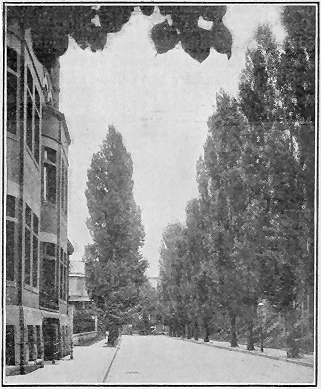
Fig. 14.—Narrow upright trees (Lombardy poplars) on a Barrow Conditions, it is better street. Washington, D. C.; midsummer.
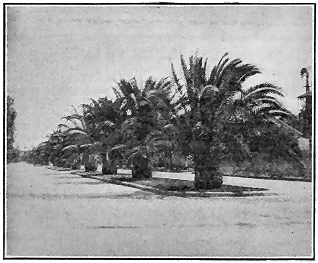
Narrow streets should be planted with columnar trees (fig. 14) or sometimes with small trees. Broad streets may be planted with spreading trees (figs. 3 and 16), or, if provided with a central parking space, with moderate-sized trees in the center and on the sides, or with trees on the sides suited to the space and formal trees in the center. (fig. 15.)
P18856HP
Fig. 15.—Formal trees in a central parking, but appropriate trees wanting on the sides of the street. Canary Island date palms in Merced, Calif.; midsummer.
As a rule, trees native to the locality that have been successfully grown in other cities should be given the preference. When a choice must be made between untried native trees and those tested in a city or town under different soil or climatic to give the native trees the first trial. There are many native trees that are promising which have not been planted on a sufficient scale or under sufficiently varied conditions to demonstrate their real value for street planting over any considerable area. Many of the trees mentioned in this bulletin may prove valuable far beyond the areas for which they are suggested. The burr oak, the swamp white oak, the scarlet oak, the chestnut oak, the white oak, the sour gum, and others may be found on further trial to be as valuable as those already demonstrated to be valuable over large areas. Those mentioned have all been tested in a small way.
Caution should be used in selecting trees with conspicuous flowers and those with edible fruits or nuts, as in many parts of the country such trees are badly mutilated by the public. Even horse-chestnuts, although the nuts are not edible, are often broken by boys clubbing the trees. That public opinion can prevent such vandalism is in evidence all along the Pacific coast and at a few places in the East. Every effort should be made to create a sentiment that will protect these attractive additions to street adornment, but where the sentiment does not exist it is better to avoid the planting of such trees except in a limited way.
P15394HP
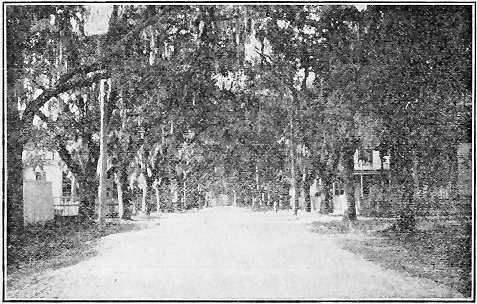
Fig. 16.—Live oaks, the handsomest southern street tree for broad street: Biloxi, Miss.; late summer.
Besides the native trees there are many introduced trees that have proved valuable and many more that are worthy of trial.[1] A fair trial of promising introduced trees should be made, and the native kinds should be thoroughly tested.
TREES FOR DIFFERENT REGIONS.
To simplify the discussion of kinds of street trees likely to prove satisfactory, the United States has been arbitrarily divided into the regions shown in figure 17. An endeavor has been made to make each division cover an area having similar growing conditions, so that the trees suggested will be likely to thrive in all its parts. A discussion of the strong and weak points of the different kinds will be found with the description of the kinds farther on in this bulletin.
Region 1.—Region 1 comprises the mild humid portion of the northern Pacific coast east to the Cascade Mountains, including the western third of Washington and Oregon and a portion of northern California. The trees native to western Europe are adapted to this region, as the climatic conditions are quite comparable. Most of our American trees also succeed here.
Some of the desirable varieties for street planting in region 1 are the Oregon, Norway, sycamore, and sugar maples; California walnut; tulip; European linden; basswood; sycamore; London plane; white and European ashes; English and American elms; English, red, and pin oaks; ginkgo; and the black locust.
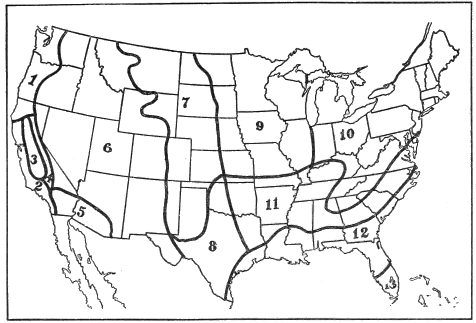
Fig. 17.—Outline map of the United States, showing the regions within which essentially similar conditions for tree growth exist.
Region 2.—Region 2 is that portion of California lying between the Sacramento and San Joaquin Valleys and the Pacific Ocean. Many varieties of trees will succeed here if given water. Because of the lack of water, unless specially irrigated the more drought-resistant species should be used.
Among the deciduous trees useful for this region are the London plane; the California and common sycamore; English, Huntingdon, and American elms; Oregon, Norway, sycamore, and English maples; white, green, and European ashes; red, English, and pin oaks; European linden; basswood; California walnut; honey and black locusts; horse-chestnut; Albizzia; and the Japanese varnish tree, or Sterculia.
Evergreen trees which will probably be successful in region 2 are the Eucalyptus[2] in variety, acacias, rubber, magnolia, California live oak, Victorian and poplar-leaved bottle trees, and in the southern portions the California pepper, silk oak, and jacaranda. Palms are much planted, but they do not make good street trees except where a formal effect instead of shade is desired.
Region 3.—Region 3 comprises the Sacramento and San Joaquin Valleys.
The deciduous trees for this region are the California walnut; London plane; California and common sycamores; Oregon, Norway, and sycamore maples; white, European, and green ashes; red, English, valley, and pin oaks; European linden; basswood; English and Huntingdon elms; honey locust; and horse-chestnut. Chinaberries and Texas umbrellas are much planted in these valleys, but are not good street trees. Olives and palms are suitable only for formal effects, while eucalypti are satisfactory but are liable to make trouble with defective sewers. Acacias grow especially well in this region except in the extreme north.
Region 4.—Region 4 includes the country from the Sacramento and San Joaquin Valleys to the crest of the Sierra Nevada Mountains. It varies in elevation and correspondingly in temperature and the amount of available moisture.
Where there is sufficient moisture, the deciduous trees recommended for region 3, except the valley oak and possibly the California sycamore, may be used. Where there is less moisture the thornless honey locust, black locust, green ash, hackberry, poplars, ash-leaved maple, and the American elm if it can be watered the first few years may be planted. In the warmer sections the chinaberry and Texas umbrella may be used.
Region 5.—Region 5 comprises the hot semiarid country of southern California and southwestern Arizona which is dependent on irrigation.
The best deciduous trees for this region are those suggested for the drier portions of region 4. With ample irrigation the deciduous trees recommended for region 3 might grow.
Among the evergreens the Texas palmetto, Parkinsonia, and the Washingtonia and some other palms can be used where other trees do not succeed. The red and desert gums may be used also in the drier regions. With ample irrigation the evergreens suggested for region 2 should succeed.
Region 6.—Region 6 comprises the intermountain section and extends from the crest of the Cascade and Sierra Nevada Mountains eastward to the eastern base of the Rocky Mountains. The region includes great variations in growing conditions, often in very short distances. As a whole it is semiarid, and in most places trees can hardly be expected to thrive without more or less irrigation, although in some of the mountain valleys and on some of the mountain slopes almost ideal conditions for tree growth exist.
In the drier parts of the region only those deciduous trees that are weeds under more congenial conditions can be grown. Those that can be planted with the greatest hope of success are the thornless honey locust, black locust, green ash, hackberry, and where the others do not succeed, the poplars and ash-leaved maple. If it can be watered for a few years the American elm usually can be grown, and in the southern half of the region the Mississippi hackberry will probably succeed. Near the southern border, on lower elevations, the chinaberry and Texas umbrella can also be planted. In the locations most favored naturally or where irrigation is possible, the trees suggested for region 9 can be used.
Evergreens that may be used for the drier portions of the southern part of region 6 are the Parkinsonia and the Texas palmetto.
Native trees may be found that will prove of greater value for limited areas than any suggested. Cities and towns contemplating street tree planting would do well to consult the nearest State agricultural experiment station or the United States Department of Agriculture if it is thought possible that something better has been found than the trees suggested.
Region 7.—Region 7 is the northern part of the Great Plains area from the foot of the Rocky Mountains at about the 5,000-foot contour line east to the ninety-eighth meridian. It is rather uniform in general conditions, the character of soil having no wide divergence and the elevation increasing gradually from south to north and east to west. The rainfall gradually increases from west to east until at about the ninety-eighth meridian the conditions are more favorable for tree growth.
The trees to be relied on are the thornless honey locust, common hackberry, black locust, green ash, ash-leaved maple, the poplars, the Chinese elm, and the American elm if it can be watered the first few years after transplanting. The mossy-cup oak is another tree worth testing in a small way, as it is native a little east of the ninety-eighth meridian. The basswood and Norway maple would probably succeed if supplied with plenty of water.
Region 8.—Region 8 is the southern part of the Great Plains.
In addition to the deciduous trees recommended for the northern Great Plains (region 7) the Mississippi hackberry, Texas umbrella, and chinaberry may be successfully grown.
Evergreen trees that may be used in region 8 are the Texas palmetto and Parkinsonia.
Region 9.—Region 9 is the upper Mississippi Valley, including the area from that already considered to Lake Michigan and south to southern Kansas. It is more favorable to tree growth than regions 6 and 7.
Trees which will succeed here are the American elm; red, pin, mossy-cup, and other native oaks; white ash; sycamore; basswood; and Norway and sugar maples.
Region 10.—Region 10 includes the northeastern part of the country from eastern Illinois to the Atlantic Ocean, and extends southward through the Appalachian Mountains. It is most favorable for tree growth.
The best trees for street planting in region 10 are the red and pin oaks, London plane, sycamore, the staminate form of the ginkgo, basswood, tulip, Norway maple, white ash, thornless honey locust, American elm, and in the southern portion of the region on light land the sweet gum. The red and sugar maples are among the best trees for suburban conditions. The hackberry will grow, but should be discarded in favor of better varieties. The mossy-cup and chestnut oaks are worthy of trial on gravelly soils in the suburbs.
Region 11.—Region 11 includes the lower Mississippi Valley and the country east of the southern Appalachian Mountains, extending from the light lands near the South Atlantic and Gulf coasts to the northern limits of the distinctively southern flora.
The typical street trees of this region are the willow oaks (fig. 1) and water oaks, the former a valuable street tree, the latter good when young but comparatively short lived, with no advantages over the willow oak. Other good trees are the red, Spanish, laurel, Darlington, and pin oaks, tulip, sweet gum, American elm, red and Norway maples, and the ginkgo.
Region 12.—Region 12 is the land near the coast from Wilmington, N. C., to the Mexican border, exclusive of the southern part of Florida.
Good deciduous trees for this region are the willow, laurel, Darlington, and Spanish oaks, tulip, sweet gum, sycamore, London plane, American elm, and the staminate form of the ginkgo. The honey locust, red or scarlet maple, Norway maple, and the hackberries are not so good.
The live oak is the characteristic tree of region 12 (fig. 16) and is the pride of the cities that have used it. Even though an evergreen, it is an excellent street tree, as it is large, spreading, and open. The palmetto and palms thrive and may be used for producing formal effects. The evergreen magnolia is a good broad-leaved evergreen.
Region 13.—Region 13 consists of the southern part of Florida. The deciduous trees suitable for this section are the willow, Spanish, and southern red oaks; American elm; Mississippi hackberry; and in the southern half of the region the Poinciana.
Evergreen trees are better suited to region 13 than to, any other portion of the United States except possibly southern California. Among the best are the live and laurel oaks, evergreen magnolia, camphor, rubber, silk oak, or grevillea, and casuarina. Eucalypti are planted to some extent in Florida, but the climate is such that only on the drier grounds of the interior are they likely to succeed, and even there they are not to be compared with other excellent species of trees that may be cultivated successfully.
TREES FOR SPECIAL PURPOSES.
In the heart of a city, where the greatest difficulty is experienced in getting trees to grow, the ailanthus will probably thrive when nearly all other kinds fail. The sycamore and the London plane are also good for such places. The Carolina poplar will frequently grow under these conditions, and its use may sometimes be warranted.
For very narrow streets the Lombardy poplar is the best tree. (fig. 14.) Trees suitable for use within the reach of ocean spray or on sandy lands near the coast are the red oak and the red or scarlet maple south to Charleston, S. C., while the sweet gum and the live oak are equally good from Norfolk southward and along the Gulf of Mexico. The red oak, sweet gum, red maple, and eastern live oak are all grown successfully along the Pacific Ocean, while the California live oak can be used from San Francisco southward. The trees that endure the most alkali appear to be the bladder-nut tree,[3] London plane, peppermint gum,[4] blue gum,[5] the Washingtonia and other hardy fan palms, Canary Island date palm, the camphor tree, and Acacia cyclops and Acacia retinodes. Only the first two withstand severe freezing weather. The red oak and the red maple are worth testing for these conditions.