AN ARCTIC JOURNAL. (continued 2)
Reading edition
Penny had passed a long way inside of the spot the steamers had been beset and nipped in; and he witnessed a sight which, although constantly taking place, is seldom seen—the entire dissolution of an enormous iceberg.
DISSOLUTION OF AN ICEBERG.
This iceberg had been observed by our squadron, and remarked for its huge size and massiveness, giving good promise of resisting a century of sun and thaw. All on board the "Lady Franklin" described as a most wonderful spectacle this iceberg, without any warning, falling, as it were, to pieces; the sea around it resembled a seething caldron, from the violent plunging of the masses, as they broke and rebroke in a thousand pieces! The floes, torn up for a distance of ten miles by the violent action of the rollers, threatened, by the manner the ice was agitated, to destroy any vessel that had been amongst it; and they congratulated themselves, on being sufficiently removed from the scene of danger, to see without incurring any immediate risk.
The fog again lifted for a short time. Penny went in my "crow's nest," as well as into the "Resolute's," and soon gave us the disagreeable intelligence, that the land-floe had broken up, and we were in the pack, instead of having, as we had fancied, "fast ice" to hold on by; and, as he remarked, "We can do nothing but push for it;—it's all broken ice, and push we must, in-shore, or else away we go with the loose floes!"
With this feeling the six vessels started in the night, in an indifferent and cross lead, we towing the "Resolute" and "Lady Franklin,"—the "Intrepid," with "Assistance" and "Sophia," astern. Breaking through two light barriers of ice, the prospect was improving; and, as they said from the "crow's nest," that eight miles of water was beyond a neck of ice ahead, I cast off the vessel in tow to charge the ice; at first she did well, but the floe was nearly six feet thick, hard and sound, and a pressure on it besides. The "Pioneer" was again caught, and the squadron anchored to the floe to await an opening. A few hours afterwards we were liberated, and, moving the vessel as far astern as we could, the fact was duly reported to the senior officer; but, as the road ahead was not open, no change of position could be made. On the morning of the 20th we were again beset, and a south gale threatened to increase the pressure; escape was, however, impossible, and "Fear not, but trust in Providence" is a necessary motto for Arctic seamen. My faith in this axiom was soon put to the proof. After a short sleep I was called on deck, as the vessel was suffering from great pressure. My own senses soon made it evident; every timber and plank was cracking and groaning, the vessel was thrown considerably over on her side, and lifted bodily, the bulkheads cracking, and treenails and bolts breaking with small reports. On reaching the deck, I saw indeed that the poor "Pioneer" was in sad peril; the deck was arching with the pressure on her sides, the scupper-pieces were turning up out of the mortices, and a quiver of agony wrung my craft's frame from stem to taffrail, whilst the floe, as if impatient to overwhelm its victim, had piled up as high as the bulwark in many places.
The men who, whaler-fashion, had, without orders I afterwards learnt, brought their clothes on deck, ready to save their little property, stood in knots, waiting for directions from the officers, who, with anxious eye, watched the floe-edge as its ground passed the side, to see whether the strain was easing; suddenly it did so, and we were safe! But a deep dent in the "Pioneer's" side, extending for some forty feet, and the fact, as we afterwards learnt, of twenty-one timbers being broken upon one side, proved that her trial had been a severe one.
Again had the ice come in upon us from the S.W., and nothing but a steady, watchful progress through the pack was left to our squadron, as well as Penny's. But I shall not weary the reader with the dry detail of our every-day labours,—their success or futility. Keenly and anxiously did we take advantage of every move in the ice, between the 20th and 31st July, yet, not seven miles in the right direction was made good; the first of August found us doubting, considerably, the prospect of reaching Lancaster Sound by a northern passage; and Capt. Penny decided, if the water approached him from the south, to strike to the westward in a lower latitude.
"PIONEER" NIPPED.
The ships—generally the "Resolute"—kept the lead in our heaving and warping operation through the pack; and, leaving a small portion of the crews to keep the other vessels close up under her stern, the majority of the officers and men laboured at the headmost ship, to move her through the ice. Heaving ahead with stout hawsers, blasting with gunpowder, cutting with ice-saws, and clipping with ice-chisels, was perseveringly carried on; but the progress fell far short of the labour expended, and the bluff bow slipped away from the nip instead of wedging it open. Warping the "Resolute" through a barrier of ice by lines out of her hawse-holes, put me in mind of trying to do the same with a cask, by a line through the bung-hole: she slid and swerved every way but the right one, ahead; I often saw her bring dead up, as if a wall had stopped her. After a search, some one would exclaim, "Here is the piece that jams her!" and a knock with a two-pound chisel would bring up a piece of ice two or three inches thick! In short, all, or nearly all, of us soon learnt to see, that the fine bow was the one to get ahead in these regions; and the daily increasing advantage which Penny had over us, was a proof which the most obstinate could not dispute.
I often thought how proud our countrymen would be of their seamen, could they have looked on the scene of busy energy and activity displayed in the solitude of Melville Bay:—the hearty song, the merry laugh, and zealous labours of the crew; day after day the same difficulties to contend with, yet day after day met with fresh resolution and new resources; a wide horizon of ice, no sea in sight, yet every foot gained to the northward was talked of with satisfaction and delight; men and officers vieing with one another in laborious duties, the latter especially, finding amongst a body of seamen, actuated by such noble and enthusiastic feelings, no necessity to fear an infringement of their dignity. The etiquette of the quarter-deck was thrown on one side for the good of the common cause; and on every side, whether at the capstan, at the track-line, hauling, heaving, or cutting, the officer worked as hard as the seamen,—each was proud of the other, and discipline suffered nought, indeed improved: for here Jack had both precept and example.
If we had our labours, it is not to be wondered at that we had also our leisure and amusements, usually at night,—a polar night robed in light,—then, indeed, boys fresh from school never tossed care more to the winds than did the majority of us. Games, which men in any other class of society would vote childish, were entered into with a zest which neither gray hairs nor stout bodies in any degree had damped. Shouts of laughter! roars of "Not fair, not fair! run again!" "Well done, well done!" from individuals leaping and clapping their hands with excitement, arose from many a merry ring, in which "rounders," with a cruelly hard ball, was being played. In other directions the fiddle and clarionet were hard at work, keeping pace with heels which seemed likely never to cease dancing, evincing more activity than grace. Here a sober few were heaving quoits, there a knot of Solomons talked of the past, and argued as to the future, whilst in the distance the sentimental ones strolled about, thinking no doubt of some one's goodness and beauty, in honour of whom, like true knights, they had come thus far to win bright honour from the "Giant of the North."
Sometimes a bear would come in sight, and then his risk of being shot was not small, for twenty keen hands were out after the skin: it had been promised as a gage d'amour by one to his betrothed; to a sister by another; a third intended to open the purse-strings of a hard-hearted parent by such a proof of regard; and not a few were to go to the First Lord with it, in exchange for a piece of parchment, if he would not object to the arrangement.
LIEUT. HALKETT'S BOAT.
Every day our sportsmen brought home a fair proportion of loons and little auks, the latter bird flying in immense flocks to all the neighbouring pools of water, and to kill ten or twelve of them at a shot when settled to feed, was not considered as derogatory to the character of a Nimrod, where the question was a purely gastronomic one. I found in my shooting excursions an India-rubber boat, constructed upon a plan of my dear friend Peter Halkett, to be extremely convenient; in it I floated down the cracks of water, landed on floe-pieces, crossed them dragging my boat, and again launched into water in search of my feathered friends. At the Whale-Fish Islands, much to the delight of my Esquimaux friends, I had paddled about in the inflated boat, and its portability seemed fully to be appreciated by them, though they found fault with the want of speed, in which it fell far short of their own fairy craft.
The separation of the squadron, occasioned by either mistake or accident, detained us for a few days in the beginning of August, in order that junction might again take place. Penny, by dint of hard tracking and heaving, gained seven miles upon us. For several days a schooner, a ketch, and a single-masted craft, had been seen far to the southward; they were now rapidly closing, and we made them out to be the "Felix," Sir J. Ross, with his boat towing astern, and the "Prince Albert," belonging to Lady Franklin, in charge of Commander Forsyth.
August 5th.—Plenty of water. The "Assistance" received orders to proceed (when her consort the "Intrepid" joined her) to the north shore of Lancaster Sound, examine it and Wellington Channel, and having assured themselves that Franklin had not gone up by that route to the N.W., to meet us between Cape Hotham and Cape Walker. I regretted that the shore upon which the first traces would undoubtedly be found, should have fallen to another's share: however, as there seemed a prospect of separation, and by doing so, progress, I was too rejoiced to give it a second thought; and that the "Assistance" would do her work well, was apparent to all who witnessed the zeal and skill displayed by her people in the most ordinary duty.
Taking in our ice-anchors, and getting hold of the "Resolute," I bid my friends of the "Assistance" good-bye, thinking that advance was now likely: this hope soon failed me, for again we made fast, and again we all waited for one another.
Amongst many notes of the superiority of steam over manual labour in the ice, I will extract two made to-day.
The "Assistance" was towed by the "Intrepid" in fifteen minutes, a distance which it took the "Resolute," followed by the "Pioneer," from 10 a.m. to 3 p.m. to track and warp.
The "Intrepid" steamed to a berg in ten minutes, and got past it. The rest of the squadron, by manual labour, succeeded in accomplishing the same distance in three hours and a half, namely, from 7 p.m. to 10 30 p.m., by which time the ice had closed ahead, and we had to make fast.
August 6th and 7th.—Very little progress: and a squadron of blank faces showed that there were many taking a deep and anxious interest in the state of affairs. The remark that Sir James Ross's expedition was by this time, in 1848, in a better position than ourselves, and only found time to secure winter quarters at Leopold Island, was constantly heard: there was, in fact, but one hope left,—we had steam, and there was yet thirty days of open navigation.
CHARGING THE ICE.
Friday the 9th of August at last arrived. Captain Penny's squadron was gone out of sight in a lane of water towards Cape York. The schooner and ketch were passing us: caution yielded to the grim necessity of a push for our very honour's sake: the ship was dropped out of the nip, the "Pioneer" again allowed to put her wedge-bow, aided by steam, to the crack. In one hour we were past a barrier which had checked our advance for three long weary days. All was joy and excitement: the steamers themselves seemed to feel and know their work, and exceeded even our sanguine expectations; and, to every one's delight, we were this evening allowed to carry on a system of ice-breaking which will doubtless, in future Arctic voyages, be carried out with great success. For instance, a piece of a floe, two or three hundred yards broad, and three feet thick, prevented our progress: the weakest and narrowest part being ascertained, the ships were secured as close as possible without obstructing the steam vessels, the major part of the crews being despatched to the line where the cut was to be made, with tools and gunpowder for blasting, and plenty of short hand-lines and claws.
The "Pioneer" and "Intrepid," then, in turn rushed at the floe, breaking their way through it until the impetus gained in the open water was lost by the resistance of the ice. The word "Stop her! Back turn, easy!" was then given, and the screw went astern, carrying with her tons of ice, by means of numerous lines which the blue-jackets, who attended on the forecastle, and others on broken pieces of the floe, held on by. As the one vessel went astern, the other flew ahead to her work. The operation was, moreover, aided by the explosions of powder; and altogether the scene was a highly interesting and instructive one: it was a fresh laurel in the screw's wreath; and the gallant "Intrepid" gave a coup-de-grace to the mass, which sent it coach-wheeling round, as it is termed; and the whole of the squadron taking the nip, as Arctic ships should do, we were next morning in the true lead, and our troubles in Melville Bay were at an end.
It was now the 10th of August. By heavens! I shall never forget the light-heartedness of that day. Forty days had we been beset in the ice, and one day of fair application of steam, powder, and men, and the much-talked-of bay was mastered. There was, however, no time to be lost. The air was calm, the water was smooth; the land-floe (for we had again reached it) lay on the one hand—on the other the pack, from whose grip we had just escaped, still threatened us. Penny had been out of sight some time, and the "Felix" and "Prince Albert" were nearly ten miles ahead!
Gentle Reader, I'll bore you no longer! We had calm water and steam,—the ships in tow,—our progress rapid,—the "Albert" and "Felix" were caught,—their news joyfully received,—and they taken in tow likewise. The dates from England were a month later than our own: all our friends were well,—all hopeful; and, putting those last dear letters away, to be read and re-read during the coming winter, we pushed on, and there was no time to be lost. Several nights before we escaped from the pack the frost had been intense, and good sliding was to be had on the pools formed by summer heat on the floes. The bay-ice2 was forming fast, and did not all melt during the day. The birds had finished breeding; and, with the fresh millions that had been added to their numbers, were feeding up preparatory to their departure south. The sun was sweeping, nightly, nearer and nearer to the northern horizon. Night once set in, we knew full well the winter would come with giant strides. "Push on, good screw!" was on every one's lip; and anxiety was seen on every brow, if by accident, or for any purpose, the propeller ceased to move. "What's the matter? All right, I hope!" Then a chuckle of satisfaction at being told that "nothing was amiss!"
DETENTION OFF CAPE YORK.
Time did not allow us, or I verily believe we might have killed tons of birds between Cape Walker and Cape York, principally little auks (Alca alle);—they actually blackened the edge of the floe for miles. I had seen, on the coast of Peru, near the great Guano mines, what I thought was an inconceivable number of birds congregated together; but they were as nothing compared with the myriads that we disturbed in our passage, and their stupid tameness would have enabled us to kill as many as we pleased.
On August 13th, Cape York being well in sight, Penny's brigs were again in view; and whilst the "Intrepid" and "Assistance," with the "Prince Albert," communicated with the natives of Cape York, the "Pioneer" pushed on, and soon passed the brigs, who, although they knew full well that the late arrivals from England had letters for them, were to be seen pushing tooth and nail, to get to the westward.
Slow—as slow as possible—we steamed all day along the "Crimson Cliffs of Beverley." The interview with the natives of Cape York, alas! was to cost us much. My frame of mind at the time was far from heavenly; for "Large Water" was ahead, our squadron many a long mile from its work; and I was neither interested, at the time, in Arctic Highlanders or "Crimson Snow!" In the evening the "Assistance" joined us; and I was told that "important information had been gained." We were to turn back; and the "Intrepid" went in chase of Penny, to get the aid of his interpreter, Mr. Petersen.
I remember being awoke at six o'clock on the morning of the 14th of August, and being told a hobgoblin story, which made me rub my eyes, and doubt my own hearing. What I thought of it is neither here nor there. Suffice it that Adam Beck—may he be branded for a liar!—succeeded, this day, in misleading a large number of Her Majesty's officers (as his attested document proves), and in detaining, for two days, the squadrons in search of Franklin. No one with common perception, who witnessed the interview on our deck between Mr. Petersen, Adam Beck, and our new shipmate, the Esquimaux from Cape York, could fail to perceive that Mr. P. and the Cape York native understood one another much better than the latter could the vile Adam Beck; and had I had any doubts upon the subject, they would have been removed when I learnt that Petersen had seen and communicated with these very natives before our squadron came up, and that no such bloody tale had been told him; in fact, it was the pure coinage of Adam Beck's brain, cunningly devised to keep, at any rate, his own ship on a coast whither he could escape to the neighbourhood of his home in South Greenland.
The fact of the "North Star" having wintered last year in Wolstenholme Sound, or "Petowack," was elicited, and that the natives had been on board of her. The "Assistance" and "Intrepid," therefore, remained to visit that neighbourhood, whilst we proceeded to the south shore of Lancaster Sound, touching, as had been pre-arranged, at Pond's Bay and Cape Possession.
Steaming along the Crimson Cliffs for a second time, we left the "Lady Franklin" and "Sophia," in a stark calm, to do their best. Fewer ships, the faster progress; and heartily did all cheer when, at midnight, we turned to the N.W., leaving the second division to do their work in Wolstenholme Sound. So ended the memorable 14th of August: it will be, doubtless, remembered by many with far from pleasant feelings; and some who have been "gulled" in England may thank Mr. Petersen that a carrier-pigeon freighted with a cock-and-bull story of blood, fire, wreck, and murder, was not despatched on that memorable day.
THE WEST WATER.
The 15th we struck westward, that is, the "Pioneer," with "Resolute" and "Prince Albert" in tow. After four hours of very intricate navigation, called "reeving through the pack," we reached the West Water,—a wide ocean of water without one piece of floe-ice, and very few icebergs. The change was wonderful—incredible. Here was nothing but water; and we were almost within sight, as we steered to the S.W., of the spot where, for forty-seven days, we had had nothing but ice! ice! ice! Let us hurry on. The West Water (as usual with the water at this season of the year) was covered with fog: in it we steered. The "Resolute," as a capital joke, in return for the long weary miles we had towed her, set, on one occasion, all studsails, and gave us a tow for four hours. When off the mouth of Lancaster Sound, the "Prince Albert" was cast off; and she departed to carry out, as I then thought, a part of the grand scheme of land travelling next year, into which it became almost daily apparent the search for Franklin would resolve itself. Already had night commenced; next came winter.
Touching at Pond's Bay was made a longer proceeding than was ever calculated upon, for a succession of thick fogs and strong gales prevented the "Pioneer" running into the bay, or ascertaining whether cairns or other marks had been erected on the coast.
The 21st of August came before we had a change of weather: happily it then took place; and the "Pioneer" (having some days before left the "Resolute," to cruise off Possession Bay) entered Pond's Bay, running up the northern shore towards a place called Button Point.
The "West Land," as this side of Baffin's Bay is called, strikes all seamen, after struggling through the icy region of Melville Bay, as being verdant and comparatively genial. We all thought so, and feasted our eyes on valleys, which, in our now humbled taste, were voted beautiful,—at any rate there were signs and symptoms of verdure; and as we steered close along the coast, green and russet colours were detected and pointed out with delight. The bay was calm and glassy, and the sun to the west, sweeping along a water horizon, showed pretty plainly that Pond's Bay, like a good many more miscalled bays of this region, was nothing more than the bell-shaped mouth to some long fiord or strait.
One of my ice-quartermasters, a highly intelligent seaman, assured me he had been in a whale-boat up this very inlet, until they conjectured themselves to be fast approaching Admiralty Inlet; the country there improved much in appearance, and in one place they found abundance of natives, deer, and grass as high as his knees. I landed with a boat's crew on Button Point. The natives had retired into the interior to kill deer and salmon: this they are in the habit of doing every season when the land ice breaks up. Numerous unroofed winter habitations and carefully secured cachés of seal-blubber proved that they had been here in some numbers, and would return to winter after the ice had again formed in the bay, and the seals began to appear, upon which the existence of the Esquimaux depends.
On first landing we had been startled by observing numerous cairns, standing generally in pairs: these we pulled down one after the other, and examined without finding any thing in them; and it was only the accidental discovery by one of the men of a seal-blubber caché, which showed that the cairns were merely marks by which the Esquimaux, on their return in the winter, could detect their stores.
LANCASTER SOUND.
The winter abode of these Esquimaux appeared to be sunk from three to four feet below the level of the ground: a ring of stones, a few feet high, were all the vestiges we saw. No doubt they completed the habitation by building a house of snow of the usual dome shape over the stones and sunken floor. Having no wood, whale-bones had been here substituted for rafters, as is usual along the whole breadth of the American coast-line from Behring's Straits; but many of the hovels had no rafters. On the whole the impression was, that the natives here lived in a state of much greater barbarity and discomfort than those we had seen about the Danish settlements on the opposite shore.
A cairn was erected by us; a record and some letters deposited for the natives to put on board whalers at a future season; and having placed a number of presents for the poor creatures in the different huts, and on the cachés, we hurried on board and made the best of our way to Possession Bay, and rejoined the "Resolute," from whom we learnt that the "North Star" had placed a record there, to say, that after having failed to cross Baffin's Bay in 1849, she had done so in 1850, and had gone up Lancaster Sound to seek the "Enterprise" and "Investigator," under Sir James Ross, they having, as we knew, meanwhile, gone home, been paid off, recommissioned, and were now, please God, in the Arctic Ocean, by way of Behring's Straits.
August 22d, 1850.—The "Resolute" in company, and steering a course up Lancaster Sound.
The great gateway, within whose portals we were now fast entering, has much in it that is interesting in its associations to an English seaman. Across its mouth, the bold navigator Baffin, 200 years before, had steered, pronounced it a sound, and named it after the Duke of Lancaster. About thirty-five years ago it was converted into a bay by Sir John Ross; and within eighteen months afterwards, Parry, the prince of Arctic navigators, sailed through this very bay, and discovered new lands extending half of the distance towards Behring's Straits, or about 600 miles. To complete the remaining 600 miles of unknown region, Sir John Franklin and his 140 gallant followers had devoted themselves,—with what resolution, with what devotion, is best told by their long absence and our anxiety.
The high and towering ranges of the Byam Martin Mountains looked down upon us from the southern sky, between fast-passing fog-banks and fitful gusts of wind, which soon sobbed themselves into a calm, and steam, as usual, became our friend: with it the "Pioneer," towing the "Resolute" astern, steered for the north shore of Lancaster Sound; and on August 25th we were off Croker Bay, a deep indentation between Cape Warrender and Cape Home. The clouds hung too heavily about the land, distant as we were, to see more than the bare outline, but its broken configuration gave good hope of numerous harbours, fiords, and creeks. From Cape Home, we entered on a new and peculiar region of limestone formation, lofty and tabular, offering to the seaboard cliffs steep and escarped as the imagination can picture to be possible. By the beautiful sketches of Parry's officers, made on his first voyage, we easily recognized the various headlands; the north shore being now alone in view; and indeed, except the mountains in the interior, we saw nothing more of the south shore of Lancaster Sound after leaving Possession Bay.
ICEBERGS AND GLACIERS.
Of Powell Inlet we saw an extensive glacier extending into the sound, and a few loose 'berg pieces floating about. This glacier was regarded with some interest; for, remarkably enough, it is the last one met with in sailing westward to Melville Island.
The iceberg, as it is well known, is the creation of the glacier; and where land of a nature to form the latter does not exist, the former is not met with.
The region we had just left behind us is the true home of the iceberg in the northern hemisphere. There, in Baffin's Bay, where the steep cliffs of cold granitic formation frown over waters where the ordinary "deep sea lead-line" fails to find bottom, the monarch of glacial formations floats slowly from the ravine which has been its birth-place, until fairly launched in the profound waters of the Atlantic, and in the course of many years is carried to the warmer regions of the south, to assist Nature in preserving her great laws of equilibrium of temperature of the air and water.
At one period—and not a very distant one either—savans, and, amongst others, the French philosopher St. Pierre, believed icebergs to be the accumulated snow and ice of ages, which, forming at the poles, detached themselves from the parent mass: this, as they then thought, had no reference to the existence of land or water. Such an hypothesis for some time gave rise to ingenious and startling theories as to the effect which an incessant accumulation of ice would have on the globe itself; and St. Pierre hinted at the possibility of the huge cupolas of ice, which, as he believed, towered aloft in the cold heavens of the poles, suddenly launching towards the equator, melting, and bringing about a second deluge.
Had the immortal Cook been aware of the certainty of land being close to him, when, in the Antarctic regions, he found himself amongst no less than one hundred and eighty-six icebergs in December, 1773; he who, from the deck of a collier, had risen to be the Columbus of England, might have then plucked the laurel which Sir James Ross so gallantly won in the discovery of the circumpolar continent of Queen Victoria's Land.
On every side of the southern pole, on every meridian of the great South Sea, the seaman meets icebergs. Not so in the north. In the 360 degrees of longitude, which intersects the parallel of 70 degrees north (about which parallel the coasts of America, Europe, and Asia will be found to lie), icebergs are only found over an extent of some 55 degrees of longitude, and this is immediately in and about Greenland and Baffin's Bay. In fact, for 1375 miles of longitude we have icebergs, and then for 7635 geographical miles none are met with. This interesting fact is, in my opinion, most cheering, and points strongly to the possibility that no extensive land exists about our northern pole,—a supposition which is borne out by the fact, that the vast ice-fields off Spitzbergen show no symptoms of ever having been in contact with land or gravel. Of course, the more firmly we can bring ourselves to believe in the existence of an ocean road leading to Behring's Straits, the better heart we shall feel in searching the various tortuous channels and different islands with which, doubtless, Franklin's route has been beset. It was not, therefore, without deep interest that I passed the boundary which Nature had set in the west to the existence of icebergs, and endeavoured to form a correct idea of the cause of such a phenomenon.
A GALE IN BARROW'S STRAIT.
Whilst this digression upon icebergs has taken place, the kind reader will suppose the calm to have ceased, and the "Resolute" and "Pioneer," under sail before a westerly wind, to be running from the table-land on the north shore of Lancaster Sound, in a diagonal direction towards Leopold Island. On the 26th of August, Cape York gleamed through an angry sky, and as Regent's Inlet opened to the southward, there was little doubt but we should soon be caught in an Arctic gale: we, however, cared little, provided there was plenty of water ahead, though of that there appeared strong reasons for entertaining doubts, as both the temperature of the air and water was fast falling.
That night—for night was now of some two hours' duration—the wind piped merrily, and we rolled most cruelly; the long and narrow "Pioneer" threatening to pitch every spar over the side, and refusing all the manœuvring upon the part of her beshaken officers and men to comfort and quiet her.
A poet, who had not been fourteen hours in the cold, and whose body was not racked by constant gymnastic exertion to preserve his bones from fracture, might have given a beautiful description of the lifting of a fierce sky at about half-past one in the morning, and a disagreeable glimpse through snow-storm and squall of a bold and precipitous coast not many miles off, and ahead of us. I cannot undertake to do so, for I remember feeling far from poetical, as, with a jerk and a roll, the "Pioneer," under fore and aft canvas, came to the wind. Fast increasing daylight showed us to have been thrown considerably to the northward; and as we sailed to the south the ice showed itself in far from pleasing proximity under the lee—boiling, for so the edge of a pack appears to do in a gale of wind. It was a wild sight; but we felt that, at any rate, it was optional with a screw steamer whether she ran into the pack or kept the sea, for her clawing-to-windward power astonished us who had fought in the teeth of hard gales elsewhere in flying Symondite brigs. Not so, however, thought a tough old Hull quarter-master whose weather-beaten face peered anxiously over the lee, and watched the "Resolute" beating Cromer-a-lee, for I heard him growl out, "Wull, if they are off a strait lee-pack edge, the sooner they make up their minds to run into it the better!" "Why so, Hall?" I inquired. "Because, sir," replied the old man, "that ship is going two feet to leeward for one she is going ahead, and she would never work off nothing!"
"Pleasant!" I mentally ejaculated; but, willing to hear more from my dry old friend, who was quite a character in his way,—"Perhaps," I said, "you have occasionally been caught in worse vessels off such a pack as you describe, or a lee shore, and still not been lost?"
"Oh! Lord, sir! we have some rum craft in the whaling ships, but I don't think any thing so sluggish as the Resolute.' Howsomdever, they gets put to it now and then. Why, it was only last year, we were down on the south-west fishing-ground: about the 10th of October, it came on to blow, sir, from the southward, and sent in a sea upon us, which nearly drowned us: we tried to keep an offing, but it was no use; we couldn't show a rag; every thing was blown away, and it was perishing cold; but our captain was a smart man, and he said,—'Well, boys, we must run for Hangman's Cove,3 altho' it's late in the day; if we don't, I won't answer where we'll be in the morning."
"So up we put the helm, sir, to run for a place like a hole in a wall, with nothing but a close-reefed topsail set, and the sky as thick as pea-soup. It looked a bad job, I do assure you, sir. Just as it was dark, we found ourselves right up against the cliffs, and we did not know whether we were lost or saved until by good luck we shot into dead smooth water in a little cove, and let go our anchor. Next day a calm set in, and the young ice made round the ship: we couldn't cut it, and we couldn't tow the vessel through it. We had not three months' provisions, and we made certain sure of being starved to death; when the wind came strong off the land, and, by working for our lives, we escaped, and went home directly out of the country."
"A cheering tale, this, of the Hangman's Cove," I thought, as I turned from my Job's comforter; and, satisfying myself that the pack precluded all chance of reaching Leopold Island for the present, I retired to rest.
STEAMING UP BARROWS STRAIT.
Next day, the 27th of August, found us steering past Cape Hurd, off which the pack lay at a distance of some ten miles, and, as we ran westward, and the breadth of clear water gradually diminished, the wind failed us; although, astern in Lancaster Sound, there was still a dark and angry sky betokening a war of the elements, whereas where we were off Radstock Bay—all was calm, cold, and arctic.
"Up steam, and take in tow!" was again the cry; and as the pack, acted on by the tide, commenced to travel quickly in upon Cape Ricketts, we slipped past it, and reached an elbow formed between that headland and Beechey Island. The peculiar patch of broken table-land, called Caswell's Tower, as well as the striking cliffs of slaty limestone along whose base we were rapidly steaming, claimed much of our attention; and we were pained to see, from the strong ice-blink to the S.W., that a body of packed ice had been driven up the straits by the late gales.
The sun was fast dipping behind North Devon, and a beautiful moon (the first we had found any use for since passing Cape Farewell on the 28th of May) was cheerfully accepted as a substitute, when the report of a boat being seen from the mast-head startled us and excited general anxiety. We were then off Gascoigne Inlet, the "Resolute" in tow. The boat proved to be the "Sophia's," and in her Captain Stewart and Dr. Sutherland; they went on board the "Resolute," and, shortly afterwards, the interesting intelligence they then communicated was made known to me.
It was this,—the "Assistance" and "Intrepid," after they left us, had visited Wolstenholme Sound, and discovered the winter quarters of H.M.S. "North Star," but nothing to lead them to place any faith in Adam Beck's tale: from thence they had examined the north shore of Lancaster Sound as far as Cape Riley, without discovering any thing; on landing there, however, numerous traces of English seamen having visited the spot were discovered in sundry pieces of rag, rope, broken bottles, and a long-handled instrument intended to rake up things from the bottom of the sea; marks of a tent-place were likewise visible. A cairn was next seen on Beechey Island; to this the "Intrepid" proceeded, and, as rather an odd incident connected with her search of this spot took place, I shall here mention it, although it was not until afterwards that the circumstance came to my knowledge.
TRACES OF SIR JOHN FRANKLIN.
The steamer having approached close under the island, a boat-full of officers and men proceeded on shore: on landing, some relics of European visitors were found; and we can picture the anxiety with which the steep was scaled and the cairn torn down, every stone turned over, the ground underneath dug up a little, and yet, alas! no document or record found. Meanwhile an Arctic adventure, natural, but novel to one portion of the actors, was taking place. The boat had left the "Intrepid" without arms of any description, and the people on the top of the cliff saw, to their dismay, a large white bear advancing rapidly in the direction of the boat, which, by the deliberate way the brute stopped and raised his head as if in the act of smelling, appeared to disturb his olfactory nerves. The two men left in charge of the boat happily caught sight of Bruin before he caught hold of them, and launching the boat they hurried off to the steamer, whilst the observers left on the cliff were not sorry to see the bear chase the boat a short way and then turn towards the packed ice in the offing. This event, together with some risk of the ice separating the two vessels, induced the party to return on board, where a general (though, as was afterwards proved, erroneous) impression had been created on the minds of the people belonging to the two ships, that what they had found must be the traces of a retreating or shipwrecked party from the "Erebus" and "Terror." A short distance within Cape Riley, another tent-place was found; and then, after a look at the coast up as far as Cape Innis, the two vessels proceeded across towards Cape Hotham, on the opposite side of Wellington Channel, having in the first place erected a cairn at the base of Cape Riley, and in it deposited a document.
Whilst the "Assistance" and "Intrepid" were so employed, the American squadron, and that under Captain Penny, were fast approaching. The Americans first communicated with Captain Ommanney's division, and heard of the discovery of the first traces of Sir John Franklin. The Americans then informed Penny, who was pushing for Wellington Channel; and he, after some trouble, succeeded in catching the "Assistance," and, on going on board of her, learnt all they had to tell him, and saw what traces they had discovered. Captain Penny then returned—as he figuratively expressed it—"to take up the search from Cape Riley like a blood-hound," and richly was he rewarded for doing so.
At Cape Spencer he discovered the ground-plan of a tent, the floor of which was neatly and carefully paved with small smooth stones. Around the tent a number of bird's bones, as well as remnants of meat-canisters, led him to imagine that it had been inhabited for some time as a shooting station and a look-out place, for which latter purpose it was admirably chosen, commanding a good view of Barrow's Strait and Wellington Channel; this opinion was confirmed by the discovery of a piece of paper, on which was written, "to be called,"—evidently the fragments of an officer's night orders.
Some sledge marks pointed northward from this neighbourhood; and, the American squadron being unable to advance up the strait (in consequence of the ice resting firmly against the land close to Cape Innis, and across to Barlow Inlet on the opposite shore), Lieut. de Haven despatched parties on foot to follow these sledge marks, whilst Penny's squadron returned to re-examine Beechey Island. The American officers found the sledge tracts very distinct for some miles, but before they had got as far as Cape Bowden, the trail ceased, and one empty bottle and a piece of newspaper were the last things found in that direction.
Not so Captain Penny's squadron:—making fast to the ice between Beechey Island and Cape Spencer, in what is now called Union Bay, and in which they found the "Felix" schooner to be likewise lying, parties from the "Lady Franklin" and "Sophia" started towards Beechey Island.
TRACES OF THE LOST EXPEDITION.
A long point of land slopes gradually from the southern bluffs of this now deeply interesting island, until it almost connects itself with the land of North Devon, forming, on either side of it, two good and commodious bays. On this slope, a multitude of preserved meat-tins were strewed about, and near them, and on the ridge of the slope, a carefully constructed cairn was discovered: it consisted of layers of meat-tins filled with gravel, and placed to form a solid foundation. Beyond this, and along the northern shore of Beechey Island, the following traces were then quickly discovered:—the embankment of a house with carpenter and armourer's working-places, washing-tubs, coal-bags, pieces of old clothing, rope, and, lastly, the graves of three of the crew of the "Erebus" and "Terror,"—placing it beyond all doubt, that the missing ships had indeed been there, and bearing date of the winter of 1845-46.
We, therefore, now had ascertained the first winter quarters of Sir John Franklin! Here fell to the ground all the evil forebodings of those who had, in England, consigned his expedition to the depths of Baffin's Bay, on its outward voyage. Our first prayer had been granted by a beneficent Providence; and we had now risen, from doubt and hope, to a certain assurance of Franklin having reached thus far without shipwreck or disaster.
Leaving us in high spirits at the receipt of such glorious intelligence, Captain Stewart proceeded in his boat to search the coast-line towards Gascoigne Inlet and Caswell's Tower. We continued to steam on; off Cape Riley a boat was despatched to examine the record left by the "Assistance;" and, from her, I heard that the "Prince Albert," which had been ordered by Lady Franklin down Regent's Inlet to Brentford Bay, had visited the said cairn, deposited a document to say so, and was gone, I now felt certain, home.
As the "Pioneer" slowly steamed through the loose ice which lay off Beechey Island, the cairn erected by Franklin's people on the height above us was an object of deep interest and conversation; and, placed so conspicuously as it was, it seemed to say to the beating heart, "Follow them that erected me!"
On rounding the western point, three brigs and a schooner were seen to be fast to the land ice in Union Bay; and, as we had been in the habit of almost scraping the cliffs in Baffin's Bay, I, forgetting the difference between the approach to a granite and a limestone cliff, and desirous to avoid the stream of ice now pouring out of Wellington Channel, went too close to the shore, and eventually ran aground; the "Resolute" just saved herself by slipping the tow-rope, and letting go an anchor. A rapidly-falling tide soon showed me that I must be patient and wait until next day, and, as the "Resolute" was in the course of the night worked into the bay, and secured, we "piped down" for awhile.
Wednesday, 28th August.—I was awoke by a hearty shake, and Captain Penny's warm "Good-morning;" he had come out to me towing the "Mary," a launch belonging to Sir John Ross, in order that I might lighten the "Pioneer," and offered me the "Sophia" brig, to receive a portion of my stores, if I would only say it was necessary.
"A friend in need is a friend indeed," and such Captain Penny proved himself; for my position was far from a pleasant one,—on a hard spit of limestone, in which no anchor could find holding ground, and, at low water, five feet less than the draught of the "Pioneer," exposed to all the set of the ice of the Wellington Channel and Barrow's Strait, with about another week of the "open season" left.
FRANKLIN'S WINTER QUARTERS
All arrangements having been made to try and float the steamer at high water, I had time to ask Captain Penny his news; the best part of which was, that as yet nothing had been found in our neighbourhood to lead to the inference that any party in distress had retreated from the "Erebus" and "Terror." He considered the harbour chosen by Franklin for his winter quarters was an excellent one.
Captain Penny gave no very cheering account of the prospect of a much farther advance for ourselves: Wellington Channel was blocked up with a very heavy floe, and Barrow's Strait to the westward was choked with packed ice; the "Assistance" and "Intrepid" were to be seen off Barlow Inlet, but their position was far from a secure one; and, lastly, Penny told me he intended, after the result of a fresh search for a record on Beechey Island was known, to communicate with the "Assistance," in order that Captain Ommanney might be fully informed of all that had been discovered, and that we might learn whether any thing had been found at Cape Hotham.
On the 29th of August, the "Pioneer," much to my joy, was again afloat, and fast to the ice in company with the other vessels; and, although my officers and crew were well fagged out with forty-eight hours' hard labour, parties of them, myself amongst the number, were to be seen trudging across the ice of Union Bay towards Franklin's winter quarters.
It needed not a dark wintry sky nor a gloomy day to throw a sombre shade around my feelings as I landed on Beechey Island and looked down upon the bay, on whose bosom once had ridden Her Majesty's ships "Erebus" and "Terror;" there was a sickening anxiety of the heart as one involuntarily clutched at every relic they of Franklin's squadron had left behind, in the vain hope that some clue as to the route they had taken hence might be found.
From the cairn to the long and curving beach, from the frozen surface of the bay to the tops of the distant cliffs, the eye involuntarily but keenly sought for something more than had yet been found.
But, no; as sharp eyes, as anxious hearts, had already been there, and I was obliged to be content with the information, which my observation proved to be true, that the search had been close and careful, but that nothing was to be found in the shape of written record.
On the eastern slope of the ridge of Beechey Island, a remnant of a garden (for remnant it now only was, having been dug up in the search) told an interesting tale: its neatly-shaped oval outline, the border carefully formed of moss, lichen, poppies, and anemones, transplanted from some more genial part of this dreary region, contrived still to show symptoms of vitality; but the seeds which doubtless they had sown in the garden had decayed away. A few hundred yards lower down, a mound, the foundation of a storehouse, was next to be seen; the ground-plan was somewhat thus:—
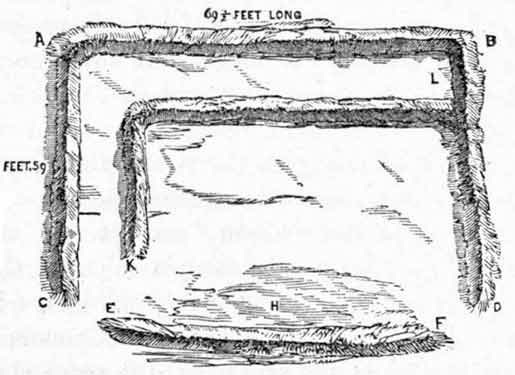
It consisted of an exterior and interior embankment, into which, from the remnants left, we saw that oak and elm scantling had been struck as props to the roofing; in one part of the enclosed space some coal-sacks were found, and in another part numerous wood-shavings proved the ship's artificers to have been working here. The generally received opinion as to the object of this storehouse was, that Franklin had constructed it to shelter a portion of his superabundant provisions and stores, with which it was well known his decks were lumbered on leaving Whale-Fish Islands.
Nearer to the beach, a heap of cinders and scraps of iron showed the armourer's working-place; and along an old water-course, now chained up by frost, several tubs, constructed of the ends of salt-meat casks, left no doubt as to the washing-places of the men of Franklin's squadron: happening to cross a level piece of ground, which as yet no one had lighted upon, I was pleased to see a pair of Cashmere gloves laid out to dry, with two small stones on the palms to prevent their blowing away; they had been there since 1846. I took them up carefully, as melancholy mementoes of my missing friends. In another spot a flannel was discovered: and this, together with some things lying about, would, in my ignorance of wintering in the Arctic Regions, have led me to suppose that there was considerable haste displayed in the departure of the "Erebus" and "Terror" from this spot, had not Captain Austin assured me that there was nothing to ground such a belief upon; and that, from experience, he could vouch for these being nothing more than the ordinary traces of a winter station, and this opinion was fully borne out by those officers who had in the previous year wintered at Port Leopold, one of them asserting that people left winter quarters too well pleased to escape to care much for a handful of shavings, an old coal-bag, or a washing-tub. This I from experience now know to be true.
Looking at the spot on which Penny had discovered a boarding-pike, and comparing it with a projecting point on the opposite side, where a similar article had been found with a finger nailed on it as a direction-post, I concluded that, in a line between these two boarding-pikes, one or both of the ships had been at anchor, and this conjecture was much borne out by the relative positions of the other traces found; and besides this, a small cairn on the crest of Beechey Island appears to have been intended as a meridian mark, and, if so, Franklin's squadron undoubtedly lay where I would place it, far and effectually removed from all risk of being swept out of the bay, which, by the bye, from the fact of the enclosed area being many times broader than the entrance of "Erebus and Terror Bay," was about as probable as any stout gentleman being blown out of a house through the keyhole. In the one case the stout individual would have to be cut up small, in the other case the ice would have to be well broken up; and if so, it was not likely Franklin would allow himself to be taken out of harbour, nolens volens, whilst he had anchors to hook the ground with, and ice-saws, with which his crews could have cut through a mile of ice three feet thick in twenty-four hours.
GRAVES OF SEAMEN.
The graves next attracted our attention; they, like all that English seamen construct, were scrupulously neat. Go where you will over the globe's surface, afar in the East, or afar in the West, down amongst the coral-girded isles of the South Sea, or here where the grim North frowns on the sailor's grave, you will always find it alike; it is the monument raised by rough hands, but affectionate hearts, over the last home of their messmate; it breathes of the quiet church-yard in some of England's many nooks, where each had formed his idea of what was due to departed worth; and the ornaments that Nature decks herself with, even in the desolation of the Frozen Zone, were carefully culled to mark the dead seamen's home. The good taste of the officers had prevented the general simplicity of an oaken head and foot-board to each of the three graves being marred by any long and childish epitaphs, or the doggerel of a lower-deck poet, and the three inscriptions were as follows:—
"Sacred to the memory of J. Torrington, who departed this life, January 1st, 1846, on board of H.M.S. 'Terror,' aged 20 years."
"Sacred to the memory of Wm. Braine, r.m., of H.M.S. 'Erebus;' died April 3d, 1846, aged 32 years.
"'Choose ye this day whom ye will serve.'—Josh. xxiv. 15."
"Sacred to the memory of J. Hartwell, a.b., of H.M.S. 'Erebus;' died January 4th, 1846, aged 25 years.
"'Thus saith the Lord of Hosts, consider your ways.'—Haggai i. 7."
I thought I traced in the epitaphs over the graves of the men from the "Erebus," the manly and Christian spirit of Franklin. In the true spirit of chivalry, he, their captain and leader, led them amidst dangers and unknown difficulties with iron will stamped upon his brow, but the words of meekness, gentleness, and truth, were his device. We have seen his career and we know his deeds!
"Why should their praise in verse be sung? The name that dwells on every tongue No minstrel needs."
From the graves, a tedious ascent up the long northern slope of Beechey Island carried us to the table-land, on whose southern verge, a cairn of stones, to which I have before referred, was placed; it had been several times pulled down by different searchers, and dug up underneath, but carefully replaced. The position was an admirable one, and appeared as if intentionally chosen to attract the attention of vessels coming up Barrow's Strait: from it, on the day I was up, the view was so extensive, that, did I not feel certain of being supported by all those who have, like myself, witnessed the peculiar clearness, combined with refraction, of the atmosphere in Polar climes, I should bear in mind the French adage,—"La verité n'est pas toujours le vraisemblable," and hold my peace.
To the west, the land of Cornwallis Island stretched up Wellington Channel for many miles, and Cape Hotham locked with Griffith's Island. In the south-west a dark mass of land showed Cape Walker, and from Cape Bunny, the southern shore of Barrow's Strait spread itself until terminated in the steep wall-like cliffs of Cape Clarence and Leopold Island.
This latter spot, so interesting from having been the winter quarters of the late relieving squadron under Sir James Ross, looked ridiculously close,—to use a seaman's term, it appeared as if a biscuit might have been tossed upon it; and the thought involuntarily rose to one's mind,—Would to God that, in 1848, Sir James Ross had known that within forty miles of him Franklin had wintered.
I have now nearly enumerated all the important points, to which, at all hours of the day and night, parties from the eight vessels assembled in Union Bay were constantly wending their way and returning; but around the whole island there were abundant proofs of the missing expedition having been no sluggards; for there was hardly a foot of the beach-line which did not show signs of their having been there before us, either in shooting excursions or other pursuits, and usually in the shape of a preserved-meat tin, a piece of rope, or a strip of canvas or rag.
BEECHEY ISLAND.
On the eastern extreme of Beechey Island, and under a beetling cliff which formed the entrance to the bay, a very neatly-paved piece of ground denoted a tent-place; much pains had been bestowed upon it, and a pigmy terrace had been formed around their abode, the margin of which was decorated with moss and poppy plants: in an adjacent gully a shooting-gallery had been established, as appeared by the stones placed at proper distances, and a large tin marked "Soup and Bouilli," which, perforated with balls, had served for a target. I carefully scanned the flat slabs of slaty limestone, of which the over-hanging cliffs were formed, in hopes of seeing some name, or date, scratched upon the surface; some clue, mayhap, to the information we so dearly longed for,—the route taken by Franklin on sailing hence, whether to Cape Walker or up Wellington Channel. But, no; the silent cliff bore no mark; by some fatality, the proverbial love for marking their names, or telling their tales, on every object, which I have ever found in seamen, was here an exception, and I turned to my vessel, after three unprofitable walks on Beechey Island, with the sad conviction on my mind, that, instead of being able to concentrate the wonderful resources we had now at hand about Beechey Island in one line of search, we should be obliged to take up the three routes which it was probable Franklin might have taken in 1846; viz., S.W. by Cape Walker, N.W. by Wellington Channel, or W. by Melville Island,—a division of force tending to weaken the chance of reaching Franklin as quickly as we could wish, unless circumstances were peculiarly favourable.
Vague reports of some of Captain Penny's people having seen sledge-marks on the eastern shores of "Erebus and Terror Bay," induced one of the officers of the "Pioneer" and myself to arrange with Captain Penny to take a walk in that direction.
Landing on the north shore of Union Bay, at the base of the cliffs of Cape Spencer, we were soon pointed out a deep sledge-mark, which had cut through the edge of one of the ancient tide-marks, or terraces, and pointed in a direct line from the cairn of meat-tins erected by Franklin, on the northern spur of Beechey Island, to a valley which led towards the bay between Capes Innis and Bowden. I conceived the trail to be that of an outward-bound sledge, on account of its depth, which denoted a heavily-ladened one.
Proceeding onward, our party were all much struck with the extraordinary regularity of the terraces, which, with almost artificial parallelism, swept round the base of the limestone cliffs and hills of North Devon. That they were ancient tidal-marks, now raised to a considerable elevation above the sea by the upheaval of the land, I was the more inclined to believe, from the numerous fossil shells, crustacea, and corallines which strewed the ground. The latter witnesses to a once more genial condition of climate in these now inclement regions, carried us back to the sun-blest climes, where the blue Pacific lashes the coral-guarded isles of sweet Otaheite, and I must plead guilty to a recreant sigh for past recollections and dear friends, all summoned up by the contemplation of a fragment of fossil-coral.
SLEDGE TRAILS.
The steep abutment of the cliffs on the north of "Erebus and Terror Bay," obliged us to descend to the floe, along the surface of which we rapidly progressed, passing the point on which the pike used by Franklin's people as a direction-post had been found. At a point where these said cliffs receded to the N.E., and towards the head of Gascoigne Inlet, leaving a long strip of low land, which, connecting itself with the bluffs of Cape Riley, forms the division between Gascoigne Inlet and "Erebus and Terror Bay," a perfect congery of sledge-marks showed the spot used for the landing-place, or rendezvous, of Franklin's sledges.
Some of these sledge-marks swept towards Cape Riley, doubtless towards the traces found by the "Assistance;" others, and those of heavily-ladened sledges, ran northward, into a gorge through the hills, whilst the remainder pointed towards Caswell's Tower, a remarkable mass of limestone, which, isolated at the bottom of Radstock Bay, forms a conspicuous object to a vessel approaching this neighbourhood from the eastward or westward.
Deciding to follow the latter trail, we separated the party in such a manner, that, if one lost the sledge-marks, others would pick them up.
Arriving at the margin of a lake, which was only one of a series, and tasted decidedly brackish, though its connection with the sea was not apparent, we found the site of a circular tent, unquestionably that of a shooting-party from the "Erebus" or "Terror." The stones used for keeping down the canvas lay around; three or four large ones, well blackened by smoke, had been the fire-place; a porter-bottle or two, several meat-tins, pieces of paper, birds' feathers, and scraps of the fur of Arctic hares, were strewed about. Eagerly did we run from one object to the other, in the hope of finding some stray note or record, to say whether all had been well with them, and whither they had gone. No, not a line was to be found. Disappointed, but not beaten, we turned to follow up the trail.
The sledge-marks consisted of two parallel lines, about two feet apart, and sometimes three or four inches deep into the gravel, or broken limestone, of which the whole plain seemed to be formed. The difficulty of dragging a sledge over such ground, and under such circumstances, must have been great, and, between the choice of evils, the sledge-parties appeared at last to have preferred taking to the slope of the hills, as being easier travelling than the stony plain. A fast-rising gale, immediately in our faces, with thick, driving snow and drift, suddenly obscured the land about us, and rendered our progress difficult and hazardous.
After edging to the northward for some time, as if to strike the head of Gascoigne Inlet, the trail struck suddenly down upon the plain: we did the same, and as suddenly lost our clue, though there was no doubt on any of our minds, but that the sledge had gone towards Caswell's Tower; for us to go there was, however, now impossible, having no compass, and the snow-storm preventing us seeing more than a few hundred yards ahead. We therefore turned back walking across the higher grounds direct for the head of Union Bay, a route which gave us considerable insight into the ravine-rent condition of this limestone country, at much cost of bodily fatigue to ourselves. The glaciers in the valleys, or ravines, hardly deserved the name, after the monsters we had seen in Baffin's Bay, and, I should think, in extraordinary seasons, they often melted away altogether, for, in spite of so severe a one as the present year had been, there was but little ice remaining.
The gale raged fiercely as the day drew on, and, on getting sight of Wellington Channel, the wild havoc amongst the ice made us talk anxiously of that portion of our squadron which was now on the opposite or lee side of the channel, as well as the American squadron that had pushed up to the edge of the fixed ice beyond Point Innis.
Seven hours' hard walking left us pretty well done up by the time we tumbled into our boat, and, thanks to the stalwart strokes of Captain Stewart's oar, we soon reached the "Pioneer," and enjoyed our dinner with more than the usually keen appetite of Arctic seamen.
WELLINGTON CHANNEL.
Such were the traces found in and about Franklin's winter quarters: one good result had arisen from, their discovery,—the safe passage of Franklin across the dangers of Baffin's Bay was no longer a question; this was a certainty, and it only remained for us to ascertain which route he had taken, and then to follow him.
Wellington Channel engrossed much attention; the Americans, with true go-ahead spirit, watched the ice in it most keenly. The gallant commander of their expedition, De Haven, had already more than once pushed his craft up an angle of water north of Point Innis; his second, Mr. Griffin, in the "Rescue," was hard at work obtaining angles, by which to ascertain the fact of Wellington Channel being a channel or a fiord, a point as yet undecided, for there was a break in the land to the N.W. which left the question still at issue.
Captain Penny, with his vessels, got under weigh one day, and ran over towards the "Assistance," as far as the pack would allow him, and then despatched an officer with a boat to communicate our intelligence as well as his own; a sudden change of weather obliged Penny to return, and the boat's crew of the "Lady Franklin," on their way back, under Mr. John Stuart, underwent no small risk and labour. They left the "Assistance" to walk to their boat, which had been hauled on the ice; a thick fog came on; the direction was with difficulty maintained; no less than eleven bears were seen prowling around the party; the boat was found by mere accident, and, after fourteen hours' incessant walking and pulling, Mr. Stuart succeeded in reaching the "Lady Franklin."
Through him we learnt that Cape Hotham and the neighbourhood of Barlow Inlet showed no sign of having been visited by Franklin, that the pack was close home against the land, and that the "Assistance" and "Intrepid" had been subject to some pressure, but were all safe and sound.
Almost every hour during our detention in Union Bay, large flights of wild fowl, principally geese and eider ducks, flew past us, as if they had come down Wellington Channel, and were making away to the southward; this certain indication of approaching winter was not to be mistaken, and we anxiously counted the hours which kept flitting past, whilst we were chained up in Union Bay.
South-easterly winds forced the pack tighter and tighter in Wellington Channel, and once or twice it threatened to beset us even in Union Bay; and on the 31st of August our position was still the same, the Americans being a little in advance, off Point Innis.
From the 1st to the 4th of September, we lay wishing for an opening, the Americans working gallantly along the edge of the fixed ice of Wellington Channel, towards Barlow Inlet.
September the 5th brought the wished-for change. A lead of water. Hurrah! up steam! take in tow! every one's spirits up to the high-top-gallant of their joy; long streaks of water showing across Wellington Channel, out of which broad floe-pieces were slowly sailing, whilst a hard, cold appearance in the northern sky betokened a northerly breeze.
THE WHITE WHALE.
With the "Resolute" fast astern, the "Pioneer" slipped round an extensive field of ice; as it ran aground off Cape Spencer, shutting off in our rear Captain Penny's brigs and the "Felix," another mass of ice at the same time caught on Point Innis, and, unable to get past it, we again made fast, sending a boat to watch the moment the ice should float, and leave us a passage to the westward. Whilst thus secured, we had abundant amusement and occupation in observing the movements of shoals of white whales. They were what the fishermen on board called "running" south, a term used to express the steady and rapid passage of the fish from one feeding-ground to the other. From the mast-head, the water about us appeared filled with them, whilst they constantly rose and blew, and hurried on, like the birds we had lately seen, to better regions in the south. That they had been north to breed was undoubted, by the number of young "calves" in every shoal. The affection between mother and young was very evident; for occasionally some stately white whale would loiter on her course, as if to scrutinize the new and strange objects now floating in these unploughed waters, whilst the calf, all gambols, rubbed against the mother's side, or played about her. The proverbial shyness of these fish was proved by our fishermen and sportsmen to be an undoubted fact, for neither with harpoon nor rifle-ball could they succeed in capturing any of them.
It was a subject of deep interest and wonder to see this migration of animal life, and I determined, directly leisure would enable me, to search the numerous books with which we were well stored, to endeavour to satisfy my mind with some reasonable theory, founded upon the movements of bird and fish, as to the existence of a Polar ocean or a Polar continent.
A sudden turn of tide, which floated the ice that had for some hours been aground on Point Innis and Cape Spencer, and carried it out of Wellington Channel, which favourable tide I therefore conjectured to be the flood, enabled the "Pioneer" and "Resolute" to start across Wellington Channel, towards Barlow Inlet.
Northward of us, ran, almost in a straight line, east and west, the southern edge of a body of ice, which we then imagined, in our ignorance, to be fixed, extending northward,—aye, to the very pole; for in the rumour of it being a mere fiord, or gulf, I had no belief, nor any one else who crossed it in our ships. The day was beautifully clear, and a cold, hard sky enabled us to see the land of North Somerset most distinctly, though thirty to forty miles distant; and yet nothing appeared resembling land in the northern part of Wellington Channel. More than one of us regretted the prospect of this yet unsearched route remaining so, and the racing mania for Melville Island and Cape Walker bore for all of us this day its fruit—unavailing regret.
A fresh and favourable gale from the northward raised our spirits and hopes, late as it now was in the season, and already, with the adventurous feelings of seamen, we began to calculate what distance might yet be achieved, should the breeze but last for two or three days. The space to be traversed, even to Behring's Straits, was a mere nothing; and all our disappointments, all our foiled anticipations, were forgotten, in the light-heartedness brought about by a day of open water and a few hours of a fair wind. As we rattled along the lane of blue water which wound gracefully ahead to the westward, the shores of Cornwallis Island rapidly revealed themselves, and offered little that was striking or picturesque. One uniform tint of russet-brown clothed the land, as the sun at eight in the evening sunk behind the ice-bound horizon of Wellington Channel.
Novel and striking as were the colours thrown athwart the cold, hard sky by the setting orb, I thought with a sigh of those gay and flickering shades which beautify the heavens in the tropics, when the fierce sun sinks to his western rest. No gleams of purple and gold lit up the hill-tops; no fiery streaks of sunlight streamed across the water, or glittered on the wave. No! all was cold and silent as the grave. In heaven alone there appeared sunshine and vitality:—it was rightly so. Frost was fast claiming its dominion, for, with declining sunlight, the space of water between the pack and the floe became a sheet of young ice, about the one-eighth of an inch in thickness.
CROSSING WELLINGTON CHANNEL.
The "Assistance" and "Intrepid" were gone, it was very evident; but the American squadron was observed in Barlow Inlet. As we approached them, at two o'clock in the morning, they were to be seen firing muskets. We therefore put our helms down, and performed, by the help of the screw, figures of eight in the young ice, until a boat had communicated with Commander De Haven, from whom we learned that one of his vessels was aground in the inlet, and that it was no place for us to go into, unless we wanted to remain there. The passage to the westward, round Cape Hotham, was likewise blocked up, and no alternative remained but to make fast to the floe to the north of us. This was done, and just in time; for a smart breeze from the S.E. brought up a great deal of ice, and progress in any direction was impossible.
I had now time to observe that the floe of Wellington Channel, instead of consisting of a mass of ice (as was currently reported) about eight feet in thickness, did not in average depth exceed that of the floes of Melville Bay, although a great deal of old ice was mixed up with it, as if a pack had been re-cemented by a winter's frost; in which case, of course, there would be ice of various ages mixed up in the body; and much of the ice was lying crosswise and edgeways, so that a person desirous of looking at the Wellington Channel floe, as the accumulation of many years of continued frost, might have some grounds upon which to base his supposition. A year's observation, however, has shown me the fallacy of supposing that in deep-water channels floes continue to increase in thickness from year to year; and to that subject I will return in a future chapter, when treating of Wellington Channel.
The closing chapter of accidents, by which the navigation of 1850 was brought to a close by the squadrons in search of Sir John Franklin, is soon told.
The "Resolute" and "Pioneer" remained, unable to move, in Wellington Channel; a northerly gale came on, after a short breeze from the S.E.; and imagine, kind reader, our dismay, in finding the vast expanse, over which the eye had in vain strained to see its limit—imagine this field suddenly breaking itself across in all directions, from some unseen cause, farther than (as appeared to us) a northerly gale blowing over its surface, and our poor barks, in its cruel embrace, sweeping out of Wellington Channel, and then towards Leopold Island. At one time, the probability of reaching the Atlantic, as Sir James Ross did, stared us disagreeably in the face, and blank indeed did we all look at such a prospect.
A calm and frosty morning ushered in the 9th of September. The pack was fast re-knitting itself, and we were drifting with it, one mile per hour, to the S.E., when Penny's brigs, that had been seen the day before crossing to the northward of us, were observed to be running down along the western shore, with the American squadron ahead of them, the latter having just escaped from an imprisonment in Barlow Inlet. About the same time, a temporary opening of the pack enabled the steam-power again to be brought to bear, and never was it more useful. The pack was too small and broken for a vessel to warp or heave through, there was no wind "to bore" through it, and the young ice in some places, by pressure, was nigh upon six inches thick; towing with boats was, therefore, out of the question.
The "Resolute" fast astern, with a long scope of hawser, the "Pioneer," like a prize-fighter, settled to her work, and went in and won. The struggle was a hard one,—now through sludge and young ice, which gradually checked her headway, impeded as she was with a huge vessel astern—now in a strip of open water, mending her pace to rush at a bar of broken-up pack, which surged and sailed away as her fine bow forced through it—now cautiously approaching a nip between two heavy floe pieces, which time and the screw wedged slowly apart—and then the subdued cheer with which our crews witnessed all obstacles overcome, and the Naval expedition again in open water, and close ahead of the Government one under Penny, and Commander De Haven's gallant vessels, who, under a press of canvas, were just hauling round Cape Hotham. A light air and bay-ice gave us every advantage.
ALL THE VESSELS MEET.
Next day, in succession, we all came up to the "Assistance" and "Intrepid," fast at a floe edge, between Cape Bunny and Griffith's Island. That this floe was not a fixed one we were assured, as the "Intrepid" had been between it and Griffith's Island, nearly as far as Somerville Island; but, unhappily, it barred our road as effectually as if it were so. Penny, with his squadron, failed in passing southward towards Cape Walker; and Lieutenant Cator, in the "Intrepid," was equally unsuccessful.
I was much interested in the account of the gallant struggle of the "Assistance" and "Intrepid" in rounding Cape Hotham. They fairly fought their way against the ice, which at every east-going tide was sweeping out of Barrow's Strait, and grinding along the shore. It is most satisfactory to see that all risks may be run, and yet neither ships nor crews be lost; and it is but fair to suppose, that, if our ships incurred such dangers unscathed, the "sweet cherub" will not a jot the less have watched over the "Erebus" and "Terror." Of course, the "croakers" say, if the floe had pressed a little more—if the ship had risen a little less—in fact, if Providence had been a little less watchful—disasters must have overtaken our ships; but when I hear these "dismal Jemmies" croak, it puts me much in mind of the midshipman, who, describing to his grandmamma the attack on Jean d'Acre, after recounting his prowess and narrow escapes, assured the old lady that Tom Tough, the boatswain's mate, had asserted with an oath, which put the fact beyond all doubt, that if one of those shot from the enemy had struck him, he never would have lived to tell the tale.
From my gallant comrade of the "Intrepid," we heard of the search that had been made in Wolstenholme Sound, and along the north shore of Lancaster Sound. In both places numerous traces of Esquimaux had been seen, at Wolstenholme Sound especially. These were numerous and recent, and the "Intrepid's" people were shocked, on entering the huts, to find many dead bodies; the friends, evidently, of our Arctic Highlander, Erasmus York, who, as I before said, had shipped as interpreter on board the "Assistance." In Wolstenholme Sound, the cairns erected by the "North Star" were discovered and visited, and, whilst speaking of her, it will be as well for me to note, that Captain Penny, on his way up Lancaster Sound, met the "North Star" off Admiralty Inlet, August 21st, gave Mr. Saunders his orders from England, and told him of the number of ships sent out to resume the search for Franklin. Captain Penny left Mr. Saunders under an impression that he was going to Disco, to land his provisions.
There was one remarkable piece of information, which I noted at the time, and much wondered at; it was derived from Captain Penny, and the officers of the "Lady Franklin" and "Sophia." It appears they crossed Wellington Channel, about ten miles higher up than we did; the ice breaking away, it will be remembered, and drifting with the "Resolute" and "Pioneer" to the south. From a headland about twelve miles north of Barlow Inlet, Captain Penny observed with astonishment that there was only about ten miles more of ice to the north of his vessels, and then, to use his own words, "Water! water! large water! as far as I could see! to the N.W." How this water came there? what was beyond it? were questions which naturally arose; but it was not until the following year that the mystery was explained, and we learned, what was only then suspected, that we had overshot our mark.
THE COMING ON OF WINTER.
Sept. 11th, 1850.—The winter of the Arctic Regions came on us, in its natural character of darkness, gale, cold, and snow. First, the wind from the S.E., with a heavy sea, which sent us careering against the floe-edge, and gave all hands a hard night's work to keep the anchors in the firm floe, as the edge rapidly broke up, under the combined effects of sea and shocks from our vessels; then, with a gust or two, which threatened to blow the sticks out of our craft, the wind chopped round to the N.W.; and a falling temperature, which Arctic statistics told us would not, at this season, ever recover itself, said plainly, that winter quarters alone remained for us.
Happily, the "Intrepid" had discovered a harbour between Cape Hotham and Martyr, on the south side of Cornwallis Island. This place, and Union Bay, in Beechey Island, offered two snug positions, from which operations in the spring with travelling parties could be well and effectually carried out. Action, action now alone remained for us; and earnestly did we pray that our leader's judgment might now decide upon such positions being taken up as would secure all directions—viz. to the south-west,—north-west and, lastly, west being provided for.
Sept. 13th.—Found the four vessels of our squadron, and one of the American brigs,—the "Advance" under Lieutenant De Haven,—all safe at the floe-edge. The floe had drifted during the gale considerably towards the shores of North Somerset; and the wedge-shaped island, called Cape Bunny, was distinctly visible: the other of the American brigs had, in the height of the gale, blown adrift and disappeared in the darkness and snow-drift. For her, as well as Her Majesty's brigs under Captain Penny, much anxiety was entertained. The American leader of the expedition, I heard, finding farther progress hopeless, intended, in obedience to his orders, to return to New York. This he was the more justified in doing, as no preparation or equipment for travelling-parties had been made by them, and their fittings for wintering in the Arctic Regions were, compared with ours, very deficient. The gallant Yankees, however, could not return without generously offering us provisions, fuel, and stores; and the officers, with a chivalrous feeling worthy of themselves and the cause for which they had come thus far, offered to remain out or exchange with any of "ours" who wanted to return home. We had no space in stowage to profit by the first offer, nor had enthusiasm yet become sufficiently damped in us to desire to avail ourselves of the proffered exchange; both were declined, and it was said that Lieutenant De Haven was told by our leader, if he could land any thing for us in Radstock Bay as a dépôt, he might render good service.
Letters were therefore hurriedly closed, letter-bags made up, and pleasant thoughts of those at home served to cheer us, as, with the temperature at about zero, and with a fresh breeze, we cast off together, and worked to the northward, towards Griffith's Island.
THE AMERICAN SQUADRON.
Rubbing sides almost with the "Advance," who courteously awaited with the "Pioneer" the heavy-heeled gambols of the "Resolute," day was drawing on before the squadron reached Griffith's Island, from the lee of which the missing American schooner was descried to be approaching. Lieutenant De Haven now hoisted his colours for home, and backed his topsail. We did the same; and after a considerable time he bore up with his squadron for New York, doubtless supposing, from no letters being sent, that we had none.
It was far otherwise; and throughout the winter many a growl took place, as a huge pile of undespatched letters would pass before our sight, and blessings of a doubtful nature were showered on our ill luck.
To the ice, which extended unbroken from Griffith's Island to Cape Martyr, we will leave the Naval expedition secured, whilst we briefly recount the most striking points in connection with the American expedition that had now left us on its voyage home.
In 1849, Mr. Henry Grinnell, a merchant of the United States, actuated by the purest philanthropy that ever influenced the heart of man, determined to devote a portion of his well-deserved wealth to the noble purpose of relieving Sir John Franklin, who, it was much to be feared, from the desponding tone of a portion of the English press on Sir James Ross's failure, was likely to be left unsought for in 1850. He therefore, at his sole expense, purchased two vessels, one of 140 tons, the "Advance," the other 90 tons, the "Rescue," and, having strengthened, provisioned, and equipped them, Mr. Grinnell then placed them under the control of his Government, in order that they might be commanded by naval officers and sail under naval discipline. The American Congress passed the necessary acts, and Lieutenant E. De Haven, who had seen service in the Antarctic seas, took command of the "Advance," as the leader of the expedition, and another distinguished officer, Mr. Griffin, hoisted his pendant in the "Rescue." On the 23d May, 1850, the two vessels sailed from New York, touching at Disco, where I am sorry to say they found my worthy friend "Herr Agar" to have died shortly after my visit; they reached the pack of Melville Bay on the 7th July, and, tightly beset until the 23d, they did not reach Cape York until early in August.
The 7th August they reached Cape Dudley Digges! (at that time we were still beset off Cape Walker in Melville Bay), thence they stood to the south-west, until they reached the West Water.
On the 18th August, when we had a thick fog and almost a calm off Possession Bay, the American squadron was in a severe gale in Lancaster Sound; and on the 25th August, after visiting Leopold Island, the gallant Americans reached Cape Riley close on the heels of the "Assistance" and "Intrepid."
From that time we have shown that they lost no opportunity of pushing ahead; and if progress depended alone upon skill and intrepidity, our go-ahead friends would have given us a hard tussle for the laurels to be won in the Arctic regions.
As a proof of the disinterestedness of their motives, men as well as officers, I was charmed to hear that before sailing from America they had signed a bond not to claim, under any circumstances, the £20,000 reward the British Government had offered for Franklin's rescue; we, I am sorry to say, had acted differently. America had plucked a rose from our brows; but in such generous enterprise, we for the most part felt that no narrow-minded national prejudices could enter, and I gloried in the thought that the men who had so nobly borne themselves, as well as he, the princely merchant who had done his best to assist the widow and orphan to recover those for whom they had so long hoped and wept, were men who spoke our language, and came from one parent-stock—a race whose home is on the great waters.
Looking at my rough notes for the following week, I am now puzzled to know what we were hoping for; it must have been a second open season in 1850,—a sanguine disposition, no doubt brought about by a break in the weather, not unlike the Indian summer described by American writers.
GO INTO WINTER QUARTERS.
September 14th.—I went in the "Pioneer," with some others, to see if the floe had opened a road to the south of Griffith's Island; it had not, nor did it appear likely to do so this season, though there was water seen some fifteen miles or so to the westward.
One day the "Assistance" and "Intrepid" started for Assistance Harbour, to winter there, but came back again, for winter had barred the route to the eastward as well as westward. One day after this, or rather, many days, we amused ourselves, with powder, blowing open a canal astern of the "Resolute," which froze over as quickly as we did it. At other times, some people would go on the top of the island, and see oceans of water, where no ship could possibly get to it, and then others would visit the same spot after a night or two of frost, and, seeing ice where the others had seen water, asserted most confidently that the first were exaggerators!
At any rate, September passed; winter and frost had undoubted dominion over earth and sea; already the slopes of Griffith's Island, and the land north of us, were covered with snow; the water in sight was like a thread, and occasionally disappeared altogether. Fires all day, and candles for long nights, were in general requisition. Some cross-fire in the different messes was taking place as the individuals suffered more or less from the cold. Plethoric ones, who became red-hot with a run up the ladder, exclaimed against fires, and called zero charming weather; the long and lethargic talked of cold draughts and Sir Hugh Willoughby's fate; the testy and whimsical bemoaned the impure ventilation. A fox or two was occasionally seen scenting around the ships, and a fox-hunt enlivened the floe with men and officers, who chased the unlucky brute as if they had all come to Griffith's Island especially for fox-skins; and the last of the feathered tribe, in the shape of a wounded "burgomaster," shivered, half frozen, as it came for its daily food.
October 2d, 1850.—Lieutenant M'Clintock had very properly urged the necessity of sending travelling parties to forward dépôts of provisions upon the intended routes of the different parties in 1851: these were this morning despatched,—Lieutenant M'Clintock, with Dr. Bradford, carrying out a dépôt towards Melville Island; Lieutenant Aldrich taking one to Lowther Island, touching at Somerville Island on the way.
Lieutenant Mecham was likewise sent to examine Cornwallis Island, between Assistance Harbour and Cape Martyr, for traces of Franklin.
We, who were left behind, felt not a little anxious about these parties whilst absent, for winter was coming on with giant strides; on the 4th, frost-bites were constantly occurring, and the sun, pale and bleary, afforded more light than warmth. Our preparations for winter were hurried on as expeditiously as possible; and the housing, which, like a tent, formed a complete covering to our upper decks, afforded great comfort and shelter from the cold bleak wind without.
LIEUTENANT MECHAM'S ADVENTURE.
On the 5th, Lieutenant Aldrich returned from his journey; he had not been able to go beyond Somerville Island—the sea between it and Lowther Island being covered with broken packed ice, half-frozen sludge, and young ice. On the 7th, Lieutenant Mecham arrived with the intelligence that the "Lady Franklin" and "Sophia" were, with the "Felix," safe in Assistance Harbour. Captain Penny, after his failure in reaching Cape Walker, had a narrow escape of being beset on the shores of North Somerset; but by carrying on through the pack, in the gale of the 11th September, he had happily secured his ships in excellent winter quarters.
Lieutenant Mecham had an adventure on his outward route, which had some interesting features: as he was crossing the entrance of a bay, since named Resolute Bay, he observed a bear amongst some hummocks, evidently breaking the young ice by a sort of jumping motion; and he then saw that he and his party had unconsciously left the old ice, and were travelling over bay-ice, which was bending with the weight of the men and sledge. Bruin's sagacity here served the seamen in good stead, and the sledge was expeditiously taken to firmer ice, whilst Mr. M. went in chase of the bear; having mortally wounded it, the brute rushed to seaward, and the sportsman only desisted from the pursuit when he observed the bear fall, and in doing so break through the ice, which was too weak to sustain its weight.
Captain Penny, on the following day, sent over his dog-sledge to secure the flesh for his dogs, by which time the unlucky bear was frozen to a hard and solid mass.
October 9th.—Lieutenant M'Clintock returned; he had placed his dépôt forty miles in advance, towards Melville Island,—three days' imprisonment by bad weather, in the tents, having foiled his hopes of reaching Bedford Bay in Bathurst Island, where he originally intended to have reached. This party had, likewise, met water to the westward, and there was now but little doubt on our minds, that, had the large field of ice which was blocking the way between Cape Bunny and Griffith's Island broken up or drifted away, our squadron would have reached, in all probability, as far as Parry did in '20; but now, the utmost we could hope to attain in the following year was Melville Island, which would be our goal, instead of our starting point.
Autumn travelling differs, in some measure, from that of the spring. I will, therefore, give the indulgent reader an account of a short excursion I made for the purpose of connecting the search from where Lieutenant Mecham left the coast, to the point at which Lieutenant M'Clintock had again taken it up; in fact, a bay, facetiously christened by the seamen (who had learned that newly-discovered places were forbidden to be named), "Bay, Oh! no we never mention it!" and "Cape No Name."
My kind friend, Mr. May of the "Resolute," volunteered to accompany me, and on Thursday, the 10th of October, we started with our tent, a runner-sledge, and five days' provisions. The four seamen and our two selves tackled to the drag-ropes, and, with the temperature at 6° above zero, soon walked ourselves into a state of warmth and comfort.
RUINS ON CORNWALLIS ISLAND.
Three hours' sharp dragging brought us to Cape Martyr; ascending the beach until we had reached a ledge of smooth ice which fringed the coast within the broken line of the tide-marks, we turned to the westward, and commenced searching the beach and neighbouring headlands. I shall not easily efface from my memory the melancholy impression left by this, my first walk on the desolate shores of Cornwallis Island. Like other things, in time the mind became accustomed to it; and, by comparison, one soon learned to see beauties even in the sterility of the North.
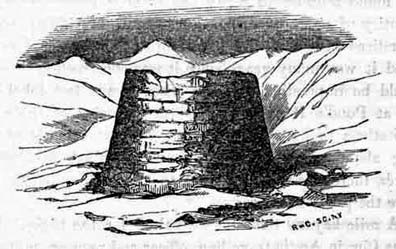
Horizontal Section, 20 feet circumference.
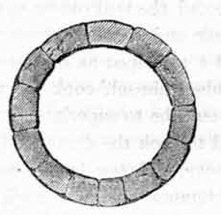
Vertical Section, 5 feet 6 inches high.