Part 2 — LAYS O’ FAËRIE
Reading edition
THE FAIRY TEMPTER
A fair girl was sitting in the greenwood shade, List’ning to the music the spring birds made; When sweeter by far than the birds on the tree, A voice murmured near her, “Oh! come, Love, with me— In earth or air, A thing so fair I have not seen as thee! Then come, Love, with me.” “With a star for thy home, in a palace of light, Thou will add a fresh grace to the beauty of night; Or, if wealth be thy wish, thine are treasures untold, I will show thee the birthplace of jewels and gold gold— And pearly caves Beneath the waves, All these, all these are thine, If thou will be mine.” Thus whispered a Fairy to tempt the fair girl, But vain was his promise of gold and of pearl; For she said, “Tho’ thy gifts to a poor girl were dear, My father, my mother, my sisters are here: Oh! what would be Thy gifts to me Of earth, and sea, and air, If my heart were not there?”
Samuel Lover
ALICE BRAND
I
Merry it is in the good Greenwood, When the mavis and merle are singing, When the deer sweeps by, and the hounds are in cry, And the hunter’s horn is ringing. “O Alice Brand, my native land Is lost for love of you; And we must hold by wood and wold, As outlaws wont to do. “O Alice, ’t was all for thy locks so bright, And ’t was all for thine eyes so blue, That on the night of our luckless flight, Thy brother bold I slew. “Now must I teach to hew the beech, The hand that held the glaive, For leaves to spread our lowly bed, And stakes to fence our cave. “And for vest of pall, thy fingers small, That wont on harp to stray, A cloak must sheer from the slaughtered deer, To keep the cold away.”— “O Richard! if my brother died, ’T was but a fatal chance; For darkling was the battle tried, And fortune sped the lance. “If pall and vair no more I wear, Nor thou the crimson sheen, As warm, we’ll say, is the russet grey, As gay the forest green. “And, Richard, if our lot be hard, And lost thy native land, Still Alice has her own Richard, And he his Alice Brand.”
II
’Tis merry, ’tis merry, in good Greenwood, So blithe Lady Alice is singing; On the beech’s pride, and oak’s brown side, Lord Richard’s axe is ringing. Up spoke the moody Elfin King, Who woned within the hill,— Like wind in the porch of a ruined church, His voice was ghostly shrill. “Why sounds yon stroke on beech and oak, Our moonlight circle’s screen? Or who comes here to chase the deer, Beloved of our Elfin Queen? Or who may dare on wold to wear The Fairies’ fatal green? “Up, Urgan, up! to yon mortal hie, For thou wert christened man; For cross or sign thou wilt not fly, For muttered word or ban. “Lay on him the curse of the withered heart, The curse of the sleepless eye; Till he wish and pray that his life would part, Nor yet find leave to die.”
III
’Tis merry, ’tis merry, in good Greenwood, Though the birds have stilled their singing; The evening blaze doth Alice raise, And Richard is fagots bringing. Up Urgan starts, that hideous Dwarf, Before Lord Richard stands, And, as he crossed and blessed himself, “I fear not sign,” quoth the grisly Elf, “That is made with bloody hands.” But out then spoke she, Alice Brand That woman void of fear,— “And if there’s blood upon his hand, ’Tis but the blood of deer.”— “Now loud thou liest, thou bold of mood! It cleaves unto his hand, The stain of thine own kindly blood, The blood of Ethert Brand.” Then forward stepped she, Alice Brand, And made the holy sign: “And if there’s blood on Richard’s hand, A spotless hand is mine. “And I conjure thee, Demon Elf, By Him whom Demons fear, To show us whence thou art thyself, And what thine errand here?” “’Tis merry, ’tis merry, in Fairyland, When Fairy Birds are singing, When the Court doth ride by their Monarch’s side, With bit and bridle ringing: “And gaily shines the Fairyland— But all is glistening show, Like the idle gleam that December’s beam Can dart on ice and snow. “And fading, like that varied gleam, Is our inconstant shape, Who now like Knight and Lady seem, And now like Dwarf and Ape.
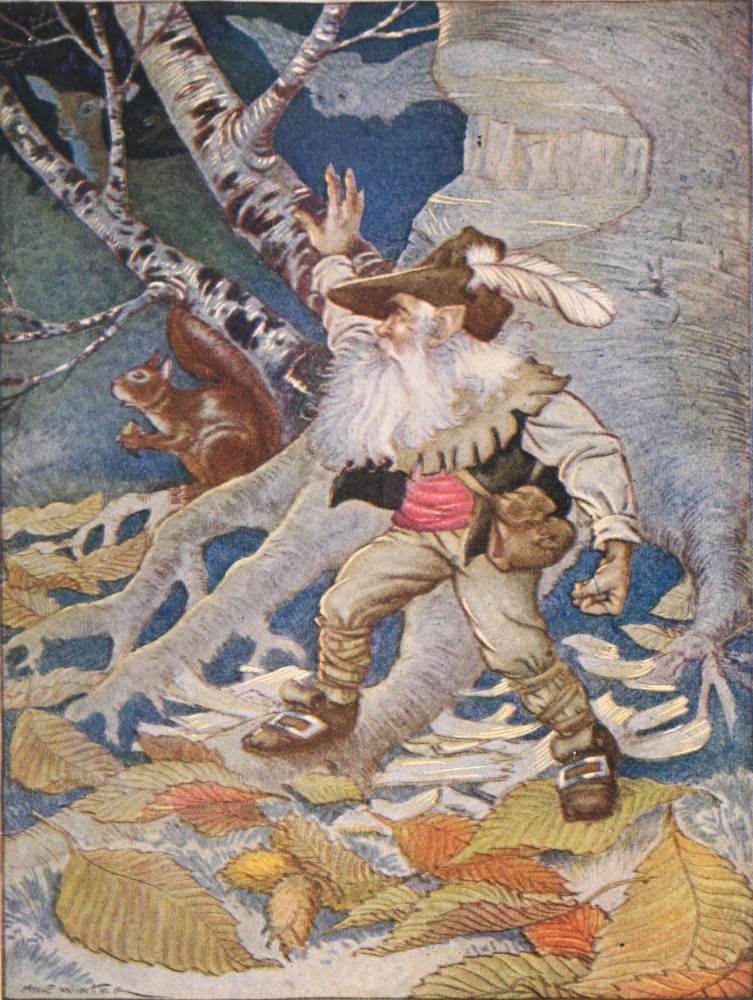
“I FEAR NOT SIGN,” QUOTH THE GRISLY ELF, “THAT IS MADE WITH BLOODY HANDS”
“It was between the night and day, When the Fairy King has power, That I sunk down in a sinful fray, And ’twixt life and death, was snatched away To the joyless Elfin Bower. “But wist I of a woman bold, Who thrice my brow durst sign, I might regain my mortal mould, As fair a form as thine.” She crossed him once, she crossed him twice— That Lady was so brave; The fouler grew his goblin hue, The darker grew the cave. She crossed him thrice, that Lady bold; He rose beneath her hand The fairest Knight on Scottish mould Her brother, Ethert Brand! Merry it is in good Greenwood, When the mavis and merle are singing, But merrier were they in Dunfermline grey, When all the bells were ringing.
Sir Walter Scott
THE ERL-KING
Oh! who rides by night thro’ the woodland so wild? It is the fond father embracing his child; And close the boy nestles within his loved arm, To hold himself fast and to keep himself warm. “O Father, see yonder! see yonder!” he says: “My boy, upon what dost thou fearfully gaze?”— “Oh! ’tis the Erl-King with his crown and his shroud,”— “No, my Son, it is but a dark wreath of the cloud.”
THE ERL-KING SPEAKS
“Oh! come and go with me, thou loveliest child; By many a gay sport shall thy time be beguiled; My mother keeps for thee full many a fair toy, And many a fine flower shall she pluck for my boy.” “O Father, my Father! and did you not hear The Erl-King whisper so low in my ear?”— “Be still, my heart’s darling—my child, be at ease; It was but the wild blast as it sung thro’ the trees.”
THE ERL-KING SPEAKS AGAIN
“Oh! wilt thou go with me, thou loveliest boy? My daughter shall tend thee with care and with joy; She shall bear thee so lightly thro’ wet and thro’ wild, And press thee and kiss thee and sing to my child.” “O Father, my Father, and saw you not plain, The Erl-King’s pale daughter glide past thro’ the rain?”—— “Oh, yes, my loved treasure, I knew it full soon: It was the grey willow that danced to the moon.”
THE ERL-KING SPEAKS AGAIN
“Oh! come and go with me, no longer delay, Or else, silly child, I will drag thee away.”— “O Father! O Father! now, now keep your hold, The Erl-King has seized me—his grasp is so cold!” Sore trembled the father; he spurred thro’ the wild, Clasping close to his bosom his shuddering child; He reaches his dwelling in doubt and in dread, But, clasped to his bosom, the infant was dead!
Sir Walter Scott, from Goethe
THE FAIRY THORN
AN ULSTER BALLAD
“Get up, our Anna dear, from the weary spinning-wheel; For your father’s on the hill, and your mother is asleep: Come up above the crags, and we’ll dance a highland reel Around the Fairy Thorn on the steep.” At Anna Grace’s door’t was thus the maidens cried, Three merry maidens fair in kirtles of the green; And Anna laid the rock and the weary wheel aside, The fairest of the four, I ween. They’re glancing thro’ the glimmer of the quiet eve, Away in milky wavings of neck and ankle bare; The heavy-sliding stream in its sleepy song they leave, And the crags in the ghostly air: And linking hand in hand, and singing as they go, The maids along the hill-side have ta’en their fearless way Till they come to where the Rowan Trees in lonely beauty grow Beside the Fairy Hawthorn grey. The Hawthorn stands between the ashes tall and slim, Like matron with her twin grand-daughters at her knee; The Rowan berries cluster o’er her low head grey and dim, In ruddy kisses sweet to see. The merry maidens four have ranged them in a row, Between each lovely couple a stately Rowan stem, And away in mazes wavy like skimming birds they go, Oh, never carolled bird like them! But solemn is the silence of the silvery haze That drinks away their voices in echoless repose, And dreamily the evening has stilled the haunted braes, And dreamier the gloaming grows. And sinking one by one, like lark-notes from the sky When the falcon’s shadow saileth across the open shaw, Are hushed the maidens’ voices as cowering down they lie In the flutter of their sudden awe. For, from the air above, and the grassy ground beneath And from the Mountain Ashes and the old Whitethorn between, A power of faint Enchantment doth through their beings breathe And they sink down together on the green. They sink together silent, and stealing side to side, They fling their lovely arms o’er their drooping necks so fair, Then vainly strive again their naked arms to hide, For their shrinking necks again are bare. Thus clasped and prostrate all, with their heads together bowed, Soft o’er their bosoms beating—the only human sound— They hear the silky footsteps of the silent Fairy crowd, Like a river in the air, gliding round. Nor scream can any raise, nor prayer can any say, But wild, wild the terror of the speechless three— For they feel fair Anna Grace drawn silently away, By whom they dare not look to see. They feel her tresses twine with their parting locks of gold, And the curls elastic falling, as her head withdraws; They feel her sliding arms from their tranced arms unfold, But they dare not look to see the cause: For heavy on their senses the faint Enchantment lies; Through all that night of anguish and perilous amaze; And neither fear nor wonder can ope their quivering eyes Or their limbs from the cold ground raise. Till out of Night the Earth has rolled her dewy side, With every haunted mountain and streamy vale below; When, as the mist dissolves in the yellow morning tide, The maidens’ trance dissolveth so. Then fly the ghastly three as swiftly as they may, And tell their tale of sorrow to anxious friends in vain—— They pined away and died within the year and day, And ne’er was Anna Grace seen again.
Samuel Ferguson
LA BELLE DAME SANS MERCI
Ah, what can ail thee, wretched wight, Alone and palely loitering? The sedge is withered from the lake, And no birds sing. Ah, what can ail thee, wretched wight, So haggard and so woe-begone? The squirrel’s granary is full, And the harvest’s done. I see a lily on thy brow, With anguish moist and fever dew; And on thy cheek a fading rose Fast withereth too. “I met a lady in the meads, Full beautiful—a Faery’s child; Her hair was long, her foot was light, And her eyes were wild. “I set her on my pacing steed, And nothing else saw all day long; For sideways would she lean, and sing A Faery’s song. “I made a garland for her head, And bracelets too, and fragrant zone; She looked at me as she did love, And made sweet moan. “She found me roots of relish sweet, And honey wild, and manna dew; And sure in language strange she said,— ‘I love thee true.’ “She took me to her Elfin grot, And there she gazed and sighed deep, And there I shut her wild sad eyes eyes— So kissed to sleep. “And there we slumbered on the moss, And there I dreamed—Ah, woe betide! The latest dream I ever dreamed On the cold hill-side. “I saw pale Kings and Princes too, Pale warriors, death-pale were they all; Who cried, ‘La Belle Dame sans Merci Hath thee in thrall!’ “I saw their starved lips in the gloom With horrid warning gaped wide, And I awoke, and found me here On the cold hill-side. “And this is why I sojourn here, Alone and palely loitering, Though the sedge is withered from the lake, And no birds sing.”
John Keats
THOMAS THE RHYMER
True Thomas lay on Huntlie bank; A ferlie he spied wi his e’e; And there he saw a lady bright, Come riding down by the Eildon Tree. Her shirt was o the grass-green silk, Her mantle o the velvet fyne; At ilka tett of her horse’s mane, Hang fifty siller bells and nine. True Thomas he pull’d aff his cap, And louted low down to his knee; “All hail, thou mighty Queen of Heaven! For thy peer on earth I never did see.”— “O no, O no, Thomas,” she said, “That name does not belang to me; I am but the Queen of fair elfland, That am hither come to visit thee.” “Harp and carp, Thomas,” she said; “Harp and carp along wi me; And if ye dare to kiss my lips, Sure of your bodie I will be.”— “Betide me weal, betide me woe, That weird shall never daunton me.”— Syne he has kissed her rosy lips, All underneath the Eildon Tree. “Now, ye maun go wi me,” she said; “True Thomas, ye maun go wi me, And ye maun serve me seven years, Thro weal or woe as may chance to be.” She mounted on her milk-white steed, She’s ta’en True Thomas up behind: And aye, whene’er her bridle rung, The steed flew swifter than the wind. O they rade on, and farther on,— The steed gaed swifter than the wind: Until they reached a desart wide, And living land was left behind. “Light down, light down, now, True Thomas, And lean your head upon my knee; Abide and rest a little space, And I will show you ferlies three. “O see ye not yon narrow road, So thick beset with thorns and briers? That is the path of righteousness. Tho after it but few enquires. “And see not ye that braid, braid road, That lies across the lily leven? That is the path of wickedness, Tho some call it the road to heaven. “And see not ye that bonny road, That winds about the fernie brae? That is the road to fair Elfland, Where you and I this night maun gae. “But, Thomas, ye maun hold your tongue, Whatever ye may hear or see; For if you speak word in Elfyn land, Ye’ll ne’er get back to your ain countrie.” O they rade on, and farther on, And they waded thro rivers aboon the knee, And they saw neither sun nor moon, But they heard the roaring of the sea. It was mirk, mirk night, and there was nae stern-light, And they waded thro red blude to the knee; For a’ the blude that’s shed on earth Rins thro the springs o that countrie. Syne they came on to a garden green, And she pu’d an apple frae a tree: “Take this for thy wages, True Thomas; It will give the tongue that can never lie.” “My tongue is mine ain,” True Thomas said, “A gudely gift ye wad gie to me! I neither dought to buy nor sell, At fair or tryst where I may be. “I dought neither speak to prince or peer, Nor ask of grace from fair ladye.” “Now hold thy peace!” the lady said, “For as I say so must it be.” He has gotten a coat of the even cloth, And a pair of shoes of velvet green; And till seven years were gane and past, True Thomas on earth was never seen.