THE LÄMMERGEIER, OR OSSIFRAGE OF SCRIPTURE.
Reading edition
Difficulty of identifying the various birds mentioned in Scripture—The vultures of Palestine—The Lämmergeier, or Ossifrage of Scripture—Appearance of the Lämmergeier—Its flight and mode of feeding—Nest of the Lämmergeier.
It has already been mentioned that even the best Biblical scholars have found very great difficulties in identifying several of the animals which are named in Scripture. This difficulty is greatly increased when we come to the Birds, and in many instances it is absolutely impossible to identify the Hebrew word with any precise species. In all probability, however, the nomenclature of the birds is a very loose one, several species being classed under the same title.
THE LÄMMERGEIER.
Keeping this difficulty in mind, I shall mention all the species which are likely to have been classed under a single title, giving a general description of the whole, and a detailed account of the particular species which seems to answer most closely to the Hebrew word.
Following the arrangement which has been employed in this work, I shall begin with the bird which has been placed by zoologists at the head of its class, namely, the Lämmergeier, the bird which may be safely identified with the Ossifrage of Scripture. The Hebrew word is "Peres," a term which only occurs twice when signifying a species of bird; namely, in Lev. xi. 13, and the parallel passage in Deut. xiv. 12. The first of these passages runs as follows: "These ye shall have in abomination among the fowls; they shall not be eaten, they are an abomination: the eagle, and the ossifrage, and the ospray." The corresponding passage in Deuteronomy has precisely the same signification, though rather differently worded: "These are they of which ye shall not eat: the eagle, and the ossifrage, and the ospray."
The word peres signifies a breaker; and the Latin term Ossifraga, or Bone-breaker, is a very good translation of the word. How it applies to the Lämmergeier we shall presently see.
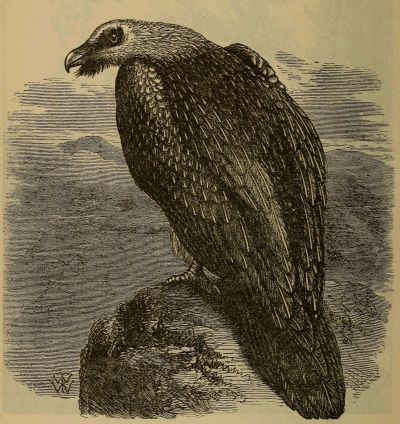
The Lämmergeier belongs to the vultures, but has much more the appearance of an eagle than a vulture, the neck being clothed with feathers, instead of being naked or only covered with down. It may at once be known by the tuft of long, hair-like feathers which depends from the beak, and which has gained for the bird the title of Bearded Vulture. The colour of the plumage is a mixture of different browns and greys, tawny below and beautifully pencilled above, a line of pure white running along the middle of each feather. When young it is nearly black, and indeed has been treated as a separate species under the name of Black Vulture.
It is one of the largest of the flying birds, its length often exceeding four feet, and the expanse of its wings being rather more than ten feet. In consequence of this great spread of wing, it looks when flying like a much larger bird than it really is, and its size has often been variously misstated. Its flight, as may be imagined from the possession of such wings, is equally grand and graceful, and it sweeps through the air with great force, apparently unaccompanied by effort.
The Lämmergeier extends through a very large range of country, and is found throughout many parts of Europe and Asia. It is spread over the Holy Land, never congregating in numbers, like ordinary vultures, but living in pairs, and scarcely any ravine being uninhabited by at least one pair of Lämmergeiers.
The food of the Lämmergeier is, like that of other vultures, the flesh of dead animals, though it does not feed quite in the same manner that they do. When the ordinary vultures have found a carcase they tear it to pieces, and soon remove all the flesh. This having been done, the Lämmergeier comes to the half-picked bones, eats the remaining flesh from them, and finishes by breaking them and eating the marrow. That a bird should be able to break a bone as thick and hard as the thigh-bone of a horse or ox seems rather problematical, but the bird achieves the feat in a simple and effectual manner.
Seizing the bone in its claws, it rises to an immense height in the air, and then, balancing itself over some piece of rock, it lets the bone fall, and sweeps after it with scarce less rapidity than the bone falls. Should the bone be broken by the fall, the bird picks the marrow out of the fragments; and should it have escaped fracture by reason of falling on a soft piece of ground instead of a hard rock, the bird picks it up, and renews the process until it has attained its object. It will be seen, therefore, that the name of Ossifrage, or Bone-breaker, may very properly be given to this bird.
Not only does it extract the marrow from bones in this peculiar manner, but it procures other articles of food by employing precisely the same system. If it sees a tortoise, many of which reptiles are found in the countries which it inhabits, it does not waste time and trouble by trying to peck the shell open, but carries its prey high in the air, drops it on the ground, and so breaks its shell to pieces. Tortoises are often very hard-shelled creatures, and the Lämmergeier has been observed to raise one of them and drop it six or seven times before the stubborn armour would yield. Snakes, too, are killed in a similar manner, being seized by the neck, and then dropped from a height upon rocks or hard ground. The reader may perhaps be aware that the Hooded Crow of England breaks bones and the shells of bivalve molluscs in a similar manner.
Mr. Tristram suggests, with much probability, that the "eagle" which mistook the bald head of the poet Æschylus for a white stone, and killed him by dropping a tortoise upon it, was in all likelihood a Lämmergeier, the bird being a denizen of the same country, and the act of tortoise-dropping being its usual mode of killing those reptiles.
A SUCCESSFUL DEFENCE.
We now see why the Lämmergeier is furnished with such enormous wings, and so great a power of flight, these attributes being needful in order to enable it to lift its prey to a sufficient height. The air, as we all know, becomes more and more attenuated in exact proportion to the height above the earth; and did not the bird possess such great powers of flight, it would not be able to carry a heavy tortoise into the thinner strata of air which are found at the height to which it soars.
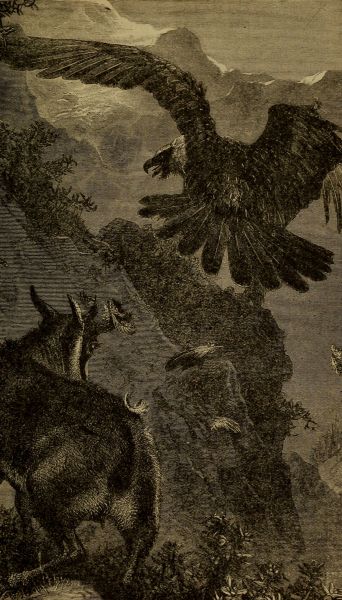
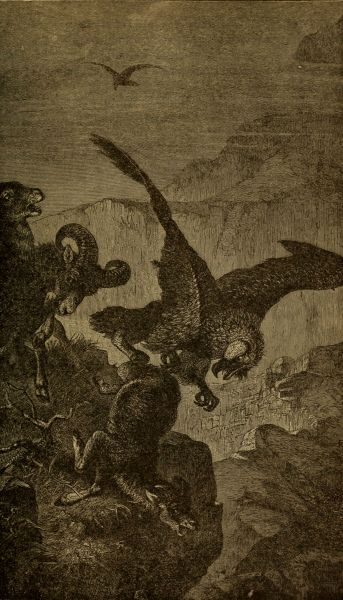
The instinct of killing its prey by a fall is employed against other animals besides snakes and tortoises, though exerted in a somewhat different manner. The bird, as has already been mentioned, lives among mountain ranges, and it may be seen floating about them for hours together, watching each inch of ground in search of prey. Should it see a goat or other inhabitant of the rocks standing near a precipice, the Lämmergeier sweeps rapidly upon it, and with a blow of its wing knocks the animal off the rock into the valley beneath, where it lies helplessly maimed, even if not killed by the fall.
Even hares and lambs are killed in this manner, and it is from the havoc which the Lämmergeier makes among the sheep that it has obtained the name of Lämmergeier, or Lamb-Vulture. So swift and noiseless is the rush of the bird, that an animal which has once been marked by its blood-red eye seldom escapes from the swoop; and even the Alpine hunters, who spend their lives in pursuit of the chamois, have occasionally been put in great jeopardy by the sudden attack of a Lämmergeier, the bird having mistaken their crouching forms for the chamois, and only turned aside at the last moment.
The reason for employing so remarkable a mode of attack is to be found in the structure of the feet, which, although belonging to so large and powerful a bird, are comparatively feeble, and are unable, like those of the eagle, to grasp the living animal in a deadly hold, and to drive the sharp talons into its vitals. They are not well adapted for holding prey, the talons not possessing the hook-like form or the sharp points which characterise those of the eagle. The feet, by the way, are feathered down to the toes. The beak, too, is weak when compared with the rest of the body, and could not perform its work were not the object which it tears previously shattered by the fall from a height.
STRUCK FROM A DIZZY HEIGHT.
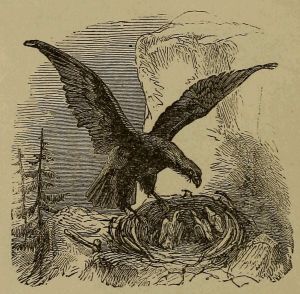
The nest of the Lämmergeier is made of sticks and sods, and is of enormous dimensions. It is almost always placed upon a lofty cliff, and contains about a wagon-load or so of sticks rudely interwoven, and supporting a nearly equal amount of sods and moss.
An allied species lives in Northern Africa, where it is called by a name which signifies Father Longbeard, in allusion to the beard-like tufts of the bill.