WHY I WAS CALLED THE STORY-TELLER
Reading edition
Some time ago the writer of these stories was asked to speak for an Indian Society. She accepted the invitation, and that night made her first Indian friends.
Her new friends told her many beautiful things about the Red Children. The more the writer learned about the Iroquois people, and things Indian, the more interested she became. After a time she began to tell the Paleface the things she had learned.
Soon, one of the tribes, the Senecas—the tribe to which her new friends belonged—heard that she was speaking for them. They wished to honor her, so they asked her to be present at their Green-Corn Feast, and become one of them.
So when the Green-Corn moon hung her horn in the night sky, the writer found the trail to the Land of the Senecas. There the Senecas adopted her into the Snipe clan of their nation. She was called Yeh sen noh wehs—"One who carries and tells the stories."
Thus it was that the writer became one of the Red Children, Yeh sen noh wehs—the Daughter of the Senecas.
The more Yeh sen noh wehs learned of the Red Children, and their simple stories, the more she loved them. One day, Yeh sen noh wehs said she would be the story-teller not only of the Senecas, but of all the tribes of the Iroquois. There are six great families of this people. Each family is called a tribe or nation.
Once, the council fires of these six nations burned from the Hudson on the east, to Lake Erie on the west, and they were a great and powerful people.
It was at the time of the Berry Moon that Yeh sen noh wehs hit the story trail. Since then she has journeyed through all the lands of the Senecas, the Onondagas, the Cayugas, the Oneidas, the Mohawks, and the Tuscaroras.
Like the story-teller of old, Yeh sen noh wehs wandered from lodge to lodge of the Iroquois. "Hanio," she would call, and as the Indians gathered round, she would tell them one of the stories that other Indian friends had told to her.
Sometimes this would remind the Red Children of another story, which Yeh sen noh wehs did not know, and they would tell it to her. It was in this way that these stories have been gathered.
There were many days when Yeh sen noh wehs told her stories, but none were told in return. Few members of the tribes—these usually the oldest—could remember the stories "they used to tell."
Sometimes Yeh sen noh wehs heard a story as she trudged along a furrow, beside a ragged Indian who was plowing with a more ragged-looking team. Or she would listen as she helped an Indian woman prepare the evening meal, pick berries, or gather nuts.
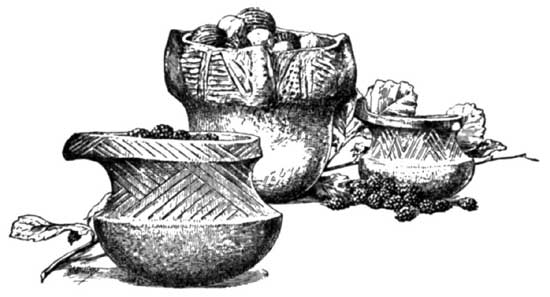
Sometimes, as Yeh sen noh wehs sat by a fire down in the depths of a beautiful wood, and watched the smoke of the sacred medicine rise, a medicine man would tell her a story; or an Indian woman would drop a word, as she sat at her door weaving baskets or making beadwork.
These stories Yeh sen noh wehs has made into a story book, that they might not be lost and forgotten; that all the Iroquois Red Children and their children's children might know and tell them, and that Paleface children might learn them as well.
The American children have no fairies of their own. They must borrow their fairies from children of other nations. Yeh sen noh wehs thought it very sad, so she put a magic feather in her cap, and winged moccasins on her feet. Then she went on the chase for real American wonder stories, and for real American fairies.
Had there not been a feather in the magic cap she wore, Yeh sen noh wehs would not have found them. But the feather pointed the way to the Nature Wonder Trail, and there she caught a glimpse of the "Little People,"—the only true American fairies.