Book 4 — DANCE OF THE NYMPHS
Reading edition
Questions to arouse interest. Of what is this a picture? What time of the year do you think it is? what time of the day? What are the people doing? Half close your eyes and look at the picture. What do you see first? what next? Where is the sun? How do you know? (Look at the trunks of the trees and the shadows.) What do you see in the foreground to the left? to the right? Do you like this scene? why?
Original Picture: Luxembourg Gallery, Paris, France. Artist: Jean Baptiste Camille Corot (k[+o]´r[+o]´´). Birthplace: Paris, France. Dates: Born, 1796; died, 1875.
The story of the picture. The artist who painted this picture, Jean Baptiste Corot, tells us that when he was a small boy he used to lean out of his window at night, long after his mother and father thought him safe in bed, to watch the clouds, the sky, and the trees. He continued this study as a young man, and soon made friends with three other young men, all artists (Rousseau, Daubigny, and Dupré) who were also studying nature. All had studios and painted in the city; but they were always longing for a glimpse of the country. One day the four started out together for a day's outing, each taking his painter's outfit. They went to the end of the omnibus line from Paris and then started on foot for a long tramp across the country. It was then they thought of the great Forest of Fontainebleau, where nature was wild and undisturbed in its wondrous beauty.
"We will go to that beautiful forest and spend our vacation there," they said.
And so it came about several weeks later. In this forest, at all times of the day or night, they could be found wandering about, searching out new vistas and discovering new wonders and beauties in nature.
They hid their paints and brushes in the rocks to keep them from the dew, and they themselves slept under the spreading branches of the great oak trees. These city-bred young men, brought up in the rush and hurry of the great city of Paris, cared for no other shelter than the wide expanse of sky and the protecting branches of the trees.
So when we know that later Corot came to live near this Forest of Fontainebleau, it is easy to guess where he painted this picture called the "Dance of the Nymphs." Sometimes this picture is called "Morning," for Corot painted another picture much like this one, and called it, "The Dance of the Nymphs, Evening."
Corot is often spoken of as the "happy one," and many stories are told of him and how surprising it was to hear him singing lustily as he painted. Seated on his camp stool before his easel, wearing his blue calico blouse and painter's hat, he was indeed happy. He is described as adding the finishing touches to one of his landscapes in this way:
"Let us put that there—tra, la, tra, la,—a little boy,—ding dong, ding dong! Oh, a little boy, he wants a cap—la, la, la, la, tra la!"
People always smiled when they saw Corot start out, carrying his easel, paints, and brushes, and singing or whistling like a care-free boy. But it happened more often that they saw him going toward home in the evening, for he had a way of starting out before sunrise when nobody was about and seating himself in some lovely spot in the woods, waiting breathlessly to see what would happen next.
That is what he did the morning he sketched this picture. The grass was heavy with dew, the birds were still asleep, all was quiet and covered with the veil of night. As the mist slowly lifted, the great trees gradually assumed definite shapes, the birds awoke, the sun shone forth, and all was bright and fresh as the early mornings in spring always are. Look at this picture, then close your eyes and open them slowly, and you yourself can see just such an awakening to life.
Is it any wonder then that, as Corot sat, pencil in hand, this lovely spring morning and watched the trees gradually take shape against the slowly lightening sky, and listened to the birds singing their morning greeting, he should fancy he saw the fairy wood nymphs come out from their secret hiding places and dance joyously about in the bright morning sunlight? It seems most natural indeed that they should be there, and dancing, too. The mere fact of being alive on such a morning as this fills us too with delight.
When Corot began to paint his large picture from the small sketch he made in the woods that morning, he must have sung his merriest tunes. The picture seems full of music, from the quivering leaves, the waving grass, and the shifting clouds to the dancing figures. Although there is not a bird in sight, we know that they are there, and it takes very little imagination to hear them singing.
At the right-hand side of the picture one of the wood nymphs has seized the hand of a timid companion, urging her to come and join in the frolic. So much are we in sympathy with those merry ones that we too find ourselves unconsciously urging her to join in the dance.
When he painted trees, Corot did not pay very great attention to details, and so we cannot always tell what kind of trees they were. He cared most to make us feel the beauty of the sunlight on their tender leaves, their growth, and the protection they offer to birds and men.
A young art student once approached Corot and asked him why he left so many things out of his pictures and put others in. Then pointing to a certain tree in Corot's painting he said, "This tree is not in the landscape." Corot smiled, then whispered to him, "Don't you tell, but I put it there to please the birds."
It would be difficult indeed to find a single straight line in our picture, so full is it of rhythmic curves, from the treetops to the graceful figures in the foreground. The skillful blending of colors, of light and shade, gives it that mysterious, misty quality which is one of its chief charms. Corot's favorite colors were pale green, gray browns, and silvery grays. One little touch of bright color in his pictures makes them alive. The costumes of the nymphs were chosen for the very few bright touches in this painting, and the tall, slender tree near the left-hand side of the picture for the pale green feathery foliage of early spring.
Our eye moves pleasantly through all the leafy maze of this enchanted forest. We are at the edge of the woods. Looking out through the trees we see the wide, open fields beyond, with their high canopy of sky, and we feel a new contentment steal over us as our eye again seeks this sheltered nook in the great Forest of Fontainebleau.
Questions to help the pupil understand the picture. How had the artist, Corot, studied the clouds, sky, and trees? With whom did he become friends? What were these three young artists doing? Where did they go for an outing? What did they take with them? What forest did they decide would be a good place to spend a vacation? How did they live in this forest? What shelter did they have? What nickname did they give Corot? How did he like to paint? How did he dress? What did he do while painting? Where was this picture painted? What is it sometimes called? What time of day did he usually start out to paint? What are the nymphs doing? What did Corot wish to tell us about the trees? What did a young art student once ask Corot? What was the answer? Of what kind of lines is this picture made up? What colors were used? Where are the bright colors? In what part of the forest is this picture? What can you see through the open space?
The story of the artist. From the very first all things seemed to favor Corot. Of a naturally happy disposition, born into a family of means, and all his life free from financial worries, everything seemed to combine to make his life one of care-free ease and pleasure.
His father and mother kept a millinery store; this must have been a good business, for they soon accumulated a comfortable fortune.
At ten years of age Corot was sent away to school at Rouen in the hope of making a business man of him. He lived with a friend of his father who was a serious man but also a great lover of nature. Corot took many a long walk with him over narrow, unfrequented paths. They took these walks usually at the close of the day, and so Corot's love of the twilight hour grew strong.
Upon his return to Paris seven years later, his father placed him in a drygoods store, where he remained for nearly nine years. Whenever there were no customers the boy would hide under the counter and draw. His employer was a good-natured man and he sympathized with Corot in his desire to be a painter. So he told the father it was of no use to try to make a business man of him as his tastes were all for art.
About this time Corot went to his father and asked his permission to study painting. The father was not at all pleased with the idea, but decided to let him try. He told his son he had set aside a certain sum of money to start him in business for himself and he could choose that or a small income which would be allowed him for the study of art. If he chose the latter, however, he must not expect any other help from his father, as he did not approve of this new venture. But Corot embraced his father most affectionately and declared he had made him the happiest person in the world. He then proceeded at once to the nearest store and bought a complete painter's outfit. Choosing a spot by the river near his father's house, he began to paint. He tells us how the girls who worked in the millinery store slipped away and came to see what he was doing. He never parted with this first painting, but kept it as a reminder of his great happiness when he was at last free to do "what he most desired in the world."
He studied under several artists, but received little encouragement until he went to Rome to study.
Most of the paintings of that time were classical, including Greek temples, shepherds, nymphs, or dryads, and such trees as cedars and palms. That is why Millet's simple peasants and Corot's misty landscapes were not appreciated.
At Rome, Corot became a great favorite among the students because of his happy nature and the rollicking, jolly songs he could sing. But as for his pictures,—they were considered very amusing.
However, one day as he sat sketching the Coliseum a friend who was regarded as an authority on landscape painting praised his work. Corot looked around expecting to be laughed at, but no,—the man was in earnest. That evening, before all the other students, he remarked that Corot might some day become the master of them all. This gave him standing among the artists and was greatly appreciated by Corot, who always felt that this praise was the beginning of his success. It was not long after this that his pictures were exhibited and many honors came to him.
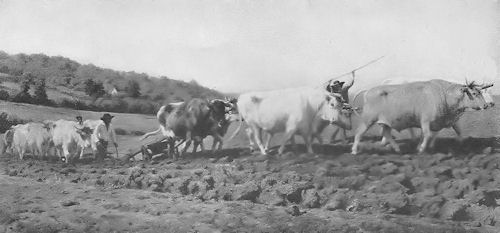
Does it seem strange that Corot and Millet, looking upon the same woods and people, living and painting so near each other, should choose such different subjects? Corot saw the same poor, toilworn peasants, and he helped them most generously when they asked him, but as for painting them—he did not think of it. Millet saw the same beautiful woods, fields, and sky, and loved them all, but to him the peasant came first.
He said, "Corot's pictures are beautiful, but they do not reveal anything new."
Corot said, "Millet's painting is for a new world; I do not feel at home there. I am too much attracted to the old. I see therein great knowledge, air, and depth, but it frightens me; I love better my little music."
In speaking of another artist he said, "He is an eagle; I am only a skylark. I send forth little songs in my gray clouds."
As success came to Corot he was most generous in helping others. Many young artists came to study with him, but he would accept no pay for his instruction and gladly did all he could to encourage and help them.
He did not have the heart to turn a beggar from his door, and often had as many as twenty-five come to him in a day. The story is told of a beggar who demanded a larger sum of money than Corot usually gave, and was refused. After he left, the artist could not paint; his day was spoiled. So he hurriedly ran out after the beggar, gave him the money, and all was well again.
During the siege of Paris he gave both time and money to help the wounded. "Papa Corot," as the people called him, was greatly beloved.
The demand for his paintings increased. He said that when youth left him, honor and fame came to make him still the happiest man in the world.
Questions about the artist. In what ways was Corot favored? What did his father and mother do? What did they hope to make of Corot? Where was he sent? With whom did he live? Where did they walk? How did this influence Corot? Upon his return home, what did he do? What did his employer finally do? What did Corot ask his father? What offer did his father make? What did Corot decide? What did he do at once? Who came to watch him? What became of this first painting? Where did Corot go to study? What subjects did most of the artists of Corot's time choose to paint? What happened that raised Corot in their estimation? Compare the subjects chosen by Corot and Millet. Tell about Corot and the beggar. Why did Corot claim to be the happiest man in the world? Does this picture make you feel happy or sad? why?
OXEN PLOWING