THE MEXICAN WAR.
Reading edition
BATTLE OF PALO ALTO.
In the course of the year 1845, the government of the United States ordered General Taylor, with about three thousand men, to take possession of the country lying between the Nueces and the Rio Grande, which country was the subject of dispute between the governments of Mexico and Texas. General Taylor reached the Rio Grande, in April, 1846. Now, the Mexican government looked upon this movement as a trespass upon their territory, and therefore declared war. Leaving a small force to occupy Fort Polk, opposite Matamoras, General Taylor, with the main body of his army, marched to Point Isabel, at the mouth of the Rio Grande. Soon after, he heard that the Mexicans had commenced to bombard Fort Polk, and that General Arista, with a large body of troops, had crossed the river. There was great difference in the strength of the two armies, but General Taylor was a very determined man, and he said he would go and relieve Fort Polk, and fight whoever opposed him. He started on the morning of the 7th of May, and about two o’clock the next day, encountered the Mexicans at Palo Alto. A dreadful battle was then fought. The Mexicans were much more numerous than the Americans, but the Americans were braver soldiers, and they had some fine guns, which could be quickly moved to any part of the field. While conducting the movement of these guns, Major Ringgold, a very brave and skilful officer, was shot through both thighs and fell to the ground. To add to his sufferings, his horse fell on him. He was taken off the field, and died, after enduring great pains for two or three days. The battle was chiefly fought with the artillery. But at one time, about one thousand Mexican lancers moved forward to attack the Americans. This splendid looking body of cavalry, however, was driven back by the dreadful fire from the American guns, and the whole Mexican army retreated. General Taylor and his brave soldiers slept upon the field of battle.
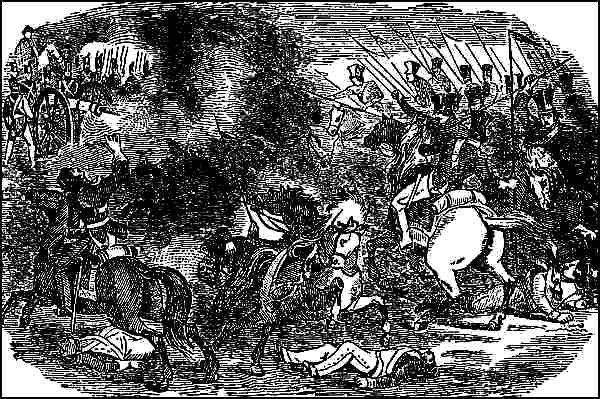
REPULSE OF CAVALRY.
MAY’S CHARGE.
BATTLE OF RESACA DE LA PALMA.
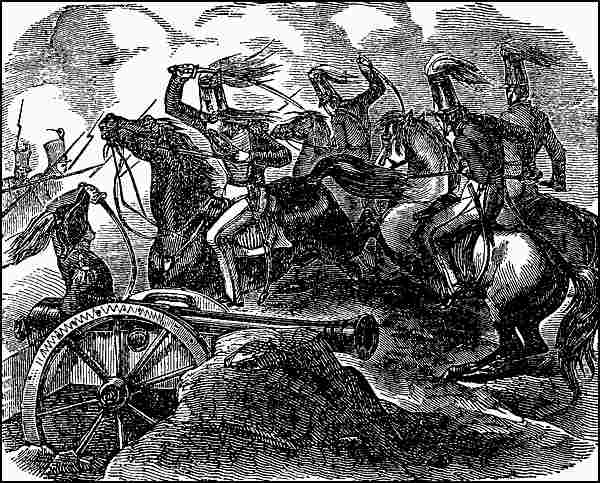
The next day after the battle of Palo Alto, General Taylor moved forward towards Fort Polk. He could hear the sound of the bombardment, and he was anxious to relieve the small garrison he had left in the fort. He soon came up with the Mexicans again. They had received more troops and had taken a strong position. It was a place called Resaca de la Palma, or the Palm Ravine. General Taylor did not hesitate to attack them. He and his men were confident that they could beat many times their number of Mexicans. The victory at Palo Alto had assured them of a victory wherever they should meet a foe. The flying artillery was brought into service and poured quick and murderous discharges into the Mexican ranks. Then Captain May, with his dragoons charged down the ravine, through the bushes, and over the guns of the enemy, cutting down all who came within reach of their sabres. General La Vega fell into their hands. The Mexicans continued the fight even after they had lost their cannon, but the Americans soon cleared the field at the point of the bayonet, and then pushed on to Fort Polk.
SIEGE OF MONTEREY.
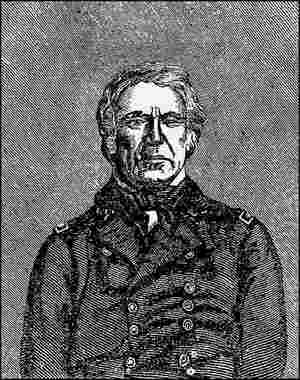
GENERAL TAYLOR.
SIEGE OF MONTEREY.
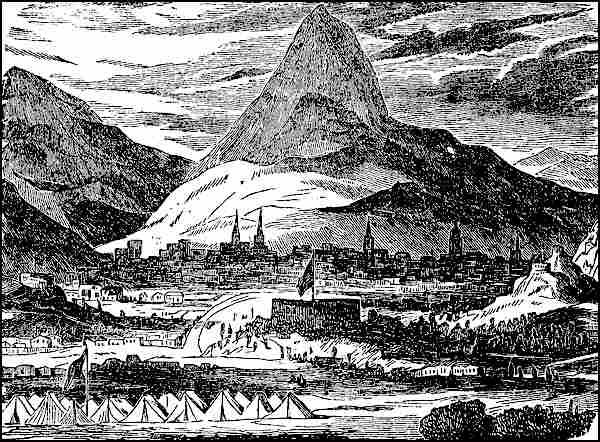
After General Taylor had taken possession of Matamoras, he waited for reinforcements and then moved forward to attack Monterey. This city was very strongly fortified by nature and art. The Saddle mountains extended on three sides of it, while the other side was protected by a high wall and strong works. Besides every house was so constructed of stone as to be looked upon as a fortification. General Ampudia, with about eleven thousand men formed its garrison. General Taylor’s army only numbered six thousand men, yet he advanced, and commenced the siege on the 21st of September. The Americans displayed the greatest bravery in the various attacks, and at the close of the first day of the siege, had taken the Bishop’s Palace and other strong outworks. The next day was employed by the Americans in preparing for another grand attack. On the 23d they assaulted the city on two sides, and their batteries made terrible havoc among the Mexicans. The Texan rangers cut their way through the houses with pickaxes, and the fighting in the streets became dreadful and destructive. The Mexicans were collected in the heart of the city, and to that point the Americans advanced. Night put an end to the fighting, and the next morning, the Mexican general proposed to surrender the city. Officers from both sides met and agreed to certain terms. Then the Mexican army marched out of the city, and the Americans entered and took possession of it. So it seemed that nothing could stop the progress of General Taylor and his men.
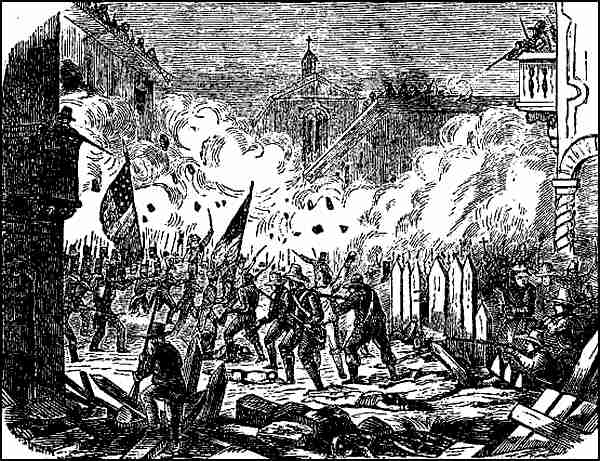
STREET FIGHT AT MONTEREY.
BATTLE OF BUENA VISTA.
The Mexicans, though beaten so often, did not lose their spirits. Their great general, Santa Anna, soon collected an army of more than twenty thousand men, and advanced towards Monterey. Now General Taylor’s army was much reduced in numbers, and the most of his troops were volunteers, who had never been in battle. But he resolved to await the attack of the great Mexican army at a place called Buena Vista. On the 22d of February, Santa Anna appeared and attacked the Americans; but was repulsed. The great battle was fought on the next day. It commenced early in the morning, and continued until night put an end to the work of death. The Mexicans almost overwhelmed the little army under General Taylor; but each man fought like a hero, and every attack of the enemy was repulsed. Captain Bragg gave them plenty of grape-shot. Three times during the day, was the American army saved by the skill and effect with which the artillery was managed. At length night came, and the exhausted troops sank down on the field. The next morning, the Mexican army had retreated and could not be found. General Taylor had therefore gained a victory over an army more than four times as large as his own.
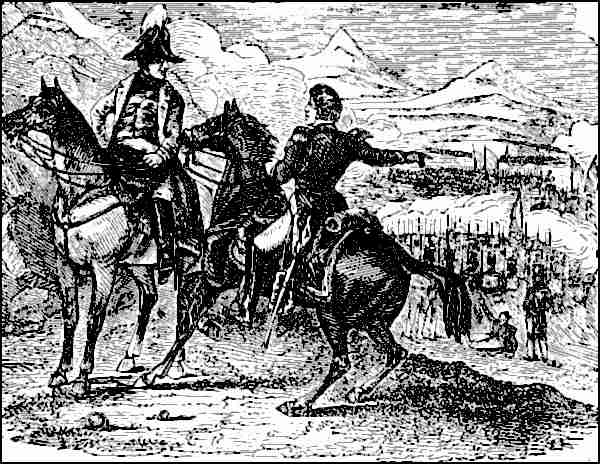
BRAGG, ASKING SUCCOR.
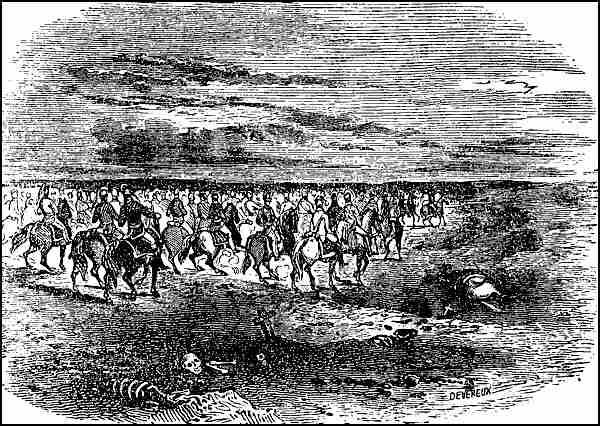
DONIPHAN CROSSING THE DESERT OF DEATH.
DONIPHAN’S MARCH.
The Americans, under the command of General Kearney, having taken possession of New Mexico, Colonel Doniphan with a regiment of mounted riflemen, was ordered to march to Chihuahua, and join General Wool. The country between Santa Fe and Chihuahua was very little known, and therefore when Colonel Doniphan set out he did not expect to encounter the toils and dangers he afterwards met. A vast and dreary desert was to be traversed, and a hostile people to be dealt with. Colonel Doniphan began his march on the 17th of December, 1846, and soon after reached the tract of country called by the Mexicans the “desert of death,” where the bones of murdered men and famished animals were strewn along the road, and where not a drop of water nor a blade of grass met the eyes of the traveller. After passing through this desert, the troops reached Bracito, where they repulsed an attack made by the Mexicans. Doniphan was reinforced soon after, and marched for Chihuahua. Near that place he again defeated the enemy. He remained six weeks at Chihuahua, and seeing nothing of General Wool, marched to meet General Taylor.
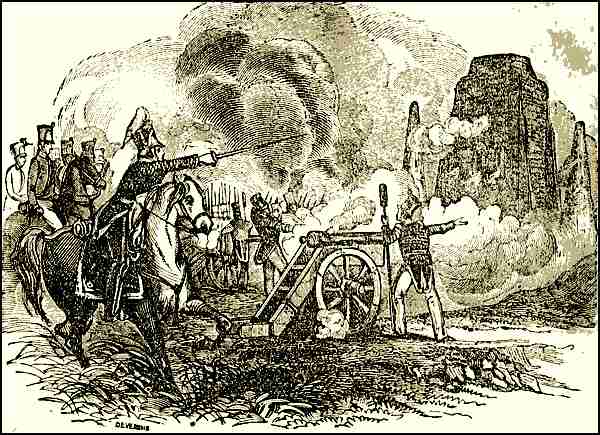
GENERAL PRICE AT TAOS.
CAPTURE OF TAOS.
After Colonel Doniphan left Santa Fe, the Mexicans rose and killed Governor Bent and five other Americans. Other murders followed. The Mexicans collected a large army, and strongly fortified a village called Pueblo de Taos. Colonel Price, with four hundred and fifty men, after defeating a portion of the enemy, marched to attack Pueblo de Taos, on the 4th of February. The greater part of the enemy were posted in a stone church. Against this church, Colonel Price brought his guns to play, but could not reduce it. An assault was repulsed. But ladders being planted, the troops cut small holes with their axes and threw fire into the church. A breach was then made in its walls, and a storming party plunged through it to attack the enemy, who then fled. The Americans pursued and killed all they overtook. About one hundred and fifty Mexicans were killed. The next day, the survivors sued for mercy, and the insurrection was at an end.
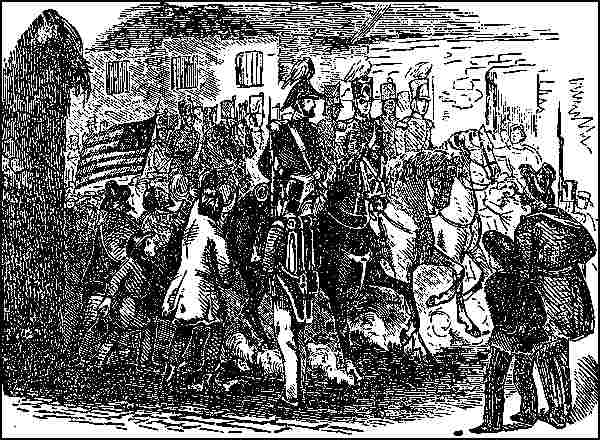
TRIUMPHAL ENTRY INTO PUEBLO DE LOS ANGELOS.
CONQUEST OF CALIFORNIA.
Upon the breaking out of the war with Mexico, orders were sent to Commodore Sloat, who commanded the squadron of United States vessels in the Pacific, to take possession of all the ports of Upper California. This was done, the people making but little resistance. Colonel Fremont, the famous explorer of the far-west, then hoisted the flag of the United States at Sonoma, a town in the northern part of California. The Mexican governor fled. Colonel Fremont with one hundred and fifty men, then hurried to join his force with that of Commodore Stockton, who had taken command of the squadron. On the 13th of August, 1846, the united forces entered the capital of California—Pueblo de los Angelos. Thus the conquest of this valuable country was complete. The people seemed to be very well satisfied with their conquerors. Commodore Stockton issued a proclamation, announcing that he took possession of the territory by authority of the government of the United States, and offering security and protection to all who submit to that authority.
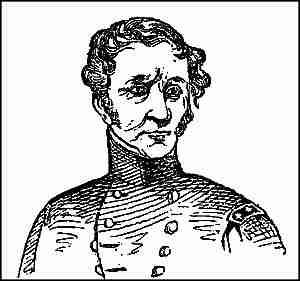
MAJOR-GENERAL WINFIELD SCOTT.
SIEGE OF VERA CRUZ.
After the capture of Monterey, as the Mexicans did not seem disposed for peace, the government of the United States determined to prosecute a more decisive campaign. A large army was collected at Anton Lizardo, and Major-General Winfield Scott took command of it. A land and naval attack upon the city of Vera Cruz and the Castle of San Juan Ulloa was fixed upon as the first object. The fleet, under Commodore Conner, transported the army to a landing place selected by General Scott, and the landing was effected on the 9th of March, 1847. Four thousand five hundred men were thrown upon the shore at once, the Mexicans making no resistance. Very soon the rest of the army was landed, and then they formed a great line around the city. Then the great guns were brought ashore and a brisk fire opened by the besiegers. The Mexicans returned the fire from the city and castle. While the soldiers were doing this, a few small steam vessels sailed up near to the castle and commenced firing upon it. This was a bold exploit, and if the Mexicans had been equal to the Americans in gunnery, they would have made the vessels pay for the boldness of their commanders. A tremendous fire of cannon balls and bomb-shells was kept up by the naval and land forces until the morning of the 26th of March, when the inhabitants, who had suffered much, compelled the governor to surrender the city and castle to General Scott. Commissioners were appointed by the commanders of both armies, as is usual in such cases, and terms of capitulation agreed upon. The Mexican troops were to march out of the city, lay down their arms, and then march for the interior, being prisoners of war on parole, and the city and castle, with all their artillery and ammunition and public stores were to be given up to the United States troops.
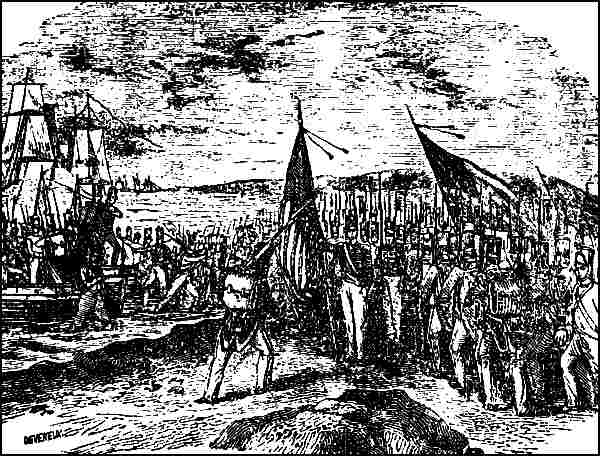
LANDING OF THE TROOPS.
After the capitulation, General Worth was appointed military governor of the city, and the troops had a short rest from the constant exertions of the siege. During this siege, General Scott lost very few men; but the enemy suffered a great deal. So that this fine city and strong castle did not cost the captors much, while it gave them an entrance to the great road leading to the city of Mexico.
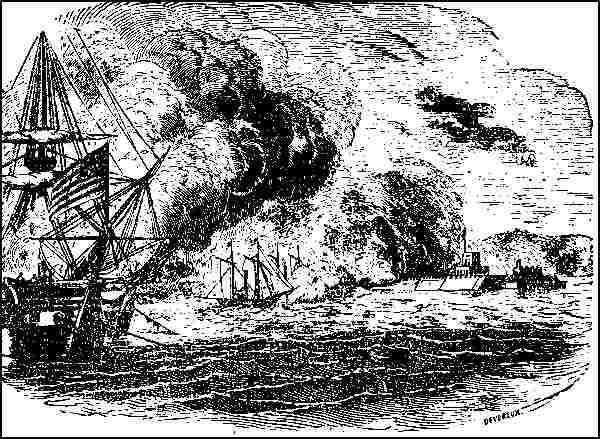
THE MOSQUITO FLEET AT VERA CRUZ.
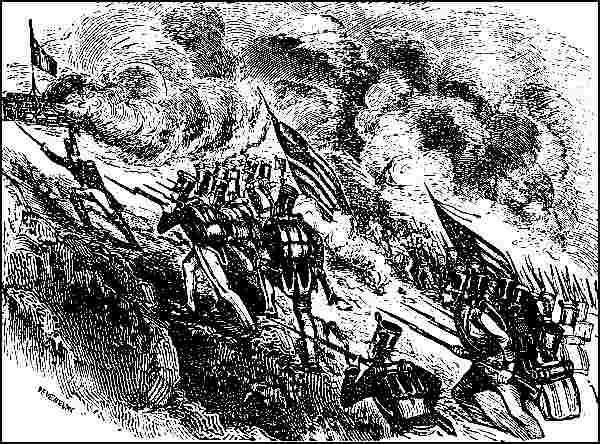
BATTLE OF CERRO GORDO.
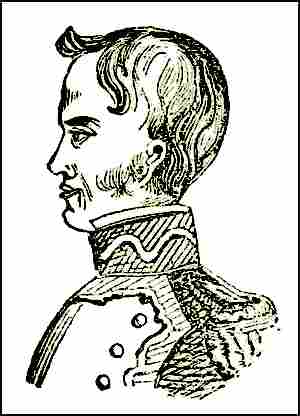
GENERAL SANTA ANNA.
BATTLE OF CERRO GORDO.
On the 8th of April, the van of General Scott’s army began its march from Vera Cruz, for the interior of Mexico. The troops met with no opposition until they approached a rocky pass called Cerro Gordo. This place, which was very strong by nature, had been carefully fortified by the Mexicans, under General Santa Anna. They thought that General Scott’s men were not brave enough to venture to attack such a strong position, defended by about fifteen thousand well furnished and disciplined troops. But General Scott soon formed his plan of attack, and on the 17th of April, ordered his divisions to take their appointed positions. The next morning, the troops advanced to the attack, under an awful fire from the Mexican batteries. Colonel Harney, with a brigade of troops, rushed up the height of Cerro Gordo, on which the principal battery was erected, and after a short struggle, drove the enemy from their works. By two o’clock in the afternoon the victory was complete. Five generals, many other officers, three thousand soldiers, forty-three pieces of cannon, and a great quantity of small arms were taken. Santa Anna, with the remnant of his army, fled towards the city of Mexico, pursued by General Worth. Great numbers of the Mexicans fell in the conflict and pursuit. General Scott lost about two hundred and fifty men. Among the prisoners was the brave General La Vega, who had been captured before at Resaca de la Palma. If all the Mexican generals had been equal to La Vega, General Scott would have had much harder fighting at Cerro Gordo.
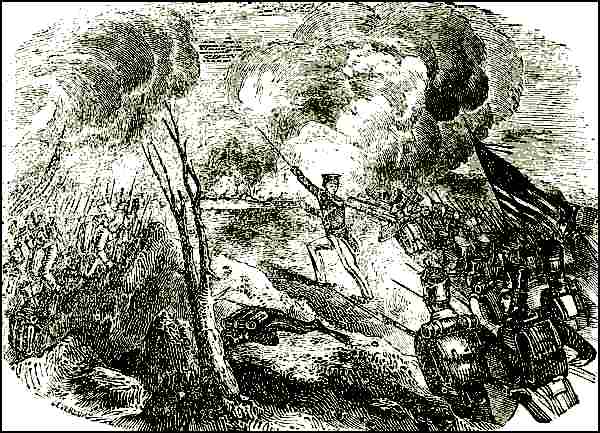
RILEY’S CHARGE AT CONTRERAS.
STORMING OF CONTRERAS.
The defeat of the Mexicans at Cerro Gordo opened the road for the United States troops as far as the city of Puebla, at which place General Scott was compelled to halt to refresh his men, and wait for reinforcements. On the 7th of August, he began his march for the capital. General Santa Anna had fortified nearly every available place to check General Scott’s progress, and it was necessary that some of the strong positions should be taken before he could proceed. One of these was Contreras, defended by General Valencia, with a great body of troops and twenty-two cannon. A detachment from General Scott’s army attacked this place on the 19th of August, but could not withstand the tremendous fire of the enemy. The next morning, the detachment, which was commanded by General Smith, having gained a road in the rear of the works, advanced to the assault. Colonel Riley headed the storming party, rushed up to the works under a heavy fire, and after a short struggle captured the cannon and drove the enemy before him. General Shields cut off the retreat, and whole companies were forced to surrender. Thus another complete triumph was gained by the Americans.
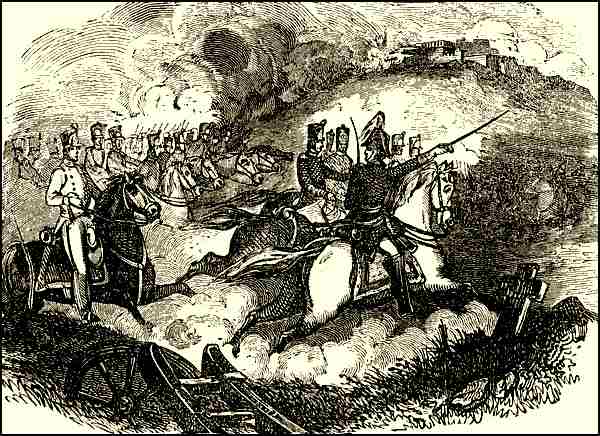
SHIELD’S CHARGE AT CHURUBUSCO.
STORMING OF CHURUBUSCO.
By the capture of Contreras, the Mexicans were forced to concentrate at Churubusco, which was still more strongly fortified than Contreras. General Scott brought his whole army to the attack upon Churubusco, and never did men behave with more valor and heroism. The fire of the Mexicans was tremendous, and the Americans suffered much from it. But post after post was carried, and the enemy found that their superior numbers could not withstand the onset. General Worth stormed the bridge, which was the strongest part of the works, while General Twiggs brought his artillery to bear on a convent, which, however, held out until General Twiggs was reinforced, when it surrendered. In the meantime, General Shields, with two brigades, encountered about four thousand Mexican infantry, whose flanks were protected by three thousand cavalry, and after a severe struggle defeated them. The enemy were routed in every part of the field, and pursued nearly to the gates of Mexico. This was the most glorious day’s work the American army had yet performed.
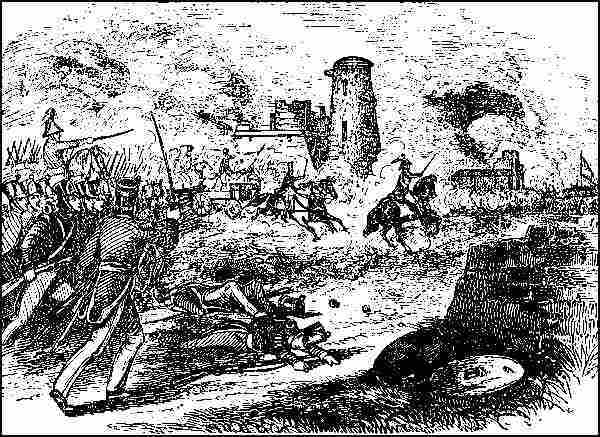
BATTLE OF MOLINO DEL REY.
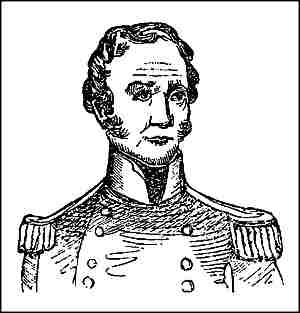
GENERAL SCOTT.
CAPTURE OF MOLINO DEL REY.
Santa Anna saved the capital from immediate assault after the battle of Churubusco, by procuring an armistice for peace negotiations. His real object was to gain time to prepare munitions of war and strengthen the defences of the city. General Scott discovered this, and put an end to the armistice. He then resolved to attempt the capture of Molino del Rey, a strongly fortified and garrisoned foundry. General Worth, with three thousand one hundred and fifty men, was detached for this service. General Worth was ignorant of the great strength of the works, but he made skilful disposition and was determined to succeed. There were three assaulting columns. The first was to assail Molino del Rey, covered by the fire of some heavy artillery. The centre was to consist of five hundred picked men, commanded by Major Wright. The third column was commanded by Colonel M’Intosh, and consisted of the second brigade, supported by Duncan’s artillery. A strong body of troops were held in reserve. On the morning of the 8th of September, the columns advanced to the assault, a tremendous fire from the batteries having shaken the walls of the enemy’s works. The central position was carried after a bloody struggle, in which Major Wright and one half his force were either killed or wounded. The Mexicans had masked batteries, which the Americans could not see till they were within range of them. On the right of the field, the assailants were completely successful, carrying the works, and slaughtering the enemy without mercy. On the left Duncan kept up a heavy fire upon the stone foundry, called Casa Mata. The assault was here repulsed; but Duncan’s artillery restored the fortune of the contest, and compelled the Mexicans to evacuate the foundry, even while they were playing triumphant music for victory. Thus General Worth was victorious in every part of the field, and the enemy were in flight. But the victory was purchased by the loss of one half of the division. The loss of the Mexicans in killed, wounded and prisoners was immense.
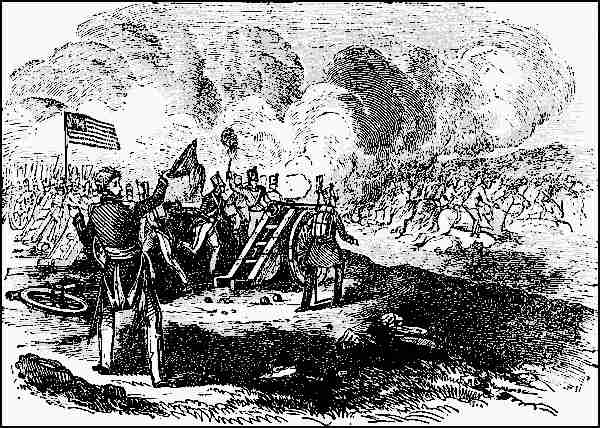
DUNCAN, AT MOLINO DEL REY.
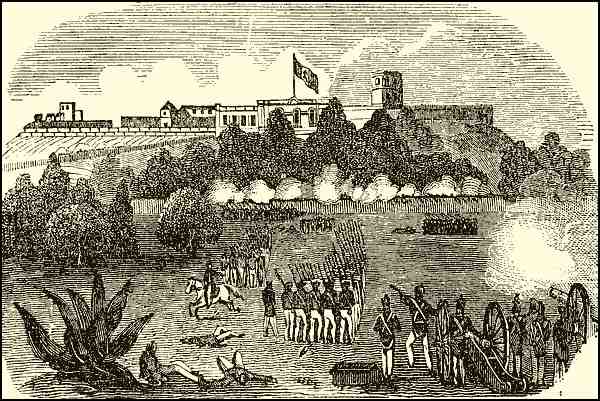
CANNONADE AND BOMBARDMENT OF CHAPULTEPEC.
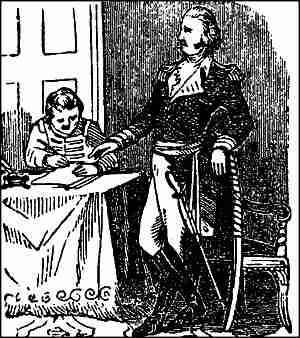
STORMING OF CHAPULTEPEC.
By the capture of Molino del Rey, and the adjacent works, the castle of Chapultepec was exposed to attack upon two sides, and General Scott hastened to form his plan for the storming of it and the gates of the capital. On the 12th of September, the batteries opened upon the castle, and with such effect that Santa Anna was prevented from throwing reinforcements into it. The Mexicans returned the fire, but as they were not equal to the Americans in gunnery, they did very little damage. On the 13th, the assault was made. General Quitman, with one division, advanced upon the northeast side, while General Pillow, with another division, assailed the height on the west. The castle was garrisoned by picked troops, well supplied with artillery, and commanded by the veteran, General Bravo. A determined defence was therefore expected, and the Americans nerved themselves for it. Pillow’s troops dashed up the rocky height amid a heavy and destructive fire from the enemy, and so rapid was the assault that the Mexicans were driven from post to post, until they had no chance to fire their mines. General Pillow fell, severely wounded, and General Cadwalader assumed the command of his division. Ladders were prepared, the walls of the castle mounted, and the American flag planted upon them. In the meantime, General Quitman advanced upon the opposite side, defeated a large detachment of the enemy, and forced his way up the height, with a rapidity and valor equal to that of the other division. A portion of his troops arrived in time to storm the walls, and enter side by side with Pillow’s troops. The Mexicans fought bravely, even after the Americans had entered the fort. Few of them asked for quarter, and fewer obtained it; as the victors were exasperated at the cruelties of the Mexicans at Molino del Rey. A great many prisoners were taken, and among others, General Bravo. Thus this fine castle, which the Mexicans had looked upon as impregnable, fell into the hands of the troops, whose progress no obstacle could check.
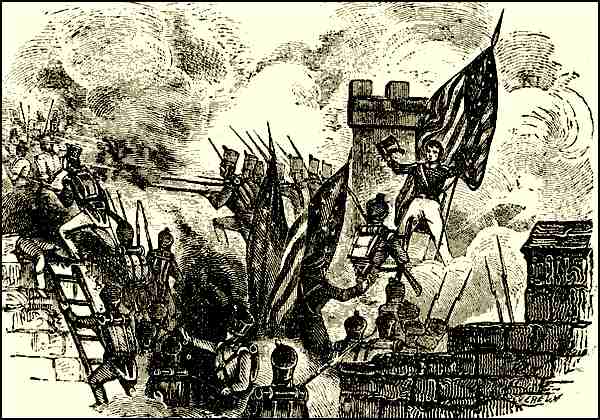
STORMING OF CHAPULTEPEC.
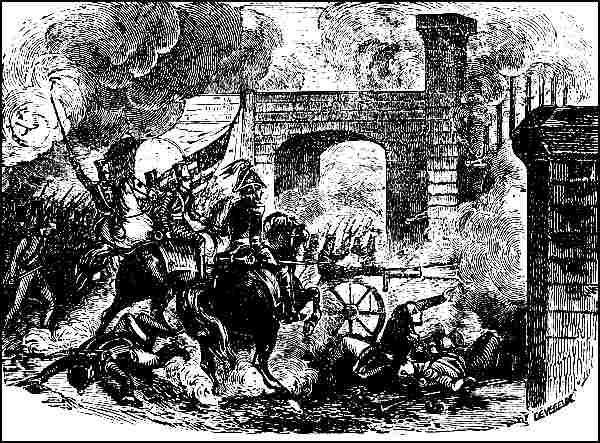
QUITMAN, AT THE BELEN GATE.
CAPTURE OF THE CITY OF MEXICO.
The Americans now advanced to attack the strong defences of the capital. By General Scott’s plan, General Twiggs kept up a heavy fire upon the southern part of the city, to divert the attention of the enemy, while General Worth advanced to attack the San Cosmo gate, and General Quitman the Belen gate. The troops of these divisions were exposed to a tremendous and destructive fire from batteries placed along the roads and at the gates. But the men now seemed insensible to danger, and pressed on with a valor that never was surpassed. Many valuable officers fell at their head, and this excited a spirit of revenge among the troops, which led them to give but little quarter to the enemy. By night-fall, both gates were carried, and the conquerors had gained a foothold in the city. The next morning, while General Scott was preparing to complete the work, the government surrendered. The Mexican army had fled from the city. On the 14th of September, the Americans entered Mexico in triumph.
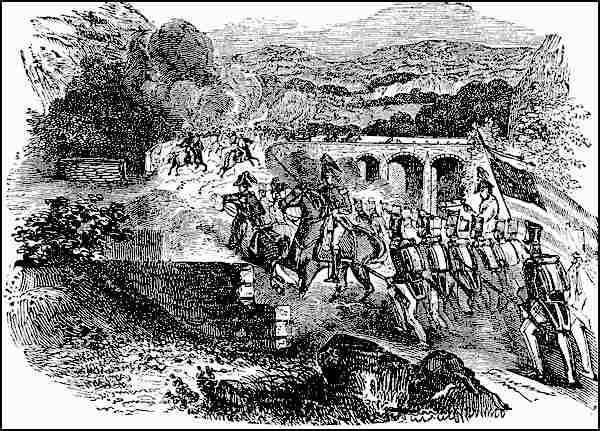
ATTACK AT THE NATIONAL BRIDGE.
DEFEAT OF THE MEXICANS AT THE NATIONAL BRIDGE.
The first affair in which General Cadwalader distinguished himself in Mexico was a skirmish at the National Bridge, during his march to join Scott at Puebla. Colonel M’Intosh had started with a train for the interior; but being attacked by an overpowering force of the enemy, had been forced to await the arrival of Cadwalader, who, hearing of his danger, hurried up, with eight hundred men to his succor. On approaching the National Bridge, Cadwalader, at the head of the united forces, seized some heights which the enemy had previously occupied. He was here attacked by a strong force, but made good his defence, charging the Mexicans incessantly, until their strength was broken, when the bridge was passed in safety. In this action the foe lost one hundred in killed and wounded: Cadwalader about fifty. This victory was won principally by artillery, a species of force with which Cadwalader was perfectly familiar.
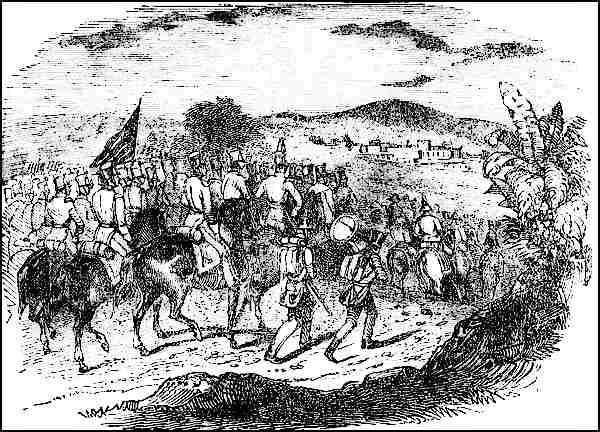
GENERAL PIERCE, ENTERING PUEBLA.
GENERAL PIERCE.
General Franklin Pierce was among the bravest of the brave who fought during the Mexican war. He took command of a reinforcement of twenty-four hundred men, at Vera Cruz, shortly after the battle of Cerro Gordo, and set out to join General Scott, who was waiting at the city of Puebla for more troops. At the National Bridge, he was attacked by a large body of Mexicans, and narrowly escaped being killed, a ball passing through his hat. He succeeded, however, in defeating the enemy, and inflicting upon them a heavy loss in men. He then pushed on, and met with no interruption till he arrived at Puebla. After his arrival, the commander-in-chief completed his arrangements and set out for the capital. In the first attack upon Contreras, General Pierce was wounded in the knee, while leading his brigade against the enemy. But he kept the field until midnight. The next day he joined the brigade, and pressed forward among the most heroic. He had dismounted to leap a ditch, forgetting his wound, when he fainted and fell directly in the line of the enemy’s fire. His escape from death was a miracle.
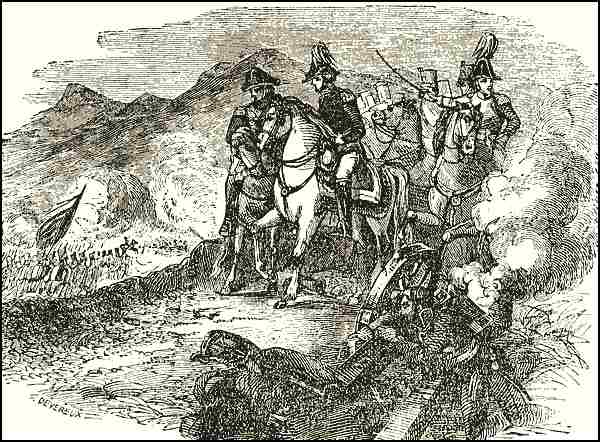
GENERAL LANE, AT ATLIXCO.
BATTLE OF ATLIXCO.
Early in October, 1847, General Joseph Lane, with about two thousand five hundred men, and five pieces of artillery, marched from Vera Cruz to reinforce the army of General Scott. Near a town called Huamantla, he encountered and defeated a large body of Mexican troops, who attempted to check his progress. Pressing forward, he met parties of Mexicans along the road several miles from Atlixco. A running fight ensued, in which the American cavalry was chiefly engaged. At length the Mexican detachments were driven into the town. Night came on, and General Lane posted his artillery on a hill near the city, and opened a heavy, well-aimed, and very rapid fire. After firing for three quarters of an hour, the batteries of the enemy were silenced; and a portion of General Lane’s troops were ordered to advance cautiously into the town. They were met by the authorities, who entreated that the town might be spared. This victory completely broke up the guerilla bands in the vicinity of Atlixco.
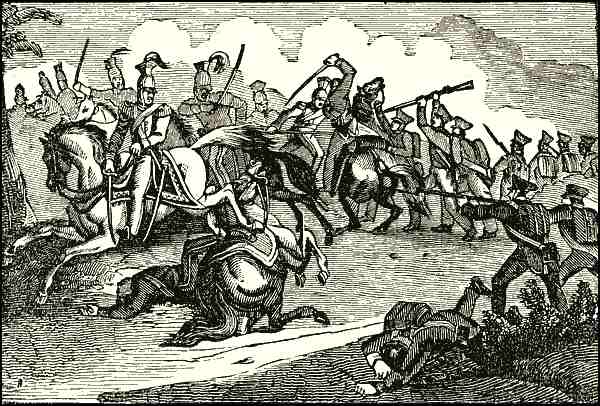
BATTLE OF BRACITO.
BATTLE OF BRACITO.
We have already given a slight outline of the famous expedition of Colonel Doniphan. We will now notice some of the exploits of his little army.
The battle of Bracito was the first engagement fought by the mounted troops, under the command of Colonel Doniphan. It occurred on Christmas day, 1847. Colonel Doniphan’s men had marched to within a short distance of the town of El Paso, and had encamped near a bend in the Bracito river. The Mexicans, in great force, came upon them, while they were in search of wood and water. A quick rally was made, and the Americans drew up on foot to receive the charge of the enemy’s cavalry. The Mexicans displayed a black flag, with skull and cross-bones worked upon it, and said they would give no quarter nor ask it. A heavy shower of balls from the rifles of the Americans caused the cavalry to wheel and retreat in confusion. A small party of the Americans then rushed up to the enemy’s line, and captured their cannon, dragging it into the American line. This daring and desperate act completely astonished the Mexicans, and they soon after made a hurried retreat, having lost about two hundred men. Colonel Doniphan lost very few men.
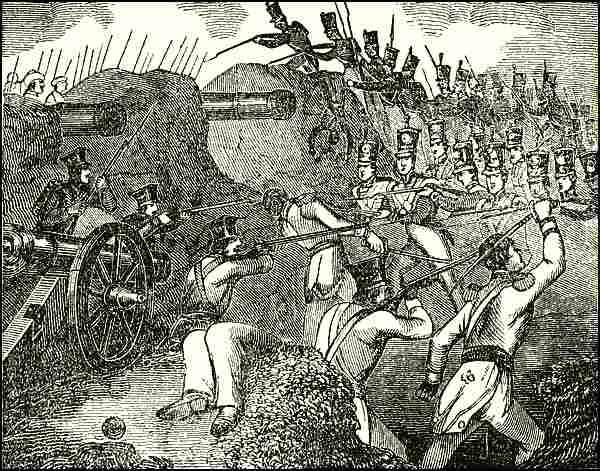
BATTLE OF SACRAMENTO.
BATTLE OF SACRAMENTO.
Colonel Doniphan’s force was increased to a thousand men, with four pieces of artillery, soon after his arrival at El Paso. Continuing his march towards Chihuahua, he reached the valley of the Sacramento. The Mexicans had taken a strong position on the banks of the Sacramento, and it was well fortified. Colonel Doniphan saw that the only chance of fighting them at all upon even ground was to get possession of the high tableland between the Seco and Sacramento rivers. Accordingly a small force was directed to advance for that purpose. This gallant band stormed the intrenchments and gained the tableland, where the whole American army was drawn up for battle. The Mexicans opened a heavy fire, and it was returned with more effect by Captain Weightman’s artillery. Then the troops were ordered to storm the works. A gallant charge was made, amid a tremendous fire, and, after a three hour’s fight, the enemy were completely defeated. The Mexicans lost about three hundred men, ten pieces of artillery, and a large quantity of ammunition. This battle was justly considered one of the most brilliant that was fought during the war. It raised the fame of Colonel Doniphan and his brave band of warriors to a very high point in public esteem.
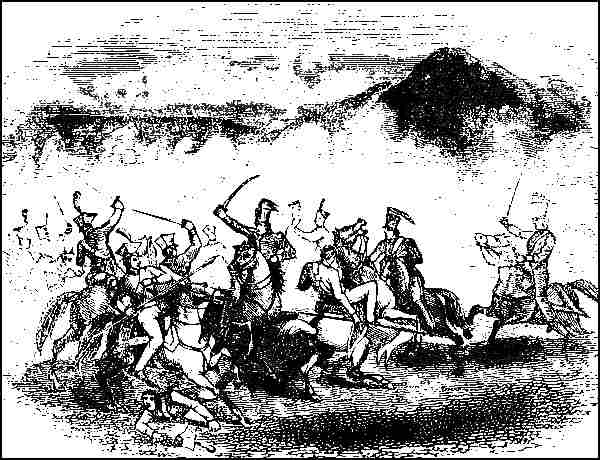
BATTLE OF PASQUAL.
BATTLE OF SAN PASQUAL.
Soon after the Americans took possession of New Mexico, General Kearney, with only one hundred dragoons for an escort, began a march through an unknown and hostile country for Upper California. On the 5th of December, having reached the frontier settlements of that territory, he was met by Captain Gillespie, with a party of riflemen, who had been sent out to give him information of an insurrection that had occurred in California. Captain Gillespie informed General Kearney that an armed party of Californians was encamped at San Pasqual, and the general immediately resolved to attack them. At daybreak, on the 6th of December, he encountered the enemy, and a well-fought action ensued. The California lancers committed some havoc among the Americans, but a furious charge from the dragoons compelled them to retreat. The fight, however, was renewed, when the enemy saw the small force that pursued them, and they were not completely defeated until about one-third of the Americans were killed or wounded. The loss of the Californians was also heavy. The subsequent junction of Commodore Stockton and his brave band of sailors with the force of General Kearney, decided the conquest of California.
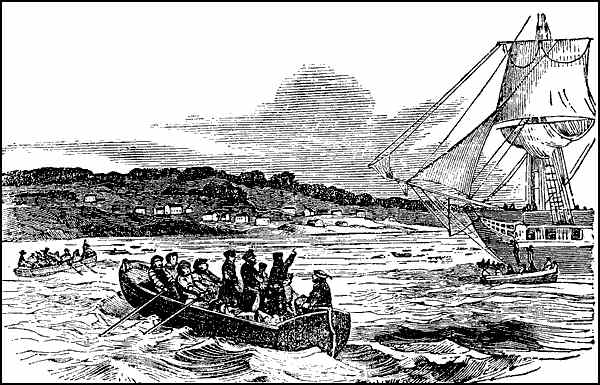
SIEGE OF MONTEREY.
CAPTURE OF MONTEREY, IN UPPER CALIFORNIA.
In June, 1846, Commodore Sloat having received information that the Mexicans had crossed the Rio Grande, determined to take possession of the principal ports of Upper California. He sailed to Monterey in the frigate Savannah, and was there joined by the Cyanne and Levant, vessels of war. Having examined the defences of the small town, and completed the arrangements for capturing it, the commodore sent Captain Mervine to demand its surrender. The Mexican commandant replied that he was not authorized to surrender the town, and referred Commodore Sloat to Governor Castro. Captain Mervine then landed two hundred and fifty seamen and marines, hoisted the star-spangled banner amid cheers from the troops and bystanders, and a national salute from the squadron. Commodore Sloat then issued a proclamation, announcing that war existed between the United States and Mexico, and the arms of the United States would be carried throughout California. The conquest was subsequently completed as just related, by the great exertions of Commodore Stockton, who succeeded Sloat, and landed men from his fleet, marched to the relief of Kearney, fought pitched battles with the enemy, and never left the affair until the conquest of the country was fully effected.
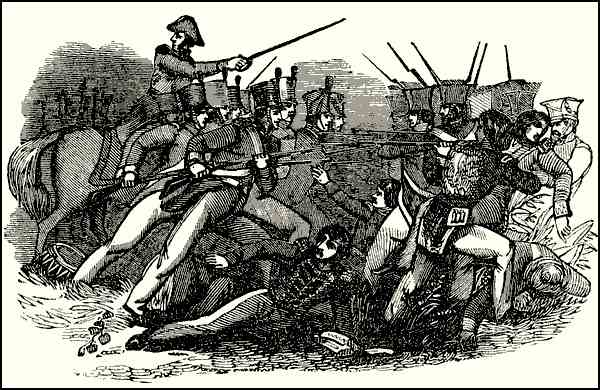
BATTLE OF SAN GABRIEL.
BATTLE OF SAN GABRIEL.
General Kearney with his small, and almost worn-out force, reached San Diego just in time to join Commodore Stockton in carrying out a plan for reducing the Californians to submission. On the 29th of December, the little army, consisting of about six hundred men—the greater part of them being seamen, started from San Diego, to march toward Puebla de los Angelos, the capital and chief city of California. They had proceeded about one hundred and ten miles toward the Rio San Gabriel, when they found about six hundred mounted men, with four pieces of artillery, drawn up to dispute the passage of the river. On the 8th of January, 1847, the necessary arrangements having been made, the Americans waded across the river, reserved their fire until they reached the opposite bank, repelled a charge of the enemy, and then charged them in gallant style. After an action of an hour and a half, the enemy were driven from the field, on which the conquerors encamped for the night. The loss of the Californians was severe.
This battle, fought by the seamen and marines of Commodore Stockton, is justly regarded as one of the most extraordinary exploits of the whole Mexican war, which, as we have seen, abounded in all sorts of romantic and heroic achievements.
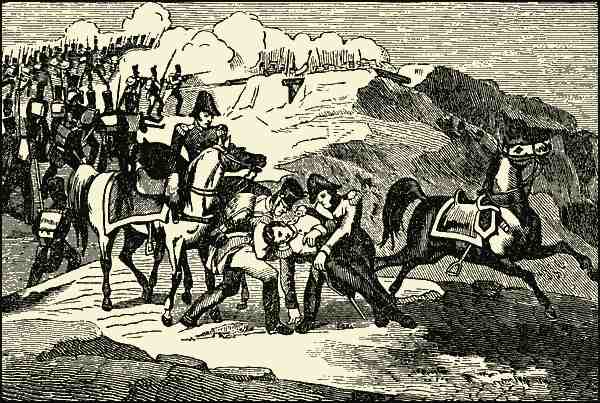
GENERAL SHIELDS AT CERRO GORDO.
GENERAL SHIELDS AT CERRO GORDO.
General James Shields distinguished himself in several battles during the Mexican war, and was severely wounded upon two occasions. In the great battle of Cerro Gordo, General Shields, with his brigade of volunteers, was directed to storm the height west of the principal battery of the Mexicans, which commanded the Jalapa road. The order was promptly and bravely executed. The volunteers advanced up the height with all the steadiness and courage of veterans, and carrying the height drove the enemy along the Jalapa road. As General Shields was advancing with his men, he was shot through the lungs. This paralyzed him, and he was carried off the field. The wound was at first thought to be mortal, but it happily proved to be otherwise. The general recovered and joined the army in time to share in the glory of the battles of Contreras, Churubusco, and the Garitas of Mexico.
General Shields is something more than a mere warrior. After the conclusion of the war, we find him assisting in the deliberation of the highest legislative body in the country, the senate of the United States. He is not a native of our country, but like the brave General Montgomery, who fell at the storming of Quebec, he is one of our adopted citizens. He was born in Ireland.
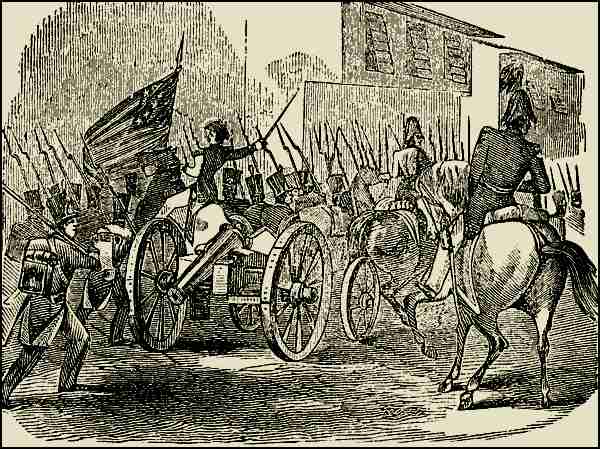
GENERAL SCOTT, ENTERING THE CITY OF MEXICO.
THE AMERICAN ARMY IN THE CAPITAL.
After the flag of the United States had been planted upon the National Palace of the capital, by General Quitman, General Scott, with the main army, entered the city. The officers were dressed in full uniform, the military bands poured forth the “Star-Spangled Banner,” and “Hail Columbia,” and every thing was arranged in such a manner as to gratify the toil-worn, but triumphant troops.
The Mexicans were now disposed to listen to the overtures of peace made by the commissioner, Mr. N. P. Trist. They appointed commissioners, who met Mr. Trist, at Guadalupe Hidalgo. After considerable discussion, a treaty of peace was agreed upon, by which New Mexico, Upper California, and the territory between the Nueces and Rio Grande were ceded to the United States. This treaty was ratified by the two governments, and in the spring of 1848, the American army evacuated Mexico.
The Mexican war thus brought to a close forms one of the most brilliant epochs in the military history of our country. It was signalized by astonishing displays of bravery and military skill; and added to our union, several states, among which is California, the richest gold region in the world.