Front matter (continued 2)
Reading edition
The scene on the landing of the lifeboat at Folkestone baffles description. Thousands of people had assembled at the harbour, and as soon as the boat appeared, cheer after cheer was raised, and rescuers and rescued were quickly brought ashore. The former received the hearty congratulations of everyone. The latter appeared too exhausted to bear the excitement of the moment, so they were at once conducted to a place where they received the care they needed after their exposure to the wind and waves.
Next morning the crew wrote a letter of thanks to all who had taken part in their rescue, in the following terms, touching in their simplicity,--
"We desire to tender our heartfelt gratitude for the way in which we have been rescued and cared for by the crew of the lifeboat, and the others who assisted in our rescue."
At noon a special service of thanksgiving was held in the parish church, Folkestone, and as the men bad lost all their belongings, a collection was made on their behalf.
CHAPTER XIV.
THE STRANDING OF THE "EIDER."
n the night of Sunday the 31st of January 1892, the North-German Lloyd liner Eider, bound from New York to Southampton, stranded on a reef of rocks off the Isle of Wight. A dense fog prevailed at the time, and a very rough sea was running. Signal rockets were immediately sent up, and about eleven o'clock the Atherfield lifeboat proceeded to her assistance. There was no immediate danger to the passengers and crew, so the captain decided to telegraph for steam tugs. The telegrams were accordingly handed into the lifeboat, and she returned to the shore to send them off.

At daylight next morning signals were made by the Eider, and the lifeboat again went out, and found that the captain wished to land some of the mails, and they were therefore brought ashore. Meanwhile news of the stranding of the steamer had been sent to the lifeboat stations at Brighstone Grange and Brooke, and these lifeboats at once put off and made for the scene of the disaster with all speed. The captain of the Eider then decided that it would be best to land the passengers, and during the day the lifeboats made altogether eighteen trips to the ship, and safely landed two hundred and thirty-three passengers, besides specie and mails. Darkness, however, came on and put an end to the work.
The next day eleven journeys were performed by the lifeboats, and one hundred and forty-six people were brought to land without accident. During Wednesday and Thursday the boats were engaged in bringing ashore bars of silver, specie, the ship's plate, and passengers' luggage. Forty-one journeys in all were made by the gallant lifeboatmen, who worked hard and nobly, and rescued three hundred and seventy-nine persons. The captain and several of the crew remained on board, and the vessel was eventually towed off the rocks and safely berthed in Southampton docks.
In recognition of the devotion to duty and self-sacrifice shown by the lifeboatmen in the work of rescue, the Emperor of Germany presented each of the coxswains of the three lifeboats with a gold watch bearing His Majesty's portrait and initials. The institution also awarded the second-service clasp to the coxswain of the Atherfield lifeboat, the silver medal to the coxswain of the Brighstone Grange lifeboat, and the third-service clasp to the coxswain of the Brooke lifeboat.
We reproduce the following poem on the stranding of the Eider, by special permission, from The Star:--
The Eider rode on the open sea
With her safety in God's own hand
For a thousand miles--ay, two, and three,
With never a sight of land.
A shell of steel on the world of waves
That severs the hemispheres,
That covers the depths of a thousand graves
And the wrecks of a hundred years.
She bore, unhurt, through the storm-god's din,
Through shower, and shade, and sheen,
With the death without and her lives within,
And her inch of steel between.
From the port behind, to the port beyond,
With never a help or guide,
Save the needle's point and the chart he conned,
The master has fought the tide.
On the bridge, in the Sunday twilight dim,
He has taken his watchful stand;
And he hears the sound of a German hymn,
And the boom of a brazen band.
He looks for the lights of the royal isle,
Ahead, to left, and to right;
Below there is music and mirthful smile,
For land must be soon in sight.
In sight? Not yet! for a fog creeps round
And the night is doubly dark.
"Slow speed! Hush! is it the fog-bell's sound,
Or the shriek of the siren? Hark!"
The fog-bell clangs from its seaward tower,
And the siren shrills in fear;
But the vapours thicken from hour to hour,
And the master cannot hear!
On the seaward headland, the beacon's blaze
Like a midday sun would seem,
But its warning rays are lost in the haze,
And the master sees no gleam!
"How goes the line? There is time to save!"
"It is ten fathom deep by the log."
"We have not tarried for wind or wave,
We cannot wait for the fog."
On, on! through the dark of a double night;
On, on--to the lurking rock!
No sound, no gleam of a saving light
Till the Eider leaps to the shock.
All night she bides where the sea death hides,
And her passengers crowd her deck;
While the leaping tides laugh over her sides
And sink from the stranded wreck.
The Eider has gold, she has human lives;
But these can assist no more.
Pray, pray, ye German children and wives,
For help from the English shore!
A signal is sent, and a signal is seen,
And a lifeboat--ay, two, and three,
From the shore to the vessel their crews row between,
And fight with the stormy sea.
They fight day and night, as true Englishmen can,
'Mid the roar of the storm-lash'd waves;
And the Eider's four hundred are saved to a man
From the terror of sea-bed graves.
The Eider bides, all broken and bent;
With the tide she shivers and starts,
And stands--for a time--as a monument
Of the courage of English hearts.
But longer lasting, the memoried grace
Of a noble deed and grand
Will knit the hearts of the English race
To the hearts of the Fatherland!
CHAPTER XV.
THE WRECK OF THE "NORTHERN BELLE."
uring a dreadful storm which swept over the British Isles several years ago, the American ship Northern Belle, from New York to London, came to anchor off Kingsgate, near Broadstairs, about a mile from the shore. The sea made great breaches over her, and, in order to lighten the vessel and help her to ride out the storm, the crew cut away two of the masts. With the flood-tide, however, the gale increased, and it was feared that the vessel would drag her anchors and come ashore. A swift-footed messenger was accordingly despatched to summon the Broadstairs lifeboat.

Without delay the crew were mustered, and the boat, on her carriage, was dragged overland to Kingsgate, a distance of two miles. It was nine o'clock when the Mary White arrived, and by that time the cliffs were lined with crowds of people. Shortly afterwards two luggers were seen bearing down upon the unfortunate vessel. One of these crafts, when trying to take out one of the ship's anchors, was overwhelmed by a heavy sea, and sank. Not one of her crew of nine men were ever seen again. The other was more successful, and five of her crew managed to get on board the Northern Belle. Every moment the multitude of spectators expected to see the vessel run ashore and be dashed to pieces on the rocks at the foot of the cliff; but as the day wore on and the anchors still held, it was thought that she would yet be safe. Heedless of the heavy snow and bitter cold, the people watched her till darkness came on and shut out the vessel from their gaze.
THEY BENT THEIR BACKS TO THE OARS.
About midnight, the long-expected catastrophe took place, the cable broke and the vessel was driven on the rocks. In the storm and darkness it would have been worse than useless to launch the lifeboat, so the men were reluctantly compelled to put off the rescue till a new day should give them sufficient light to see what they were doing. Next morning, about seven o'clock, the remains of the ill-fated ship could be seen, and lashed to the only remaining mast were the figures of twenty-three perishing sailors. What they must have suffered in the cold and darkness of that terrible night may be imagined, but it cannot be described.
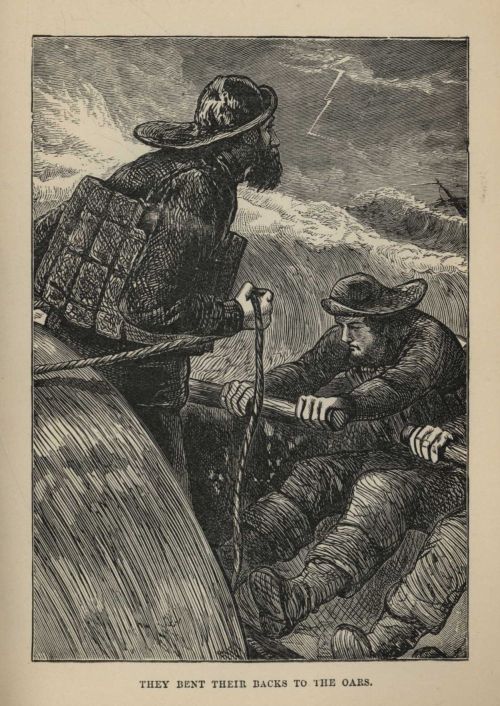
The lifeboat was dragged down to the water's edge, and the crew got into their places. The coxswain stood up in the stern, grasping the yoke lines, and watching for a favourable moment to put off. The faces of the men were grave, for they knew the terrific struggle that was before them, and, with such a high sea running, who knew if they would come back again? The coxswain gave the word, and the boat was pushed off into the raging surf. The boatmen bent their backs and made headway in spite of the storm. Over and over again they were lost to sight, and those on shore were filled with fear for their safety, but the good boat breasted each wave gallantly, and quickly drew near to the wreck.
Great difficulty was experienced in getting alongside, and in the struggle the bow of the lifeboat was badly damaged, but at last the boat was made fast. The poor sailors were so benumbed by their long exposure to cold that they were almost helpless, and this made the task of the boatmen still more difficult. At length, after tremendous exertions, they succeeded in taking off seven of the crew. On account of the broken condition of the boat and the high sea, it was not judged prudent to take more, so she was cut adrift from the wreck and returned to the shore with her precious burden.
Fearing that an accident might happen to the Mary White and disable her for further service, a second lifeboat had been brought over from Broadstairs. She was now launched, and made for the wreck, from which she shortly afterwards returned with fourteen men. Only two sailors now remained on board, the aged captain and the pilot. The former stubbornly refused to leave his ship, declaring that he would rather be drowned; and the latter said that he was not going to leave the old man to perish by himself.
The coxswain allowed two hours to pass, expecting that the captain would change his mind and signal for them to come and take him off; but when he showed no signs of yielding, he called the men together and launched the lifeboat. After a stiff pull they reached the wreck, and tried to persuade the captain to save himself, but he remained obstinate. Then the men declared that they would remain by the wreck as long as she held together, even if they waited a week. The coxswain pointed out to the captain that he was not only throwing his own life away for no good reason, but that he was also endangering the lives of those in the boat, and he told him that it was his duty to save himself. At length he was persuaded of the folly of his action, and came down from the rigging. The pilot, whose chivalrous feelings alone had kept him in this perilous position, also gladly entered the saving boat.
Great were the rejoicings on the beach when it became known that the whole crew had now been rescued. The shipwrecked men were taken to a house near at hand, but they were so exhausted that they were unable to eat.
Shortly afterwards three horses were harnessed to the transporting carriage of the Mary White, and she was taken back to Broadstairs. As she approached the town, the people came out to meet her, and with cheers loud and long welcomed the heroes home.
An eye-witness of the rescue says: "The lifeboatmen were not labouring under any species of excitement when they engaged in the perilous duty, which they performed so nobly and so well. Under the impression that these men would never return,--the impression of all who witnessed their departure from the shore,--I watched their countenances closely. There was nothing approaching bravado in their looks, nothing to give a spectator any idea that they were about to engage in a matter of life or death, to themselves and the crew of the ship clinging to the fore-rigging of the Northern Belle. They had no hope of a decoration or of a pecuniary reward when, with a coolness of manner and a calmness of mind which contrasted strongly with the energy of their movements, they bounded into the lifeboat to storm batteries of billows far more appalling to the human mind than batteries surmounted by cannon and bristling with bayonets. There could be no question about the heroism of these men."
CHAPTER XVI.
A GALLANT RESCUE.
hortly after daybreak, on the 4th January 1894, the lookout on the pier at Clacton-on-Sea saw a vessel strike on the Buxey Sand, about six miles from the shore. Without a moment's delay the warning was given, the lifeboat, Albert Edward, was manned and launched. There was need of the utmost speed. A strong easterly gale was raging at the time, accompanied by a nipping frost and blinding snowstorm. Owing to the extreme cold, it was feared that the shipwrecked crew would be unable to hold on till help arrived.

When the lifeboat reached the distressed vessel, it was found to be impossible to get alongside, so the coxswain ordered the anchor to be let go to windward. This was done, and the boat veered down to the full length of her cable. The waves continually broke over the vessel, and caused her to bump upon the sand in a frightful manner, thus preventing the lifeboat from approaching her. Under these circumstances, the boatmen decided to haul in the cable, and to drop the anchor nearer the vessel. This was a work of no little difficulty, and was rendered on this occasion highly dangerous by the anchor having fouled something on the sand. They tugged and strained for some time, but all to no purpose, and they were at last compelled to cut the rope. The sail was then set, and the lifeboat proceeded to the leeside of the ship.
There everything was in a terrible muddle, for the masts and rigging, which hung over the bulwarks, swayed about, threatening death to anyone who ventured within their reach. The sea was running too high to permit the men to board the ship, but by ebb-tide the coxswain thought that the sea would become smoother, and thus enable him to rescue the men at less risk. The crew of the vessel were nearly frozen to death, and it seemed as if they could not hold out much longer. The coxswain made signs to the poor fellows to fasten a buoy to a line, and slack it away from the ship towards the lifeboat. His signs were understood and promptly obeyed, but unfortunately the line caught in the rigging alongside and stuck fast.
The resources of the lifeboatmen were not yet exhausted. Sailing as close as possible to the vessel, they threw out a grappling line, which luckily caught on, and the boat was held. The coxswain shouted to the sailors to make another rope fast, but they paid no heed to his order. No sooner did they perceive that the boat was fixed than they began to crawl along the mast. Only one man had been taken on board, when a heavy sea swept down upon the lifeboat. The rope which fastened her to the wreck was not strong enough to bear the strain, and once more the Albert Edward was driven from the ship.
Canvas was again set to windward for about half an hour, and then the boat was headed for the wreck. The tide was now on the ebb, and less difficulty was experienced in getting a hold on the ship. One by one the poor fellows were taken on board the lifeboat, till only the captain remained. He was an old man, and so exhausted by suffering that he was unable to jump for the boat. A line was therefore thrown to him which he fastened round his waist, and the coxswain went to assist him over the rail of the ship. Just as he was in the act of performing this humane service he was knocked overboard by a sudden lurch. As he struggled in the water, he received a severe blow on the head and a wound across the eye from pieces of floating wreckage. His case was desperate, but he did not lose his presence of mind for a moment. Seizing hold of the rope which was made fast round the captain, he managed to keep himself afloat till his companions rescued him from his perilous position. Nothing daunted, he then made further efforts to save the captain, who was at length hauled through the surf and lifted on board in safety.
Just as this was accomplished, a heavy sea snapped the rope, and the lifeboat left the wreck, having on board the whole crew of seven men. In getting off the sands, on her homeward journey, the boat was frequently smothered by the heavy seas, and several of the men were badly hurt by being dashed against the side. At length, after a long, toilsome struggle, the harbour was reached, the lifeboat and her crew being covered with ice. In spite of the severity of the weather, a number of people were on the pier to give the heroes a hearty reception. The shipwrecked men, who were completely exhausted, were supplied with food and put to bed to recover from the effects of their exposure and fatigue. Their vessel was the St. Alexine of Copenhagen, bound for Stranraer with deals.
CHAPTER XVII.
A BUSY DAY.
n the early morning of the 7th of November 1890, while one of the severest storms known for years on the coast of Lancashire was at its height, signal flares were observed about three miles out at sea. A gun was fired to arouse the lifeboatmen, and in a few minutes the Fleetwood boat was launched and hurrying on her errand of mercy in the wake of a steam-tug. It was almost dark at the time, and the two vessels were quickly lost to view. The news rapidly spread that the lifeboat had been summoned, and soon a number of people were making their way to the beach in the hope of catching a sight of the distressed vessel.
It was not until seven o'clock that the hull of a large barque loomed in sight to those on shore, and it was then evident that but for the gallant services of the lifeboatmen all on board would be lost. Having got well to windward, the tow-rope was let go, and the boat drifted gradually down to the wreck. Here lay the real danger, and it required all the seamanship of the coxswain to prevent the boat from being dashed against the side of the ill-fated vessel, or swept past the mark by the force of the sea. When within a short distance, the boat was brought to an anchor, and veered down on her cable close to the wreck, which was found to be the Labora, a Norwegian ship.
The work of rescue was promptly begun, and as it was found to be utterly impossible for the lifeboat to approach near enough to take the men off, the coxswain shouted to the sailors to throw him a line. A lifebuoy was accordingly thrown overboard with a rope attached, and floated to the boat. Communication having been thus established, the crew were dragged through the surf in safety. The work of rescue lasted above two hours, and the boat was repeatedly filled with water, so that the fact that not a single life was lost reflects great credit on the seamanship of the coxswain and his men. The whole crew of the Labora, thirteen in number, were taken on board, the captain being the last man to leave the ship.
Sail was then hoisted on the lifeboat, and she made for the shore with all speed. Notwithstanding the gale and the driving rain, hundreds of spectators had assembled along the beach to await the return of the boat. When at length she appeared, she was greeted with shouts of joy, and landed the rescued crew amid a perfect salvo of cheering.
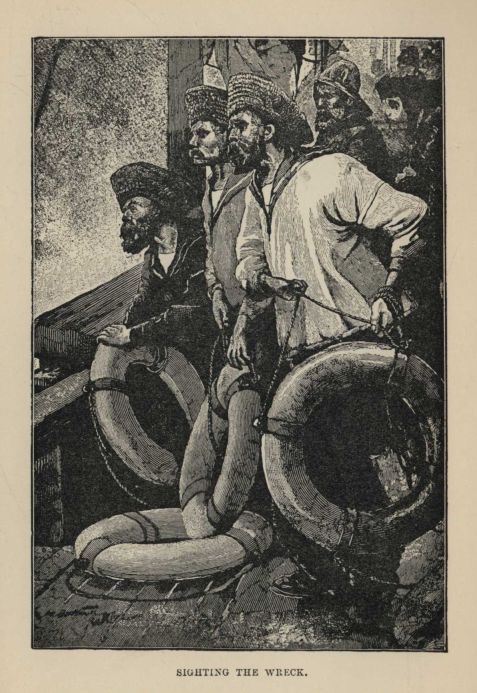
A few hours later, news of another wreck was brought to Fleetwood. Utterly regardless of their rough experience in the early morning, the crew again donned their lifebelts and manned the lifeboat. As they were towed out by the steamer, a magnificent sight was witnessed, the waves dashing furiously over the boat as she ploughed her way through the water, and both vessels were often completely hidden from sight by the seas breaking over them.
SIGHTING THE WRECK.
Regardless of the drenching they received, they held resolutely on their way, and soon the distance of five miles which intervened between them and the wreck was covered. The crew hailed the approach of the saving boat with loud cheers, but great difficulty was experienced in effecting the rescue, as all the masts and rigging were dashing about alongside the ship. To avoid the wreckage striking the lifeboat, and at the same time to get sufficiently near for the sailors to jump aboard, required great skill and judgment, as well as a cool head and a steady nerve.
Owing to the position in which the stranded vessel was lying, every sea broke over her, and threatened to swamp the lifeboat. Eventually the whole crew of eleven men were rescued, and the lifeboat was headed for the shore, where the crew were landed in a most exhausted condition. But for the brave efforts and untiring exertions of the lifeboatmen, the crews of both of those vessels would have been lost, and well might the noble fellows congratulate themselves on having within a few short hours saved twenty-four of their fellow-men from death.
CHAPTER XVIII.
A RESCUE IN MID-OCEAN.
t is a common belief at the present day that our sailors are no longer the same bold, kind-hearted fellows that they were before the introduction of steam and other modern improvements. From time to time, however, a brief account of some splendid act of heroic daring, performed on the high seas, finds its way into the newspapers, and proves that, after all, Jack is of the same race as the men who, in bygone days, won for England the proud title of "Mistress of the Seas."
Recently, while the Cunard steamer Parthia was crossing the Atlantic from America to England, her passengers had an opportunity of witnessing a genuine feat of derring-do of the old heroic kind. It was a Sunday afternoon, and for some hours the barometer had been steadily falling, a sure sign of a coming gale. Overhead the blue sky was dotted with white clouds, but away to the south and west the heavens were of a dull leaden colour.
About four o'clock, true to the indications it had given, the storm burst. The fury of the wind raised a tremendous sea, and after running for a time, it was judged prudent to bring the Parthia head on to the waves. All the passengers were ordered below lest they should be washed overboard, and the hatches were securely battened down to prevent the cabins being flooded. Every now and again the crew on deck were waist deep in water, as the steamer dipped her bows into the sea and took great surging waves on board.
For six hours the vessel lay-to, and during all that time the tempest raged with undiminished fury. The wind screamed and whistled mournfully through the rigging, and the mountainous waves dashed themselves with tremendous force against the sides of the ship, throwing the spray as high as the masthead At ten o'clock the gale moderated, and the steamer once more resumed her voyage. The night passed without further incident, and when the sun rose next morning out of the heaving waters it gave promise of a fair day.
Meanwhile a far different scene was being enacted on the angry ocean some miles away. A sailing ship was being tossed about like a plaything. One by one her sails were blown to ribbons, her planks sprung a-leak under the continued pounding of the waves, and as the vessel slowly settled down the crew gave themselves up for lost. As the water-logged hull tumbled about in the trough of the sea, they expected that she would go down every moment, but day broke and found them still afloat, looking for help in every direction and finding none. Assistance was, however, at hand.
All this time the Parthia had been steadily steaming on her homeward voyage. About nine o'clock in the morning the look-out man reported that a vessel was in sight. As the steamer approached, it became apparent to all on board that the ship was in distress. She lay low in the water, her rigging was all in a tangle, and upon the deck twenty-two wretched, pale-faced men could be counted, watching the steamer with wistful gaze. All these had to be saved, and every man on board the Parthia knew that this could only be done at the risk of the lives of those who went to their assistance, for a heavy sea was still running.
Few things are more perilous and difficult than lowering a boat during a storm in mid-ocean. The most seamen-like smartness may fail to save the frail fabric from being dashed to pieces against the iron side of the vessel, and even if the boat succeeds in getting away, the utmost skill is necessary to prevent her from being upset. Everyone of the Parthia's crew knew the danger, but not one of them shrank from the duty which faced them.
"Volunteers for the wreck!" shouted the captain, and in response to his summons eight men sprang forward and scrambled into the lifeboat. The third officer stepped into the stern, and took the rudder lines in his hands. Every man sat silent and ready while the boat swung from the davits. Calmly the order was given to lower, and the boat sank swiftly down to the water. As she rose on the crest of the next wave, the blocks were unhooked, and in another moment she was making for the wreck.
The passengers who thronged the deck of the Parthia watched the lifeboat in an agony of excitement. Now she disappeared as completely as if she had gone to the bottom; then she rose on the crest of a mighty billow, where she poised for an instant before taking the headlong plunge into the watery abyss beyond. A short struggle brought the boat within reach of the doomed vessel, and the mate shouted to the crew to heave him a line. It was caught, a lifebuoy was attached to it, and it was hauled on board the wreck. To the lifebuoy was tied a second line, one end of which was held by the lifeboat crew. The meaning of these arrangements soon became apparent. One of the shipwrecked sailors slipped his shoulders through the lifebuoy, plunged into the sea, and was dragged into the lifeboat. One by one the sailors were hauled on board, till eleven had been rescued. Then, with a cheering shout to those who were left behind, the boat returned to the steamer.
Meanwhile the captain of the Parthia had been busy making all the necessary preparations for taking the shipwrecked men on board. A rope with a loop at the end was suspended from the foreyard arm, and under this the lifeboat was stationed. The rope was then passed down, and the loop slipped under the arms of one of the men, who was then hoisted on board by the sailors.
When the first boatload had been safely deposited on the deck of the steamer, the lifeboat returned to the wreck. By means of the lifebuoys and lines the remainder of the crew were taken off, and afterwards hoisted on board the steamer in the same way as their companions. Her work having been accomplished, the lifeboat was hauled in, and the Parthia went "full speed ahead," to make up for lost time.
An eye-witness of this perilous and gallant rescue says:--
"To appreciate the pathos and pluck of an adventure of this kind, one must have served as a spectator or actor in some such scene. The expression on the faces of those shipwrecked men, as they were hoisted one by one over the Parthia's side; the bewildered rolling of their eyes, their expression of suffering, slowly yielding to the perception of the new lease of life mercifully accorded them, graciously and nobly earned for them; their streaming garments, their hair clotted like seaweed on their foreheads; the passionate pressing forward of the crew and passengers to rejoice with the poor fellows on their salvation from one of the most lamentable dooms to which the sea can sentence, will ever be vividly imprinted on the minds of those who witnessed the occurrence."
CHAPTER XIX.
THE "THREE BELLS."
aptain Leighton, of the British ship Three Bells, some years ago rescued the crew of an American vessel sinking in mid-ocean. Unable to take them off in the storm and darkness, he kept by them until morning, running down often during the night, as near to them as he dared, and shouting to them through his trumpet, "Never fear! hold on! I'll stand by you!"
Beneath the low-hung night-cloud
That raked her splintering mast,
The good ship settled slowly,
The cruel leak gained fast.
Over the awful ocean
Her signal guns pealed out.
Dear God! was that Thy answer
From the horror round about?
A voice came down the wild wind,
"Ho! ship ahoy!" its cry:
"Our stout Three Bells of Glasgow
Shall stand till daylight by!"
Hour after hour crept slowly,
Yet on the heaving swells
Tossed up and down the ship-lights,
The lights of the Three Bells.
And ship to ship made signals,
Man answered back to man,
While oft to cheer and hearten
The Three Bells nearer ran.
And the captain from her taffrail
Sent down his hopeful cry,
"Take heart! hold on!" he shouted,
"The Three Bells shall stand by!"
All night across the water
The tossing lights shone clear;
All night from reeling taffrail
The Three Bells sent her cheer.
And when the dreary watches
Of storm and darkness passed,
Just as the wreck lurched under,
All souls were saved at last.
Sail on, Three Bells, for ever,
In grateful memory sail!
Ring on, Three Bells of rescue,
Above the wave and gale!
J. G. WHITTIER.
CHAPTER XX.
ON THE CORNISH COAST.
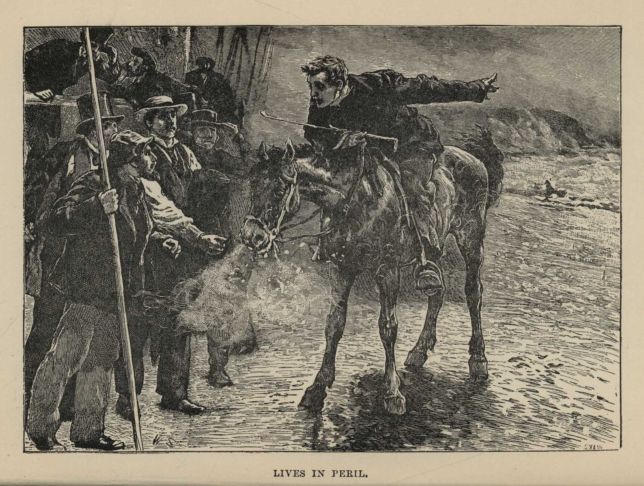
ne stormy December day, a few years ago, a horse reeking with foam galloped into Penzance, bearing a messenger with news that a ship which had got into the bay was unable to make her way out, and would in all probability be wrecked. The news spread through the quaint old town like wildfire, and in a few minutes hundreds of people were on the shore anxiously watching for the ship. From time to time she could be seen through the mist, and it was evident that her captain and crew were making every effort to head her out to the open sea; but there was little chance of success with such a furious gale blowing directly inshore. Anchors were thrown out in the hope of averting the threatened disaster, but they were of no use, and soon the vessel was drifting helplessly to the shore. "Man the lifeboat! man the lifeboat!" was then the cry, and coastguards and fishermen rushed off to the boathouse at full speed.
LIVES IN PERIL.
There was not a moment to spare. Horses were brought out and harnessed to the carriage, the men took their places, and away went the horses at full speed. The boat was launched into the breakers with a hearty cheer, and headed straight for the wreck.
Meanwhile a terrible tragedy was being enacted between the wreck and the shore, some distance to the east. The captain had seen two shore boats put off to his assistance, and after battling bravely with the sea for some time give up the attempt. He did not see the lifeboat, and, thinking that the safety of himself and his crew depended on their own efforts, he ordered one of the ship's boats to be lowered. No sooner had it touched the water than it was dashed to pieces against the side of the ship. A second boat was got out of the davits, and the captain and nine men got into her in safety, and made for the shore. She had not gone far when a huge wave pounced down upon her, whirled her round, and in another moment the men were struggling in the water, about three hundred yards from the shore. A few sailors seized the keel of the upturned boat, but again and again they were dashed from their hold by the heavy breakers, others seized the oars, and the captain struck out for the shore, followed by a few of his men. On the beach the people were helpless; but, seeing the captain swimming towards them, some of the strongest men joined hands, and waded out into the sea to meet him. One brave man, famous for miles round on account of his great strength, threw off his coat, and, followed by several others, dashed into the surf, determined to rescue at least one of the perishing sailors. When he got hold of one man he handed him over to his companions to be taken ashore, and, in defiance of the enormous breakers, he stayed out until he had rescued three men from certain death. Nine men reached the shore, but only four of those, who, full of health and strength, had put off from the wreck half an hour before, survived.
Now let us return to the lifeboat. "After a pull of more than an hour she reached the vessel. As she was pulling under her stern, a great sea struck the boat, and immediately capsized her. All on board were at once thrown out; the noble boat, however, at once self-righted. The coxswain was jammed under the boat by some wreckage, and very nearly lost his life, having to dive three or four times before he could extricate himself. When dragged on board, he was apparently dead, and in this state was brought ashore. Another man, pulling the stroke oar, was lost altogether from the boat, and the men were all so exhausted that they could not pull up to rescue him; but his cork jacket floated him ashore, when a brave man, named Desreaux, swam his horse out through the surf and rescued him.
"The inspecting-commander of the coastguard, who expressed an earnest wish to go off on this occasion, was also on board, and with others suffered severely. It is due to him to say that his great coolness and judgment, as well as his exertions, greatly aided in bringing the boat and her exhausted crew to shore. The second coxswain also behaved like a hero, and, though scarcely able to stand, managed the boat with the greatest skill when the coxswain was disabled.
"Judge of the dismay of those on shore when they saw the boat returning without having effected a rescue. It was at once clear that some disaster had happened, and they rushed to meet her. There was the coxswain, apparently dead, a stream of blood trickling from a wound in his temple, one man missing, and all the crew more or less disabled. Volunteers were at once called for. The second coxswain pluckily offered to go again, but this was not allowed, and his place was taken by the chief officer of the coastguard. In a short time another crew was formed, and the boat put off.
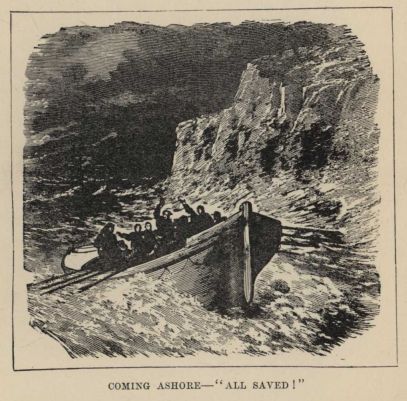
"No words can describe the struggle which followed. The boat had to be pulled to windward in the teeth of a tremendous gale. Sometimes she would rise almost perpendicular to the waves, and the people on shore looked on with bated breath, fearing she must go over. The way was disputed inch by inch, and at last the victory was won. Long and loud rang the cheers as the boat neared the shore, and quickly the shipwrecked mariners and their brave rescuers were safe.
"It was afterwards found that one of the second crew had three ribs broken, and several of the others had wounds and bruises more or less severe. Happily, none of the injuries proved fatal, and before long all the men, even the coxswain, went about their work as usual. The wrecked vessel was the North Britain, with a cargo of timber on board from Quebec."
CHAPTER XXI.
A PLUCKY CAPTAIN.
izard Point in Cornwall, the most southerly headland in England, is a piece of rocky land, which "has caused more vivid and varied emotions than any other on our coasts. The emigrant leaving, as he often thinks, his native land for ever; the soldier bound for distant battlefields, and the sailor for far-distant foreign ports, have each and all strained their eyes for a last parting glimpse of an isle they loved so much, and yet might never see again. And when the lighthouses' flash could no longer be discerned, how sadly did one and all turn into their berths to think--ay, 'perchance to dream'--of the happy past and the doubtful future.
"How different are the emotions of the homeward bound--the emigrant with his gathered gold, the bronzed veteran who has come out of the fiercest conflict unscathed, and the sailor who has safely passed the ordeal of fearful climes. The first glimpse of that strangely named rocky point is the signal for heartiest huzzas and congratulation."
There is, unfortunately, another side to this pleasant picture. Not unfrequently vessels become enveloped in the fogs, which prevail off this dangerous coast, and go crashing on to the rocks, there to become total wrecks. On the 4th of March 1893 an incident of this kind occurred. While the steamship Gustav Bitter of Newcastle-on-Tyne was proceeding from London to the Manchester Ship Canal with a general cargo, she stranded during a dense fog on the Callidges Rocks, off the Lizard Point. The engines were immediately reversed in the hope of getting her off, but she stuck fast. The captain gave the order for the long-boat to be lowered, and he got into her with seven men. As he was about to secure the boat's painter the rope was suddenly cut, and the strain being thus taken off, caused the captain to tumble into the sea, and he was compelled to swim to the boat to save his life. The second mate jumped from the deck of the doomed vessel, and tried to reach the boat, but unhappily he failed in the attempt, and was drowned.
News had already reached the shore that a ship was in danger, and the Polpear lifeboat was promptly manned and launched. When she reached the vessel the fog had lifted, and it was found that her bow was under water, and four men were clinging to the rigging. Great difficulty was experienced in getting near the vessel, as the seas were breaking completely over her and over the lifeboat. The lifeboatmen, however, succeeded in getting their grapnel on board, and the boat was brought up alongside. Three of the crew, watching their opportunity, left the rigging and went hand over hand along the grappling line from the steamer to the lifeboat. The fourth man, who is said to have been disabled by rheumatism, was unable to move from the rigging. His case was indeed desperate, for it was impossible to take the boat to the side of the ship on which he was lashed, on account of the shallowness of the water. To add to the difficulty of the situation, one of the men who had been rescued was in a very exhausted condition, and it was feared that he would not live much longer. After a little delay the boatmen decided, as there was no immediate danger of the vessel breaking up, that they would make for the shore, land the three men, and then return for the sufferer. The grapnel was accordingly freed from the rigging, and they pulled for the shore with all speed where the poor fellows were landed and well cared for. The lifeboat then proceeded on her return journey to the steamer.
Meanwhile another lifeboat had put off from the shore. On her way to the scene of action she fell in with the long-boat in which the captain and seven men had left the wreck. The little vessel was nearly half full of water and in great danger of being swamped, so her occupants were taken on board the lifeboat. They then told their rescuers that they had left four of their companions on board the steamer. Though the men were greatly exhausted with the hard pull of three miles which they had already performed, they gave a hearty shout and again bent their backs to the oars, and the remaining distance of a mile to the wreck was soon covered.
They of course were surprised to see only one man in the rigging instead of the four they had expected to find. The reason of his being where he was having been explained by the captain, several lifeboatmen volunteered for the dangerous task of rescuing the unfortunate man. The coxswain, however, thought it best to accept the offer of the captain, who was well acquainted with the ship, and had already proved himself a good swimmer. Two grapnels were thrown into the rigging of the steamer, and the captain swung himself on board by means of one of the lines. He reached the rigging, took the man out, and fastened a running line to his waist. Then he made a signal, and the poor fellow was hauled on board the lifeboat.
COMING ASHORE--"ALL SAVED!"
The captain was now compelled to take to the rigging again to avoid being washed overboard by the heavy seas, which were breaking over the ship. Twice he attempted to get off, but he was driven back each time. Watching his opportunity he tried again, and without either lifebelt or line plunged into the sea and swam to the boat. The work of rescue being then accomplished, the boat returned to the shore.
The silver medal of the Institution, accompanied by a copy of the vote inscribed on vellum, was awarded to Captain David Graham Ball, the master of the vessel, in recognition of his gallant conduct.
CHAPTER XXII.
BY SHEER STRENGTH.
uring the terrific storm which spread such destruction over a large area of the United Kingdom in October 1889, a vessel was seen to be labouring heavily, and showing signals of distress, some two or three miles off the coast of Merionethshire. As she was rapidly drifting towards a very dangerous reef of rocks, the Aberystwyth lifeboatmen were speedily summoned. The tide was low at the time, and great difficulty was experienced in getting the boat to the water's edge. Several times she stuck in the soft sand, and the united exertions of the lifeboatmen could not move her forward a single inch. Plenty of willing helpers, however, were at hand, and after much labour and loss of valuable time, the boat was at length pushed into the sea on her carriage, and the crew took their places.
To avoid being blown on the rocks the men found it was necessary to row out for a considerable distance. The oars were manned, and the helpers eagerly waited for the word of command from the coxswain to let her go. The order was given; but here a fresh obstacle presented itself. The waves were rolling inshore with such fury that the greatest exertions of the boatmen failed to get her off, and notwithstanding the fact that scores of men went into the water till the waves broke over their heads, a considerable time passed before the boat could be got clear of her carriage and set afloat. Then the crew began a struggle against wind and waves, the like of which had not been seen for nine years, when one of the boatmen lost his life through exposure.
The men tugged at the oars with all their might, and seemed to be gaining slowly; but after they had been rowing for an hour they found themselves just where they started. Great white seas broke over the boat, drenching the men to the skin, and carrying her back towards the shore. Again and again the struggle was renewed, and again and again the boat was carried back on the crests of the waves. Sometimes the boat would be thrown on end, in an almost perpendicular position, and then fall into the trough of the sea and disappear.
For two hours the struggle against the angry sea and the fierce wind was kept up. During that time six oars were broken, and several times the boat narrowly escaped being upset. Then three huge rollers came in quick succession and carried the boat into the comparatively smooth water near the pier. She was brought alongside the landing-stage, and more oars and five additional men were taken on board.
As soon as the extra men were put in their places, another attempt was made to get the boat out to sea. The wind still blew with unabated force, and sea after sea broke over the little vessel. Slowly but steadily she made headway, and though she was often lost to sight in the trough of the sea, or buried in spray, she at length gained a point where the coxswain thought it was safe to hoist the sail. This was done, and away sped the lifeboat after the retreating vessel.
On getting alongside it was found that she was an American ship, and though terribly battered she was still holding on to her anchors. Two of the lifeboatmen were put on board to assist in navigating her, and, at the request of the captain, the boat remained alongside for some time, in order to be in readiness to save the crew in the event of the cables parting. While she was in this position an immense wave dashed right into the lifeboat, and three of the crew were swept overboard. They were afterwards picked up in a very exhausted condition.
Seeing that their services were not now required, the lifeboatmen cast off from the wreck and made for home, which was reached shortly before midnight. Their undaunted spirit won for them the admiration of the thousands of spectators who had watched their battle with the storm, and the owners of the vessel, wishing to show their appreciation of the crew's services, sent the sum of £30 "to be divided among the men as some slight recognition of their gallant conduct."
CHAPTER XXIII.
WRECKED IN PORT.
he spacious harbour of Milford Haven, on the south-west of Pembrokeshire, the finest in the kingdom, and large enough to shelter the whole British fleet, was, a few months ago, the scene of a most gallant rescue by a crew of South Wales lifeboatmen. On the 30th of January 1894, the full rigged iron ship Loch Shiel of Glasgow was stranded on Thorn Island, at the entrance to the Haven. She was bound for Australia with a general cargo, and had on board thirty-three persons, seven of whom were passengers.
As soon as the vessel struck, the captain tried the pump, and found that there was a quantity of water in the hold, and that the ship was rapidly sinking by the stern. He at once ordered the boats to be lowered. Then a mattress was brought on deck, soaked with paraffin oil, and lighted as a signal of distress. The flare was seen by the coastguard at St. Anne's Head, several miles away, and they telegraphed the news of the disaster to the lifeboat station at Angle. Obedient to the summons, the lifeboat put off to the rescue. Meanwhile several of the shipwrecked men had been forced to take refuge in the mizzen rigging, and others had climbed over the jibboom and landed on the rocks.
Presently the lifeboat came dashing along in splendid style. On nearing the vessel the anchor was dropped, and the boat's bow brought close to the mizzen rigging, to which six men could be seen clinging. One of these was an invalid passenger, and great difficulty was experienced in getting him on board. More than once the men expected to see him lose his hold and fall into the sea, but he, fortunately, had sufficient strength to hold on till he reached the arms stretched out to save him. The remaining sufferers were then quickly taken out of the top, the anchor was hauled in, and the boat pulled round to the leeside of the island, to take off the remainder of the crew and passengers.
Mr. Mirehouse, the Honorary Secretary of the Angle Branch of the Royal National Lifeboat Institution, who had accompanied the boat, and Edward Ball and Thomas Rees, two of the crew, now landed. Taking with them a rope and a lantern, they crawled along the edge of the cliff until they arrived above the spot where the people had taken refuge. They then lowered the rope over the cliff, and, in spite of the darkness of the night and the fury of the storm, they hauled up the remainder of the crew and passengers of the Loch Shiel, one of whom, a lady, was in a very weak and exhausted condition. But the rescue was not yet completed. The return journey had yet to be made along the narrow and dangerous pathway, in some parts barely a foot wide. The difficulties of the passage were further increased by having to guide the rescued and exhausted persons. To the credit of Mr. Mirehouse and his two men, be it told, that after great exertions and several narrow escapes they succeeded in bringing all in safety to the place where the lifeboat was in waiting.
As a very heavy surf was running, it was decided that the boat should make two trips. Twenty persons were accordingly put on board and landed at Angle. Then she returned immediately to the island for the remainder. At half-past six on the following morning she completed her second journey, and the whole thirty-three men and women were again in safety on the mainland. Some of the rescued people were taken to the residence of Mr. Mirehouse, and were most kindly cared for by him and his family; others were taken charge of by other residents.
Some time afterwards the following letter was received by Mr. Mirehouse from the captain of the vessel:--
GLASGOW, 21*st February* 1894.
DEAR SIR,--You and your dear lady, and your household, and all the inhabitants of Angle, please accept my humble thanks for the great kindness you all did to me and to my crew and passengers on the 30th and 31st January 1894; firstly, in taking us from the wreck of the ship Loch Shiel, on Thorn Island, and then having us at your house and other houses in Angle for some considerable time, thirty-three people in all.--I am, dear sir,
THOMAS DA VIES, Master of the ill-fated ship Loch Shiel of Glasgow.
A highly gratifying letter was also received by the Honorary Secretary from the owners of the vessel, conveying their thanks for the services rendered to the crew and passengers. The crew of the ship also wrote expressing their thanks to the lifeboatmen for saving their lives, and to those who afterwards supplied them with food and clothing.
The silver medal of the Royal National Lifeboat Institution was awarded to Mr. Mirehouse, Thomas Rees, and Edward Ball in recognition of the bravery displayed by them, in going to the edge of the cliffs and rescuing the remainder of the passengers and crew, and in afterwards conducting them to a place of safety.
* * * * *
[The Royal Lifeboat Institution, the story of whose noble work we have followed, is supported solely by voluntary contributions, and to our credit as a nation be it said, that this admirable Society has never appealed in vain for funds to carry on its work. To the usual sources of revenue--annual subscriptions, donations, and legacies--another has been recently added, known as "Lifeboat Saturday." Originated in Manchester in 1891 by Mr. C. W. Macara, it rapidly spread from place to place, till now nearly every important town, both maritime and inland, sets apart one Saturday in each year to collect funds for this purpose. A procession is organised and one or two fully manned lifeboats are hauled through the streets, and where there is water launched at a convenient place. The presence of the boats and their crews never fails to arouse the greatest enthusiasm. The object of this movement is to further increase the funds of the Institution, that they may be able not only to reward the crews, but also in the event of loss of life, or permanent injury to health, to compensate those and all dependent on them for support. I have just been informed by the Secretary of the Royal National Lifeboat Institution that already this year (August 1894) they have granted rewards for saving nearly 500 lives. The lifeboatmen are all volunteers, and, as we have seen, each time they go out on service they literally take their lives in their hands. As the President of the Board of Trade recently said: "I trust the time will never come when the English public will abdicate their duty and their highest privilege of supporting such a noble Institution."]
THE END
PRINTED BY MORRISON AND GIBB LIMITED, EDINBURGH