A PURITAN INGÉNUE
Reading edition
By John Seymour Wood
115
I
The Archibald house, on West Forty-— Street, was of the character described as a “modernized front.” A handsome arch in rough stone surmounted the front-door, which was done in polished oak and plate-glass. The stoop was on a level with the sidewalk; a richly carved bow-window jutted out from the second story. “No. 41,” in old iron open work, formed 116a pretty grating above the door. There was, in fact, nothing which would lead an ordinary person to conceive of the house as given over to boarders, except, possibly, the sign,
TO LET, FURNISHED.
which was posted conspicuously below the first-story window, and at an angle which enabled him that ran to read.
Old Mr. Archibald’s death, the autumn before, had left his widow rather poorer than she anticipated. He was a great collector of pretty things. His taste was exquisite, and he had gratified it by filling his house with a variety of bric-à-brac, pictures, statuary, and old furniture, which made it a centre of attraction to many of the old gentleman’s artistic friends. Mrs. Archibald, loath to dispose of her husband’s art collections, determined 117to let the house, as it stood, “at an exorbitant figure, to a very rich tenant without children.” Under these terms, on her departure for Europe, her agent was entrusted with the house, and her son Jerome, when he saw her off on the steamer, received a parting injunction, “Be sure and see that they have no children.” Jerome Archibald saw his mother and sisters depart—in no very enviable frame of mind; but he was a good son, and he resolved to forego Newport, if it would tend to dispose of the house as his mother wished, and add to her diminished income.
His mother and sisters sailed in May. It was now July, and very warm and disagreeable. As the “heated term” set in, he began to think it too bad, you know, of mamma and the girls to remain abroad for three whole years. It was positively absurd. What was he to do? After the house was let—where was he 118to go? By Jove, he felt deuced lonely, don’t you know! It was especially trying for a sensitive man to go in and out of a house with a great placard on it, “To Let, Furnished,” but it was a deal more trying to have people come and want board. Yes, actually, two ladies came one morning and wanted to know if they could see the landlord. It was positively ridiculous! His agent was a clevah fellow, but even he gave up hope of letting the house until fall. Hadn’t he better run down to Newport? He got a letter from Dick Trellis that morning, and they really didn’t see how they were going to get on without him in the polo matches. It put him in a fuming fury. He had never stayed late in the city in summer before. How infernally hot it was—and nahsty—don’t you know! His collars were in a perpetual state of wilt—they never wilted at Newport. Then everybody was not only out of town, having a 119good time somewhere, but they had a provoking way now of ostentatiously boarding up their front-doors—yes—and their windows, too—which made it doubly disagreeable for those who had to remain. It was bad enough to see the blinds drawn down, but boxing up their stonework and planking up their front-doors caused Mr. Jerome Archibald unutterable pangs. Then they thought it was a boarding-house!
They were coming again in the afternoon, at four. There were two of them—ladies. In his rather depressing and solitary occupation of living alone in his house, with one solemn apoplectic cook and one chalk-faced maid, in order to exhibit it to that endless raft of females with “permits,” who universally condemned or “damned with faint praise” his father’s exquisite taste in rugs and furniture, Mr. Jerome Archibald had to-day admitted to himself a distinct pleasure in 120showing “Miss Perkins” and her niece (whose name did not happen at the time to be mentioned) over the house, and pointing out in his quiet way its excellences.
They saw the sign, they said, and so made bold to enter. Evidently Miss Perkins was a prim, thin, tall, spectacled, New England old maid. She had the delicate air and manner of a lady. A lady faded, perhaps, and unused to a larger social area than that surrounding her native village green. She had also the timid manner of hesitancy of New England spinsters—hesitancy concerning everything except questions of casuistry and religion—and seemed, in what she did, to be spurred on from behind by the niece, who was, on the whole, as Mr. Jerome Archibald told a friend at the club later, “quite extraordinary.”
In the first place, as he said, the niece was undeniably beautiful.
121“She wore rawther an odd street dress,” he said, “made up in the country somewhere, by a seamstress who gathered her crude notions of the prevailing fashions from some prevaricating ladies’ journal, and her hat was something positively ridiculous—but her face!” The fastidious Mr. Jerome Archibald at once conceded to it a certain patrician quality of elegance. It denoted pure blood and pure breeding, somewhere up among Vermont hills or Maine forests. A long line of “intelligent ancestors,” perhaps. It was fine, and—beautiful. The forehead high, nose straight, the large eyes gray, the mouth and chin sweet, and yet quite determined. When he showed them a large room at the rear, on the second story, facing the north, the niece had observed, with a lofty air—mind, the room was literally crammed with the most costly bric-à-brac—“I think this will suit me very well, aunt dear, on account of the light.”
122He noticed in her unfashionable dress a certain artistic sense of freedom, a soupçon of colored ribbon here and there, and he concluded that she was all the more interesting, as an artist, in that she so quietly accepted the elegancies around her. She gave an unconscious sigh over a small glass-covered “Woodland Scene,” by Duprez. Mr. Jerome Archibald noticed it, and inwardly smiled, delighted.
Perhaps the niece captivated him the more by her silent appreciation of some things he himself admired exceedingly. It was odd that she seemed always to choose his favorites. There was nothing said as to the rent, the size of the house, the lot, the plumbing. He spent an hour showing his etchings alone, and in the afternoon, at four, they were coming again, “to decide.”
123
II.
Of course Mr. Jerome Archibald must have been an extremely susceptible young man to have fallen in love at first sight with a strange young woman, who had come to look at his house with a view to renting. But he was—“rawther down and depressed.” The usual summer malaria had set in. The usual excavations in the streets were going on—they were digging with “really extraordinary energy” that summer—the pavements were up on all the Fortieth streets. Fifth Avenue presented the appearance of a huge empty canal. It was something more, this presidential year, than the perennial laying down and taking up of pipes. “He was really ripe for une grande affaire du cœur,” said one of his club friends, he was getting so lonesome. He did fall quite entirely in love, precipitately, unquestionably, 124in spite of the fact that they took the house for a boarding-place! They asked to hire but one room only.
When they arrived, at 4 P.M., they sat a few moments in the reception-room, while the chalk-faced, alert maid announced them to Archibald in the room above. Miss Perkins folded her faded, gloved hands in her lap and sat up on the sofa stiffly. They had looked at ever so many houses, and they had come back to No. 41 with instinctive preference.
“I don’t think one room would be so very expensive,” said Miss Perkins. “He could put up two beds easily in that north room, and the room we saw on Thirty-fourth Street was only twelve dollars—what do you think, Elvira?”
“I think twelve dollars is altogether too high,” said the niece, looking up from a delicate little Elzevir she was holding. “I think he wants to let the rooms very much; none of them seem 125to be taken. Remember it is midsummer, aunt dear.”
There was a little pause.
“Of course he will prefer having nice people. It will be a great help to your art, Elvira—you can study at great advantage. There are so many pictures for you to copy. I think your father would say it was a ‘lucky find.’ If you will persist in your art, why, I think we are very fortunate.”
“You are always ready to sneer at my art, Aunt Perkins.” And she gave a peculiar laugh.
“It is something that has come up since my day,” she replied, glancing about over the pictures and the rare editions on the table. “I was brought up to plain living. But I guess if we can get it all for twelve dollars we ought to be satisfied. It’s a pleasant change to see the city. It’s pleasant to see these ornaments. Yes, I don’t 126blame art so much as your father does, Elvira, and I don’t believe he would blame it if he knew we could have so much of it for twelve dollars.”
“Father secretly admires it as much as I do,” said the niece; “only he likes to talk.”
Just then Mr. Jerome Archibald entered. He was faultlessly dressed in half-mourning for his father. Indeed, he had dressed himself with exceeding care, being desirous, he frankly admitted to himself, of making an impression. He bowed graciously, and took Elvira’s extended gloved hand, which, as she offered it, he held a moment. “Have you decided?” he asked.
They had explained, when they left in the morning, that they should want only one room, and he tacitly inferred that they would require board. He received a dreadful shock, but made up his mind that the charming niece would prove the 127more charming on closer acquaintance, and he deliberately decided to keep both the gentle New Englanders under his roof for a time, if he could! The more he thought of the plan, the more interesting the situation became to him. He fairly dreaded, at last, lest they should find their way into a remote boarding-house in some cheap quarter of the city, where it would be quite impossible for him to follow them. He gravely announced to the astonished maid that he had determined to let out the rooms to the ladies, who, he pretended for her benefit, were old acquaintances. When they were announced he was scarcely able to conceal his pleasure. Mr. Jerome Archibald had fallen in love.
“We have decided to take one room,” said Elvira, “if we can agree upon the price; and we wish to know the price of board—”
128“We shan’t want much to eat,” put in Miss Perkins, with a nervous twitch.
Archibald admirably concealed a smile. His long mustache aided him a good deal in doing this. He was still standing, and he put his hand to his lips: “I think we shall agree very easily upon the price,” he said.
Miss Perkins again twitched a little. “We thought twelve dollars—room and board——” she said, leaving the sentence half finished, while Elvira looked up at him, expectantly.
“My dear ladies, I should not think of charging more than ten. You are strangers in the city, and I would not impose upon you for the world. It happens that this is the dull season——”
“So we thought,” said Miss Perkins, “and board and lodging ought to come a little cheaper.”
“Precisely. The maid will show you your sleeping-room—and, of course, the 129entire house is at your service. I hope you will find everything to your comfort. I am very anxious to please.” He laughed a little.
Elvira gave him a grateful, but at the same time a rather patronizing, glance. He felt at once that in carrying out his little ruse he had placed himself deliberately upon a questionable footing with the beautiful girl. He hoped, however, to redeem himself by impressing her with his knowledge of the pursuit which, he accurately judged, had brought the ladies to the city. Archibald had at one time done a little painting himself. He had dreamed dreams, as a young man, which indolence and the stern business atmosphere of the city had choked off prematurely. As he looked down upon the girl’s sweet gray eyes a vision of this youthful period came back to him. Twenty-two and thirty-two have this in common, that the latter age is not too 130far away to quite despise the younger enthusiasm. Archibald at thirty-two still believed in himself, don’t you know.
III.
Several days passed, during which the ladies settled themselves very readily in their new surroundings. They were very methodical, preferring to rise at an hour which, to Archibald, was something savoring of barbarism. He studied their habits, with a view to conforming to them as far as possible, but found that he could not bring himself to give up his nine-o’clock breakfasts, and so went to his club, leaving orders that the ladies should be accommodated at the earliest hour they might choose. He found that they had discovered Central Park, and came to make it a habit to stroll with them of a morning upon the Mall, and around the stagnant lakes. Central Park 131was a novelty to him, except as seen from horseback, or a four-in-hand, and it really seemed very beautiful those summer mornings—he was really surprised, don’t you know! He wondered that nice people did not use the Park more—as they did Hyde Park in London. As the days went on he filled his house with flowers, turned the second floor into an immense studio for Elvira, sat about and watched her, criticised, encouraged her. He forgot Newport, forgot his polo. He had strangely ceased to be bored. He was happy in New York in midsummer! Dick Trellis told his polo friends at Newport that Archibald was probably undergoing private treatment for softening of the brain, which theory, in fact, they deemed sufficiently complimentary.
As for his mother and sisters in Europe—why, pray, should he inform them of his little joke?
132Elvira worked away at her easel when the light was best—during the afternoon. In the evening, after dinner, the ladies became socially inclined. It was then that they allowed Archibald to smoke in the “studio” and talk Art with Elvira. Indeed he found it very difficult to talk anything else with the shy New England primrose.
About Art—with a big A—she was rapturous. There seemed to be in her soul a strange hunger for everything ornate and richly beautiful. Archibald devoted himself to studying her. He became strangely interested in East Village, Vt., where, he gathered, the Hon. Ephraim B. Price, her father, was a very distinguished Republican lawyer and politician. He drew Aunt Perkins out concerning her Congregational church, her minister, her fear of the Catholics, her fondness for cats, her secret disbelief in Art. Once in a while 133they read him a letter from the Hon. Ephraim, in which he could see reflected their own liking for him. He found that he was spoken of as “Landlord Archibald.” The Hon. Ephraim was a shrewd old fellow, however, and his counsels and advice were generally of the “trust-not-too-much-to-appearances” order. One evening Miss Perkins complained of a headache, and Archibald found himself alone for an hour with Elvira. She sat beneath the rich brazen lamp, with its pretty crimson shade, absorbing some of the red glow in her lovely face. They had been two weeks in the city, and out of delicate feeling had deposited two ten-dollar bills upon the mantelpiece in the library, where Archibald would see them. He had roared with laughter over them and intended having them framed, but ultimately he found a different use for their amusing board-money.
134He made some little allusion to the time they had been with him.
“Two very short weeks,” said Elvira, “and you have been so very unusually kind, Mr. Archibald. You have done so much for us. We have noticed it. Is it usual for landlords to—to do so much, in the city?”
“It depends,” he said, gravely. “Landlords do more for people who are congenial—you are congenial——”
“Oh!” A slight pause.
“You are more than congenial, really,” said Archibald. “For you take an interest, Miss Price. I have secretly espied both you and your aunt dusting——”
Elvira bit her lip. “We have dusted,” she admitted, reddening a little, “but it is merely out of force of habit.”
“Really,” said Archibald, “I rawther like you the better for it, don’t you know!”
“I’m afraid,” said Elvira, her face 135lighting up with conscious pleasure, “that you have made up your mind as a landlord to like us, whatever we do. I’m afraid you would not like it at all if you knew everything that aunt has done.”
“Tell me—I will keep it a profound secret, I assure you,” he laughed.
“She has actually dared to invade your kitchen!”
“Has she?” said Archibald, dubiously; “really!”
“Yes, and she declares that your cook wastes enough every day to keep four families!”
“Really!” said Archibald; “I’ll have to look into it.”
“You won’t save much out of what we pay,” said Elvira, “and we don’t want to stay if it doesn’t pay you; but——”
“Well?”
“Mr. Archibald, we are poor.” She looked down.
“I’m very sorry, I’m sure—I—” he 136really did feel a compassion which found its way into his voice, and made it tremble a little.
“Aunt says you can’t be making any money. Now, we don’t think it is right to stay another day and be burdens, do you see?”
A solemn pause.
“Isn’t that what they are talking about so much now in the novels?” he asked, at length.
“What?”
“The terrible New England conscience?”
“Right is right and wrong is wrong, Mr. Archibald, disguise it how we may,” and Elvira compressed her pretty lips firmly.
Archibald puffed on his cigar, lazily.
“I wasn’t sure,” he said, as if a doubt had crept into his mind.
She glanced at him impatiently.
“Can’t you see how wrong it would be 137for us to stay here and enjoy all we have in your beautiful house, knowing that we were swindling you?” She stamped her foot. “Mercy!” she added, half to herself, “what can you be made of?”
He hastened to a display of rugged conscience, which relieved her.
“Oh, of course, I see how wicked it would be if you did swindle; but I’m making money! Really—I haven’t spent the twenty dollars board-money yet. Oh, pray rest assured—I shan’t lose. I will tell you when I run behind.”
A great sense of relief seemed to come over the girl.
“But it is all we can pay. I told father I would not ask for more. Father said he knew it would take more, but I said I would give up Art first.”
“Oh, I say!” he protested.
“And to-morrow I am going to begin taking lessons, but I will not call on father for another cent. He shan’t be able 138to throw it in my face that it turned out as he said, and that I was wrong. When he and I dispute it always does turn out as he says—this time it shan’t.”
Archibald laughed a little. The poor fool, don’t you know, was so captivated that every word, every action of the girl was music to him. The two weeks of observation had told on her dress. To-night she wore a white muslin, elaborated with pretty ribbons. She no longer seemed especially rustic to him. He noticed that she was doing her hair now in the prevailing style. “By Jove!” he said to himself, “I’ll see that she comes out at the Patriarchs’ next winter!”
This was his highest earthly happiness for a débutante.
“I am going to make money,” she went on; “I’m going to paint vases, plates, odds and ends, pot-boilers, you know, and so father shan’t know what it costs.”
139
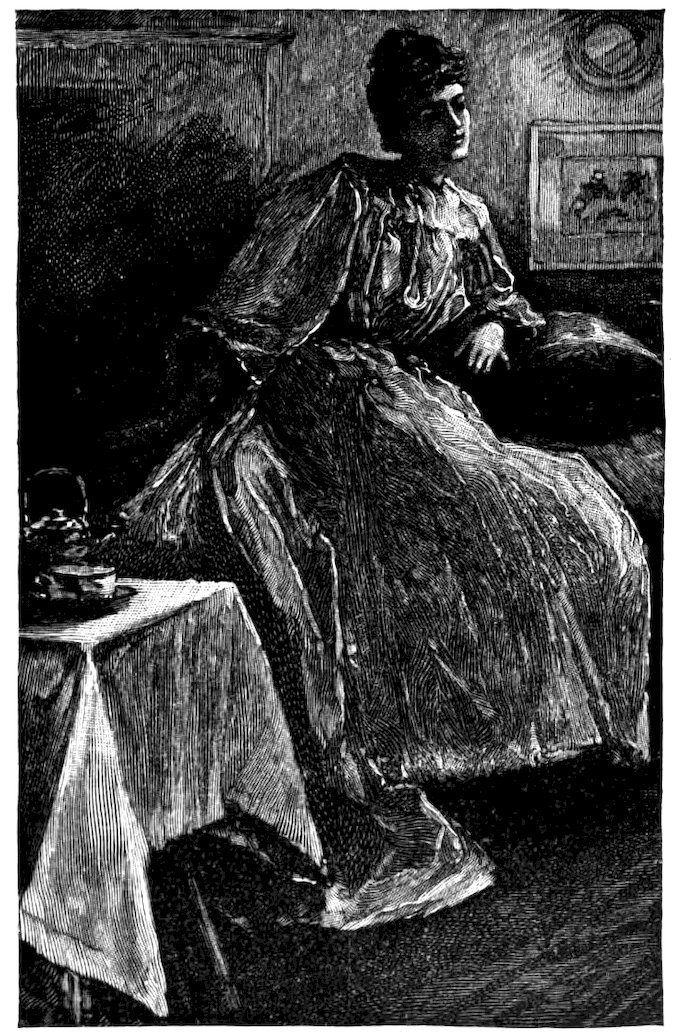
140“Oh, by the way, if you do,” he pretended, lazily blowing out a ring of smoke, “I happen to know a fellow—an old friend of mine—who gives very fair prices for those sort of things. Now, I am sure he will take any gimcrack you may do.”
Somehow the word gimcrack displeased her.
“My Art work has always been thought very pretty in East Village,” she said. “It would never sell, but it was thought pretty. I used to long to help father—and our family is so large, you know, four little brothers and two sisters younger than I am—and now, if I only could get on, and help father! Oh, Mr. Archibald, you don’t know how little law there is to go round in East Village!” She heaved a deep sigh.
He tried to appear sympathetic.
“I know a fellow who gets a thousand dollars for a portrait, and he has only 141just commenced. You can’t help but succeed, Miss Price, really!”
She gave him a grateful glance.
“Oh, if I could!” she said, anxiously. “I taught school one winter, but the pay was so small. And I’ve tried—you will laugh, Mr. Archibald, at my telling you these things—but I’ve tried story writing. I was so hopeful about it, and it took as many as ten rejections before I became convinced; and now, if my Art fails me——”
She gave a little fluttering sigh.
“I think you have talent.”
“Perhaps it is only enthusiasm——”
“That amounts to the same thing. It will keep you up to your work. They used to tell me I had talent, but I had no enthusiasm, so I dropped it. I wish to encourage you,” he added; “I hope you will go on. It takes a lot of work, but you have just the right temperament. You will work. You will get on, and 142when you become celebrated, Miss Price, you won’t forget your old friends?”
He realized that it was a rather bold step forward, and he trembled for her reply.
“I shall always recommend your house,” she said, a little stiffly, making him feel more than ever her aristocratic superiority to landlords, “and I shall always remember your kindness. We went to at least six boarding-houses until we saw your sign—we saw the landladies. Really, Mr. Archibald, you have no idea how vulgar and unartistic most of the houses were. There was always a disagreeable odor, as if somebody was frying something. If I do succeed, as I wish, and make friends, and get to be known, and all, you may be certain that I shan’t forget you. I may organize an Art class, and take the whole house myself!”
He went no further. It was enough to him, as he sat opposite her in his evening 143dress, his rich opal, set with diamonds, flashing on his white shirt-front, his lawn tie, low shoes, white waistcoat—everything in the latest and most expensive style—it was enough for Mr. Jerome Archibald to sit there and smoke his delicate Havana, and reflect that he at least had her promise to do what she could to recommend his boarding-house!
The next day, at dinner, he again suggested, in an offhand way, that Miss Price should turn her attention to portrait-painting. Miss Perkins seriously objected at once.
“Your father would never give his consent,” she said. “There was old Mr. Raymond, who lived on the Poor Farm, because he found portrait-painting didn’t pay.”
“Mr. Raymond painted dreadful, hideous caricatures,” said Elvira. “He painted my mother’s portrait, and father is always throwing him in my face. But 144I don’t know. I have no one to begin on except aunt, and I have tried and tried, and I can’t get anything but the expression of her spectacles.”
Even Aunt Perkins laughed at this a little.
“Begin on me,” ventured Archibald. “Call it the ‘Portrait of an Ideal Landlord.’”
There was a little pause. The ladies rose without replying, and Archibald followed them into the drawing-room, feeling indefinitely that he had been too forward. As he lit his cigar and sat near an open window, feeling the cool southern breeze, he reflected that it was not improbable that in East Village the only landlord known to them was the keeper of a common tavern. It amused him to think of their primitive, quaint ignorance of city ways. He pictured the small life of East Village, Vt., the narrow social horizon, the strange interest in politics, the religious intolerance, the “strong” views on the temperance question which obtained there, and which leaked out from Miss Perkins as the days went on into August. The easy sense of accommodation to their new surroundings also amused him.
145
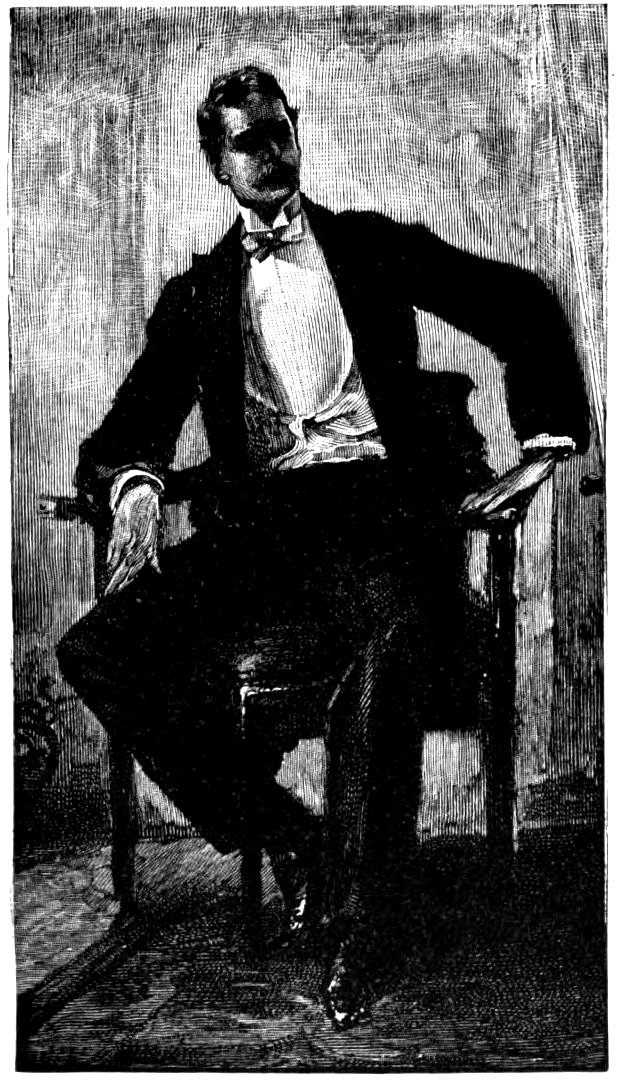
146Archibald returned to the portrait. “I’d rawther like to have one for the dining-room,” he said; “I think it would interest some of my boarders when they come back next winter. I could give you no end of sittings, Miss Price——”
Elvira exhibited some hesitancy:
“Well, I might try,” she said. “But I’m not at all good at hair——”
“Shave off my mustache if you like,” said the infatuated Archibald, with a grimace.
The ladies changed the subject decorously. It was plain that Archibald’s little advances toward an intimacy, to be derived from portrait-painting, were being 147met in rather an unencouraging spirit, don’t you know! The next day he invited them, as an agreeable diversion, to visit Coney Island; but Elvira made an excuse that she had no time for “pleasuring.” They seemed, indeed, to have few pleasures. The morning walk in Central Park was given up; Miss Perkins spent the greater part of the time when Elvira was at the Art School in riding to and fro, apparently, upon street-cars. One day she came home very late to dinner, saying that she had discovered the “Belt Line.” While waiting her return for dinner, Archibald had an agreeable tête-à-tête with Elvira.
IV.
He was growing more and more in love with this self-contained, charming, young New Englander. It had come to a time when he felt that he must speak. They 148had been at No. 41 now these four weeks, aunt and niece, and yet they had managed to preserve their distance. He was no nearer than the day they arrived.
He reflected that the pleasant little daily comedy which had amused him so entirely would have to be given up the instant he made known to her his state of feeling. But at the same time he felt he could act out the equivocation no longer. He must, as a gentleman, make a clean breast of his deception. Archibald had seen a great deal of women, and he believed that he understood them pretty well. He believed he understood Miss Price well enough to reckon upon the flattery of her sudden fascination that first day, for him, as the cause of his deceit. He planned to boldly tell her this, one day, while they were waiting for Miss Perkins to revolve around the “Belt Line.” But Elvira turned the conversation against his will. She seemed to have remarkable 149intuitions, this strange creature! Perhaps she had an intuition then. At any rate, she announced their determination to return to East Village the following Saturday.
“Father writes that his ague is no better—that I must come home,” she said. “There are, besides, the preserves——”
Archibald expressed no surprise. “If you go,” he said, “I think I’ll take a run up there also. I have the greatest curiosity about East Village.”
“There is nothing—it is dreadfully—I wouldn’t have you visit East Village for all the world!”
“Why?”
“Because—” she replied, sedately.
Recognizing this as a sufficient reply, Archibald took a seat on the sofa near her. She was in one of her pretty, soft, white muslins, tied, this evening, with ribbons of the very latest shade of fashionable apple-green. He had noticed the steady growth 150of fashion in the girl’s appearance, but he was not quite prepared for the dozen silver bangles, which jingled as she raised her hand to her hair. She had a pretty arm and hand, and were it not for the bangles, which somehow altered the current of his thought, he had nerved himself up to the point of taking, or trying to take, her hand in his, and telling her in a manly way his story. The bangles, however, don’t you know, diverted him. He could not be serious. He laughed. It was as if he had happened upon a wood nymph in seven-button kid gloves! She misinterpreted his laughter, believing that he intended to ridicule the pastoral delights of East Village.
“I’m not ashamed of Vermont,” she said, drawing away a little. “I can’t bear to have it laughed at. You would laugh at East Village, Mr. Archibald—you laugh at everything. You are not sincere. You have too much of the city 151in you—too much of its glitter and—” She caught his eyes directed laughingly upon her bangles, and blushed guiltily.
“Time works its changes, don’t you know,” he said. “Even you, Miss Elvira, are a little affected.”
“I hate myself for it,” she said; “I do find myself growing to like things I never cared for before. I think of what I have on from morning to night,” she confessed, guiltily, with an imploring glance at her landlord.
“Can the dead dulness of midsummer in the city have wrought so wondrous a change?” he laughed. “How very gay, really, you will be next winter.”
“Seriously,” said Elvira, “I look forward to a visit to East Village as a complete change and rest. When I think of the white, dead walls of our meetinghouse, I am glad; when I think of the lack of color in everybody up there, it makes me glad; when I think of the plainness 152of everything, the simpleness, the truth of everything, I’m glad to go back. But don’t you—don’t come up to Vermont, Mr. Archibald. Really, please, don’t.”
Again Archibald felt impelled to seize her white, pretty hand, and tell his story. He had never come to so intimate a point before. What chance had he ever to come so near again? All that his mother and sisters could write would have no effect upon him now. All that his friends at the club would say, all that his Aunt Newbold would say—his Aunt Newbold was the formidable dragon of his family—nothing, he felt sure, would alter his mind. He had deliberated a month, he would deliberate no more. Besides, she was going away; perhaps if he did not speak his opportunity would never again occur. He paled a little as he was about to open his lips.
Bother!
153The chalk-faced maid entered with a card on a silver tray.
V.
Mr. Jerome Archibald had very few hatreds; people whom he disliked he carefully avoided. Being fastidious to an extreme, he had few friends, but he likewise had no enemies. He had, however, a certain cousin who lived in Boston, who had in some way early offended him, and for whom he continued to have a most inexplicable dislike. Hunnewell Hollis was a Harvard man, who had been a great swell at college, and who was considered “clevah.” He was a year or two older than Archibald, and he usually presumed a little upon his age and upon his superior education. It was Hunnewell Hollis’s card which was brought up on the silver tray.
Archibald impatiently rose and went 154down to the reception-room. There he found Hollis walking up and down the room, apparently in some excitement.
“Jerry, this won’t do, old man!—heard ladies’ voices upstairs! ’Twon’t do! Lucky I ran down with the yacht. Now I’m going to carry you off with me. By the way, Somers and Billy Nahant and Jack Chadwick are here, and I took the liberty to invite them here overnight—knew you were alone—knew you would be glad to put them up.”
“By Jove, you do me great honor! Unfortunately I haven’t room for you—I’ve only just let the house—taken—by Jove! I must take in the sign.”
Archibald’s face betrayed no sign of his justifiable prevarication.
“Well, then, as it is dinner-time I’ll stay to dinner with you.”
“Sorry, very sorry. But the ladies who have taken the house would think it very odd——”
155“Well, how in the devil are you dining with them, Jerry?”
“They asked me, in order to discuss the terms. A few details before signing the lease, don’t you know!”
“Well, it puts me in a rather awkward position; I’ve left the fellows your address; they’ll be here shortly.”
“Why don’t you head ’em off?” suggested Archibald, coolly.
Mr. Hunnewell Hollis gave his cousin a glance of anger. “The whole thing is rather fishy,” he said, suspiciously. “I trust, Jerry, for the honor of the family——”
Archibald never quite detested his cousin so much before.
“There are a great many adventuresses about; they are on the lookout for rich young men like you, Jerry,” and Hunnewell Hollis, giving his cousin a rather gravely serious nod, took up his hat and cane and departed.
156Archibald went directly upstairs. He heard a rustle of a dress against the furniture. Had Elvira been listening? He hoped not.
VI.
Adventuress! How that odious word rang in his ears as he entered the room where the sweet primrose face was still in its corner of the sofa. He swore he would never write to, nor speak to, Hunnewell Hollis again. He had done with him forever. Yet, had he heard the rustle of her dress? It gave him a slightly disagreeable sensation to think that it were possible. Elvira Price apparently had not moved from her seat. She was in the same pretty attitude in which he had left her, leaning back, easily, against the corner of the sofa, her hands crossed in her lap. As he entered it seemed to him that she was studying his face.
“I was so anxious about aunt,” she 157said. “I went out to the stairs thinking I heard her come in. Do you know, it isn’t the Belt Line only; she goes to a mission—a boy’s mission. She has taken the greatest interest in it; all the teachers have gone away for the summer. It is in an out-of-the-way part of the city, and it worries me.”
Archibald hesitated a moment, then he said:
“Did you hear the row with my cousin? He was very impertinent; but all Bostonians are impertinent.”
The name Bostonian seemed to give her a slight sensation.
“You have been in Boston?” he asked.
“N—yes, and I, too, found Bostonians impertinent.” She gave him an appealing glance; then she added, after a pause, “I find New York quite different.”
Miss Perkins came in shortly after, much fatigued, and Archibald after dinner went over to the club, where he fell 158in with Hunnewell Hollis again, in spite of the fact that he did his best to avoid him. Hunnewell had found his yachting friends, and they had had a very good dinner. They were all very talkative—Somers, Billy Nahant, and Jack Chadwick. They were in flannel suits and yachting caps, and each was bronzed and sunburned to a fine copper hue.
“What is the name of the people who have taken your house?” asked Hunnewell, bluntly, after he had introduced Archibald to his friends.
“Miss Perkins and her niece, Miss Elvira Price,” replied Archibald, coldly.
Instantly Billy Nahant pricked up his ears. “Why,” he said, “isn’t she an actress? Didn’t she play in Boston last winter?”
“Who?” asked Archibald.
“Why, Elvira Price. She made quite a hit, I believe—her début too—at the Boston Theatre. She played to crowded 159houses exactly two weeks; at the end of that time, to everyone’s surprise, she went home to Vermont, whence she came, and she calmly gave up the stage forever!”
Archibald’s face was a study.
“Did you know you were letting your mother’s house to actresses?” asked Hollis, with a sneer.
“Miss Price is probably a different person from the one to whom Mr. Nahant has reference,” said Archibald, coldly.
“I remember the girl,” said Jack Chadwick. “She was very young and beautiful, and fitted her part admirably. She made an excellent ingénue. She held herself well—not at all gushing, don’t you know—but poetic, spirituelle. She played in ‘A Scrap of Paper’—some picked-up company with her. She carried the play very well. I have often wondered what became of her.”
“So this is the creature who has rented 160your house, and whom you dined with to-night,” sneered Hollis; “an ingénue, indeed!”
“Miss Price is a lady—not a ‘creature,’” said Archibald, haughtily. “As far as I have seen, she can only honor our house by remaining under its roof.” And Archibald bowed stiffly, and took his leave in the midst of an embarrassed silence.
VII.
He preferred not to see Elvira again before she took her departure for Vermont the next day. Her aunt remained in the city to look after her “mission work.” Archibald presented her, as the gift of a rich, unknown friend, fifty dollars—their board-money—to send some of her boys into the country. After Elvira’s departure he became very despondent. Elvira’s image was broken to him, and while she had not become in his mind 161quite an adventuress, yet she had concealed her former life from him. She had deceived him.
But as the days went by and he missed her, he found that he must speak to Miss Perkins about Elvira’s acting, or go through a serious case of nervous prostration. He said very bluntly to her, one day, at dinner:
“So I hear your niece is a great actress.”
Miss Perkins gave him a quick, sharp glance.
“She has acted,” she replied. “But Elvira Price had too much conscience to act long.”
He gave a sigh of relief.
“She acted in Boston, because she was bound to try it. She wanted to try everything—everything that would keep her father out of the poor-house and educate the family. But acting, Mr. Archibald, is a dreadful business! As soon as 162Elvira saw into it a little she quit. The air wasn’t pure enough, somehow, for her. Elvira, she needs awful pure air!”
Again Archibald felt a certain glow of satisfaction steal over him.
“Do you know,” he said, after a suitable pause, “I am more than half-inclined to make her angry by running up to East Village.”
Miss Perkins gave a little quinzied laugh of satisfaction. She was beginning to like Archibald very much.
“It would startle Elvira; but she’d be pleased,” ventured the thin old maid. “She’d be pleased—in spite of everything!”
A few days later Archibald, after half a day’s journey, found himself in Vermont. As the train drew near East Village the mountains grew higher and the scenery wilder. He could see the great August moon roll itself above the high crest of the mountains to the west. Though 163Archibald was far from superstitious, he was pained to observe that he saw the moon over his left shoulder.
It was late when he stumbled from the steps of the car upon the wooden platform of the station at East Village. It was dark, also, and to him, extraordinarily cold. He groped his way, shivering, past a blinding reflector, where half a dozen men in cow-hide boots were examing a list of invoices, to what he could dimly outline as the village stage. No one spoke to him, and he found that no one seemed to care whether he, the sole passenger, was carried. He had visions of an unpleasant nature of being deposited inside the coach in a shed or stable to await the morning. He felt the stage pitch and toss for twenty minutes like a bark upon an angry sea. When all was still again he found that the driver had drawn up before a white-pillared old-fashioned house, which stood a little back 164from the street. At the side of the gate a small wooden building bore the sign, which was illuminated by the stage lamp,
Ephraim B. Price, Attorney at Law.
“Oh,” said Archibald, “this is Elvira’s house, and the driver is delivering my box of flowers.”
He leaned forward, hoping to catch sight of the fair young girl when the front-door opened to take in the box. But he was disappointed. The impatient driver had merely left it on the steps of the high, white-pillared portico, after giving the door-bell a vigorous pull.
Then followed a further few minutes of pitching and tossing, and the stage drew up before the tavern-door. A row of a dozen men, whose hats were drawn down over their eyes, and whose feet fell instantaneously from the rail to the floor as the coach drew up, came forward, and one of them betrayed a desire to grasp Archibald’s 165in his own horny hand. “Guess ye’ll stop overnight? Th’ain’t no other place. ’Sprised to see a stranger to-night, tew. Will you go in an’ sign—will you, sir?”
“So this uncouth ruffian,” thought Archibald, “is Elvira’s ideal landlord! No wonder she distrusts me!”
“We’re local temp’rance,” said the landlord. “An’ no licker’s being seen to East Village for nigh six years. Not a drop, sir, an’ it’s bustin’ my ho-tel higher’n a kite. Yes, it is!”
Archibald expressed commiseration.
“As I tell’d Squar’ Price, ‘yeou high-toned, ’ristocratic temp’rance folk’ll hurt East Village when ye close the hotel!’ Why, when a gent comes up here fr’ the city, he wants to be able to call fer a glass o’ gin or a glass o’ whiskey ’s often ’s he likes.”
Archibald thought he detected the faint smell of liquor upon the landlord’s breath 166as he talked, and it occurred to him that his obtrusively free-and-easy-manner was the result of a secret violation of the prohibitory local license law. “Bein’ fr’ the city, as you be,” said the landlord, lowering his voice to a whisper, and placing his heavy hand on Archibald’s shoulder familiarly, “I calc’late you’re cold an’ ready for a tidy drink. I calc’late I’m talkin’ to a gent as is used ter lickerin’ up, even ef ’tis agin the law?” To humor him, Archibald admitted that he had no stringent prohibitory sentiments.
“Well then, good! Jest you foller me!”
Archibald followed the landlord out into the hotel yard, where the latter pulled up the flaps of a cellar-door. Hearing the creaking sound, and taking it for an admonitory signal, the row of men on the hotel piazza, who had resumed their seats, again dropped their feet on the floor, rose, and came out into the yard in Indian file, 167in perfect silence. Archibald followed his landlord down into the darkness of the cellar, where, beneath the dim light of a solitary candle he perceived a cask with a wooden spigot, and near it half a dozen tin cups. The men filed down the steps behind him. “You’ve heerd o’ apple jack?” asked the landlord, in a whisper.
Archibald nodded.
“Drink that, then!” and the landlord handed him a cupful of the beverage. It was enough to intoxicate him. He drank but a very little; as he saw the other men were waiting, he passed the cup on to them.
“Welcome to East Village, stranger,” said one of the men, drinking. “Be you up ’ere a-sellin’ marchandize?”
“Oh, no!”
“Be you come to see the Squar’?”
“Well—perhaps—yes.”
“Wa’l, this is a dead give away!” and the men laughed noisily, as rustics will. 168“Don’t mention this ’ere cider to Squar’ Price!”
The next morning was delicious, the air clear and smelling of the mountains. The mist hung above the distant river, and a line of hills showed their green wooded outline above it. As Archibald breathed the sweet country air, he stepped more briskly, felt less of his city malaria, drew into his lungs a long breath of the fresh, invigorating summer wind, which seemed to come to him across the high upland, from such a vast distance.
He came to the old colonial gate and entered. The Hon. Ephraim B. Price was just at the moment sauntering down the gravel path from his house to his law office. As he saw Archibald enter, he came forward somewhat more rapidly. He was a man of large frame, gaunt rather than spare, of prominent cheekbones, of lengthy chin-beard. His eyes 169were very keen, and his entire expression was one of patient alertness—as if there was very little to be alert over, but a deep necessity of keeping up a reputation. Archibald learned afterward how indefatigable a partisan, and how strenuous a believer in the Republican party the Hon. Ephraim was.
“Sir,” he said, after greeting Archibald, and looking with a grin of pity upon his engraved card—a grin directed chiefly to the “Mr.” before Archibald’s name—“you are Elvira’s landlord down to New York—tell me, how is your city and State going, do you think?”
Archibald felt taken aback. Politics were something of which he knew nothing. He was but barely aware that it was a presidential year. In the city he kept severely out of politics, as hardly the employment of gentlemen.
“I—I—think it will go Democratic.”
A more violent frown than before. “If 170I thought so, sir; if I imagined so; if for one instant I believed that what we fought for during the war—Eh, Elvira? Here is Mr. Archibald!”
Then the Hon. Ephraim turned abruptly and entered his office, where, it may be added, he sat for the next hour, his feet on the cold stove before him, meditating where his next fee was to come from, and breaking out with an occasional invective against the wicked democracy.
Before the old gentleman was a square window which looked out over the town. All day long he sat before this, as upon a watch-tower—a censor of village morals and deportment.
“Father is so interested in the election,” apologized Elvira. “But how strange to see you here; and I told you not to!”
She held a small gray kitten in her arms, which she stroked slowly. She was still in his favorite white muslin, and she 171had a gentle, sweet flush of pleasure in her face.
“I came, Miss Price—because—don’t you know—I—aw—missed you,” and he smiled.
“You are very good. How is Aunt Perkins? Did she bring her mission boys to your house? She has written that a friend of yours has given fifty dollars for the boys. Do tell me about it. Is she well? Have any more boarders come?”
She plied him with questions as they strolled toward the white-pillared portico. The house was old and shabby, but he did not notice it. The place was run down and impoverished, but it seemed very beautiful to him, for he noticed that she wore one of his roses in her lustrous hair.
Entering the hallway he met some of the younger brothers and sisters, and felt a sudden strange affection spring up in his heart for them. Elvira took him 172through into a gloomy parlor, lined with plain hair-cloth furniture. On the walls were several portraits. “This was my mother,” said the girl, affectionately, pointing to what Archibald felt to be a hideous daub, a red-faced woman in black, against a green background. It was the portrait by Mr. Raymond, whose abode was now the poor-house. “She died only two years ago——”
“I fancy if she had lived,” said Archibald, “you would not have tried—the stage?”
She looked at him calmly a moment.
“That Boston man has told you?”
“Yes, I learned the fact from his friends.”
“I shall never—again.” There was a despairing pathos in her voice.
“Elvira,” he said, slowly, “as I see it—I think it was very noble of you to try.”
Then, unaccountably to him, she burst into tears.
173“It is what I love—what I long for—to be an actress—a great actress,” she sobbed. “But I can’t—I can’t! I can’t exist with those creatures—those horrible men who hang about you! No one knows what I endured! No one knows what, too, I gave up when I left the stage and came home; but I had to.”
He leaned forward in sympathy.
“You may say what you will, but there is no Art like acting, and nothing so fine as applause. Oh, that I could bring myself to do it—to be strong enough to do it—to save our fortunes—to help father. You little know how I have suffered, Mr. Archibald.”
“By Jove—I—I quite like you for it!”
He was on his feet at her side. Impulsively he bent down and whispered close to her ear. “Let me be your audience the rest of my life! Act for me—let me applaud everything—anything you do, my darling! always! always!”
174She put him away.
“I don’t feel I have acted just right with you,” she said. “I should have told you that I was—or might be again—an actress.” She spoke coldly. “I don’t believe you want them in your boarding-house. They are not always desirable, I believe!” Elvira’s eyes were fastened on the floor.
Archibald paced to and fro in the parlor. “Confound her odd New England conscience!” he muttered to himself. Seizing her hands, he cried, passionately, “I, too, must confess. Elvira, I loved you that first day you came. I loved you! Therefore I let you think—it was a boarding house.”
“And it isn’t—it’s your own private—Oh, Mr. Archibald!”
She sat and looked at him with a horrified stare. The full truth of his imposition began to steal upon her gradually. Then her face fell and she averted it, as 175she felt that a fatal untruth had come between them. She rose quietly and left him standing near her. She went upstairs to her room and threw herself upon her bed in an agony of tears.
Through it all Archibald had merely smiled!
VIII.
But when she left him he felt rather weak for a moment, as if his city malaria had returned upon him with a double force. As Elvira showed no signs of returning, he amused himself by turning over the leaves of the family photograph album. Face by face revealed the stern, set, arid, Puritan features, the hard, determined chins, and the “firmness,” which, in the person of the Hon. Ephraim, he felt still dominated and controlled the public affairs of East Village. He threw down the album with a feeling of impotent rage against the survival of this colonial 176“narrowness,” as he liked to call it. He walked out of the house and wandered, much crestfallen and full of malaria, along the village street toward the hotel. A great many farm wagons were tied along the sidewalk, and there were numbers of fresh-cheeked country girls walking in threes and fours, and sweeping the sidewalk as they went. Upon a slight elevation stood a white wooden meetinghouse, with a white steeple, and it gave him a chill even on that warm morning to look at it—it looked so cold. Small groups of hard-featured farmers in fur caps stood on the corners of the streets discussing, presumably, the crops. He wondered if the fur caps were needed in that arid, bleak region to keep warm the natives’ sense of Right and Wrong? He made his way out, beneath some beautiful elms, into a small, old-fashioned burying-ground, where he discovered that “erring sinners” apparently comprised the only 177element of those who were requested to “Pause and Read.” Feeling himself to be now, for some reason, a distinctly immoral person, he read some of the quaint epitaphs, to which he was invited, in a spirit of humility, which presently changed to amusement. In death as in life, the hard, stern old village characters preserved on their headstones a fund of grim humor for the “sinner,” which in Archibald’s instance made him smile. “Oh,” he sighed to himself, “I long to take her away from all this sort of thing—forever!”
He took a long walk in the afternoon, and returned to the hotel to find a coldly worded note from Elvira inviting him around to tea. He removed the stains of his walk, and dressed himself with his usual care. He found Elvira waiting for him beneath the high white pillars, in an unbecoming, and as it seemed to him, forbidding dress of black. Her face seemed 178unusually stern and relentless. There were traces of tears in her red eyelids, but the tears were dried away now, and her eyes were very bright and hard.
“Don’t say anything now. Father feels very deeply about it. We have had a long talk. When he heard of the—of the unfortunate house affair—he was so angry I could hardly pacify him.”
Archibald’s heart sank within him. He fairly shivered.
“He said that he did not want me to lower my standard,” continued Elvira, in her clear, musical, passionless voice. “And I told him that he need have no fears. I wanted to see you first, and tell you. Let us not have any feeling about it.”
“Any feeling!” exclaimed Archibald. “Why—how can we help it!”
“Let us act as if we had never understood one another. I will go back to the city with you, and Aunt Perkins and I will find some other place at once.”
179“Go back with me—and expect me to show no feeling! Elvira, this is preposterous!”
“Then I will go back alone.” She compressed her lips, just as he had observed her father do.
“I beg pardon, Elvira, do you mean—can you mean that I can never—I can never hope!”
She nodded her pretty flower-like head gravely. “Come in to tea, won’t you?” she said, coolly. “I want father to hear you talk about Art.”
He turned on his heel. At last he, too, was angry.
“Thanks, awfully,” he said. “But if I go back to the hotel now, I shall just have time to pack my valise and catch the evening train.”
He walked rapidly away, leaving her standing upon the white-pillared portico, looking with pure, sweet, upturned face, like a saint who has for all time renounced 180the world, the flesh, and the devil. Had he looked back, Mr. Jerome Archibald’s tender heart would have been touched by her attitude; he would have returned, and, against her will, clasped her in his arms and covered her pale lips with warm kisses. It might have melted her high “standard” a little. But he let a night intervene without seeing her, and the entering wedge of her high sense of duty did its work before morning. He determined to remain another day and make a further trial. When he called the next day she was obdurate. “Love cannot be built upon deceit and untruth,” she said, sententiously. “I was not frank, you were not. It is better that we should part. I could never hold up my head—I could never face the world. I know what they would call me. They would call me an adventuress! and they would hate me for being successful. Yes—your mother, your sisters—everyone.”
181“But you were perfectly innocent about it, Elvira.”
There was a little pause.
“I, too, was innocent. I meant no more than to have you near me, where I could learn to know you—love you—and now, really, it seems as if you had built up a mountain of ice between us, don’t you know.”
She merely shook her head.
When Archibald returned to the city his malaria compelled him to go away again almost immediately to Newport. There, a few weeks later, his agent wrote him that he had succeeded in renting the house “at an exorbitant figure to a very rich tenant without children”—thus fulfilling his mother’s conditions to the letter. He went back to the city, recovered in health, to pack up a few personal effects, and found to his surprise that Miss Perkins and her niece were, at the moment he arrived, in the house. They had taken 182board on Ninth Street, and had gone up to take a last look of the charming interior where, Elvira guiltily acknowledged, life had been “so wrongly pleasant.” He found Elvira holding a fan in her hand and seated pensively in an old Venetian chair in what was formerly her studio. As he entered the room she rose, blushing a most vivid red, and as rapidly turning pale again.
“Mr. Archibald!” she exclaimed. “I did not know you were in the city!”
“I have been here only an hour,” he said, stiffly.
“It is time for us to go;” and she turned to the door.
“Elvira!” His face looked sick and ghastly.
“Well?” She drew herself up very coldly.
“Are you made of stone?”
“Mr. Archibald, what can you mean?”
“My child, you are capable of grinding 183one who loves you into powder—like—er—a millstone!”
“Aunt Perkins!” she called out, “let us go!”
“No,” he cried, “I will not let you go. You shall hear me! I love you! Do you hear? And you shall not leave this house until you say you will be my wife! I know you care for me—everything tells me so—but you will wear your own and my heart out with your hard, cruel conscience! What brought you here? You loved me! Why have you been sitting in this room? You love me, Elvira—I know it—I feel it!”
Gently he drew her to him and kissed her. She laid her head on his shoulder and breathed a little contented sigh. “I don’t think this—is right!” she said.
185