Christmas and Remembrance
Reading edition

1
It is a benediction of nature that generally we remember more vividly and oftener what has given us happiness rather than what has given us pain. Christmas in particular is the time for recollecting, and now I am recollecting Christmases even more remote in character from modern Christmases than they are in time.
We lived on a ranch twenty-seven horse miles from our “shopping center.” That was Beeville, Texas, which later became the family home. Three or four times a year a wagon went to town and hauled out supplies, but the biggest haul was just before Christmas.
As I look back, those days seem to have been days of great plenitude—not because of anything like family prosperity, for we lived meagerly, but because of the necessity of local stockpiling. Sugar came in barrels, molasses in kegs or big jugs, flour in barrels or in tiers of 48-pound sacks, beans and coffee in bushel sacks (the coffee to be roasted and ground), lard in 50-pound cans, tomatoes, salmon, and other canned goods in cases. Then at Christmas time there was a large wooden bucket of mixed candy—enough for us six children, for our visiting cousins, and for the children of several Mexican families living on the ranch, most of them farmers. Each of these families received also a new blanket and a sack of fruit.
We had home-made candy not infrequently, but Christmas was the only time of year when it snowed candy. There were no chocolates, as I recollect—just a mixture of lemon drops and an assortment of variously shaped hunks of sugar, both hard and gummy, variously colored, alloyed, and flavored, with peppermint being dominant.
Christmas was also distinguished by apples, oranges, raisins (on stems), almonds, walnuts, pecans, and a coconut or two. We ate some of the coconut as broken out of the shells, but its main function was to be grated and mixed with sliced oranges and sugar into ambrosia—as inevitable for Christmas dinner as turkey is for Thanksgiving. Nobody then dreamed of having fruit every morning for breakfast. Oranges, apples, raisins, and nuts were put into stockings and hung on Christmas trees. They were a rare treat.
These fruits and nuts left a stronger impression on my mind than all other gifts associated with childhood Christmases except books, firecrackers, Roman candles—and my first new saddle. There were tin bugles, toy trains, and dolls for the girls, but we—the boys, at least—had so much fun making our own toys that no bought toy has left any impression on my memory. Christmas was the time for new pocket knives, and very useful they were. My father taught us to whittle water-wheels, which could be run only when an occasional rain made Long Hollow run. The axle for the wheel might be a piece of wood or a section of dried cornstalk, less durable but much more easily fitted with paddles than hard wood. The toy bugles would not split the air as brightly as cane whistles whittled out of an old fishing pole.
We may have had colored balloons at some Christmas, but I recollect only the ones made from bladders. Hog-killing time is cold weather. The chief prize for us from every hog and every calf, cow, or steer butchered was the bladder. A human mouth was the only air-pump for blowing up this home-contrived balloon. Held, air-expanded, near a fire, it would keep on expanding until the material was very thin and dry. Then came the climax—an explosion. Nobody wanted to part with his bladder-balloon, but that grand explosion could not be resisted.
I never heard of Fourth of July fireworks until I was nearly grown. Firecrackers and Roman candles were as much a part of Christmas as ambrosia. The firecrackers could be set off by day, but the Roman candles were for darkness, when everybody watched the pyrotechnics. They vanished all too quickly, like most other beautiful things—but not from the great reality called memory.
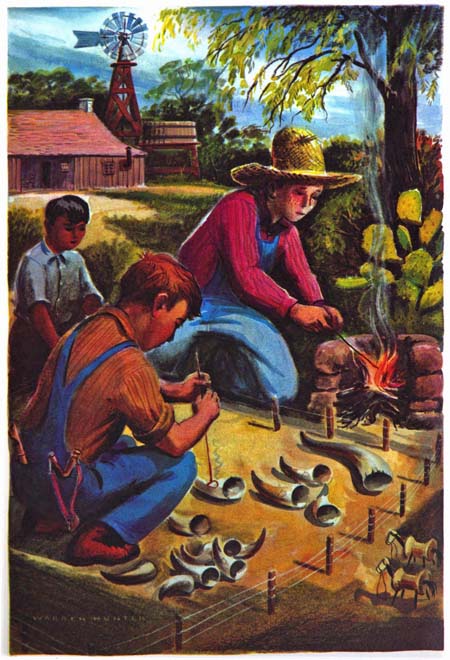
There were toy pistols and airguns, but a new pair of rubbers for a nigger-shooter gave just as much satisfaction. At one time we got more satisfaction from lead bullets gouged out of live oak trees than from any other form of shooting. Our house was on the edge of a grove of scores of live oak trees, some of them very large and old. When Uncle Ed Dubose, my mother’s half brother, came in the fall to hunt and again at Christmas time with all the family, he freely spent ammunition perfecting his marksmanship. His targets were tree trunks. He was an indefatigable treasure-hunter also, but he never found a bonanza comparable to that he left us children in the form of lead.
From it, from solder melted off tin cans, and from now and then a haul of babbitt found in wornout windmills, we minted dollars. We melted our metal in a large iron spoon over an outdoor fire and poured the liquid into a round wooden bluing box, wherein it quickly cooled and solidified. (Bluing for laundry in those days came in powdered form, for dissolving in water—in wooden boxes, with tops that screwed on, about the diameter of a dollar.) This free coinage was limited only by the supply of crude metal. The more canned goods we consumed and the more old bullets we could find, the higher the rate of coinage. The two principal uses the dollars had were for pitching—into holes in the ground—and for buying cattle, horses, sheep, and goats from each other.
Each of us had a play ranch enclosed by miniature fences—twine (our barbed wire) strung on sticks stuck into the ground like posts. Our cattle were tips of horns that had been sawed off cattle at the chute in the big picket cowpens about a hundred yards from the house. Our horses were spools from which my mother and neighbors had used the thread in endless sewing; our goats were empty snail shells; our sheep were oak galls. Sheep and goats were very plentiful and, therefore, had a low value; cattle and horses were harder to come by.
With running irons made of baling wire and heated red hot in a fire, we branded the cattle, sheep, and horses, but could not brand the snail-shell goats. We made long trains of flat rectangular sardine cans, coupled together by pieces of wire, to haul the stock from ranch to ranch. Our dog, Old Joe—named after Beautiful Joe, the wonderful hero of a favorite book—made a very unsatisfactory engine to pull the freight train. We hitched green lizards, snared with the hair of horsetail, to a single sardine can or to a cardboard matchbox that served as a wagon. Lizards never make tractable teams.
This ranching, with all of its ramifications, was not primarily Christmas play. It went on more in the summer than in the winter, but no Christmas toys could compete with it. Certain Christmas books added to prolonged play.
We children always knew positively that there would be books on the Christmas tree or in our stockings. We always wanted particular titles, and we had the before-Christmas pleasure of speculating on what known and unknown books Santa Claus might bring. I don’t remember what Christmas it was that Ivanhoe came to make knights of us boys. Old Stray, an irritatingly gentle horse that could hardly be forced out of a walk, enriched the flowering of our knighthood. Swiss Family Robinson made us into cave-dwellers. We dug our own cave into the bank of Long Hollow, some distance below the house.
I wasn’t yet reading when for Christmas I received an illustrated book, with a linen cover, about an owl that hooted. On demand my father read it aloud over and over. We could hear owls hooting in the live oaks many nights of the year, and my father could talk owl talk. Every time he read the book he had to tell us what the owl says, in words long drawn out from deep down: “I cook for myself. Who cooks for you-all?” There are very few conversationalists to whom I had rather listen than to a hoot owl, and often to this day his lonely and beautiful who-ing takes me back to a Christmas of childhood, to a child’s book, and to my father’s voice.
There were no commercial Santa Clauses in the country, so far as I know. The only Santa Claus for us was my father. At an early age I learned his identity, but that knowledge had no effect on the great illusion, any more than knowing that a grown woman could not literally live in a shoe had on the Mother Goose fact that there was an old woman who lived in a shoe—and she had so many children she didn’t know what to do.
My father cut the Christmas tree out in the pasture—a comely live oak or maybe a “knock-away” (anacahuita)—and brought it in secretly. After it was hung with gifts and lighted with little colored candles and we had all gathered to behold it, Santa Claus would bound in, all in white and red, as cheery in his ruddy complexion, reindeer country manners, other-world talk, and contagious spirits as the Saint Nicholas of “The Night before Christmas.” In disguised voice he called out the names on the packages and added joy to the gift in the way he presented it. Then he would disappear, and presently Papa would come in and claim his own presents with as much eagerness as we had received ours.
“The gift without the giver is bare.” Gifts can be manufactured, some beautiful, many useful, but giving-out feelings can’t be—though they can be cultivated. The love and cheer associated with Christmas will always be the best thing about it. How often just a good word that conveys the word-giver’s generosity of spirit enriches people! I remember the “Merry Christmas, sir!” of a gray-haired woman scrubbing stone steps at a college in Cambridge, England, during the war; and recollection of her sturdy, cheerful, kind nature brightens my world. I can hear my mother’s “Christmas Gift” or “Merry Christmas” as I write these words. Whoever heard her greeting received a gift, for she meant every syllable of it, felt every tone in it.
Sunrise, starlight, silence of dusk are never trite. Generous feelings and cheering words are never trite. Merry Christmas!

2
In memory as well as in actuality, Christmas is the time for coming home. Many a father lives for these homecomings of a scattered brood, but it is the mothers who make them. Fay Yauger’s “I Remember” suggests something of almost universal contrast:
My father rode a horse And carried a gun; He swapped for a living And fought for his fun— I remember his spurs Agleam in the sun. My father was always Going somewhere— To rodeo, market, Or cattleman’s fair— I remember my mother, Her hand in the air.
My own mother has been dead five Christmases now. She was eighty-seven years old when she died and had been a widow for twenty-eight of those years. Maybe every mother is a matriarch; matriarchy was very strongly pronounced in mine. She invariably wanted her children and then grandchildren and great-grandchildren home at Christmas, and they generally got there. If I live to be a hundred, at every Christmas I’ll be remembering the brightness of her face, the eagerness of her greeting, the love in all her conduct—including cooking.
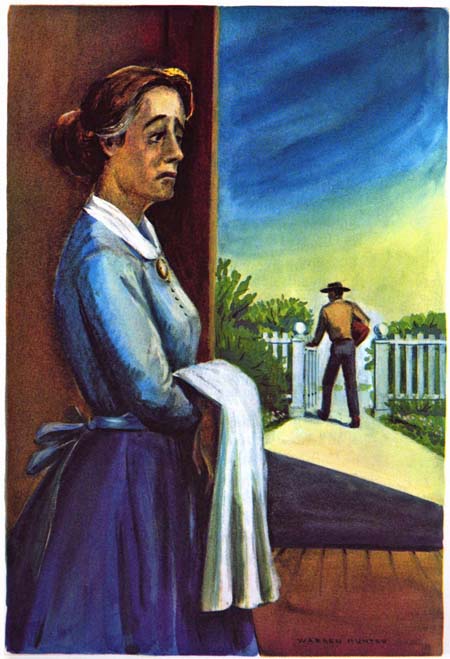
There was a kind of homecoming in our family—the returning of a presence without the immediate returning of the person—that seems to me to belong to Christmas, though it did not actually occur at that season. Not long after the United States entered the First World War, my mother and father had three sons and a daughter in the service. The baby of the family, Martha, was still in school and so was Henry, the youngest son, eighteen years old. My mother was thinking how she would have him for a time at least, as a stay while she cared for a sick husband and her own aged mother.
During World War I, millions of youths who joined the army volunteered. One day Henry came to my mother and said, “Mama, I wish you wouldn’t feel as you do about my enlisting. I want to go. I feel like a slacker staying at home.”
“Son,” she replied—and it was never her nature to take all day to make up her mind—“if you feel that way, go ahead and enlist. I’d rather you’d go and never come back than stay home feeling like a slacker.” Nor would it ever have occurred to her to try to pull wires to get him into a soft place.
Henry joined the Marines and within a few weeks was across the Atlantic. He was the only one of us four brothers who got a shot at the Kaiser’s young Hitlers, but when he was fighting in the Argonne, he wasn’t calling himself lucky, I guess. In October, 1918, Mama had a letter from him and knew he was somewhere on the front.
November 11 and the Armistice came. I had been in France myself a few weeks at that time. I can still hear and see the French peasants around the artillery camp where I was stationed, going about all day saying to each other and to any American soldier they met, “Fini le guerre, fini le guerre—The war is finished, the war is finished.” Some had tears in their eyes. They were in a kind of daze. They were in a transport as if peace on earth and good will to all men had suddenly arrived to end all wars. They were kind and simple people, like the masses of people of all nations, whether red, white, black, yellow, or brown.
The Armistice had been declared and battling had ceased. November passed, and no word from Henry. Had he survived? One by one the days of December passed and Christmas came, little sister Martha the only child at home, and no word of assurance from Henry and no dreaded word from the War Department either. One by one the long nights of January and the days made longer by waiting for a letter that did not come, passed.
Nearly every family in Beeville had a boy in the service. A few were not coming back. Some had come. The others had been heard from. Everybody knew that Henry’s whereabouts were unknown. The post office had been so besieged over the telephone, every day and Sunday too, with inquiries as to whether a letter had come from this boy or that, the inquirers too eager to wait for the mail, that the postmaster ordered the phone taken out. He was a good friend of my family.
One day in February, 1919, my mother answered the ring of the telephone in her house. A post-office clerk was calling. The postmaster, he explained, had sent him across the street to telephone from a store. The postmaster wanted my mother and father to know that a letter had just arrived—from Henry. Yes, from Henry, postmarked U. S. Army of Occupation, in Germany.
With Mama and Papa in the house at this hour were an infant grandson, lying in a baby buggy, and his mother, Elizabeth, my brother Lee’s wife, Lee being in the Air Corps.
“I can go faster than anybody else,” Elizabeth cried.
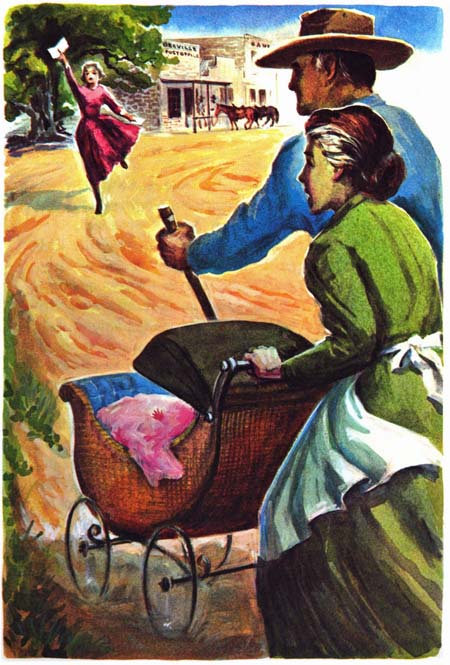
The post office was about four blocks away. As she tore out, Mama and Papa followed as rapidly as they could, pushing the baby buggy. There was no pavement to roll it over. The streets were sandy and gullied, but the baby buggy was more than halfway to the post office when Elizabeth met it coming back. She was running, hand stretched out holding a letter that had already been torn from the envelope.
There in the middle of the street the little group read it through—a father enfeebled beyond his years by a disease that was soon to carry him off, a young kinswoman of eager sympathy, and a mother, still wonderfully vigorous, who had said, “Go, son. I’d rather you’d go and never come back than stay home feeling like a slacker.” I asked her years later for her definition of bravery. “A brave person,” she came back, with steel-spring energy, “is a person who is scared to death and goes ahead anyway.”
I don’t remember now why no letter had come from Henry. Anyway, a letter now brought him home in safety and changed the world for a few people who had been waiting in utter anxiety.

3
This story, which is a true one, goes back to the days of oxen—a time and a tempo in which people
could stand beneath the boughs And stare as long as sheep and cows.
Many a man and boy, and many a woman and girl too, had a strong affection for oxen reliabilities bearing such names as Old North and Crump, Tom and Jerry, Bigfoot Wallace and Jim Bowie, Bully and Blackie.
Take Old Samson and the rollicky crew that drove the freight train he helped pull. It was carrying supplies west from Jefferson on the Louisiana line. The wagon to which Samson was yoked happened to be loaded with bacon and barrelled whiskey. One day he went lame. The next morning a bullwhacker suggested that he be shod with bacon rind. Accordingly the rinds were cut off two sides of salt pork and put on Samson for shoes. While he was being held, the ingenious whacker suggested Samson would feel more at ease in the strange footgear if he had a dram. A quart bottle was filled out of a barrel and poured down Samson’s throat. “Well, sir, that old ox licked out his tongue and smacked his lips and went against the yoke. For a while, with his new bacon-rind slippers and morning dram, he was as frisky as a young colt. He tried to pull the whole load by himself.”
Some drivers of oxen were more noted than the most noted oxen. Not long after Texas joined the Confederacy, a youngster named Tim Cude went from Live Oak County to enlist in the Army. Although he was only sixteen years old, his way with oxen was a community wonder—especially the power of his voice over them. It was a voice young and lush, but strong, without the gosling quality. He did not charm the oxen by whispering—horse-charmer style—in their ears.
Brindle and Whitey were his wheelers, Sam Houston and Davy Crockett, the leaders. They were steers of the old-time Texas Longhorn breed, and they could pull a log out of its bark. When Tim commanded them, they would go to their places to be hitched to wagon or plow. Tim was partial to Brindle, and when he put a hand over the ox’s head, the ox would often show his pleasure by licking out his tongue. The four oxen were the last inhabitants of the little Cude ranch that Tim told good-by when he left to fight the Yankees. He was an only child. He did not realize what emptiness he left behind him. He seldom wrote to relieve it.
Months after Appomattox, his mother and father learned that he was still alive at Lee’s surrender. Tim Cude was a mature man now, strong and rangy with a full-grown beard. More months, then a year, then two years, dragged by, and still Tim did not come home, and there was no word from him. At first his father and mother talked with high hopes of his coming. Then, gradually, they came to saying little, even to each other, about his return. They still nursed a hope, but the heavy conviction settled down on them that Tim must be among the many other boys in gray who would never come back home. Their hope grew gray and secret, without confidence. The days went by as slow as laboring oxen walk.
In the late spring of 1867 Mr. Cude put a few beeves in a herd going north. Six months later the owners of the herd returned and paid him the first money he had seen in years. The aging couple needed the money to buy necessities with, but Mr. Cude had a hard time persuading “mama” to go with him down to Powderhorn on the coast for the purchases. “Tim might come while we are gone,” was her only argument. Mr. Cude’s argument that, if he came, he would stay until they got back, had slight weight with her. She wanted to be there. Mr. Cude would not argue, not even to himself, much less to her, that Tim would never come, but he often reasoned gently that it was better for them both to be resigned.
It was in December before Mrs. Cude finally consented to go. They took a load of dry cow-hides with them, and as the oxen pulled them south at the rate of about two miles an hour, they went over their plans again and again for spending the money.
The plans cheered them. They would have plenty of real coffee now, instead of tea from parched acorns and corn, and a new coffee grinder that would do away with the labor of pounding the grains in a sack with a hammer. Their old coffee mill was absolutely worn out. They would get sacks of flour and have real flour bread. “You remember how Tim always likes flour gravy,” Mrs. Cude said. She would have enough calico for three new dresses and a sunbonnet, besides a tablecloth; he would have new boots, new hat and breeches, and percale for sewing into shirts. “I’ll get some blue for Tim,” Mrs. Cude said. There would be a new plow for the cornpatch and lumber for a gallery to the frame house, so hot in the summer.
It took them five or six days to get down to Powderhorn, and then two days to buy everything and load the wagon. On the way back Mrs. Cude kept wishing they’d make better time, but the four old tortoise-stepping oxen never moved a foot faster. “Perhaps Tim came home today,” Mrs. Cude would say at the evening camp. “I dreamed last night that he came just after dark,” she’d say over the morning campfire, always burning long before daybreak. In all the dragging months, months adding themselves into years, no day had dawned, no night had fallen, that she had not made some little extra preparation for her boy’s coming home. In all the period of waiting, this was the first time she had not been there to welcome him. As she approached the waiting place now, the hopes of more than fourteen absent days and of more than fourteen absent nights were all accumulated into one hope. Perhaps Tim had come. Mr. Cude shared the hope, too, but it hurt him to see “mama disappointed,” and he never encouraged day-dreams.
At last they were only six miles from home. Christmas was only three days away. Then the oxen stalled in a mudhole at the crossing on La Parra Creek. For an hour Mr. Cude struggled and worried with them, trying to make them make the supreme pull. Mrs. Cude threw all her strength on the spoke of one wheel. Finally Mr. Cude began the weary business of unloading some of the freight and carrying it on his back out of the creek.
Then suddenly they were aware of a man, dismounted from the horse beside him, standing on the bank just ahead. Being down in the creek, they could not have seen his approach. His frame, though lank, was well filled out, his face all bearded, his clothes nondescript. In his posture was something of the soldier. Nearly all Southern men had, in those days, been soldiers. For a second he seemed to be holding something back; then he gave a hearty greeting that was cordially responded to.
“Those look like mighty good oxen,” the young man said, coming down, as any stranger in that country at that time would come to help anybody in a tight.
“They are good oxen, but they won’t pull this wagon out now,” Mr. Cude answered. “I guess they’re getting old like us. We been working them since before the war.”
The stranger had moved around so that he was very near the wheel oxen, which he faced, instead of the driver and his wife. His hand was on Brindle’s head, between the long rough horns, and the old ox, whose countenance was the same whether in a bog hole or a patch of spring tallow weed, licked out his tongue.
“I believe I can make these old boys haul the wagon out,” the man said.
“They wouldn’t do any better for a stranger than for their master,” Mr. Cude answered.
“There’s only one person who could get them to pull,” added Mrs. Cude. “That’s our boy who went to the war.”
“Did he know oxen?” the young man asked out of his beard.
“Oh, yes, and they knew him. They liked him.”
Then for a little while there was silence.
As Mr. Cude began drawing up his rawhide whip, again the offerer of help, pleading now, asked for a chance to try his hand.
“Very well,” Mr. Cude agreed slowly, “but every time you try to make ’em pull and they don’t budge the wagon, they’re that much harder to get against the yoke the next time.”
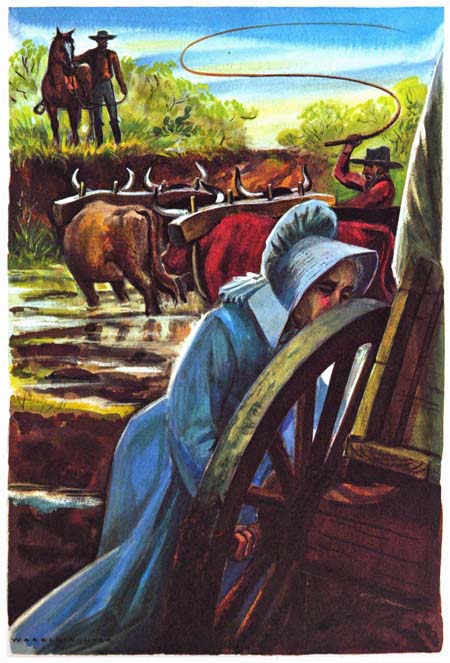
The young man asked the names of the oxen and got them. Then he took the long whip, not to lash the animals—for that was not the whip’s function—but to pop it. He swung it lightly and tested the popper three or four times, as if getting back the feel of something long familiar that had been laid aside. Then he curved the fifteen feet of tapering plaited rawhide through the air—and the ringing crack made the sky brighter. At the same time he began calling to the oxen to come on and pull out. He talked to Brindle and Whitey and Sam Houston and Davy Crockett harder than a Negro crapshooter talking to his bones.
The oxen, without a jerk, lay slowly, steadily, mightily, into the yokes. The wheels began to turn. The whip popped again, like a crack of lightning in the sky, and the strong voice rose, pleading, encouraging, confident, dominating.
The oxen were halfway up the bank now. They pulled on out, but nobody was talking to them any longer. No welcome of feast and fatted calf ever overwhelmed a prodigal son like that, initiated by four faithful old oxen, which Tim Cude received from his mother and father on the banks of an insignificant creek in a wilderness of mesquite. All the gray in the world was suddenly wiped out by sunshine, and all the mockingbirds between the San Antonio River and the Rio Grande seemed to be singing at once.
The oxen, silent and slow, kept on pulling down the road.