THE KINGFISHER OR HALCYON BIRD
Reading edition
WITH THE WATER WATCHMAN
"Please, Jack," begged Phyllis.
"Girls always talk," replied Jack.
"I will not say a word to you—indeed I will not."
"Well, if you spoil my fishing—" began Jack.
"And I'll pick thimbleberries for our lunch," said Phyllis, eagerly.
So it happened that a small girl in a great sunbonnet followed a small boy with a still larger straw hat and a fishing-pole and line, out of the back gate and down the lane.
True to her promise, Phyllis said nothing, but trudged along behind Jack with wide open, watchful brown eyes.
By and bye the children came to a pond of shining, clear water. How still everything seemed, how brightly the sun shone!
"Now if you talk you'll scare the fish," said Jack, with an air of great importance.
"I will not talk," Phyllis whispered back, shutting her lips very tightly and sitting down beside her brother with a little sigh.
Jack threw his line—Phyllis watched with awe. They sat for a moment waiting for a "bite."
Then Jack jerked the line up sharply, not so much because he thought he had caught something, as because he hoped he would catch something.
"I don't believe there are any fish here," he grumbled at last.
But Phyllis's bright eyes had caught sight of something and she forgot all about the fishing and her resolve not to speak.
"Look!" she cried, pointing to a fallen tree-trunk which hung over the water.
On a branch sat a bird. He was considerably larger than a robin.
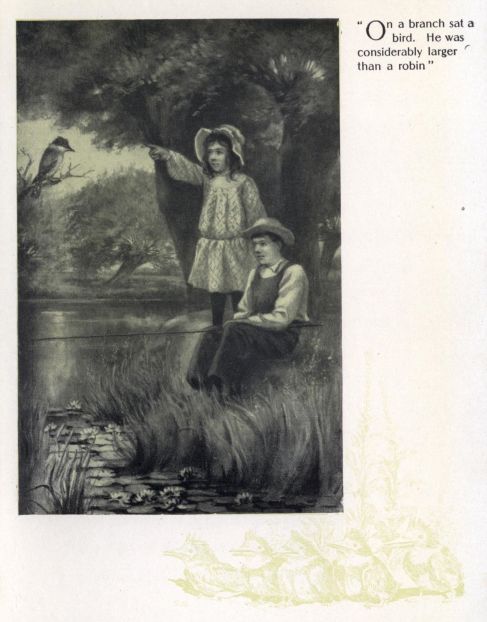
"On a branch sat a bird. He was considerably larger than a robin"
On the top of his head was a tall crest, which reached to the nape of his neck.
His back and the entire upper part of his body was blue. His wings and short tail bore spots and bars of white.
The lower part of his body was white and across his breast ran two bands of blue.
"His bill is longer than his head!" laughed Phyllis. "What a funny big head and what funny little feet! Who is he, Jackie?"
"A kingfisher!" Jack replied.
"What is he doing?" asked Phyllis.
"Fishing," said Jack, shortly.
In a moment Jack spoke again.
"There must be fish here if Mr. Kingfisher is on the lookout. He is a famous old fisherman. He could not live without fish to eat. Did you notice the white spot above each eye?"
Encouraged by the sight of the other fisherman, Jack again cast his line and waited for a bite.
Phyllis watched the bird. Suddenly it seemed to drop from the branch. It dived into the water.
There was a great flutter and splash—a struggle. Then the bird in the blue and white uniform perched again on the old branch.
The children watched eagerly.
In the bird's strong bill was a scaly, glittering fish. It wriggled and flopped helplessly, but could not escape.
The bird held the fish firmly in its strong grasp, raised his head and struck the fish three or four sharp knocks against the branch. Then the fish wriggled no longer.
"He can never swallow that big fellow!" cried Jack, forgetting his own fishing. "I have seen kingfishers swallow minnows alive and whole, but that fish is too large for him to manage!"
The bird, however, seemed to think that he could "manage" it. He started to swallow the fish. When it was half-way down his throat it stuck.
With much sputtering and gagging the bird brought the fish up again. But he must have his dinner, and not in the least discouraged, tried again.
He gagged and writhed. The scales and fins stuck in his throat. Up came the fish again.
Four—five times he struggled to swallow the fish. Five times he failed to succeed. Five times the fish-scales glittered again in the sunlight. Such strange wrigglings and twistings the bird made.
"The poor fellow is having an unhappy time with his lunch," laughed the children.
At the sixth effort the fish was safely landed in the bird's stomach.
With a flash of blue wings he circled through the air. He gave a noisy rattling cry as he alighted on a branch nearer to the children.
Again the bird watched the water intently. Again he dived like a flash. Again he bore a fish to the surface and killed it by striking it against the tree.
But this time the kingfisher did not swallow the fish. He rose with it in his bill and flew gracefully away.
The children watched for some time, but the strange blue bird did not return. Then Jack turned again to his fishing.
"I thought you were to furnish the thimbleberries for lunch," he said.
"So I shall," Phyllis replied, snatching up her basket and starting off in the direction of some bushes which she could see.
So Jack was left to his fishing and Phyllis went berrying.
Sure enough the bushes proved to be loaded with beautiful ripe berries. Soon the little fingers were stained quite purple and the little basket was half filled with berries.
As she started to return to her brother, Phyllis passed along the foot of a high bank. She was singing softly to herself when she heard the rattling cry of the kingfisher quite near.
He gracefully swung into sight on wide-spread wings. He bore another fish in his strong bill.
When he saw Phyllis he stopped short and held himself perfectly still in the air while he looked at her.
At length, deciding that she was harmless, he circled past the little girl and entered a small hole on the face of the bank.
"Why!" said Phyllis. "I wonder why he has gone in there. I shall wait for him to return."
So Phyllis waited until the bird came out. Then she held out her basket of berries.
"Will you have some of my berries?" she said. "I'm sure that your throat must be sore from the scratching of those fish-scales. You had to try so many times before you got it down. Tell me, did this last fish also stick in your throat?"
The kingfisher "chuckled" deep down in his throat.
"I do not eat berries," he said. "I usually eat fish. I sometimes eat large insects or shrimps, but I love to fish."
"So does my brother," said Phyllis, politely, glancing at Jack sitting motionless on a rock in the sunshine.
"Why did you go into that hole to eat?"
The kingfisher chuckled again.
"That is my nest," he said. "My wife is in there. I took the fish to her. She can fish quite as well as I, but our eggs are just hatching and she dare not leave them."
"That a bird's nest?" cried Phyllis. "Who made it?"
"Mrs. Kingfisher and I did," was the reply. "We found this fine steep bank when we came from the south in March.
"I began the nest myself. I held myself still in the air before the bank just as I did when I first noticed you. Then I drove my beak into the soft bank with quick plunges. How the clay rattled and rolled and splashed into the water below!
"It was but a very short time before I had a foothold on the bank. Mrs. Kingfisher and I worked very quickly. Soon we dug ourselves out of sight."
"But how do you dig—"
"Oh, just look at my bill, Phyllis. With it I loosen the earth. With my feet I scratch the dirt out in a perfect shower behind me. Our tunnel is so narrow that we could not turn around in it."
"How deep is it?" asked the little girl, pushing back her big hat and peering in.
The kingfisher did not seem to hear her. He just went on with his story.
"Perhaps a little less than two feet from the outside we made a turn to the right. After that we were obliged to bring the earth out in our beaks.
"Two could not work at once. While I worked at the tunnel Mrs. Kingfisher fished. While she worked, I fished. At last the tunnel was eight feet long.
"'That is a very safe distance,' said Mrs. Kingfisher to me. 'Let us dig no more, but make our nest here at the end of the tunnel.'
"We built a wonderful nest," the bird went on, "a fine prickly nest for our little ones. We did not line it with feathers and moss. We carefully arranged a pile of fish-bones and scales at the farthest end of the tunnel. On these bones and scales my wife laid six white eggs. Already four little baby kingfishers have pecked their way out of the white shells. The others will be out soon.
"I must be off about my fishing. Mrs. Kingfisher and I will both be very busy now catching minnows for those blue babies of ours."
With another chuckle and rattle the kingfisher flew away to his fishing station over the pond.
Phyllis picked up her basket of berries and returned to the spot where Jack still sat patiently holding his pole.
"Oh, Jack—" Phyllis began.
"Sh-h-h-h!" whispered Jack. "You promised not to talk. You'll scare the fish away. Girls always talk."
"I'm sorry," said Phyllis. "How many have you now?"
"None—but I've had a nibble several times. I think they'd bite better if the sun would go under a cloud."
"Let's eat our lunch now," begged Phyllis. "Perhaps there'll be some clouds by the time we finish."
As they ate Phyllis told her brother about the kingfisher's nest and babies. When they finished the sky was as blue as ever.
"These are halcyon days," said Jack, looking very wise.
"Wh-a-a-t—?" said Phyllis, wholly puzzled and half frightened at the new word.
"Well, you see father told me about them the other day when we were fishing in this same place.
"It seems that long ago when people were not very wise, they believed all sorts of queer things. They told strange stories about the things which they did not understand.
"In those days kingfishers were called halcyons. Some said these birds made nests which floated on the sea.
"As long as these eggs or birdlings were in the nest, the people said, the sea would remain smooth and the weather fair.
"Ever since then, when we hear any one speak of 'halcyon days,' we know that they mean pleasant happy days."
"Then," laughed Phyllis, "this has been one of the 'halcyon days' even though you failed to catch any fish."
Then two tired little people trudged home through the river reeds and down the lane.
On their way the blue kingfisher flashed by, chuckling harshly deep down in his throat.
THE HALCYON BIRDS
That evening Phyllis opened a new book and on almost the first page she saw something about the halcyon birds.
"Perhaps it is Jack's story," she said. Then she curled herself up on the soft sofa and this is the story she read.
In the beautiful long ago, in the wonderful country of Greece there lived a king, wise and just and peaceful. His people loved him.
The king lived in a marble palace on the top of a low hill. With him lived his wife, the lovely Queen Halcyone.
But though the king was wise and just and good, his heart was sad. There was unrest in the land. Troubles were rife in Greece.
At length one day the king came to the room where Queen Halcyone sat with her maids. They were spinning carefully and happily together.
"My Halcyone—my queen," said the king, "as you know, I am greatly troubled and disturbed. I do not know what is the best thing for me to do. I must seek wise advice from the gods."
Queen Halcyone dropped her distaff and looked in fear at the king.
"I must go," said the king to Halcyone, "on a long journey across the seas. As you know, in the Temple of Apollo there is a wise oracle. To this oracle must I go in search of counsel."
Then the lovely Queen Halcyone's heart was filled with sorrow. She feared that harm might come to the king, whom she loved for his goodness and his kindness.
Halcyone fell on her knees before the king. She begged him to postpone this terrible journey across the seas.
"Indeed," cried she, "there are cruel dangers, O my king! The journey is long and wearisome. Remain at home with me!"
The king smiled pityingly upon his lovely queen. He kissed her gently before he answered.
"It seems to me," he said, sadly, "that there is no other way. I must go."
"Ah, then, I pray, take me also. Let me share the dangers and the weariness."
"You could not—" the king began.
"In truth it would be easier far than to bear the loneliness and dread when you are gone. It would be weary waiting for your return!"
Now the king loved Halcyone. He longed to remain at home with her. But already the boat lay ready for departure—and there was no place for Halcyone.
Already the oarsmen sat at their benches ready to row away. So the king bade Halcyone farewell and stepped on board and quickly pushed off.
With bitter tears Halcyone stood on the bank and watched the king's boat push out from shore.
When it looked but a speck she shaded her eyes with her hand and still watched. But when in the purple distance the tiny speck could no longer be seen, Halcyone turned with a sigh to the marble palace and her maidens.
On and on across the waters the little boat sped. For a time all went well. At night the stars shone. In the morning the sun arose from the blue waters and travelled across a cloudless sky. Gentle winds blew, filling the sails and pushing the little boat quietly on its way.
But one day a change came over the sea. The moaning of the wind was heard. Dark clouds scurried across the sky.
The waves rose high and broke in white crests of foam. The rain poured down. The wind crept up and sprang upon the little boat with fury.
For a time the boat rose and fell with the waves. It pitched and rolled and reeled. Great waves splashed over it, washing the oarsmen overboard.
The masts were torn away. At last the little boat, buried in the trough of the wave, sank beneath the water.
The king and all his crew lay buried deep beneath the deep blue sea.
Weeks passed. Months passed. A year went by.
Queen Halcyone wandered restlessly up and down the shore. With weary eyes she watched the purple distance. But the king did not return.
She prayed to the gods that they would guard and protect the king whom she loved so dearly. She went to the sacred altars of her country, and burned incense there.
When the goddess Juno heard the prayers and saw the tears of the lovely Queen Halcyone, she was sad for her. Juno called to her side the beautiful rainbow messenger, Iris.
"Iris," said Juno, "this night I wish you to go down on your rainbow bridge to the god of dreams.
"Ask him to send to Halcyone a dream which shall tell her of the fate of her husband, the king. It is better that she should know what has befallen him whom she loved than to wander thus in uncertainty."
So Iris, the beautiful messenger, swept down to the god of dreams—and that night Halcyone dreamed that the king came to her and told her his story. He told her how the boat and all therein had long since been buried under the sea.
"Be brave, my Halcyone," said the shade of the dead king. "Be brave and patient, and soon perchance, if the gods will, thou shalt come to me in the land of shades."
When the dream left her, Halcyone sprang from her couch and ran again to the seashore. She stretched out her arms and called aloud to Aeolus, the father of the winds.
"O great father Aeolus," she prayed, "give me wings so large and strong that they will carry me to the spot where the king now lies.
"Hear me, Aeolus! Hear Halcyone, thy child!"
And as she prayed, lo, she rose slowly into the air. The folds of her blue robe enwrapped her.
Halcyone floated out across the sea. Again and again her breast touched the white crest of the waves and left its foam on her throat and on the bosom of her dress.
On and on she sped across the billowy waters. Her wings were firm, strong, untiring.
At last, floating upon the water she spied the form of the king. With a hoarse rattling in her throat she called to him.
With her strong wings outspread, Halcyone hung motionless above the king. Those broken cries came again and again from her throat.
And Juno, looking down from her cloudland home, saw Halcyone kneeling on the waves beside the dead king. She leaned down from her place in the heavens and touched the king's forehead.
Lo! there rose from the water two strong-winged birds in dresses of blue and white.
"Ah," sighed Aeolus, "let us call them the halcyon birds, for the lovely Halcyone, whose love did not fail her.
"Let these birds live ever beside the waters and rear their young in peace and quiet.
"Behold, when Halcyone broods over her little ones I will hold my winds in check. The waters shall be quiet and the sun shall shine merrily.
"And these days of peace and quiet and happiness shall be called 'halcyon days,' for ever."
ALL ABOUT THE KINGFISHER
SUGGESTIONS FOR FIELD LESSONS
Comes north in early March—remains until December, often throughout the year.
Song—harsh, discordant, laughing chuckle or rattle—never musical.
Upper parts blue—wings and tail with white markings—lower parts white with two blue bands across breast—bluish tinge on sides—a white spot in front of each eye.—Head large and crested—bill longer than head—feet small.
Food—principally fish which it obtains by diving and kills by striking against a tree if large, or swallows alive if small.—This food supplemented by larger insects, shrimps, etc.
Nest—tunnelled out of bank—six to eight feet deep—at the extreme end of tunnel is the nest made of fish-bones and scales.
Eggs—pure white—four to six in one brood.