See page 107. A LESSON OF MERCY.
Reading edition
See page 107. A LESSON OF MERCY.
It was the month of January; the fields and houses were covered with snow, and the skaiters and sliders were gliding on the ice; the streets of the towns were covered with snow, and the poor people crowded to the wood merchants,[A] some to buy faggots, while others could only afford to purchase a few billets, just enough to make a little fire in their humble cottages.
Among them was a girl named Margaret, not quite ten years old. She was but poorly dressed, and she shivered with cold.
The little girl stood near a shed where a great many faggots were piled. She looked first at the wood and then at the money in her hand, yet did not enter the shed, but stood shivering in the street.
On the opposite side of the way lived Mr. Basil. His eldest son, Joseph, happened to be at the window and saw this little girl examining the bundles of wood.
After looking at her for a few minutes, he thought she was some workman’s daughter, and might not have money enough to buy the wood she was sent for. He was very sorry for this, and crossed over the road to her.
Joseph. It is very cold, my little girl, and you have neither bonnet nor gloves.
Margaret. I never had any, Sir; but I am not very cold.
J. What are you doing here; do you wish to buy one of these bundles of wood?
M. I should like to do so, but I am afraid that I have not got money enough.
J. For whom do you wish to buy the wood?
The little girl looked down and seemed rather troubled at this question.
J. Did your father or your mother send you for it?
M. No, Sir, I wanted to give it to Old Thomas?
J. Who is Old Thomas?
M. He is our neighbour. He is a mason, and he hurt his leg a fortnight ago, while removing some stones. He is unable to work, and is confined to his bed, and must be very cold.
J. Does he know that you intend to give him a bundle of wood?
M. I have not told him, Sir.
J. My little girl, how did you get this money?
M. It was paid me this morning for a pair of socks which I knit last week.
J. Is that your regular employment?
M. No, Sir, I work at the cotton factory; and my father, and mother, and little brother, work there also.
J. How could you find time to make the socks?
M. They were only small ones; I knit them last week, very early in the morning and during the dinner hour.
J. Then you have worked very hard to help your poor neighbour?
M. Was it not my duty, Sir? has not God told us to do so? [added she, modestly, and not in the boasting way in which some children talk about any good they have done.]
J. Did you buy any wood for Thomas before to-day?
M. No, Sir; last Saturday I had earned three-halfpence, but I lost them while I was running to the shop.
J. I suppose you were very sorry?
M. Why, Sir, I could not help it when they were gone. I hoped God would enable me to be more careful next time.
J. How much money have you now?
M. I have again got three-halfpence, and here they are, quite safe.
J. Well; let us ask what the bundles cost.
The price of each faggot was two-pence, and the wood-merchant said he could not afford to sell them for less. Poor Margaret was very sorrowful when she heard this, and she was going to depart, when Joseph said he would pay the other half-penny.
The little girl was filled with joy. She put down her three-halfpence, then caught up a bundle of wood and ran down the street as fast as her burden would let her. Joseph looked after her, and saw her turn into a court at some distance. He at first thought he would follow her, and go to see Old Thomas, but he recollected it was the time for his drawing lesson, and besides, he saw his father at the window beckoning to him.
“Who was that little girl?” said Mr. Basil.
Joseph told his father what had passed, and went to his drawing. When his lesson was over, he asked his father if he might go and see Old Thomas.
“We will go together, after dinner,” said Mr. Basil.
In the afternoon they went. The poor mason lodged in a small house at the further end of the court. The pavement was covered with snow, except one small space, which had been swept very carefully, and on which a number of birds were picking up some food. Just then little Margaret came out of the house carrying a few crumbs in her hands, which she threw upon the place from which she had swept the snow. The birds flew to a wall just by, and when she was gone they returned to pick up the crumbs.
“I am glad to see you are so kind to these birds,” said Mr. Basil to the little girl.
M. They are such pretty creatures, and now they cannot find any thing to eat in the gardens and fields.
Mr. B. But God takes care of them, he sends you to give them some food. God does not forget even the meanest of his creatures, and it is a pleasure to be of use even to these little birds. But where is the poor mason you spoke about this morning?
The little girl recollected Joseph, and blushed as she opened the door where Thomas lived. Mr. Basil and his son entered, and, after a kind visit to the old man, they returned home.
As they entered the house, Mr. Basil heard a noise in the garden, and looking over the pales, he saw a lark with its foot caught in a trap of bricks. The poor bird made a noise as if in pain, and tried in vain to get released.
Mr. Basil went to the place, and found that a brick had caught the poor lark by the leg, and crushed its foot.
“How cruel,” said he; and, calling the servant, asked who had set the trap. He was very sorry to hear that Joseph had made it that morning.—He then took the lark, went into the house, and called his children.
“See,” said he to Joseph, shewing him how the poor lark was hurt, “see the effects of your cruelty. This poor little creature was hungry, it came to our house to pick up something which was of no use to us, and you have been the means of breaking its leg, and causing it to suffer as you see.”
The children were all very sorry, when they saw how the poor lark had its leg crushed, and how much pain it suffered.
“It shall suffer no more pain;” said Mr. Basil, killing the poor bird. “It is lawful for us to take the life of animals when we need them for food, but we are to be very careful not to put them to more pain than can be avoided. There was no occasion to catch this lark, and still less to set a trap for it, in which it might suffer much pain, for a very long time. Here,” added he, giving the bird to Joseph, “look at it; think how much it suffered; this is your work to-day; compare it with what the little girl has done! My boy, you were right in being kind to her: but how inconsistent your cruel conduct towards the poor birds!”
Joseph could not reply. He felt how cruelly he had acted, when he saw how the poor bird’s leg was crushed, and he determined never to set such a trap again. I hope all my readers will form the same resolution. In the evening, his father spoke again respecting the bird. “Please, Sir, not to say any more about it,” said Joseph; “I see how wrong I acted, and have been quite ashamed when I compared my conduct with that of the little girl.”
Mr. B. Tell me how you could be so cruel.
J. I had no idea the trap would have made a poor bird suffer so much; I thought it would have been killed at once.
Mr. B. But why should you desire to take away the life of a poor bird? It is true, that God has given power to man over all animals, and that we may deprive them of life when we need them for food. But you did not want to satisfy your hunger, nor was it your means of getting a livelihood, as is the case with some persons: how could you be so thoughtless?
J. Papa, I forgot myself this morning.
Mr. B. How so?
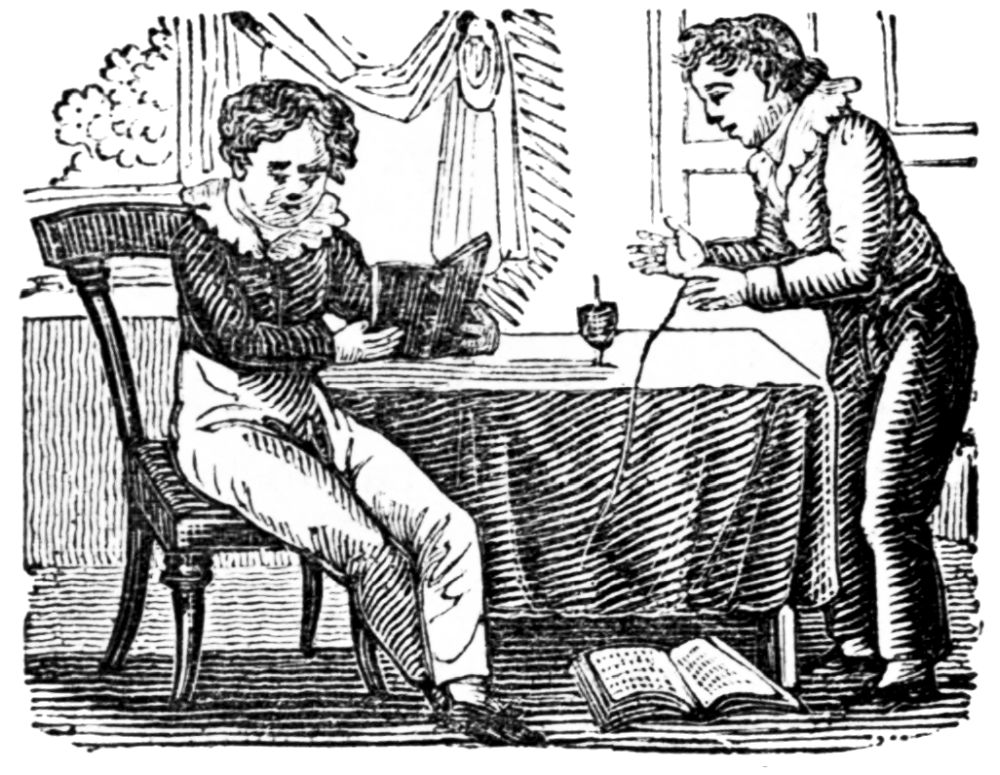
J. I was cross when I got up, and then felt uncomfortable, and did not like to pray and read my Bible; and I began to quarrel with William, who wished to learn his lesson. I threw down my book on the floor, and spun my humming top. After breakfast, I went into the garden, where I saw some birds, and as I had nothing to do, I made the trap to catch them.
Mr. B. Well, Joseph, I am glad to find you are sensible you have done amiss. When the day begins badly it seldom passes without something wrong. What has happened to-day should be a lesson to you; remember to watch over your heart. Think of Christ; he was “gentle, meek, and mild:” let your conduct be in all things as becometh the gospel of Jesus Christ, who suffered for our sins, to purify our hearts, and to fill us with love to him and all around us.
Joseph did not forget his father’s words, and at night he prayed that he might be made more like the blessed Son of God while upon earth.
He began the next day in a very different manner, and after breakfast, asked his father to let him go and see poor Old Thomas.
Mr. B. Willingly; and here is a bundle of things your mother was going to send to the little girl; you may take them, and some tracts, and tell her to ask her parents to let her come to see your mother to-morrow morning.
As Joseph passed along the court, he saw that the place was again cleared from the snow, and the birds were hopping about it. He thought of the poor lark.
Thomas was better, and able to stand. He told Joseph how kind Margaret had been. “You cannot think,” said he, “what a good girl she is. She is so attentive, so gentle, and so patient, that it is very plain her chief delight is in doing good to others.”
J. I suppose her parents have instructed her carefully?
T. They have nothing but their own labour to depend upon, but they have the fear of the Lord, and that is better than riches. They have brought up their children in his ways. If God had not sent them to be my neighbours, what would have become of me?
J. Margaret brought you some wood yesterday, did not she?
T. Yes, Sir; and her mother has told me how hard she worked to earn this money. Good girl! out she is always the same: she cannot see others in trouble without trying to do something to comfort them. Even dumb creatures share her kindness. She collects every crumb for “the dear pretty birds,” as she calls them.
J. It is very happy for a child to be born with such a kind disposition.
T. Oh, Sir, it is not by nature that she has this kind disposition. I knew her from a baby; and, till she was seven years old, she was just as thoughtless as other children: but since that time she has, by the grace of God, become very different.
J. Do you suppose she really loves Christ?
T. I am as sure of it as one person can be respecting another. I fully trust that Margaret is a child of God, and that her heart has been changed by his grace. Our Lord said, “by their fruits ye shall know them;” and an evil tree cannot bring forth those good fruits which God requires.
Joseph was struck with this account of Margaret. He could not help again comparing her conduct during the day before with his own, and he felt humbled by the comparison, but he determined to pray more earnestly for divine grace than he had ever yet done.
As Margaret was at the factory, Joseph left the bundle with Thomas, gave him some books suited for the afflicted, desired him to deliver the message, and returned home.
As he passed along the court, he looked at the birds once more, and took from them another lesson of mercy. “Ah,” said he, “it is very true that we are naturally cruel and hard-hearted. Real love to the bodies and souls of our fellow-creatures, can only be found in a heart which ‘has been changed by divine grace, and which has felt love for the Saviour;’ and those who love him will not be cruel, even to birds and beasts.”
Joseph did not forget the lessons he had received; he was more earnest in his prayers at the throne of grace. His conduct soon shewed that his prayers had been heard and answered: even as our Lord promised,
“ASK AND YE SHALL RECEIVE.”