Front matter (continued 4)
Reading edition
"Lord forbid that I should want anything for not standing in Pip's way," said Joe, staring.
"Lord forbidding is pious, but not to the purpose," returned the lawyer. "The question is, Would you want anything? Do you want anything."
"The answer is," returned Joe, sternly, "No."
"Then I am instructed to communicate to him," said Mr. Jaggers, throwing his finger at me, sideways, "that he will come into a handsome property. Further, that it is the desire of the present possessor of that property, that he be immediately removed from his present sphere of life and from this place, and be brought up as a gentleman—in a word, as a young fellow of great expectations."
My dream was out; my wild fancy was surpassed by sober reality; Miss Havisham was going to make my fortune on a grand scale!—at least, so I thought at the time.
"Now, Mr. Pip," pursued the lawyer, "I address the rest of what I have to say to you. You are to understand, first, that it is the request of the person from whom I take my instructions, that you always bear the name of Pip. You will have no objection, I dare say, to that easy condition. But if you have any objection, this is the time to mention it."
I gasped, but had no objection.
"The second condition," he resumed, "is that you are not to know the name of your benefactor, for the present. I will act as your guardian and see that you are educated properly. You desire an education, don't you?"
I replied that I had always longed for it.
"Good. Then we will see to getting you a tutor. But first you should have some new clothes to come away in. When will you be ready to leave? Say this day week. You'll want some money. Shall I leave you twenty guineas?"
He produced a long purse, with the greatest coolness, and counted them out on the table and pushed them over to me. This was the first time he had taken his leg from the chair. He sat astride of the chair when he had pushed the money over, and sat swinging his purse and eyeing Joe.
"Well, Joseph Gargery? You look dumbfoundered?"
"I am!" said Joe, in a very decided manner.
"It was understood that you wanted nothing for yourself, remember?"
"It were understood," said Joe. "And it are understood. And it ever will be similar according."
"But what," said the lawyer, swinging his purse, "what if it was in my instructions to make you a present, as compensation?"
"As compensation what for?" Joe demanded.
"For the loss of his services."
Joe laid his hand upon my shoulder with the touch of a woman. I have often thought of him since, like the steam-hammer, that can crush a man or pat an egg-shell, in his combination of strength with gentleness. "Pip is that hearty welcome," said Joe, "to go free with his services, to honor and fortun', as no words can tell him. But if you think as Money can make compensation to me for the loss of the little child—what come to the forge—and ever the best of friends—"
Oh, dear, good Joe, whom I was so ready to leave and so unthankful to, I see you again, with your muscular blacksmith's arm before your eyes, and your broad chest heaving, and your voice dying away. Oh, dear, good, faithful, tender Joe, I feel the loving tremble of your hand upon my arm, as solemnly this day as if it had been the rustle of an angel's wing!
But at the time I was lost in the mazes of my future fortunes, and could not retrace the by-paths we had trodden together. I begged Joe to be comforted. Joe scooped his eyes with his disengaged wrist, as if he were bent on gouging himself, but said not another word.
After the lawyer had taken his leave, Joe and I went into the kitchen, where we found Biddy and my sister, and told them of my good fortune.
They dropped their sewing and looked at me. Joe held his knees and looked at me. I looked at them, in turn. After a pause they heartily congratulated me; but there was a certain touch of sadness in their congratulations that I rather resented.
Now that I was actually going away I became quite gloomy. I did not know why, but I sat in the chimney corner looking at the fire, my elbow on my knee; and while the others tried to make the conversation cheerful, I grew gloomier than ever.
But the bright sunlight of the next morning dispelled my doubts and fears, and I began to count the days eagerly. I went down to Trabb's, the tailor's, and got measured for a wonderful suit of clothes, much to the consternation of Trabb's boy, who thought himself equal to any blacksmith that ever lived. Then I went to the hatter's and the bootmaker's and the hosier's, and felt rather like Mother Hubbard's dog, whose outfit required the services of so many trades. I also went to the coach-office and took my place for seven o'clock Saturday morning. And everywhere about the village the news of my great expectations preceded me and I was heartily stared at.
Uncle Pumblechook was especially officious at this time. He acted as though he were the sole cause of all this.
"To think," said he, swelling up, "that I should have been the humble instrument of this proud reward."
He thought, like all the rest of us, that Miss Havisham was my unknown benefactor. It was a natural mistake, as she had been kind to me in her way; and I had seen the lawyer at her house. But it was a mistake after all and led to other unhappy blunders ere I learned the truth.
For, many years afterward, I found that "my convict"—the man I had helped down in the churchyard—was none other than the friend who had left me this fortune. He had escaped again from the hulks and, coming into a considerable property, had arranged with the lawyer to use it in making a gentleman out of the little boy he had found crying on the tombstone. But, as I say, none of us knew it or suspected it at first.
And now, those six days which were to have run out so slowly, had run out fast and were gone, and to-morrow looked me in the face more steadily than I could look at it. As the six evenings had dwindled away to five, to four, to three, to two, I had become more and more appreciative of the society of Joe and my sister and Biddy. On this last evening, I dressed myself out in my new clothes, for their delight, and sat in my splendor until bedtime. We had a hot supper on the occasion, graced by the inevitable roast fowl, and we had some flip to finish with. We were all very low, and none the higher for pretending to be in spirits.
It was a hurried breakfast, the next morning, with no taste in it. I got up from the meal, saying with a sort of briskness, as if it had only just occurred to me, "Well! I suppose I must be off!" and then I kissed my sister, and kissed Biddy, and threw my arms around Joe's neck. Then I took up my little portmanteau and walked out. The last I saw of them was, when I presently heard a scuffle behind me, and, looking back, saw Joe throwing an old shoe after me and Biddy throwing another old shoe. I stopped then, to wave my hat, and dear old Joe waved his strong right arm above his head, crying huskily "Hooroar!" and Biddy put her apron to her face.
I walked away at a good pace, thinking it was easier to go than I had supposed it would be, and reflecting that it would never have done to have an old shoe thrown after the coach, in sight of all the High-street. I whistled and made nothing of going. But the village was very peaceful and quiet, and the light mists were solemnly rising, as if to show me the world, and I had been so innocent and little there, and all beyond was so unknown and great, that in a moment with a strong heave and sob I broke into tears. It was by the finger-post at the end of the village, and I laid my hand upon it, and said, "Good-bye, oh, my dear, dear friend!"
So subdued was I by those tears, that when I was on the coach, and it was clear of the town, I deliberated with an aching heart whether I would not get down when we changed horses, and walk back, and have another evening at home, and a better parting. But while I deliberated, we had changed and changed again, and it was now too late and too far to go back, and I went on. And the mists had all solemnly risen now, and the world lay spread before me. My boyhood was over. Henceforth I was to play a man's part—a man with Great Expectations.
THE STORY OF LITTLE DORRIT
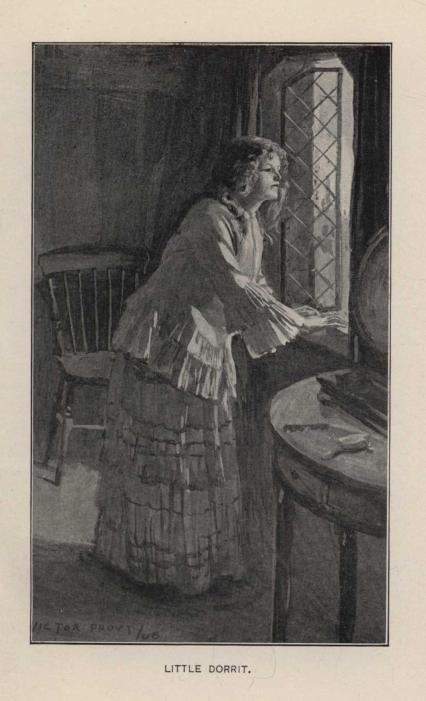
LITTLE DORRIT.
I. THE CHILD OF THE MARSHALSEA
Some years ago when the laws of England were harsher than they are now, there were debtors' prisons, or big, gloomy jails into which men were put, if they couldn't pay what they owed. This was cruel and unjust, for the prisoner was of course cut off from the chance to earn any more money; and so he might linger there for years or even his whole life long, if some friend did not come to his relief. But otherwise the prisoner was given many liberties not found in ordinary jails. His family might live with him, if they chose, and come and go as they pleased.
One of the largest of these debtors' prisons was called the "Marshalsea." One day a gentleman was brought there who had lost his money in business; but so confident was he of speedily regaining his liberty, that he would not unpack his valise, at first. His name was William Dorrit, an easy-going man who had spent his money freely and paid little attention to his tradesmen's bills. Now that he had fallen upon evil days, he thought that his friends would be glad to help him. But as the days and weeks passed with no prospect of aid, he was persuaded not only to unpack his belongings but also to have his wife and two children brought to live with him.
The two children, Fanny and Edward—commonly called "Tip"—were so young when they were brought to the Marshalsea, that they soon forgot any earlier life, and played very happily with other children in the prison yard. Not long after, a little sister was added to their family. She was christened Amy, but was so tiny that everybody called her "Little Dorrit."
Being born in the prison, Little Dorrit was petted and made much of. Every one there seemed to claim her, and visitors were proudly shown "the Child of the Marshalsea."
The turnkey, who was a kind-hearted man, took an especial interest in her.
"By rights," he remarked, when she was first shown to him, "I ought to be her godfather."
Mr. Dorrit looked at the honest fellow for a moment, and thought that he would suit better than some of their false friends.
"Perhaps you wouldn't object to really being her godfather?" he said.
"Oh, I don't object, if you don't," replied the turnkey.
Thus it came to pass that she was christened one Sunday afternoon, when the turnkey, being relieved, went up to the font of Saint George's church, and promised and vowed on her behalf, as he himself related when he came back, "like a good 'un."
This invested the turnkey with a new proprietary share in the child, over and above his former official one. When she began to walk and talk, he became fond of her; bought a little arm-chair and stood it by the high fender of the lodge fireplace; liked to have her company when he was on the lock; and used to bribe her with cheap toys to come and talk to him. The child, for her part, soon grew so fond of the turnkey, that she would come climbing up the lodge steps of her own accord at all hours of the day. When she fell asleep in the little arm-chair by the high fender, the turnkey would cover her with his pocket handkerchief; and when she sat in it dressing and undressing a doll—which soon came to be unlike dolls on the other side of the lock—he would contemplate her from the top of his stool, with exceeding gentleness. Witnessing these things, the inmates would express an opinion that the turnkey, who was a bachelor, had been cut out by nature for a family man. But the turnkey thanked them, and said, "No, on the whole it was enough for him to see other people's children there."
At what period of her early life the little creature began to perceive that it was not the habit of all the world to live locked up in narrow yards, surrounded by high walls with spikes at the top, would be a difficult question to settle. But she was a very, very little creature indeed, when she had somehow gained the knowledge, that her clasp of her father's hand was to be always loosened at the door which the great key opened; and that while her own light steps were free to pass beyond it, his feet must never cross that line. A pitiful and plaintive look, with which she had begun to regard him when she was still extremely young, was perhaps a part of this discovery.
Wistful and wondering, she would sit in summer weather by the high fender in the lodge, looking up at the sky through the barred window, until bars of light would arise, when she would turn her eyes away.
"Thinking of the fields," the turnkey said once, after watching her, "ain't you?"
"Where are they?" she inquired.
"Why, they're—over there, my dear," said the turnkey, with a vague flourish of his key. "Just about there."
"Does anybody open them, and shut them? Are they locked?"
The turnkey was at a loss. "Well!" he said, "not in general."
"Are they very pretty, Bob?" She called him Bob, by his own particular request and instruction.
"Lovely. Full of flowers. There's buttercups, and there's daisies, and there's"—the turnkey hesitated, being short of names—"there's dandelions, and all manner of games."
"Is it very pleasant to be there, Bob?"
"Prime," said the turnkey.
"Was father ever there?"
"Hem!" coughed the turnkey. "Oh, yes, he was there, sometimes."
"Is he sorry not to be there now?"
"N—not particular," said the turnkey.
"Nor any of the people?" she asked, glancing at the listless crowd within. "Oh, are you quite sure and certain, Bob?"
At this difficult point of the conversation Bob gave in, and changed the subject; always his last resource when he found his little friend getting him into a political, social, or theological corner. But this was the origin of a series of Sunday excursions that these two curious companions made together. They used to issue from the lodge on alternate Sunday afternoons with great gravity, bound for some meadows or green lanes that had been elaborately appointed by the turnkey in the course of the week; and there she picked grass and flowers to bring home, while he smoked his pipe. Afterwards they would come back hand in hand, unless she was more than usually tired, and had fallen asleep on his shoulder.
In those early days the turnkey first began profoundly to consider a question which cost him so much mental labor, that it remained undetermined on the day of his death. He decided to will and bequeath his little property of savings to his godchild, and the point arose how could it be so "tied up" that she alone should benefit by it. He asked the knotty question of every lawyer who came through the lodge gate on business.
"Settle it strictly on herself," the gentleman would answer.
"But look here," quoth the turnkey. "Supposing she had, say a brother, say a father, say a husband, who would be likely to make a grab at that property when she came into it—how about that?"
"It would be settled on herself, and they would have no more legal claim on it than you," would be the professional answer.
"Stop a bit," said the turnkey. "Supposing she was tender-hearted, and they came over her. Where's your law for tying it up then?"
The deepest character whom the turnkey sounded was unable to produce his law for tying such a knot as that. So, the turnkey thought about it all his life, and died without a will after all.
But that was long afterwards, when his god-daughter was past sixteen. She was only eight when her mother died, and from that time the protection that her wondering eyes had expressed towards her father became embodied in action, and the Child of the Marshalsea took upon herself a new relation.
At first, such a baby could do little more than sit with him, deserting her livelier place by the high fender, and quietly watching him. But this made her so far necessary to him that he became accustomed to her, and began to be sensible of missing her when she was not there. Through this little gate she passed out of childhood into the care-laden world.
What her pitiful look saw, at that early time, in her father, in her sister, in her brother, in the jail; how much, or how little of the wretched truth it pleased God to make visible to her, lies hidden with many mysteries. It is enough that she was inspired to be something which was not what the rest were, and for the sake of the rest.
And while the mark of the prison was seen only too clearly in her vain, selfish sister, and weak, wayward brother, Little Dorrit's life was singularly free from taint; her heart was full of service and love.
And so, in spite of her small stature and want of strength, she toiled and planned, and soon became the real head of this poor, fallen house.
At thirteen, she could read and keep accounts—that is, could put down in words and figures how much the bare necessaries that they wanted would cost, and how much less they had to buy them with. She had been, by snatches of a few weeks at a time, to an evening school outside, and got her sister and brother sent to day schools during three or four years. There was no instruction for any of them at home; but she knew well—no one better—that her broken-spirited father could no longer help them.
To these scanty means of improvement, she added another of her own contriving. Once, among the curious crowd of inmates, there appeared a dancing-master. Her sister Fanny had a great desire to learn to dance, and seemed to have a taste that way. At thirteen years old, the Child of the Marshalsea presented herself to the dancing-master, with a little bag in her hand, and said timidly, "If you please, I was born here, sir."
"Oh! You are the young lady, are you?" said the man, surveying the small figure and uplifted face.
"Yes, sir."
"And what can I do for you?"
"Nothing for me, sir, thank you," anxiously undrawing the strings of the little bag; "but if, while you stay here, you could be so kind as to teach my sister cheap—"
"My child, I'll teach her for nothing," said the dancing-master, shutting up the bag.
He was as good-natured a master as ever danced to the Insolvent Court, and he kept his word. Fanny was so apt a pupil, and made such wonderful progress that he continued to teach her after he was released from prison. In time, he obtained a place for her at a small theatre. It was at the same theatre where her uncle—who was also now a poor man—played a clarinet for a living; and Fanny left the Marshalsea and went to live with him.
The success of this beginning gave Little Dorrit courage to try again, this time on her own behalf. She had long wanted to learn how to sew, and watched and waited for a seamstress to come to the prison. At last one came, and Little Dorrit went to call upon her.
"I beg your pardon, ma'am," she said, looking timidly round the door of the milliner, whom she found in tears and in bed; "but I was born here."
Everybody seemed to hear of her as soon as they arrived; for the milliner sat up in bed, drying her eyes, and said, just as the dancing-master had said,
"Oh! You are the child, are you?"
"Yes, ma'am."
"I am sorry I haven't got anything for you," said the milliner, shaking her head.
"It's not that, ma'am. If you please I want to learn needlework."
"Why should you do that," returned the milliner, "with me before you? It has not done me much good."
"Nothing—whatever it is—seems to have done anybody much good who comes here," she returned in all simplicity; "but I want to learn, just the same."
"I am afraid you are so weak, you see," the milliner objected.
"I don't think I am weak, ma'am."
"And you are so very, very little, you see," continued the milliner.
"Yes, I am afraid I am very little indeed," returned the Child of the Marshalsea; and so began to sob over that unfortunate defect of hers, which came so often in her way. The milliner—who was not morose or hard-hearted, only newly insolvent—was touched, took her in hand with good-will, found her the most patient and earnest of pupils, and made her a cunning workwoman in course of time.
And so, presently, Little Dorrit had the immense satisfaction of going out to work by the day, and of supplying her father with many little comforts which otherwise he would not have enjoyed.
But her hardest task was in getting her brother out of prison and into some useful employment. The life there had been anything but good for him; and at eighteen he was idle and shiftless, not caring to lift a finger for himself. In her dilemma, Little Dorrit went to her old friend, the turnkey.
"Dear Bob," said she, "what is to become of poor Tip?"
The turnkey scratched his head. Privately he had a poor opinion of the young man.
"Well, my dear," he answered, "something ought to be done with him. Suppose I try to get him into the law?"
"That would be so good of you, Bob!"
The turnkey was as good as his word, and by dint of buttonholing every lawyer who came through the gate on business, he found Tip a place as clerk, where the pay was not large, but the prospects good.
Tip idled away in the law office for six months, then came back to the prison one evening with his hands in his pockets and told his sister he was not going back again.
"Not going back!" she exclaimed.
"I am so tired of it," said Tip, "that I have cut it."
Tip tired of everything. With intervals of Marshalsea lounging, his small second mother, aided by her trusty friend, got him into a variety of situations. But whatever Tip went into, he came out of tired, announcing that he had cut it.
Nevertheless, the brave little creature did so fix her heart on her brother's rescue, that while he was ringing out these doleful changes, she pinched and scraped enough together to ship him for Canada. When he was tired of nothing to do, and disposed in its turn to cut even that, he graciously consented to go to Canada. And there was grief in her bosom over parting with him, and joy in the hope of his being put in a straight course at last.
"God bless you, dear Tip. Don't be too proud to come and see us, when you have made your fortune."
"All right!" said Tip, and went.
But not all the way to Canada; in fact, not farther than Liverpool. After making the voyage to that port from London, he found himself so strongly impelled to cut the vessel, that he resolved to walk back again. Carrying out which intention, he presented himself before her at the expiration of a month, in rags, without shoes, and much more tired than ever.
At length he found a situation for himself, and disappeared for months. She never heard from him but once in that time, though it was as well for her peace of mind that she did not. He was making trades for a tricky horse dealer.
One evening she was alone at work—standing up at the window, to save the twilight lingering above the wall—when he opened the door and walked in.
She kissed and welcomed him; but was afraid to ask him any question. He saw how anxious and timid she was, and appeared sorry.
"I am afraid, Amy, you'll be vexed this time. Upon my life I am!"
"I am very sorry to hear you say so, Tip. Have you come back?"
"Why—yes. But that's not the worst of it."
"Not the worst of it?"
"Don't look so startled, Amy. I've come back in a new way. I'm one of the prisoners now. I owe forty pounds."
For the first time in all those years, she sank under her cares. She cried, with her clasped hands lifted above her head, that it would kill their father if he ever knew it; and fell down at Tip's graceless feet.
It was easier for Tip to bring her to her senses, than for her to bring him to understand what a pitiable thing he had done. But he agreed to help keep it a secret from their father; and Little Dorrit toiled harder than ever, in the hope of one day getting him out again.
Thus passed the life of the Child of the Marshalsea until she became a young woman.
II. HOW THE PRISON GATES WERE OPENED
Among the ladies for whom Little Dorrit sewed by the day was a Mrs. Clennam, a cold, stern person who lived in a cold, stern house. Yet she gave the child plenty of work and paid her fairly well. So Little Dorrit was often to be found in some gloomy corner there, sewing away busily and adding nothing at all to the few far-away sounds of the quiet old rooms.
Mrs. Clennam lived alone, except for a dried-up servant or two, and she herself had lost the use of her limbs. So it is no wonder that the house was gloomy, and that Mrs. Clennam's son Arthur found it so, when he returned from a long visit in India. Arthur Clennam was a young man who had ideas of his own, and who had disappointed his mother by refusing to continue his father's business. They were not in sympathy—which made the house seem all the colder. But he was kind, open-hearted, and impulsive.
Though timid Little Dorrit kept as much in the dark corners as possible, Arthur soon noticed her, and asked one of the old servants who she was. He could learn nothing except that she was a seamstress who came by the day to sew, and who went away every night, no one knew where. The child interested him, and he resolved to follow her one evening and learn where she lived. He did so, and was amazed to see her enter the gate of a large forbidding building,—he did not know what building, as he had been long abroad.
Just then he saw an old man, in a threadbare coat, once blue, come tottering along, carrying a clarinet in a limp, worn-out case. As this old man was about to enter the same gate, Arthur stopped him with a question.
"Pray, sir," said he, "what is this place?"
"Ay! This place?" returned the old man, staying a pinch of snuff on its road, and pointing at the place without looking at it. "This is the Marshalsea, sir."
"The debtors' prison?"
"Sir," said the old man, with the air of deeming it not quite necessary to insist upon that name, "the debtors' prison."
He turned himself about, and went on.
"I beg your pardon," said Arthur, stopping him once more, "but will you allow me to ask you another question? Can any one go in here?"
"Any one can go in," replied the old man; "but it is not every one who can go out."
"Pardon me once more. Are you familiar with the place?"
"Sir," returned the old man, squeezing his little packet of snuff in his hand, and turning upon his interrogator as if such questions hurt him, "I am."
"I beg you to excuse me. I am not impertinently curious, but have a good object. Do you know the name of Dorrit here?"
"My name, sir," replied the old man most unexpectedly, "is Dorrit."
Arthur pulled off his hat to him. "Grant me the favor of half a dozen words. I have recently come home to England after a long absence. I have seen at my mother's—Mrs. Clennam in the city—a young woman working at her needle, whom I have only heard addressed or spoken of as Little Dorrit. I have felt sincerely interested in her, and have had a great desire to know something more about her. I saw her, not a minute before you came up, pass in at that door."
The old man looked at him attentively. "Are you in earnest, sir?"
"I do assure you that I am."
"I know very little of the world, sir," returned the other, who had a weak and quavering voice. "I am merely passing on, like the shadow over the sun-dial. It would be worth no man's while to mislead me; it would really be too easy—too poor a success, to yield any satisfaction. The young woman whom you saw go in here is my brother's child. My brother is William Dorrit; I am Frederick. You say you have seen her at your mother's (I know your mother befriends her), you have felt an interest in her, and you wish to know what she does here. Come and see."
He went on again, and Arthur accompanied him.
"My brother," said the old man, pausing on the step, and slowly facing round again, "has been here many years; and much that happens even among ourselves, out of doors, is kept from him for reasons that I needn't enter upon now. Be so good as to say nothing of my niece's working at her needle. If you keep within our bounds, you cannot well be wrong. Now! Come and see."
Arthur followed him down a narrow entry, at the end of which a key was turned, and a strong door was opened from within. It admitted them into a lodge, or lobby, across which they passed, and so through another door and a grating into the prison. The old man always plodding on before, turned round, in his slow, stiff, stooping manner, when they came to the turnkey on duty, as if to present his companion. The turnkey nodded; and the companion passed in without being asked whom he wanted.
The night was dark; and the prison lamps in the yard, and the candles in the prison windows faintly shining behind many sorts of wry old curtain and blind, had not the air of making it lighter. A few people loitered about, but the greater part of the population was within doors. The old man taking the right-hand side of the yard, turned in at the third or fourth doorway, and began to ascend the stairs.
"They are rather dark, sir, but you will not find anything in the way," he said.
He paused for a moment before opening the door on the second story. He had no sooner turned the handle, than the visitor saw Little Dorrit, and understood the reason of her dining alone, as she always preferred to do.
She had brought the meat home that she should have eaten herself, and was already warming it on a gridiron over the fire, for her father, who, clad in an old gray gown and a black cap, was awaiting his supper at the table. A clean cloth was spread before him, with knife, fork, and spoon, salt-cellar, pepper-box, glass, and pewter ale-pot. Such zests as his cayenne pepper and pickles in a saucer were not wanting.
She started, colored deeply, and turned white. The visitor, more with his eyes than by the slight impulsive motion of his hand, entreated her to be reassured and to trust him.
"I found this gentleman," said the uncle—"Mr. Clennam, William, son of Amy's friend—at the outer gate, wishful, as he was going by, of paying his respects, but hesitating whether to come in or not. This is my brother William, sir."
"I hope," said Arthur, very doubtful what to say, "that my respect for your daughter may explain and justify my desire to be presented to you, sir."
"Mr. Clennam," returned the other, rising, taking his cap off in the flat of his hand, and so holding it, ready to put on again, "you do me honor. You are welcome, sir." With a low bow. "Frederick, a chair. Pray sit down, Mr. Clennam."
He put his black cap on again as he had taken it off, and resumed his own seat. There was a wonderful air of benignity and patronage in his manner.
These were the ceremonies with which he received all visitors.
"You are welcome to the Marshalsea, sir. I have welcomed many gentlemen to these walls. Perhaps you are aware—my daughter Amy may have mentioned—that I am the Father of this place."
"I—so I have understood," said Arthur, dashing at the assertion.
"You know, I dare say, that my daughter Amy was born here. A good girl, sir, a dear girl, and long a comfort and support to me. Amy, my dear, put the dish on; Mr. Clennam will excuse the primitive customs to which we are reduced here. Is it a compliment to ask you if you would do me the honor, sir, to—"
"Thank you," returned Arthur. "I have dined."
She filled her father's glass, put all the little matters on the table ready to his hand, and then sat beside him while he ate his supper. She put some bread before herself, and touched his glass with her lips; but Arthur saw she was troubled and took nothing. Her look at her father, half admiring him and proud of him, half-ashamed for him, all devoted and loving, went to his inmost heart.
The Father of the Marshalsea condescended towards his brother as an amiable, well-meaning man; a private character, who had not arrived at distinction.
"Frederick," said he, "you and Fanny sup at your lodgings to-night, I know. What have you done with Fanny, Frederick?"
"She is walking with Tip."
"Tip—as you may know—is my son, Mr. Clennam. He has been a little wild, and difficult to settle, but his introduction to the world was rather"—he shrugged his shoulders with a faint sigh, and looked round the room—"a little adverse. Your first visit here, sir?"
"My first."
"You could hardly have been here since your boyhood without my knowledge. It very seldom happens that anybody—of any pretensions—any pretensions—comes here without being presented to me."
"As many as forty or fifty in a day have been introduced to my brother," said Frederick, faintly lighting up with a ray of pride.
"Yes!" the Father of the Marshalsea assented. "We have even exceeded that number. On a fine Sunday in term time, it is quite a reception!"
Thus the old man prattled on, proud of his queer distinction, and yet showing traces of the fine gentleman he once was. And while he listened, Arthur felt his heart throb with sympathy for the brave girl, sitting silent across the table, who had so long borne the burdens of this ruined family upon her frail shoulders.
He could not say anything to her, here, but when he rose to take his leave, he asked her by a look to come with him to the gate. He felt he must make some explanation for thus intruding and learning her secret.
"Pray forgive me," he said, when they paused alone at the gate. "I followed you to-night from my mother's. I should not have done so, but, believe me, it was only in the hope of doing you some service. What I have seen here, in this short time, has increased ten-fold my heartfelt wish to be a friend to you."
She seemed to take courage while he spoke to her.
"You are very good, sir. You speak very earnestly to me. But I—but I wish you had not watched me."
He understood the emotion with which she said it to arise in her father's behalf; and he respected it, and was silent.
"Mrs. Clennam has been of great service to me. I don't know what we should have done without the employment she has given me. I am afraid it may not be a good return to become secret with her. I can say no more to-night, sir. I am sure you mean to be kind to us. Thank you, thank you."
She was so agitated, and he was so moved by compassion for her, and by deep interest in her story as it dawned upon him, that he could scarcely tear himself away. But the stoppage of the bell, and the quiet in the prison, were a warning to depart; and with a few hurried words of kindness he left her gliding back to her father.
The next day, Arthur missed Little Dorrit at his home, and wondered if she might be ill. The weather was stormy, but she was not usually hindered by that. So he walked out toward the prison to look for her; and was presently rewarded by seeing her hurrying along in the face of the gale.
She had just reached the iron bridge, some distance from the gates, when his voice caused her to stop short. The wind blew roughly, the wet squalls came rattling past them, skimming the pools on the road and pavement, and raining them down into the river. The clouds raced on furiously in the lead-colored sky, the smoke and mist raced after them, the dark tide ran fierce and strong in the same direction. Little Dorrit seemed the least, the quietest, and weakest of Heaven's creatures.
"Let me put you in a coach," said Arthur Clennam, very nearly adding, "my poor child."
She hurriedly declined, thanking him, and saying that wet or dry made little difference to her; she was used to go about in all weathers. He knew it to be so, and was touched with more pity, thinking of the slight figure at his side, making its nightly way through the damp, dark, boisterous streets, to such a place of rest.
"But I am glad to have seen you, sir," she added shyly. "I did not want you to think that we were ungrateful for your interest and kindness, last night. And, besides, I had something else to say—"
She paused as if unable to go on.
"To say to me—" he prompted.
"That I hope you will not misunderstand my father. Don't judge him, sir, as you would judge others outside the gates. He has been there so long! I never saw him outside, but I can understand that he must have grown different in some things since."
"My thoughts will never be unjust or harsh towards him, believe me."
"Not," she said, with a prouder air, as the misgiving evidently crept upon her that she might seem to be abandoning him, "not that he has anything to be ashamed of for himself, or that I have anything to be ashamed of for him. He only requires to be understood. I only ask for him that his life may be fairly remembered. All that he said was quite true. He is very much respected. Everybody who comes in is glad to know him. He is more courted than any one else. He is far more thought of than the Marshal is." If ever pride were innocent, it was innocent in Little Dorrit when she grew boastful of her father.
"It is often said that his manners are a true gentleman's, and quite a study. He is not to be blamed for being in need, poor love. Who could be in prison a quarter of a century, and be prosperous!"
What affection in her words, what compassion in her repressed tears, what a great soul of fidelity within her, how true the light that shed false brightness round him!
"If I have found it best to conceal where my home is, it is not because I am ashamed of him. God forbid! Nor am I so much ashamed of the place itself as might be supposed. People are not bad because they come there. I have known many good friends there, and have spent many happy hours."
She had relieved the faithful fulness of her heart, and modestly said, raising her eyes appealingly to her new friend's, "I did not mean to say so much, nor have I ever but once spoken about this before. But it seems to set it more right than it was last night. I said I wished you had not followed me, sir. I don't wish it so much now, unless you should think—indeed I don't wish it at all, unless I should have spoken so confusedly, that—that you can scarcely understand me, which I am afraid may be the case."
He told her with perfect truth that it was not the case; and putting himself between her and the sharp wind and rain, sheltered her as well as he could.
"I feel permitted now," he said, "to ask you a little more concerning your father. Has he many creditors?"
"Oh! a great number."
"I mean detaining creditors who keep him where he is?"
"Oh, yes! a great number."
"Can you tell me—I can get the information, no doubt, elsewhere, if you cannot—who is the most influential of them?"
Little Dorrit was not sure of any names, but she had heard her father mention several people with whom he said he once had dealings. She told him these names, and Clennam made a careful note of them.
"It can do no harm," he thought, "to see some of these people."
The thought did not come so quietly but that she quickly guessed it.
"Ah," said Little Dorrit, shaking her head with the mild despair of a lifetime. "Many people used to think once of getting my poor father out, but you don't know how hopeless it is."
She forgot to be shy at the moment, in honestly warning him away from the sunken wreck he had a dream of raising; and looked at him with eyes which assuredly, in association with her patient face, her fragile figure, her spare dress, and the wind and rain, did not turn him from his purpose of helping her.
But presently an incident happened which showed him a new side to her life—still of helpfulness and service.
They were come into the High Street, where the prison stood, when a voice cried, "Little mother, little mother!"
Little Dorrit stopped, looking back, when an excited figure of a strange kind bounced against them, fell down, and scattered the contents of a large basket, filled with potatoes, in the mud.
"Oh, Maggy," said Little Dorrit, "what a clumsy child you are!"
Maggy was not hurt, but picked herself up immediately, and began to pick up the potatoes, in which both the others helped. Maggy picked up very few potatoes, and a great quantity of mud. She was a curious, overgrown creature of about eight-and-twenty, with a vacant smiling face and a tattered shawl. She seemed twice as large as the child to whom she evidently looked for protection and called "little mother."
Arthur Clennam looked with the expression of one saying, "May I ask who this is?" Little Dorrit, whose hand Maggy had begun to fondle, answered in words. They were under a gateway into which the majority of the potatoes had rolled.
"This is Maggy, sir."
"Maggy, sir," echoed the personage presented. "Little mother!"
"She is the granddaughter—"
"Granddaughter," echoed Maggy.
"Of my old nurse, who has been dead a long time. Maggy, how old are you?"
"Ten, mother," said Maggy.
"You can't think how good she is, sir," said Little Dorrit, with infinite tenderness.
"Good she is," echoed Maggy, transferring the pronoun in a most expressive way from herself to her little mother.
"Or how clever," said Little Dorrit. "She goes on errands as well as any one." Maggy laughed. "And is as trustworthy as the Bank of England." Maggy laughed. "She earns her own living entirely. Entirely, sir!" in a lower and triumphant tone. "Really does!"
"What is her history!" asked Clennam.
"Think of that, Maggy!" said Little Dorrit, taking Maggy's two large hands and clapping them together. "A gentleman from thousands of miles away, wanting to know your history!"
"My history?" cried Maggy. "Little mother."
"She means me," said Little Dorrit, rather confused; "she is very much attached to me. Her old grandmother was not so kind to her as she should have been; was she, Maggy? When Maggy was ten years old," she continued, "she had a bad fever, sir, and has never grown any older since."
"Ten years old," said Maggy, nodding her head. "But what a nice hospital! So comfortable, wasn't it? Oh, so nice it was. Such a Ev'nly place!"
"She had never been at peace before, sir," continued the young girl, turning towards Arthur for an instant and speaking low, "and she always runs off upon that."
"Such beds there is there!" cried Maggy. "Such lemonades! Such oranges! Such d'licious broth and wine! Such Chicking! Oh, ain't it a delightful place to go and stop at!"
"So Maggy stopped there as long as she could," said Little Dorrit, in her former tone of telling a child's story, the tone designed for Maggy's ear; "and at last, when she could stop there no longer, she came out. Then, because she was never to be more than ten years old, however long she lived—"
"However long she lived," echoed Maggy.
"And because she was very weak—indeed, was so weak that when she began to laugh she couldn't stop herself—which was a great pity—"
Maggy grew mighty grave of a sudden.
"Her grandmother did not know what to do with her, and for some years was very unkind to her indeed. At length, in course of time, Maggy began to take pains to improve herself, and to be very attentive and very industrious; and by degrees was allowed to come in and out as often as she liked, and got enough to do to support herself, and does support herself. And that," said Little Dorrit, clapping the two great hands together again, "is Maggy's history, as Maggy knows!"
Ah! that was all the history, as Little Dorrit told it. But Arthur, reading between the lines, saw in Maggy's absolute love and devotion the weeks and months of toil and care on the part of a pitying faithful child whose own burden seemed great enough without carrying others. The dirty gateway with the wind and rain whistling through it, and the basket of muddy potatoes waiting to be spilt again or taken up, never seemed the common hole it really was, when he looked back to it by these lights. Never, never!
Thereafter, Arthur Clennam, who was a man of some means, devoted a great part of his time to tracing out the Dorrit records. He went from one government office to another—a long, weary round of them—before he could get any light on the matter. He employed an agent whose specialty was to search out lost estates. And at last, after several months, their combined efforts were rewarded.
Mr. Dorrit was found to be heir-at-law to a large estate that had long lain unknown, unclaimed, and growing greater. His right to it was cleared up by this skilful agent; so that all Mr. Dorrit had to do, now, would be to discharge his debts, and he would be a free man.
When Arthur was convinced of this surprising fortune, he hastened first to Little Dorrit, whom he wished to see alone. But before he could say a word, his face told her that something unusual was afoot.
Hastily dropping her sewing, she cried, "Mr. Clennam! What's the matter?"
"Nothing, nothing! That is—nothing bad. I have come to tell you good news."
"Good fortune?"
"Wonderful fortune!"
Her lips seemed to repeat the words, but no sound came.
"Dear Little Dorrit," he said, "your father—"
The ice of the pale face broke at the word, and little lights of expression passed all over it. They were all expressions of pain. Her breath was faint and hurried. Her heart beat fast, but he saw that the eyes appealed to him to go on.
"Your father can be free within this week. He does not know it; we must go to him from here, to tell him of it. Your father will be free within a few days. Remember we must go to him, from here, to tell him of it!"
That brought her back. Her eyes were closing, but they opened again.
"This is not all the good fortune. This is not all the wonderful good fortune, Little Dorrit. Shall I tell you more?"
Her lips shaped "Yes."
"He will be a rich man: A great sum of money is waiting to be paid over to him as his inheritance; you are all henceforth very wealthy. Bravest and best of children, I thank Heaven that you are rewarded!"
She turned her head towards his shoulder, and raised her arm towards his neck; then cried out, "Father! Father! Father!" and swooned away.
The housekeeper came running in at this, and Little Dorrit was soon revived, smiling bravely at her own weakness. But the news had been too much for her. It was the dream of her lifetime—come true!
"Come!" she exclaimed, "we must not lose a moment, but must hasten to my father!"
When the turnkey, who was on duty, admitted them into the lodge, he saw something in their faces which filled him with astonishment. He stood looking after them, when they hurried into the prison, as though he perceived that they had come back accompanied by a ghost apiece. Two or three debtors whom they passed, looked after them too, and presently joining the turnkey, formed a little group on the lodge steps, in the midst of which there originated a whisper that the Father was going to get his discharge. Within a few minutes it was heard in the remotest room in the prison.
Little Dorrit opened the door from without, and they both entered. Her father was sitting in his old gray gown, and his old black cap, in the sunlight by the window, reading his newspaper. His glasses were in his hand, and he had just looked round; surprised at first, no doubt, by her step upon the stairs, not expecting her until night; surprised again, by seeing Arthur Clennam in her company. As they came in, the same unwonted look in both of them, which had already caught attention in the yard below, struck him. He did not rise or speak, but laid down his glasses and his newspaper on the table beside him, and looked at them with his mouth a little open, and his lips trembling. When Arthur put out his hand, he touched it, but not with his usual state; and then he turned to his daughter, who had sat down close beside him with her hands upon his shoulder, and looked attentively in her face.
"Father! I have been made so happy this morning!"
"You have been made so happy, my dear?"
"By Mr. Clennam, father. He brought me such joyful and wonderful intelligence about you!"
Her agitation was great, and the tears rolled down her face. He put his hand suddenly to his heart, and looked at Clennam.
"Compose yourself, sir," said Clennam, "and take a little time to think. To think of the brightest and most fortunate accidents of life. We have all heard of great surprises of joy. They are not at an end."
"Mr. Clennam? Not at an end? Not at an end for—" He touched himself upon the breast, instead of saying "me."
"No," returned Clennam.
He looked at Clennam, and, so looking at him, seemed to change into a very old haggard man. The sun was bright upon the wall beyond the window, and on the spikes at the top. He slowly stretched out the hand that had been upon his heart, and pointed at the wall.
"It is down," said Clennam. "Gone!"
He remained in the same attitude, looking steadfastly at him.
"And in its place," said Clennam, slowly and distinctly, "are the means to possess and enjoy the utmost that they have so long shut out. Mr. Dorrit, there is not the smallest doubt that within a few days you will be free, and highly prosperous. I congratulate you with all my soul on this change of fortune, and on the happy future into which you are soon to carry the treasure you have been blessed with here—the best of all the riches you can have elsewhere—the treasure in the dear child at your side."
With those words, he pressed Mr. Dorrit's hand and released it; and his daughter, laying her face against his, encircled him in the hour of his prosperity with her arms, as she had in the long years of his adversity encircled him with her love and toil and truth; and poured out her full heart in gratitude, hope, joy, blissful ecstasy, and all for him.
"I shall see him, as I never saw him yet. I shall see my dear father, with the dark cloud cleared away. I shall see him, as my poor mother saw him long ago. Oh, my dear, my dear! Oh, father, father! Oh, thank God, thank God!"
Mr. Dorrit came slowly out of the daze into which he had seemed to fall. To divert his mind, Arthur told him how the good fortune had been found through the skill of an agent.
"He shall be rewarded!" he exclaimed, starting up. "Every one shall be—ha!—handsomely rewarded! Every cent I owe shall be paid. Oh! can this be true? A freeman, and all my debts paid! Give me my purse, Amy!"
He clutched it as if it were already overflowing with gold, and paced rapidly up and down the room. Just then a great cheering arose in the prison yard.
"The news has spread already," said Clennam, looking down from the window. "Will you show yourself to them, Mr. Dorrit? They are very earnest, and evidently wish it."
"I—hum—ha—I confess I could have desired, Amy, my dear," he said, jogging about in a more feverish flutter than before, "to have made some change in my dress first, and to have bought a—hum—a watch and chain. But if it must be done as it is, it—-ha—it must be done. Fasten the collar of my shirt, my dear. Mr. Clennam, would you oblige me—hum—with a blue neckcloth you will find in that drawer at your elbow. Button my coat across at the chest, my love. It looks—ha—it looks broader, buttoned."
With his trembling hand he pushed his gray hair up, and then, taking Clennam and his daughter for supporters, appeared at the window leaning on an arm of each. The inmates cheered him very heartily, and he kissed his hand to them with great urbanity and protection. When he withdrew into the room again, he said "Poor creatures!" in a tone of much pity for their miserable condition.
Presently he said, unexpectedly:
"Mr. Clennam, I beg your pardon. Am I to understand, my dear sir, that I could—ha—could pass through the lodge at this moment, and—hum—take a walk?"
"I think not, Mr. Dorrit," was the unwilling reply. "There are certain forms to be completed; and although your detention here is now in itself a form, I fear it has to be observed for a few hours longer."
"A few hours, sir," he returned in a sudden passion. "You talk very easily of hours, sir! How long do you suppose, sir, that an hour is to a man who is choking for want of air?"
It was the cry of a man who had been imprisoned for nearly a quarter of a century.
Little Dorrit had been thinking too. After softly putting his gray hair aside, and touching his forehead with her lips, she looked towards Arthur, who came nearer to her, and pursued in a low whisper the subject of her thoughts.
"Mr. Clennam, will he pay all his debts before he leaves here?"
"No doubt. All."
"All the debts for which he has been imprisoned here, all my life and longer?"
"No doubt."
There was something of uncertainty and remonstrance in her look; something that was not all satisfaction. He wondered to detect it, and said:
"Are you not glad?"
"It seems to me hard," said Little Dorrit, "that he should have lost so many years and suffered so much, and at last pay all the debts as well. It seems to me hard that he should pay in life and money both."
"My dear child—" Clennam was beginning.
"Yes, I know I am wrong," she pleaded timidly, "don't think any worse of me; it has grown up with me here."
The prison, which could spoil so many things, had tainted Little Dorrit's mind no more than this. It was the first speck Clennam had ever seen, it was the last speck Clennam ever saw, of the prison atmosphere upon her.
He thought this, and forebore to say another word. With the thought, her purity and goodness came before him in their brightest light. The little spot made them the more beautiful.
THE PERSONAL HISTORY OF DAVID COPPERFIELD
I. MY EARLIEST RECOLLECTIONS
The first things that I seem to remember are the figure of my mother with her pretty hair and youthful face, and Peggotty, our faithful servant, large of figure, black of eye, and with cheeks and arms so hard and red that I wondered the birds didn't peck them in preference to apples. I believe I can remember these two at a little distance apart, dwarfed to my sight by stooping down or kneeling on the floor, and I going unsteadily from the one to the other. My father I never saw, for he died before I was born.
What else do I remember? Let me see. There comes to me a vision of our quaint cosy little home, the "Rookery." On the ground floor is Peggotty's kitchen, opening into a back yard; with a pigeon-house on a pole, in the centre, without any pigeons in it; a great dog-kennel in a corner, without any dog; and a quantity of fowls that look terribly tall to me, walking about, in a ferocious manner. There is one cock who gets upon a post to crow, and seems to take particular notice of me as I look at him through the kitchen window, who makes me shiver, he is so fierce. Of the geese outside the gate who come waddling after me with their long necks stretched out when I go that way, I dream fearfully at night.
Here is a long passage leading from Peggotty's kitchen to the front door. A dark storeroom opens out of it, and that is a place to be run past at night; for I don't know what may be among those tubs and jars and old tea-chests, in which there is the smell of soap, pickles, pepper, candles, and coffee, all at one whiff. Then there are the two parlors: the parlor in which we sit of an evening, my mother and I and Peggotty—for Peggotty is quite our companion, when her work is done and we are alone—and the best parlor where we sit on a Sunday; grandly but not so comfortably.
And now I see the outside of our house, with the latticed bedroom windows standing open to let in the sweet-smelling air, and the ragged old rooks'-nests still dangling in the elm trees at the bottom of the front garden. Now I am in the garden at the back, beyond the yard where the empty pigeon-house and dog-kennel are—a very preserve of butterflies, as I remember it, with a high fence, and a gate and padlock; where the fruit clusters on the trees, riper and richer than fruit has ever been since, in any other garden, and where my mother gathers some in a basket, while I stand by, bolting gooseberries slyly, and trying to look unmoved.
A great wind rises, and the summer is gone in a moment. We are playing in the winter twilight, dancing about the parlor. When my mother is out of breath and rests herself in an elbow-chair, I watch her winding her bright curls round her fingers and straightening her waist, and nobody knows better than I do that she likes to look so well, and is proud of being so pretty.
That is among my very earliest impressions,—that, and a sense that we were both a little afraid of Peggotty, and submit ourselves in most things to her direction.
Peggotty and I were sitting one night by the parlor fire, alone. I had been reading to Peggotty about crocodiles. I must not have read very clearly, for I remember she had a cloudy impression that they were a sort of vegetable. I was tired of reading, and sleepy; but having leave, as a high treat, to sit up until my mother came home from spending the evening at a neighbor's, I would rather have died upon my post than have gone to bed.
We had exhausted the crocodiles, and begun with alligators, when the bell rang. We went out to the door; and there was my mother looking unusually pretty, I thought, and with her a gentleman with beautiful black hair and whiskers, who had walked home with us from church last Sunday.
As my mother stooped down on the threshold to take me in her arms and kiss me, the gentleman said I was a more highly privileged little fellow than a monarch—or something like that.
"What does that mean?" I asked him, over her shoulder.
He patted me on the head; but somehow, I didn't like him or his deep voice, and I was jealous that his hand should touch my mother's in touching me—which it did. I put it away as well as I could. My mother gently chid me for being rude; and, keeping me close to her shawl, turned to thank the gentleman for bringing her home.
From the moment that I first saw the gentleman with the black whiskers, I held a deep instinctive dislike to him. And I am sure Peggotty agreed with me, from some remarks I chanced to hear her utter to my mother. But Mr. Murdstone—that was his name—began coming often to the Rookery, and exerted himself always to be agreeable to me, calling me a fine boy and patting me on the head; so I tried to think myself very ungrateful. But still I could not make myself like him. The sight of him made me fear that something was going to happen—I didn't know what.
Not long after that, when Peggotty and I were sitting alone, she darning and I reading farther in the crocodile book,—for my mother was out, as she often was, with Mr. Murdstone,—she bit off a thread and asked:
"Master Davy, how should you like to go along with me and spend a fortnight at my brother's at Yarmouth? Wouldn't that be a treat?"
"Is your brother an agreeable man, Peggotty?" I inquired doubtfully.
"Oh, what an agreeable man he is!" cried Peggotty, holding up her hands. "Then there's the sea; and the boats and ships; and the fishermen; and the beach; and 'Am to play with—"
Peggotty meant her nephew Ham, but she spoke of him as a morsel of English Grammar.
I was flushed by her summary of delights, and replied that it would indeed be a treat, but what would my mother say?
"Why, then, I'll as good as bet a guinea," said Peggotty, intent upon my face, "that she'll let us go. I'll ask her, if you like, as soon as ever she comes home. There now!"
"But what's she to do while we're away?" said I, putting my small elbows on the table to argue the point. "She can't live by herself."
If Peggotty were looking for a hole, all of a sudden, in the heel of that stocking, it must have been a very little one indeed, and not worth darning.
"I say! Peggotty! She can't live by herself, you know."
"Oh, bless you!" said Peggotty, looking at me again at last. "Don't you know? She's going to stay for a fortnight with Mrs. Grayper. Mrs. Grayper's going to have a lot of company."
Oh! If that was it, I was quite ready to go. I waited, in the utmost impatience, until my mother came home from Mrs. Grayper's (for it was that identical neighbor), to ascertain if we could get leave to carry out this great idea. Without being nearly so much surprised as I had expected, my mother entered into it readily; and it was all arranged that night, and my board and lodging during the visit were to be paid for.
The day soon came for our going. It was such an early day that it came soon, even to me, who was in a fever of expectation, and half afraid that an earthquake or a fiery mountain, or some other accident might stop the expedition. We were to go in a carrier's cart, which departed in the morning after breakfast. I would have given any money to have been allowed to wrap myself up over-night, and sleep in my hat and boots.
It touches me nearly now, although I tell it lightly, to recollect how eager I was to leave my happy home; to think how little I suspected what I did leave for ever.
I am glad to recollect that when the carrier began to move, my mother ran out at the gate, and called to him to stop, that she might kiss me once more. I am glad to dwell upon the earnestness and love with which she lifted up her face to mine.
As we left her standing in the road, Mr. Murdstone came up to where she was, and chided her for being so moved. I was looking back round the awning of the cart, and wondered what business it was of his. Peggotty, who was also looking back on the other side, seemed anything but satisfied, as the face she brought back into the cart denoted.
The carrier's horse was the laziest horse in the world, I thought, as he shuffled along with his head down. But Peggotty had brought along a basket of refreshments which would have lasted us handsomely for a journey three times as long. And at last we drove up to the Yarmouth tavern, where we found Ham awaiting us. He was a huge, strong fellow, about six feet high, with a simple, good-natured face.
He put me upon his shoulder, and my box under his arm, and trudged away easily down a lane littered with shipbuilders' odds and ends, past forges, yards and gas works, till we came out upon an open waste of sand, with the sea pounding upon it and eating away at it. Then Ham said,
"Yon's our house, Mas'r Davy!"
I looked in all directions, as far as I could, and away at the sea, but no house could I make out. There was a black barge, or some other kind of boat, not far off, high and dry on the ground, with an iron funnel sticking out of it for a chimney and smoking very cosily; but nothing else in the way of a house that was visible to me.
"That's not it?" said I. "That ship-looking thing?"
"That's it, Mas'r Davy," returned Ham.
If it had been Aladdin's palace, roc's egg and all, I suppose I could not have been more charmed with the idea of living in it. There was a delightful door cut in the side, and it was roofed in, and there were little windows in it; but the charm of it was that it was a real boat which had no doubt been upon the water hundreds of times, and which had never been intended to be lived in on dry land.
It was beautifully clean inside, and as tidy as possible. There was a table, and a Dutch clock, and a chest of drawers, and a tea-tray with a painting on it. The tray was kept from tumbling down by a Bible; and the tray, if it had tumbled down, would have smashed a quantity of cups and saucers and a tea-pot around the book. On the walls there were some colored pictures, framed and glazed, of scripture subjects. There were some hooks in the beams of the ceiling whose use I did not know; and some lockers and boxes scattered around, which served for seats.
One thing I particularly noticed in this delightful house was the smell of fish, which was so searching that when I took out my pocket-handkerchief to wipe my nose, I found it smelt exactly as if it had wrapped up a lobster. On my whispering this to Peggotty, she informed me that her brother dealt in lobsters, crabs, and crawfish; and I afterwards found that a heap of these creatures, in a state of wonderful confusion with one another, and never leaving off pinching whatever they laid hold of, were usually to be found in a little wooden lean-to where the pots and kettles were kept.
We were welcomed by a very civil woman in a white apron, whom I had seen courtesying at the door when I was on Ham's back, about a quarter of a mile off; likewise by a most beautiful little girl with a necklace of blue beads, who wouldn't let me kiss her when I offered to, but ran away and hid herself.
By and by, when we had dined in a sumptuous manner off boiled fish, melted butter, and potatoes, with a chop for me, a hairy man with a very good-natured face came home. As he called Peggotty "Lass," and gave her a hearty smack on the cheek, I had no doubt that he was her brother; and so he turned out—being presently introduced to me as Mr. Peggotty, the master of the house.
"Glad to see you, sir," said Mr. Peggotty. "You'll find us rough, sir, but you'll find us ready."
I thanked him and replied that I was sure I should be happy in such a delightful place.
The civil woman with the white apron was Mrs. Gummidge, an old widowed lady who kept the boat-house in fine order. The little girl was Emily, a niece of Mr. Peggotty's. She had never seen her father, just as I had never seen mine—which was our first bond of sympathy. She had lost her mother, too; and as we played together happily in the sand, I told her all about my mother and how we had only each other and I was going to grow up right away to take care of her.
Of course I was quite in love with little Emily. I am sure I loved her quite as truly as one could possibly love. And I made her confess that she loved me. So when the golden days flew by and the time of parting drew near, our agony of mind was intense. The farewells were very tearful; and if ever in my life I had a void in my heart, I had one that day.
I am ashamed to confess that the delightful fortnight by the sea had driven out all thoughts of home. But no sooner were we on the return journey, than the home longing came crowding in upon me tenfold. I grew so excited to see my mother, that it seemed as if I couldn't wait for that blundering old cart. But Peggotty, instead of sharing in these transports, tried to check them, though very kindly, and looked confused and out of sorts.
The Rookery would come, however, in spite of her, when the carrier's horse pleased—and did. How well I recollect it, on a cold, gray afternoon, with a dull sky threatening rain!
The door opened, and I sprang in, half laughing and half crying as I looked for my mother. It was not she who met me, but a strange servant.
"Why, Peggotty!" I said, ruefully, "isn't she come home?"
"Yes, yes, Master Davy," said Peggotty. "She's come home. Wait a bit, Master Davy, and I'll—I'll tell you something."
"Peggotty!" said I, quite frightened. "What's the matter?"
"Nothing's the matter, bless you, Master Davy dear!" she answered, with an air of cheerfulness.
"Something's the matter, I'm sure. Where's mamma?"
"Master Davy," said Peggotty, untying her bonnet with a shaking hand, and speaking in a breathless sort of way; "what do you think? You have got a Pa!"
I trembled, and turned white. Something—I don't know what, or how—connected with my father's grave in the churchyard, and the raising of the dead, seemed to strike me like an unwholesome wind.
"A new one," said Peggotty.
"A new one?" I repeated.
Peggotty gave a gasp, as if she were swallowing something that was very hard, and, putting out her hand, said,
"Come and see him."
"I don't want to see him."
"And your mamma," said Peggotty.
I ceased to draw back, and we went straight to the best parlor, where she left me. On one side of the fire, sat my mother; on the other, Mr. Murdstone. My mother dropped her work, and arose hurriedly but timidly, I thought. "Now, Clara, my dear," said Mr. Murdstone, "recollect! control yourself. Davy boy, how do you do?"
I gave him my hand. Then I went and kissed my mother; she kissed me, patted me gently on the shoulder, and sat down again to her work. I could not look at her, I could not look at him. I knew quite well that he was looking at us both; and I turned to the window and looked out there, at some shrubs that were drooping their heads in the cold.
As soon as I could, I crept upstairs. My old dear bedroom was changed, and I was to lie a long way off. I rambled downstairs to find anything that was like itself, so altered it all seemed; and roamed into the yard. I very soon started back from there, for the empty dog-kennel was filled up with a great dog—deep-mouthed and black-haired like Him—and he was very angry at the sight of me, and sprang out to get at me.
II. I FALL INTO DISGRACE
That first lonely evening when I crept off alone, feeling that no one wanted me, was the most miserable of my life. I rolled up in a corner of my bed and cried myself to sleep.
Presently I was awakened by somebody saying, "Here he is!" and uncovering my hot head. My mother and Peggotty had come to look for me, and it was one of them who had done it.
"Davy," said my mother, "what's the matter?"
I thought it very strange that she should ask me, and answered, "Nothing." I turned over on my face, I recollect, to hide my trembling lip, which answered her with greater truth.
"Davy," said my mother. "Davy, my child!"
I dare say, no words she could have uttered would have affected me so much, then, as her calling me her child. I hid my tears in the bedclothes, and pressed her from me with my hand, when she would have raised me up.
Then I felt the touch of a hand that I knew was neither hers nor Peggotty's, and slipped to my feet at the bedside. It was Mr. Murdstone's hand, and he kept it on my arm as he said:
"What's this? Clara, my love, have you forgotten? Firmness, my dear!"
"I am very sorry, Edward," said my mother. "I meant to be very good."
"Go below, my dear," he answered. "David and I will come down together."
When we two were left alone, he shut the door, and sitting on a chair, and holding me standing before him, looked steadily into my eyes.
"David," he said, making his lips thin, by pressing them together, "if I have an obstinate horse or dog to deal with, what do you think I do?"
"I don't know."
"I beat him. I make him wince and smart. I say to myself, 'I'll conquer that fellow'; and if it were to cost him all the blood he had, I should do it. What is that upon your face?"
"Dirt," I said.
He knew it was the mark of tears as well as I. But if he had asked the question twenty times, each time with twenty blows, I believe my baby heart would have burst before I would have told him so.
"You have a good deal of intelligence for a little fellow," he said, with a grave smile that belonged to him, "and you understood me very well, I see. Wash that face, sir, and come down with me."
"Clara, my dear," he said, when I had done his bidding, and he walked me into the parlor, with his hand still on my arm; "you will not be made uncomfortable any more, I hope. We shall soon improve our youthful humors."
What a little thing will change the current of our lives! I might have been made another creature perhaps by a kind word just then. A word of welcome home, of assurance that it was home, might have made me respect my new father instead of hate him. But the word was not spoken, and the time for it was gone.
From that time my life was a lonely one. My mother petted me in secret, but plainly stood in awe of Mr. Murdstone; and even the dauntless Peggotty must needs keep her peace. His word alone was law.
After a time his sister, Miss Murdstone, came to live with us. And from the second day of her arrival she took charge of the household keys, and managed things with a firmness second only to her brother himself.
There had been some talk of my going to boarding-school. Mr. and Miss Murdstone had originated it, and my mother had of course agreed with them. Nothing, however, was concluded on the subject yet, and in the meantime I learned my lessons at home.
Shall I ever forget those lessons! They were presided over nominally by my mother, but really by Mr. Murdstone and his sister, who were always present, and found them a favorable occasion for giving my mother lessons in that miscalled firmness which was the bane of both our lives. I believe I was kept at home for that purpose. I had been apt enough to learn, and willing enough, when my mother and I had lived alone together. I can faintly remember learning the alphabet at her knee. To this day, when I look upon the fat black letters in the primer, the puzzling novelty of their shapes and the easy good-nature of O and Q and S seem to present themselves again before me as they used to do. But they recall no feeling of disgust or reluctance. On the contrary, I seem to have walked along a path of flowers as far as the crocodile-book, and to have been cheered by the gentleness of my mother's voice and manner all the way.
But these solemn lessons which succeeded I remember as the death-blow to my peace, and a grievous daily drudgery and misery. They were very long, very numerous, very hard,—and I was generally as much bewildered by them as I believe my poor mother was herself.
Let me remember how it used to be, and bring one morning back again.
I come into the second-best parlor after breakfast with my books and an exercise-book and a slate. My mother is ready for me at her writing-desk, but not half so ready as Mr. Murdstone in his easy-chair by the window, though he pretends to be reading a book, or as Miss Murdstone, sitting near my mother, stringing steel beads. The very sight of these two has such an influence over me that I begin to feel the words I have been at infinite pains to get into my head all sliding away and going I don't know where. I wonder where they do go, by the bye?
I hand the first book to my mother. Perhaps it is a grammar, perhaps a history or geography. I take a last drowning look at the page as I give it into her hand, and start off aloud at a racing pace while I have got it fresh. I trip over a word. Mr. Murdstone looks up. I trip over another word. Miss Murdstone looks up. I redden, tumble over half-a-dozen words, and stop. I think my mother would show me the book if she dared, but she does not dare, and she says softly:
"Oh, Davy! Davy!"
"Now, Clara," says Mr. Murdstone, "be firm with the boy. Don't say 'Oh, Davy, Davy!' That's childish. He knows his lesson, or he does not know it."
"He does not know it," Miss Murdstone interposes, awfully.
"I am really afraid he does not," says my mother.
"Then you see, Clara," returns Miss Murdstone, "you should just give him the book back and make him know it."
"Yes, certainly," says my mother; "that is what I intend to do, my dear Jane. Now, Davy, try once more, and don't be stupid."
The natural result of this treatment was to make me sullen, dull, and dogged; and my temper was not improved by the sense that I was daily shut out from my mother.
One morning, after about six months of these lessons, when I went into the parlor with my books, I found my mother looking anxious, Miss Murdstone looking firm, and Mr. Murdstone binding something round the bottom of a cane,—a lithe and limber cane, which he left off binding when I came in, and poised and switched in the air.
"Now, David," he said, "you must be far more careful to-day than usual." He gave the cane another poise and another switch, and laid it down beside him with an expressive look and took up his book.
This was a good freshener to my presence of mind as a beginning. I felt the words of my lessons slipping off, not one by one, or line by line, but by the entire page. I tried to lay hold of them; but they seemed, if I may so express it, to have put skates on and to skim away from me with a smoothness there was no checking.
We began badly, and went on worse. I had come in, with an idea that I was very well prepared, but it turned out to be quite a mistake. Book after book was added to the heap of failures, Miss Murdstone being firmly watchful of us all the time. And when we came to the last, my mother burst out crying.
"Clara!" said Miss Murdstone, in her warning voice.
Mr. Murdstone laid down his book and stood up, cane in hand.
"David, you and I will go upstairs," he said.
He walked me up to my room slowly and gravely, and when we got there, suddenly twisted my head under his arm.
"Mr. Murdstone! Sir!" I cried to him. "Don't! Pray don't beat me! I have tried to learn, sir, but I can't learn while you and Miss Murdstone are by. I can't indeed!"
"Can't you, indeed, David?" he said. "We'll try that."
He had my head as in a vice, but I twined round him somehow, and stopped him for a moment, entreating him not to beat me. It was only for a moment that I stopped him, for he cut me heavily an instant afterwards, and in the same instant I caught his hand in my mouth, and bit it through. It sets my teeth on edge to think of it!
He beat me then, as if he would have beaten me to death. Above all the noise we made, I heard them running up the stairs, and crying out—I heard my mother crying out—and Peggotty. Then he was gone; and the door was locked outside; and I was lying, torn and sore and raging, upon the floor.
How well I recollect, when I became quiet, what an unnatural stillness seemed to reign through the whole house! How well I remember, when my smart and passion began to cool, how wicked I began to feel!
I sat listening for a long while, but there was not a sound. I crawled up from the floor, and saw my face in the glass, so swollen, red, and ugly that it almost frightened me. My stripes were sore and stiff, and made me cry afresh, when I moved; but they were nothing to the guilt I felt. It lay like lead upon my breast.
For five days I was imprisoned thus within my room, seeing no one except Miss Murdstone, who came to bring me food. They live like years in my remembrance. On the fifth night I heard my name softly whispered through the keyhole.
I groped my way to the door, and, putting my own lips to the keyhole, whispered,
"Is that you, Peggotty, dear?"
"Yes, my own precious Davy," she replied. "Be as soft as a mouse, or the Cat'll hear us."
I understood this to mean Miss Murdstone, her room being close by.
"How's mamma, dear Peggotty? Is she very angry with me?"
I could hear Peggotty crying softly on her side of the keyhole, as I was doing on mine, before she answered, "No. Not very."
"What is going to be done with me, Peggotty, dear? Do you know?"
"School. Near London."
"When, Peggotty?"
"To-morrow."
"Sha'n't I see mamma?"
"Yes," said Peggotty. "Morning."
Then she stole away, fearful of surprises. In the morning Miss Murdstone appeared as usual, and told me I was going to school, which was not altogether such news to me as she supposed. She also informed me that when I was dressed, I was to come down stairs into the parlor, and have my breakfast. There I found my mother, very pale and with red eyes, into whose arms I ran, and begged her pardon from my suffering soul.
"Oh, Davy!" she said. "That you could hurt any one I love! Try to be better, pray to be better! I forgive you; but I am so grieved, Davy, that you should have such bad passions in your heart."
They had persuaded her that I was a wicked fellow, and she was more sorry for that than for my going away. I felt it sorely. I tried to eat my parting breakfast, but my tears dropped upon my bread and butter, and trickled into my tea. I saw my mother look at me sometimes, and then glance at the watchful Miss Murdstone, and then look down, or look away.
"Master Copperfield's box there?" said Miss Murdstone, when wheels were heard at the gate.
I looked for Peggotty, but it was not she; neither she nor Mr. Murdstone appeared. My former acquaintance, the carrier, was at the door; the box was taken out to his cart and lifted in.
"Clara!" said Miss Murdstone, in her warning note.
"Yes, my dear Jane," returned my mother. "Good-bye, Davy. You are going for your own good. Good-bye, my child. You will come home in the holidays, and be a better boy. God bless you!"
Miss Murdstone was good enough to take me out to the cart, and to say on the way that she hoped I would repent, before I came to a bad end; and then I got into the cart, and the lazy horse walked off with it.
We had not gone half a mile when I was astonished to see Peggotty burst from a hedge and climb into the cart. Not a word did she say, but she squeezed me tight, crammed a bag of cakes into my pockets, and put a purse into my hand. After a final squeeze she got down from the cart and ran away as quickly as she had come.
My pocket-handkerchief was now so wet that the carrier proposed spreading it out upon the horse's back to dry. We did so, and I then had leisure to look at the purse. It had three bright shillings in it from Peggotty, and—more precious still—two half-crowns folded together in a bit of paper, on which was written, in my mother's hand, "For Davy. With my love."
I was so overcome by this that I asked the carrier to reach me my handkerchief again, but he said I had better let it dry first. I thought so too, and wiped my eyes on my sleeve this time.
Then the cakes came in for consideration. I offered the carrier one which he ate at a gulp, without the slightest change of expression.
"Did she make 'em?" asked the carrier, whose name, by the way, was Barkis.
"Peggotty, you mean, sir?"
"Ah!" said Mr. Barkis. "Her."
"Yes, she makes all our pastry, and does all our cooking."
Mr. Barkis said nothing for some moments. Then—
"Perhaps you might be writin' to her, later on?"
"Yes, indeed," I said.
"Then you just say to her that Barkis is willin'. Would you?"
"Yes, sir," I replied, considerably puzzled by the message. And I did deliver it the very first time I wrote to Peggotty. I did not then know that the carrier meant, by being "willing," he wanted to marry my good Peggotty and was too shy to say so for himself.
At Yarmouth I changed to the coach for London; and at London, to still another coach for Salem, the school. And so, after a long, wearisome journey, I reached my new destination. Another leaf of my life was turned over, and a fresh one begun.
III. SCHOOL. STEERFORTH AND TRADDLES
Salem House was a square brick building with wings. The schoolroom was very long, with three rows of desks running the length of it and bristling all around with pegs for hats and slates. Scraps of copy-books and exercises littered the floor. The other students had not yet returned from their holidays when I took my first peep into this room, in company with Mr. Mell, one of the tutors.
Presently I chanced to see a pasteboard sign lying upon a desk and bearing these words:
"TAKE CARE OF HIM. HE BITES."
I hurriedly climbed upon the desk, fearful of a dog underneath; but saw none.
"What are you doing there?" asked Mr. Mell.
"I beg your pardon, sir," I replied. "If you please, I'm looking for the dog."
"Dog? What dog?"
I pointed to the sign.
"No, Copperfield," he said gravely. "That's not a dog; that's a boy. My instructions are to put this sign on your back. I'm sorry to do so, but must do it."
With that, he took me down, and tied the placard, which was neatly constructed for the purpose, on my shoulders like a knapsack; and wherever I went, afterwards, I had the consolation of carrying it.
What I suffered nobody can imagine. Whether it was possible for people to see me or not, I always fancied that somebody was reading it. It was no relief to turn round and find nobody; for wherever my back was, there I imagined somebody always to be, until at last I positively began to have a dread of myself as the boy who did bite.
Mr. Creakle, the master of the school, was a short, thick-set man, and bald on the top of his head. He had a little nose and large chin. He had lost his voice and spoke almost in a whisper, which surprised me greatly, for his face always looked angry, and the exertion of talking made his thick veins stick out so that he looked angrier still.
When the boys began to come back I found my ordeal, on account of the sign on my back, not quite so great as I had feared; and it was chiefly on account of the first fellow to arrive, Tommy Traddles. Dear Tommy Traddles! You made a friend of a poor, lonesome, frightened boy that day, who will always be loyal to you so long as he lives.
Traddles was a jolly looking boy who laughed heartily when he first saw the card, as at a great joke; and he saved me from any further shyness by introducing me to every boy and saying gaily, "Look here! Here's a game!" Happily, too, most of the boys came back low-spirited, and were not very boisterous at my expense. Some of them certainly did dance about me like wild Indians and could not resist patting me, lest I should bite, and saying, "Lie down, sir!" and calling me Towzer. But on the whole I got through rather easily.
I was not considered as being formally received into the school, however, until J. Steerforth arrived. Before this boy, who was reputed to be a great scholar, and was very good-looking, and at least half-a-dozen years my senior, I was carried as before a magistrate. He inquired, under a shed in the playground, into the particulars of my punishment, and was pleased to express his opinion that it was "a jolly shame"; for which I became bound to him ever afterwards.
Then Steerforth asked how much money I had; and when I told him, he suggested that it was the proper thing for a new boy to stand treat to the others. I agreed, but felt helpless; whereupon he kindly volunteered to get the things for me and smuggle them into my room. I was a little uneasy about spending my mother's half-crowns, but didn't dare say so. I handed them over to him and he procured the feast and laid it out on my bed, saying,
"There you are, young Copperfield, and a royal spread you've got!"
I couldn't think of doing the honors of the feast, at my time of life, while he was by; my hand shook at the very thought of it. I begged him to do me the favor of presiding; and my request being seconded by the other boys he acceded to it, and sat upon my pillow, handing round the viands with perfect fairness, I must say. As to me, I sat on his left hand, and the rest were grouped about us, on the nearest beds and on the floor.