DR. MARY CRAWFORD OF BROOKLYN TELLS OF AMERICAN AMBULANCE WORK IN A PARIS HOSPITAL.
Reading edition
TRAGEDY AND HUMOR MIXED.
Dr. Mary Merritt Crawford, who in 1907 became widely known as Brooklyn's first woman ambulance surgeon, and who has established for herself since that time an enviable reputation in the medical profession, served in the American Ambulance Hospital at Neuilly-Sur-Seine under Dr. du Bouchet and Dr. Joseph Blake. Her letters recounting her experiences among the wounded describe in the most graphic manner the terrible nature of the wounds inflicted in modern warfare.
She writes:
"We have been getting so many men with frozen feet from the trenches. They have had much snow near Ypres, they say, and the cold is terrible. Last night one poor Frenchman, who had been in the trenches for several weeks before he was wounded, was told he would be sent away to-morrow. His regiment is still up north and he would be sent there. He went almost mad with despair and tried to kill himself. This is the only case I've come directly in contact with, although I've heard of others. I wonder there aren't more. Most of the little 'piou-pious' take it with wonderful stoicism. It is fate, and they accept it, but no one wants to go back to trench fighting. I don't blame them for anything they do. Human flesh and blood cannot stand it beyond a certain point."
"Two days ago we had a poor wretch admitted, who had, by actual count, 150 shrapnel wounds on him. You never saw anything so ghastly as he was. The shell had burst so close that all his hair was singed, and he was literally peppered with pieces of shell. He died to-night and I couldn't help but be glad a little, for his suffering would have been so awful and long-drawn out had he lived.
"To-day I'm dismissing one of my little zou-zous (Zouaves). He gave me one of his buttons as a souvenir, and when I gave him 2 francs he wouldn't take it until I told him to keep it as a souvenir, not as money. Then he did finally consent. He had to go out in the same dirty uniform, all blood-stained and with the bullet hole in his coat. The French Government is making the gray-blue clothes as fast as possible. I've seen a number when walking in Paris. They are the same cut as before, not as trim and compact as our service clothes, but the men inside are splendid, and as patients, ideal."
A Dog That Saved His Master.
"I must write you just one story that came to me at the ambulance just before Christmas, even though it is a little late. We had a French soldier brought in frightfully wounded. He came from the region around St. Mihiel. One leg had to be amputated, and, besides that, he had half a dozen other wounds. His dog came with him—hunting dog of some kind. This dog had saved his master's life. They were in the trenches together, when a shell burst in such a way as to collapse the whole trench. Every one in it was killed or buried in the collapse, and this dog dug and dug until he got his master's face free, so that he could breathe, and then he sat by him until some reinforcements came and dug them all out. Every one was dead but this man. We have both the dog and the man with us. The dog has a little house all to himself in the court, and he has blankets and lots of petting, and every day he is allowed to be with his master for a little while."
"I am very tired to-night. For some time now I've had charge of the dental cases, in addition to my regular work. Just now I have nine of them. They are the men who have fractures of the upper or lower jaws besides other wounds. The American dentists here are doing wonderful work—some of the most brilliant that is done in any department. Such deformities you never saw. The whole front of one man's face is gone, and how we are going to build him a new one I don't see, but as soon as he is ready we'll begin grafting and plastic work generally. One of these men is a black boy, the saddest figure in the whole hospital to me. His identification tag was lost in transit. He doesn't read or write or speak a word of French and none of our Senegalesi, Moroccans, Algerians, or Tunisians can talk to him. He is utterly alone and lost. In the course of time the Government will place him, but it will be a long process. His wound is ghastly. The bullet hit his front teeth, but as his lips must have been drawn back in a snarl or laugh at the time, no wound appears there. The whole of his left upper and lower teeth were blown out, upper and lower jaw fractured and literally his whole left cheek blown away. You can put your fingers right into his mouth from just in front of his ear and see the inner side of his lips. It is awful taking care of him, but he is as patient as some poor dog who knows you are trying to help him.
"Next week I am going to have all my jaw cases photographed together. Their deformities are frightful, but they are cheery. One man whose whole front face is almost gone is now radiant. You see he couldn't smoke because he couldn't suck in the air, having no upper teeth or lip. Well, the dentists built him a kind of 'false front' of soft rubber, and now he is 'très gentil,' as he says, and can smoke nicely. My poor black boy is much better. Dr. Blake did a marvelous operation on his face and closed in most of the gap. Suddenly to-day we discovered he was talking French. Before he wouldn't say a word—couldn't, poor fellow!—and seemed not to understand. He says his name is Hramess ben something or other. Also he says that he fought for three days with that ghastly, blown-to-pieces face, and didn't give up until he got the bullet in his back. Did I tell you we got the bullet out, and he has it as a souvenir? He nearly died of mortification because we had thought he was a Senegalesi—he is so dark. He says he is an Algerian, and has told us his regiment.
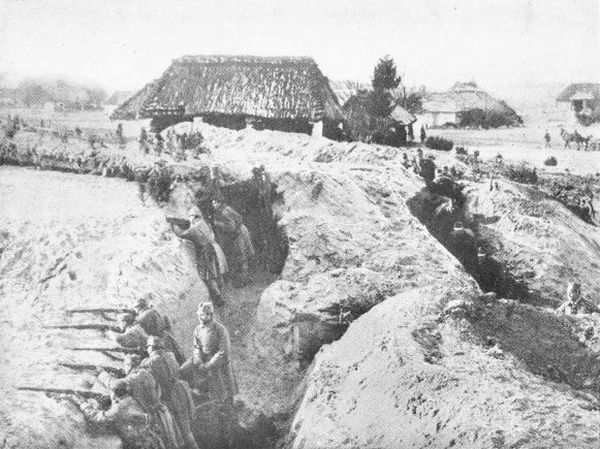
Photo by International News Service
REMARKABLE GENERAL VIEW OF THE AUSTRIAN TRENCHES NEAR JASIONNA, SHOWING THE COVERED SHELTERS AS WELL AS OPEN DITCHES AND THE WINDING LANES OF CIRCULATION
"I must finish this letter with an attempted account of our wonderful fête de Noël, which was held here this afternoon [this letter was written on Christmas Eve], and which will terminate at midnight with a mass in the chapel. A famous opera singer is to sing Gounod's 'Ave Maria,' and I'm going to prop open my weary eyes and attend it.
"We decorated the wards and halls with holly and mistletoe, which grows in great abundance and richness here in France. We had the tree all lighted by electric bulbs downstairs, with a beautiful Santa Claus giving out gifts. All walking cases filed in and received small gifts. Many came in chairs, too. Meantime a trained chorus was walking through the halls from floor to floor, singing Christmas carols, and finally Santa Claus carried his gifts to all the bed patients. In the meanwhile the chapel was filled with soldiers and nurses, and many patriotic songs were sung. The singing made me so homesick that the tears came and I had to go back to my sick men. I bought each man a package of cigarettes and a box of matches, and I gave an enlargement of the group photo I sent you to each man in it. Also I lent them my big silk American flag to help decorate.
The Clown of the Hospital.
"Ahmed, the big Turco, who came to me with seven shrapnel wounds, but is now almost well, and who I told you is the proud husband of two wives and the father of six sons—he does not count the daughters—got hold of the flag somehow, and now it hangs proudly over his bed. By the way, he heard this morning that one of his wives, Fatima, has presented him with a son, so now he has seven. Such joy! While I was down at noon buying the tobacco and a few little things for K—— I saw a little doll, chocolate in color, dressed as a baby. I bought it and put it on Ahmed's pillow when he wasn't looking. The instant he spied it he let off a yell: 'Mon fils de Tunis!' and hugged that poupée and carried on most delightfully.
"I also bought a wooden crane, whose head, neck, and feet move, for Moosa, the black Senegalesi. I told you about him a long time ago, but not by name. He is the one who said a prayer over his wound and tried to bite every one who came near him. He has become quite tame under the influence of Dr. Chauneau, who is the most charming old Frenchman imaginable. Moosa got toys exactly like a child and was just as delighted. He laughs just like a typical Southern darky does, and is altogether funny. They keep him in a red jacket and cap, and the color effect is splendid. It reminds me of chocolate and strawberry ice cream.
"That Turco, Ahmed, whom I've spoken of several times, and who is absolutely devoted to me, keeps the ward in a perfect gale. Last night the men had a regular circus there, and it was all fomented by that old rascal. I've told you how he insists on calling me 'maman' and is jealous as a spoiled child if I show any extra attention to any of the other patients in the ward. Well, last night old Ahmed was very much excited when I came in after supper. He has learned some English, which he now mixes with his French and Arabic. When I asked him what was the trouble he said: 'Spik, maman?' meaning might he talk. I graciously gave him permission, whereupon he burst into burning speech.
"He said they were all French, both Arabs and Frenchmen, and the English were their allies, weren't they? Yes. They were all wounded? Yes. All in the same cause? Yes. Some had more than one wound; he had seven? Yes. Then why weren't they all fed alike? Why should Risbourg sit in bed, never walking, never going to the table to eat—in fact, never doing any of the things they all had to do—and yet have extra feeding? You see, Risbourg is the case I told you of that nearly died of hemorrhage from a small arm wound. He had to be transfused and he is on extra feeding to make up his blood. He does eat enormously, and I love to see him do it.
"Well, I noticed that Risbourg was the only one who wasn't laughing, so I called Ahmed to attention and told him the story of the hemorrhage, whereupon he gave me a huge wink to show that it was all a joke. Risbourg didn't regard it as such, so I went over and told him that I understood, and that I wanted him to eat as much as he wanted, and that it was all right. He is really very devoted to me, and said: 'You, doctor, you understand, but all the time Ahmed tells the nurse to tell you that I eat too much.'
"By this time they were all crowding around him trying to make up, and he added: 'I know why they say such things! It is because I am of the infantry of France, and they are zouaves and tirailleurs (artillerymen) of Africa. I am alone among them.'
"Well, this was getting serious, so I made a speech and told them they were all Frenchmen and brothers, and we all 'vived la France!' Then Old Incorrigible had to pipe up again: 'Mais, maman, Risbourg said I didn't smell good. And he spat when I said I was a Frenchman. And also he said he was a German.'
"I said: 'Risbourg, did you tell him you were a German?' Risbourg smiled broadly (he has one tooth gone just like Dave Warfield) and said: 'Yes, doctor, but because the Irish boy told me to. Je fais une plaisance.' So then I pointed out to him that he had had his little joke, and Ahmed had had his, when he said that he ate too much. Great applause from the Arabs, who quickly got the ethical point. So we all made up and shook hands."