PRINCESS GERDA.
Reading edition
I.
The King came home from battle, He came in triumph proud; Before, the heralds flying, With trumpets pealing loud, Ten thousand warriors followed, With gleaming spear and shield, A goodly store of trophies Brought from the bloody field, A forest bright of banners Unfurled like tongues of flame, And clanking ranks of captives To swell the mighty train. Beneath the arching gateway And up the stony street, To time of martial music, Passed on the trampling feet; But ever chief and foremost The King in triumph rode; His armor flashed in sunlight, Gay-plumed his helmet glowed, High stepped his coal-black charger, Impatient of the rein, And curved the sleek neck proudly And shook the rippling mane. More proud than he the rider— In look and mien more proud; Before, the heralds speeding And trumpeting aloud How Eric, the invader— Long time a dreaded foe— Lay with the gory corses Upon the plain below; And how of his great army A paltry little band In hopeless rout Had turned about And fled to their own land. Quick, at the cry of herald And clattering of hoof, From door and wall and window, From balcony and roof, Black hung the crowd; with praises Did all the city ring— With praises for the warriors, With praises for the King:— So loud, the infant Gerda Was wakened from her sleep, And, writhing in her cradle, Forsooth began to weep, The while they praised her father Till all the air did ring, The while the people shouted, “Forever live the King!”
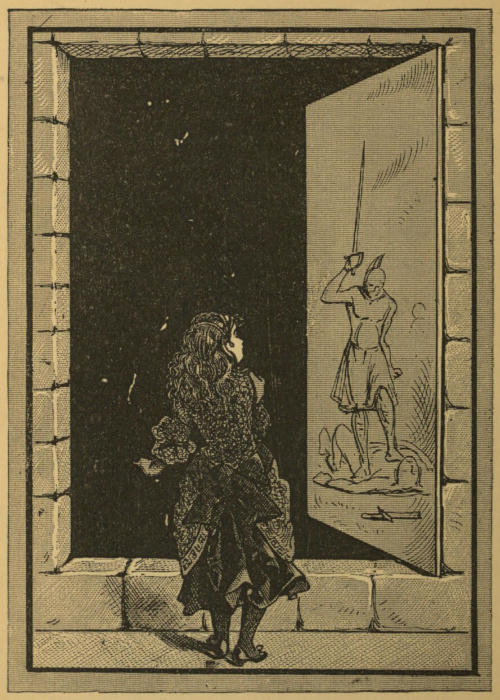
There in the masonry, Black space and then a stairway.—Page 177.
II.
All day it rained. The white doves Came not at Gerda’s call, To flock about the casement High up the palace wall, To coo ’neath her caresses, And plume their wings of snow, And pick the crumbs she scattered Upon the ledge below. It rained all day. The sunbeams Were weak and wan and rare— The beams that seven summers Had played with Gerda’s hair. All day it rained unceasing. The quaint old lofty room, For lack of bird and sunbeam, Was drear and full of gloom; And left among the shadows, The while the raindrops beat, With restless little fingers, With restless little feet, Went Princess Gerda roaming The quaint old room around, And thus behind the tapestry, It chanced, a picture found— A painting blurred and faded: Two men had fought, and one Lay vanquished, while the other, With foot his neck upon, A murd’rous weapon brandished Above the prostrate head. “Thou hateful, hateful fellow!” In anger Gerda said, And clenched her small fist straightway And smote the lifted hand. Lo! backward swung the picture, As tho’ a fairy’s wand Obeying; and before her, There in the masonry, Black space and then a stairway— So much did Gerda see. “Where does it go?” she wondered, And, no one being nigh, Into the darkness ventured, Nor waited for reply. Down, down, and ever downward, The granite steps led on; With now and then a winding, With ever and anon A pause, a narrow landing, But never ray of light. On, on, went little Gerda, And downward thro’ the night, Recalling wondrous stories The good nurse Hedvig told Of a strange realm and dreamlike, All paved and ceiled with gold, Where ruled the merry elf-king— A realm far underground, That a few favored mortals By patient search had found. So, on and on went Gerda, And downward through the night. At length in maze of passages That led to left and right, The stony staircase ended; And, searching in the dark, She wandered hither, thither: The elf-land, where? But hark! What sound was that? She listened. A moaning somewhere near! Again, again, a moaning! She fled away in fear. From right to left she hurried; She hurried to and fro; She called: “O good nurse Hedvig, Come to me here below!” Came never word of answer. She could not find the way. In terror trembling, sobbing, Still onward did she stray. “Who weeps?” Again she listened. The voice was low and kind. “’Tis I—’tis Princess Gerda; The way I cannot find.” “Fear not, O Princess Gerda! If thou wilt turn the key, How gladly will I offer To be a guide for thee.” Her little fingers feeling The slimy stones along, Found out the door of iron— The iron door so strong: And standing there on tip-toe, With all her might and main, She, reaching, tried the rusty key, But tried and tried in vain. “Once more, once more, O Princess!” At that she tried once more; The hinges grated harshly, And open flew the door; And one came forth whose features And form she could not see For the deep darkness round her; But never aught cared she, Because the voice was pleasant And drove away all fear— The voice that softly questioned, “How happened Gerda here?” “Down, down the longest stairway That ever yet was found, I came to hunt for fairies That dwell beneath the ground.” “Now tell me, sweetest Gerda, If I will show the way, And lead thee from the darkness Far up into the day, Wilt never of thy venture, Nor ever of thy guide, To any speak? Wilt promise?” She eagerly replied, “Oh, yes, yes, yes! I promise!” And, hand in hand, the two The dank and dismal corridors Went searching through and through. A narrow length of passage, Low-ceiled, at last they gained, And midway in this passage A narrow doorway framed; And winding from this doorway Stone steps, a narrow flight, They found and followed—followed Far up out of the night. But when the little Gerda, Safe in the dim old room, That now seemed full of sunlight After the greater gloom— When quick she turned to see him Who led—the pictured wall, The overhanging tapestry She saw—and that was all. And many days she marveled, And many nights did dream Of that good guide and gentle, Who came and went unseen. But never more the stairway, So long and dark, she tried. She told not of her venture, She told not of her guide. The dungeon-keeper, bringing The daily drink and bread, The iron doors found open! The prisoners had fled! In doubt and wonder gazing, He paled with sudden fear: “Alack! the King will hear it! Alack! the King will hear!” Down fell the bread and water— With flaming torch he sought A narrow length of passage Deep through the rough rock wrought; And there for miles he wandered, Lit by the torch’s ray, Nor guessed how lately other feet Had traveled the same way. At last he reached a country Beside the western sea— A fair and goodly country. There now in peace dwelt he.
III.
The years have passed, and Gerda, Now grown a maiden tall, Looks from the latticed casement High up the palace wall; But not for flash and flutter Of snowy wings looks she— Thro’ rain or sun No longer come The white doves merrily; For peace and they have flown afar, And all the land is red with war. Great Ivar, dreaded Ivar, Who rules the northern coast, Across his rocky borders Has led a conquering host; And smiling field and hamlet Despoiling as they came, Five months before the city walls The savage hordes have lain. The glimmer of their camp-fires The Princess Gerda sees, Their tents, their hostile ensigns A-floating in the breeze. She looks forth from her window With eyes grown used to tears; And as she looks she listens— What sound is that she hears? A crash, a shriek, a shouting— A battlement gives way; Swift thro’ the breach come rushing The foe in dire array, And sudden as a thunder-storm Sweeps o’er the smiling day, The air is dark and clamorous And wild with deadly fray. But calm and clear Does Gerda hear His orders ring, As the brave King, Unfaltering, Keeps the fierce foe at bay. But see! he falls! “The King is down!” Who’ll guard the walls? Who’ll save the town? “The King is slain! we fight in vain! Alack, alack, the King is slain!” The panic-stricken soldiers, Pale-faced, from street to street Flee wildly, as the enemy Pursue their flying feet: “The King is slain, the town is lost! Who can withstand great Ivar’s host!” But look! what stranger legions Against the hostile tide Leap forth in shining armor And bold advancing ride, Ride on and ever onward, Beat back the hostile tide? “The gods! the gods! Valhalla Has sent its warriors down To fight against our Ivar! To battle for the town!” And in dismay and terror Is hushed the conquering cry. From street to street, In swift retreat, And over fallen battlement, The pale besiegers fly— Fly fast and far; nor pause they Till, on the northern shore, They see the birchen forests, And hear the breakers roar. Meanwhile, with peals of gladness The rescued city rang, And loud their great deliverance The joyous people sang, And loud they sang the praises Of him, the unknown knight, Who led his valiant legions To battle for the right. So loud and long their praises, Awaking from his swoon, The King o’erheard, and seeing Who wore the chieftain’s plume, Aghast, stood up and questioned, Hand on his horse’s rein, “What art thou—man or spirit? And what may be thy name?” “I am, O King, no spirit; And Eric is my name;— Prince Eric, son of Eric, Who sleeps on yonder plain.” “What! Eric? son of Eric? Ah, I have heard of thee, How wise and well thou rulest Beside the western sea. But why dost thou come hither To drive away the foe, And earn my people’s praises, Since well thou seem’st to know That it was I, In years gone by, Who laid thy father low?” “Not for thy people’s praises I hither led my band, But with, O king, thy favor, To win thy daughter’s hand.” “Great soul and gallant suitor! Well doth he play his part, Who, seeking hand of daughter, Doth steal the father’s heart.” But Princess Gerda saw not: She heeded naught of all, Nor gazed she from the window High up the palace wall. “Wherefore the loud rejoicing, Wherefore the triumph vain, Since he is dead—my father,— Since he, the King, is slain?” With streaming eyes she greeted Two ent’ring at the door, Aye, even him who bowed so low His white plumes swept the floor; The other—lo! her father! Behold his spirit come! She stood in trembling wonder; Her pallid lips were dumb. “Fear not, O Princess Gerda! If thou wilt turn the key, How gladly will I offer To be a guide for thee!” So spake the Prince; and Gerda In listening paler grew; Recalling guide and venture, The words, the voice she knew. “They come to me from spirit-land! Two heroes are they, tall and grand, And clad in armor bright!” And in her fear, As they drew near, The quaint old room reeled round her, And all was black as night. But when again the Princess Her blue eyes opened wide, And saw the good King kneeling And smiling at her side, And heard him softly whisper, “Behold, my little one, I bring to thee a suitor Will please me for a son”— She bowed in sweet submission, And meekly answered she: “Whatever please my father, That also pleaseth me.” And in the royal city, And all the country thro’, Were festal cheer and gladness Where late were war and woe; For the good King’s dominions And those the sea beside, Were wed when Princess Gerda Became brave Eric’s bride.